INTRODUCTION
Under what conditions is Islam likely to serve as a platform for political, even liberal, reform? Previous research has suggested that orthodox Muslims are more communitarian in their economic views and less liberal in their political preferences because individuals are seen as being embedded within a larger community that places a higher value on social order than on individual achievement and liberty (Davis and Robinson Reference Davis and Robinson2006; Guiso, Sapienza, and Zingales Reference Guiso, Sapienza and Zingales2003; Said Reference Said1978; Tibi Reference Tibi2008; Wallerstein Reference Wallerstein1999). More recently, however, the premise that pious Muslims are unlikely to support political liberalism and democracy has been seriously challenged (Anderson Reference Anderson2004; Esposito and Mogahed Reference Esposito and Mogahed2008; Inglehart and Norris Reference Inglehart and Norris2003; Jamal and Tessler Reference Jamal and Tessler2008; Tessler, Jamal, and Robbins Reference Tessler, Jamal and Robbins2012). The association of communitarian economic attitudes and orthodox Islam has also received mixed assessments (Chen and Lind Reference Chen and Lind2007; Davis and Robinson Reference Davis and Robinson2006). This article suggests that Islam is likely to attract individuals with politically reformist views when traditional secular political ideologies and party politics are not readily available. In the absence of secular political ideologies and representative political mechanisms, reformist-minded individuals are likely to turn to religion as a platform for political change. In particular, when Muslims are a minority in a repressive non-Muslim society, Islamic orthodoxy can serve as a political platform for politically and economically liberal forces by providing language and symbols to mobilize and express their desire for change.
In modern democracies, reformist-minded individuals can make use of existing party platforms to advance their interests. However, if freedom of association and fair elections are not in the offing, then reformers are likely to look for alternative ideologies. While the political opposition may consider using religion as a political platform in any politically repressive society with a substantial religious tradition lacking credible secular ideologies of political change, it is particularly likely when religion can serve as a distinct identity marker for the minority. Since aggrieved minorities in repressive states have little or no access to the standard political mechanisms for change, they often turn to religion for mobilization. As a social force that opposes the government's political and economic restrictions, we suggest that the religiously infused opposition is likely to be both economically and politically liberal — seeking a smaller role for the government in public life, because it opposes an illiberal and repressive state. In societies where Islam has historical roots, Islamic orthodoxy is the most likely alternative to traditional political ideologies. It follows that more economically and politically liberal Muslims living in repressive non-Muslim societies are more likely to find themselves in the camp of orthodox Muslims and supporters of the Islamic legal system, Sharia.
In this article, we investigate this argument and develops the theory in the next section. It explains why individuals with more liberal political and economic attitudes in repressive Muslim minority societies may express stronger support for Sharia, which is more often than not viewed as a highly illiberal social framework. Then, we derive five hypotheses regarding the relationship between political economy attitudes and identification with Islamic orthodoxy. In the third section, we introduce an original data set and our methodology, which is followed by a discussion of the results. Consistent with the article's key hypotheses, the analysis indicates that those who support free market institutions and greater regional autonomy also tend to support Islamic orthodoxy. The final section discusses the implications of the results for research on political Islam and limitations that must be recognized, and which we hope will be addressed in future work.
ISLAM AND POLITICAL ECONOMY
Secularization theory, as introduced by Durkheim and Weber (Durkheim [Reference Durkheim1933] 2013; Weber [Reference Weber1930] 2005), has faced substantial empirical challenges from the rise of religion around the world in recent years (Berger Reference Berger1999; Thomas Reference Thomas2005; Stark Reference Stark1999). Some scholars have argued that personal insecurities lie behind this trend (Immerzeel and van Tubergen Reference Immerzeel and van Tubergen2013; Norris and Inglehart Reference Norris and Inglehart2011), whereas others have suggested that religion filled a vacuum after the end of the Cold War and its (secular) ideological warfare (Huntington Reference Huntington1997; Toft, Philpott, and Shah Reference Toft, Philpott and Shah2011). Adopting a rational choice approach, Gill (Reference Gill2008) argues that the ruler's political survival, tax interests, and economic growth inform decisions regarding a state's liberalization of religious regulation. Other scholars, such as Toft, Philpot, and Shah (Reference Toft, Philpott and Shah2011), associate the rise of religion in the modern world with traditional culture and values. Another strand of research finds that churches in the United States support and promote civic engagement among their members (Djupe and Gilbert Reference Djupe and Gilbert2006; Neiheisel, Djupe, and Anand Reference Neiheisel, Djupe and Sokhey2008) and provide mobilization tools to their constituents in times of need (Djupe and Gilber Reference Djupe and Gilbert2002).
This article aims to bridge these views by providing an explanation for the rise of religion in modern politics that applies under fairly general scope conditions. We suggest that state repression and minority status jointly shape the public expression of religion, and thus the state's obstruction of secular opposition contributes to the creation of religious challengers. Since the state prevents minority groups from adopting alternate (secular) strategies, such as economic advancement and/or allying with the state, those members of the minority who seek political change and oppose the state turn to religion. In this way, religious orthodoxy in the minority group becomes associated with political and economic liberalism by the virtue of attracting economically and politically liberal individuals who are opposed to the repressive secular state and cannot find secular expression for their ideas and needs.
This logic would seem to contradict scholars who argue that Islam is hostile to free markets and economic liberalism, whether the hostility is attributed to Islamic law's failure to protect property (Kuran Reference Kuran2010a; Reference Kuran2010b), its treatment of women in Muslim majority countries (Fish Reference Fish2002), or the lack of separation between religion and state (Mernissi Reference Mernissi2002; Mazarr Reference Mazarr2007; Inglehart and Norris Reference Inglehart and Norris2003). Using World Values Survey data, some scholars have characterized Islam as being negatively associated with ‘‘attitudes that are conducive to growth’’ and have portrayed Muslims as being the most ‘‘anti-market” among adherents to the world's major religions (Guiso, Sapienza, and Zingales Reference Guiso, Sapienza and Zingales2003, 228, 280). There are reasons to doubt a direct negative association, however, and scholars have argued that Islam itself has no intrinsic relationship with economic stagnation or growth (Ragab Reference Ragab1980). Comparing Muslim-majority countries to other countries at the same developmental stage, Pryor (Reference Pryor2007) found no relationship between economic development and Islam. Noland (Reference Noland2005) found that Islam was in fact positively associated with economic growth (Noland Reference Noland2005). “If anything,” he wrote, “Islam promotes growth” (Noland Reference Noland2005, 1232). In terms of relationship between Islam and political liberalism and democratization, the evidence that Islam is antithetical to democratic ideas is also dim (Harnischfeger Reference Harnischfeger2008; Yavuz Reference Yavuz2009; Robinson Reference Robinson1997, 373–387). Moreover, according to some researchers, the causal arrow may actually be reversed (Platteau Reference Platteau2008; Rodinson Reference Rodinson1974). The persistent failure of the state to provide public goods in Muslim-majority countries may have led to the rise of religion's role in political and economic affairs, religion was “the handmaiden rather than the master of politics” (Platteau Reference Platteau2008, 330).
The implication is that political autocracy and economic underdevelopment may have made Islam more salient and attractive as an alternative ideology to the state's secular and inefficient political economy. This view of “endogenous Islam” is somewhat counter-intuitive, but consistent with a number of existing studies. Explaining why Islam became the rallying point in Iran's revolution of 1979, Bayat (Reference Bayat and Asef2013) writes that the Shah's government had effectively eliminated the secular opposition in the country prior to the revolution, leaving only Islam as a possible platform for uniting the opposition. Islam may be able to resolve systemic social problems and provide public goods when the state is either unwilling or unable to do so. This view is also compatible with Berman's (Reference Berman2009) assessment of how to rein in violent religious groups. He argues that the governments in areas with active radical religious groups should improve public services, foster religious freedom, and religious pluralism in order to successfully combat and contain such groups. This is consistent with the view of radical Islam as a response to economic disparity and political oppression. In the post-cold war era, Islam is especially likely to become an ideological platform for social forces seeking political change, not necessarily because Islam is itself a revolutionary ideology but because other platforms do not work or are unavailable to social actors.
According to Toft, Philpott, and Shah Reference Toft, Philpott and Shah2011, the rise in religious politics during the second half of the 20th century stems from the failure of secular political ideologies, the spread of electoral democracy, and improvements in communication technology.Footnote 1 Arguments about the failure of secular “isms” and the corresponding rise of religion were visibly present in Huntington (Reference Huntington1993; 1997), who argued that civilizational divides associated with religious differences will determine conflicts after the end of cold war. Empirical studies have not provided support for Huntington's claim (e.g., Chiozza Reference Chiozza2002; Russett, Oneal, and Cox Reference Russett, Oneal and Cox2000). Rather than religious differences manifesting themselves in an increased likelihood of interstate conflict, we take a more instrumental view of religion as a loose framework that can be used by political opposition groups to advance their political goals in the absence of other political platforms and mechanisms.Footnote 2
Along with other religions, Islam offers its subscribers a “belief system” (an “umbrella ideology”) that provides core beliefs of a predominantly symbolic nature, with important institutions and organizing principles, but it does not compel individuals to adopt the same political and economic outcome across all societies. Islam can therefore be reconciled with diverse political and economic ideologies. Geertz's (Reference Geertz1968) comparative analysis of Islam in Morocco and Indonesia is a classical demonstration of such differences. In a series of studies, Davis and Robinson analyze survey data from seven Muslim majority countries and find that religiously orthodox people in Abrahamic religions tend to be economically communitarian. More religiously orthodox respondents are more likely to favor a greater role for government in the economy to equalize incomes and take care of the poor. Conversely, Islamic modernists will be more inclined toward economic individualism and a laissez faire approach. However, “in politically repressive societies, support for Islamic law is less strongly related to a desire for greater government responsibility for everyone and equalizing incomes” (Davis and Robinson Reference Davis and Robinson2006, 182). This suggests that political oppression may pit Muslims against the government and foster economic attitudes that are orthogonal to government sponsored redistributive policies.
When Muslims are in the minority, especially in politically repressive and economically centralized societies, individual incentives to favor greater government control and intervention in the economy are generally reversed, since redistribution is more likely to benefit “ethnic others” (Alesina, Baqir, and Easterly Reference Alesina, Baqir and Easterly1999; Bustikova Reference Bustikova2014; Dancygier Reference Dancygier2010; Habyarimana, Humphreys, Posner, and Weinstein Reference Habyarimana, Humphreys, Posner and Weinstein2007). When religion is an ethnic marker that can distinguish majorities and minorities, economic (and political) attitudes among Muslims may be quite different from what previous researchers found in Muslim-majority countries (Davis and Robinson Reference Davis and Robinson2006).Footnote 3 Even the institution of zakat (“purification,” which requires Muslims who can afford it to give a percentage of their income to the poor) was different in Muhammad's time when Muslims were a minority versus when they were a majority (al-Shiekh Reference al-Shiekh and L. Esposito1995, 366–367; Hadith 2:24:537).Footnote 4 In Mecca, where Muhammad and his followers were a minority, zakat was voluntary. When Muhammad and his followers migrated to Medina, and established the first Islamic state, zakat became obligatory. When Muslims are a minority in a politically repressive society, we hypothesize that the taste for redistribution will be weaker and economically liberal attitudes will prevail.
This is not unique to Islam. Researchers have noted the different attitudes of English religious dissenters to religious freedom at the time when they were a religious minority in Britain versus when they became the ruling majority of the Massachusetts Bay Colony (Gill Reference Gill2008). Regardless of the religion, we would submit that members of the minority religion tend to be more in favor of democratic rule and economic liberalism, since these ideologies are more likely to protect their rights and to serve their interests. We take this argument one-step further, and suggest that if secular political mechanisms exist for advancing the interests of the excluded groups in a given population, religion is likely to play a less significant role in politics.
When the state persistently fails to provide public goods, it provides more space for religion in political and economic affairs. In some cases, religious movements provide the very public services that states are supposed to provide — e.g., the political opposition in Egypt and Lebanon organized itself through Islamic movements that bypassed those failing states and provided public goods directly to the population (Davis and Robinson Reference Davis and Robinson2009; Cammett and Issar Reference Cammett and Issar2010; Wickham Reference Wickham2002). It follows from this that if the state becomes more adept at providing public goods and political freedoms return, the influence of religion may diminish. Islamic political parties may fall apart or fragment after alternative political platforms and mechanisms become available, and the initial motivation for their creation has passed. This appears to be happening to Indonesia's Islamic parties (Assyaukanie Reference Assyaukanie2005; Hefner Reference Hefner2011; Mujani and Liddle Reference Mujani and William Liddle2009), although some researchers caution against rushing to conclusions (Tanuwidjaja Reference Tanuwidjaja2010). Islamic parties lose their appeal when their constituents are well informed about the political and economic platforms of all available political forces and do not seem to fare particularly well even after the Arab Spring (Pepinsky, Liddle, and Mujani Reference Pepinsky, William Liddle and Mujani2012; Kurzman and Naqvi Reference Kurzman and Naqvi2010; Kurzman and Türkoğlu Reference Kurzman and Türkoğlu2015).Footnote 5
THE EMERGENCE OF ISLAM AND ITS RELATION TO THE STATE
The North Caucasus in Russia affords an excellent setting to test theories about the political economy of religion. During the Soviet period, the Communist ideology was quite successful in eliminating religion from all public space in the region — only a handful of mosques and churches were left intact across the North Caucasus. Prior to the 1917 October revolution, both Islam and Orthodox Christianity played important roles in the North Caucasus that defined settlement patterns and Moscow's policies toward individuals and groups. During the Russian-Caucasus war of 1817–1864, Islam achieved an extraordinarily high social status, and the Dagestani commander, Imam Shamil, established the first theocratic state in the Northeastern Caucasus. Prior to the Russian conquest of the North Caucasus in 19th century, Islam had little influence in the vast majority of places in the region, which were primarily governed by customary law (adat) or by a mixture of Islamic canons and local customs. Yet today religion in the region has become increasingly important in political life.
Despite the government's high level of control, the state has failed to resolve the pressing issues of the day — the economy remains stagnant; political exclusion and repression are the norm.Footnote 6 In the absence of other political mechanisms and ideologies, Islam has become an attractive solution to the region's social problems. Whereas the secular state is perceived as being inherently corrupt and incapable of addressing the region's concerns, Islam has become both an attractive political goal — the improvement of public goods provision — and a tool for mobilization in a society that is politically repressive and where the government dominates the economy. Just as Islam can bring together different ethnic groups and social strata among Muslims, it also tends to reinforce the differences between Muslims and non-Muslims.
This story of “endogenous Islam” is not new.Footnote 7 Russia's conquest of the North Caucasus in the 19th century similarly stimulated the adoption of Islam; when the Russians first arrived, many of the North Caucasians did not practice Islam at all (Coene Reference Coene2010). Although Islam was already present among Circassians in the Northwestern Caucasus, it had a primarily symbolic meaning, and Islamic judges made their judgments according to customary laws and traditions, rather than according to Islamic canons. However, the subsequent colonization of the North Caucasus prompted individuals to “rally around the crescent” (Pokrovsky Reference Pokrovsky2009; Coene Reference Coene2010; Gammer Reference Gammer2003; Hassner Reference Hassner2009).
The Russian government today possesses almost total economic and political control over the region. It is the dominant source of economic activity in the North Caucasus, where cash injections from Moscow account for 58–92% of each republic's budget. Direct elections of regional Governors were abolished in 2004 and replaced with presidential appointments. Since 2004, the people of the North Caucasus have been unable to replace their leadership through elections or any other legal way. Regional political parties in Russia are also outlawed.Footnote 8 Jointly, these conditions limit political activism to federal parties and informal political institutions, but even those are quite limited. Economics and politics are highly centralized.Footnote 9 The authoritarian turn in Russia is noticeable throughout the Russian Federation. Freedom House now codes the political system in Russia as “not free.”Footnote 10 In 2011, the National Parliamentary elections resulted in large-scale protests in Moscow and elsewhere amidst allegations of massive election fraud (Barry Reference Barry2011). Political participation, even in federal parties, appears to be of limited utility to individuals in the North Caucasus because elections are routinely rigged.Footnote 11
One might wonder whether the Islamic Orthodox population would oppose the political status quo, regardless of its content and other conditions, because they object to being ruled by the non-Muslim state authorities. Yet survey evidence from Dagestan casts doubt on this conjecture. Scholars have documented a decline in religiosity among young Dagestanis during the 1990s when the level of democratization was higher, and a subsequent increase of religiosity in the 2000s, which coincided with the rule of Vladimir Putin and the consolidation of authoritarianism in Russia (Abdulagatov Reference Abdulagatov2012).Footnote 12 Even though Islam experienced a renaissance after the end of the Union of Soviet Socialist Republics, young people were still noticeably less religious, and religion among youth was declining. However, the absence of a participatory political system, combined with economic inefficiencies and rising material inequality, generated a search for alternatives. The central government's fear of Islam and separatism led it to inject more funds into the regional budget to increase the region's financial dependence on subsidies (Hale Reference Hale2008). As a result of the inefficiencies that resulted, the central state has become synonymous with corruption, moral decay, and political repression for many respondents in the North Caucasus.Footnote 13 Islam offers an alternative, especially to individuals in a Muslim-minority country, such as Russia, where the central state is disassociated from Islam.
Some scholars might see the turn to Islam as a function of the state's unwillingness to accommodate local interests (Toft, Philpott, and Shah Reference Toft, Philpott and Shah2011). However, Russia has accommodated the Sufi brand of Islam — “traditional Islam” — whereas the Salafi type of Islam has been outlawed since it first appeared in the North Caucasus in the 1990s. Unlike the Catholic Church in Latin America, which embraced social reformist ideas to stay afloat in countries where it faced competition from other Christian denominations (Gill Reference Gill1998), Salafi Islam did not significantly change the strategy of Sufi Islam, most likely because the central government maintained effective control over official Muslim clergy and their policies.
After 1991, people were allowed to practice religion more freely and there was an initial surge in religiosity. Yet Islam did not begin serving as a coherent “belief system” that promised to break the cycle of economic inefficiency and political-cultural repression until the late 1990s and early 2000s. The spread of Islam in the region in the period after the breakup of Soviet Union is often attributed to filling an ideological vacuum, or regarded as a purely cultural phenomenon. However, Islam did not become the political force that it is today in the region until the late 1990s and early 2000s (Gall and de Waal Reference Gall and de Waal1997).Footnote 14 Islam emerged as a culturally appropriate and effective response only during the Second Chechen War when the central government moved in to re-establish direct rule over the region and curbed the region's autonomy (Knysh Reference Knysh2004).Footnote 15 What was initially a Chechen nationalist insurgency formally turned into an armed Islamic movement only in 2007, when the leader of militants, Doku Umarov, proclaimed the Caucasus Emirate.Footnote 16
Separatism in the North Caucasus did not begin as an Islamic movement (Dunlop Reference Dunlop1998). Only after persistent and multiple setbacks did Islam became the preferred “systemic response” of a multiethnic region (Hassner Reference Hassner2009). Recent surveys from the region indicate that many respondents, especially the middle class, want more autonomy in their political affairs even now (Siroky, Dzutsev, and Hechter Reference Siroky, Dzutsev and Hechter2013). Apart from historical reasons, external sponsorship may have contributed to shaping local preferences for Islam. The Chechen resistance to Russian rule started off as a secular movement, but gradually morphed into a movement dominated by an Islamic ideology, not least because the nascent Chechen separatist secular state failed to provide public goods (Derluguian Reference Derluguian1999). Islam turned out to provide a more sustainable solution for overcoming the collective action problem among the regional radicals, than ethnic identity (Siroky and Dzutsati Reference Siroky and Dzutsati2015; Toft and Zhukov Reference Toft and Zhukov2015). Islam served to unite people who were otherwise only loosely linked, and often belonged to different socio-economic strata and ethnic groups. It stands to reason that Sharia supporters are likely to be more diverse when faced with political suppression than they would otherwise be under a more liberal regime in which there are other political options, and support for Sharia can remain more ideologically pure.
In light of this discussion, the next section develops five specific hypotheses about the relationship between political economy preferences and support for Sharia.
HYPOTHESES
This framework for studying the salience of Islamic fundamentalism follows Davis and Robinson, and other scholars in this field, in measuring each respondent's religious preferences in terms of their degree of support for Sharia. The first three hypotheses focus on economic preferences and the next three on political attitudes.
In the past, the Soviet government ran all business activities. The Russian government continues to provide the vast majority of employment opportunities and benefits.Footnote 17 In view of the high level of dependence on subsidies from the central government, the first hypothesis tests the idea that respondents who prefer a smaller role for the government in the economy will also express more support for Sharia. While we do not require respondents to understand all of the intricacies and consequences of living under Sharia, we believe that respondents comprehend quite well that living under Sharia would represent a serious departure from the status quo, and thus indicating support for Sharia implies a form of resistance to the central government's policies, its endemic corruption and the region's economic stagnation. In our view, support for Sharia is a religiously infused symbolic resource for those who desire change but have no other avenues for expressing their political and economic attitudes. This reasoning leads to the first two hypotheses.
H1: Respondents expressing greater support for private ownership of enterprises (as opposed to government ownership) will tend to express greater support for Sharia.
H2: Respondents expressing greater support for private ownership of the means of production (as opposed to government ownership) will tend to express greater support for Sharia.
If Sharia supporters uphold the primacy of private ownership of enterprises and private ownership of the means of production, as opposed to government ownership, then we should also expect them to be overrepresented among the class of actual and aspiring entrepreneurs.
H3: Aspiring and existing entrepreneurs will tend to express greater support for Sharia.
Turning to politics, many people in the region associate the current political problems with the central government. We therefore predict that those individuals with a preference for greater political autonomy and local governance (as opposed to more centralization of political power) will tend to support Sharia in the North Caucasus.
H4: Respondents who favor greater regional autonomy will tend to express greater support for Sharia.
The inefficiencies created by the economic policies of the central state have lead people in the Muslim periphery to think that the central government is inherently corrupt. The central state sends funds to ensure the loyalty of the Muslim peripheral areas. However, instead of economic development, government investments are embezzled and increase corruption and income inequality, which decreases support for the central government (Klasnja and Tucker Reference Klasnja and Tucker2013; Seligson Reference Seligson2002). Of course, the central state may not necessarily want private enterprise to flourish in areas where separatism is a potential issue, since this could provide an alternative source of revenue that might be exploited by separatists. Such governments may therefore have incentives to supplant private businesses with its own funding to ensure local loyalty. Reformist-minded individuals are likely to regard the government's involvement in the economy as harmful, because they associate corruption and economic inequality with the government's activities. Since these same individuals are excluded from political power, and no mechanism exists to bring them into power, individuals who regard the central government as the primary culprit for corruption should express more support for Sharia. This leads to the fifth and final hypothesis:
H5: Respondents who place the primary responsibility for corruption on the central (non-Muslim and not regional) government will tend to express greater support for Sharia.
To assess these hypotheses, we now introduce our data and methods, and then discuss our results.
DESCRIPTION OF THE SURVEY DATA
The Institute of Socio-Political Research, a subsidiary of the Russian Academy of Sciences, conducted a survey of over 1769 respondents in seven republics of the North Caucasus in 2008 using stratified probability sampling (Dzutsev Reference Dzutsev2008).Footnote 18 Territorial (types of settlements) and quotidian (gender, ethnicity, and education) strata were used. The data were collected through face-to-face interviews and had a response rate of 74%. Following previous empirical research, the main indicator of Islam is based on a question regarding each respondent's support for Sharia as opposed to secular law. “Support for Sharia” is measured on a four-point ordinal scale, which takes a value of 1 if the respondent would “certainly like” to live under secular law, 2 if the respondent would “rather live” rather under secular law, 3 if the respondent would “rather live” under Sharia, and 4 if the respondent would “certainly like” to live under Sharia.Footnote 19 Respondents who support secular law comprise 56% of the sample, 29% support “rather” secular law, 11% of respondents support “rather” Sharia, and 4% of respondents are “certainly” for Sharia.
To examine the first hypothesis, we utilize a survey question that measures support for Private ownership of big enterprises. It was originally coded as 1 = certainly permissible, 2 = somewhat permissible, 3 = somewhat not permissible, 4 = certainly not permissible, 5 = hard to say.Footnote 20 To explore Hypothesis 2, we use a question about ownership of the Means of production, which takes a value of 0 when the respondent thinks that it is best when the government owns the means of production, and takes value of 1 if it is deemed better that the means of production are privately owned. Hypothesis 3 is analyzed using a variable called Business that measures entrepreneurial aspirations on an ordinal scale, where 1 that stands for “absolutely would not like to have a business of my own” to 5 “already own business.”
Turning to the political hypotheses, we assess Hypothesis 4 using two proxies. The first is an ordinal indicator, Regional Power, which takes a value of 1 when respondents want federal authorities to have more power up to a value of 4 when respondents want regional authorities to have greater power. Hypothesis 5 is examined using an indicator, which we call Federal Corruption. Federal Corruption focuses on the respondent's opinion about who is primarily responsible for corruption in the respondent's region. It is measured on an ordinal scale and ranks from 1 = “certainly regional authorities” to 5 = “certainly federal authorities,” with the middle category that says “both are equally responsible.” We also include several control variables. The first is the respondent's Income, which is measured on a non-monetary scale from 1 = “cannot afford food and clothing” to 5 = “can afford everything.” The respondent's education is measured on an eight-point scale (from under 7 grades up to a doctorate). We include an indicator of whether the respondent is a Native, which takes a value of 1 if the respondent self-identifies as an ethnic native to the North Caucasus and 0 otherwise. In most cases, “0” indicate ethnic Russians. Urban is a dichotomous indicator that takes a value of 1 if the respondent resides in a city and 0 if the respondent resides in a rural area. Age is an interval variable that is made up of six intervals: 18–24 year-olds, 25–34 year-olds, 35–44 year-olds, 45–54 year-olds, 55–59 year-olds, 60 and over. Male is a dichotomous indicator that takes a value of 1 if the respondent is male, and 0 if the respondent is a female. Dissatisfaction with the general situation in the republic is measured using an ordinal indicator on the increasing scale from 1 = very satisfied with the situation in the region to 4 = very dissatisfied with the situation in the region. Finally, Unpopularity of the region's governor is measured with an ordinal variable using an increasing scale from 1 for popular to 4 for unpopular. Respondents in this question are asked whether they would approve of the current governor to be reappointed in the future.
We also used several regional controls as fixed effects. Violence measures insurgency-related incidents that involved rebels killed, injured or arrested, government forces killed or injured, civilians killed, injured or kidnapped.Footnote 21 Unemployment measures the percent unemployed and Average Salary measures the average salary in each republic.Footnote 22 All regional fixed effects come from the same year as the year that the survey was conducted: 2008.
THE STATISTICAL MODEL AND DISCUSSION OF RESULTS
We estimated two ordinal logistic regression models on the ordinal response variable, “Support for Sharia.” The first model includes controls and the explanatory variables, and the second adds fixed regional effects.Footnote 23
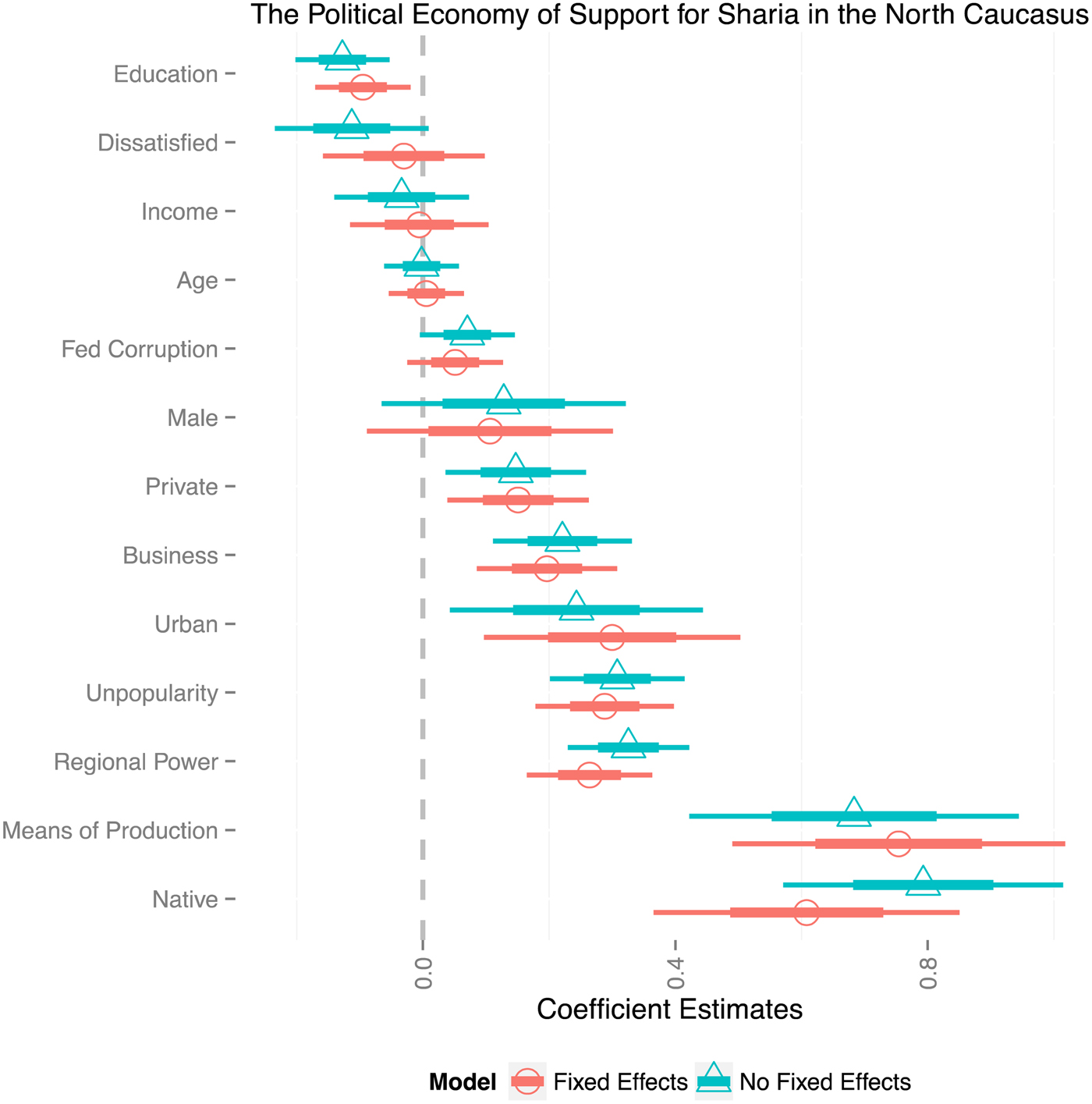
Figure 1 presents the main results of these models.Footnote 24 The points (circles and triangles) on the horizontal lines are mean coefficients for the independent variables. The thick horizontal line around each symbol represents one standard deviation and the thin line depicts two standard deviations. Coefficients to the left of the dotted vertical zero line are negatively related to support for Sharia, and those to the right of the dotted vertical zero line have a positive relationship with support for Sharia. When the thick horizontal line does not cross the dotted vertical line, at 0.00, then that independent variable is statistically significant at the conventional 5% alpha level (p < 0.05); and when the thin line does not cross the dotted line, the variable is statistically significant at the 1% level (p < 0.01).
Coefficient plot for two regression models of support for Sharia.Footnote 25

We find that support for Sharia and support for private ownership of large enterprises are positively related in all of the estimated models, and the result is statistically significant across all specifications, consistent with the first hypothesis. There is also a positive and statistically significant relationship between support for private ownership of the means of production and support for Sharia, as suggested by the second hypothesis. We also found that aspiring entrepreneurs were more likely to express support for Sharia. These results cast some doubt on the view that Islam (as an identity marker and set of beliefs, not as a set of legal and financial institutions) is incompatible with free markets and economic individualism. Respondents who tend to support the private ownership of enterprises, private ownership of the means of production and entrepreneurship are significantly more supportive of Sharia in the North Caucasus.
The same findings emerge in regard to political liberalism. The results indicate that those who demand self-rule for their respective regions also expressed stronger support for Sharia. Respondents who think that the federal government has more responsibility than regional rulers to tackle corruption were also significantly more likely to support Sharia, although this indicator becomes statistically insignificant in Model 2 (with regional controls). In sum, these results suggest that those with political views that are more liberal (in favor of more self-government) are considerably more likely to express greater support Sharia.
Some control variables about which we did not theorize are worth mentioning briefly. We found that more educated respondents were less likely, and natives of the North Caucasus were predictably more likely, to support Sharia. Urban residents and respondents who have a lower regard for the regional governor were more likely to support for Sharia, consistent with the notion that people who want reforms have a greater propensity to support Sharia.Footnote 26
The evidence we provide about the union between Islamic orthodoxy and liberal political economy attitudes is suggestive, but certainly not dispositive. With cross-sectional data, there are often concerns about reverse causality, some of which we have already touched upon in the discussion of the emergence of Islam.Footnote 27 Here, we reiterate some of these points and try to address some others plausible criticisms.
In the North Caucasus, as well as in other parts of the former Soviet Union, the weakening of the communist ideology preceded the rise of Islam.Footnote 28 Unlike the revolution in Iran, Islam amassed its influence in the region as the state's failures multiplied throughout 1990s (rather than before the 1990s). If Islam were the cause of economic and political attitudes of individuals, we would have seen Islamic revolution in Chechnya in 1991, when the opportunity presented itself, but instead the revolution in Chechnya was secular nationalist. It took roughly 10–15 years of persistent state failure, political repression and economic corruption before the center-periphery dispute in the North Caucasus took on Islamic overtones. To paraphrase Platteau (Reference Platteau2008), Islam was “the handmaiden rather than the master of politics.” A distinctly clerical embodiment of the issues did not emerge fully until 2007, when Doku Umarov proclaimed “the Caucasus Emirate,” which happened only after the previous secular resistance movement had demonstrably failed to ameliorate the political and economic situation.
Previous research on the attitudes among young people in Dagestan revealed that religiosity among youth was gradually declining throughout 1990s, which were characterized by the greatest degree of economic and political liberalism in Russia's history. When the political environment became more repressive, and the economic order more illiberal, religion came to serve as the loose umbrella ideology for uniting the political opposition and disaffected individuals in the North Caucasus.Footnote 29 The causation may have been from Islamic orthodoxy to political economy attitudes in other parts of the world, but in the North Caucasus, the causation flowed primarily from politics and economics to religion, as specified in our framework.
IMPLICATIONS AND LIMITATIONS
This study contributes to a growing body of literature concerned with the relationship between Islam, politics, and economics. Previous research has suggested that orthodox Muslims may be more communitarian in their economic views and less liberal in their political preferences, since individuals are seen as being embedded within a larger community that places a particularly high value on social order. Yet most studies of Islamic political economics have relied almost exclusively on evidence from Muslim majority countries in the Middle East and North Africa, and have treated belief in religious orthodoxy as a predictor of political and economic preferences, rather than as a derivative of them. When Muslims are a peripheral minority in a non-Muslim polity that imposes severe restrictions on political participation and in which the government plays a dominant role in the economy, Islam can provide a coherent set of symbols and a language for expressing discontent and the desire for change. Even in the Arab world, the premise that Muslims who are pious are unlikely to support political liberalism and democracy is dubious at best (Tessler, Jamal, and Robbins Reference Tessler, Jamal and Robbins2012; Jamal and Tessler Reference Jamal and Tessler2008, Tessler Reference Tessler2010).
Islam should thus be understood as a fluid language of symbols that is compatible with sundry economic and political ideologies, including capitalism and democracy. The analysis shows that individuals who support economic individualism and political liberalism are more likely to favor the adoption of Sharia. When other forms of social action are blocked, Islam can serve as a broad platform for those who seek change and some of the most politically and socially active individuals join orthodox Islam. Using original data from the North Caucasus, the empirical evidence supports these hypotheses, and the general idea that Islam can emerge as a systemic solution to the pressing issues that other organizations, principally the state, have failed to resolve.
We are keen to acknowledge several limitations. First, our analysis does not examine Islamic practice or behavior, and is limited to self-reported preferences. Second, the generalizability of our results may be limited to societies where Muslims comprise a peripheral minority and to places where political freedoms are sufficiently curbed to exclude secular ways of expressing popular discontent. In Muslim-majority countries, where participatory mechanisms are damaged, the political opposition will have to adopt an especially radical interpretation of Islam in order to differentiate itself from the government, which is also Islamic. It is naturally much harder for Islam to be an umbrella ideology for disenfranchised parts of the population in a Muslim-majority country than it is in a Muslim-minority country. Scholars have long recognized that the context determines the salience of a given identity, since it shapes the utility of adopting a particular identity market as primary, and imbues it with meaning (Mozaffer and Scarritt Reference Mozaffar and Scarritt1999; Posner Reference Posner2004; Eifert, Miguel, and Posner Reference Eifert, Miguel and Posner2010; Olzak and Shanahan Reference Olzak and Shanahan2014). Whereas Muslims in a Muslim-minority country can be what Gellner (Reference Gellner1983) called an “entropy resistant” group simply by virtue of being Muslims, in Muslim-majority countries Islam is not useful as a discriminating identity marker. A final limitation that bears noting is that the quantitative analysis does not speak to the evolution of preferences over time, since the data are limited to one point in time.
This article contributes to the ongoing debate between “supply side” and “demand side” scholars of religion by developing a parsimonious explanation for the rise of religion under specific political and economic conditions. Although we do not necessarily reject the importance of personal insecurities (Immerzeel and van Tubergen Reference Immerzeel and van Tubergen2013; Norris and Inglehart Reference Norris and Inglehart2011) or the inherent human need to belong to a religious group (Iannaccone Reference Iannaccone1998; Stark and Finke Reference Stark and Finke2000), our findings suggest that the entrepreneurial class and the political reformers revert to supporting Sharia because they are frustrated with the social and economic situation in their region. They are not turning to religion to take care of them, but rather to draw on the organizational resources of religion to help them to overcome the collective action problem and achieve certain political goals.
For policy-makers, one implication of this study may be that if the central government liberalizes its policies on the economy and politics, and provides additional culturally specific public goods, people who chose to join Islam to advance reformist goals may revert back to secular forms of activity because they can exploit secular venues for expressing political discontent and for pursuing private economic gain. Although Islamic ideology may display some degree of “stickiness,” even after a political regime liberalizes, this analysis leads one to expect that the loose “Islamic alliance” of diverse social forces would become more fractured and less fundamentalist as a result of a change in government policy.
Supplementary materials and methods
To view supplementary material for this article, please visit http://dx.doi.org/10.1017/S1755048316000134.