


Introduction
In an influential paper, Leucht et al. (Reference Leucht, Hierl, Kissling, Dold and Davis2012) described an overview of meta-analyses of the efficacy of medication in psychiatry and general medicine, with the declared goal of putting the efficacy of the former into perspective. Effect sizes of general medicine medication (median 0.37, mean 0.45, 95% CI 0.37–0.53) and psychiatric drugs (median 0.41, mean 0.49, 95% CI 0.41–0.57) were similar and in general modest, leading the authors to conclude that ‘psychiatric drugs were not generally less efficacious than other drugs’ (p. 97). The authors were very cautious in interpreting their findings, explicitly stating (p. 101) that (a) ‘any comparison of different outcomes in different diseases can only serve the purpose of a qualitative perspective’ and (b) ‘the increment of improvement by drug over placebo must be viewed in the context of the disease's seriousness, suffering induced, natural course, duration, outcomes, adverse events and societal values’. Caveats were explicitly addressed and delineated, such as those related to the use of different categories of outcomes in psychiatry versus general medicine. For instance, a given effect size observed on a rating scale on which changes in score have an opaque clinical meaning might be less relevant to attain than a smaller effect size on important health outcomes such as mortality or major, clearly observable and quantifiable, events (e.g., heart attack, stroke).
Over the 5 years since its publication, this paper has become highly cited, with enough citations to place it in the top 1% of the academic field of Psychiatry/Psychology according to Clarivate Analytics InCites™ Essential Science indicators, which are based on a highly cited threshold for field and publication year. In Scopus, as of June 2017, the paper had been cited 135 times. It offers therefore an interesting case in citation content analysis because its assumed exclusively qualitative perspective, as well the array of caveats and restrictions that are attached to its reported quantitative findings, offer ample opportunities for distortion, misinterpretation and exploitation as support for a priori agendas or post hoc hypothesising.
Therefore, our goal was to explore the reception and dissemination of this paper in the scientific medical literature, in particular which aspects of its message were taken on, whether it was cited with due consideration to its caveats or, conversely, whether it was cited for the most part uncritically, as an essential piece in a narrative maintaining that the low efficacy of some psychiatric medications or therapies was not an issue of concern.
Method
The study protocol was registered at the Open Science Framework (https://osf.io/9dqat/). The study is a pre-specified citation content analysis.
Eligibility criteria
All published papers citing the target paper (Leucht et al. Reference Leucht, Hierl, Kissling, Dold and Davis2012), regardless of their type or whether they included data or not, were eligible. Papers in English, German, French, Italian, Spanish and Romanian were considered. For citing papers, no restrictions were placed over the types of conditions or domains, the population, the interventions or comparators that were directly studied or discussed.
Search
Scopus was chosen as it is more inclusive than other databases like Web of Science. It was searched to identify citing papers (June 1, 2017).
Outcomes
The primary outcome coded dichotomously (yes/no) was whether or not the citation of target paper was used to justify a small or modest ES observed for a given treatment. This categorisation relied on both (a) the wording used by the authors quoting the paper and (b) Cohen's classification (Cohen, Reference Cohen1988) defining small, modest and large effect sizes. The verbatim quote referencing the target paper was also extracted for qualitative analysis.
Secondary outcomes refer to the quote in which the authors of the citing paper referenced the target paper, as well as to the citing paper as a whole.
For the quote in which the target paper was referenced, the following information was extracted: (a) any mention of caution or caveats; (b) the point that the citation is making (the notion that treatment effectiveness in psychiatry closely resembles that in general medicine, or the notion that treatment effectiveness in general medicine closely resembles that in psychiatry, or the notion that treatments have large effects, or the notion that treatments have moderate effects, or the notion that treatments have small effects, or discussion of small effects not covered by the previous categories, such as a small effect claimed by comparison with the target paper, described as relevant but without making the parallel with general medicine, or other points when none of the previous categories applied); (c) the type of condition discussed (psychiatric, general medical condition or both); (d) the type of disease discussed; (e) the category of treatment discussed (drug, device, psychological intervention, surgery); and (f) the specific type of treatment.
For the citing paper as a whole, we extracted information on (a) type of paper [experimental, defined as systematically collecting and analysing data, including systematic reviews and qualitative research, or non-experimental (i.e., viewpoint, editorial, narrative reviews)]; (b) mention of any conflict of interest (COI) listed at the end of the paper; (c) industry involvement, including partial, in funding the paper; and (d) name of the funder.
Data extraction
Two raters (IC and FN) independently extracted information about the outcome measures from each of the papers citing the target article and subsequently coded it into the categories mentioned. All disagreements were resolved by discussion.
Data synthesis
The primary analysis was descriptive and focused on tabulating and presenting the extracted variables. Verbatim examples were extracted and presented for the primary outcome. Outcomes were presented as numbers and percentages, where possible. Co-authorship networks were constructed to identify possible clusters of authors citing the paper.
An exploratory univariate logistic regression was used to explore the relationship between the primary outcome (use of the quote to justify a small or modest ES) and each of a subset of secondary outcomes pre-specified in the protocol: (a) type of paper, (b) COI, (c) point made, coded dichotomously (the notion that treatment effectiveness in psychiatry closely resembles that in general medicine, as stated in the Leucht et al.’s paper versus other points), (d) type of condition and (e) type of treatment. All associations with a p-value <0.25 were subsequently explored in a multivariate logistic regression. All analyses were done in R version 3.4.1 (2017-06-30, The R Foundation for Statistical Computing).
Results
Searches
The search identified 135 citing papers in Scopus. From these, 15 were excluded because of language (n = 4), full-text unavailability (n = 10) or absence of citation of the target paper (n = 1). Consequently, 120 papers were retained for analysis. All extracted information and the list of included citing papers is available in Supplementary Table 1. Among these, 63 (53%) quoted Leucht et al.’s paper to justify a small or modest ES observed for a given therapeutic, and 113 (94%) did not mention any caveats. Among the seven papers mentioning caveats, one was a comment on the target paper (Seemuller et al. Reference Seemuller, Moller, Dittmann and Musil2012), and another was co-authored by its lead author, Stefan Leucht (Leucht et al. Reference Leucht, Helfer, Gartlehner and Davis2015).
Quote in which the target paper is referenced
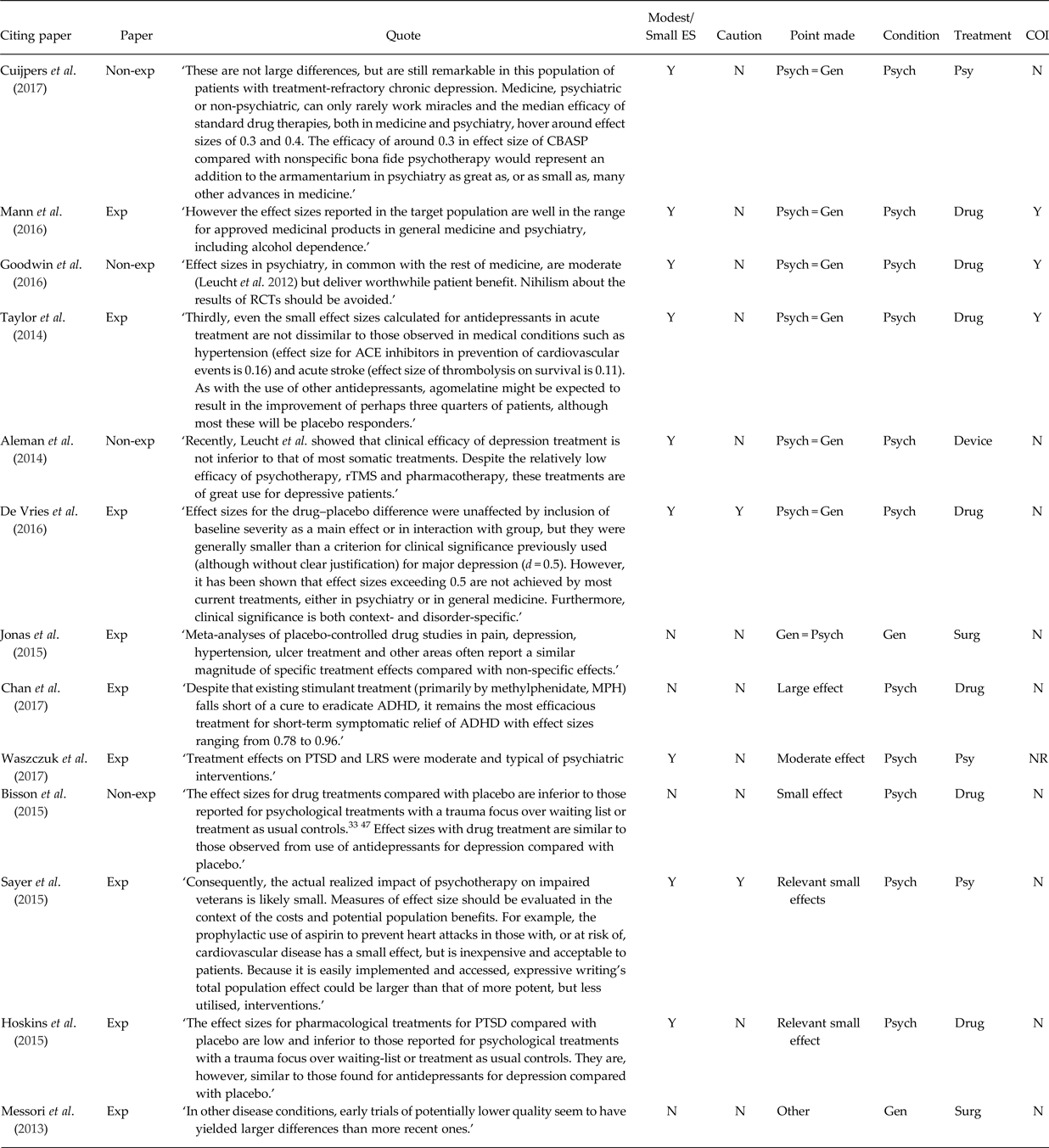
Seventy-two (60%) used the citation to claim that treatment effectiveness in psychiatry closely resembles that in general medicine, while one (1%) used it to claim that treatment effectiveness in general medicine closely resembles that in psychiatry. Sixteen (13%) quoted Leucht et al. to support the idea that treatments have large effects, five (4%) moderate effects and three (3%) small effects. Seven (6%) used it to argue that small effects are relevant without making the parallel with general medicine and 16 (13%) made other points (see Supplementary table 1 for the detailed reasons). A total of 110 (91%) paper were about psychiatric conditions, eight (7%) were about general medical conditions (among these, four by the same authors) and two (2%) were about both conditions. Table 1 gives examples of these different categories with verbatim formulations extracted from the citing papers.
Represented verbatim extracts from the citing papers illustrating the primary and secondary variables

COI, conflict of interest; ES, effect size; Exp, experimental; N, no; Non-exp, non-experimental; Gen, general medicine; Psych, Psychiatry; Psy, psychological treatment; Surg, surgery; Y, yes.
Forty-two (35%) papers quoted the paper in a general context without pointing towards any specific condition, 34 (28%) quoted it for affective disorders, 19 (16%) for psychosis, seven (6%) for addiction and seven (6%) for attention deficit hyperactivity disorder (ADHD). The remaining 11 (9%) were about various other conditions.
Ninety (75%) used the paper to make a comment on the effects of drugs, 14 (12%) on psychological interventions and nine (7%) in the general context of treatments (including all interventions). In the remaining seven (6%), the paper was used to comment on a surgical intervention (n = 3), a device (n = 2), a nutritional intervention (n = 1) and an educational programme (n = 1).
More specifically, among these categories, 41 (34%) papers quoted it without pointing towards any specific category of treatment, 28 (23%) were about antidepressants and 18 (15%) about antipsychotics. The remaining 37 (31%) were about various treatments.
Citing paper as a whole
Leucht et al.’s paper was cited in 40 (33%) experimental papers. COIs were reported in 55 papers (46%), 51 (42%) papers reported no COIs, whereas in 14 (12%) this information was missing. Ten (8%) studies had a direct industry sponsorship, including six from Lundbeck about nalmefene (n = 4) and vortioxetine (n = 2).
Co-authorship network
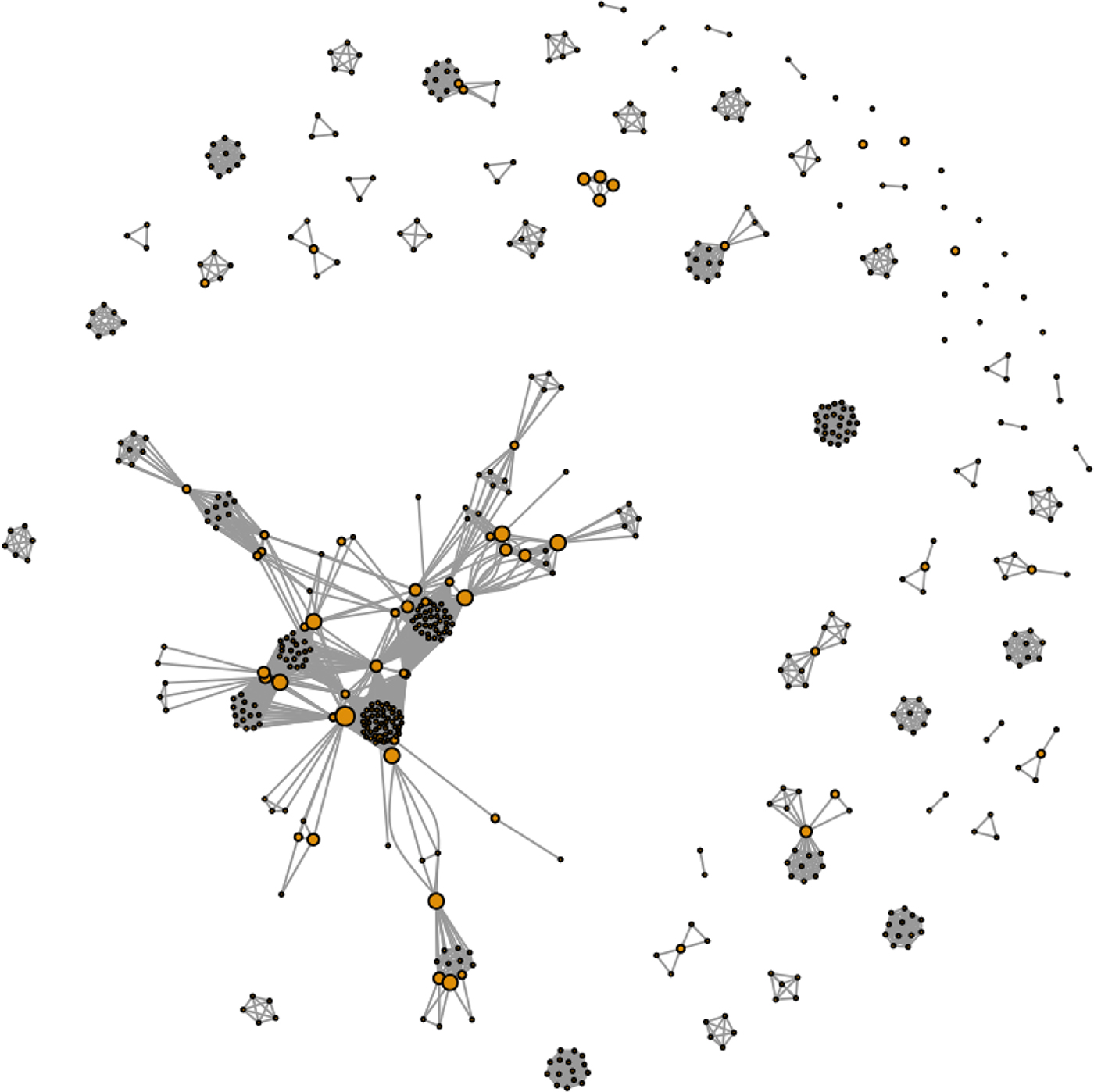
The co-authorship network is presented in Fig. 1. We identified a big cluster of interconnected authors citing the paper, although the vast majority of citations were done by a constellation of independent authors. The network involves 521 individual authors with a median number of citation of 1 (minimum = 1, maximum = 5).
Co-authorship researcher networks. Each circle represents one author (larger diameter indicates a larger number of publication by this author) and each line connecting two authors indicates the presence of at least one publication they have co-authored (larger diameter indicates a larger number of publication in common). All analyses were performed using the igraph library in R.

Logistic regressions
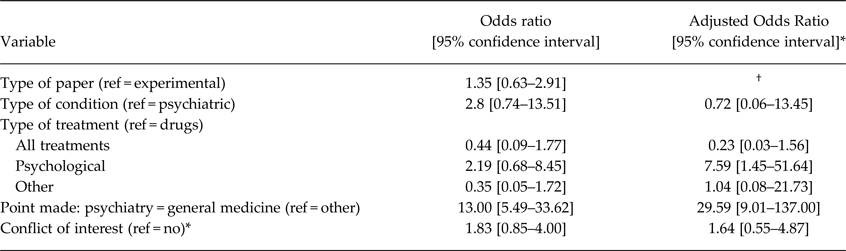
Logistic regressions are presented in Table 2. In univariate analysis, we found an association between a quote justifying small or modest effects and the point that treatment effectiveness in psychiatry closely resembles that in general medicine. This association survived in multivariate analysis. In addition, the context of a psychological intervention was associated in multivariate analysis with citation in a context of small or medium effects. No significant associations were found for the other explanatory variables.
Univariate and multivariate logistic regression exploring association between a citation to justify small or medium effects and pre-specified explanatory variables

Some exploratory variables were dichotomized for the purpose of modelling.
* 14 missing data.
† Type of paper did not survive univariate analysis (p-value >0.25), therefore the multivariate logistic regression only explored the link between a citation to justify small or medium effects and A/type of condition, B/type of treatment, C/point made and D/conflict of interest.
Discussion
Summary of evidence
We examined the dissemination of a highly influential paper (Leucht et al. Reference Leucht, Hierl, Kissling, Dold and Davis2012) in the scientific medical literature by means of descriptive citation analysis and exploratory regression analysis. This particular paper provided an interesting case study, because, apart from being highly cited, it combined a thought-provoking main finding (i.e., psychiatric drugs are no less effective that drugs in general medicine) with an exhaustive and judicious description of caveats qualifying it. The authors went to great length to underscore their interpretation can only be qualitative and label their analysis as solely intended to put the effectiveness of psychiatric drugs into perspective. It was thus relevant to examine whether the reception on the paper has taken on the whole ‘package’, including the qualitative essence of its findings and the limitations attached, or rather focused on selecting the fragments that could be then molded into support for a priori agendas or post hoc hypothesising.
Over half of the citing articles used the reference to Leucht and colleagues in a context where it served to justify small or modest effects. Our regression analysis suggests this might especially be the case when the point made was in line with the main claim of Leucht's paper (the idea that treatment effectiveness in psychiatry closely resembles that in general medicine). Interestingly, only one paper reversed this idea by citing the target paper to argue that treatment effectiveness in general medicine closely resembles that in psychiatry. In addition, while three quarters of the quotes commented on drugs, some were made to comment on other interventions, such as psychological interventions. It is possible that the contingent of quotes about psychological interventions are a particular subgroup, dealing with therapies with particularly trivial effects (Sayer et al. Reference Sayer, Noorbaloochi, Frazier, Pennebaker, Orazem, Schnurr, Murdoch, Carlson, Gravely and Litz2015). It is worth noting that Leucht and colleagues did not include any meta-analyses of psychological interventions, a fact which excluded the possibility of citing the paper to justify a certain effect. Conversely, for psychotropic drugs, such as for instance the effectiveness of methylphenidate for ADHD, some authors referenced Leucht et al. in lieu of the original meta-analysis included in the overview. Moreover, the paper was cited uncritically. Only seven of the 120 analysed papers mentioned any caveats. Out of these, one was a comment on the target paper (Seemuller et al. Reference Seemuller, Moller, Dittmann and Musil2012), and another was co-authored by its lead author, Stefan Leucht (Leucht et al. Reference Leucht, Helfer, Gartlehner and Davis2015). In spite of the original authors’ insistence on caveats, the subsequent citing literature seems to have overwhelmingly ignored them.
Interestingly, ten of the papers benefited from industry support, with the same pharmaceutical corporation being involved in six of these. Though these numbers are small, they do point to the possibility of the industry becoming sensitive to a potentially reassuring scientific justification of small effects and we would not be surprised to find Leucht et al. referenced as an argument in drug approval documentation. This would represent a dangerous path to follow, as evidence is already accruing that the bar is too low for drug approvals by regulatory agencies (Downing et al. Reference Downing, Aminawung, Shah, Krumholz and Ross2014; Naci et al. Reference Naci, Smalley and Kesselheim2017), as it was the case for the very recent approval of the paliperidone 3-month injection by the EMA (Ostuzzi et al. Reference Ostuzzi, Papola, Gastaldon and Barbui2017).
These findings further supports our thesis that the reception of Leucht et al. in the subsequent scientific research – and indirectly what elevated this paper to highly cited status – was a case of citation bias, by systematically ignoring content that conflicted with the narrative one aimed to advance (Greenberg, Reference Greenberg2009). Of note, such biases are not surprising since previous citation content analyses revealed a plethora of citation distortions (Greenberg, Reference Greenberg2009), and also highlighted worrisome issues with the way highly cited papers are subsequently used in the literature, the same data being interpreted antithetically by different investigators, depending on their prior support for one or the other side of the evidence (Tatsioni et al. Reference Tatsioni, Bonitsis and Ioannidis2007). Undoubtedly, scientific journals may establish clearer rules on their requirements for correct citation and more effort can be invested in the peer review phase to aid accurately checking references and detecting possible misleading citations. However, there are other qualities that cannot be forced upon scientists by means of policy and reporting guidelines, such as being reflective. Readers should always remain vigilant and critical.
Limitations
In the first draft of this paper, we suggested that the specific distortions we identified might reveal something about the psychiatric profession's desire to be integrated with general medicine as described by Joanna Moncrieff (Moncrieff, Reference Moncrieff2008). However, a reviewer suggested that our citation of Moncrieff was not quite accurate, pointing to the fact that she examined psychiatrists’ sense of identity from a historical perspective, referring in particular to the period in the 1950s and 1960s when psychiatrists were considered ‘second-class’ doctors, working in asylums rather than in hospitals. While it is possible that some of that spirit might have survived in modern psychiatrists, we may very well have been distorting the initial idea of the paper, so as to fit it into our own narrative. Therefore, we were adding, albeit unintentionally, a potential citation distortion. We decided to discuss this example here as an illustration of how easy it is to be swayed by one's own ‘story-telling’ and to speculatively decontextualise and interpret previously published literature as supportive.
Because the data we collected were very subjective, we resorted to two independent extractions. Nevertheless, to make our judgement, we relied on both the wording used by the authors quoting the paper and Cohen's classification (Cohen, Reference Cohen1988) defining small, modest and large effect sizes. Finding a more objective method of quantification would have been impossible given that the authors of the citing papers operate with different notions or small or modest. Moreover, results of our regressions analyses should be interpreted cautiously, as such analyses are only exploratory and prone to residual confounding. In addition, our sample of citing papers was small and estimates of regression analyses may be 1/underpowered to uncover subtler associations as for example with COIs and 2/overly imprecise for identified associations (large confidence intervals).
Perspective
It is interesting to note that, with the exception of ADHD, the citations making use of Leucht et al. were about psychiatric conditions and treatments for which effectiveness was shown to be small or modest to moderate at best. For instance, antidepressants in the treatment of affective disorders were consistently shown to have small magnitude benefits (Jakobsen et al. Reference Jakobsen, Katakam, Schou, Hellmuth, Stallknecht, Leth-Moller, Iversen, Banke, Petersen, Klingenberg, Krogh, Ebert, Timm, Lindschou and Gluud2017), particularly when corrected for publication bias (Turner et al. Reference Turner, Matthews, Linardatos, Tell and Rosenthal2008). For antipsychotics for psychotic disorders, a very similar picture emerged with moderate overall effects, further reduced to small effects when corrected for small sample bias and publication bias (Turner et al. Reference Turner, Knoepflmacher and Shapley2012; Leucht et al. Reference Leucht, Leucht, Huhn, Chaimani, Mavridis, Helfer, Samara, Rabaioli, Bacher, Cipriani, Geddes, Salanti and Davis2017). The influential paper of Leucht and colleague provided on many occasions a narrative normalizing such low efficacy: it was particularly exploited to feed into ‘a story’ in which modestly effective psychiatric treatments were normalised by purporting a seeming equivalence of psychiatry with general medicine. The paper was summoned as proof of this equivalence and its quantitative findings were regularly referenced. Effect estimations obtained or discussed in a citing paper were compared to ESs in the Leucht et al. overview of meta-analyses, seen as some sort of benchmark against which the intervention in question can be weighted. The absence of any mentioning of caveats is likely to mislead the reader of the citing paper into forgetting that while numbers might seem similar, that impression is illusory. An effect size is not reducible to just numbers and the very idea of a small, medium or large effect (Cohen, Reference Cohen1988) is intricately interwoven with the type of outcome. A small ES for a psychiatric scale can simply mean a 1 or 2 points intensity change for a symptom rated on a Likert-type scale. However, it could also literally mean lives saved or, conversely, almost nothing at all, depending on whether it was observed on an outcome like a life-threatening event, or on a surrogate outcome with disputed clinical relevance, such as glycated haemoglobin for diabetes (Boussageon, Reference Boussageon2014). In addition, effect sizes depend on variability and may appear higher in small trials of highly selected population than in large-scale pragmatic studies. The fact that the citing literature overwhelmingly obliterated this part is of concern. This entire crucial conversation is by-passed when one authoritatively cites Leucht et al.’s paper. If psychiatry is like general medicine, the storyline seems to go, one need not worry about finding only modest, and often trivial, effects for psychiatric drugs or other treatments, as this is exactly what should be expected.
Conclusion
Leucht and colleagues’ overview of meta-analyses had the explicit aim of putting the effectiveness of psychiatric drugs into perspective by relating it to other fields of medicine and, as an immediate consequence, by defending psychiatry from ‘deep mistrust’ (p. 97) and mounting criticism. Our survey on the paper's dissemination in the scientific literature over the past 5 years points to its overwhelmingly uncritical reception. It also seems to indicate that beyond defending psychiatry as a discipline, the paper served to lend support and credibility to a therapeutic myth: trivial effects of mental health interventions, most often drugs, are to be expected and therefore accepted.
Post scriptum
To a reader interested in citing our work, please contact us to choose a correct wording. We will not endorse claims such as ‘general medicine is as bad as psychiatry’ or ‘psychiatry is as bad as evidence-based medicine’, but would be delighted to see citations of our work suggesting that some clinical sense and critical thinking are welcome to avoid spin, decontextualisation and oversimplification of important issues in the field of therapeutics.
Supplementary material
The supplementary material for this article can be found at https://doi.org/10.1017/S2045796017000750.
Financial support
IC was funded Laura and John Arnold Foundation and the Romanian National Authority for Scientific Research and Innovation, CNCS – UEFISCDI, project number PN-II-RU-TE-2014-4-1316 (awarded to Ioana A. Cristea), none of which had any role in the preparation of the manuscript or decision to submit. FN is funded by Laura and John Arnold Foundation, Fondation Pierre Deniker and Rennes University Hospital (CORECT: COmité de la Recherche Clinique et Translationnelle), who had no role in the preparation of the manuscript or decision to submit.
Conflict of interest
Both authors have completed the Unified Competing Interest form at http://www.icmje.org/coi_disclosure.pdf (available on request from the corresponding author) and declare that: (1) No authors have support from any company for the submitted work; (2) FN has relationships (travel/accommodation expenses covered/reimbursed) with Servier, BMS, Lundbeck and Janssen who might have an interest in the work submitted in the previous 3 years; (3) No author's spouse, partner or children have any financial relationships that could be relevant to the submitted work; and (4) none of the authors has any non-financial interests that could be relevant to the submitted work.
Ethical standard
None.
Availability of data and materials
All extracted data are available in the main text and in the supplementary material.




Target article
Defending psychiatry or defending the trivial effects of therapeutic interventions? A citation content analysis of an influential paper
Related commentaries (2)
Being influential or being misleading? Citation bias in psychiatric research and practice
The clinical significance of drug-placebo differences