1. Introduction
Trending WNW–ESE across the border between Turkey and Bulgaria, the Strandja Massif forms an approximately 300 km long and 100 km wide metamorphic belt. The Strandja Massif is bounded by the metamorphic rocks of the Rhodope Massif to the S and SW, and upper Cretaceous volcanics of the Sredna Gora zone to the N. Middle Mesozoic amphibolite–greenschist facies metamorphism and the presence of N-vergent compressional structures have long been known (Chatalov, Reference Chatalov and Dewey1991; Okay et al. Reference Okay, Satir, Tüysüz, Akyüz and Chen2001). Its metamorphic characteristics and age of deformation are, however, poorly known for both its basement and the cover units. Only few and sparsely distributed age data are available to the geological community (e.g. Okay et al. Reference Okay, Satir, Tüysüz, Akyüz and Chen2001). Metamorphic facies discriminated so far are rather coarse and made only on the basis of mineral paragenesis of the rocks, such as amphibolite–greenschist facies (Okay et al. Reference Okay, Satir, Tüysüz, Akyüz and Chen2001).
In this study we aim to determine the metamorphic conditions that occurred in the Strandja Massif in detail and the age of deformation and its meaning for the metamorphic history of the region. For petrological analyses, eight samples are studied in order to reveal the metamorphic evolution of the Strandja Massif. The Rb–Sr dating method is used on both biotites and white micas from 21 samples to determine the time of metamorphism and subsequent cooling. The time of cooling to specific temperatures can be determined using different minerals through different dating methods taking into account the closure temperature concept (blocking or isotopic closure temperature) (Dodson, Reference Dodson1973; Villa, Reference Villa1998). The isotopic closure temperature may also be used to infer the age of exhumation or exhumation rate of a region. For this, isotopic closure temperatures of different minerals are converted to depths assuming a geothermal gradient. However, there are debates about both the closure temperature concept and converting temperature data to exhumation rates. Recent studies indicate that the isotopic closure temperature of a specific mineral can be a function of various processes such as solid-state diffusion parameters, effective grain size, temperature, cooling rate, fluid activity, deformation and surrounding exchange medium (Dodson, Reference Dodson1973; Villa, Reference Villa1998; Montel, Kornprobst & Vielzeuf, Reference Montel, Kornprobst and Vielzeuf2000; Müller, Aerden & Halliday, Reference Müller, Aerden and Halliday2000; Kühn et al. Reference Kühn, Glodny, Iden and Austrheim2000; Glodny et al. Reference Glodny, Austrheim, Molina, Rusin and Seward2003, Reference Glodny, Ring, Kühn, Gleissner and Franz2005; Reddy et al. Reference Reddy, Wheeler, Butler, Cliff, Freeman, Inger, Pickles and Kelley2003; Glodny, Kühn & Austrheim, Reference Glodny, Kühn and Austrheim2008). The metamorphic conditions of the Strandja Massif allow us to suggest that white mica Rb–Sr ages show the time of the deformation during the epidote–amphibolite-facies conditions and biotite ages represent cooling through greenschist-facies conditions.
2. Geological setting and field relations
The Strandja Massif is unconformably overlain by either unmetamorphosed Upper Cretaceous volcanic and volcanoclastic rocks to the north or by an Eocene–Oligocene sequence of limestone, sandstone and shale to the south (Fig. 1). To date, three tectonostratigraphic units are differentiated in the Strandja Massif: (i) a Palaeozoic basement comprising micaschist and various types of orthogneiss and amphibolite (Okay et al. Reference Okay, Satir, Tüysüz, Akyüz and Chen2001; Natal'in et al. Reference Natal'in, Satir, Sunal and Toraman2005; Natal'in, Sunal & Toraman, Reference Natal'in, Satir, Sunal and Toraman2005; Sunal et al. Reference Sunal, Natal'in, Satir and Toraman2006, Reference Sunal, Satir, Natal'in and Toraman2008), (ii) a Lower to Middle Triassic to Middle Jurassic cover sequence (Chatalov Reference Chatalov and Dewey1991; E. Toraman, unpub. M.Sc. thesis, İstanbul Tech. Univ., 2002) consisting of metaconglomerate, metasandstone, phyllite, calc-phyllite and marble (Okay et al. Reference Okay, Satir, Tüysüz, Akyüz and Chen2001; Hagdorn & Göncüoğlu, Reference Hagdorn and Göncüoglu2007), and (iii) an allochthonous unit of Triassic metasedimentary and metavolcanic rocks, which was thrust onto the former two units (e.g. Chatalov, Reference Chatalov and Dewey1991; Gerdjikov, Reference Gerdjikov2005).
Main tectonic units of the northern Aegean, the Balkanides and NW Turkey (modified after Okay & Satır, Reference Okay and Satir2000). IAES – Izmir-Ankara-Erzincan suture; NAFZ – North Anatolian Fault Zone; MFZ – Maritsa Fault Zone; WCFZ – West Crimean Fault. Coordinates are degrees (latitude N and longitude E).

The Strandja Massif underwent greenschist- to lower amphibolite-facies metamorphism during Late Jurassic time (Okay et al. Reference Okay, Satir, Tüysüz, Akyüz and Chen2001; Lilov, Maliakov & Balogh, Reference Lilov, Maliakov and Balogh2004; Natal'in et al. Reference Natal'in, Satir, Sunal and Toraman2005; Natal'in, Sunal & Toraman, Reference Natal'in, Satir, Sunal and Toraman2005). Furthermore, the Palaeozoic basement rock association of the Strandja Massif was involved in a pre-Triassic (pre-Permian?) regional metamorphic event, which is deduced from (i) a discordance between the internal foliation of metagranite clasts and that of the matrix of the basal metaconglomerate of the cover sequence (E. Toraman, unpub. M.Sc. thesis, İstanbul Tech. Univ., 2002; Gerdjikov, Reference Gerdjikov2005; Natal'in et al. Reference Natal'in, Satir, Sunal and Toraman2005; Natal'in, Sunal & Toraman, Reference Natal'in, Satir, Sunal and Toraman2005), (ii) the presence of two distinct foliations in pre-Permian orthogneisses (Natal'in et al. Reference Natal'in, Satir, Sunal and Toraman2005; Natal'in, Sunal & Toraman, Reference Natal'in, Satir, Sunal and Toraman2005), and (iii) the presence of a migmatitic gneiss with a Pb–Pb zircon evaporation age of 285 ± 13 Ma (Okay et al. Reference Okay, Satir, Tüysüz, Akyüz and Chen2001). The metamorphic grade of the older pre-Triassic (pre-Permian?) metamorphism is not constrained.
We studied a 15 km by 20 km area on the southern margin of the Strandja Massif where the pre-Triassic basement and the Triassic cover sequence are exposed (Figs 1, 2). The pre-Triassic basement is represented by various types of strongly- to weakly-foliated metagranites, orthogneisses, micaschists and amphibolites, while the Triassic cover sequence consists of a metasedimentary series starting with metaconglomerates and passing into metasandstones.
Geological map of the study area. For location see Figure 1 (coordinates are UTM, European (ED50) and Zone 35).

The metagranites and orthogneisses comprise the Kırklareli metagranite, leucocratic metagranite, hornblende–biotite orthogneiss and biotite–muscovite orthogneiss. Intrusive contacts and up to 2 m thick mafic microgranular enclaves are still recognizable in the Kırklareli metagranite and hornblende–biotite orthogneiss. The Kırklareli metagranite is pinkish grey and displays an augen gneiss structure defined by K-feldspar and locally plagioclase porphyroclasts in a relatively fine-grained matrix. The leucocratic metagranite differs from the Kırklareli metagranite in its leucocratic and fine-grained nature. The hornblende–biotite orthogneiss is greenish dark grey and has an equigranular texture. The biotite–muscovite orthogneiss has a fine-grained equigranular texture. The leucocratic metagranite occurs as 0.5 to 25 m thick dykes in the hornblende–biotite, biotite–muscovite and biotite schists. The Pb–Pb evaporation ages of igneous zircons crystallized in the magmatic precursors of these orthogneisses yielded ages ranging from 315 to 256 Ma, testifying to the presence of the Late Carboniferous to Permian magmatic activity in the Strandja Massif (Okay et al. Reference Okay, Satir, Tüysüz, Akyüz and Chen2001; Natal'in et al. Reference Natal'in, Satir, Sunal and Toraman2005; Natal'in, Sunal & Toraman, Reference Natal'in, Satir, Sunal and Toraman2005; Sunal et al. Reference Sunal, Natal'in, Satir and Toraman2006).
The micaschists are of two types: Type-1 is represented by garnet–biotite schists, type-2 by biotite schists. Type-1 micaschists are exposed in the middle part of the study area and are of sedimentary origin as testified by detrital zircons with Pb–Pb evaporation ages of 460 to 2700 Ma (Sunal et al. Reference Sunal, Satir, Natal'in and Toraman2008). Type-2 is associated with the well-foliated amphibolites and exposed in the southernmost part of the study area (Fig. 2).
The metaconglomerate of the cover sequence comprises stretched and elongated gravels (aspect ratio ranges between 1:2 and 1:4) of orthogneiss and quartzite, ranging from 1 to 30 cm in size in a well-foliated matrix. Some orthogneiss clasts in the metaconglomerate, originating from the basement units, contain an old foliation which is discordant to the matrix foliation, suggesting derivation from a pre-Triassic metamorphic domain (E. Toraman, unpub. M.Sc. thesis, İstanbul Tech. Univ., 2002; Gerdjikov, Reference Gerdjikov2005; Natal'in et al. Reference Natal'in, Satir, Sunal and Toraman2005; Natal'in, Sunal & Toraman, Reference Natal'in, Satir, Sunal and Toraman2005). The metasandstones are characterized by a fine grain size (Ø ~ 1 mm) and a greenish colour. Bedding and cross-bedding are locally recognizable.
The foliation generally strikes in an E–W direction, dipping at 20–60° to the south, and commonly crosscuts the lithological boundaries (Fig. 2) (Natal'in et al. Reference Natal'in, Satir, Sunal and Toraman2005). However, local bending of the foliation occurs owing to folding. The stretching lineation plunges on average to the south at 10 to 60°. The orthogneisses are dissected by two mylonite zones: one is approximately 400 m thick and 5 km long, and is represented by biotite mylonites in the Kırklareli metagranite (Fig. 2); the second is represented by a ~ 100 m thick and ~ 15 km long muscovite mylonite and defines the northern lithological boundary of the Kırklareli metagranite (Fig. 2; Natal'in et al. Reference Natal'in, Satir, Sunal and Toraman2005).
Kinematic criteria such as oblique foliation, local mantled porphyroclasts and (S-C) structures consistently indicate a top-to-the-N sense of shear. Moreover, east of the study area, a large thrust slice consisting of basement orthogneisses was mapped lying along a shear zone with N–S lineation over the Triassic cover rocks (Okay et al. Reference Okay, Satir, Tüysüz, Akyüz and Chen2001; Natal'in et al. Reference Natal'in, Satir, Sunal and Toraman2005; Natal'in, Sunal & Toraman, Reference Natal'in, Satir, Sunal and Toraman2005), which indicates that the shear zone in the region studied is also of a contractional nature. N-vergent deformation has also been described from the other parts of the Strandja Massif (Çağlayan, Şengün & Yurtsever, Reference Çağlayan, Şengün and Yurtsever1988; Okay et al. Reference Okay, Satir, Tüysüz, Akyüz and Chen2001; Gerdjikov, Reference Gerdjikov2005).
3. Petrography and mineral compositions
Over 100 thin-sections were petrographically examined, and nine of them were chosen for electron microprobe work. Estimated modal abundances of these nine samples are summarized in Table A1 (online Appendix at http://journals.cambridge.org/geo) and mineral compositions are listed in Tables 1–4 and shown in Figures 3, 4. Mineral analyses were performed at Heidelberg University using a CAMECA SX-51 microprobe equipped with five wavelength-dispersive spectrometers and an additional Si-Li detector (Oxford Instruments). Operating conditions were 15 kV accelerating voltage and 20 nA beam current. Counting times were usually 10 s except for Mg, Ca, Al (20 s) and Ti (30 s) in ilmenite. Beam diameter was usually ~ 1 μm except for feldspar analyses which were performed with a defocused beam (5–10 μm). Raw data were corrected for matrix effects with the help of the PAP algorithm (Pouchou & Pichoir, Reference Pouchou and Pichoir1984, Reference Pouchou, Pichoir and Armstrong1985) implemented by CAMECA. Synthetic and natural standards were used for calibration before each measurement session. Detection limits are generally in the order of 0.1 wt% of the element under consideration.
Selected representative analyses of epidote minerals from basement amphibolites, orthogneisses and schists

XFe – Fe/(Fe+Al); total Fe has been assumed to be Fe3+.
Selected representative analyses of a garnet grain from biotite schist GK206 (data from garnet grain shown in Fig. 6)

oro – outer rim of overgrowth; coo – centre of overgrowth; ıro – inner rim of overgrowth orc – outer rim of the core; coc – centre of the core.
Selected representative analyses of biotite and white micas from basement amphibolites, orthogneisses, schists and cover schists

XMg – Mg/(Mg+Fe2+); all Fe has been assumed to be Fe2+; Bt – biotite; Ms – muscovite/phengite.
Selected representative analyses of amphiboles from amphibolites

A, B and C stand for crystallographic sites in standard amphibole formula ‘A0–1B2C5T8O22(OH)2’; Al(IV) and Al(VI) refer to tetrahedral and octahedral aluminium, respectively. Calculation method by Schumacher (Reference Schumacher1997).
(a) Compositional variation of plagioclases from the basement orthogneisses and schists (epidote–amphibolites), and the cover schists (greenschists). (b) Chemical variation of biotites from the basement orthogneisses and schists (epidote–amphibolites), and the cover schists (greenschists). (c) Variation of (Altot) v. Si in K-white micas from the basement orthogneisses and schists (epidote–amphibolites), and the cover schists (greenschists). (d) Epidote compositions (XFe3+) from the basement orthogneisses and schists (epidote–amphibolites).

Amphibole compositions of the basement amphibolites (samples NK11–1 and GK203).

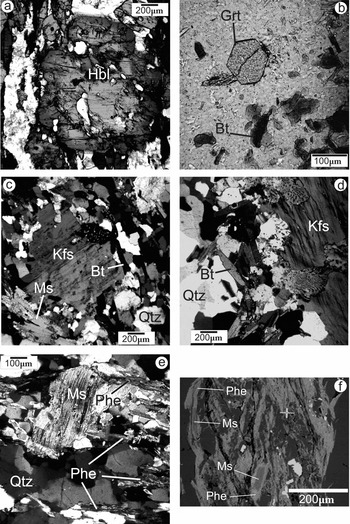
The Kırklareli metagranite consists of muscovite, biotite, microperthitic microcline, plagioclase, quartz and accessory epidote, zircon, apatite, titanite and magnetite. Foliation is defined by the parallel elongation of biotite and muscovite. Both microperthitic microcline (XOr ~ 0.94–0.98) and plagioclase (An2–34) locally form porphyroclasts, representing mostly igneous relics (Figs 3a, 5c, d). Myrmekites are common. Muscovites display Si contents of 2.79–3.30 cations per 11 oxygens (Fig. 3c; Table 3). XMg values of biotites show a large scatter from 0.35 to 0.58 (Fig. 3b; Table 3). Epidotes are characterized by Fe3+/ (Fe3++Al) of 0.18–0.27 (Fig. 3d; Table 1).
Photomicrographs illustrating microtextural features of micaschists, orthogneisses, amphibolites and metasandstones. (a) A large hornblende grain with inclusions of plagioclase, quartz and epidote in amphibolite (sample GK203, crossed polarized). (b) An idioblastic garnet grain in a matrix consisting of plagioclase, biotite, quartz and epidote (sample GK206, plane polarized). (c), (d) Relict feldspar grains with myrmekites in biotite–muscovite orthogneiss (Kırklareli metagranite, sample NK86–2, crossed polarized). (e) Relict large muscovite grain is bent and finer-grained phengites overgrow the muscovite grain. Note that the finer-grained phengites define the foliation (sample GK304, crossed polarized). (f) Some fine-grained phengite-rich white micas have relict cores of muscovite (sample GK304, back-scattered electron image). Bt – biotite; Grt – garnet; Hbl – hornblende; Kfs – k-feldspar; Ms – muscovite; Phe – phengite; Qtz – quartz.

Amphibolites are usually well-foliated, and comprise hornblende, biotite (XMg ~ 0.49–0.57), plagioclase (An23–34), chlorite (XMg ~ 0.55–0.62), epidote and variable amounts of quartz. Some of the plagioclase grains contain relic cores with An13–14, coinciding with the peristerite gap. In addition some grains are reversely zoned. With an increase in the amount of quartz, amphibolites grade into amphibole-bearing biotite gneisses. Rutile, apatite, titanite and ilmenite form accessory phases. Epidote occurs both as inclusions in hornblende and as discrete grains in the matrix, and displays XFe3+ values of 0.19–0.27 (Fig. 3d; Table 1). Generally the cores of the epidotes display lower XFe3+ values relative to the rims. Hornblendes are characterized by tschermakitic compositions with XMg of 0.48–0.65 (Fig. 4; Table 4) and are compositionally zoned (Fig. 5a), whereby Si, Mg and Ca decrease, and Al, Fe and Na increase towards the rim (Table 4).
Garnet–biotite schists (Type-1) include biotite, plagioclase (An21–29), epidote, quartz, garnet and accessory zircon, ilmenite and apatite. Garnet occurs as small sub- to idioblastic grains with very few or no inclusions (50–300 μm; Fig. 5b). They show a compositional range Alm57–74Pyp6–11Grs22–3Sps24–12 (Table 2). Each garnet grain consists of two domains, a core and an overgrowth, separated from each other by a compositional jump (Fig. 6). The core domains are characterized by Mg–Fe-richer and Ca-poorer compositions relative to the rims. Mn in both domains (core and overgrowth) increases rimwards. This compositional feature is characteristic of diffusion-controlled zoning (Spear, Reference Spear2004). In this study, increased Mn content at the rim is interpreted as the result of diffusion resulting from retrograde metamorphism. Similar compositional jumps in garnets were ascribed either to polymetamorphism (e.g. Jeřábek et al. Reference Jeřábek, Faryad, Schulmann, Lexa and Tajčmanová2008) or fractionation and different garnet-forming reactions during a single metamorphic cycle (e.g. Konrad-Schmolke et al. Reference Konrad-Schmolke, O'brien, De Capitani and Carswell2008). Both garnet domains are inclusion-free, hindering any inference on the associated mineral phases during the growth of each garnet domain. Epidote is characterized by XFe3+ values of 0.19–0.24, and some have rare earth element (REE)-richer cores (up to 5 wt%). Ilmenite occurs both as inclusions in garnet and as discrete grains in the matrix, and both cases display elevated MnO contents (2 and 3 wt%).
(a) Ca, Fe, Mg and Mn chemical imaging of a garnet from the basement schists (sample GK206). Note that line with arrow indicates chemical profile. (b) Compositional profile across garnet grain from the basement schists shown in (a) (representative analyses are given in Table 2). For a colour version of this figure see online Appendix at http://journals.cambridge.org/geo.

The metasandstone comprises muscovite-phengite (Table 3), quartz, albite (An0–2), calcite, K-feldspar (XOr ~ 0.95–0.96), biotite (XMg ~ 0.72–0.74; Ti ~0.06–0.08 cations per formula unit (cpfu; Table 3) and accessory apatite, zircon and titanite. Albite displays multiple twinning and locally forms large grains. Large grains of muscovite form bent and kinked crystals, and are relict detrital grains (Fig. 5e) displaying Si contents of 3.0–3.15 cations per 11 oxygens (Fig. 3c). However, finer-grained muscovites are represented by phengites (Si = 3.25–3.45 cations per 11 oxygens), defining the foliation, and locally have relict muscovite cores (Fig. 5e, f).
Mylonites within the Kırklareli metagranite (Fig. 2) differ from the host rocks by their well-foliated nature and fine grain sizes (~200 μm). Mineral constituents are quartz, plagioclase, K-feldspar, biotite, muscovite and minor epidote and titanite. The mylonites in the northern part are devoid of biotite (Fig. 2). Porphyroblasts are rare, and quartz and feldspar have nearly the same grain sizes. Muscovites locally form fish. Grain boundaries are lobate to cuspate. These textural features suggest that the mylonitization occurred under relatively high temperature conditions (≥400°C) (Passchier & Trouw, Reference Passchier and Trouw1996, p. 52).
Overall, plagioclases, muscovites, epidotes and garnets display wide intra-sample compositional variations owing to the presence of relics from the former igneous and/or metamorphic stage (Figs 3, 6).
4. Metamorphic conditions
On the basis of the arguments outlined above, it was suggested that portions of the basement sequence were subjected to a pre-Triassic metamorphism during the Early Permian (Okay et al. Reference Okay, Satir, Tüysüz, Akyüz and Chen2001; Natal'in et al. Reference Natal'in, Satir, Sunal and Toraman2005). Here we try to constrain the P–T conditions of the latest metamorphism, rather than the pre-Triassic one, even though the samples also contain relict minerals from former igneous and metamorphic stages (e.g. Alm–Sps-rich garnet cores, Ab-rich plagioclase cores and muscovite-rich cores in the white micas).
The metamorphic mineral assemblages in the amphibolites and orthogneisses (pre-Triassic basement) are characterized by the stable coexistence of plagioclase (An17–35) + epidote ± hornblende ± quartz, suggestive of epidote–amphibolite-facies conditions (e.g. Miyashiro, Reference Miyashiro1993, pp. 280–7). In these rock types, the metamorphic plagioclases are represented by An17–35, suggesting that the metamorphic conditions exceeded the peristerite gap (Laird, Reference Laird, Veblen and Ribbe1982; Maruyama, Liou & Suzuki, Reference Maruyama, Liou and Suzuki1982). However, the metasandstone sample GK304 (Triassic cover) comprises the mineral assemblage biotite + muscovite + K-feldspar + albite + quartz + calcite, which can occur in the greenschist or albite–epidote–amphibolite facies, a transitional facies between greenschist- and epidote–amphibolite-facies (e.g. Maruyama, Suzuki & Liou, Reference Maruyama, Suzuki and Liou1983; Topuz et al. Reference Topuz, Altherr, Satir and Schwarz2004).
In general, the mineral assemblages documented are not very suitable for placing ‘tight’ constraints on the P–T conditions. However, some constraints on the P–T conditions could be placed from the mineral assemblages in the garnet–biotite schist (sample GK206) and amphibolite (samples NK11-1 & GK203). Metamorphic temperatures are estimated by garnet–biotite and hornblende–plagioclase thermometry, and metamorphic pressures by garnet–biotite–plagioclase–quartz barometry. Compositions of the matrix biotites and intermediate zones of the garnet overgrowths are used, because the garnet core domains are not in equilibrium with the matrix biotite, and we do not have any constraint on the mineral assemblage present during the growth of the garnet cores. The computer program GTB provided by Spear & Kohn (Reference Spear and Kohn1999) was used for P–T estimation calculations. Garnet–biotite thermometry according to the formulation of Ferry & Spear (Reference Ferry and Spear1978) together with the garnet solution model after Berman (Reference Berman1990) yields a temperature of 510 ± 20°C (2σ), and the garnet–biotite–plagioclase–quartz barometry after Hoisch (Reference Hoisch1991, Reference Hoisch1992) gives a pressure of 0.70 ± 0.10 GPa (2σ; Fig. 7).
Combination of individual P–T estimates deduced for the basement unit from sample GK206. Actinolite–hornblende transition according to Baker (Reference Baker1990). Approximate boundaries between metamorphic facies are shown as dotted lines: GS – greenschist facies; EBS – epidote–blueschist facies; EA – epidote–amphibolite facies; AM – amphibolite facies (Krogh, Oh & Liou, Reference Krogh, Oh and Liou1994 and references therein).

Hornblende–plagioclase thermometry after Spear (Reference Spear1980, Reference Spear1981) for the adjacent hornblende–plagioclase compositions consistently yields temperatures of 485–540°C, which are in agreement with the garnet–biotite temperatures (Fig. 8).
Temperature estimates of the basement amphibolites (Spear, Reference Spear1980, Reference Spear1981).

The P–T conditions for the northernmost domain are poorly defined. The metasandstones (e.g. sample GK304) contain a high-variance mineral assemblage biotite + muscovite + K-feldspar + albite + quartz + calcite. Presence of primary calcite in the assemblage suggests that the bulk composition of the protolith was not Ca-free, and accordingly the peristerite gap was not crossed. The uncrossed nature of peristerite gap and presence of biotite might indicate lower metamorphic conditions.
5. Geochronology
To constrain the time of medium-grade metamorphism and cooling history of the region, Rb–Sr biotite and muscovite whole-rock dating was performed on 21 samples distributed over the whole area (Fig. 2). During the sample selection, the criteria such as (i) uniform distribution of the samples throughout the study area, (ii) freshness of the dated samples, and (iii) modal contents of the samples (biotite and/or muscovite) were taken into account.
Mineral separation (biotite, muscovite) was carried out using conventional techniques including crushing, sieving, a magnetic separator and heavy liquids. The dated fractions were between 125 and 180 μm in every dated sample. Rb–Sr isotopic analyses were performed with a FINNIGAN MAT-262 multicollector mass spectrometer in Tübingen. Rb and Sr contents of whole rocks were determined by X-ray fluorescence, using lithium borate fusion discs with an accuracy better than 2%. Rb and Sr concentrations of mineral separates were determined by isotopic dilution. Sr and light rare earth elements (LREE) were isolated on quartz columns by conventional ion exchange chromatography with a 5 ml resin bed of Bio Rad AG 50W-X12, 200–400 mesh. Sr was loaded with a Ta–HF activator on preconditioned W filaments and was measured in single-filament mode. Analyses of 28 separate loads of the NBS987 Sr standard yielded a 87Sr/86Sr ratio of 0.710259 ± 0.000012. Total procedural blanks were < 200 pg for Sr that were loaded with a Si-gel onto a preconditioned Re filament and measured at ~ 1300°C in single-filament mode. Age determinations are based on a 87Rb decay constant of 1.42 × 10⁻¹¹/yr (Steiger & Jäger, Reference Steiger and Jäger1977). Fractionation was corrected by normalizing the 86Sr/88Sr ratios to 0.1194. The input errors for age computations are 1% (2σ) for 87Rb/86Sr ratios and 0.003% (2σ) for 87Sr/86Sr ratios (see Siebel et al. 2005 for a detailed discussion). The Rb–Sr mineral whole-rock isochron age calculations were performed using the Isoplot 3.0 program produced by Ludwig (Reference Ludwig2003). For the interpretation of the ages provided in this study, it should be kept in mind that they contain only mineral and whole-rock data, in other words ages calculated using the two-point isochron method, which represent apparent ages. Two-point isochron calculations always reveal low error values that are mainly based on an assigned a priori Rb/Sr error of 1%. The two-point isochron approach inherently assumes initial isotopic equilibrium among all phases of a rock, which may or may not be correct for a given rock. If isotopic equilibrium has not been achieved during a geological process, such a two-point isochron age is at risk of deviating from the true age of the process, and the true uncertainty on the age may be underestimated by the formal calculation of age errors from the two data points.
The Rb–Sr biotite ages range from 153.9 ± 1.5 Ma (2σ) in the south to 134.4 ± 1.3 Ma (2σ) in the north (Fig. 9; Table 5). The Rb–Sr muscovite ages cluster mostly between 157.7 ± 1.5 and 162.3 ± 1.6 Ma. However, two samples (MS1 and GK134) yielded outlier age values of 149.6 ± 1.5 Ma and 149.1 ± 2.1 Ma. However, the muscovites from the northernmost portion yielded considerably older age values between 279.2 ± 3.0 and 295.6 ± 2.8 Ma (Fig. 9). The Rb–Sr biotite ages are similar to the previously published scarce K–Ar biotite and Rb–Sr biotite ages (Okay et al. Reference Okay, Satir, Tüysüz, Akyüz and Chen2001; Lilov & Maliakov, Reference Lilov and Maliakov2001; Lilov, Maliakov & Balogh, Reference Lilov, Maliakov and Balogh2004).
Distribution of Rb–Sr biotite (Bt) and muscovite (Ms) ages in the study area and alignment of them on a roughly S–N directed cross-section. Coordinates are UTM, European (ED50) and Zone 35.

Results of Rb–Sr dating on muscovite and biotite separates

WR – whole-rock, Bt – biotite, Ms – muscovite, Hbl – hornblende, vwlf – very well foliated, wlf – well foliated, wkf – weakly foliated, f – foliated, Q – quartz, Pl – plagioclase, Kfs – potassium feldspar, Ep – epidote, Chl – chlorite, Cal – calcite, Grt – garnet, Zrn – zircon, Ap – apatite, Ttn – titanite, Ilm – ilmenite. Coordinates are UTM (ED50), Zone 35.
*Ages recalculated after O. Vonderschmidt (unpub. M.Sc. thesis, Univ. Tübingen, 2004) according to the following errors; 2σ error on 87Rb/86Sr is 1%; 2σ error on 87Sr/86Sr is 0.003%. Errors are given as 95% confidence limit.
Pb–Pb zircon evaporation data on the orthogneisses on the same rock types revealed that their igneous protoliths were formed between 315 and 256 Ma (Okay et al. Reference Okay, Satir, Tüysüz, Akyüz and Chen2001; Natal'in et al. Reference Natal'in, Satir, Sunal and Toraman2005; Sunal et al. Reference Sunal, Natal'in, Satir and Toraman2006) and the micaschists contain detrital zircons with age intervals of 430–2700 Ma (garnet–biotite schist) and 300–350 Ma (biotite schist). Cathodoluminescence (CL) images revealed the presence of small metamorphic overgrowths on the zircons, which, however, could not be dated by the Pb–Pb evaporation method (Sunal et al. Reference Sunal, Satir, Natal'in and Toraman2008). On the other hand, the Rb–Sr systematics on biotite and muscovite apart from the ‘older’ ages (279–295 Ma) should refer to the latest metamorphic event in the Strandja Massif.
6. Discussion
6.a. Meaning of mineral isochron ages
The closure temperature is a complex function of several factors such as solid-state diffusion parameters, effective grain size, temperature, cooling rate, fluid activity, deformation and surrounding exchange medium (Dodson, Reference Dodson1973; Villa, Reference Villa1998; Montel, Kornprobst & Vielzeuf, Reference Montel, Kornprobst and Vielzeuf2000; Müller, Aerden & Halliday, Reference Müller, Aerden and Halliday2000; Kühn et al. Reference Kühn, Glodny, Iden and Austrheim2000; Glodny et al. Reference Glodny, Austrheim, Molina, Rusin and Seward2003, Reference Glodny, Ring, Kühn, Gleissner and Franz2005; Reddy et al. Reference Reddy, Wheeler, Butler, Cliff, Freeman, Inger, Pickles and Kelley2003; Glodny, Kühn & Austrheim, Reference Glodny, Kühn and Austrheim2008). Absence of a free fluid phase and of suitable minerals with which the micas can exchange Sr may strongly increase closure temperature (Kühn et al. Reference Kühn, Glodny, Iden and Austrheim2000; Glodny, Kühn & Austrheim, Reference Glodny, Kühn and Austrheim2008). However, in our sample set, the presence of synkinematic quartz veins indicates fluid activity during deformation. Besides, the dated samples are well-foliated and contain epidote and apatite. The epidote and apatite in free fluid-bearing environments can act as a large Sr reservoir with which the micas can exchange Sr (Zeck & Hansen, Reference Zeck and Hansen1988; Glodny, Kühn & Austrheim, Reference Glodny, Kühn and Austrheim2008). The Rb–Sr age difference between the biotite ages in the south and those in the north is ~ 15 Ma, which cannot be accounted for by the analytical uncertainty, usually in the order of 1 to 3 Ma (95% confidence level (2σ)). The biotite ages are thus best explained as dating their Sr-isotopic closure at fluid-present conditions, at temperatures in the range of ~300 to 400°C (Purdy & Jäger, Reference Purdy and Jäger1976; Giletti, Reference Giletti1991; Del Moro et al. Reference Del Moro, Puxeddu, Radıcatı Dı Brozolo and Vılla1982). The biotite ages date a stage of greenschist-facies conditions during post-metamorphic exhumation of the Strandja Massif.
Given that estimated metamorphic peak temperatures were near the commonly assumed isotopic closure temperature of muscovite for Sr diffusion (~500°C), we interpret the muscovite ages from the southern and central parts of the study area as dating either synmetamorphic deformation (e.g. Freeman et al. Reference Freeman, Inger, Butler and Cliff1997) or a very early stage of postkinematic cooling (between 157.7 ± 1.5 and 162.3 ± 1.6 Ma). A clear distinction between these two options is impossible. In any case, these muscovite ages date a near-peak stage of Middle to Late Jurassic metamorphism. The pre-Jurassic ages from the northern part of the study area (apparent ages between 279 ± 3.0 and 295 ± 2.8 Ma) are interpreted as mixed ages, because the dated samples contain both relict igneous and metamorphic muscovite (Figs 5e, f). The apparent ages give a minimum age for igneous muscovite crystallization and a maximum age for the muscovite-forming metamorphism.
6.b. Geodynamic significance
The section of the Strandja Massif in the study area has Palaeozoic basement rocks with Triassic cover units. The cover consists of a transgressive sequence that starts with metaconglomerates at the base and reaches marbles (not observed in the studied part) at the top of the section. This sequence was interpreted as epi-continental by Okay et al. (Reference Okay, Satir, Tüysüz, Akyüz and Chen2001). However, Chatalov (Reference Chatalov and Dewey1991) reported an allochthonous Triassic sequence in the Bulgarian section of the massif that comprises greenschist-facies phyllites and metabasites. This unit was formerly interpreted as an accretionary complex (e.g. Şengör, Yılmaz & Sungurlu, Reference Şengör, Yılmaz, Sungurlu, Dixon and Robinson1984). Okay et al. (Reference Okay, Satir, Tüysüz, Akyüz and Chen2001) interpreted this allochthonous Triassic sequence as the main reason for regional metamorphism occurring in the Strandja Massif.
As revealed by the study presented here, the Middle Mesozoic cooling in the Strandja Massif displays a significant diachronism. The tectonic event controlling the metamorphism and subsequent cooling/exhumation propagated northward between Late Jurassic and Early Cretaceous time. Diachronous cooling was described from different tectonic settings such as compressional (e.g. Boyle, Burton & Westhead, Reference Boyle, Burton and Westhead1994; Dallmeyer et al. Reference Dallmeyer, Martínez Catalán, Arenas, Gil Ibarguchi, Gutiérrez Alonso, Farias, Bastida and Aller1997; Crowley & Parrish, Reference Crowley and Parrish1999; Gray et al. Reference Gray, Foster, Goscombec, Passchier and Trouwe2006; Tricart et al. Reference Tricart, Van Der Beek, Schwartz and Labrin2007; Jeřábek et al. Reference Jeřábek, Faryad, Schulmann, Lexa and Tajčmanová2008), extensional (e.g. Holm & Dokka, Reference Holm and Dokka1993; Bertrand et al. Reference Bertrand, Rangin, Maluski and Bellon2001) and transpressional segments of strike-slip systems (Morillon et al. Reference Morillon, Féraud, Sosson, Ruffet, Crevola and Lerouge2000; Koons et al. Reference Koons, Norris, Craw and Cooper2003). In the case of the Strandja Massif, compression led to overturned folding and thrusting, deduced from (i) the occurrence of the cover sequence beneath the basement (Fig. 9), (ii) an inverse metamorphic gradient, and (iii) top-to-the-N ductile shear zones (Natal'in et al. Reference Natal'in, Satir, Sunal and Toraman2005; Natal'in, Sunal & Toraman, Reference Natal'in, Satir, Sunal and Toraman2005).
Pressure estimates obtained in this study indicate that during the deformation, the Strandja Massif was buried to depths of 22–29 km. The oldest non-metamorphic rocks unconformably resting on the Strandja Massif are represented by earliest Late Cretaceous sandstones (Cenomanian, ~ 95 Ma, Okay et al. Reference Okay, Satir, Tüysüz, Akyüz and Chen2001; Türkecan & Yurtsever, Reference Türkecan and Yurtsever2002) on the northern flank and an Eocene–Oligocene sequence of limestone, sandstone and shale on the southern flank (Çağlayan, Şengün & Yurtsever, Reference Çağlayan, Şengün and Yurtsever1988). This suggests that at least parts of the Strandja Massif were at the Earth's surface before 95 Ma. It should be noted that erosion was also a contributing mechanism for exhumation in the Strandja Massif. During Early Cretaceous time, a nearly E–W-trending depositional basin was present on the Moesian, parts of the Sredna Gora zone and the Strandja Massif (Minkovska, Peybernès & Nikolov, Reference Minkovska, Peybernès and Nikolov2002; Fig. 1). The southern margin of this basin is represented mainly by up to 4000 m thick flysch-type coarse siliciclastics, while the northern margin is made up of a considerably wider shallow water carbonate platform. This suggests significant clastic input from the south, namely from the Strandja and probably parts of the Rhodopes.
There are several tectonic zones and massifs surrounding the Strandja Massif, but their palaeotectonic position and geological relationships with the Strandja Massif are not clear because of the subsequent geological deformation phases that destroyed most of the older structures. Two different zones have been identified to the N and NW of the Strandja Massif: the Sredna Gora and the Balkan zones (Chatalov, Reference Chatalov1988; Yanev, Reference Yanev2000). The Sredna Gora zone mainly consists of Upper Cretaceous unmetamorphosed volcanics. The Balkan zone has the same Late Palaeozoic basement as the Strandja Massif but it is not metamorphosed either (Carrigan et al. Reference Carrigan, Mukasa, Haydoutov and Kolcheva2005; Sunal et al. Reference Sunal, Natal'in, Satir and Toraman2006). The Rhodopes, the Circum-Rhodope Belt and small metamorphic domains in southern Thrace and Biga Peninsula are located to the S and SW of the Strandja Massif (Fig. 1). In contrast to the Strandja Massif, these metamorphic domains locally contain rock assemblages that suggest involvement in accretion and subduction events (e.g. Okay & Satır, Reference Okay and Satir2000; Mposkos & Krohe, Reference Mposkos and Krohe2006; Bonev, Marchev & Singer, Reference Bonev, Marchev and Singer2006; Bauer et al. Reference Bauer, Rubatto, Krenn, Proyer and Hoınkes2007; Topuz et al. Reference Topuz, Okay, Altherr, Satir and Schwarz2008). The timing of the high P–T metamorphism in southern Thrace and the Biga Peninsula is estimated to be Late Cretaceous (Okay & Satır, Reference Okay and Satir2000; Topuz et al. Reference Topuz, Okay, Altherr, Satir and Schwarz2008). The relationship between the Strandja and the Rhodope massifs during the Late Jurassic to Early Cretaceous interval is still a matter of conjecture (Fig. 1). For example, Gerdjikov & Gautier (Reference Gerdjikov2005) and Gerdjikov (Reference Gerdjikov2005) have discussed the absence of a known suture zone between these two units. Both regions have similar basement geology having Permo-Carboniferous granitoids of the Variscan event (Cherneva & Georgieva, Reference Cherneva and Georgieva2005; Carrigan et al. Reference Carrigan, Mukasa, Haydoutov and Kolcheva2005; Liati & Fanning, Reference Liati and Fanning2005; Sunal et al. Reference Sunal, Natal'in, Satir and Toraman2006) and mid-Mesozoic metamorphism (Liati, Reference Liati2005; Bauer et al. Reference Bauer, Rubatto, Krenn, Proyer and Hoınkes2007; Bonev et al. 2009), but rock types and grades of metamorphism differ from each other. Metamorphism in the Rhodope massif reveals mainly high- to ultrahigh-pressure conditions (Mposkos & Krohe, Reference Mposkos and Krohe2006; Bauer et al. Reference Bauer, Rubatto, Krenn, Proyer and Hoınkes2007) that form as a result of northward subduction of the Nestos Ocean (e.g. Ricou, Reference Ricou1994). Recent geochronological data consistently suggest that the timing of high- to ultrahigh-pressure metamorphism in the Rhodopes is at ≥160 Ma (e.g. Mposkos & Krohe, Reference Mposkos and Krohe2006; Bauer et al. Reference Bauer, Rubatto, Krenn, Proyer and Hoınkes2007). Furthermore, the time of retrogression of high- to ultrahigh facies to amphibolite facies is given as c. 144 Ma (Krenn et al. Reference Krenn, Bauer, Proyer and Hoınkes2007). This retrogression is linked with unroofing of the eclogites via extensional tectonics (Krenn et al. Reference Krenn, Bauer, Proyer and Hoınkes2007). In the Balkan region, at least in terms of timing of the metamorphic events, the Rhodope Massif seems to be geologically related to the Strandja Massif. However, the relationship between the Strandja and the Rhodope massifs is obscured by subsequent geological events that make it difficult to reconstruct a Mesozoic tectonic framework, such as (i) Tertiary metamorphic overprint in the Rhodopes, (ii) later strike-slip faults that formed between these metamorphic massifs, and (iii) the Tertiary basin that developed on both the Strandja and the Rhodope massifs. In Bulgaria, a pronounced right-lateral strike-slip fault, i.e. the Maritsa fault zone (MFZ in Fig. 1), with an offset of over 100 km, is located between the Strandja and the Rhodope massifs (Burg et al. Reference Burg, Ricou, Ivanov, Godfriaux, Dimov and Klain1996; Ivanov, Reference Ivanov2000). The elongation of the Maritsa fault into Turkey is concealed in the Pliocene sedimentary rocks of the Thrace basin (c.f. Perinçek, Reference Perinçek1991; Yaltırak, Reference Yaltirak2002). The Turkish section of the fault is known as the Thrace–Eskişehir Fault Zone (TEFZ in Fig. 1) that was thought to be active between the Early Miocene and Pliocene (Yaltırak, Reference Yaltirak2002). Despite these difficulties, the compressional deformation in the Strandja Massif seems very likely related to the northward subduction and accretion events in the Rhodopes that occurred during Late Jurassic to Early Cretaceous time.
7. Conclusions
The southern part of the Strandja Massif, NW Turkey, comprises a basement of various orthogneisses, micaschists and amphibolites, and an epiclastic cover of metaconglomerate and metasandstone. Both sequences underwent a transitional greenschist- to epidote–amphibolite-facies metamorphism in a compressional regime during Late Jurassic to Early Cretaceous time. The ages of peak or near-peak metamorphism are clustered between 157.7 ± 1.5 and 162.3 ± 1.6 Ma and subsequent cooling occurred diachronously between 153.9 ± 1.5 Ma and 134.4 ± 1.3 Ma, starting in the south and progressing to the north. The compressional regime probably resulted from thrusting and overturned folding, and was ultimately related to the coeval subduction and collision events in the southerly Rhodope Massif.
Acknowledgements
This paper forms a part of the Ph.D. thesis of G. Sunal at the University of Tübingen. Field work and travel expenses were funded by ITU Research fund (#11-07-128) and TÜBITAK (The Scientific and Technical Research Council of Turkey, Project no: YDABCAG 101Y010). The help of G. Bartholomä during mineral separation, and W. Siebel and E. Reitter during isotopic measurements is gratefully appreciated. Early drafts of the manuscript were reviewed by A. I. Okay, P. Bons and W. Siebel, which led to considerable improvement of the ideas. We thank R. Altherr for friendly access to the electron microprobe facility in Heidelberg. Insightful and constructive reviews were provided by U. Ring and two anonymous referees.