Introduction
My title is purposefully oxymoronic. It is oxymoronic because I offer an International Relations (IR) interpretation of internal politics within a member of the international system. It is purposeful because I hope to spark similar work and expect that what is commonly defined, by default, as internal politics in much of the world is consistent with what theories of international politics expect international actors to do. I particularly want to persuade readers that an apparent incompatibility between neo-realism and empirical reality in Africa is an illusion largely caused by a mistaken assumption that neo-realist theory applies only to official states.
This article is thus a neo-realist and data-oriented response to a provocative and persuasive essay published in this journal by William Brown.Footnote 1 Brown addresses an ‘Africanist challenge’ to ‘IR theory’, carefully distinguishing between disparate camps within both bracketed areas. He demonstrates that the ‘challenge’ is only against realism, and suggests that both the realists and their Africanist critics are unlikely to come to any sort of mutual understanding because both suffer from overly-rigid conceptualisations of states and of anarchy. Brown concludes that other IR theories with more flexible engagement of concepts like ‘state’ and ‘anarchy’, are useful for understanding African international relations, international relations in other regions, and for diagnosing weaknesses in both realist and critical camps.
While largely sympathetic to Brown's argument and claims, I suggest his characterisation of realism as unredeemable is too hasty. My reading of prominent neo-realist theorists suggests they perceive their variant of realist theories to be applicable to more than just official state members of the international system. Such theoretical generality notwithstanding, the vast majority of quantitative research in IR, much of which tests hypotheses drawn from neo-realist theories, is analysis exclusively of ‘official states’. But if the theories are not logically tied to exclusive analysis of official states, then the behaviours of other actors offer important evidence against which to test the theories' accuracy. What are the ‘other actors’? I contend they are all the ‘unofficial states’, the unrecognised but nevertheless autonomous political entities that control territory and people while possessing military capabilities. According to Christopher Clapham, land, people and guns are ‘the most basic criterion for statehood’, even if that statehood is unofficial.Footnote 2
Unrecognised states and other autonomous political entities (APEs) are not only common in Africa, but are important forces in African IR.Footnote 3 If realist theory applies to both official states and APEs, and if Africa's IR is heavily influenced by its large population of APEs, then a fair test of the applicability of neo-realist theory to Africa requires analysis not only of the official states, but also of all the APEs resident and active there as well. But, since current IR datasets ignore the behaviours of the APEs, I cannot undertake that fair test here. Instead, I offer an historical narrative of a half decade's interactions among official states and APEs within the Congo, and conclude that their behaviour was largely consistent with neo-realist expectations.
Before offering that narrative and neo-realist friendly interpretation, I first provide some justification for my interpretation of neo-realism as relevant to behaviour among non-state actors. After then providing the historical narrative, I round out the article with a discussion of how the neo-realist behaviours described in the narrative suggest connections between war and state making. This is an important connection to draw, because, according to Brown,Footnote 4 many of the ‘Africanist critics’ of ‘IR theory’ suggest Africa's profoundly different state making context is the source of the mismatch between IR theory and African reality.
An ‘Africanist critique’ of ‘IR theory’
The quotes around ‘Africanist critique’ and ‘IR theory’ are intended to make explicit my recognition that there is no one Africanist critique, and neither are all IR theories equally critiqued. Rather, Africanists vary quite widely in how similar they think Africa is to the rest of the world,Footnote 5 and the IR theory most clearly under attack is realism. Brown contends:
It soon becomes clear that when critics argue that IR theory is inadequate for Africa – because it focuses on states and not other actors, that it limits itself to interstate relations and ignores other transnational processes, or that it operates as if there were no connection between what goes on within states and what goes on between them – they are actually talking about neorealism […]
And Jeffrey Herbst claims:
[T]he vision in much of the international relations literature of states enmeshed in some kind of Hobbesian struggle in a merciless international environment really has very little resemblance to Africa as ruled by the colonialists or Africans. In particular, the realist view of the world is problematic in systems where the use of force between units is not a serious concern.Footnote 6
Herbst's claim is particularly interesting as an example of an Africanist critic of ‘IR theory’ nevertheless employing a traditional concept of the state. Unlike Herbst, Brown rejects realism's conceptualisation of the state: ‘the realist conceptualization of the state and of anarchy are to be found wanting in and of themselves […]’. Rather, he favours the use of different theories altogether, ‘With a modified understanding of the units of the international system, and of the structure of relations between them, the extent of African difference could be reduced from a difference of kind, as one side or other of a dichotomy, to a matter of degree.’Footnote 7 What might that ‘modified understanding’ look like? Brown concludes ‘it is hard to see how it [African IR] can be properly conceived without some working notion of the nature of the system of which it is a part […] the state, anarchy and interdependence should remain key elements in any such conceptualization’, and suggests that liberal theories, and the English School particularly, offer useful ‘relational understandings’ of these key elements.Footnote 8
I suggest that neo-realist conceptualisations of states and anarchy are sufficiently flexible to permit just such useful modified understandings. Consider, Kenneth Waltz writes: ‘Balance-of-power politics prevail wherever two, and only two, requirements are met: that the order be anarchic and that it be populated by units wishing to survive.’Footnote 9 What ‘units’ does Waltz mean?: ‘To achieve their objectives and maintain their security, units in a condition of anarchy – be they people, corporations, states, or whatever – must rely on the means they can generate and the arrangements they can make for themselves. Self-help is necessarily the principle of action in an anarchic order.’Footnote 10 Clearly, Waltz expects that any survival-oriented actor operating under anarchy will behave as neo-realists anticipate – that is, they will take self-help measures to increase their power, form alliances, and otherwise enhance their security.
Waltz's conceptualisation of anarchy is also quite flexible. He writes: ‘Anarchy is seen as one end of a continuum whose other end is marked by the presence of a legitimate and competent government.’Footnote 11 Thus, so long as the environment tends toward the anarchic end of the continuum, and so long as the actors are survival oriented, neo-realism should be an accurate guide to behaviour. Brown recognises this, writing: ‘For Waltz, so long as there is a legitimate authority attempting to uphold its right to monopolize legitimate force, then the assumption of domestic hierarchy may still be useful.’Footnote 12 But given that few African governments are competent or legitimate, the presumption should be that in Africa particularly, the territory ‘legitimately’ assigned to many ‘states’ are anarchic rather than hierarchic, and neo-realist expectations should apply within them.Footnote 13 What's more, Waltz anticipates applications of his theory to analysis of actors within states: ‘Was China from the 1920s to the 1940s a hierarchic or anarchic realm? Nominally a nation, China looked more like a number of separate states existing alongside one another […]’.Footnote 14 Were data about China's ‘separate states’ available, Waltz would expect those data to show balancing alliances, power maximisation, and other self-help survival-oriented behaviours.Footnote 15
I read foundational neo-realist work as permitting considerable flexibility with respect to the units studied and thus to the empirical purview within which the theory is applied. If data collectors' understandably try to economise on their data gathering costs by focusing only on official, legally-recognised states, and have thereby created a mismatch between theoretical expectations and empirical reality as observed in Africa, it is the datasets that are wrong, not neo-realist theories.
There certainly is statistical evidence of African Exceptionalism generated with these, arguably non-representative, datasets. Douglas Lemke demonstrates that Africa has far fewer wars than expected based on comparison with empirical patterns in the rest of the world. Errol Henderson shows that joint democracy is not pacifying among African dyads. And Pierre Englebert and Rebecca Hummel provide evidence of how uncommon secessions are in Africa.Footnote 16
Exclusive study of ‘official states’ is not necessitated by neo-realist theory. As a result, a fair test of neo-realism in Africa should evaluate the behaviour of all APEs. Studying only ‘official states’ in Africa may do violence to neo-realist expectations. But, the fair test I advocate is impossible because data on many of the official states, and on virtually all of the autonomous political entities, are unavailable. Thus, an important direction for future research is to expand existing data resources to include all relevant actors.
Lacking that large dataset, I instead present an historical narrative of ‘international politics’ within the Republic of the Congo (later known as Zaire) just after independence. I pay particular attention to when APEs emerged, and to how they interacted with the official Congolese state, and with other official states and APEs in the area. I apply neo-realist arguments about balancing behaviour and about conflict onsets and outcomes, in an effort to make sense of what happened in Congo during its early history. I find the behaviour of the Congo's official and unofficial actors easily recognisable as self-interested efforts to survive under anarchy.
International politics within Congo
On 1 July 1960 the Belgian Congo was replaced by a newly independent Republic of the Congo (hereafter, Congo). In the ensuing six years the country experienced violent secessionist struggles, rebellions, UN and other interventions, marauding mercenary armies, and two coups d'état. These experiences are referred to as the First Congo Crisis. Here I restrict myself to a sketch of those aspects of the First Congo Crisis pertinent to a neo-realist analysis of official states and autonomous political entities in Congo from 1960 through 1965. Excellent, fascinating, extensive and remarkably compatible histories of the Crisis are offered by others, and I refer interested readers eager to learn more, or sceptical of my claims, to those sources.Footnote 17
Why study international politics within the Congo during this early period of the country's history? The early period of Congolese independence offers a record of many actors engaging in horrific violence while also finding opportunities to cooperate with each other. That the period in question is now forty years in the past has allowed a substantial historical literature to become available for scrutiny, and which can be compared with contemporaneous accounts. And yet, it is a body of empirical material that has been, as far as I can tell, entirely ignored by past IR researchers.Footnote 18 This makes my study unique in content, and given that I study non-state actors through a neo-realist lens, unique in form as well.
This narrative necessitates a coding rule for identifying the existence of autonomous political entities governing a recognisable inhabited territory and possessing military forces. Standard IR datasets only recognise actors satisfying minimum population thresholds, and recognised diplomatically by international ‘legitimators’ like Britain and France, or from international bodies like the UN.Footnote 19 Increasingly even researchers within the Correlates of War project recognise the value of expanding the standard ‘state list’ to include additional state-like entities.Footnote 20 How to expand the state list is, however, unclear. Minimum population thresholds and diplomatic status may be arbitrary, but are concrete criteria for inclusion in a dataset. Relaxing these criteria is theoretically advantageous, but practically difficult. In offering my own coding rules for consideration of an actor as an autonomous political entity, I am painfully aware of the truth behind Gleditsch and Ward's claim that ‘In our view, a single set of foolproof criteria is desirable but may not be possible. As a result, all lists of independent states rely at least in part on subjective evaluations based on relatively fuzzy criteria.’Footnote 21
I consider an autonomous political entity (APE) to be an international actor pertinent to the evaluation of IR theory when it achieves independent control of a territory. Independence can be established in a variety of ways. An APE is independent if it declares independence and the actor previously identified as possessing claim to that territory does not contradict the claim of independence. A declaration of independence could be a formal document/statement, or the initiation of a civil war or secessionist struggle. Calls for autonomy qualify as declarations of independence if accompanied by construction of a military force.
Alternatively, an APE is independent if it declares independence, this claim is militarily contradicted by another actor, but that actor is unable to subdue the APE declaring independence. Similarly, an APE is independent if it declares independence, this claim is contradicted by another actor, but that actor nevertheless does not resort to military force to subdue the actor declaring independence. Finally, I regard an APE as independent even absent a declaration of independence, provided it possesses military capabilities unauthorised by the APE or state previously possessing claim to that territory, so long as it persists in possession of that unauthorised independent military capability.
In sum, I identify an actor as an APE when its control of territory is established by other APEs or official states acquiescing to that independence or being unable to stop it. APEs could qualify as independent for a very short period of time (the Balubakat APE, described below, persisted for only two months). Similarly, my coding rules include no limits on how much territory or how many people an actor must govern in order to qualify as an APE. Imposing minimum thresholds would contradict the logic of my relaxation of coding rules, and would prevent me from testing realist expectations about weak actors being at particular disadvantage internationally. Small size and small population correlate with weakness, and thus lower boundaries on area or population would curtail variation on these important correlates of international success and survival.
Note that formal diplomatic recognition is not a requirement for inclusion in my dataset as an APE. Formal recognition of an actor's independence qualifies it as an APE, and specifically as an official state within the larger class of APEs. But diplomatic recognition is not required for inclusion as an APE nor does it establish a ‘different kind’ of APE. That said, it is surely the case that APEs enjoying legal diplomatic recognition possess a valuable resource unrecognised APEs would like to have (and which they work hard to win). In the Congolese case analysed below, being the ‘official’ government of Congo certainly was an asset for Leopoldville. Leopoldville's legal status necessitated that UN peacekeepers coordinate with it, and empowered Leopoldville's arguments against foreign support for any of the other APEs. Legal sovereignty is, rather unambiguously, an asset inconsistently available across developing states and within the population of APEs, and not surprisingly correlates strongly with survival.Footnote 22
Unfortunately, many of the terms I use to identify APEs are vague. How ‘independent’ a putative APE's military is may be impossible to define explicitly. The extent to which an APE's leaders actually control the territory they claim is also necessarily imprecise. These are valid objections against my coding rules for APEs. However, a moment's consideration demonstrates equally that such concerns plague existing data sets' codings of ‘official states’. How ‘independent’ were Warsaw Pact militaries during the Cold War (or were NATO militaries during the same decades)? It is impossible to say. Pakistan is listed as an official state member of COW datasets from 1947 onwards, and yet the extent to which the government in Islamabad controls the peoples and territories ‘officially’ designated Pakistani is debatable at best. Thus, to the extent that the imprecision of my rules for coding actors as APEs are valid, they are valid critiques of the entire enterprise of quantitative IR scholarship. I am forced to make some subjective decisions, and do so reminded of the Gleditsch and Ward quote above.
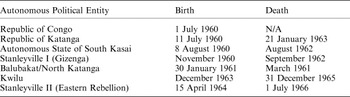
Employing these coding rules, I identify seven actors as official states or APEs within the Congo, existing for all or part of the years 1960 through 1966. In the narrative to follow the circumstances of their births, deaths and struggles while in existence are recounted, but for summary purposes, here is a list:
Autonomous Political Entity, births and deaths

On 1 July 1960 the Republic of the Congo asserted independence over the territory formerly colonised as the Belgian Congo. Belgium's recognition of Congo satisfies my coding rule of the actor as an APE. The UN' seating of a Congolese delegation in November 1960 satisfies Correlates of War official state coding rules. But the Congo that emerged was not a unified, legitimate, or capable actor. In spite of huge territory, large population, and vast economic resources officially recognised to be Congolese, the political reality was of a much more disjointed and impoverished polity. ‘The authority of the new government rarely extended beyond Leopoldville [Kinshasa] and Equateur provinces and a part of Kasai […]’.Footnote 23
Independence was preceded by a contentious decolonisation process featuring elections for a national legislature and negotiations after those elections to select national leaders. Dozens of parties were rapidly created to contest these elections, and the initial outcome was a product of intense compromise that created significant discontent among some of Congo's elite.
Three days after independence the armed forces mutinied because Belgian officers who had remained to lead the army asserted that their control was to be unchanged from colonial times. Soldiers had expected to be promoted to officer positions, that salaries would rise, and that the entire Belgian officer corps would quickly be replaced by indigenous leaders. These expectations unmet, the soldiers mutinied and fears for Belgian citizens remaining in Congo led Belgium to dispatch 3,000 paratroopers to protect its remaining nationals.
Amid these disturbances, the southeastern province of Katanga announced its secession on 11 July. Scholars of the period are unanimous in describing the political entity that emerged as independent of Leopoldville, as possessing its own military, the Katanga Gendarmes, numbering 5–7,000 troops plus foreign mercenaries, and of governing its territory.Footnote 24 Katanga thus satisfies my coding rules as an APE starting on 11 July 1960.
Katanga produced, in the decade before independence, 80 per cent of the colony's mineral output.Footnote 25 The intense concentration of national wealth within this one province suggested it had sufficient resources to survive on its own. The province also had been one of particularly high European settlement, thus encouraging its leader Moises Tshombe to believe an independent Katanga would be recognised diplomatically. Indeed, Britain, France and South Africa were friendly with Tshombe's government, and Belgium established diplomatic relations with it at the consular level.Footnote 26
Congo could not afford to lose the majority of its mineral resources, nor did leaders in Leopoldville relish the precedent of provinces choosing for themselves whether to remain part of Congo. As a result, Prime Minister Lumumba ordered the Congolese Army (still reeling from the mutiny) to subdue the Katangan Secession.
On the 14th of July the UN Security Council authorised a peacekeeping mission (ONUC) to restore order so that Belgian forces could withdraw from the country. Disagreement arose between UN General Secretary Dag Hammerskjold and Prime Minister Lumumba over whether the UN force should also subdue Katanga and remove Belgian and other mercenaries supporting the secession. Dissatisfied with what he perceived as half-hearted UN efforts, Lumumba asked the Soviet Union for assistance subduing Katanga. His approach to the Soviet Union raised Western fears that he harboured communist sympathies, and thus the First Congo Crisis became a front in the Cold War.Footnote 27
Adding to Leopoldville's troubles, on 8 August 1960 the southern part of Kasai province asserted its independence as the Autonomous State of South Kasai (alternately known as the Mining State of South Kasai, and as the Diamond State). Local leader Albert Kalonji was dissatisfied (as was Katangan leader Tshombe) with the political manoeuvres that rendered Lumumba Prime Minister, and this discontent, coupled with the diamond wealth of South Kasai, encouraged this second secession. In South Kasai, ‘a state was created’ that ‘enjoyed two years of self-rule’, supporting claims that the polity qualifies as an APE. Its independence was not recognised by any official states, although Katanga and South Kasai signed treaties ‘for economic, financial, and military cooperation’.Footnote 28
South Kasai's secession was particularly disadvantageous for Congo's government because it placed a second APE, also hostile to Congo, between the Congolese army's home bases and Katanga. This further complicated efforts to conquer Katanga. Meeting this expanded crisis head-on, Prime Minister Lumumba ordered the Congolese Army into South Kasai to subdue the new APE. The effort did not initially succeed, and resulted in massacres of Kasaian residents in late August 1960.
Here tensions between Hammerskjold and Lumumba again played a role, because when the UN General Secretary described the massacres as genocidal and blamed them on Lumumba,Footnote 29 Congo's President Kasavubu claimed to be justified in removing Lumumba from office. In response, Lumumba declared Kasavubu removed for overstepping his constitutional authority, and Congo's parliament further muddied the water by nullifying both removals. In mid-September Joseph Mobutu, an army leader, announced he was removing both President and Prime Minister in a coup d'état, and replacing them with a ‘college of commisaires’ to run the country. Lumumba was placed under house arrest in Leopoldville on 15 September.Footnote 30
In spite of his disputes with Tshombe, Kalonji, Kasavubu, Mobutu and Hammerskjold, Lumumba remained the most popular politician in the country and enjoyed particularly strong support in the north and east. When his house arrest persisted for several months, and when the UN's Credentials Committee recognised Kasavubu and Mobutu's representatives (on 10 November 1960), ‘the strategy emerged of establishing a rival government in Stanleyville (Kisangani) and carrying on the struggle from there […] support of the provincial government was assured, and pro-Mobutu officers were removed from the army detachments. By the end of the month, Lumumbist control over Orientale had been consolidated.’Footnote 31 Vice Premier Gizenga, Lumumba's chief deputy, led these efforts, and Stanleyville thus emerged as a fourth relevant actor and third APE.
In late November Lumumba escaped and tried to reach Stanleyville to lead the new APE's efforts to conquer the rest of Congo. His escape failed, he was recaptured and in January 1961 transported to Katanga under mysterious circumstances, where he was assassinated. His death was announced in February, but even without him the Stanleyville APE flourished. It overturned the pro-Leopoldville government of Kivu province on 25 December 1960, and expanded into Katangan and Kasaian territory by late February 1961.Footnote 32 These expansions increased the territory and population of the Stanleyville APE, and that combined with negative reactions to Lumumba's murder ‘helped Gizenga consolidate his regime, and several African and Soviet bloc countries accorded it official recognition’.Footnote 33 Stanleyville's success then created neo-realist ripples in other parts of Congo.
First, the promise of help from a rapidly rising Stanleyville APE encouraged dissidents within Katanga to secede from the Katangan APE. On 30 January 1961 the Association of Luba People of Katanga (known as the Balubakat) proclaimed the secession of North Katanga.Footnote 34 That the independence of the Balubakat/North Katanga APE was strongly supported by the Stanleyville APE seems a clear instance of balancing by Balubakat against Katanga, and of a divide-and-conquer strategy by Stanleyville against Katanga. Neo-realists anticipate such behaviour as standard practice by survival-oriented actors operating under international anarchy.Footnote 35
In a second ripple, Katanga and South Kasai expanded their military alliance (on 27 February 1961) to include the Congolese government in Leopoldville as a third ally.Footnote 36 Katanga and South Kasai were at war with the Republic of Congo, and the Congolese army was active on Katangan and South Kasaian territory (committing massacres of civilians as well as contesting these two APEs' armed forces). But, true to orthodox enemy-of-my-enemy-is-my-friend logic, these three united against the larger common threat of a rising Stanleyville APE. Its successful incursions into Katanga and Kasai, and the threat this expansion subsequently posed to the ‘official state’, overcame ongoing antagonisms among Leopoldville, Katanga and Kasai, much as the British government was able to swallow its antagonism to the Soviet Union when they found themselves common enemies of Nazi Germany.Footnote 37 Also consistent with neo-realism is the fact that as soon as the Stanleyville APE began to decline, the alliance between Katanga and South Kasai reverted to a dyadic commitment and conflict between both APEs with Leopoldville resumed.
Before Stanleyville declined, however, Balubakat fell. This APE was tiny and distant from its main ally's centre of resources. According to Young, its entire military force in March 1961 comprised only 164 soldiers.Footnote 38 Given that the Katangan Gendarmes are estimated to have had at least 5,000 soldiers, and that the alliance with Congo freed all of these soldiers to deal with other threats, no realist or neo-realist would be surprised that Balubakat was invaded and conquered by Katanga in March 1961. A basic tenet of such theory is that the strong do as they will; the weak suffer what they must.Footnote 39 Facing a 30 to 1 disadvantage, neo-realists (and perhaps anyone else) would anticipate Balubakat losing its struggle with Katanga and then losing its independence. Balubakat's existence as an APE was very short, only two months, in spite of possessing an ally in Stanleyville.
Stanleyville itself soon struggled to survive. A blockade of the Congo River was successfully instituted by Leopoldville, and reinforced when Sudan forbade use of its territory for transit of military supplies to the APE. As a result, although there were promises of support from the Soviet bloc, there was no effective way to deliver that support. By April 1961, facing military collapse, Gizenga entered negotiations with Mobutu and Kasavubu about resolving the dispute over which government would officially represent the country. After initially agreeing to the installation of Adoula as the new Prime Minister (in August 1961), Gizenga returned to Stanleyville and reasserted the APE's independence from the government in Leopoldville. But now Leopoldville was able to exploit divisions within Gizenga's Stanleyville government, and that coupled with the blockades led to military collapse. By September 1962 Gizenga was imprisoned in Leopoldville, and all of Stanleyville APE was governed from Leopoldville.
The elimination of Stanleyville reinvigorated Leopoldville's efforts to conquer Katanga and South Kasai. A diplomatic front was opened, and negotiations between Katanga's Tshombe and the new Congolese Prime Minister Adoula occupied much of 1962. These proved fruitless, however, and so military conflict renewed. Negotiations between South Kasai and Leopoldville were a low priority, because military operations against South Kasai began to bear fruit in late 1961. By February 1962 South Kasai's military forces were debilitated, and by August 1962 South Kasai was reintegrated into Congo.Footnote 40
While these diplomatic and military efforts went forward, pressure mounted in the UN to wrap up the ONUC peacekeeping force. A majority of ONUC forces were Indian soldiers. India strongly desired their return because India and China had waged war in the Himalayas earlier that year. The Secretariat and Security Council were sympathetic to India's desire to bring its troops home, but no one wanted to leave with Congo still divided. Thus, in late 1962 the ONUC mission worked alongside Congo's military to end the Katanga secession. Operation ‘Grand Slam’ began on 24 December 1962, and completely overwhelmed Katangan resistance with Leopoldville's forces advancing in the north and ONUC fighting in central and southern Katanga. On 21 January 1963 the Katangan parliament officially announced Katanga had rejoined Congo. Tshombe went into exile in Spain, and, ominously, a large proportion of the Katangan Gendarmes chose exile in Angola rather than laying down their arms.Footnote 41
The struggles of the early independence era persisted after the conquest of Katanga and South Kasai. Supporters of Lumumba who had gone into exile after his murder and the suppression of the Stanleyville APE bided their time until they could launch new independence movements. The first of these was sparked in December 1963 in the Kwilu region of Bandundu province. The uprising was led by Pierre Mulele, who had been Minister of Education in Lumumba's cabinet, and then was the foreign representative of Stanleyville APE in Egypt and Eastern Europe. After Stanleyville APE was conquered, he went to China and studied Maoist insurgency tactics. Upon his return to his native Kwilu region in mid 1963, he began organising camps where he recruited soldiers and trained them in guerrilla tactics. When, shortly thereafter, an uprising erupted, the entire ‘Kwilu area was beyond central control for quite some time’, indicating Mulele's efforts created an independent political unit qualifying as an APE.Footnote 42
In April 1964 a second rebellion began. Pro-Lumumba exiles in Brazzaville organised and gathered resources in hopes of renewing the struggle to reclaim control of Congo. In January 1964 they sent agents (one of whom was Laurent Kabila), to Burundi to infiltrate eastern Congo and begin an uprising against Leopoldville. This uprising began near Bukavu on 15 April 1964. Initially it enjoyed great success, such that ‘On September 5, 1964, the “people's government” of Stanleyville was installed […] By the end of September, about half of the country was under control […]’ of this insurgent government. This independent control, and obvious possession of military resources, indicates a new APE, ‘Stanleyville II’, had emerged. Although foreign governments did not formally recognise the independence of Stanleyville II, China ‘provided significant military supplies […] through Tanzania […]’.Footnote 43
The speed with which Stanleyville II came to power and spread over so much of northern and eastern Congo demonstrated the inability of both Prime Minister Adoula and the Congolese army to hold Congo together (Nzongola-Ntalaja describes Stanleyville II's territory of control as stretching from northern Katanga through Kivu and Orientale and parts of Equateur provinces).Footnote 44 Concerned about survival, Mobutu invited Tshombe (the former leader of the Katangan secession) to return from exile and replace Adoula as Prime Minister. The expectation was that Tshombe would recall the Katangan gendarmes from exile, and that they would offer sterner resistance to Stanleyville II. Like the alliance between Katanga, Kasai, and Leopoldville against Stanleyville APE, this second ‘alliance’ between Leopoldville and the Katangan leader defied existing enmity in the face of a larger shared threat.Footnote 45 Tshombe returned, recalled the Katangan gendarmes, and augmented them with Belgian mercenaries to wage a more successful war.Footnote 46 Tshombe's Katangan/mercenary forces went on immediate offensive against Stanleyville II APE, and conquered the city of Stanleyville in November 1964. At this point the APE contracted to include North Katanga, Kivu, and the hinterlands of Orientale province.
Meanwhile, Mulele's forces were initially successful and ‘posed stiff resistance to government troops’.Footnote 47 But they were perceived outside Kwilu as an exclusively Bapende-Bambundu movement, and failed to generate support from other ethnic groups. Most debilitating, they were unable to merge with the Eastern Rebellion and did not coordinate efforts with Stanleyville II. Leopoldville fought back against Kwilu, and as in the war against Stanleyville II, employed substantial numbers of mercenaries supported by American airlift and supply. Leopoldville defeated Kwilu's military forces in December 1965 (although Nzongola-Ntalaja claims isolated pockets held out independently until late 1967). Mulele himself escaped across the Congo River to Brazzaville, but in 1968 accepted an amnesty offer from Mobutu. He foolishly returned, and was executed.Footnote 48
With Kwilu conquered, Tshombe's Katangan gendarmes and Belgian mercenaries were able to put increasing military pressure on the leadership of Stanleyville II. Even with this clear and present threat, Stanleyville II's leaders were unable to present a unified front. Nzongola-NtalajaFootnote 49 details what can only be described as unwillingness to govern effectively the territories they controlled. As a result, they never gained public support that might have helped them retain power, and Leopoldville was able to roll them back until by July 1966 the Stanleyville II APE was all but eliminated. ‘All but eliminated’, because a group of rebels led by Laurent Kabila held out in a remote part of Kivu known as the ‘Fizi pocket’ until at least the mid 1980s.Footnote 50
In the course of suppressing these rebellions, Tshombe sought greater power in Leopoldville. Alarmed by his manoeuvres, Mobutu launched a second coup d'état in November 1965. He declared a military dictatorship, called off previously scheduled national elections, and so ended Congo's first Republic. Once the Stanleyville II APE was conquered, the First Congo Crisis finally came to an end.
The Congo crisis and IR datasets
Conflicts among and between seven distinct independent political entities, only one of which was legally recognised as an ‘official state’, occurred during these six years. These conflicts included at least four wars. Fatality figures bear out this claim. A recent World Bank volume includes a compilation of fatality figures for four of these conflicts.Footnote 51 These include 80,000 to 110,000 deaths in Katanga's war with Leopoldville and ONUC. South Kasai's war against Leopoldville is estimated to have involved 2,000 to 5,000 deaths. For Kwilu's war against Leopoldville, 3,000 to 6,500 deaths are listed, and the violence associated with Stanleyville II's Eastern Rebellion is claimed to have cost 46,000 lives. Even the low estimates for each of these conflicts are well above the death totals required by the Correlates of War Project for classification of a conflict as a war.Footnote 52 I have not found estimates of death tolls associated with Gizenga's first Stanleyville APE, even though sources include comments about ‘overturning governments’, ‘troop penetrations’, and the negative consequences of blockades preventing Stanleyville from securing military supplies. Perhaps the death toll was not particularly high, but it seems impossible that this conflict would not qualify as at least the APE equivalent of a Correlates of War Militarised Interstate Dispute.Footnote 53 Similarly, no source reports any definitive fatality figures for Balubakat's struggles against Katanga during its brief independent existence. However, Young claims that from 1960–1962 ‘most believed that 20,000 deaths in North Katanga alone was a minimum figure’.Footnote 54 A spike in those fatalities may have occurred during the Katangan re-conquest of Balubakat. Even though there were only 164 Balubakat soldiers, it is hard to imagine that battle fatalities were avoided.
The narrative describes four wars, and two additional militarised disputes. It provides evidence of an alliance, an informal alignment, and economic and financial cooperation between two APEs. There is also considerable discussion of diplomatic relations between many of the APEs and the outside world. Virtually all of these international-political-behaviours are omitted from traditional IR datasets because they occurred within the recognised territory of a system member. The alliances between Katanga and South Kasai, and between those two APEs and Leopoldville, are not listed in standard alliance datasets.Footnote 55 More importantly, the conflicts are represented by standard IR datasets quite differently. The Correlates of War Project lists only one conflict in all of Congo during 1960–65. COW Civil War #655: ‘Zaire versus Katanga and Leftists’, allegedly began on 4 July 1960 (with the Army mutiny?), and ended on 1 September 1965 (when both the Kwilu and Stanleyville II APEs still existed?). Presumably the ‘leftists’ COW refers to were the pro-Lumumba Gizenga regime in Stanleyville (and perhaps also the pro-Lumumbists in Kwilu and Stanleyville II). But if so, then it is inappropriateto classify enemies like anti-Lumumba Katanga and pro-Lumumba Stanleyville as a coherent ‘side’ in a civil war.Footnote 56
The PRIO/Uppsala Armed Conflict Dataset is more inclusive, including three conflicts in its coverage of Congo 1960–1965.Footnote 57 It lists the wars of Katanga and of South Kasai, but classifies each as ‘minor’ in intensity level. That 80,000 to 110,000 deaths (in Katanga's war) qualifies as ‘minor’ is an error. Perhaps most of the deaths were civilian losses, and PRIO/Uppsala, like COW, purposefully reports only battle fatalities (although the lone COW civil war encompassing this entire period is reported to have caused 100,050 battle fatalities). But PRIO/Uppsala lists the intensity level of the conflict between Leopoldville and Stanleyville II as ‘War’. Surely, if this Eastern Rebellion (which the World Bank records as including 46,000 fatalities) was a war, so too was the twice-as-fatal Katangan secession.
The International Crisis Behaviour Project (ICB) dataset lists two conflicts in Congo during these years.Footnote 58 ICB Crisis #176 ‘Congo I-Katanga’ was a crisis for Belgium and Congo that lasted from 5 to 15 July 1960. The crisis trigger for Belgium was the army mutiny and threat to Belgian residents of the Congo. The trigger for Congo was the actions of the Belgian paratroopers dispatched to defend Belgian residents. This crisis ended for Belgium and Congo on 15 July when UNOC was authorised. Also included within Crisis #176 is a crisis for Congo triggered by Katanga's secession. The Katanga-Congo part of the crisis ended, according to the ICB dataset, when Tshombe agreed to negotiate with Adoula in February 1962. The ICB narrative makes no mention of the fact that these negotiations failed, or that Katanga's secession was ended a year later via military conquest. Similarly, no mention is made of any of the other secessions and/or rebellions that occurred during these years.
ICB Crisis #211 ‘Congo II’ is recorded as a crisis for Congo, Belgium, the US and the Soviet Union lasting from 4 August to 30 December 1964. The crisis for these states was part of the Eastern Rebellion associated with the Stanleyville II APE. But the emergence of that rebellion and APE in April of 1964 is not included as part of this crisis by the ICB project. Belgium and the US are crisis actors because, as Tshombe's Katangan/mercenary force advanced on Stanleyville, the rebels there held Belgian, American and other Westerners hostage. The Soviet Union was a participant in this ICB crisis because as the Stanleyville II APE lost ground, the Soviets feared they would lose influence in the region. Thus, most of the war associated with the Stanleyville II APE (which began in April 1964 and ran through July 1966), is omitted from ICB's account of this crisis.
Clearly, standard conflict datasets obscure many of the details of the struggles underway within the territory internationally recognised as the Congo. Conflicts are omitted, inappropriately combined, or recorded with characteristics (such as dates, or fatality levels), hard to substantiate given descriptions in historical sources. Similar misrepresentations of Congo's Correlates of War composite capabilities index (COW's widely used power measure), or of Congo's GDP, also occur in standard datasets. If Leopoldville routinely controlled only the western parts of the country, then recording the population or economic output of the entire country as ‘Congo's Power’ is clearly inaccurate. Thus, in standard national capabilities datasets, Congo is recorded as inaccurately powerful during these years. That alliance datasets similarly exclude information about alliances and alignments in the area, also suggests that standard datasets do not accurately represent what happened within the Congo during these years.
Of course, none of the researchers who compiled these datasets express any interest in autonomous political entities that exercised unrecognised independence within these territories. In order to ease collection of global datasets, coding rules are created to simplify the task. Focusing on diplomatic recognition as a case selection rule creates one such simplifying coding rule. It is thus not fair to criticise existing datasets for obscuring the international politics of autonomous political entities in the developing world, because these datasets were never intended to represent those activities.
But, although the collectors of existing datasets may be exonerated, users of those datasets must be sensitive to what they exclude when making claims about international politics based on those datasets. Given the evidence described above, it is no surprise that studies employing standard war datasets find a dearth of wars in Africa, because those standard datasets exclude many African wars. Similarly, it is not a surprise that Africa appears to have less secession than other parts of the world, because datasets about secession ignore the possibility of one APE seceding from another APE, and do not consider the creation of an independent polity to be a secession unless a clear demand for separation is made. Consequently the effective independence of Stanleyville APE in late 1960 is not listed in standard datasets as a secession, even though the otherwise equivalent independence of Katanga in mid 1960 is. The only difference between those two cases is that in one the separators called their action a secession, but in the other they did not.
In constructing my narrative I have considered the existence and behaviours of political actors excluded from standard IR datasets. Consequently, I report far more ‘international political behavior’ than is to be found in standard IR datasets. Much of the additional behaviour I report clearly resembles international neo-realist activity – war fighting, the strong conquering the weak, actors confronted with common enemies allying with each other, etc. My larger claim is that if the time were taken to re-code datasets to include the APEs operating unofficially alongside of Africa's official states, statistically-oriented IR researchers would observe far more African wars, African secessions, and African alliances. I further claim that, as in the case of the larger international politics of the First Congo Crisis, analysis of this larger body of African APE and official state international behaviour would resemble international politics in the developed world. And so I claim that neo-realism is not ‘wrong’ for Africa. Rather, standard IR research practice is.Footnote 59
War and state making in Congo
Within his summary of the ‘Africanist critique’ of realism, Brown recognises that ‘Lying behind many of these arguments is a concern with the differences between the emergence of the “Westphalian” state system in Europe and the states system in Africa.’Footnote 60 Brown summarises the lack of scholarly unanimity regarding the emergence of the European state system. But it is nevertheless clear that many critics of realism and neo-realism, and many specialists in African IR, emphasise the differences between how African states came into existence and how European states were created. Conveniently, the Congo case narrated here is a particularly interesting one from the perspective of state making, and one potentially very useful for suggesting greater similarity than difference between European and African state making processes.
In direct contrast to the claim that the state making context of post-colonial Africa differs fundamentally from earlier European experiences, Thomas Callaghy asserts:
Many of the problems faced and strategies adopted by African rulers are similar to those that appeared during the formation of the modern state in Europe from the sixteenth through the eighteenth centuries and in early post-colonial Latin America. In all of these cases the major area of conflict is the location and distribution of political power and economic resources; it is a struggle between an emerging state structure and societal and external groups for power, sovereignty, and resources.Footnote 61
The conflicts between Leopoldville and the various APEs it confronted (and between Katanga and Balubakat) clearly involved disagreement about who would enjoy political power and who would receive sovereign independence. The conflicts comprising the First Congo Crisis can usefully be perceived as state making struggles.
A large body of literature about state making exists. The most prominent theoretical argument about how states are made asserts that wars make states. As indicated above, there is healthy debate about whether the theory of war and state making is consistent with African state making. I believe my focus on both official states and APEs in Africa shows that, like neo-realism, this body of theory, contrary to many claims, also applies to Africa.
The state making literature began with, and continues to be dominated by, Europe's experience. The foremost scholar of European state making, Charles Tilly, describes state making as a side effect of elites' pursuit of self interest. Power holders' struggles against each other motivated the extraction of resources for war making from the populations controlled, and similarly motivated the accumulation of capital from those who could help elites borrow or buy war materiel. According to Tilly, war making, extraction, and capital accumulation interacted to shape European state making. Power holders did not intend to create states. Instead, they warred on each other and their neighbours in order to check competitors and therefore enjoy the advantages of power within a secure or expanding territory. Those leaders who built physical and social infrastructure found their territories easier to extract resources from, and easier to defend. Their states were an innovation that allowed them to mobilise resources more efficiently. In this way, states emerged as a consequence of war and of preparation for war. Similar arguments are offered by many scholars.Footnote 62
In spite of the existence of articles with titles such as ‘War and State Making: Why Doesn't It Work in the Third World?’,Footnote 63 the literature on state making in the developing world is not uniformly antagonistic to the Tilly-inspired European story. Rather, like debates about IR theory and Africa, state making debates range from those who see state making in the developing world as fundamentally different from Europe's experience, to those who think Tilly-esque arguments require only minor modification before being useful to understand today's post-colonial world.
For example, while Ayoob sees Tilly's European state making experience as a pertinent comparison for the situation facing leaders of developing states today, Herbst emphasises the important geopolitical difference between modern African state making and Europe's historical experience.Footnote 64 Several scholars suggest Africa's colonial interruption generated a set of unworkable political entities that nevertheless were granted sovereignty at the time of decolonisation. Young details why colonialism in Africa was so much more destructive of pre-colonial polities than elsewhere in the world, and thereby suggests why subsequent state making efforts might have been so unsuccessful.Footnote 65 Similarly, Englebert suggests that the overlap between pre- and post-colonial polities in Africa is disproportionately small compared to other regions. As a result, Africa's post-colonial states lack legitimacy to such an extent that state making is perhaps impossible.Footnote 66
Many additional studies comment in passing on the applicability of Europe's state making model to the rest of the world. Malaquis writes that ‘Africa is currently undergoing fundamental changes similar to those that gave rise to the Westphalian state system in Europe.’ Swatuk offers an explicitly African recognition of Tilly's work, reminding us: ‘states make wars and wars make states. This is no less so in Southern Africa […]’. Referring to Africa's pre-colonial state making experiences, Warner writes: ‘The broad outlines of sixteenth to nineteenth century African history should be familiar to scholars of European state formation.’ Reno writes: ‘Some European princes built states, whereas others built leagues, empires, and city-states; similarly, one finds different responses to changing global conditions in Africa. As in Europe, the social and spatial distribution of resources, the availability of external partners, and the success of earlier efforts toimplant a popular idea of state all play critical roles in shaping the options available to rulers who must innovate in efforts to survive.’Footnote 67
In short, there is no lack of argument about how state making in today's developing world may resemble or differ from earlier efforts elsewhere. Debates among scholars of state making parallel, nearly exactly, debates about the applicability of IR theory to Africa and the developing world. And as in the other debate, there are contrasting empirical studies about the efficacy of the war-makes-states hypothesis in the developing world. Miguel Angel Centeno argues that neither internal nor external warfare has contributed to the development of states in Latin America.Footnote 68 But in direct contrast, Cameron Thies finds a statistically significant relationship between war and preparation for war on the one hand, and the tax capacity of Latin American governments on the other. And, in a later study, he reports a similar relationship between conflict activity and tax capacity in post-colonial Africa.Footnote 69 In recent work, Thies estimates a statistical model of the tax capacity of African states, using as predictor variables the state making tools Herbst emphasises in his critique of the applicability of war and state making models for African state making.Footnote 70 Thies finds no consistent relationships between states' tax ratios and any of the non-war variables Herbst argues are associated with state making success in Africa. The conclusion to be drawn from Thies' three studies is that war and preparation for war do contribute to the tax capacity of African and Latin American post-colonial states (and thus presumably to how ‘well made’ those states are). This conclusion, specifically with regard to Africa, is reinforced by an earlier analysis.Footnote 71
I share Thies' optimistic assessment of the usefulness of the war-and-state-making story for understanding African and developing world state making efforts. But I add different evidence to substantiate this optimism. Specifically, whereas Thies analyses the state making experiences of official states exclusively, I recommend we focus on all state making actors in Africa. After including APEs alongside the official state in Congo, I conclude that similar war and state making experiences are evident in Africa as in Europe. Each of the APEs I describe above tried, to varying extents, to govern the territories under their control, and to extract resources from them in order to survive against the official state's opposition, or against the opposition of other APEs. Katanga, South Kasai, Kwilu, Balubakat, and both Stanleyville APEs failed in their state making efforts because they did not win their wars. Had the ANC government in Stanleyville II improved the efficiency of its governance, and extracted more resources for military use, and had it provided more services to the people living in the territory to ensure their loyalty and assistance, they likely would have replaced the government in Leopoldville and it would have been the Mobutu-Kasavubu government that died.
These claims lead to an expectation that wars can contribute to state making in central Africa just as in Europe. More specifically, they expect that the Congo government that emerged at the end of the First Congo Crisis was a more effective political organisation than were the APEs it subdued. It should also be the case that the Congo that emerged from that six year ordeal was stronger institutionally than was the first independent government led by Lumumba. Both expectations are clearly supported. Young and Turner describe not only how popular Mobutu's post-1965 government was, but also how successful it was at governing early on, and how optimistic the country's future looked from the time of his November 1965 coup d'état through the early 1970s.Footnote 72 That discussion of effective and popular governance is in direct contrast with Nzongola-Ntalaja's presentation of corruption and inefficiency in Stanleyville II.Footnote 73
Expanding empirical analyses to include consideration of state making APEs suggests that the European-inspired war-and-state-making argument might resonate in Africa too. An analysis of state making in Africa that ignores all of the state making entities lacking diplomatic recognition (that is, all the unofficial APEs), would offer as biased a view of African state making as would an analysis of European state making that pretended the current members of the EU were always the only state making entities on that continent. Tilly writes about the two dozen or so instances of successful European state making (that is, the states that still exist), but also discusses the 60 or so failed cases (European APEs that lost their wars and were absorbed by other states or APEs). Any unbiased claims about state making must be based on both successful and unsuccessful cases. Focusing only on official states in African analyses of state making misdirects attention to a very skewed sample of the relevant actors.
But a call to expand datasets to get an unbiased evaluation of state making arguments raises the practical question of how many APEs there might be in Africa. How much work will it take to include in standard-style datasets all the non-standard cases of independent polities struggling to survive under anarchy? There likely have been many more unofficial APEs than official states in Africa from independence to the present. Surely all the secessionist groups were or are APEs. Similarly, insurgents that control territory qualify as APEs relevant to IR theories and to state making arguments.Footnote 74
Conclusion
Scholars debate whether IR theories and state making arguments have explanatory power in Africa and the developing world. I claim these theories have not been given a fair trial in empirical analyses of Africa and the developing world. The political entities of the developing world are younger, institutionally, than those in the developed West. As such, their consolidation of power over the territories assigned to them is much less well-established than are the polities of Europe or North America. Since politics, like nature, abhors a vacuum, the areas of developing states not controlled by ‘official’ governments become controlled by local leaders, warlords, insurgents, etc. That these substitutes for official states exist is rather widely understood. But, that these substitute political entities interact with each other and with official states in ways consistent with neo-realist theories has, with a few exceptions, escaped scholarly attention. Further, that neo-realist theory does not rule out analysis of these unofficial APEs, is not widely recognised. My contribution is to suggest that inclusion of the existence of and behaviours involving these autonomous political entities within our evaluations of neo-realism and of arguments about war and state making, support claims that these theories and arguments do help us understand international politics in Africa specifically and the developing world more generally. I hope readers will agree that I have offered evidence that neo-realist theories may satisfy Brown's expectation that:
With a modified understanding of the units of the international system, and of the structure of relations between them, the extent of African difference could be reduced from a difference of kind, as one side or other of a dichotomy, to a matter of degree. Africa could then be seen to exist within the same analytical and real, historical world as the West […]Footnote 75
But the presentation here suggests a daunting data collection task, namely, that existing IR datasets need to be (perhaps vastly) expanded. We need to include alongside the annual observations of ‘official states’ similar observations of autonomous political entities. This task is daunting both because it means that probably at least as much work as initially went into compiling official state datasets now needs to be undertaken to include the heretofore omitted actors. And adding to that burden is the obstacle that data about the APEs are likely going to be harder to collect.
The endeavour is important enough to be undertaken. The narrative above hints at what is to be gained by expanding how we study IR. The omissions from and misrepresentations within official state IR datasets about Congo's conflicts during this time period is, even without the discussion of neo-realism, sufficient evidence to support a claim that existing IR research on Africa offers a distorted image of African IR simply because existing datasets themselves distort African political reality.
In other research I have applied my APE coding rules to identify the existence of, and then collected data about the activities of, APEs in the Rio de la Plata area of South America during their first fifty years of independence. Including the two political units that eventually gained ‘official state’ status (Argentina and Uruguay), I found twenty APEs present in the Rio de la Plata for some or all of the 1810–1862 period. After compiling the information I collected about all of these actors into datasets closely resembling those IR scholars use in their official state analyses, I found strong support for realist hypotheses about war onset, alliance formation, and about when secessions produce new APEs and when wars eliminate existing political entities.Footnote 76 The first five post-independence decades in the Rio de la Plata featured intense struggles between competing political entities about what sorts of states would be built in the area. The similarities between those intense early-independence state making experiences and the ones described here for early-independence Congolese state making, are striking. That the struggles in both of these disparate areas resemble international political competition and state making struggles in the developed world, suggests that neo-realist and state making theories have much more empirical purchase than their critics admit.