INTRODUCTION
Ovarian cancer is the eighth most common cancer in women and the fifth leading cause of cancer deaths. This type of cancer accounts for more deaths than all of the other gynecological malignancies combined (Fishman et al., Reference Fishman, Cohen, Blank, Shulman, Singh, Bozorgi, Tamura, Timor-Tritsch and Schwartz2005). About 20,180 women were diagnosed with ovarian cancer in 2006 (American Cancer Society, 2007). When detected in the early stages, ovarian cancer has an excellent rate of cure; however, when left unattended until advanced stages, ovarian cancer often requires aggressive multi-modality therapies such as surgery and chemotherapy. Diagnosis is often delayed due to subtle physical symptoms and usually reveals advanced disease (Reid, Reference Reid, Maclean, Gore and Miles1999). Although the standard treatment achieves a complete clinical response in 70–80% of women with advanced disease, the cancer recurs in approximately 75% of patients (Ferrell et al., Reference Ferrell, Cullinane, Ervin, Melancon, Uman and Juarez2005; Fishman et al., Reference Fishman, Cohen, Blank, Shulman, Singh, Bozorgi, Tamura, Timor-Tritsch and Schwartz2005).
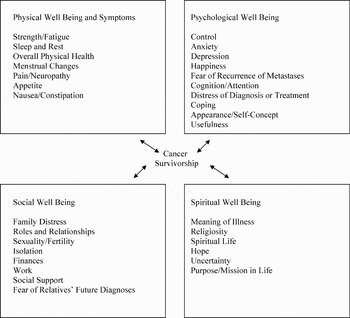
The theoretical model that guided this research was the Quality of Life Model Applied to Ovarian Cancer Survivors (Ersek et al., Reference Ersek, Ferrell, Dow and Melancon1997) (Fig. 1). This model depicts four domains of QOL: physical well-being and symptoms, and social, psychological, and spiritual well-being. Physical well-being and symptoms includes strength/fatigue, sleep and rest, overall physical health, menstrual changes, pain/neuropathy, appetite, and nausea/constipation. Social well-being includes family distress, roles and relationships, sexuality/fertility, isolation, finances, work, social support, and fear of relatives' future diagnoses. Psychological well-being includes control, anxiety, depression, happiness, fear of recurrence or metastases, cognition/attention, distress of diagnosis or treatment, coping, appearance/self-concept, and usefulness. Finally, the spiritual well-being domain includes meaning of illness, religiosity, spiritual life, hope, uncertainty, and purpose/mission in life. The present study focused on psychological and physical domains of QOL, as well as the uncertainty aspect of the spiritual QOL domain.
Quality of Life Model Applied to Ovarian Cancer Survivors.

It has long been known that being diagnosed with cancer creates anxiety, anger, sadness, and depression for patients (Weisman, Reference Weisman1976). For women with ovarian cancer, difficulties with diagnosis and aggressive, ongoing treatment may result in severe psychological distress reactions, with psychological distress worsening during disease progression over a 2 year period (Guidozzi, Reference Guidozzi1993; McCorkle et al., Reference McCorkle, Pasacreta and Tang2003; Booth et al., Reference Booth, Beaver, Kitchener, O'Neill and Farrell2005). In a study investigating the prevalence of psychological distress by cancer site, including gynecological cancers, it was found that patients receiving multi-modal therapy are at risk for psychological distress associated with related adverse reactions and complications (Zabora et al., Reference Zabora, Brintzenhofeszoc, Curbow, Hooker and Piantadosi2001). Symptom distress affects global QOL among women with both newly diagnosed and recurrent disease (Lakusta et al., Reference Lakusta, Atkinson, Robinson, Nation, Tanzer and Campo2001).
Despite their psychological distress, women who have undergone surgery for ovarian cancer do not routinely receive optimal psychological care that involves opportunities to express their concerns, obtain information, and access support (Norton et al., Reference Norton, Manne, Rubin, Carlson, Hernandez and Edelson2004; Booth et al., Reference Booth, Beaver, Kitchener, O'Neill and Farrell2005). Care of these patients in the clinical setting often focuses on management of the multitude of physical needs, including stabilization post-surgery, improvement of functioning, and preparation for additional cancer treatment. Patients' psychological needs are often considered secondarily if at all. Identification of procedures to reliably identify and intervene with highly distressed women would greatly improve quality of care (Institute of Medicine, 2001).
Although the relationship between gynecological cancers, including ovarian cancer, and QOL has received empirical attention, findings pertaining to factors associated with compromised dimensions of QOL have been inconsistent. To help clarify and build upon the existing knowledge, the present study sought to provide a full description of demographic, clinical, and other risk factors associated with QOL from a sample of post-surgical women with ovarian cancer who participated in a clinical trial testing the effects of a specialized nursing intervention that addressed psychological and physical care.
Several studies support the relationship between diminished QOL and ovarian cancer (Guidozzi, Reference Guidozzi1993; Anderson, Reference Anderson1994; Portnoy et al., Reference Portenoy, Kornblith, Wong, Vlamis, Lepore, Loseth, Hakes, Foley and Hoskins1994; Kornblith et al., Reference Kornblith, Thaler and Wong1995; Hamilton, Reference Hamilton1995; Montazeri et al., Reference Montazeri, McEwen and Gillis1996; Fish & Lewis, Reference Fish and Lewis1999; Bodurka-Bevers et al., Reference Bodurka-Bevers, Basen-Enquist and Carmack2000; Lakusta et al., Reference Lakusta, Atkinson, Robinson, Nation, Tanzer and Campo2001; Zabora et al., Reference Zabora, Brintzenhofeszoc, Curbow, Hooker and Piantadosi2001; Norton et al., Reference Norton, Manne, Rubin, Carlson, Hernandez and Edelson2004). Subgroups of women with ovarian cancer identified as being at higher risk for distress associated with the psychological dimension of QOL include those with late stage disease, younger age, recurrent disease, or who were recently diagnosed (Portnoy et al., Reference Portenoy, Kornblith, Wong, Vlamis, Lepore, Loseth, Hakes, Foley and Hoskins1994; Kornblith et al., Reference Kornblith, Thaler and Wong1995; Montazeri et al., Reference Montazeri, McEwen and Gillis1996; Norton et al., Reference Norton, Manne, Rubin, Carlson, Hernandez and Edelson2004), but results have varied. Researchers agree, however, that patients who are highly distressed could benefit from evaluation and treatment for psychological and psychiatric effects of their cancer (Roth et al., Reference Roth, Kornblith, Batel-Copel and Holland1998; Holland, Reference Holland1999). Recommendations have included routine psychological assessment and monitoring, and development of systems and mechanisms to screen, identify, and intervene with women at high risk for psychological distress in oncology settings (Kornblith et al., Reference Kornblith, Thaler and Wong1995; Zabora et al., Reference Zabora, Brintzenhofeszoc, Curbow, Hooker and Piantadosi2001; Fitch, Reference Fitch2003; McCorkle et al., Reference McCorkle, Pasacreta and Tang2003; Hegel et al., Reference Hegel, Moore, Collins, Kearing, Gillock, Riggs, Clay and Ahles2006).
The current literature underscores the need for health care professionals to attend to the psychological dimension of QOL among this population, particularly because of the tendency to focus on physical symptoms, but also because of the risk that ongoing distress, often considered to be a normal reaction to a stressful situation, may lead to a more serious psychological condition (McCorkle et al., Reference McCorkle, Pasacreta and Tang2003; Hegel et al., Reference Hegel, Moore, Collins, Kearing, Gillock, Riggs, Clay and Ahles2006). Patients, especially those with more advanced disease and experiencing the most distress, have been shown to desire information and participation in their care (Stewart et al., Reference Stewart, Wong, Cheung, Dancey, Meana, Cameron, McAndrews, Bunston, Murphy and Rosen2000), and therefore may be open to psychological interventions. Previous nurse-led interventions have been effective in reducing psychological distress (McCorkle et al., Reference McCorkle, Pasacreta and Tang2003; Booth et al., Reference Booth, Beaver, Kitchener, O'Neill and Farrell2005), but more research is needed to develop reliable screening tools, test interventions, and identify whom interventions should target.
METHODS
Description of Larger Study
This study is part of a larger randomized clinical trial that tested the effects of a specialized nursing intervention program provided by advanced practice nurses in consultation with psychiatric-consultation liaison nurses on QOL outcomes, including anxiety, depressive symptoms, uncertainty, symptom distress, and overall QOL in women with newly diagnosed or recurrent ovarian cancer. Data reported here were collected at baseline while women were hospitalized following surgery for suspected ovarian cancer. Emotional distress, number of symptoms and comorbidities, cost of care, survival, and sociodemographic characteristics were also studied. The effects of the 6-month intervention were evaluated using self-report questionnaires administered at baseline, 1, 3, and 6 months post-hospitalization. The study was approved by the Institutional Review Board at the Yale University School of Nursing. The present study reports the baseline data on anxiety, depressive symptoms, uncertainty, symptom distress, and overall quality of life.
Recruitment Procedures
Recruitment took place between December 2003 and June 2006. Efforts were made to take all consecutive patients who had surgery for suspected ovarian cancer. Potential subjects were initially identified at Gynecological Oncology rounds by a nurse recruiter. Initial contact with potential subjects was made in the hospital by the Project Director who explained the study, obtained consent, and administered baseline instruments. If the first contact could not be scheduled prior to hospital discharge, a home visit was scheduled as close to discharge as possible.
Sample Description
Post-surgical women suspected of having a primary diagnosis of ovarian cancer were recruited from a large, northeastern teaching hospital associated with a comprehensive cancer center. Inclusion criteria were: (1) suspected diagnosis of new or recurrent ovarian cancer; (2) prognosis of at least 6 months; (3) to be discharged with orders to initiate chemotherapy; (4) age of 21 years or older; and (5) living within the State of Connecticut.
A total of 281 women were identified as eligible to participate in the study. Sixty-two were lost to follow up primarily because they were not scheduled for additional cancer treatment or because they returned to their referring physician at another treatment center. Of the remaining 219 women, 149 enrolled, yielding a response rate of 68%. The main reasons for refusal to consent included unwillingness to take on one more thing (n = 18) and not interested (n = 15). Four of the enrolled subjects were excluded from analysis due to lack of complete baseline data. The final sample therefore consisted of 145 women. Although detailed statistics were not available for the 70 women who chose not to participate, our sample did not differ from the general population of women on the unit who were there for the same type of surgery as identified by diagnostic related groups (DRGs); this general population had a mean age of 59.23.
Instruments
A combination of instruments was used to measure our overall construct of QOL outcomes. Within these measures, there were several instruments that measured psychological distress. Based on previous studies of psychological distress in patients with cancer (Weisman, Reference Weisman1976; Zabora et al., Reference Zabora, Brintzenhofeszoc, Curbow, Hooker and Piantadosi2001), and the QOL model for ovarian cancer survivors (Ersek et al., Reference Ersek, Ferrell, Dow and Melancon1997), psychological and physical distress were evaluated by measuring women's anxiety, depressive symptoms, uncertainty, symptom distress, and overall mental and physical QOL. These constructs were measured using the State-Trait Anxiety Inventory (STAI) (Speilberger et al., Reference Spielberger, Gorsuch and Lushene1970), the Center for Epidemiological Studies-Depression Scale (CES-D) (Radloff, Reference Radloff1977), the ambiguity subscale of the Mishel Uncertainty in Illness Scale (MUIS) (Mishel, Reference Mishel1977), the Symptom Distress Scale (SDS) (McCorkle & Young, Reference McCorkle and Young1998), and the Short-Form Health Survey (SF-12) (Ware et al., Reference Ware, Kosinski and Keller1996).
The state anxiety subscale of the STAI is a 20-item self-report scale with a scoring range of 20–80; higher scores reflect greater anxiety, and a score of ≥48 indicates impairment. For each item, the respondent can answer from a possible range of 1 “not at all” to 4 “almost always.” Cronbach's alpha coefficient ranged from .83–.92 for state anxiety indicating good internal consistency (Speilberger et al., Reference Spielberger, Gorsuch and Lushene1970). Studies of women with ovarian cancer that used the STAI have reported mean scores ranging from 34.6–38.56 (Bodurka-Bevers et al., Reference Bodurka-Bevers, Basen-Enquist and Carmack2000; Boscalgia et al., 2005; Parker et al., Reference Parker, Kudelka, Basen-Engquist, Kavanagh, de Moor and Cohen2006), as opposed to scores reported for women in the general population (mean = 34.35) (Speilberger et al., Reference Spielberger, Gorsuch and Lushene1970).
The CES-D consists of 20 items and six major symptom areas, including depressed mood, guilt/worthlessness, helplessness/hopelessness, psychomotor retardation, loss of appetite, and sleep disturbance. Each item is rated on a scale from 0 to 3 in terms of frequency of occurrence during the past week. The total score may range from 0 to 60, with a score of 16 or more indicating impairment. Original reporting of Cronbach's alpha for the reliability of the CES-D ranged from .84 to .90 (Radloff, Reference Radloff1977). Previously reported CES-D scores of women with ovarian cancer have ranged from 15–17.4 (Fowler et al., Reference Fowler, Carpenter, Gupta, Golden-Kreutz and Anderson2004; Costanzo et al., Reference Costanzo, Lutgendorf, Sood, Anderson, Sorosky and Lubaroff2005).
The 13-item ambiguity subscale of the MUIS (Mishel, Reference Mishel1977) was used to measure the uncertainty the women perceived regarding their own symptoms, diagnosis, relationships with caregivers, and planning for the future. Scores can range from 13 to 65 with higher scores indicating more uncertainty. The scale has been found to be reliable and stable across multiple populations (Mishel, Reference Mishel1981). No previous studies were found to report on the MUIS for women with ovarian cancer.
The SDS is comprised of 13 symptoms commonly experienced by patients with cancer (e.g., pain, nausea, fatigue). Each item is rated on a scale from 1–5 where “1” indicates absence or rare occurrence of the symptom, and “5” indicates high frequency and/or severity of the symptom. Total symptom distress is obtained as the unweighted sum of the 13 items, a value ranging from 13 to 65. Both internal consistency and test-retest reliability estimates indicate the SDS is reliable (McCorkle & Benoliel, Reference McCorkle and Benoliel1983; McCorkle & Young, Reference McCorkle and Young1998). Previous studies that have used the SDS with samples including women with ovarian cancer have reported scores ranging from 27.57 to 28.08 (McCorkle et al., Reference McCorkle, Benoliel, Donaldson, Georgiadou, Moinpour and Goodell1989, Reference McCorkle, Jepson, Malone, Lusk, Braitman, Buhler-Wilkerson and Daly1994, Reference McCorkle, Strumpf, Nuamah, Adler, Cooley, Jepson, Lusk and Torosian2000).
The SF-12 (Ware et al., Reference Ware, Kosinski and Keller1996) is derived from the Medical Outcomes Short-Form 36 (SF-36), which measures overall QOL. The SF-12 consists of 12 items that represent physical and mental health aspects of QOL. A “profile” of scores for the QOL dimensions, each standardized to the range 0–100, is generated. Overall QOL is then computed as the unweighted average of the values for these standardized scores. Test-retest reliability of the physical and mental subscales have been reported as .89 and .76, respectively. No previous studies were found to report on the SF-12 for women with ovarian cancer.
Data Analysis
Statistical analyses were conducted using SAS software version 9.1 (SAS Institute, Inc., Cary, NC). The first step was to compute descriptive statistics for demographic information and survey instrument outcomes. Frequency distributions were compiled for all relevant variables. Means and standard deviations were computed for continuous variables (STAI, CES-D, MUIS, SDS, SF-12). Spearman correlations were computed to analyze the strength and direction of the relationships between demographic and clinical variables and the psychological distress measures (age, STAI, CES-D, MUIS, SDS, SF-12) for the total sample and each relevant subpopulation (intervention and control). For age-related analysis, we divided our sample into women older than or younger than 60 because the mean age of women diagnosed with ovarian cancer is close to age 60 (American Cancer Society, 2007). The Wilcoxon Sum Rank Test was conducted to determine whether or not there were significant differences between the means of our baseline measures and those from similar studies. Pearson correlations were used to identify the magnitude of the relationship among QOL measures.
RESULTS
Demographic and Clinical Characteristics of the Sample
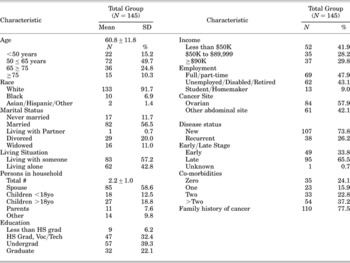
The sample is described in Table 1. The mean age of the women was 61 years with a range of 21–86 years. The majority were Caucasian (92%); 7% were Black and the remainder were Asian or of another background. Over half of the sample were married (57%), 20% were divorced, 11% were widowed, and 13% were never married and/or lived with parents. About 57% lived with someone, most often a spouse and older children (>18 years), and 43% lived alone. Most of the sample (61%) had a college or graduate education. Forty-eight percent were employed, 43% were not working, disabled, or retired, and 9% were homemakers. Forty-two percent had an income of less than $50,000 per year, 28% between $50,000 and $89,999, and 30% above $90,000.
Sample demographic and clinical characteristics

We attempted to recruit all women scheduled for gynecological surgery to rule out ovarian cancer. The final sample included 84 women with primary ovarian cancer (58%), and 61 women with other cancers (42%), including uterine and other cancers metastasized to the ovaries and abdomen. Subjects included women who were newly diagnosed (74%) or recurrent (26%) at the time of enrollment. Thirty-four percent were diagnosed with early stage cancer (Stage I or II) and 65% with late stage cancer (Stage III or IV) according to the staging system of the International Federation of Gynecology and Obstetrics. The stage was unknown for one patient. Thirty-seven percent of subjects reported two or more co-morbidities, and 78% reported a family history of cancer.
Description of Psychological Distress Instruments
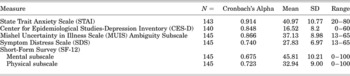
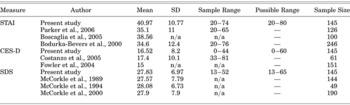
Descriptive data for the QOL measures appear in Table 2. Women who were diagnosed with primary ovarian cancer did not perform differently than the women diagnosed with other gynecological metastatic cancers on any of the QOL measures (data not presented). The mean score on the STAI was 40.97 (SD = 10.77), which was significantly higher than in previous samples of women with epithelial ovarian cancer for which complete data were available (Bodurka-Bevers et al., Reference Bodurka-Bevers, Basen-Enquist and Carmack2000; Parker et al., Reference Parker, Kudelka, Basen-Engquist, Kavanagh, de Moor and Cohen2006). The mean score on the CES-D was 16.52 (SD = 8.2), which was consistent with previously reported means for similar populations (Fowler et al., Reference Fowler, Carpenter, Gupta, Golden-Kreutz and Anderson2004; Costanzo et al., Reference Costanzo, Lutgendorf, Sood, Anderson, Sorosky and Lubaroff2005), and which exceeds the cut-off point indicating the need for additional evaluation of depressive symptoms. The mean score on the ambiguity subscale of the MUIS was 37.13 (SD = 8.98). The mean score on the SDS was 27.83 (SD = 6.97), which is consistent with or higher than previous samples. The mean score on the SF-12 was 24.26 (SD = 6.5), with respective means of 8.16 (SD = 2.44) and 14.37 (SD = 3.44) for the physical and mental dimensions. Table 3 compares the mean scores of our sample on the measures for which mean scores were reported in other studies. The Wilcoxon procedure demonstrated significant differences between means.
Descriptive data for QOL measures

Results on QOL measures and comparison to the literature

Of the 37 women who scored above the cut-off point on the STAI, 86% (n = 32) also scored above the cut-off point on the CES-D. Four women did not exceed the cut-off point and one woman did not have a CES-D score for comparison. Pearson correlations confirmed that the STAI and CES-D were highly correlated at the .0001 level. Women with higher scores on the SDS also showed elevated (i.e., worse) scores on the STAI, CES-D, MUIS, and lower (i.e., worse) mental and physical subscales of the SF-12. Table 4 presents baseline correlations of the QOL outcomes.
Baseline correlations of QOL outcomes

p < .0001 NS = not significant
Demographic and Clinical Factors Related to QOL
Of all the demographic and clinical characteristics, younger age, greater education, early stage disease, and newly diagnosed were highly correlated with various QOL measures. Further analysis showed that those women with more education had higher (i.e., worse) scores on the STAI (X2(1) = 7.3552; p = .01), the CES-D (X2(1) = 4.0703; p = .04), and the SDS (X2(1) = 8.6446; p = .003). There was also a significant correlation of these measures with age; younger women (≤60) tended to have worse scores on the STAI and CES-D (r s = −0.2192; p = .008; r s = −.2327; p = .005, respectively). Women with late stage disease tended to have lower (i.e., better) scores on the CES-D than women with early stage disease (X2(1) = 4.0664; p = .04). Finally, women who were newly diagnosed had higher (i.e., worse) scores on the mental subscale of the SF-12 (X2(1) = 5.3966; p = .02).
DISCUSSION
This investigation evaluated psychological distress and examined demographic, clinical, and other risk factors among a sample of women with ovarian cancer. We found that the women with confirmed diagnoses of primary ovarian cancer did not score significantly different than the women diagnosed with other gynecological cancers metastasized to the ovaries on any of the QOL measures. This finding may be explained by the fact that all of the women were recruited prior to knowing their confirmed diagnoses and therefore shared the same existential plight and potential for distress.
Our sample of women scored consistent with or higher than previously reported scores on the STAI, CES-D and SDS, underscoring those women who have undergone surgery for ovarian cancer are a highly distressed group. We also found that different subgroups of women, i.e., those who were younger, more educated, and were newly diagnosed were at risk on different dimensions of QOL. Further, we found that women who had greater symptom distress also had more anxiety, depressive symptoms, uncertainty, and lower mental and physical QOL.
Findings pertaining to demographic risk factors may be explained in that it is possible that younger women were more distressed because they have more to contend with (e.g., children, jobs) in terms of incorporating their disease and treatment into their lives. More educated women may be better able to access and comprehend information about ovarian cancer, and may therefore have more distress about the implications of their disease, treatment, and prognosis. Newly diagnosed women had lower mental health; these scores may be explained in that a new diagnosis of cancer is overwhelming and frightening.
Our results should be interpreted with a few limitations in mind. Our sample was somewhat homogeneous in that they were predominantly well-educated, of high socioeconomic status, living in one state, and treated at the same medical center, so generalizability is limited. Although some racial differences were found, there were very few minorities included in the sample because ovarian cancer is not common among black women, Asian women, or women in other minority groups (Barnholtz-Sloan et al., Reference Barnholtz-Sloan, Tainsky, Abrams, Severson, Qureshi, Jacques, Levin and Schwartz2002). Additionally, the majority of our sample had late stage disease, was newly diagnosed, and was enrolled post-operatively and while still hospitalized, which may have caused them to report greater distress. Finally, the generalizability of our results to women with primary ovarian cancer is limited because our sample included women with cancers metastatic to the ovaries and abdomen; however, all underwent similar surgeries and chemotherapy treatment regimens, making the course of physical and mental care parallel.
Women who have undergone surgery for ovarian cancer have such a multitude of physical needs that their psychological needs may be neglected. Once ovarian cancer is suspected, surgery is scheduled urgently, leaving women wondering how their seemingly innocuous symptoms turned out to be cancer. Post-surgery, distress is heightened as they begin the long recovery from abdominal surgery and await the results of their pathology reports and the treatment regimen they can expect for the coming months. This is an extremely vulnerable time because women must attempt to cope with the disruption to their and their families' lives, the loss of reproductive function which can affect their sense of self-worth and feminine identity, as well as with the effects of premature menopause which can lead to sexual dysfunction, physical discomfort, and the onset of mood symptoms (McCorkle et al., Reference McCorkle, Pasacreta and Tang2003). Additionally, women may also have an understanding and be fearful of other disease and treatment related factors, such the shortened prognosis associated with ovarian cancer, the high probability of recurrence, the hereditary component of the disease which forces consideration of genetic testing for their daughters, and the adverse effects associated with chemotherapy, including pain, fatigue, nausea, vomiting, insomnia, and impaired role performance. All of these factors contribute to the potential for lower QOL.
Particularly in the inpatient setting, clinicians' priorities are to address physical aspects of the disease, i.e., stabilization of the disease and symptoms. This focus may persist in the outpatient setting even when the patient is stabilized and visits involve administration of chemotherapy treatment and symptom management. We found that greater symptom distress was correlated with greater psychological distress. Attention to symptom distress warrants high priority; however, symptom distress and psychological distress may have a reciprocal relationship, indicating the importance of attending to both symptom and psychological distress.
Attending to psychological sequelae of ovarian surgery is complicated. Women may or may not reveal the presence or extent of psychological distress to their clinicians due to fear of stigmatization or diversion from physical aspects of care, and even if aware of their patients' distress, clinicians may not feel qualified or that they have the time to handle patients' psychological needs (American Psychological Oncology Society, 2000). This situation underscores the need for these women to be evaluated for distress and referred for services. The current system is inadequate in doing so and the importance of screening cannot be underestimated.
Our results indicate that women with ovarian cancer are at risk for prolonged problems given their prognosis. Clinicians should recognize early on that women who have undergone surgery for ovarian cancer are a highly distressed group for whom psychological interventions need to be initiated at the outset of the clinical relationship. Early screening has also been advocated in order to provide a baseline for comparison as patients' progress along the care continuum (Hegel et al., Reference Hegel, Moore, Collins, Kearing, Gillock, Riggs, Clay and Ahles2006). Interventions should include routine screening for distress as well as referral to appropriate psychological, social, and pastoral services. Such interventions are critical for this population because of the high likelihood that they will get treatment following first-line therapy and will need to consider alternatives for supportive care. Due to limited resources to address psychological distress among this population, these women should be treated in health care settings with high volumes of patients with ovarian cancer in order to facilitate navigation of the system and where communication specialists are available (Institute of Medicine and Commission on Life Sciences, 1999). Health care professionals who do not work in such settings and/or who may not have access to such resources should consider referring patients to outside resources; however, many health care settings are adequately staffed to assist patients. It then seems that effective management of psychological distress is more a matter of awareness and referral practices than availability of appropriate resources. Routine screening for distress and referral to appropriate psychological and social services may facilitate quality cancer care.
ACKNOWLEDGEMENTS
This study was funded by the National Institutes of Health, National Institute for Nursing Research, 1R01NR07778, R. McCorkle, PI.