Introduction
The graveyards of the late Bronze Age (second millennium BC) in northern Pakistan and the upper Indus Valley are known as the Cemetery H culture after discoveries at Harappa. Alongside undisturbed primary interments, they reveal what appears to have been a growing tendency towards the re-use of graves, and the exhumation, manipulation, disarticulation and spatial arrangement of selected body parts (Stacul Reference Stacul1975). The emergence of such funerary polymorphism (sensu Boulestin & Duday Reference Boulestin and Duday2006) hints at new, complicated sets of symbolic actions, possibly mirroring important changes in identities and social functions within the living communities. All of this matches chronologically with major, although still poorly understood, ethno-genetic scenarios and large-scale linguistic diffusion processes both on the Iranian Plateau and in the northern part of the Indo-Pakistani sub-continent—the presumed diffusion from a Central Asian homeland of the first nomadic Indo-European-speaking communities.
Secondary or delayed burial practices resulting in collective graves have been explained in different ways by various authors since the late nineteenth century. Some consider them a consequence of the time needed to collect the wealth required for prestigious funerals (Miles Reference Miles1965; Schroeder Reference Schroeder2001). Alternatively, in Swat, they have been ascribed to “the semi-nomadic life style of transhumant people who used to carry the bodies of their dead back to their country of origin” (Castaldi Reference Castaldi1968: 592). Stacul (Reference Stacul1975) explained the practice on ethnic-religious grounds as the diffusion of funerary traditions from Central Asia and later from the Iranian Plateau. The interpretation by Kuz'mina (Reference Kuz'mina2007: 309) of double burials as an “Indo-Aryan antecedent” of the sati custom of Hindu aristocratic tradition—the ritual suicide of the widow after her husband's death—has no supporting evidence, as it is not backed by the required microstratigraphic records, nor by osteological studies.
Collective graves have, in other contexts, been deemed to be family or clan graves, re-opened for successive burials. In the absence of genetic and/or microstratigraphic evidence, this is a reasonable but not assured inference, although it can sometimes be indirectly reiterated by radiocarbon dates that support generational time intervals in collective burials (as seen in Lull et al. Reference Lull, Micó, Rihuete-Herrada and Risch2013). Instances of stone cist graves being re-used almost 2000 years later (Laneman Reference Laneman2012), however, defy similar explanations. The need to incorporate “the properties of a certain dead and mythicized person in contexts of actions related to the living” (Bettencourt Reference Bettencourt, Bettencourt, Sanchez, Alves and Valcarce2010: 37; see also Barrett Reference Barrett, Barrett and Kinnes1988: 31–32), as well as considerations of memory and ‘social time’ (Mizoguchi Reference Mizoguchi1993), may also be involved. For post-processual archaeologists, funerals and the handling of human remains “alter traditional ideologies, transform existing imbalances of power, or change the identities of the living and the dead” (Schroeder Reference Schroeder2001: 79; see also Chapman Reference Chapman2003: 308–309). Archaeologists following body theory (the human body as a social construct) have focused on the power of human bones, in their materiality, to symbolise the self and social identities over extended periods (Schroeder Reference Schroeder2001: 90; Chénier Reference Chénier2009). Commingled bones may in fact support egalitarian principles, communal ideologies and group identities (Chesson Reference Chesson1999), thus helping to construct imaginary group ancestries; others have remarked, however, that “corpses in ‘collective’ contexts are not necessarily a sign of communalism and a lack of individualism or vice versa” because the dead are always treated individually (Weiss-Krejci Reference Weiss-Krejci and Lillios2011: 164). Nilsson Stutz (Reference Nilsson Stutz, Fahlander and Oestigaard2008) emphasised the physicality of the entire human cadaver, its ‘corporeality’—biological and chemical changes after death—as a shared human experience requiring socially structured disposal.
While a full review is outside the scope of this article, different perspectives and viewpoints on the collective performance of death might have an important impact on our understanding of ancient funerary practices of the still mysterious societies of ancient Swat. Less clear, however, is how similar processes, to a large extent based upon ethnoarchaeological observation or just hypothesised in the frame of the systemic context so far, may be actually recognised in the materiality of the archaeological record. The point is that in order to understand the codes, and possibly the symbolic implications of a behaviour that is endemically complex, graves need to be excavated in micro-stratigraphic detail, but within a holistic perspective, linking the surface record of the ancient funerary lots (including traces of funerary architecture or markers, which are the true link between the living and the dead) to the graves’ sub-surface stratigraphy. Greater attention should therefore be paid to the later negative interfaces or trenches and subsequent fillings above the first burial: the material evidence of the re-opening of the graves. Moreover, our experience shows that repeated burials and re-excavation of the same pits result in sequences of different, well-recognisable inner filling layers. Finally, realistic reconstructions of subsequent burials in the same graves need to be radiocarbon dated and arranged in a consistent series (Lull et al. Reference Lull, Micó, Rihuete-Herrada and Risch2013).
Previous research
We applied these principles to the protohistoric graveyards of the second and first millennia BC in north-western Pakistan. These sites have been identified as an important source of archaeological evidence since the early 1960s, when numerous burials were excavated in the Swat Valley and in the neighbouring regions of the Khyber Pakhtunkhwa Province, formerly North West Frontier Province. Indeed, these cemeteries were the subject of extensive excavations and gave rise to considerable scholarly debate, but many issues still remain unresolved (Dani Reference Dani1967, Reference Dani, Dani and Masson1992; Silvi Antonini & Stacul Reference Silvi Antonini and Stacul1972; Stacul Reference Stacul1975, Reference Stacul, Allchin and Allchin1997; Müller-Karpe Reference Müller-Karpe1983; Vinogradova Reference Vinogradova2001; Coningham et al. Reference Coningham, Young, Ali, Coningham and Ali2007: 261–63; Ali et al. Reference Ali, Hamilton, Newson, Qasim, Young and Zahir2008).
On the basis of typological and stratigraphical evidence, and through comparisons with other protohistoric burial complexes in Central Asia and Iran, the graves were dated to the period between the late Bronze Age and the end of the Iron Age (Stacul Reference Stacul1966, Reference Stacul1969; Müller-Karpe Reference Müller-Karpe1983; Vinogradova Reference Vinogradova2001; Zahir Reference Zahir2012). Yet the proposed periodisation and absolute chronology remained controversial, mainly because the radiocarbon dates available from graves excavated in the 1960s, which were limited in number and biased by sampling problems, did not support a coherent chronological framework. The Swat Valley and neighbouring areas are, however, crucial for the social changes that occurred in protohistoric southern Central Asia and in the Indo-Pakistani sub-continent from the late Bronze Age to the Iron Age. Furthermore, they are located along one of the main routes probably followed by people, goods and ideas that moved from Central Asia to South Asia and vice versa. Additionally, protohistoric burial practices in these regions were highly diversified, particularly in terms of the treatment of human remains.
Previous field reports indicate that tombs of this period in Swat and the nearby valleys usually comprised two superimposed spaces, the upper being a cavity filled with earth, the lower a cist or burial chamber covered by large stone slabs and containing the remains of the dead with grave goods. Tombs were used for one, two and occasionally three or more individuals, generally deemed as non-contemporaneous. On record are single, double and collective graves, primary and secondary interments, and the co-occurrence of cremation (absent in the newly excavated sites) and inhumation rituals. Bodies were placed flexed on one side and were often accompanied by disarticulated skeletal remains grouped in one or more clusters of bones. Nevertheless, specific body treatments were not entirely restricted to particular phases, but varied in occurrence over time, giving a multifaceted picture of funerary practices. Grave goods included pottery, bone and ivory objects, and metal items (copper and iron), but few ornaments and only rarely weapons. Individuals of both sexes and all ages are represented in the graves so far excavated. Unfortunately, no correlation had hitherto been attempted between the variations in tomb structure, their spatial distribution, the grave goods, the re-opening and manipulation of the bones, and the age, gender and social identity of the deceased.
New funerary evidence from the field
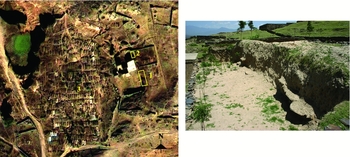
Between 2011 and 2012, in the framework of an innovative programme of community archaeology directed by Luca M. Olivieri (ACT-Field School Project; see Olivieri Reference Olivieri, Marati and Vassallo2013), the authors excavated part of two protohistoric cemeteries at Gogdara IV and Udegram in the middle Swat Valley. Three graves were excavated at Gogdara IV, while 26 tombs were fully excavated at Udegram, although 31 tombs in total were identified there. In this article, we present the main results of our research at Udegram (Figure 1).
Left) location of the excavated areas: 1) main trench; 2) north trench; 3) modern Muslim graveyard (source: Google Earth. Image date: 1 December 2009; date accessed: 10 January 2017); right) general view of the site before excavation (photograph by M. Vidale).

Wooden architecture at Udegram
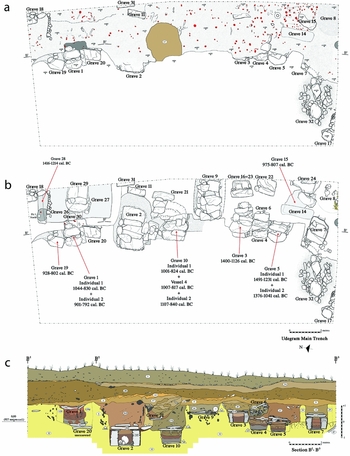
The graves were sealed by massive colluvial layers dating to the Early Historic period. These sediments had preserved the original ground surface and the traces of activity associated with the cemeteries. The buried surface retained not only the remains of small mounds piled above the tombs, but also postholes of wooden posts, some belonging to rectangular and round fences delimiting the perimeters of graves (Figure 2a), while other postholes form circles or clusters of 1–1.5m in diameter. Excavation also revealed traces of planks set vertically in the ground, hinting at rectangular wooden constructions. Among Kafir and Kalash societies of the Pakistani Kohistan, corpses were traditionally left above ground to decompose in wooden boxes, with old reports mentioning the smell of decaying bodies that pervaded the air at those sites (Robertson Reference Robertson1896: 642).
Udegram graveyard: a) the trampled surface with post-holes; b) the excavated graves; c) the north–south section of the main trench (drawings by R. Micheli).

Substantial and very visible wooden erections thus stood on the ground surface. Such wooden platforms or clusters of poles may have been used to suspend corpses, as isolated mandibles and scattered human teeth were found on the trampled ground surface of the cemetery. Alternatively, and more probably, these wooden platforms held suspended bags or baskets containing partial skeletal remains awaiting secondary interment (Vidale et al. in press). Other wooden features may have marked the position of underground chambers, which were re-opened in subsequent rituals. All of this interpretation also explains a famous passage by Quintus Curtius (History of Alexander 10.8–10; Rolfe Reference Rolfe1946), wherein Alexander the Great's soldiers, crossing the north-western Swat Valley at night, “cut down trees and raised a flame, which, fed by logs, caught the sepulchres of the inhabitants. These had been built of old cedar, and widely spread the fire which had been started, until all were levelled with the ground”.
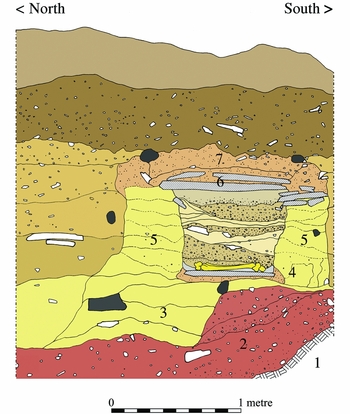
In previous reports (Silvi Antonini & Stacul Reference Silvi Antonini and Stacul1972), graves were represented as irregular rows of rectangular pits of variable depth. We found that the construction of the graves was, in fact, more elaborate (Figure 3). Our excavations revealed three main types of funerary architecture: 1) simple pits dug in the soil; 2) chambers with rammed clay walls; and 3) structures with dry stone walls made of flat schist slabs (14 courses in height as a rule). The graves were covered by three or more large rectangular schist slabs, the joints sealed by smaller stones. Chamber floors were paved with a single large slab or smaller pieces. Most of the larger graves, however, were built as massive chambers of rammed earth, gradually piled and beaten within frames made of vertical planks that were later removed. This technique was identified and confirmed through cross-sections (Figure 3). As far as the authors know, it has never been previously reported in Pakistan. It closely resembles the hāngtǔ technique for building rammed-earth walls and platforms in China from the Late Neolithic and Bronze Age onwards (Chang Reference Chang1968). Once the grave had been closed, low mounds of earth were piled on top, and here people deposited small portable terracotta lamps.
Grave 24 at Udegram, showing details of the construction: 1) the schist bedrock; 2) thick layers of gravel and schist flakes; 3) layers of clean silty clay supporting and surrounding the grave; 4) basal schist slabs set flat in a shallow depression and fixed with a mud-like mortar; 5) perimeter walls made by pressing superimposed slabs of clay into a template of wooden planks, which was later removed. In other graves, walls were then internally lined with stone slabs; 6) large capstones sealed by mud mortar; 7) an eroded low mound of clay. The succession of silty clay lenses and coarser gravel layers that seeped into the chamber provide evidence for multiple re-openings of the grave (drawing by R. Micheli & M. Vidale).

The construction, re-opening and maintenance of the graves were collective efforts: during excavation, we found that seven to eight men were needed to move and set aside a single slab. Furthermore, artificial terraces and rammed-earth enclosures were strongly affected by erosion that exposed the capstones, and thus required continuous maintenance.
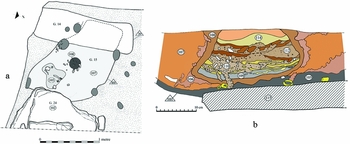
Not all of the tombs were made in such a substantial form. Grave 15 was built as a cist with wooden walls supported externally by vertical logs (Figure 4a). Most of the skeletal elements had been removed, while a broken femur showed the impact of a heavy chopping blade. The furnishings included a decayed wooden vessel set on the stone floor after part of the skeletal remains had been manipulated and re-exhumed. Its section (Figure 4b) emphasises the clayish traces of sediments that gradually substituted the vessel's wooden walls during natural decay. The decayed container might be the protohistoric equivalent of the wooden pots with food or other substances that Kafirs placed in wooden coffins for the benefit of the dead (Robertson Reference Robertson1896: 641). The cist also contained a basket or bag made of woven fibres: similar features in this and other graves appear as patches of lighter and finer clay that had slowly filtered through the fibres in the filling process. Similar graves, ephemeral and comparatively poorly furnished, would have gone unrecognised without an accurate and slow excavation method.
Grave 15 at Udegram: a) evidence of wooden features, including a wooden vessel (SU 108) and probable wickerwork containers decayed in situ. Skeletal remains were manipulated and to a large extent removed after deposition; b) micro-stratigraphic section of the wooden container (SU 108) found at the centre of the tomb (drawings by R. Micheli).

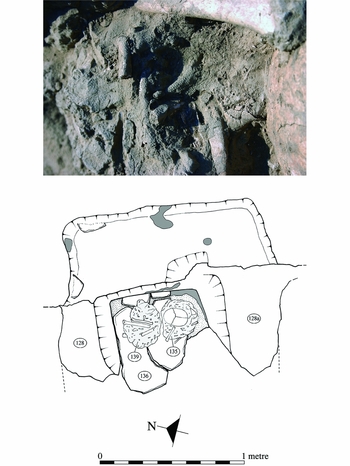
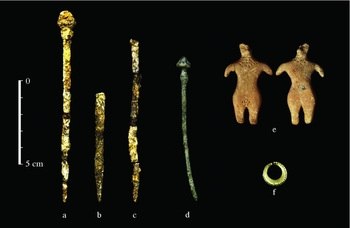
Cloth, in contrast, was probably a valuable material deposited in burials of a higher rank. A primary burial of a child (grave 30) had traces of a red cloth, while a secondary burial of another child (grave 1, individual 1) was wrapped in cloth. Its fabric left a neat imprint in the fine clay that had slowly filled the grave's cavity by seeping from the surrounding clay walls (Figure 5). The same grave also contained a miniature terracotta female figurine and a crescent-shaped gold earring with chased dots (Figure 6e–f). Perishable funerary architecture and furnishings may therefore have signalled hierarchies of status in the ancient Swat communities.
A detail of the cloth imprint (top) found on the exterior of the bundle containing the bones of individual 1 (SU135) in grave 1 (bottom) (photograph by M. Vidale; drawing by R. Micheli).

a–c) Grave 19, fragmentary iron pins; d) grave 6, copper/bronze pin; e) grave 1, miniature terracotta female figurine; and f) gold earring (photographs by M.A. Khan).

Re-opened graves and secondary burials
Stratigraphic excavation of the burial chambers made it possible to recognise the sedimentary evidence of phases of closure and re-opening, during which pots and other items were abandoned at different levels in the fill. Phases of closure were marked by micro-laminated lenses of pure silty clay that slowly seeped into the empty, closed chamber from the corners and along the walls; a re-opening of the grave is revealed by the sudden influx of coarser sediments and schist gravel, small sherds and chips of human bone falling from the topsoil.
Almost all of the graves had been re-opened shortly after burial, as demonstrated by the permanence of some of the weakest skeletal joints in burials that had been re-opened to place pots on the hands and knees of the deceased, as in grave 3; or to remove and displace, to various degrees, the bones (graves 2, 7 & 15). It is now clear that many ceramic assemblages, previously mapped as synchronous deposits, are not necessarily such and probably do not simply reflect the original grave goods, but represent a palimpsest of offerings and removals as parts of longer funerary cycles, often including exhumation.
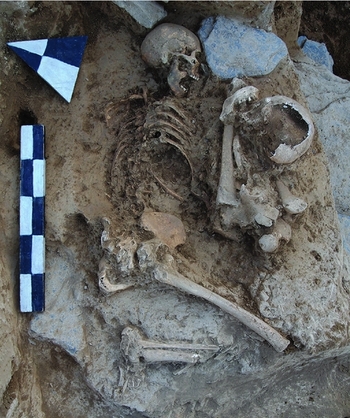
The high frequency of double and multiple burials, fractional and often secondary, has been acknowledged since the earliest excavation reports (Silvi Antonini & Stacul Reference Silvi Antonini and Stacul1972: 11–12). Secondary fractional burials were generally interpreted as those of the earlier occupant, moved aside to make space for the new corpse. Double burials at Udegram are in fact the norm, not anomalies. Out of 26 graves excavated at Udegram, only 5 held primary undisturbed burials; even these cases may represent the early steps of a funerary cycle that did not progress further. On microstratigraphic grounds we ascertained that the prevailing funerary custom (n = 10 graves) was a double interment in which a primary undisturbed occupant was generally followed by a secondary interment (Figure 7). This reverted, in the majority of cases, the order previously assumed, in that what was considered the secondary burial was actually the primary. Secondary burials contained the remains of another individual, placed, as a rule, in front of the face of the first. Secondary interments were wrapped in cloth bundles or kept in baskets, and displayed a recurring arrangement: the cranium always placed on top of the long bones, packed and aligned, with smaller bones (mandible, phalanges and vertebrae) collected in a basal layer, seemingly having slipped down. This funerary pattern was also common in the cemeteries of Katelai I, Loebanr I and Butkara II. Thanks to the anthropological analysis by Maria Letizia Pulcini, we know that at Udegram, in the majority of cases, the primary burial was a mature adult female, resting directly on the floor of the grave, followed by a secondary burial of a male, of the same age or slightly younger, but not young enough to be considered her son. In some cases, the coxal and long bones of the secondary burial had indisputable cut marks from defleshing, left by metal blades that included cleavers.
Grave 6 at Udegram (photograph by R. Micheli).

All of this suggests a female-centred pattern: women were buried in megalithic graves, thereby alluding to their leading role in the household, while the remains of a male relative(?) played an important but secondary role as an ‘accessory’, joining the female occupant after a divergent and more transformative funerary process that may have involved exposure, defleshing and sometimes bone-chopping. Interestingly, even the graves most evidently re-opened and manipulated were re-filled and sealed again by heavy capstones. On the top of these graves we regularly found a pair of large ceramic containers, unbroken or almost complete—a large jar with a neck, and a globular vessel with four horizontal lugs. These vessels, rare in the other cemeteries so far excavated, were probably used in the exhumation ceremonies. Later they were dumped, mouth downwards, and left undisturbed and partially visible on the low mounds that covered the graves.
Absolute chronology
The protohistoric cemeteries have previously been assigned to a three-phase sequence: Period V, c. 1500/1400–1100 BC; Period VI, c. 1100–700 BC; Period VII, c. 700–400 BC (Stacul Reference Stacul1966; Dani Reference Dani1967: 48, Reference Dani, Dani and Masson1992; Müller-Karpe Reference Müller-Karpe1983; Possehl & Gullapalli Reference Possehl, Gullapalli and Pigott1999; Vinogradova Reference Vinogradova2001). During this time span there was a general shift in funerary practices, accompanied by changes in grave goods, while continuity is confirmed by the uninterrupted use of the same graveyards. Nevertheless, the chronology of these phases was based on only 13 samples from graves at Katelai I, Loebanr I, Butkara II and Timargahra, collected in the 1960s; in other words, from 10 out of some 700 graves excavated in the last 50 years. This is too few to support the proposed sequence, the duration of the three phases and changes in burial traditions. In addition, some radiocarbon dates reveal discrepancies between the absolute chronology and the cultural ascription of the grave goods to the hypothesised phases.
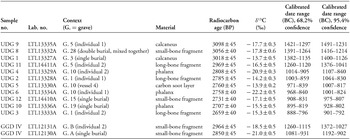
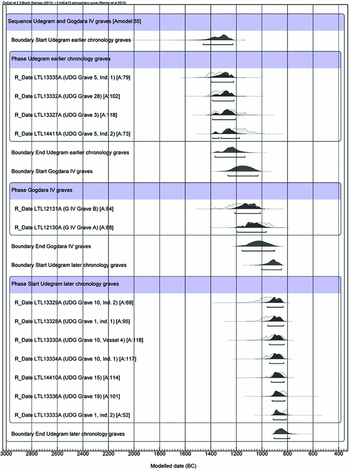
A new series of AMS radiocarbon dates (Table 1) were obtained from samples collected from two graves at Gogdara IV (Vidale et al. in press) and seven graves at Udegram (Figure 8). At the latter site, two cultural horizons were defined on the basis of the accompanying ceramics. A modelled, calibrated distribution taking into account both the Gogdara IV and Udegram radiocarbon dates is shown arranged in sequence in Figure 8.
List of radiocarbon and calibrated dates of Udegram and Gogdara IV graves. AMS dates by Centro di Datazione e Diagnostica (CEDAD) of Lecce University (Italy). Calibration: OxCal version 4.2.3 (Bronk Ramsey 2009); IntCal13 atmospheric curve (Reimer et al. 2013).

Modelled calibration distribution at the 95.4% confidence level of radiocarbon dates from the Gogdara IV and Udegram graves. Calibration was performed using OxCal v4.2.3 (Bronk Ramsey Reference Bronk Ramsey2009) and the IntCal13 atmospheric curve (Reimer et al. Reference Reimer, Bard, Bayliss, Beck, Blackwell, Ramsey, Buck, Cheng, Edwards, Friedrich, Grootes, Guilderson, Haflidason, Hajdas, Hatté, Heaton, Hoffmann, Hogg, Hughen, Kaiser, Kromer, Manning, Niu, Reimer, Richards, Scott, Southon, Staff, Turney and van der Plicht2013).

The model is organised into three phases based on the possible calendar age at the 95% confidence level. The earlier dates for Udegram range from 1460–1133 cal BC, while the later dates range from 1002–783 cal BC. The former comprises graves 3, 5 and 28, while the latter includes graves 1, 10, 15 and 19. The Gogdara IV dates, ranging from 1266–901 cal BC, fall between the two Udegram series. The latter graveyard was, therefore, used (perhaps with a gap) from c. 1500/1400 to around 800 cal BC or a little later.
In Stacul's view, the end of the Iron Age in the Swat Valley fell in the fourth century BC (Stacul Reference Stacul, Taddei and Callieri1990: 609), on the evidence of ceramic comparisons with Charsadda (Wheeler Reference Wheeler1962) and Hasanlu III A in western Iran (Stacul Reference Stacul1969: 85). And yet such a chronological boundary does not fit well with the new radiocarbon dates from Udegram, where Iron Age burials came to an end in the eighth century BC.
In Chitral, funerary practices of protohistoric tradition seem to have continued until AD 800–1000 (Ali et al. Reference Ali, Batt, Coningham and Young2002, Reference Ali, Hamilton, Newson, Qasim, Young and Zahir2008). One might presume that in Swat too, similar Iron Age customs persisted after 800 BC until c. 500–400 BC or later, as proposed by Stacul (1990, 1997). At present, however, there is no evidence to substantiate such a view. In contrast, at Saidu Sharif, an Early Historic graveyard dating to the fifth century BC was discovered below an important Buddhist sacred complex. Three radiocarbon dates on human bone demonstrate that by that time in the middle Swat Valley, completely different funerary practices had appeared that had nothing in common with the protohistoric traditions observed at Udegram and in other sites of the Swat Valley (Olivieri Reference Olivieri2016).
Early evidence of iron artefacts at Udegram
In grave 19 at Udegram three iron pins were found, one of them still attached to the skull as a hair ornament. The radiocarbon date from this grave gives a range of 928–802 cal BC (Table 1), and is therefore relevant to the question of Iron Age origins in northern Pakistan. The earliest well-dated iron artefacts and slag were discovered at Bala Hisar, Charsadda, and are dated to 1200–900 cal BC (McDonnell & Coningham Reference McDonnell, Coningham, Coningham and Ali2007: 155). In Swat, this important technological change is commonly assigned to Period VII of the protohistoric cemeteries (Stacul Reference Stacul, Agrawal and Chakrabarti1979, Reference Stacul, Allchin and Allchin1997). Iron is not, however, frequently found in graves in Swat and Dir, with only 7 per cent containing iron objects (Stacul Reference Stacul1966: 60). Further, none of the small number of graves previously dated by 14C had iron artefacts. The best-dated iron comes from a burial in Chitral dated to 255–180 cal BC (Ali et al. Reference Ali, Hamilton, Newson, Qasim, Young and Zahir2008); locally, iron artefacts continued to be deposited in tombs until the tenth century AD. Reliable evidence for a widespread iron technology in the Swat Valley comes from the Early Historic site of Barikot/Bir-kot-ghwandai (Callieri et al. Reference Callieri, Brocato, Filigenzi, Olivieri and Nascari1992; Olivieri Reference Olivieri2014).
In this light, the radiocarbon date from grave 19 establishes firm chronometric evidence for the early development of the Iron Age in the Swat Valley, although there is a strong possibility that the use of iron had begun earlier. The iron pin worn by the deceased in grave 19 (Figure 6a) faithfully replicates a common copper or bronze pin type also present in grave 6 (Figure 6d). The introduction of iron, first as an ornamental material competing with copper, and only later used for tools and weapons, is consistent with a historical pattern well attested in the wider Eurasian continent at the end of the second millennium BC.
Conclusion
New evidence provides an image of the Swat graveyards (and the local funerary practices) that is very different to that offered by previous research. Substantial traces of above-ground wooden architecture suggest that the graves were well marked and fenced, and were thus easy to maintain and re-open. The inclusion in the grave goods of perishable items of wood, wickerwork and cloth alters our perception of the relative richness of the individual graves. Micro-stratigraphy reveals that graves were often re-opened, with multiple episodes of deposition and the removal and/or addition of body parts and pottery vessels as stages in a longer funerary cycle. Secondary, sometimes defleshed, burials of males often followed the primary interment of an adult female, and grave goods accompanied both deposits, while at the same time, bones and objects could also be removed. These conclusions cast some doubt on the usefulness of the ceramic assemblages found in the cists for typo-chronological assignment of the graves themselves. Finally, the new radiocarbon dates from Gogdara IV and Udegram indicate the need to revise the chronology and phasing so far proposed.
On the whole, it is clear that previous archaeological and historical frameworks, depending upon partial and biased archaeological data, have limited value. This study is a new attempt at unveiling the complexity of funerary practices and the prolonged interaction between the living and the dead in protohistoric Swat, but further excavations and new absolute dates are needed to validate the interpretations presented here, in order to discuss the new evidence in terms of rituals and social implications. In short, we need an archaeology based upon sound middle-range theory inferences before addressing wider questions on the ethnic and/or linguistic background of protohistoric Swat.