INTRODUCTION
The cookiecutter shark, Isistius brasiliensis (Quoy & Gaimard, Reference Quoy, Gaimard and de Freycinet1824), was first described as Scymnus brasiliensis based on a 140 mm total length (TL) female specimen from off Brazil. The species was later designated as the type species for the newly erected genus Isistius Gill, Reference Gill1865. Isistius brasiliensis is one of only two species in the genus. The other species Isistius plutodus Garrick & Springer, Reference Garrick and Springer1964, is known from only about ten specimens, but has not been reported from the eastern Pacific (Ebert et al., Reference Ebert, Fowler and Compagno2013). A third species, Isistius labialis Meng et al., Reference Meng, Zhu and Li1985, was recently determined to be a junior synonym of Isistius brasiliensis (White & Last, Reference White and Last2013).
Isistius brasiliensis is an oceanic shark species with a widespread, but scattered, distribution throughout the Atlantic, Indian and Pacific oceans. This shark is typically found off continental and insular slopes, from deep to midwater, between 85 and 3500 m, where it is believed to migrate from deeper water towards the surface at night (Ebert, Reference Ebert2013). In the eastern Pacific, it is known from the south-eastern and eastern Central Pacific from northern Chile to Guadalupe Island, but has not been confirmed as occurring off the eastern North Pacific.
Isistius brasiliensis has been suspected of occurring from off the California coast based on circumstantial evidence; primarily crater wounds observed on northern elephant seals, Mirounga angustirostris (LeBoeuf et al., Reference Le Boeuf, McCosker and Hewitt1987; Ebert, Reference Ebert2003; J. Harris, Alaska Fisheries Science Centre, personal communication) (Figure 1). However, no actual specimens of Isistius brasiliensis have ever been caught or observed in Californian waters. The closest confirmed record of this species is from off Guadalupe Island, Baja California, Mexico, located about 406 km south of California (Ebert, Reference Ebert2003).
Adult female northern elephant seals, Mirounga angustirostris, with cookiecutter shark, Isistius brasiliensis, bite wounds on San Miguel Island, California. Photograph courtesy of Jeff Harris, Alaska Fisheries Science Centre.

Here, we report on the first confirmed record of Isistius brasiliensis from off the California coast.
MATERIALS AND METHODS
Morphometric measurements modified after Ebert (Reference Ebert2013) were taken to the nearest 0.1 mm prior to preservation and are presented as a percentage of the TL. The specimen was fixed in 10% formalin and subsequently preserved in 70% ethanol. The specimen has been deposited into the Ichthyology collection at the California Academy of Sciences (CAS) under the accession number CAS 238014. Tissue samples were taken, sent to the College of Charleston, South Carolina, USA, for sequencing, and were accessioned (GN-1621).
RESULTS
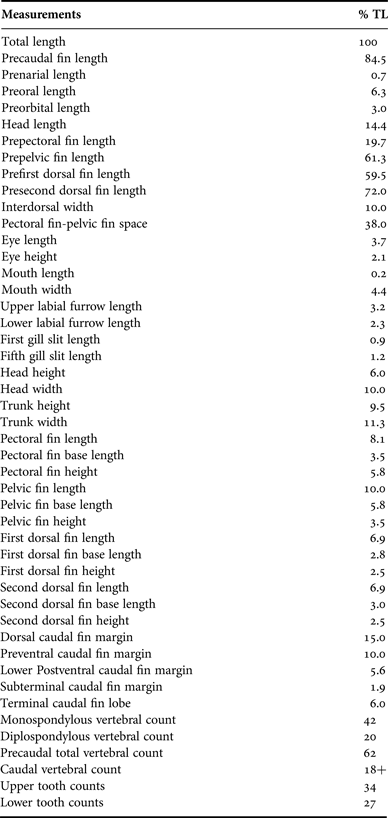
On 23 October 2014, two small sharks were caught in a sablefish pot off San Nicolas Island, California (32°59′05″N 120°25′99″W), at a depth of 1132–1116 m, and landed in Morro Bay. One of the specimens, a female, was retained, photographed, frozen and subsequently sent to Moss Landing Marine Laboratories, where its identification was confirmed as a cookiecutter shark, Isistius brasiliensis (Chondrichthyes: Squaliformes: Dalatiidae) based on a combination of characteristics, including: a small, slender, cigar-shaped body, with a short bulbously conical snout, a long abdomen, two spineless nearly equally sized dorsal fins and a large nearly symmetrical caudal fin; mouth with expanded sectorial lips; teeth strongly differentiated between upper and lower jaws, uppers narrow, erect, with single acute cusp, no lateral cusplets, lowers very large, bladelike, interlocked with high broad, erect cusp; tooth counts on this specimen were 34 in the upper jaw, 27 in the lower jaw; first dorsal fin set far back, originating just in front of pelvic fin origins, insertion over pelvic fin bases. Coloration on body prior to preservation is a uniform medium brown with a prominent dark collar marking around the gill region and extending ventrally across the throat, not as conspicuous on dorsal head surface; snout tip to upper jaw dark brown, becoming a lighter brown on cheek and lower jaw to collar marking, but lighter brown behind collar beginning at about pectoral fin origin; posterior edges of dorsal, pectoral and pelvic fins distinctly light to translucent; caudal fin upper and lower lobes very dark brown, but posterior fin edge narrowly light to translucent (Figure 2). Morphometric measurements and meristic counts are presented in Table 1.
Isistius brasiliensis (Quoy & Gaimard, Reference Quoy, Gaimard and de Freycinet1824), CAS 238014, 432 mm TL, female. A. Lateral view; B. ventral view of collar marking; C. close-up of mouth showing teeth.
Morphometric and meristic data for the specimen of Isistius brasiliensis (CAS 238014, female, 432 mm TL). Measurements are expressed as a percentage of total length (% TL).
DISCUSSION
This is the first confirmed extant record of Isistius brasiliensis from off the California coast. It is also a new modern record for Californian waters. Isistius brasiliensis is known from the fossil record, dating back to the late Miocene of the San Mateo Formation, Oceanside, California (Long, Reference Long1994). The record of this species from off San Nicolas Island, California, extends its known range from Guadalupe Island by more than 400 km. However, previously reported evidence of crater wounds on northern elephant seals from Año Nuevo, California, further extends its probable range from Guadalupe Island by at least 1000 km (LeBoeuf et al., Reference Le Boeuf, McCosker and Hewitt1987). DNA sequencing of the ND2 gene for this specimen was found to cluster closely with other specimens of I. brasiliensis from around the world, confirming that this is a relatively wide-ranging species (G. Naylor, College of Charleston, personal communication).
The occurrence of I. brasiliensis brings the number of shark species now confirmed to occur in Californian waters to 43 (Ebert, Reference Ebert2003; Ebert et al., Reference Ebert, Knuckey and Kamikawa2014).
ACKNOWLEDGEMENTS
The authors would like to thank Katelyn Massaroni (West Coast Groundfish Observer Program) for saving the specimen, Georgon Lapham (captain, F/V Michele Ann), Douglas Long (Saint Mary's College) for discussion and comments on the elasmobranch fossil record from California, Gavin Naylor (College of Charleston) for sequencing the tissue sample, Jeff Harris (Alaska Fisheries Science Centre) for discussions on the occurrence of crater wounds on pinnipeds, Jon Fong (California Academy of Sciences) and Justin Cordova (Moss Landing Marine Laboratories) for general assistance. Additional support was provided by a National Science Foundation grant (Jaws and Backbone: Chondrichthyan Phylogeny and a Spine for the Vertebrate Tree of Life, DEB 1132229) to Gavin Naylor, College of Charleston.