Introduction
Personal pronouns such as I, you or he are basic linguistic tools of interpersonal communication. They express reference to the speaker or addressee, or to third persons who are not participants in the exchange. Because of their importance for social interaction, they are likely to be related to other aspects of social cognition. At the same time, pronouns are linguistically complex. They are closed-class elements that fulfill grammatical functions, and their referents depend on the context. In the case of first- and second-person pronouns, the constant shifting of referents between the speaker and addressee in a conversation is particularly salient: I and you are different people for different speakers within one conversation. It is thus conceivable that the early use of pronouns is related to children’s increasing social understanding, but it could also reflect general language development.
Besides narrowly defined personal pronouns (I, you, she), person reference is also encoded in possessive pronouns (my, yours, her). We thus use the term person-referring pronouns to refer to personal and possessive pronouns together. The present study uses longitudinal data on child English to examine the relations between children’s use of person-referring pronouns and their acquisition of mental state language, which we use as a marker of social understanding here (following Bartsch & Wellman, Reference Bartsch and Wellman1995; or Kristen et al., Reference Kristen, Sodian, Thoermer and Perst2011). The key assumption tested here is that person-referring pronouns, especially in first and second person, have special relation to mental state words that goes above and beyond their general relation to language development. We address this question using lagged correlations to extract information from a series of longitudinally collected language transcripts. This analytic procedure can provide information on the sequence of developmental events and suggest the causal relations between different aspects of language development.
Person-referring pronouns and social understanding
In developmental psychology, it has been long surmised that the emergence of correct person-referring pronouns may indicate growing social understanding in typical children (Goodenough, Reference Goodenough1938; Piaget, Reference Piaget1929). It is supported by a number of research findings showing relations between the use or comprehension of person-referring pronouns and various non-linguistic skills and activities that require social cognition, such as mirror self-recognition (Courage, Edison & Howe, Reference Courage, Edison and Howe2004; Lewis & Ramsay, Reference Lewis and Ramsay2004), spontaneous cooperative behaviors, i.e., willingness to help others (Brownell, Ramani & Zerwas, Reference Brownell, Ramani and Zerwas2006), pretend play (Lewis & Ramsay, Reference Lewis and Ramsay2004), the understanding of different visual perspectives (Loveland, Reference Loveland1984), or the composite of intention, pretense understanding and visual perspective taking (Chromá & Smolík, Reference Chromá, Smolík and Scott2017). These documents show relations between pronouns and other cognitive domains, but they generally did not control for the general level of language development in children, so the relation between pronouns and social cognition could be due to a general effect of language, rather than specific effect of pronouns. At the same time, there is only limited research examining the correlates or precursors of pronoun emergence within the language domain. Language may contain a number of other indicators of advancing social understanding that could be related to the emergence of pronouns.
There are two special phenomena in the acquisition of person-referring pronouns that may show their relation to social understanding. These are pronoun reversals (the usage of you in reference to self or I in reference to addressee) and the reference to self and addressee by proper or common nouns instead of pronouns. Both of these phenomena were studied in children with autism spectrum disorders (ASD; e.g., Jordan, Reference Jordan1989; Tager-Flusberg, Reference Tager-Flusberg1994) as well as in typical children (e.g., Dale & Crain-Thoreson, Reference Dale and Crain-Thoreson1993). The occurrence of pronoun reversals and nominal first- and second-person reference in ASD children have often been interpreted as consequences of the impairment in social cognition, and they are also currently stated as diagnostic criteria of ASD according to DSM V (American Psychiatric Association, 2013). However, the role and importance of these phenomena for ASD has been recently questioned (Barokova & Tager-Flusberg, Reference Barokova and Tager-Flusberg2020; Gernsbacher, Morson & Grace, Reference Gernsbacher, Morson and Grace2016), even though some recent research supports their relations (Overweg, Hartman & Hendriks, Reference Overweg, Hartman and Hendriks2018). Barokova and Tager-Flusberg (Reference Barokova and Tager-Flusberg2020) pointed out that controlling for both linguistic and social skills concurrently might be crucial.
Mental state language, social understanding and pronouns
One well-researched segment of linguistic skills that reflects social understanding in children is mental state language (MSL). This encompasses words and expressions referring to internal states and processes occurring in people’s minds. Bartsch and Wellman (Reference Bartsch and Wellman1995) suggested that before children talk about internal cognitive processes (e.g., think) or desires (want), they start talking about perceptual processes (see, hear) or emotions (sad), which are easier to observe but also suggest that children appreciate other’s internal world. MSL demonstrates children’s basic understanding of others’ minds much earlier than they succeed in false belief tasks, which are often used as the indicators of children’s developing social understanding (Wellman, Cross & Watson, Reference Wellman, Cross and Watson2001; Wimmer & Perner, Reference Wimmer and Perner1983). At the age of two, children talk about desires using words such as want (Bretherton & Beeghly, Reference Bretherton and Beeghly1982), and around the age of 3, they will start using knowledge-related words such as think, know, and guess (Shatz, Wellman & Silber, Reference Shatz, Wellman and Silber1983). MSL helps children access mental states of their own and others (Beeghly & Cicchetti, Reference Beeghly and Cicchetti1994), and regulate their social interactions (Beeghly, Bretherton & Mervis, Reference Beeghly, Bretherton and Mervis1986; Beeghly & Cicchetti, Reference Beeghly and Cicchetti1994). MSL is also a precursor of skills needed to succeed in false belief tasks, as suggested by relations between children’s MSL and their later performance on false belief measures (Brown, Donelan-McCall & Dunn, Reference Brown, Donelan-McCall and Dunn1996; Dunn, Brown, Slomkowski, Tesla & Youngblade, Reference Dunn, Brown, Slomkowski, Tesla and Youngblade1991; Moore, Pure & Furrow, Reference Moore, Pure and Furrow1990).
MSL and person-referring pronouns are thus two potential correlates of early social cognition that are both based in the language domain. Due to this double connection, it is reasonable to surmise that they develop in sync, or with a regular pattern of precedence. Research reviewed here showed that both MSL and person-referring pronouns are related to various aspects of social cognition outside of the language domain, but there has not been much work examining these two linguistic aspects of social understanding together. Markova and Smolík (Reference Markova and Smolík2014), using parent reports, as well as Smolík and Bláhová (Reference Smolík and Bláhová2021), using spontaneous speech samples, demonstrated that the use of person-referring pronouns in Czech was related independently to both the level of linguistic development and the usage of MSL. In addition to pronouns, they found similar effects for first- and second-person verb inflections, which in pro-drop languages often serve as sole means of person reference instead of pronouns. Similar findings were reported by Longobardi, Spataro, Pecora, and Bellagamba (Reference Longobardi, Spataro, Pecora and Bellagamba2019) for parent-reported data from Italian children. The limitation of these reports is that they focused on concurrent relations between different components of individual language skills. These may be confounded by a number of factors, of which the most obvious is the general level of language skills; children who use many pronouns and also many mental state terms are likely to have generally high language skills, and language skills may thus be the common cause of high MSL and pronoun use. Another important confound is situational: increased usage of mental state terms requires increased use of person-referring pronouns to clarify who is experiencing the mental state. Therefore, the two categories may be correlated, especially when assessed data from spontaneous conversations.
Self, addressee and the others
In addition to the relation between MSL and person-referring devices, Markova and Smolík (Reference Markova and Smolík2014) analyzed potential differences between the first- and second-person reference and identified a stronger relation between MSL and second person in pronouns as well as verb inflections. Longobardi et al. (Reference Longobardi, Spataro, Pecora and Bellagamba2019) also analyzed third-person pronouns and conjugations, and found that MSL had strong relations with second and third person in pronouns (in contrast to first person). Regarding verb inflections, the correlation was significant for all the three grammatical persons.
The asymmetry between talking about self and others is known in language acquisition: Bartsch and Wellman (Reference Bartsch and Wellman1995) described higher token frequency of MSL about self than about others in transcripts of spontaneous language samples of English-speaking children. The talk about one’s own desires and beliefs before the third year comprised 70 and 85 % of these two types of MSL, respectively. Bartsch and Wellman also found that the first references to one’s own mental states occurred about two to three months earlier than first references to mental states in others. The authors pointed out that higher token frequency or earlier occurrence do not mean that own mental states are understood better or earlier. Girouard, Ricard and Decarie (Reference Girouard, Ricard and Decarie1997), combining spontaneous and elicited data, found a similar three-month gap between the production of first-person pronouns (at about 25 months) and second-/third-person pronouns (at about 28 months) for both English and French children. Recently, Kelty-Stephen, Fein and Naigles (Reference Kelty-Stephen, Fein and Naigles2020) analyzed developmental trajectories of first-, second- and third-person pronoun spontaneous use and found a different pattern for first person (earlier and more frequent occurrence) and no difference between second and third person.
The approach
Our study uses data on early pronouns and mental state language from a longitudinal corpus of child English, the Manchester corpus. Transcript data have good ecological validity, and can provide two basic measures of the mastery and use of specific word classes. One is the number of all occurrences of words from a given category, i.e., the number of tokens. The other is the number of different words in the category, i.e., types. The number of tokens shows how often people find it necessary or useful to use the category of words. This may be due to pragmatic and conversational factors as well as the discourse topic. High token numbers in children’s speech thus do not necessarily mark a better mastery of the category, but some minimum level of mastery is needed to show high token numbers.
Number of types reflects the linguistic diversity of this category. This is likely to be related to its linguistic and conceptual mastery: knowing e.g., a lot of words for mental states suggests better understanding of internal processes than knowing only a few. In contrast, the number of tokens may point out to how useful or important a category is for children. Previous research on MSL and pronouns has used different measures. Markova and Smolík (Reference Markova and Smolík2014) or Longobardi et al. (Reference Longobardi, Spataro, Pecora and Bellagamba2019) relied on parent report checklists, which can only reflect the number of types. Smolík and Bláhová (Reference Smolík and Bláhová2021) reported the number of types as well as tokens based on language sample transcripts but the type numbers were low, so the token analyses appeared to be more reliable and provided more consistent results. Kelty-Stephen et al. (Reference Kelty-Stephen, Fein and Naigles2020) used the number of pronoun tokens as their primary dependent variable. Because of these discrepancies in the previous literature, we examined both types and tokens of pronouns and MSL words in this study. We assume that the mastery of the relevant linguistic items, i.e., different pronoun forms and MSL vocabulary, is best reflected in the number of types for each category. However, if the acquisition of pronouns and MSL is related, we would also expect to find relations between the number of pronoun and MSL tokens, even though these might be inflated by conversational factors. In line with these considerations, we also refer to type frequency as mastery of pronouns, and token frequency as the use of pronouns.
The approach taken here relies on the notion of Granger causality, which is the relation between two time series in which the observations on one series reliably predict observations made on the second series. This may be considered as evidence that the variable in the first time series has causal effects on the variable in the second series. It does not necessarily mean true causality; there are many situations in which changes in one variable are reliably followed by changes in another without direct causality from the first to the second. However, such a relation suggests that some causal relations between the variables are likely, whether direct or more complex. For longitudinal corpora of child language, reliable temporal precedence of one phenomenon before another suggests a possible causal relation that needs to be explained.
In practice, Granger causality can be documented using lagged correlation or regression analyses in which the values of a variable at one time point are used to predict the values of the same or other variables at a later point. Analyses based on lagged correlations have been reported in research based on longitudinal child language transcripts (Huttenlocher, Waterfall, Vasilyeva, Vevea & Hedges, Reference Huttenlocher, Waterfall, Vasilyeva, Vevea and Hedges2010; Szagun & Schramm, Reference Szagun and Schramm2019), but the technique is not used widely. It is well suited for analyzing data from longitudinal corpora that have relatively low number of participants but high number of observation points. Our study presents an example of using this method on data from a large longitudinal corpus of child English.
While the lagged correlations provide a glimpse into the temporal relations between variables, it is important to describe the concurrent relations between measures collected from the same language samples. This provides background information about natural co-occurrence between the categories of interest, and increases the interpretability of lagged correlation or regression analyses.
Questions and hypotheses
The primary question addressed in this paper is whether there are relations between the use and mastery of person-referring pronouns and MSL, above and beyond relations that could be explained by general levels of language development. Of particular interest are the first- and second-person pronouns in which the constantly switching reference between speakers and addresses should be especially challenging from the social-cognitive viewpoint. Third-person pronouns, on the other hand, may serve as a reference measure: like first- and second-person pronouns, they are short, closed class elements used to refer to persons, but their use depends on social understanding to a lesser extent. All analyses shown here were thus performed on first-, second- and third-person pronouns with the assumption that pronouns in first and second person should be more closely related to mental state language than those in third person.
The key cross-lagged analyses used the measures of MSL to predict person-referring pronouns at the subsequent time point, controlling for MLU. The key hypothesis was that the mastery of first- and second-person pronouns, indicated by the number of pronoun types, would have unique relations to language development in general and to social understanding, as indexed by the diversity of MSL terms. This should be especially strong in second-person pronouns, as suggested by the results from Markova and Smolík (Reference Markova and Smolík2014) and Longobardi et al. (Reference Longobardi, Spataro, Pecora and Bellagamba2019), and some theoretical proposals (Wechsler, Reference Wechsler2010). With regard to the direction of causality, there are various possible scenarios. If social understanding is one of the preconditions of pronoun mastery, as suggested by Markova and Smolík (Reference Markova and Smolík2014), Longobardi et al. (Reference Longobardi, Spataro, Pecora and Bellagamba2019) or Naigles et al. (Reference Naigles, Cheng, Xu Rattanasone, Tek, Khetrapal, Fein and Demuth2016), MSL should predict the use of pronouns but not vice versa. On the other hand, if pronouns predicted MSL mastery, it would suggest that the mastery of interpersonal communicative devices is instrumental in expanding social understanding. It could also be the case that the effect is cyclic and that there would be mutual prediction between the mastery of pronouns and MSL. This would indicate that language and social understanding are intertwined in their development and no clear precedence can be established.
A complementary set of analyses used the number of tokens rather than types for both MSL and pronouns. This tested whether the frequency of children’s talk about self and others would be related to the frequency of their talking about mental states. This could reflect their increasing mastery of socio-cognitive reasoning as well as person differentiation, but it could also reflect changes in children’s interest in these domains or family specific interaction style. We had no specific hypotheses for this analysis, but we aimed to test whether the use of each category would predict the use of the same category at the subsequent time point. If that were the case, it would show that the cross-lagged regression analysis could uncover stable preferences in children’s language, lending support to our approach.
In addition to analyses using lagged regressions, we also examined the relations between pronoun and MSL types and tokens in concurrent analyses of the same transcripts. These relations are likely to be influenced by conversational factors; e.g., increase in the reference to self (I) may be related to increased use of you because the transcript captures a conversation with participants referring to each other. At the same time, they can show whether different types of personal pronouns, as well as MSL, tend to co-occur. In particular, if first- and second-person pronouns are together influenced by social understanding to a larger extent than third-person pronouns, they should show closer relations in these analyses, and should be more closely related to MSL than third-person pronouns. Analyses of concurrent relations also provide reference and control to check the basic assumptions of our approach. For the number of types, we expected stronger mutual relations between first- and second-person pronouns, compared to third person, and stronger relations between MSL and the first- and second-person pronouns. For the number of tokens, we expected a similar pattern, based on previous findings (Smolík & Bláhová, Reference Smolík and Bláhová2021).
Method
The corpus
We used the Manchester corpus (Rowland, Pine, Lieven & Theakston, Reference Rowland, Pine, Lieven and Theakston2003) from CHILDES (MacWhinney, Reference MacWhinney2000). This includes recordings of 12 children mostly within their third year of life, with lowest age at the beginning 1;8 (627 days) and highest age at the end 3;0 (1105 days). The MLUm in the corpus ranges from 1.12 to 4.27, and the corpus covers a period of rapid expansion of the grammatical and morphological system of the children’s language.
Data extraction
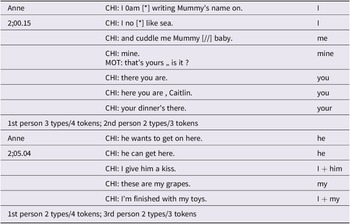
Transcripts from the same child recorded on the same day were merged in one. Then, all transcripts were searched for all words that appeared in the transcripts, using the lemmatized information provided on the %mor line. For each different word, a frequency count was taken from each transcript. The resulting database was then used to search for the forms of interest. For person-referring pronouns, these included: I, me, my, mine; you, your, yours; he, him, his, she, her. The maximum number of types was thus 4 for first-, 3 for second- and 5 for third-person pronouns (see Table 1 for examples). The list of mental state language terms is shown in Table 2, and is based on Markova and Smolík (Reference Markova and Smolík2014) and Bartsch and Wellman (Reference Bartsch and Wellman1995), including words referring to sensory and perceptual processes, emotions, internal cognitive processes and desires. The total numbers of occurrences for each of these elements for each transcript were recorded, along with the information on MLUm and the number of utterances, word tokens and word types in the transcripts. The extraction was performed using custom Perl routines written by the first author.
Example of token and type counts in short excerpts from actual transcripts.

List of MSL terms.

The number of pronoun and MSL tokens in each transcript is obviously related to the total length of the transcript. To a lesser extent, this is also true about the number of pronoun and MSL types. For this reason, the token and type counts were divided by the number of utterances in each transcript and these proportions were used as variables in subsequent analyses.
Statistical analysis
We performed four sets of analyses, two for concurrent relations between pronouns and MSL and two for predictive relations. All analyses consisted of mixed models with one of the target variables as the dependent variable and the remaining categories as predictors. In addition, MLU in morphemes and chronological age in days were used as additional predictors. Models included random intercepts for children; the low number of participants (12) did not make it possible to fit a more complex random effect structure.
For the models of concurrent relations, the proportions of pronoun types or tokens were used as dependent variables and MSL was only used as a predictor. There thus were three models in each set, one for each pronominal person. In predictive models, dependent variables were each pronominal person as well as MSL, so that there were four models in each set. The analyses were fit in R using the lme4 package (Bates, Maechler & Bolker, Reference Bates, Maechler and Bolker2011) with p-values calculated with the Satterthwaite correction using the lmerTest package (Kuznetsova, Brockhoff & Christensen, Reference Kuznetsova, Brockhoff and Christensen2017). To provide the estimates of effect size for the effects of individual variables, the coefficients are reported as standardized beta weights. Multicollinearity checks were performed by calculating the VIF using the car package (Fox & Weisberg, Reference Fox and Weisberg2018) in R.
Results
Concurrent relations
Figure 1 shows the relation between the age and the proportion of pronoun and MSL types per 100 utterances, using smoothed curves. The growth is quite strong in MSL and the third-person pronouns, somewhat flatter in the first person and very limited in the second person.
Smoothed growth curves showing the number of different pronouns or MSL words per 100 utterances across the age span, averaged over all children.

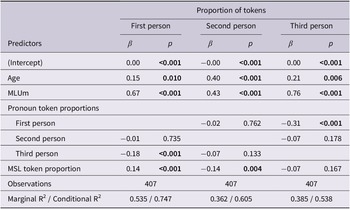
The first set of concurrent models was with the proportion of first-, second-, and third-person pronoun tokens in the transcript as the dependent variable, with results summarized in Table 3. All three models in the first set showed significant effects of age and MLU on the pronoun tokens, indicating that the use of pronouns increases with age and language skills, and that both have an independent contribution. In the model for first-person pronouns, there was a significant negative effect of third-person pronouns, and similarly, there was a significant negative effect of first-person pronouns in the model for third-person pronouns. The use of second-person pronouns was not related to pronouns in either first or third person. Mental state language was positively related to first-person pronouns but negatively to second-person pronouns, with no significant relation for third-person pronouns.
Concurrent models for pronoun tokens.

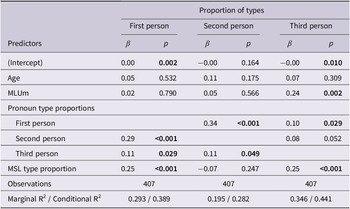
Our second set of models for concurrent measures used word types and revealed a different pattern (see Table 4). Proportion of first-, second-, and third-person pronoun types was not related to age, and only third-person pronouns were related to MLU. All three groups of pronouns were significantly and positively related to the remaining groups of pronouns, except for the effect of second-person pronouns on third-person pronouns, which was only marginally significant with p-value just above 0.05. The number of pronoun types in a transcript is thus interrelated for all three types of pronouns. Mental state language had a positive relation to the first- and third-person pronouns but, perhaps surprisingly, not with second-person pronouns. This pattern shows that there is a relation between the growth of pronominal reference and mental state language, but it is limited to first- and third-person pronouns.
Concurrent models for pronoun types.

Predictive relations
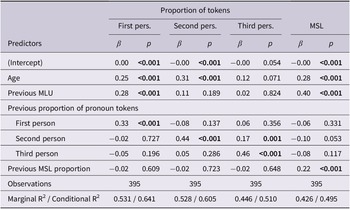
The key questions were addressed by two sets of predictive models. The first set used pronoun or MSL tokens, and the results are summarized in Table 5. This set of token models confirmed that the method is sensitive to developmental continuities in the use of word classes because each pronoun and MSL variable was significantly predicted by itself. The preferences for using the pronoun classes and MSL are thus stable across transcripts. However, the predictive relations between different pronoun persons and MSL were limited to the effect of second-person pronouns on later use of third-person pronouns. Token frequency of MSL had no predictive effects on the use of pronouns in any person, nor did the pronouns have predictive effects on token frequency of MSL.
Predictive models for pronoun and MSL tokens.

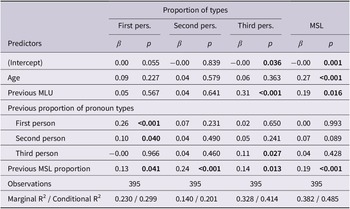
The final and most important analysis examined predictive relations between the use of pronoun and MSL types per utterance. The predictors were age, previous transcript’s MLU, the previous proportions of first-, second-, and third-person pronouns and the previous proportions of MSL types. The results, which are summarized in Table 6, revealed a significant effect of previous MSL types on the diversity of pronouns in all three persons, with the strongest effect (β=0.24) for second person. Additionally, there was an effect from the previous proportion of first- and third-person pronouns on the subsequent proportion of the same person pronouns. This effect was absent for second-person pronouns. First-person pronoun types were also predicted by the previous proportion of second-person types. MLU was a significant predictor for third-person pronouns and MSL, and MSL was also uniquely predicted by age.
Predictive models for pronoun and MSL types.

Discussion
Overall, the results support the view that the development of personal pronouns is supported by expanding social understanding; but the pattern of findings is complex and it disconfirms some of our expectations. The lagged regression analyses demonstrate that the relations between pronouns and MSL are not due simply to discourse-based co-occurrences, and confirm the usefulness of the Granger causality approach to the analysis of spontaneous language transcript data. At the same time, contrary to expectations, there are very few specific relations between first- and second-person pronouns as opposed to third-person pronouns. The notion that the shifting reference in first and second person will result in similarities between pronouns expressing these persons was not confirmed. The comparison of analyses examining tokens and types has proven informative and points out that these measures can tell different stories and should both be considered, if possible.
Analyses of concurrent relations
Models examining the concurrent relations between pronoun and MSL tokens found independent relations of both MLU and age with the use of all three pronominal persons, suggesting that pronoun use, i.e., token frequency, is tied to the growth in the linguistic domain, indexed by MSL, as well as general cognitive growth, indexed by age. There were significant negative relations between the frequency of first- and third-person pronouns but not second-person pronouns, which contrasted with the hypothesis that first- and second-person pronouns would be closely related. The negative relation between first and third person means that the more children talk about themselves, the less they talk about others, and vice versa. This might be due to personal preference for talking about own actions or observing and commenting on others, or it could result from conversational dynamics: in some conversations, i.e., some transcripts, children would focus more on self; in others, they would comment on other people. Our results in this respect resemble those reported by Kelty-Stephen et al. (Reference Kelty-Stephen, Fein and Naigles2020) or Girouard et al. (Reference Girouard, Ricard and Decarie1997) in the contrast between first and third person. However, their studies also documented similarities between second and third person, which is not the case for concurrent token measures here.
Frequency of MSL tokens was positively related to the use of first person and negatively related to second person, which also refuted the hypothesis that first- and second-person pronouns would pattern together. MSL tokens were unrelated to third-person pronoun tokens. The most likely reason for the opposite effects for first and second person is that children initially use MSL about themselves. This is consistent with the observation that children first talk about their own mental states or about themselves in general (e.g., Bartsch & Wellman, Reference Bartsch and Wellman1995; Girouard et al., Reference Girouard, Ricard and Decarie1997). Overall, the analysis of tokens provided some unexpected results, like the absence of relations between second-person pronouns on one hand and MSL and first-person pronouns on the other.
In contrast to token models, the models using pronoun types found positive relations between all pronoun persons. This indicates that the growth of the pronominal system is parallel in the three categories of pronouns, even though the usage, as indicated by tokens, differs. While all pronouns were mutually related, only third-person pronouns were related to MLU, so it is not the case that all pronouns are closely tied to syntactic development in general. Mental state language had a significant positive relation to the first- and third-person pronouns, but not to second-person pronouns. This confirms that MSL and person-referring pronouns are related, but it is also in conflict with the prediction that both first- and second-person elements are closely related to social understanding and thus MSL.
Taken together, the concurrent analyses of tokens and types had some commonalities but also differences, as expected. In both sets of models, there was a positive relation between first-person pronouns and MSL; in contrast, second person pronouns were unrelated (types) or negatively related (tokens) to MSL. The token models showed negative relations between first- and third-person pronouns, whereas the type models indicated mutually positive relations between all pronoun types. The type analyses thus show more consistent positive relations between the categories studied here, and token analyses show a more varied pattern. This is consistent with the view that token analyses reflect situational and conversational factors to a larger extent than type analyses, and that type analyses are more closely related to the mastery of the underlying categories.
These results are in contrast with previous studies showing significant concurrent relation between number of MSL types and types of second-person pronouns (Longobardi et al., Reference Longobardi, Spataro, Pecora and Bellagamba2019; Markova & Smolík, Reference Markova and Smolík2014) – however, there are several differences between the present and the previous studies. The previous studies used Czech and Italian, both pro-drop languages, in which the verb inflection is often the only person-referring device in an utterance. This could affect the relations between pronouns and MSL; perhaps children only use pronouns to emphasize the reference to person, and this strengthens the MSL-pronoun relations. Also, these previous studies analyzed children’s production of MSL and person-referring devices as reported by parents, which may not reflect the short-term co-occurrences in conversations but the overall usage. The predictive relations should be more informative in this respect.
Analyses of predictive relations
In the predictive analyses of tokens, pronouns in all persons as well as MSL tokens had a significant effect on the same type of elements in subsequent transcripts, indicating that the individual-specific frequency of various language elements has good stability in children’s language, and that this can be discovered using measures from language samples. Language level, as indexed by MLU, was a predictor of frequency in subsequent transcripts for first-person pronouns and MSL only. The use of second-person pronouns predicted an increased use of third-person pronouns later on. This is again at odds with the hypothesis that first- and second-person pronouns should be related, just as in the analyses of concurrent relations. It may suggest that talking about conversational partners is a precursor of talking about other people in general, while self-talk is motivated by other needs and unrelated to the interest in other people, whether addressees or third persons. Finally, MSL tokens did not predict pronoun tokens in any person. The amount of talk about mental states is thus not indicative of children’s use of pronouns in later conversations. This is inconsistent with the assumption that MSL and pronouns are developmentally related; however, the token numbers are greatly influenced by situational and conversational factors. The key assumption is more meaningfully tested in analyses of types.
The analyses of types revealed that the number of MSL words predicted the number of pronoun forms in all three persons, but MSL itself was not specifically predicted by any pronoun type. This finding confirms that increasing social understanding, as measured by the mastery of MSL vocabulary, is a precursor of pronoun mastery. However, the relation is not limited to first- and second-person pronouns but is also present for third person. This counters our expectations but it does validate, using direct child data, the findings reported by Longobardi et al. (Reference Longobardi, Spataro, Pecora and Bellagamba2019) for parent-report data. Also Kelty-Stephen et al. (Reference Kelty-Stephen, Fein and Naigles2020) found that third-person pronouns were related to social understanding, suggesting that the first- and second-person switching reference is not the main factor relating pronouns and MSL.
Besides the universal effect of MSL for pronouns of all three grammatical persons in the present study, the results for word types revealed a significant effect of age for MSL and not MLU, suggesting that the growth of MSL vocabulary depends mainly on general cognitive growth. MLU was a significant predictor for third-person pronouns and MSL but not first- and second-person pronoun types. For first- and third-person pronouns, significant effects of the same-person pronouns were found, but this was not the case for second-person pronouns. On the other hand, second-person pronoun types were significant predictors of first-person types. This is one of the few findings in our study tying the first- and second-person pronoun development.
Are pronouns related to social understanding?
Our results indicate that pronouns indeed are related to social understanding and that their development depends on a sufficient level of social cognition. At the same time, the pattern of findings is not completely consistent. The strongest indication for the relation comes from the predictive analyses of types, where all three persons of pronouns were predicted by MSL. Predictive analysis of tokens revealed no relations between MSL use and pronouns. The analyses based on concurrent data found a consistent relation between first-person pronoun types and tokens and MSL, although the relation between second-person tokens and MSL tokens was negative. Overall, this pattern provides additional support to the view that social cognition is a factor in the development of pronouns. On the other hand, it is unexpected that the evidence is strongest for first-person, conflicted for second-person pronouns, and that also third-person pronouns show reliable relations with mental state language in the analyses using word types. This suggests that the mastery of the pronominal system as a whole, rather than specifically first- and second-person, depends on developing social cognition.
Differences between mastery and use
The analyses of types and tokens differed for concurrent as well as predictive models. Overall, in the analyses of types, pronouns were consistently related to MSL, with the exception of second-person pronouns in the concurrent analysis. Analyses of tokens provided more varied results, with conflicting first- and second-person relation to MSL for concurrent analyses and no relations for predictive analyses. One possibility is that the conversational and contextual dependency of token counts means that they are intrinsically unstable measures and the amount of noise prevents them for showing any consistent patterns. However, the predictive analysis shows that the token counts are sufficiently stable to predict themselves. The variability of token measures likely reflects the real variability of use, with pronouns of different persons serving different purposes, and also being different from the use of MSL words. The positive relation of first-person and negative relation of second-person pronoun tokens to MSL in concurrent analyses indicates a closer affinity of MSL to talking about self in children. It is likely that this changes with age, which is an open question for further research.
The type analyses are more consistent, in line with the view that they reflect the mastery of different language domains rather than use in specific conversations. They show a consistent mutual relation between pronouns in the concurrent analyses, suggesting that the underlying knowledge needed for the development of the pronoun system is shared across persons, and largely also with MSL. On the other hand, the results counter the assumption that the first- and second-person pronouns share some characteristics above and beyond third-person pronouns. This is a potentially important contribution to the existing body of research.
Is the first and second person special?
First- and second-person pronouns appear to be special in the mechanism of shifting reference to speaker and addressee. This shifting reference itself is often viewed as the crucial characteristic of first- and second-person pronouns that makes them related to social understanding (Charney, Reference Charney1980; Loveland, Reference Loveland1984; Wechsler, Reference Wechsler2010). It is also the aspect of language that leads to pronoun reversals, i.e., using I/me/my for the addressee and – more often – you/your for self. If social understanding were needed to decode the shifting reference, MSL would be expected to have stronger specific relations to first and second person in our study. However, in our key model the effect size in relation to MSL for first person is almost the same as for third person (β=0.13 and 0.14, respectively), the second person having a stronger effect (β=0.24). This suggests that social understanding is important for the system of person reference in general, not specifically because of the need to understand the shifting reference. It also suggests that in studying pronoun reversals, the general frequency and morphological diversity of person reference should be controlled to ensure that the potential correlation of reversals with lower social understanding is not a confound of generally lower person reference.
Pronoun reversals have been viewed as a typical sign of autism disorder and interpreted in two ways: as an artefact of the echolalia of autistic individuals (Kanner, Reference Kanner1943) or as a sign of insufficient social understanding (see the overview in Gernsbacher et al., Reference Gernsbacher, Morson and Grace2016). Several studies pointed out that the prevalence of reversals in autistic population is disputable (Barokova & Tager-Flusberg, Reference Barokova and Tager-Flusberg2020; Jordan, Reference Jordan1989). Other studies found the pronoun reversals in typically developing children, which also weakens the claim of the reversals being connected to the impaired social understanding (Chiat, Reference Chiat1982; Dale & Crain-Thoreson, Reference Dale and Crain-Thoreson1993; Evans & Demuth, Reference Evans and Demuth2012; Oshima-Takane, Reference Oshima-Takane1992; Schiff-Myers, Reference Schiff-Myers1983). Our results do not address the issue of reversals directly but suggest that the relations with social understanding are not limited to first- and second-person pronouns, and thus the pronoun reversals may not be primarily due to deficits in this domain.
There is another device of person reference with special importance for child language – the reference by names when talking about self or addressee. This avoids the shifting mechanism of pronouns completely and it is often considered to be a sign of lower level of social development. However, the study by Smiley, Chang and Allhoff (Reference Smiley, Chang and Allhoff2011) showed that a balanced usage of reference by pronouns and names in the parents has the most positive effect on the successful final acquisition of pronouns in their children. Chromá and Smolík (Reference Chromá, Smolík and Scott2017) showed that a composite of measures of social cognition development (intention and pretense understanding and visual perspective taking) was positively correlated to the use of both pronouns and names in reference to self and addressee. Along with these findings on reversals and nominal reference to persons, we interpret our present results as support for a holistic view of person reference, proposing that frequent and morphologically diverse person reference in a child is related to more advanced social understanding, regardless of any specific mode or person of such reference. This includes correctly shifted pronouns and verb person inflections in all three grammatical persons, systematically reversed pronouns for first and second person, as well as reference by names. This proposal must be tested on new data. However, the present findings are consistent with this view and suggest that talking about persons in general, regardless of whether shifting reference is involved, is a consequence of increasing level of social understanding.
A possible alternative thinking about this is that shifting reference is also involved in the use of third person (Kelty-Stephen et al., Reference Kelty-Stephen, Fein and Naigles2020). Child has to make a decision whether to label someone as “you” or “she” or by her name, i.e., even the use of third person requires evaluating the speaker and addressee position. To test whether reference shifting (including third-person pronouns) is the component of pronoun mastery that is related to mental state language, it would be important to analyze separately the usages of third person that refer to those present in the situation and those who are outside of the situational context. Only those who are available as potential participants in the conversation can plausibly become addressees and thus be labeled with second-person pronouns; and the use of pronouns in this context should thus be more closely tied to measures of social understanding.
Limitations and open questions
We analyzed the relations between pronouns and MSL using summary information about the use of these language elements. Using this approach, we could not detect incorrect person reference such as pronoun reversals, and we could not find the instances of nominal self- and addressee reference (mommy play etc.). This somewhat limits our approach, given that our findings underline the importance of person reference in general rather than first- and second-person pronouns. In future, studies that reliably encode nominal reference should examine how this relates to talking about persons using pronouns. However, reliability of this information in the corpora is limited. Also, it would be useful to code for the syntactic role of pronouns as well as the syntactic and conceptual aspects of MSL use: what is the subject, whether it is overt, and whether the MSL item refers to self or other. This would contribute to the interpretation of relations between MSL and particular grammatical persons. An analysis on a similar corpus of a pro-drop language with verb inflection for person reference might provide important insights as well.
One possible limitation is the difference between our variables of interest in the amount of growth. As Figure 1 shows, MLU, and the number of types for MSL and third-person pronouns showed quite visible growth. To a lesser extent, it is also true for the first-person elements, but the number of second-person types was fairly low throughout. It is possible that the lack of some effects involving the second-person pronouns in this study is related to this lack of growth-related variability. Overall, the analysis of language transcripts needs to be complemented with more targeted measures of pronoun mastery.
One open question posed by this study is the role of language in pronoun acquisition. While the previous studies found evidence that person reference is uniquely affected by MSL as well as general language development, the effects of language in the present study were modest. In the predictive analysis of word types, MLU was only significant as a predictor of third-person pronouns and MSL. It is possible that most of the effect of general language is captured in the MSL variable, leaving little for MLU to add. However, the best way to control for the importance of language would be to have direct test-based measures of language development in children.
Conclusions
The present analysis provides new evidence on the relations between the emergence of pronominal reference and social understanding in children. Unlike most previous reports, it is based directly on child data from language transcripts, and it relies on causally informative analyses that address the developmental precedence relations between pronouns and mental state language. The key findings demonstrate that the increasing knowledge of mental state language is a precursor of the mastery of pronouns but not vice versa, indicating that the increases in social understanding are needed to expand person reference. The relation between social understanding, indexed by mental state language, and pronominal reference is not limited to the first and second person. This indicates that the shifting reference of first and second person is not the reason why pronoun development depends on social understanding. Social understanding is closely tied to the acquisition of person reference by pronouns; but this effect is general for all person reference, suggesting that social understanding is important for the ability to talk about people in general, not just me and you.
Acknowledgements
This study was supported by the Czech Science Foundation (GA ČR; Grant GA19-15576S awarded to the first author) as well as by institutional support of the Czech Academy of Sciences (RVO 68081740).