Traumatic brain injury (TBI), particularly mild traumatic brain injury (mTBI) and its co-morbidities are prevalent among military personnel who have served in Iraq and Afghanistan. Conservative estimates suggest a 15–22% rate of mTBI among the 2 million United States (US) troops deployed to Afghanistan and Iraq since 2001 (Hoge et al., Reference Hoge, McGurk, Thomas, Cox, Engel and Castro2008; Tan, Reference Tan2009; Tanielian & Jaycox, Reference Tanielian and Jaycox2008; Terrio et al., Reference Terrio, Brenner, Ivins, Cho, Helmick, Schwab and Warden2009). These injuries have resulted in a host of psychological, neurological, sensory, movement, pain-related, cognitive and neuroendocrine-related sequelae (Hoge et al., Reference Hoge, McGurk, Thomas, Cox, Engel and Castro2008; Tan, Reference Tan2009; Tanielian & Jaycox, Reference Tanielian and Jaycox2008; Terrio et al., Reference Terrio, Brenner, Ivins, Cho, Helmick, Schwab and Warden2009). According to the Defense and Veterans Brain Injury Center (DVBIC), the organisation charged with tracking medical diagnoses of TBI in the US Military, the incidence between 2000 and 2012 (Quarter 1) was 244,217, with 187,539 (76.8%) mild cases, 40,449 (16.6%) moderate cases and 2469 (1.0%) severe cases. An additional 3877 (1.6%) were classified as being penetrating and 9883 (4.0%) were not classified (Military Health System Office of Strategic Communications, 2012). Recent data from Brenner et al. (Reference Brenner, Homaifar, Olson-Madden, Nagamoto, Huggins, Schneider and Corrigan2013) suggested notable rates of TBI among all veteran cohorts. In this study, individuals seeking mental health services (mean age 53.2 years, range 21–86 years) at a Department of Veterans Affairs Medical Center were recruited and completed a structured clinical interview regarding lifetime history of TBI. The mean number of lifetime injuries was 2.5, with most frequent causes being assault, transportation and falls. Of note, 27% of the most severe injuries reported were moderate to severe in nature.
Mental health complaints are frequent post-injury, with symptoms being associated with damage to areas of the brain and adjustment post-TBI. At four major trauma hospitals across Australia, Bryant and colleagues (Reference Bryant, O'Donnell, Creamer, McFarlane, Clark and Silove2010) used a prospective cohort design to explore the prevalence of psychiatric disorders post-mTBI. One year post-injury, 34% of individuals reported a psychiatric disorder, with 25% reporting conditions (e.g., depression, generalised anxiety disorder, Post-traumatic Stress Disorder (PTSD) and agoraphobia) that they had not experienced prior to the TBI.
Major depression is the most frequently reported condition post-injury, with prevalence rates of greater than 25% among civilian cohorts (Rutherford, Merrett, & McDonali, Reference Rutherford, Merrett and McDonali1977; Schoenhuber & Gentilini, Reference Schoenhuber and Gentilini1988; van Zomeran & van den Burg, Reference van Zomeren and van den Burg1985). A recent study by Hart et al. (Reference Hart, Brenner, Clark, Bogner, Novack, Chervoneva and Arango-Lasprilla2011), indicated that minor depression (2–4 of the symptoms of depression (at least one cardinal) that persist for at least 2 weeks) is as common as Major Depressive Disorder (MDD criteria; Diagnostic and Statistical Manual of Mental Disorders, 4th ed. (DSM-IV), American Psychiatric Association, 2000), with rates 1 year post-injury being 22% and 26%, respectively. Additional work by Hart et al. (Reference Hart, Hoffman, Pretz, Kennedy, Clark and Brenner2012) suggested that three-quarters of those with MDD at year 1 experienced clinically significant symptoms at year 2.
In exploring the association between suicide and TBI among individuals seeking care within the Veterans Health Administration (VHA), Brenner, Ignacio and Blow (Reference Brenner, Ignacio and Blow2011) found that those who were diagnosed as having a TBI by their VHA provider were approximately 1.5 times (95% confidence interval (CI), 1.24–1.92) more likely to die by suicide than those without TBI. The positive association was not explained by the presence of psychiatric disorders; however, higher rates of psychiatric diagnoses were identified among those with TBI who died by suicide than those who did not. Among those with TBI (all severity levels) who did not die by suicide, notable rates of MDD (8.97%), PTSD (9.81%), and Bipolar I and II Disorder (4.55%) were observed; however, rates among those with TBI who died by suicide were significantly higher (MDD, 22.86%; PTSD, 21.9%; Bipolar I and II Disorder, 9.52%).
Recently conducted systematic reviews regarding evidence-based treatments for those with TBI and co-occurring mental health symptoms have not specifically focused on the veteran and military population, suggesting that existing data are very limited. Fann, Hart and Schomer (Reference Fann, Hart and Schomer2009) conducted a systematic review to evaluate the evidence of interventions (i.e., pharmacological, other biological, psychotherapeutic and rehabilitation interventions) for depression following TBI. They found a ‘paucity of randomized controlled trials for depression following TBI’, with the largest pharmacological study having enrolled 54 participants and none of the psychotherapeutic/rehabilitation interventions ‘prospectively targeting depression’ (p. 2383). Preliminary evidence was in support of serotonergic antidepressants and cognitive behavioural interventions.
In 2009, Soo and Tate conducted a Cochrane review of psychological treatments used in the management of anxiety among those with TBI. They identified three trials. Secondary to issues related to methodological quality, only two trials were reviewed (total n for both trials = 44). Results provided support for the use of cognitive behavioural therapy (CBT) among people with mTBI and diagnosed acute stress disorder, and CBT plus neurorehabilitation among those with mild to moderate injuries, to address anxiety.
Although, to date, systematic reviews such as those outlined above have not been conducted to inform practice among those working with veterans and military personnel with TBI, VHA has provided clinical guidance regarding minimum levels of care that should be provided to all veterans seeking mental health services. In September of 2008, VHA released the Uniform Mental Health Services Handbook (Department of Veterans Affairs, 2008) in which the essential components of mental health programmes to be implemented across the country are delineated. Specific requirements suggest that all veterans with PTSD, depression or anxiety disorders ‘must have access’ to evidence-based treatment (EBT; e.g., Cognitive Processing Therapy, Prolonged Exposure). Moreover, ‘all care sites, medical centers and community-based outpatient clinics need to provide evidence-based pharmacotherapy when indicated for mood disorders, anxiety disorders, PTSD, psychotic disorders, substance use disorder, dementia, and other cognitive disorders’, as well as access to combined psychosocial and psychopharmacological treatment (p. 31). Although the Handbook indicates that ‘Mental health services including cognitive testing, diagnosis, evaluation, management of mental health and behavioral symptoms, and family consultations (when appropriate and when veterans with adequate decision-making capacity consent) must be available for all patients with TBI who may require these services’ (p. 35–36), specific guidance regarding implementation of EBT for those with TBI and co-occurring mental health problems was not discussed.
In response to the needs of the increasing number of veterans with PTSD and mTBI seeking care within VHA, a consensus conference regarding Practice Recommendations for Treatment of Veterans with Co-morbid TBI, Pain, and PTSD was held in 2008 (National Center for Posttraumatic Stress Disorder, 2010). Based on the lack of existing evidence, the recommendation of the panel was that treatment should be symptom focused and based on the current VA/DoD (Department of Defense) clinical practice guidelines for mTBI, PTSD and pain (http://www.healthquality.va.gov/). In addition, there was agreement that veterans with mTBI and/or pain and PTSD should have the opportunity to receive EBTs for PTSD, including Prolonged Exposure and Cognitive Processing Therapy. The VA/DoD Clinical Practice Guidelines for Management of Concussion/mTBI (Management of Concussion/mTBI Working Group, 2009) also highlight the need to treat individual symptoms with both psychotherapeutic and pharmacological intervention as indicated.
Based on the limited findings presented above, the growing needs of veterans and military personnel with TBI (all severity), and recent research efforts regarding veterans and military personnel with TBI, the current systematic review was conducted to answer the following key question: ‘What is the evidence in support of treatment for mental health conditions (i.e., PTSD, anxiety, depression, substance abuse, psychosis and mania) among veterans and military personnel with a history of TBI?’
Methods
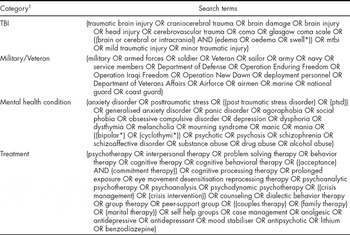
PubMed, PsychInfo and EMBASE were searched for articles published in English from January 1980 through October 2012, and related to the human species to gather relevant articles to answer the key question stated above. Table 1 presents the search strategy employed.
Search Strategy

1Terms in each category were joined by ‘AND’ in the search strategy.
Data were abstracted by a psychologist with experience related to mental health interventions for veterans with a history of TBI, and a research assistant with experience working on TBI-related research studies. All abstracts were reviewed by two ‘blind’ reviewers to determine whether they met inclusion criteria. Studies were included if they met the following study characteristics (PICOS):
• Population(s): Veterans or members of the military who have experienced TBI and a co-occurring mental health condition. Studies that do not differentiate between adult and child populations, or between veteran/military and civilian populations, were excluded. Studies that state a clear case definition for TBI that falls within the definitions provided by the VA/DoD Clinical Practice Guideline for Management of Concussion/Mild Traumatic Brain Injury (Management of Concussion/mTBI Working Group, 2009) were included.
• Intervention(s): Psychological, psychosocial and pharmacological interventions. Computer-based interventions were not included.
• Comparator(s): Similar populations that have not been diagnosed with TBI; comparison group not required for inclusion.
• Outcome(s): Mental health symptoms (i.e., PTSD symptoms, anxiety, depression, substance abuse, psychosis and mania).
• Setting: No limitations based on study setting.
Articles were included if the full text article was in English and the population was adult. Included articles presented original study data or were systematic reviews or meta-analyses. Studies must have had a sample size of 15 or greater. Only intervention studies were included and the article had to report a mental health outcome (as listed above). At the abstract review level, disagreements regarding inclusion criteria were resolved by including a third reviewer.
Full text was obtained for all articles that met inclusion criteria and those that did not were excluded. Full-text articles were reviewed by two ‘blind’ reviewers. If upon full-text review, it was determined that the article did not meet inclusion criteria (as noted above), it was excluded.
The authors searched for any additional studies via three methods. First, the authors reviewed the reference lists of all included articles. Second, the authors sent seven experts in the field of traumatic brain injury and mental health intervention the final list of included articles and asked them if they were aware of additional articles that were not included. Finally, the authors conducted a search of the grey literature according to the suggestions provided by GreyNet (www.greynet.org). The following sites were searched: Centre for Reviews and Dissemination, Clinical Medical and Health Research, SCIRUS, Sciverse Scopus, WorldWideScience.org, and the World Health Organisation. All articles identified through these methods that potentially met inclusion criteria were to be reviewed according to the process detailed above.
Studies that met inclusion criteria following full-text review were evaluated for risk of bias. Factors of interest included inconsistency, indirectness, imprecision and publication bias. Overall risk of bias and bias across studies was taken into consideration when rating the quality of the body of literature for each outcome of interest (Balshem et al., Reference Balshem, Helfand, Schunemann, Oxman, Kunz, Brozek and Guyatt2011). This was informed by the GRADE approach (Balshem et al., Reference Balshem, Helfand, Schunemann, Oxman, Kunz, Brozek and Guyatt2011). Data synthesis was not completed due to the small number of articles included in this systematic review. As such, summary measures and synthesis methods are not reported. A review protocol is available on the Veterans Integrated Services Network (VISN) 19 Mental Illness Research, Education and Clinical Center (MIRECC) website at http://www.mirecc.va.gov/visn19.
Results
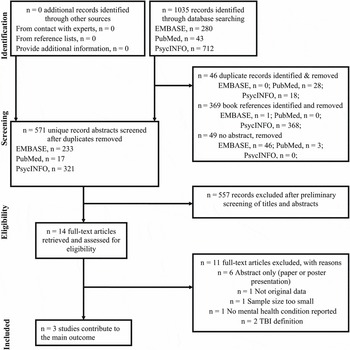
The authors reviewed 1035 article titles, 571 abstracts and 14 full-text articles. Each step of the search and review process is detailed in a four-phase flow diagram (Figure 1) developed by the PRISMA work group (Liberati et al., Reference Liberati, Altman, Tetzlaff, Mulrow, Gotsche, Ioannidis and Moher2009). Following the initial search, which yielded 1035 article citations, we excluded 46 duplicate articles and 369 book references. We also excluded 49 citations that did not have an abstract, as it was determined via consensus that it was very unlikely that any research articles describing original research would not have an abstract. The remaining 571 abstracts were reviewed with respect to the PICOS inclusion criteria described above. All abstracts that did not meet these criteria were excluded (n = 557). Following full text review of the remaining 14 articles, 3 met inclusion criteria. Full-text articles were excluded based on the definition of TBI used (or not described; n = 2), not being original research (n = 1), having a sample size of less than 15 (n = 1) or not reporting that participants had a mental health condition (n = 1). Six additional manuscripts were excluded once it was discovered that the citations were for abstracts from a paper or poster presentation (i.e., not a published research article; n = 6). Further searches through contact with experts, review of references and grey literature search did not yield additional articles.
Flow diagram.

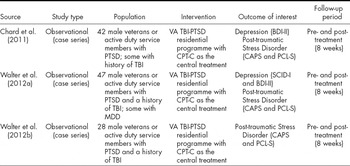
In Table 2, the study characteristics of the three articles that met inclusion criteria are presented. While all three articles reported on data collected in the same residential VA PTSD/TBI treatment programme, the articles varied with respect to purpose and findings; however, across articles it was unclear if unique participant data were utilised in the analyses conducted. Chard, Schumm, McIlvain, Bailey and Parkinson (Reference Chard, Schumm, McIlvain, Bailey and Parkinson2011) reported on the effectiveness of the programme with respect to outcomes related to depression and PTSD. Walter, Barnes and Chard (Reference Walter, Barnes and Chard2012a) explored the impact of presence or absence of MDD on depression and PTSD outcomes following treatment in the programme. Walter, Kiefer and Chard (Reference Walter, Kiefer and Chard2012b) looked as to whether or not veterans’ PTSD and post-concussive symptoms improved following treatment, and if a reduction in PTSD symptoms was associated with decreased post-concussive symptoms.
Study Characteristics

BDI-II, Beck Depression Inventory-II; CAPS, Clinician Administered PTSD Scale; CPT-C, Cognitive Processing Therapy-Cognitive; PCL-S, PTSD Checklist - Stressor Specific Version; SCID-I, Structured Clinical Interview for DSM-IV Axis I Disorders.
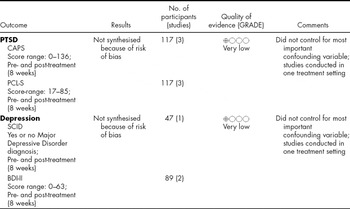
In Table 3, the summary of findings for the body of evidence, organised by mental health outcome, is presented. Because all three of these articles were observational studies, the body of evidence received an initial rating of ‘low’. Specifically, studies employed a single-arm design; as such there were no comparison groups. When considered as a body of evidence, the overall rating was determined to be ‘very low’ secondary to risk of bias present across these studies. The intervention evaluated was conducted in the context of a residential treatment programme with Cognitive Processing Therapy-Cognitive (CPT-C) being the primary EBT provided. Efforts to examine the impact of CPT-C in particular, while controlling for the potential impact of other components of the residential treatment were not employed. The rating of ‘very low’ was maintained following evaluation of indirectness (external validity). That is, the three investigations were conducted within the same VA residential treatment programme; thereby calling into question differences between the group studied and the overall population of interest (Guyatt et al., Reference Guyatt, Oxman, Kunz, Woodcock, Brozek, Helfand and Schunermann2011).
Summary of FindingsOutcomes in Evidence-based Intervention Strategies for Veterans with TBI and Co-morbid Mental Health Conditions Population: Veterans and military personnel with a history of TBI and co-morbid mental health condition Intervention: Psychological, psychosocial or pharmacological Comparator: Similar population without a history of TBI Outcome: Mental health symptoms Setting: No limitation

CAPS, Clinician Administered PTSD Scale; PCL-S, PTSD Checklist - Stressor Specific Version; SCID-I, Structured Clinical Interview for DSM-IV Axis I Disorders; BDI-II, Beck Depression Inventory-II.
Discussion
Findings from previous reviews (Fann et al., Reference Fann, Hart and Schomer2009; Soo & Tate, Reference Soo and Tate2009) reflect an overall paucity of evidence-based mental health treatments for civilians with TBI. The evidence-base for veteran and/or military population is also highly limited. The current systematic review identified only three publications meeting criteria for inclusion. Those investigations, while meritorious for beginning to establish an evidence base for veteran/military populations, ultimately yield collectively a quality of evidence that must be regarded as very low, based upon critical analysis.
As previously discussed, the three identified investigations feature important limitations when considering the quality of evidence. It is worth reiterating that each of these studies represents a worthwhile contribution to the medical literature, and they serve as initial steps in filling the current evidence-base void. Regarding limitations surrounding the present systematic review process, it is of course possible that existing investigations were not identified despite the rigorous methodology employed. Nevertheless, it seems unlikely that a substantial body of evidence that escaped detection exists, and we may safely conclude that there remains an urgent need for research in this area.
The paucity of evidence in this area has important implications for patients, providers and healthcare systems, particularly those serving veteran and military populations. Veterans and military personnel with a history of TBI and co-morbid mental health conditions are in need of treatment. In the absence of evidence-based treatments specific to veteran and military personnel with a history of TBI, it is appropriate to turn to the evidence derived from non-military/veteran populations. Systematic review in non-military/veteran populations (Fann et al., Reference Fann, Hart and Schomer2009) supports the use of serotonergic antidepressants and cognitive behavioural interventions in managing post-traumatic depression. Presumably, veterans and military personnel with a history of TBI experience neurotransmitter disturbances that are analogous to those experienced by civilians with TBI, such that similar psychopharmacological strategies and interventions may be employed. Prescribers treating veterans and/or military personnel with a history of TBI and co-morbid mental health conditions should be familiar with psychopharmacological principles and existing recommendations applicable to the general population (see Arciniegas & Silver, Reference Arciniegas, Silver, Silver, McAllister and Yudofsky2011). Cognitive behavioural interventions may also be useful in treating anxiety disorders experienced by veterans and/or military personnel with a history of TBI (Soo & Tate, Reference Soo and Tate2009).
In addition to treatment recommendations/guidelines derived from the general population, providers caring for veterans and/or military personnel with TBI and co-morbid mental health conditions should also be familiar with practice recommendations specific to these populations. Emblematic of such is the VA/DoD clinical practice guidelines for mTBI, PTSD and pain (National Center for Posttraumatic Stress Disorder, 2010). The consensus statement emphasises the appropriateness and importance of offering veterans with mild TBI the opportunity to engage in evidence-based treatments for PTSD, such as Prolonged Exposure and Cognitive Processing Therapy. Similarly, VA/DoD Clinical Practice Guidelines for Management of Concussion/mTBI (Management of Concussion/mTBI Working Group, 2009) stress that ‘treatment of psychiatric symptoms following concussion/mTBI should be based upon individual factors and the nature and severity of symptom presentation, and may include both psychotherapeutic and pharmacological treatment modalities’. Hence, a history of mTBI should not preclude the use of otherwise appropriate evidence-based treatment strategies for mental health conditions or symptoms.
History of moderate–severe TBI, however, is substantially more likely to yield neuronal injury that may complicate psychopharmacotherapy, with potentially heightened susceptibility to side effects. Moderate–severe injuries may also yield cognitive, emotional or behavioural impairments that may require modifications of psychotherapeutic interventions (Hsieh, Ponsford, Wong, & McKay, Reference Hsieh, Ponsford, Wong and McKay2012; Soo & Tate, Reference Soo and Tate2009). Chard et al. (Reference Chard, Schumm, McIlvain, Bailey and Parkinson2011) found that veterans with a history of moderate or severe TBI may receive more therapeutic benefit from Cognitive Processing Therapy than veterans with a history of mTBI; however, this finding has yet to be replicated. In the interim, it is recommended that modifications be made to treatment as indicated. Such modifications may include: extending therapy sessions, providing more frequent sessions, extending duration of treatment and offering ‘booster’ sessions (Olson-Madden, Brenner, Matarazzo, Signoracci, & Expert Consensus Collaborators, Reference Olson-Madden, Brenner, Matarazzo and Signoracci2013). In instances that require modifications, cautious approaches involving conservative initial dosing (start low and go slow) and/or consultation with providers experienced in brain injury medicine, rehabilitation and EBTs is appropriate.
Additional research to expand the evidence base is clearly needed. A cogent and relatively expedient way to do so may involve adapting proven therapies from the civilian sector to veterans/military populations, and then conducting research to establish the effectiveness of the adapted treatment programme. A contemporary example of such involves the adaptation of the Window to Hope (WtoH) programme to US veterans (Department of Veterans Affairs, 2012; Simpson, Tate, Whiting, & Cotter, Reference Simpson, Tate, Whiting and Cotter2011). The WtoH programme is a psychological intervention for treating chronic hopelessness among persons with moderate to severe TBI. WtoH remains the only evidence-based treatment of hopelessness and suicidal ideation for TBI survivors. Currently, an investigation at the VISN 19 MIRECC involves the adaptation of this programme, originally developed in Australian civilian populations, to US veterans, and is demonstrating its feasibility and efficacy in treating hopelessness among US veterans with moderate to severe TBI seeking care at VA.
Summary
There unfortunately exists very little in the way of evidence-based treatment options for veterans and/or military personnel with a history of TBI and co-morbid mental health conditions. The current systematic review reveals an extremely modest quantity and quality of evidence. But the current needs faced by our veteran and military populations with a history of TBI mandate proceeding with evidence-informed treatment despite the state of the science. Those charged with caring for such individuals may reasonably offer treatments based upon evidence derived from the civilian sector, or may turn to expert recommendations, guidelines and/or consensus statements. Particularly applicable are guidelines specifically developed for military or veteran populations, such as VA/DoD Clinical Practice Guidelines. Additional research is needed to expand the evidence base guiding the treatment of veterans and/or military personnel with a history of TBI and co-morbid mental health conditions.