INTRODUCTION
Several developments over the past 2 decades have major implications for corporate governance, which have become an important issue for academics, professionals, legislators, and international agencies. Many corporate scandals in various developed nations have been characterized by weak mechanisms of corporate governance. This has motivated research and analysis of the relationship between good corporate governance and firm performance.
From a theoretical perspective, several models argue that a proper governance structure reduces agency problems and conflicts of interest, generating value for the organization. However, the global financial and economic crisis has highlighted weaknesses in corporate governance, especially in the financial sector (Hilb, Reference Hilb2010; Smallman, McDonald, & Mueller, Reference Smallman, McDonald and Mueller2010). In this context, an international debate has arisen on the effectiveness of the executive incentive system to ensure that executives make decisions consistent with the shareholders’ interest and to achieve long-term sustainability performance (Galbreath, Reference Galbreath2012). In this respect, the European Commission (EC) (2010) suggests that the inappropriate compensation system established in the top executives has negatively affected the firms’ long-term viability and, consequently in the shareholders’ firm value.
In the last 2 decades, the relevance of variable pay schemes has considerably increased. Theoretically, the purpose of variable pay should be to align the interests of managers with the owners. However, the European Corporate Governance Forum remarks that ‘experience has shown that variable pay schemes have become increasingly complex and that in certain instances this has lead to excessive remuneration and manipulation’ (2009: 1). In this regard, the EC also highlights that ‘the remuneration policies in the financial sector, based on short-terms profits without taking into account the corresponding risks, contributed to the financial crisis’ (2010: 10).
The widespread public attention on executive compensation in financial sector suggests that the design of the compensation structure deserves closer scrutiny. Empirical studies (Adams & Mehran, Reference Adams and Mehran2003; John & Qian, Reference John and Qian2003; Kaplan & Rauh, Reference Kaplan and Rauh2010) have found evidence that the structure and evolution of executive compensation differ between financial and non-financial industries, which might be due to differences in the investment opportunities and the regulation between financial and non-financial industries. Nonetheless, the literature focused on financial firms and aspects of corporate governance, such as executive compensation, is still limited (Aebi, Sabato, & Schmid, Reference Aebi, Sabato and Schmid2012). This study attempts to contribute to the compensation research by providing an analysis on executive compensation and corporate performance in the financial sector.
Recent academic studies have examined whether flawed compensation structures in financial firms contributed to the most recent financial crisis (Faulkender, Kadyrzhanova, Prabhala, & Senbet, Reference Faulkender, Kadyrzhanova, Prabhala and Senbet2010). However, to date there is no consensus whether compensation policies were a critical driver of the financial crisis. Fahlenbrach and Stulz (Reference Fahlenbrach and Stulz2011) find that no evidence exists that banks with a better alignment of the executive's interests with those of the shareholders had higher stock returns during the crisis. Erkens, Hung, and Matos (Reference Erkens, Hung and Matos2009) show that Chief Executive Officer (CEO) compensation packages that rely more on annual bonuses, and less on long-term equitiy-based compensation, are associated with greater losses in financial firms during the crisis and higher risk taking before the crisis. Hau and Thum (Reference Hau and Thum2009) find that higher executive compensation is positively associated with bank losses. Minnick, Unal, and Yang (Reference Minnick, Unal and Yang2011) present evidence that banks with higher pay-performance sensitivity have significantly higher stock returns around the time of acquisitions announcements and align better the interests of the CEO with the interests of shareholders. These mixed results suggest that more rigorous investigation of compensation structures at financial sector is clearly needed.
This study extends the previous empirical evidence on compensation policy at financial firms focusing on the Spanish banking system, which has been in the brink of the collapse. In Spain, bank's executives have long been criticized for their high compensation received in companies with poor performance. The depth of the economic crisis in the Spanish financial institutions and the intervention and nationalization of several banking institutions (Royo, Reference Royo2013) are incoherent with the millionaire salaries and severance packages received by their executive managers. This fact raises questions about the influence of executives to define their own incentive schemes. In this context, sporadic studies have explored the relationship between the characteristics of board of directors and the level and structure of compensations (Manzaneque, Merino, & Banegas, Reference Manzaneque, Merino and Banegas2011) and between the economic performance and the ownership form of the bank (Crespí, García-Cestona, & Salas, Reference Crespí, García-Cestona and Salas2004; Grifell-Tatjé, Reference Grifell-Tatjé2011). However, research on the consistency between executive compensation and the corporate performance requires further development.
This study fills in this gap and examines how corporate performance has affected the executive pay in the Spanish banking system during the period 2004–2008. This work follows Jensen and Murphy (Reference Jensen and Murphy1990) and defines the relation between executive pay and performance as ‘pay-performance sensitivity’ which shows how compensation varies with measured performance. Consistent with the managerial power theory (Bebchuk, Fried, & Walker, Reference Bebchuk, Fried and Walker2002; Bebchuk & Fried, Reference Bebchuk and Fried2004), this study casts doubt on a linear relationship between executive pay and performance and aims to examine the pay-performance sensitivity depending on the sign of variation in bank performance. This study focuses on short executive pay (SEP), which does not include post-employment benefits or equity compensations benefits with the aim of providing robust results given the peculiarities of the financial institutions included in the sample and the limitation of public information, as well as avoiding that the research question could be biased by the possible effect of nonlinear association between stock options and firm performance (Hanlon, Rajgopal, & Shevlin, Reference Hanlon, Rajgopal and Shevlin2003; Devers, Cannella, Reilly, & Yoder, Reference Devers, Cannella, Reilly and Yoder2007).
This study contributes to research in several ways. First, it expands the managerial power theory because it introduces the variation of corporate performance and the ownership type as new factors in the general explanation of this theory. Second, it provides new empirical evidence related to a nonlinear relationship of the pay-performance sensitivity depending on the sign of the variation of the performance in Spanish banking system. Third, this study uses a rigorous methodology that is consistent with the presence of unobserved heterogeneity in each institution and controls endogeneity problems. Fourth, it advances the debate about whether the structure of executive compensation aligned the interest of managers and shareholders before and during the most recent financial crisis. Fifth it identifies new avenues for future research to advance the understanding of the relation between executive compensation and corporate performance.
This work is divided into five sections. After this introduction this study presents a literature review and the hypotheses. The third section includes information on the sample, variables, and the methodology used in estimating the models. Section four presents the results and the final section offers the main conclusions.
LITERATURE REVIEW AND HYPOTHESES
The relationship between executive compensation and company performance has been widely analysed from theoretical and empirical perspectives. Agency theory (Jensen & Meckling, Reference Jensen and Meckling1976; Fama & Jensen, Reference Fama and Jensen1983) argues that the incentives of managers can be aligned with the objectives of the shareholders through the design of a contract that links the compensations of executives with business results (Evans & Weir, Reference Evans and Weir1995). However, Zingales (Reference Zingales1998) remarks that it is impossible to perfect a priori contract that fairly shares quasi-rents generated by a company to all its stakeholders, including executives and shareholders, and this quasi-rents will be captured by those groups with the most bargaining power.
This controversy is extended to empirical works (Sánchez-Marín, Baixauli-Soler, & Lucas-Pérez, Reference Sánchez-Marín, Baixauli-Soler and Lucas-Pérez2010). On the one hand, most of the studies have revealed a statistically significant positive relationship between changes in the wealth of shareholders and the compensations of executives (Jensen & Murphy, Reference Jensen and Murphy1990; Murphy, Reference Murphy1999; Conyon & Schwalbach, Reference Conyon and Schwalbach2000; Lee, Lee, & Wu, Reference Lee, Lee and Wu2010) and this relationship is consistent with agency theory. On the other hand, other studies offer evidence for the existence of a negative or negligible relationship between performance and the compensations of executives, concluding that managers put its own interests before the aims of the company owners (Core, Holthausen, & Larcker, Reference Core, Holthausen and Larcker1999; Duffhues & Kabir, Reference Duffhues and Kabir2008).
Devers et al. (Reference Devers, Cannella, Reilly and Yoder2007) argue that the mixed findings that pervade the field may result from a narrow focus that failed to incorporate other theoretical perspectives and methodologies. Recent theoretical developments have expanded agency theory explanations of the incentive alignment construct (Nyberg, Fulmer, Gerhart, & Carpenter, Reference Nyberg, Fulmer, Gerhart and Carpenter2010). In this vein, managerial power theory states that boards of directors approve compensation schemes that deviate from optimal contracting, since directors are subject to influence by management or are ineffective in overseeing managerial behaviour. As a result, top executives may camouflage or extract corporate rents by means of inefficient pay structures which are more in the interest of executives than shareholders. However, the evidence regarding the impact of CEO power on their compensations is insufficient and requires further studies (Tien, Chen, & Chuang, Reference Tien, Chen and Chuang2013).
Accordingly to the argument that top executives generally prefer a higher level of compensation that is less contingent upon performance, managerial power theory states that top executives have influence over the board of directors to approve compensation contracts that are more favourable to receive higher levels of pay and less sensitive to performance (Shin, Reference Shin2013). In a recent meta-analysis (Van Essen, Otten, & Carberry, Reference Van Essen, Otten and Carberry2012) on existing empirical studies focused on the managerial power theory, Van Essen, Otten, and Carberry. (Reference Van Essen, Otten and Carberry2012) conclude that top executives with greater power tend to receive higher levels of total pay and total compensation. However, the authors find that the results for performance-pay sensitivities provide less support for managerial power theory. Van Essen, Otten, and Carberry (Reference Van Essen, Otten and Carberry2012) explain that this unexpected finding could be due to the existence of a nonlinear relationship between CEO pay and performance, since the number of studies investigating nonlinear relationships is relatively limited.
Recently, few scholars (Leone, Shuang, & Zimmerman, Reference Leone, Shuang and Zimmerman2006; Canarella & Nourayi, Reference Canarella and Nourayi2008) have challenged the linear relationship between executive compensation and performance, and have examined a nonlinear and asymmetric influence of performance on compensations, depending on whether the company is profitable or not. Yet no theoretical or empirical consensus exists on how this asymmetry is reflected. Canarella and Nourayi (Reference Canarella and Nourayi2008) conclude that, from an accounting approach, a positive return by a company has a positive influence, although the executives are rewarded to greater extent for a positive return than they are penalized for a negative return. Leone, Shuang, and Zimmerman (Reference Leone, Shuang and Zimmerman2006) suggest that the salaries of managers are more sensitive to losses than to expected but unrealized profits. The authors state that these results are in line with the theoretical approach of the optimal contract. This approach is based on the idea that the implementation of an optimal contract reduces agency costs in relation to the expropriation of income from shareholders by the executives. Therefore, if the compensations of executives were more sensitive to expected profits than losses (the opposite case to that evidenced) then the executives may be rewarded for profits that do not finally appear. If the compensation were not reimbursed then an ex post settling up problem would be created.
While the limited previous studies have analysed the asymmetric influence of firm performance on executive compensations, depending on whether the company is profitable or not, none of these has considered a nonlinear relationship of the pay-performance sensitivity depending on the variation of corporate performance. This study sets its aim in this underdeveloped area of investigation in order to advance the debate about whether the structure of executive compensation aligned the interest of managers and shareholders before and during the most recent financial crisis.
The financial crisis has revealed weaknesses in the pay-setting process in the financial institutions since compensation schemes did not help mitigate agency problems and failed to closely align the interests of executives and shareholders (Faulkender et al., Reference Faulkender, Kadyrzhanova, Prabhala and Senbet2010). According to this argument, this study expands the explanation of the managerial power theory. This study states that whether the board of directors does not effectively oversee the design of incentive systems, the managers will have important influence over the compensation arrangements in order to serve their own interests rather than shareholders. In this case, it is expected that the pay-performance sensitivity is greater when the variation in the corporate performance is positive than when the variation is negative. Consequently, this study tests the existence of a nonlinear relationship that is asymmetrical in terms of pay-performance sensitivity to the sign of variation in bank performance. Accordingly, the following hypothesis is presented:
Hypothesis 1 : The SEP presents an asymmetric positive relationship with performance, since the SEP is more sensitivity with respect performance when the variation in performance is positive than when the variation in performance is negative with respect the previous year.
In this context, several empirical studies have estimated an econometric model where the explanatory variables are contemporary related with the explanatory variables. However, the assumption of not considering the dynamic behaviour of economic variables has been widely refuted. It is argued that the relationship between compensations and company profits is not only contemporary (Murphy, Reference Murphy1999; Duffhues & Kabir, Reference Duffhues and Kabir2008). Moreover in the short-term executive pay is taken into account the profit-sharing and bonuses if they are paid within 12 months of the end of the period. Therefore, the following hypothesis is proposed:
Hypothesis 2 : The SEP is influenced by current performance and the performance of the previous year.
It is also argued that the executive compensation is persistent over time, which makes this variable dependent on its own past. Canarella and Nourayi (Reference Canarella and Nourayi2008) and Lilling (Reference Lilling2006) incorporated the first lag of the dependent variable in the equation and concluded that there was a positive and significant relation between the variable and the first lag. Consequently, the following hypothesis is expected:
Hypothesis 3 : The contemporary executive pay is positively related to pay of the previous period.
In the Spanish banking system there are important differences in the corporate governance between commercial banks and savings banks. Commercial banks are privately owned institutions with a concentrated ownership structure and with a strong shareholder control (shareholder-oriented approach). Spanish savings banks are commercial non-profit organizations (Hansmann, Reference Hansmann1996), which have no owners or shareholders and are controlled by multiple interest groups: local and regional governments, employees, depositors and their founding entities (stakeholder-oriented approach). Several authors (Crespí, García-Cestona, & Salas, Reference Crespí, García-Cestona and Salas2004; García-Marco & Robles-Fernández, Reference García-Marco and Robles-Fernández2008; Sagarra, Mar-Molinero, & García-Cestona, Reference Sagarra, Mar-Molinero and García-Cestona2013), have argued that the dispersed ownership structure and the lack of shareholder control of the savings banks could give managers more freedom of action and leave much room for abuse and corrupt practices. Therefore, according to managerial power theory, executive managers of Spanish savings banks have more power over the board of directors to negotiate for higher pay than executive managers of commercial banks. In this case, the following hypothesis is suggested:
Hypothesis 4 : The SEP in the Spanish savings banks is higher than the commercial banks.
SAMPLE, VARIABLES OF THE MODEL, AND METHODOLOGY
Sample
The sample includes banks and savings banks issuing securities admitted to trading on regulated markets from Spain for the period 2004–2008. According to the Spanish Securities and Investments Board, 22 banks and 42 savings banks are required to publish an annual corporate governance report (CNMV, 2008). Credit cooperatives were not considered because of their low market share in the Spanish banking sector.
Data for the top executive pay has been extracted from the annual accounts and the annual corporate governance report for each bank. Additionally, the financial information from 2000 to 2007 for each bank has been obtained from Intertell database. The financial information for the year 2008 has been gathered from the annual accounts published by Spanish Securities and Investments Board. However, this information was collected until May 2009 and in this date 11 banks had not yet published their accounts, therefore, some information is missing.
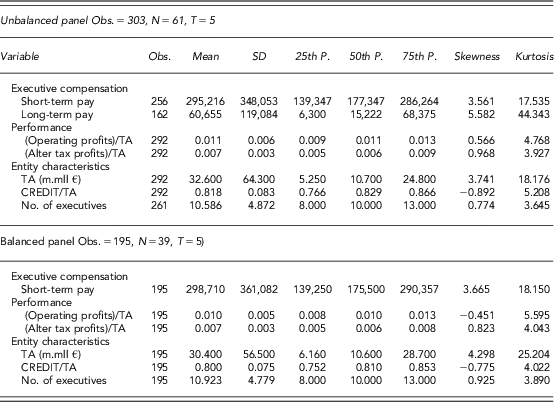
The available information was used to construct an unbalanced panel of 61 banks (22 banks and 39 savings banks), which represents ~95% of the sample. After removing those financial institutions that did not have all the data and establishing that it is needed 5 years of continuous data, the final sample was a balanced panel of 195 observations for nine banks and 30 savings banks, which represents 61% of sample. Table 1 shows the descriptive statistics of the data included in each panel. In general, the data analysed does not show a normal distribution. Variables such as SEP and total assets are characterized by positively asymmetrical distribution and high kurtosis.
Descriptive statistics

The table shows the descriptive statistics of the data included in unbalanced and balanced panel.
Variables
This article uses the panel data methodology since this study has the cross-sectional and time-series data available. The models use the subscript ‘i’ ‘t’ to refer to a given variable corresponding to the ith bank at time t. Following previous studies (Perry & Zenner, Reference Perry and Zenner2001; Lilling, Reference Lilling2006; Canarella & Nourayi, Reference Canarella and Nourayi2008; Duffhues & Kabir, Reference Duffhues and Kabir2008; Vander Bauwhede, Reference Vander Bauwhede2009; Barontini & Bozzi, Reference Barontini and Bozzi2011; Shiwakoti, Reference Shiwakoti2012), the neperian logarithm of executive compensation (ln(SEPi,t)) is used as the dependent variable of the model. As presented above, the executive compensation variable is measured by SEP. This variable includes the following concepts: wages, salaries and social security contributions, paid annual leave and paid sick leave, profit-sharing and bonuses (if payable within 12 months of the end of the period) and non-monetary benefits (such as medical care, housing, cars and free or subsidized goods or services) for current executives (International Accounting Standards IAS 11, 2003: 138). Following this definition, SEP does not include post-employment benefits or equity compensation benefits for four reasons. The first reason is to homogenize the variable regarding executive compensation, since the savings banks are not listing on the stock market and therefore the stock options are not applicable. Moreover, the SEP represents a high percentage (83%) over the total executive pay. The third reason is due to the limitation in the public information available about long-term executive pay since the 37% of the analysed sample does not mention the long-term executive pay in their annual accounts. The fourth reason is not to consider the possible effect of nonlinear associations between stock options grants and firm performance (Hanlon, Rajgopal, & Shevlin, Reference Hanlon, Rajgopal and Shevlin2003; Devers et al., Reference Devers, Cannella, Reilly and Yoder2007), since the inclusion of the equity compensations in the applicable institutions (banks represents 23% of the sample) could bias the results of this study.
An explanatory variables included in the model is the performance of the bank (Pi,t). This variable can be used as a proxy for the operating margin per unit of total assets, or for after-tax profits per unit of asset; although the latter would mean taking into account operating profits, as well as extraordinary profits, or losses and discretionary provisions. Following Core, Holthausen, and Larcker (Reference Core, Holthausen and Larcker1999), Duffhues and Kabir (Reference Duffhues and Kabir2008), Iannotta, Nocera, & Sironi (Reference Iannotta, Nocera and Sironi2007) and the proxy used for the performance variable for each bank is the operating margin ratio divided by total assets, because this margin is the most faithfully reflects the performance of a bank. This study uses accounting ratios-based measures of performance because market-based performance measures cannot be applied in the majority institutions of the sample. Spanish savings banks do not issue shares, since they do not have owners or shareholders. Additionally, accounting-based measures reflect current performance, whereas market-based measures reflect investor's perceptions of future value (Devers et al., Reference Devers, Cannella, Reilly and Yoder2007).
Another variable is the ‘SUBINDUSTRYi,t’ which is defined by the two different ownership types examined in this study. Following previous studies (Crespí, García-Cestona, & Salas, Reference Crespí, García-Cestona and Salas2004; García-Marco & Robles-Fernández, Reference García-Marco and Robles-Fernández2008), a dummy variable is used to reflect the differences between the Spanish savings banks and commercial banks. This dummy variable takes a value of 1 for Spanish savings banks and 0 for commercial banks.
Despite the numerous recommendations (Comisión Conthe, 2006; EC, 2009) to increase the transparency of compensations for executives and directors as a measure against excessive salaries, the public information about compensations of executive remains partial. The salaries received by a bank's key personnel are published as a global amount. In addition to this limitation in the information, the banks do not follow uniform criteria regarding the posts listed, nor do they list the roles played by key personnel. Furthermore, comparison is made more difficult because this variable shows a wide range in the sample used. Therefore, given the public information available, the dependent variable has been calculated dividing SEP by the number of executives that the bank lists as key personnel. In this regard, with the aim of controlling the fact that the average compensations of executives decrease as the number of key personnel increase, this study has included in the model the number of key personnel (NEi,t). Moreover, the differences in compensations among key personnel are lower in posts with lesser responsibilities and may even reach a minimum; therefore, this study has also introduced the squared in the number of executives (NEi,t 2) in the model.
With respect to other control variables, this study follows Andres and Vallelado (Reference Andres and Vallelado2008) and employs two measures related to banking business: the neperian logarithm of total assets (TAi,t) as an indicator of size; and the volume of credits granted per unit of total assets (CREDITi,t) as a proxy of banking activity. The efficiency of risk management is also included in the model. To this end, this study uses a dummy variable indicator of banks authorized by the Bank of Spain (MA_RISKi,t) to implement the ‘internal ratings-based’ approach, because these banks, according to Basel II (Basel Committee on Banking Supervision (BCBS), 2004), must have advanced management systems and risk measurement in place. Additionally, this study uses dummy variables for different years (YEARt).
Methodology
As indicated by Gibbons and Murphy (Reference Gibbons and Murphy1990) agency theory suggests that the compensations of executives are related to performance in absolute or relative terms. This work has started from equation (1), which is a widely used model in the literature (Murphy, Reference Murphy1985; Jensen & Murphy, Reference Jensen and Murphy1990) that links executive compensation with the performance of a bank.
 $$\ln {{(SEP)}_{i,t}}\, = \,{{{\rm{\beta }}}_{\rm{0}}}\, + \,{{{\rm{\beta }}}_{\rm{1}}}\,\times \,{{P}_{i,t}}\, + \,{{{\rm{\beta }}}_{\rm{2}}}\,\times \,{{P}_{i,t{\rm{ - 1}}}}\, + \,\mathop{\sum}\limits_{j\, = \,{\rm{1}}}^J {{{{\rm{\lambda }}}_j}} \,\times \,V.CONTRO{{L}_{i,t}}\, + \,{{u}_{i,t}}$$
Model (1) from a time dimension focus includes the first lag corresponding to an exogenous variable. This feature does not breach the basic hypothesis of the general linear model because all the explanatory variables remain deterministic. However, the cross-sectional and temporal nature of data means that consideration must be given to the existence of latent unobservable effects specific to each individual. If these effects are not considered explicitly in the model, the estimated coefficients of the explanatory variables will be biased, as they reflect some of the unobservable effects of each individual (Novales, Reference Novales2000).
 $${ \ln (SE{{P}_{i,t}})\, = \, {{{\rm{\beta }}}_{\rm{0}}}\, + \,{{{\rm{\beta }}}_{\rm{1}}} \cdot {{P}_{i,t}}\, + \,{{{\rm{\beta }}}_{\rm{2}}} \cdot {{P}_{i,t{\rm{ - 1}}}}\, + \,{{{\rm{\beta }}}_{\rm{3}}} \cdot SUBINDUSTR{{Y}_{i,t}} \cr \quad + {{{\rm{\beta }}}_4} \cdot N{{E}_{i,t}}\, + \,{{{\rm{\beta }}}_{\rm{5}}} \cdot NE_{{_{{i,t}} }}^{{\rm{2}}} \, + \,{{{\rm{\beta }}}_{\rm{6}}} \cdot \ln {{(AT)}_{i,t}}\, + \,{{{\rm{\beta }}}_{\rm{7}}} \cdot CREDI{{T}_{i,t}} \cr \quad + {{{\rm{\beta }}}_{\rm{8}}} \cdot MA\_RIS{{K}_{i,t}}\, + \,\mathop{\sum}\limits_{J\, = \,{\rm{1}}}^4 {{{{\rm{\lambda }}}_J}} \cdot YEA{{R}_t}\, + \,{{{\rm{\eta }}}_i}\, + \,{{{\rm{\upsilon }}}_{it}} \cr}$$
Equation (2) specifies the general econometric model of this work, where the error term is divided (υi,t) into two components: the individual effects (ηi) which include the effect of non-observable variables in each bank, constant over time, and the stochastic disturbance. Traditionally, two transformations have been used of equation (2) to eliminate the problem of unobserved heterogeneity: deviations from the group averages (within estimator) and time differences (Gibbons & Murphy, Reference Gibbons and Murphy1990; Perry & Zenner, Reference Perry and Zenner2001).
Most studies assume that the explanatory variables of the model are exogenous as their values are taken as given, and so remain uninfluenced by the variable to be explained. However, in our model this hypothesis runs contrary to the empirical evidence, because from an accounting point of view, bank profit is affected by the salary costs of all employees (temporary and permanent). In this regard, recent studies suggest that analysing the behaviour of some corporate governance variables in isolation may not be appropriate (Andres & Vallelado, Reference Andres and Vallelado2008). Additionally, empirical evidence shows that the compensations of the executives are persistent over time. Based on model (2), a lagged-dependent variable is introduced and the result is the model (3). In this model, this study tests the hypothesis H03 by analysing the sign and the significance of the coefficient of the delayed dependent variable.
 $${ \ln (SE{{P}_{i,t}})\, = {{{\rm{\beta }}}_{\rm{0}}}\, + \,{{{\rm{\beta }}}_{\rm{9}}} \cdot \ln (SE{{P}_{i,t{\rm{ - 1}}}})\, + \,{{{\rm{\beta }}}_{\rm{1}}} \cdot {{P}_{i,t}}\, + \,{{{\rm{\beta }}}_{\rm{2}}} \cdot {{P}_{i,t{\rm{ - 1}}}}\, + \,{{{\rm{\beta }}}_{\rm{3}}} \cdot SUBINDUSTR{{Y}_{i,t}} \cr \quad+ \,{{{\rm{\beta }}}_{\rm{4}}} \cdot N{{E}_{i,t}}\, + \,{{{\rm{\beta }}}_{\rm{5}}} \cdot NE_{{_{{i,t}} }}^{{\rm{2}}} \, + \,{{{\rm{\beta }}}_{\rm{6}}} \cdot \ln {{(AT)}_{i,t}}\, + \,{{{\rm{\beta }}}_{\rm{7}}} \cdot CREDI{{T}_{i,t}} \cr \quad+ {{{\rm{\beta }}}_{\rm{8}}} \cdot MA\_RIS{{K}_{i,t}}\, + \,\mathop{\sum}\limits_{J\,{\rm{ = }}\,{\rm{1}}}^4 {{{{\rm{\lambda }}}_J}} \cdot YEA{{R}_t}\, + \,{{{\rm{\eta }}}_i}\, + \,{{{\rm{\upsilon }}}_{it}} \cr}$$
In model (3) it is assumed that the relationship between the compensations of executives in logarithms and the performance of the bank is linear. By following Leone, Shuang, and Zimmerman (Reference Leone, Shuang and Zimmerman2006), this study proposes model (4) in order to test the nonlinearity and the existence of asymmetry in the relationship between the variations in performance and SEP, depending on whether the company performances were better or worse than the previous year (hypothesis H01).
 $${ \ln (SE{{P}_{i,t}})\, = {{{\rm{\beta }}}_{\rm{0}}}\, + \,{{{\rm{\beta }}}_{\rm{9}}} \cdot \ln (SE{{P}_{i,t{\rm{ - 1}}}})\, + \,{{{\rm{\beta }}}_{\rm{1}}} \cdot {{P}_{i,t}}\, + \,{{{\rm{\beta }}}_2} \cdot {{P}_{i,t{\rm{ - 1}}}}\, + \,{{{\rm{\alpha }}}_1} \cdot {{P}_{i,t}} \cdot {{N}_{i,t}}\, + \,{{{\rm{\alpha }}}_{\rm{2}}}{{P}_{i,t{\rm{ - 1}}}} \cdot {{N}_{i,t{\rm{ - 1}}}} \cr \quad + \,{{{\rm{\beta }}}_{\rm{3}}} \cdot SUBINDUSTR{{Y}_{i,t}}\, + \,{{{\rm{\beta }}}_{\rm{4}}} \cdot N{{E}_{i,t}}\, + \,{{{\rm{\beta }}}_{\rm{5}}} \cdot NE_{{_{{i,t}} }}^{{\rm{2}}} \, + \,{{{\rm{\beta }}}_{\rm{6}}} \cdot \ln {{(AT)}_{i,t}} \cr \quad + \,{{{\rm{\beta }}}_{\rm{7}}} \cdot CREDI{{T}_{i,t}}\, + \,{{{\rm{\beta }}}_{\rm{8}}} \cdot MA\_RIS{{K}_{i,t}}\, + \,\mathop{\sum}\limits_{J\, = \,{\rm{1}}}^4 {{{{\rm{\lambda }}}_J}} \cdot YEA{{R}_t}\, + \,{{{\rm{\eta }}}_i}\, + \,{{{\rm{\upsilon }}}_{it}} \cr}$$
where Ni,t is the dummy variable that indicates negative variations, respectively, in the performance of the ith bank between two consecutive periods. That is:
 $$ {{N}_{i,t}}\, = \:\left\{{\matrix{ \rm{0} \ \ {\it si} \ \ {{{\it P}_{\it i,t}}{{ - }}{{\it P}_{\it i,t{\rm{ - }}1}}\geq 0} \cr \!\!\!{\rm{1}} \ \ {si} \ \ \ {{{P}_{i,t}}{\rm{ - }}{{P}_{i,t{\rm{ - }}1}} \less 0} \right. $$
This dummy variable is multiplied by the corresponding performance. In this way, equation (4) introduces two variables that reflect the negative variations in performance between the periods t−1, t and t−2, t−1. Specifically, this study uses a characteristic (the sign of the variation in performance) to define the two regimes of behaviour, and in this way, it should improve the linear approximation.
In this context, the lag in the SEP is introduced as an explanatory variable, and this becomes related to the lag of the error term, so resulting in inconsistent estimates for both the within estimator and the first-difference estimator. An alternative method to avoid the discussed estimation problems for autoregressive models is to use an instrumental variable approach. Following the steps of Canarella and Nourayi (Reference Canarella and Nourayi2008) and Lilling (Reference Lilling2006), this study applied the generalized method of moments (GMM). Various forms of GMM estimators are feasible, depending on the definition of the conditions relative to the moments. Arellano and Bond (Reference Arellano and Bond1991) proposed the GMM difference estimator. It takes advantage of all the conditions of lineal moments arising from the assumption of non-correlation with the error term.
Blundell and Bond (Reference Blundell and Bond1998) demonstrated one of the limitations of this estimator by showing that if the autoregressive parameter is close to unity and there are few time periods, then simulations will produce estimates with a large bias in finite samples and coefficients that are imprecisely calculated. To overcome their weakness as instruments with variable lags at various levels, Arellano and Bover (Reference Arellano and Bover1995) and Blundell and Bond (Reference Blundell and Bond1998) proposed the system-GMM estimator. This estimator implies an additional restriction on the initial process conditions, so that all the available moments can be exploited through a system that uses lags in differences and levels of the dependent variable as instruments of the equation in levels and differences, respectively.
This article uses the system-GMM that has been implemented using a two-step estimator, so that estimates are efficient and asymptotically robust in the presence of heteroscedasticity. Additionally, standard second-stage error correction as proposed by Windmeijer (Reference Windmeijer2005) for small samples is applied.
RESULTS
Two-step GMM-system estimator
In this section, the results have been obtained using the sample which is derived from the balanced panel, where data for 5 consecutive years for each bank is available. Arellano and Bond (Reference Arellano and Bond1991) state that this is essential for testing errors are not second-order serial autocorrelation, condition necessary to ensure the robustness of the estimates.
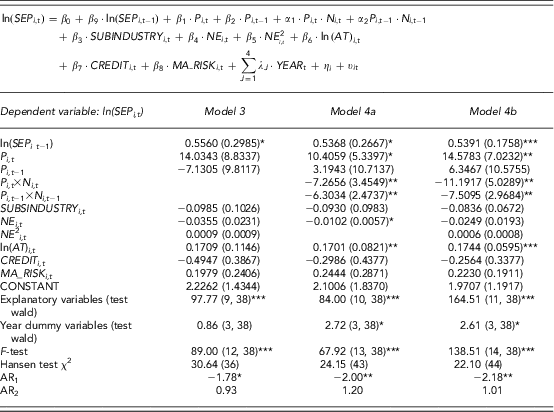
Table 2 shows the results of the estimation of the system-GMM models (3) and (4).Footnote 1 This section focuses directly on model (4b) because the variables that reflect the asymmetry are statistically significant. If only the contemporaneous year is considered, it appears that there is a positive relationship between SEP and performance. Furthermore, the pay-performance sensitivity is asymmetrical regarding the variation of the performance because whether the variation in the performance of the bank is positive there is greater sensitivity (β1 = 14.5783) to performance than when the variation is negative (β1 + α1=3.3866). This difference in the pay-performance sensitivity depending on the sign of the variation of performance calls into question the role of the pay-performance incentives to align interest of executives and shareholders. This result supports the hypothesis H01 and is consistent with the managerial power theory, which states that executives may influence the pay-setting process in their own interests.
GMM-system estimator
Model (3) and (4).
The table reports the two-step GMM system estimator. The dependent variable is executive compensation (ln(SEPi,t)). Explanatory variables are: contemporary and first lag of performance (Pi,t, Pi,t −1), negative variations in performance between t-1, t (Pi,t×Ni,t), negative variations in performance between t-2, t-1 (Pi,t −1×Ni,t −1), ownership type (SUBINDUSTRYi,t) and the control variables that measure: number of executives (NEi,t), number of executives squared (NE 2i,t) bank business (ln(AT)i,t ,CREDITi,t ,,MA_RISKi,t)
Standard errors with the robust adjustment for small samples proposed by Windmeijer (2005) are in brackets. Statistically significant at 1%(***), 5%(**) and 10%(*).
The findings show that the compensations of executives are affected by the current performance. However, surprisingly the direct influence on compensations of the performance of the previous period is not clear, therefore, this study cannot provide clear evidence regarding the hypothesis H02. It could mean that the executive has been motivated to make decisions based in the improvement of the immediate corporate performance.
The estimate of the coefficient for the lag of the variable dependent is 0.5391 and statistically significant. Thus, the hypothesis H03 is confirmed and, this study finds evidence in the sample examined that the executive compensation is persistent over time, which makes this variable depend on its own past.
Surprisingly, this study does not find enough evidence to support the idea that Spanish savings banks have more power over the board of directors to negotiate for higher pay than executive managers of commercial banks. Therefore, the results reject the hypothesis H04. It could be due to the limited and unbalanced sample of banks respect to savings banks of this study. Large samples of banks are clearly needed to test the robustness of this result.
The control variables generally show the expected sign although they are not statistically significant, with the exception of the variable size which is statistically significant and positively related to the executive pay.
Validation of the results
The data used for the estimations in the previous sections is shown in nominal terms. However, this work has repeated the empirical study using data in real terms and the results are similar to those discussed above. To this end, the data for economic variables has been deflated using the general index of consumer prices published by the Spanish national institute of statistics with 2004 as the base year. The analysis has also been repeated using the methodology proposed by Arellano and Bover (Reference Arellano and Bover1995) applied in unbalanced panel. The signs of the variables have not generally changed – and the values of the coefficients have not altered substantially.Footnote 2
Additionally, Table 2 shows the joint statistical significance and validation of instruments for each regression. The Wald test was used in all the estimates to reject the null hypothesis that the variables are jointly equal to zero. The Hansen over-identification test was made on models (3) and (4) and revealed that this study cannot reject the null hypothesis of validity of the instruments being used to control the problem of endogeneity. Focusing on the autocorrelation test, this study cannot reject the null hypothesis that errors are not second-order serial autocorrelation. These results do not reject the validity of the results of the empirical study.
CONCLUSION AND DISCUSSION
The recent controversy over the excessive executive pay associated with the corporate scandals and the financial crisis has called into a question the effectiveness of the executive incentive system to ensure that executives make decisions consistent with the shareholders’ interest. In this context, this paper contributes to this debate by providing empirical evidence regarding the relationship between executive pay and corporate performance in the Spanish banking sector. In particular, the aim is to examine the pay-performance sensitivity depending on the sign of variation in bank performance.
From a theoretical point of view, this study expands the explanation of the managerial power theory which states that top executives may influence the pay-setting process to approve compensation schemes that are more favourable to executives than shareholders. In accordance with this reasoning, this study suggests that executives may have influence to change the pay-performance sensitivity in their own interests depending on the sign of the variation of the performance.
From a methodology perspective, the article discusses the novel use of GMM that controls endogeneity problems and is consistent with the presence of unobserved heterogeneity in each bank. Given the small sample size, this study additionally implements standard Windmeijer error correction.
The main results reveal that SEP is positively associated with contemporaneous corporate performance, as well as present an asymmetric relationship in terms of sensitivities. The asymmetry in the pay-performance sensitivity is greater when the variation in results is positive than when the variation of the results is negative. This result is consistent with the managerial power theory and calls into question the role of the pay-performance incentives to align interest of executives and shareholders.
Regarding practical implications, the paper reveals that in spite of the numerous international recommendations in related to increase openness in executive compensation, there are numerous limitations in obtain public information about the compensations, mainly in long-terms executives pay and in individual terms, and without this information the shareholder and the rest of stakeholders can not control over excessive executive remuneration. Moreover, the results suggest that the board of directors and banking regulation should improve the supervision on the executive pay-setting process with the aim of ensuring that pay-performance incentive fulfils its purpose to align the interest of executive and shareholders.
This study has limitations that might open new areas for future research. The results of this study might be limited by the sample, the availability of information and the variables used in the empirical models. Future studies could move beyond Spanish savings banks and commercial banks to focus on cross-national studies to identify best practices and explore how context shapes managerial practices. In addition, the differences in incentive systems between Spanish savings banks and commercial banks could be further explored. To test the robustness of this study, future works should use more finely grained measurements of executive pay and could examine the nonlinear relationship between performance and the four pay components: salary, bonus, equity participation and post-employment compensations. Moreover, this study could be extended to pay-volatility sensitivities which would be another fruitful avenue for new and interesting theoretical and empirical developments. Finally, this study encourages further research on the question whether the compensation structures in financial firms contributed to the instability, excessive risk-taking, and the most recent global financial crisis.
Acknowledgement
The authors wish acknowledge the financial support received from grant E-2010-48 and projects P1 1B2010-13 and P1 1B2010-04 through the Universidad Jaume I.