Introduction
Around the globe, entrepreneurship and self-employment have been promoted as means to enhance national and regional economic sustainability (cf., Millán, Congregado, & Roman, Reference Millán, Congregado and Roman2014), as a means of contributing to economic growth, job creation and innovation (Blanchflower, Reference Blanchflower2000; Nesheim, Reference Nesheim2003; Carlsson, Acs, Audretsch, & Braunerhjelm, Reference Carlsson, Acs, Audretsch and Braunerhjelm2009; Van Stel & De Vries, Reference Van Stel and de Vries2015). Self-employment may include a wide range of actors, selling goods or offering labour, such as ‘business owners with employees, craft workers, traders, farmers, traditional independent professionals, such as doctors and lawyers, skilled workers, and workers in unskilled occupations’ (Annink & Den Dulk, Reference Annink and Den Dulk2012: 384). Regarding the solo self-employed, those without (paid) employees, a distinction can be made between ‘voluntarily self-employed’ and ‘involuntary self-employed’ (Hughes, Reference Hughes2003). Besides variations in personal drivers and circumstances, the solo self-employed may also be faced with different business contexts. In this paper, we take a broad definition of modes of self-employment and include the range of (solo) self-employed actors. Self-employment has recently sparked scholarly interest, for example, in why individuals choose and remain in self-employment (Millán, Congregado, & Roman, Reference Millán, Congregado and Roman2014; Patel & Thatcher, Reference Patel and Thather2014). However (solo), self-employment is still an underresearched field and the picture emerging from the literature suggests that the ‘blessings’ of self-employment are not unambiguous. In scholarly and societal debates, self-employment is often presented as a means to enhance life choices and balance in line with personal values. It can create an ideal environment in which individuals can optimise the subjective and objective consequences for their careers and enable them to combine work and nonwork activities in more satisfactory ways. However, the psychological and management literatures on self-employment and the work–life interface (including work–life balance, health and well-being, and work, career, family and life satisfaction) provide us with a somewhat haphazard collection of paradoxical and sometimes seemingly contradicting results, raising more questions about why individuals choose (or are forced into) and remain working as self-employed instead of choosing a traditional mode of employment.
A more holistic multi-level framework, which transcends and integrates individual issues, like work–life balance and job satisfaction, and which includes explanatory factors originating at multiple analytical levels into a comprehensive theoretical perspective would benefit the research field(s) of (solo) self-employment. Relatively, little scholarly attention has been paid to how the self-employed enact and experience their working and nonworking lives, how they manage the relationship between them and how this impacts their work–life interface (including work–life balance, health and well-being, and work, career, family and life satisfaction), which may be influential in whether they remain in self-employment (DeTienne, Reference DeTienne2010; Gorgievski, Bakker, Schaufeli, Van der Veen, & Giesen, Reference Gorgievski, Bakker, Schaufeli, Van der Veen and Giesen2010). We aim to contribute to the scholarly and societal debates on self-employment and the work–life interface, by presenting an integrated and multi-level theoretical model that helps to understand how the interplay of contextual factors creates both opportunities and tensions that impact the work–life interface of self-employed workers. Our theoretical study aims to contribute to the field of self-employment and the work–life interface in several ways.
First, in order to disentangle the complex web of factors at multiple analytical levels that may push individuals towards or pull them away from being a self-employed worker, we present a brief overview of existing studies on self-employment and the work–life interface from the psychological and management literatures (second section). Given that the findings are mixed and sometimes contradictory, we conclude that there is a need for a broader contextual perspective in order to understand differences in self-employed workers’ work–life interface.
Second, by presenting a cross-national perspective on self-employment, we show how differences in macro- and meso-contextual factors in three nations (United Kingdom, the Netherlands and Japan) not only have the potential to influence individuals’(micro level) decisions to enter and remain in self-employment, but also how these may impact their work and nonwork lives and experiences of the work–life interface (third section).
Third, in an attempt to reduce the gaps revealed by our literature review (second and third sections), we build on and extend the insights from the existing Person–Environment Fit (P–E Fit) literature (Dawis, England, & Lofquist, Reference Dawis, England and Lofquist1964; Dawis & Lofquist, Reference Dawis and Lofquist1984; Schneider, Reference Schneider1987; Dawis, Reference Dawis1992; Kristof, Reference Kristof1996; Kennedy, Reference Kennedy2005; Kristof-Brown, Zimmerman, & Johnson, Reference Kristof-Brown, Zimmerman and Johnson2005) to develop a multi-level model. This model presents multiple types of fit which can be used as a theoretical lens to understand how the interactions between macro-, meso- and micro-level factors create opportunities and tensions at the micro-level impacting the enactment and experience of the work–life interface of self-employed workers (fourth section).
Fourth, to illustrate the usefulness of our extended P–E Fit model, we apply this to our three cases (United Kingdom, the Netherlands and Japan) and derive some propositions to guide future research into cross-national differences in how self-employed workers enact and experience the work–life interface (see fifth section). In the final section the limitations of the model, research implications and policy implications are discussed.
Literature Review on Self-Employment and the Work–Life Interface
Multiple needs, goals and values driving Self-Employment
The literature on self-employment has revealed different drivers for entering self-employment (e.g., Milkie & Peltola, Reference Milkie and Peltola1999; Rebick, Reference Rebick2005; Budig, Reference Budig2006a, Reference Budig2006b; Masuda, Reference Masuda2006; Komoto Reference Komoto2008; Sakamoto & Spinks, Reference Sakamoto and Spinks2008; Constant, Reference Constant2009; Dawson, Henly, & Latreille, Reference Dawson, Henley and Latreille2009; Tuttle & Garr, Reference Tuttle and Garr2009; Carter, Reference Carter2011; Gorgievski, Ascalon, & Stephan, 2011; Annink & Den Dulk, Reference Annink and Den Dulk2012; JILPT, Reference Jones and Urasawa2012). Amongst these are the desire to be one’s own boss, and particularly the demand for autonomy and time-spatial flexibility, task diversity, responsibility, ‘corporate’ social responsibility and work–life balance. For some individuals, entering self-employment may mitigate the frustration and dissatisfaction associated with the lack of resources such as limited personal development, slow career advancement and unmet career expectations in previous employment. For others, self-employment is driven by the desire to accumulate greater economic resources. In some cases, self-employment is as a result of a ‘push’, for example, due to corporate downsizing, or by the lack of alternative labour-market opportunities (cf., Pagán, Reference Pagán2009). It is noteworthy that some studies have found gendered differences in the decision to enter self-employment.
Paradoxical outcomes of self-employment
The self-employed work outside of the structures of traditional employment. Those who work on a ‘solo’ basis are frequently home based and may adopt working patterns that match their personal goals, values and needs, and also those of their clients. However, it remains unclear how this affects their work–life enactment, work–life balance and well-being. On one hand, the literature has identified a number of positive individual outcomes from self-employment, such as enhanced job security, autonomy and job satisfaction, irrespective of income achieved or hours worked (Hundley, Reference Hundley2001; Benz & Frey, Reference Benz and Frey2008; Binder & Coad, Reference Binder and Coad2013). On the other hand, potential negative outcomes have also been revealed, such as job stress, psychosomatic health problems, higher overall burnout, emotional exhaustion, a lack of accomplishment, more work–family conflict and lower family satisfaction (Jamal, Reference Jamal1997; Parasuraman & Simmers, Reference Parasuraman and Simmers2001; Jamal, Reference Jamal2007).
These ambivalent findings have led some commentators to identify a ‘paradox of self-employment’, describing the self-employed workers’ experiences as a ‘double edged sword’ (Prottas & Thompson, Reference Prottas and Thompson2006). For example, although self-employed parents in a study by Hilbrecht and Lero (Reference Hilbrecht and Lero2014) felt that self-employment contributed positively to their sense of control and work–life balance, they also felt that they were ‘always on’, needing to be available to both their families and their clients, and this created time pressures. Furthermore, Gold and Mustafa (Reference Gold and Mustafa2013) observed that ‘work always wins’ if in conflict with self-employed workers’ domestic arrangements, resulting in irregular working hours and interwoven work and nonwork commitments. In a similar vein, Hyytinen and Ruuskanen (Reference Hyytinen and Ruuskanen2007) found that although autonomy may be an indicator of flexibility, self-employment was associated with longer hours and working at atypical hours.
Various factors have been identified as influencing the outcomes from self-employment. These include the stability of work (Aguilar, García Muñoz, & Moro-Egido, Reference Aguilar, Garcia Munoz and Moro-Egido2013), gender of the worker (Gimenez-Nadal & Ortega-Lapiedra, Reference Gimenez-Nadal and Ortega-Lapiedra2010; Craig, Powell, & Cortis, Reference Craig, Powell and Cortis2012; Duncan & Pettigrew, Reference Duncan and Pettigrew2012) and the use of physical boundaries (Mustafa & Gold, Reference Mustafa and Gold2013). In a study including 23 countries, Benz and Frey (Reference Benz and Frey2008) reported that self-employed workers are substantially more satisfied with their work than employed workers. This finding confirms the outcomes of other studies (cf., Blanchflower & Oswald, Reference Blanchflower and Oswald1998; Blanchflower, Reference Blanchflower2000; Hundley, Reference Hundley2001; Kawaguchi, Reference Kawaguchi2002). Strikingly, self-employed workers are more satisfied with their work, despite having lower earnings and working more hours than employed workers (Cholotta & Drobnič, Reference Cholotta and Drobnič2011). Álvarez and Sinde-Cantorna (Reference Álvarez and Sinde-Cantorna2014), however, suggested that the positive effect of self-employment on job satisfaction can be attributed to higher levels of time-spatial flexibility and work autonomy. Another important aspect is volition as a key factor, since the ‘involuntary self-employed’ have been found to experience different outcomes than the ‘voluntary self-employed’ (Binder & Coad, Reference Binder and Coad2013). Nevertheless, although the self-employed were found to be more satisfied than employees in terms of the type of work activities undertaken, they were less likely to be satisfied in terms of job security (Millán, Hessels, Thurik, & Aguado, Reference Millán, Hessels, Thurik and Aguado2013).
Cross-National Perspective on the Work–Life Interface of Self-Employed Workers
It can be argued that the effects of the opportunity to change one’s work and nonwork domain may, or may not be penalised (Vinkenburg, Van Engen, & Peters, Reference Vinkenburg, Van Engen and Peters2015), depending on the contexts in which the self-employed enact their work and nonwork lives. Although all modes of self-employment commonly tend to provide limited access to sick pay and pension provisions and lack representation by labour unions (Keizer, Reference Keizer2013), some modes of self-employment may be more vulnerable than others due to local contextual factors. Moreover, the values and goals that need to be achieved in the national environment in which the self-employed operate may not be in congruence with an individual’s values and goals. As such, the outcomes of self-employment at the micro level may directly, or indirectly, be influenced by macro-level factors. Other potential influences are institutional factors and cultural factors. In addition, household level factors may affect the outcomes of self-employment at the micro level. Of course, these macro, meso and household factors all interact, influencing how self-employed workers enact and experience the work and nonwork interface.
Micro–Meso–Macro
Discussing the influences of macro-level factors such as the national institutional, economic and cultural contexts on an individual’s choice for a certain mode of (self) employment touches on the debate of the micro–macro divide. On the one hand, there is the issue of fundamental differences in the theoretical assumptions and methodological traditions of management scholars and psychological researchers about micro–macro divides, and even within both these disciplines there are divides concerning the actual definitions of micro- and macro environments (Molloy, Ployhart, & Wright, Reference Molloy, Ployhart and Wright2011). On the other hand, there is the issue of the dichotomous micro–macro divide as being too general, lacking a meso level of reality (Dopfer, Foster, & Potts, Reference Dopfer, Foster and Potts2004; Reid, Sutton, & Hunter, Reference Reid, Sutton and Hunter2010). Erez and Gati (Reference Erez and Gati2004) not only propose a multi-level model of culture, but also posit that culture has a dynamic nature in which there are both top-down influences as well as bottom-up influences. Culture as a dynamic entity with a complex interplay between the different levels of culture.
Kossek and Ollier-Malaterre (Reference Kossek and Ollier-Malaterre2012) propose a multi-cross-level model linking individuals to organisations in a cross-national context concerning work–family policies and stress the influence of nested relationships. They argue, building on a review of existing frameworks by Bardoel and de Cieri (Reference Bardoel and de Cieri2006):
Multi- and cross-level models are particularly relevant in the work-life field where social policies at the macro level, corporate practices at the meso level and individual needs and expectations at the micro level are closely interlinked (Kossek & Ollier-Malaterre, Reference Kossek and Ollier-Malaterre2012: 23).
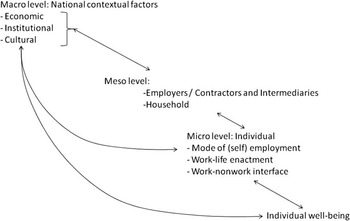
By subdividing the national institutional, economic and cultural contexts in macro, meso and micro levels to better understand what influences self-employment in different countries, a multi-cross-level model approach is required. For reasons of clarity, in the present study the definition for the micro level is the individual’s direct personal context. The meso level concerns the groups the individual is a member of or directly has contact with. Groups in this meso-level context consist of members the individual personally (mostly) knows, like his/her household, the organisation (s)he is working for or the intermediary the individual works with to find new contracts. The macro level being the national, global and impersonal context.
Cross-national differences accounting for variations in the self-employed work–life interface
Our literature review located studies from several countries (e.g., Australia, Canada, Japan, the Netherlands, Pakistan, South Africa, Spain, Sweden, United Kingdom, United States of America), indicating strong global interest in (solo) self-employment. It might be argued that the ambivalent outcomes of self-employment revealed by our literature review may be partly attributed to the variety of national macro contexts impacting both the meso- and micro-level conditions and outcomes (Hinks & Gruen, Reference Hinks and Gruen2007; Saarni, Saarni, & Saarni, Reference Saarni, Saarni and Saarni2008), however, cross-national contextual differences have not, in the main, been taken into account.
Acknowledging the varieties in the macro context allows for the possible impact of the nations’ macro contexts (economic, institutional and cultural) to be investigated. In this paper, we examine the influence of the macro context of the United Kingdom, the Netherlands and Japan. These nations were chosen because they represent very different contexts, providing a rich understanding of how these national contexts influence self-employment. Meanwhile, though different in cultural and/or economic perspectives, these nations also share strong similarities, which are discussed below, enhancing comparability opportunities. We focus on the organisations and the intermediaries (meso level) that operate between these organisations and self-employed workers in each country (macro level), the conditions of the household (meso level) and the outcomes experienced at the individual level (micro level). Figure 1 illustrates the relationships between all three (macro, meso and micro) levels.
Interactions of macro-level, meso-level and micro-level contextual factors in the context of self-employed work

Contextual influences: Evident in United Kingdom, the Netherlands, Japan
Economic systems
The prevalence, mode and type of self-employment is likely to be influenced by the national context in which the self-employed operate. National contexts can be classified according to contrasting business systems of ‘liberal’ and ‘coordinated’ market economies (Hall & Soskice, Reference Hall and Soskice2001).
Liberal market economies are characterised by a free-market approach where institutions are intended to facilitate rather than constrain market forces. As a result, liberal market economies are often dynamic, innovative and willing to shift into new areas of business activity (McCann, Reference McCann2014).
Coordinated market economies (CMEs) are characterised by a higher degree of state regulation and different financing structures for business, allowing a longer-term perspective to be adopted. Instead of shareholder interests being dominant, a broader stakeholder approach predominates. In this contribution, we illustrate self-employment in the context of two countries where self-employment is growing, but in contrasting business systems (UK liberal market economy; the Netherlands CME). In addition, we include Japan, a CME where self-employment is currently a less significant feature of the economy and in contrast to the Netherlands, where coordination is organised at national level, in Japan coordination is organised at enterprise level. However, although Japan and the Netherlands share the same business system (CME), culturally the Netherlands is more similar to the United Kingdom than to Japan (Hofstede, Reference Hofstede2001; Hofstede, Hofstede, & Minkov, Reference Hofstede, Hofstede and Minkov2010). To make sense of this complex web of cross-national differences and similarities, the macro context is divided into three subcontexts: economic, institutional and cultural, which are explored below.
Economic
In the United Kingdom, ~15% of those in work in 2016 (Q1) were identified as self-employed, rising from 13% in 2008, and the United Kingdom has experienced the third largest percentage increase in self-employment across the EU since 2009 (Office for National Statistics, 2016). In particular, there has been a rise in self-employment amongst the over 65 year olds. Self-employment is prevalent in certain industries, including construction, transport (taxi and delivery drivers) and recent growth amongst professional, scientific and technical workers. Commentators have argued that growth is limited due the lightly regulated labour-market, which means that standard work is relatively cheap, which constrains the demand for alternative employment (Keizer, Reference Keizer2013).
Moving the focus to the Netherlands, it is projected that one-third of the workforce of large corporations will soon be flexible workers (Verbiest, Goudswaard, & Van Wijk, Reference Verbiest, Goudswaard and Van Wijk2014), since the percentage of solo self-employed has been on the rise in recent years (10% in 2010 compared with 12% in 2016 [Q1] [Central Bureau of Statistics (NL), 2016]). Solo self-employment is often ‘opportunity motivated’ and often undertaken by experienced, highly educated, male workers, from the nation’s ethnic majority (Dekker, Reference Dekker2010). They mostly work in the fields of specialised business services, trade–commerce, construction, financial services, culture, sports and recreation and Information and Communication Technologies (Central Bureau of Statistics data analysed, commissioned by ikwordzzper.nl, 2013) and occupy a relatively strong labour-market position. Despite an enduring economic crisis, the revenue of self-employment has been stable for the last 5 years (De Jager, Reference De Jager2013; ZZP Barometer, 2014). In Japan, the self-employment rate has declined since 1975 (11.1% in 2015 compared with 22.3% in 1990 [Statistics Bureau of Japan, 2016]). Although new types of self-employment, such as Information and Communication Technologies professionals, have attracted some attention in recent years, this has not become a major trend (Saitoh, Sakamoto, & Spinks, Reference Saitoh, Sakamoto and Spinks2009). The number of specialist and/or technical self-employed businesses has been increasing since the 1990s, but not sufficiently to offset the decrease of those in the agricultural and retail sectors. Since the early 1990s, Japan struggled through what has come to be known as the ‘lost decade’. However, amongst female and young workers, alternative employment modes have rapidly risen during the last decade (Rebick, Reference Rebick2005; JILPT, Reference Jones and Urasawa2012).
Overall these three economic contexts show different trends. In the Netherlands and the UK self-employment rates have risen, albeit in different industries and amongst different age cohorts and demographical subgroups, while in Japan the self-employment rate has fallen although it is becoming more popular for certain demographical subgroups, namely females and young workers.
Institutional
In the United Kingdom, self-employment constitutes a buffer that allows organisations to respond to fluctuating market demands and which also affects unions’ strategies towards organisation of the self-employed (Keizer, Reference Keizer2013). Self-employed benefit from tax advantages but also receive fewer work-related social benefits. Unions have voiced concern over so-called ‘bogus self-employment’ where workers are required to become independent contractors by a former employer, since this may be against the interests of the worker (Keizer, Reference Keizer2013). This is estimated to be about 1% of all self-employment, although measuring bogus, or false self-employed is extremely difficult (Institute for Public Policy Research and Hatfield, 2015). Nonprofit organisations such as the Association of Independent Professionals and the Self-Employed act as a lobby group for the interests of the self-employed in the United Kingdom.
In the Netherlands, the government actively promotes self-employment as a means of boosting the competitiveness of the Dutch economy (Sociaal Economische Raad [SER], 2010), while at the same time developing laws to counter bogus self-employment (Government of the Netherlands, Reference Gorgievski, Ascalon and Stephan2014). Opponents have, however, argued that this discourages employers from hiring self-employed professionals and are likely to choose temporary workers instead. The labour unions ‘FNV Zelfstandigen’ (FNV Independents) and ‘CNV Zelfstandigen’ specifically organise the self-employed. The self-employed are also represented in the Social and Economic Council at the highest level of representation. In addition, national and local nonprofit groups lobby for the interests of self-employed professionals. Contrary to the United Kingdom, in the Netherlands self-employed do not have specific tax advantages, they do enjoy an ‘entrepreneurs deduction’ for their business, just like any other businesses (Belastingdienst [Tax Authorities], 2016).
The Japanese labour-market legislation can be characterised by dualism (Ishikawa & Dejima, Reference Ishikawa and Dejima1994). Internal labour-markets offer lifetime employment which guarantees stability of position, career development and increases in salary, whereas external labour-markets offer temporal flexible jobs with low wages, few benefits and little job security (Houseman & Osawa Reference Houseman and Osawa2003; Jones & Urasawa, 2011). In the light of demographic issues, such as an ageing and declining population, current Japanese economic policy supports local economies by revitalising agriculture, forestry and fisheries and assisting business start-ups and micro enterprises. Self-employment has been identified as a viable option for both the elderly and women to make use of their experience by starting up their own businesses and to balance work and family life (Prime Minister of Japan & His Cabinet, 2014). However, Japanese enterprise unions view self-employed workers as outsiders to the enterprise community and merely as employment buffers (Keizer, Reference Keizer2013).
In summary, in the United Kingdom the government offers tax advantages for self-employment, but at the cost of social benefits. Concerns have been expressed, however, by commentators including unions about the growth of bogus self-employment. In the Netherlands, there are no tax incentives but the government actively tries to counter bogus self-employment. The interests of the self-employed are represented by labour unions specifically for self-employed and these are represented at the highest level. In Japan, for those with no access to the ‘cradle to the grave employment’ self-employment may be a viable option, perhaps as a second choice or on a temporal basis.
Cultural
Entrepreneurship is embedded in the culture of both the British and the Dutch (Gelderblom, Reference Gelderblom2004) and both have a tradition as sea-faring and trading nations. Although often being grouped under larger headings serving Dutch state policy, for example, the Dutch East India Company, entrepreneurs operated in a wide variety of smaller independent businesses and (solo) self-employed (Gelderblom, Reference Gelderblom2004).
Traditional Japanese culture, in contrast, can be characterised as homogeneous and group oriented in which solo entrepreneurship or individual activity is not prioritised. In line with this, organisations’ Japanese-style human resource management is based on the ‘we are one family’ philosophy, having lifetime employment, seniority wage system and in-house unions (Koike, Reference Koike1999).
Hofstede (Reference Hofstede2001) and Hofstede, Hofstede, and Minkov (Reference Hofstede, Hofstede and Minkov2010) have conducted influential studies comparing over 70 nations on six dimensions: power distance, individualism versus collectivism, masculinity versus femininity, uncertainty avoidance, long-term orientation versus short-term normative orientation and indulgence versus restraint. On three of the dimensions, power distance, individualism/collectivism and indulgence/restraint, the United Kingdom and the Netherlands score similarly and clearly differ from Japan. Japan exhibits a larger degree of power distance, a higher degree of collectivism and a lower degree of indulgence compared with the United Kingdom and the Netherlands. On the other three dimensions, there are differences between all three nations (www.geerthofstede.nl, 2015).
A Multi-Level Model to Understand Contextual Factors Impacting Self-Employed Work–Life Interface
Conceptualising the work–life interface
In order to disentangle the factors explaining the variation in outcomes of self-employment for individuals’ work–life enactment, balance and well-being revealed by our literature review, we propose a theoretical model to study a variety of different modes of self-employment and types of work. In order to allow for some generalisation, the model takes into account the various different modes of self-employment. Moreover, in order to develop a more holistic understanding on how self-employment impacts the work–life interface at the individual level, it is important to start from a wider perspective that can be applied to all of the self-employed workforce, regardless of, for example, gender, age, household situation, ethnicity and work (dis)ability.
The current work–life literature has been critiqued as being too narrowly focussed on parents and carers (Greenhaus & Powell, Reference Greenhaus and Powell2006; Ozbilgin, Beauregard, Tatli, & Bell, Reference Ozbilgin, Beauregard, Tatli and Bell2011; De Janasz, Forret, Haack, & Jonsen, Reference De Janasz, Forret, Haack and Jonsen2013). Thus, our theoretical model considers the work–life interface encompassing the relationship between work and nonwork, including nondomestic activities which have received little attention to date (e.g., leisure pursuits, community involvement, participating in religious or volunteering activities, supporting extended families) (cf. Eby, Casper, Lockwood, Bordeaux, & Brinley, Reference Eby, Casper, Lockwood, Bordeaux and Brinley2005).
P–E Fit theory as a theoretical lens
The P–E Fit is a well-known theory that has often been used to analyse general well-being, job satisfaction and intention to quit of employed workers (French, Caplan, & Harrison, Reference French, Caplan and Van Harrison1982; Muchinsky & Monahan, Reference Muchinsky and Monahan1987; Dawis, Reference Dawis1992; Caplan & Van Harrison, Reference Caplan and Van Harrison1993; Kristof-Brown, Zimmerman, & Johnson, Reference Kristof-Brown, Zimmerman and Johnson2005; Ostroff & Schulte, Reference Ostroff and Schulte2007). The model postulates, as the name implies, the degree to which an individual employee (mis)fits with his/her work environment. A misfit is likely to lead to an individual changing jobs as a result of quitting, or getting fired, or even returning to education to retrain for a new job. A good fit is likely to predict a stable and successful career. Whether an individual fits with his/her work environment is dependent on the degree to which an individual’s characteristics, abilities, expectations, needs and personal values are met or shared by the demands of the job, the work culture, intrinsic and extrinsic rewards, and the values of his/her employer (Holland, Reference Holland1985a, Reference Holland1985b; Schneider, Reference Schneider1987; Kristof, Reference Kristof1996; Schneider, Kristof-Brown, Goldstein, & Smith, Reference Schneider, Kristof-Brown, Goldstein and Smith1997; Kennedy, Reference Kennedy2005; Kristof-Brown, Zimmerman, & Johnson, Reference Kristof-Brown, Zimmerman and Johnson2005; Talbot & Billsberry, Reference Talbot and Billsberry2010). Fit, however, may not be a fixed state. Both parties involved, worker and employer seek a state of congruence. They actively pursue, reactively and/or passively, a good fit for mutual benefit (Holland, Reference Holland1985a, Reference Holland1985b; Schneider, Reference Schneider1987; Kristof, Reference Kristof1996; Schneider, Kristof-Brown, Goldstein, & Smith, Reference Schneider, Kristof-Brown, Goldstein and Smith1997; Kennedy, Reference Kennedy2005; Kristof-Brown, Zimmerman, & Johnson, Reference Kristof-Brown, Zimmerman and Johnson2005; Talbot & Billsberry, Reference Talbot and Billsberry2010).
An adaptation of P–E Fit theory is the Theory of Work Adjustment (Dawis & Lofquist, Reference Dawis and Lofquist1984). This theory has a narrower perspective, focussing mostly on the fit of an individual within an organisation, the resulting satisfaction levels, and the degree of person–environment correspondence. This is a construct which is very similar to congruence and refers to the continual process of adjustment in which the individual and the organisation try to match one another’s needs and supplies – supplies being everything either side has to offer that could be of use to the other, for example, financial rewards, training, skills or personality characteristics.
Applying the P–E Fit theory to self-employment
Self-employment can be seen as a means to enhance life choice and balance in line with personal values, to create an ideal environment in which to optimise the subjective and objective consequences for one’s work career and to enable the combination of work and nonwork activities in more satisfactory ways. It then follows that the P–E Fit model is a logical approach to examine self-employment, and the self-employed workers’ work–life interface.
Over many years, the development of the P–E Fit literature has generated several different P–E Fit measures. It should be recognised, however, that to date, many studies building on P–E Fit theories have employed a rather narrow focus. More recently some studies have suggested using multiple P–E Fit measures (Sekiguchi, Reference Sekiguchi2004; Kennedy, Reference Kennedy2005; Edwards & Billsberry, Reference Edwards and Billsberry2010; Chuang, Shen, & Judge, Reference Chuang, Shen and Judge2016; Yu, Reference Yu2016). In line with this, we propose using multiple P–E Fit measures in order to explain self-employed workers’ work–life interface. Although previous studies have proposed integrating multiple levels of P–E Fit (Sekiguchi, Reference Sekiguchi2004; Kennedy, Reference Kennedy2005; Edwards & Billsberry, Reference Edwards and Billsberry2010; Chuang, Shen, & Judge, Reference Chuang, Shen and Judge2016; Yu, Reference Yu2016), the nonwork domain has largely been ignored. Below, we will explore four measures widely used in the literature and reflect on their usefulness for this study. These measures are: Person–Organisation Fit (P–O Fit); Person–Vocation Fit (P–V Fit); Person–Job Fit (P–J Fit); and Person–Group Fit (P–G Fit). In order to complement our model, we will conclude by presenting the often neglected fit with the home domain.
P–O Fit focusses on how an individual and an organisation meet each other’s expectations and demands or needs and to what degree values and goals are shared. In short, this concept is often referred to in terms of needs versus supplies and value congruence (Caplan, Reference Caplan1987; Chatman, Reference Chatman1989; O’Reilly, Chatman, & Caldwell, Reference O’Reilly, Chatman and Caldwell1991; Cable & Judge, Reference Cable and Judge1996; Kristof, Reference Kristof1996; Boon & den Hartog, Reference Boon and den Hartog2011). Needs versus supplies , on the one hand, refers to the needs an individual has, both psychological and economic (e.g., having a cognitively challenging job, a sense of belonging, a certain income, job security). On the other hand, the individual supplies his or her skills, personal characteristics, and experience. The organisation, in turn, might be in need of, for example, specific skills, a certain number of workers, certain levels of experience, and provides the individual with economic rewards, financial stability, and possibilities to build a career, develop skills and access further training. The needs of self-employed workers are likely to differ from the needs of traditionally employed workers, possibly related to the reason why they became self-employed in the first place. Gaining insight into the specific needs of the self-employed might provide organisations with insights to find and build ties with self-employed workers and their organisation or network.
Value congruence is the degree of similarity between the values held by the individual and those held by the organisation that he or she works for. Values, as described by Edwards and Cable (Reference Edwards and Cable2009: 655) based on prior research (Rokeach, Reference Rokeach1973; Schwartz, Reference Schwartz1992; Meglino & Ravlin, Reference Meglino and Ravlin1998), can be defined as judgements about the importance of certain end-states and normatively desirable behaviours. While normatively desirable behaviours are likely to be of less importance for self-employed, as they may not work for any one organisation for a long time, the importance of certain end-states is likely to be of a much greater importance. Incongruence between the values that drive the self-employed towards their chosen end-states and organisational values, or the inability of organisations to accommodate the values that drive the self-employed might explain much of the current problem that the self-employed and organisations face finding and maintaining relationships with self-employed workers.
P–V Fit is a measure of congruence between an individual’s vocational interests and the work environment to make such a vocation possible (Holland, Reference Holland1985a, Reference Holland1985b; Parsons, Reference Parsons1909; Tracey & Rounds, Reference Tracey and Rounds1993; Furnham, Reference Furnham2001; Harris, Moritznes, Robitschek, Imhoff, & Lynch, Reference Harris, Moritzen, Robitschek, Imhoff and Lynch2001). Instead of focussing on the relationship between an individual and a specific organisation or even a specific job, P–V Fit addresses the extent to which an individual is satisfied with his/her profession or vocation in general. (Dis)satisfaction can arise from disappointing job opportunities in relation to personal expectations from a the viewpoint of a vocational career. In addition, the work environment of a self-employed worker following a particular vocation is likely to differ from the work environment of a traditional employee. P–V Fit is likely to be significantly influenced by a nation’s economic, institutional and cultural context, inhibiting and/or encouraging following a vocation as a means to self-employment (Gorgievski, Ascalon, & Stephan, 2011). The economic context might, for example, encourage such a career while the cultural context might inhibit it.
P–J Fit is defined by Edwards (Reference Edwards1991) as the fit between an individual’s abilities and desires and the demands and attributes of a specific job. It is also described by Kristof (Reference Kristof1996) as demands versus abilities. Narrower than P–O Fit and P–V Fit, P–J Fit explicitly examines the degree of satisfaction resulting from the match of specific demands of a certain job concerning the required skills, personality characteristics and employability of an individual with the actual skills, abilities and personality characteristics of that individual. The individual may, for example, be overwhelmed by the demands of the job, or alternatively not sufficiently challenged by the demands of the job.
Since P–J Fit has predominantly been researched using traditionally employed workers, a similar concept could be added to address self-employed workers. As they do not have a job in the sense that employees have a job, but rather have contracts to carry out assignments for organisations or to sell goods to certain clients, an equivalent fit measure would be a Person–Contract Fit (P–C Fit), describing the match between the requirements of the contract and the abilities of the self-employed worker. Since self-employed workers generally have more flexibility and autonomy than employees to decide what kind of job/contract demands they prefer to do, a good P–C Fit might reflect higher levels of job crafting opportunities, possibly enhancing overall well-being for the self-employed. In line with the literature which examines other forms of nonstandard work where constructs have been adapted to reflect the work arrangement, a separate study could explore the viability of a P–C Fit and the possibility to use it as a measure to compare employees and self-employed workers in regard to their satisfaction with their work and rewards (financial) and to what degree these are matched by their abilities and expectations (financial).
P–G Fit is a measure of fit concerning the compatibility between an individual and his or her coworkers related to group-oriented outcomes and the need for cohesion (Werbel & Johnson, Reference Werbel and Johnson2001; Boon & den Hartog, Reference Boon and den Hartog2011). P–G Fit is sometimes referred to as Person–Team Fit. The importance of group-oriented outcomes might be different for the self-employed. Although the self-employed might lack cohesion with the organisation they currently work for, the need for cohesion may be met by becoming part of a network of self-employed workers. Thus, a desirable level of cohesion can be achieved without losing a sense of autonomy, often important for self-employed workers. These networks can subsequently be of value to self-employed on a meso level, increasing their chances of finding contracts or attaining other professional goals.
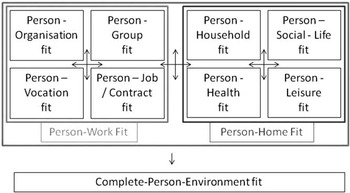
Traditionally P–E Fit literature has focussed on the work environment, neglecting the nonwork environment and does not take into account self-employed workers. This calls for an extension of the P–E Fit model. The four fit measures described above, P–V Fit, P–O Fit, P–G Fit and P–J Fit/P–C Fit, can be grouped as being an individual’s Person–Work Fit. To complement this fit with the work environment, a group is introduced by our theoretical model to cover the nonwork environment, namely the Person–Home Fit, explaining variations in the work–life interface of self-employed workers in various nonwork contexts. The model therefore takes into account that an individual’s environment encompasses both work and nonwork domains. This allows us to investigate how home demands and resources affect opportunities, tensions, choices and experiences in the self-employed workers’ work domain.
We argue that refining P–E Fit to include the entire environment, work and nonwork, gives more credit to the fit that self-employed workers need to achieve in order to manage the work–life interface in a satisfactory way. On the one hand including the fit between self-employed workers, their assignments and the organisations they work for and on the other the fit between self-employed workers and their nonwork domain and the particular demands and resources experienced there. Hence, examining how their personal values and needs fit the entire environment.
Person–Home Fit refers to the household, leisure time, personal health and the social groups to which one belongs. To the knowledge of the authors, no nonwork domain P–E Fits have thus far been investigated in the context of the P–E Fit model. This gap in the literature could be addressed by developing the following aspects of Person–Home Fit.
Person–Household Fit (P–HH Fit)
The home or personal situations consists first of all of a household. Whether consisting of a family, shared nonfamily living or living alone, this personal context influences wants and responsibilities which subsequently influence the work domain. This context is named P–HH Fit.
Person–Leisure Fit (P–L Fit)
Another important aspect of an individual’s personal life is how (s)he spends leisure time, this is grouped as P–L Fit. Being exposed to less job security might translate to more stress experienced by the self-employed which could be offset by (the need for more) leisure time to unwind and/or to switch off from work. Since self-employed workers are reported to work longer hours, P–L Fit might explain certain tensions experienced and problems faced by the self-employed, potentially leading to health problems.
Person–Health Fit (P–He Fit)
Health is likely to be an especially important consideration for the self-employed, since they are unlikely to have access to sick pay if unable to work. Where one person cannot work due to lower back problems, another might continue working, even though suffering from a form of amyotrophic lateral sclerosis, as with one of the brightest minds of our time working in theoretical physics. This health aspect, consisting of both physical and psychological aspects, is named P–He Fit.
Person–Social-Life Fit (P–SL Fit)
An important aspect of an individual’s home context is with whom (s)he associates. This might partly overlap with the leisure fit measure, but not necessarily so, and also with work fit measures if, for example, colleagues become friends. However, the social groups, outside of the household and the work environment, such as groups of friends, religious and volunteering groups, should also be considered. Problems at work can, for example, be discussed with friends or other self-employed workers from one’s network, which in turn potentially influences the work domain. Therefore, we include P–SL Fit in Figure 2.
Conceptual model of Complete-Person–Environment Fit for self-employed workers

Thus in summary, our conceptual model incorporates multiple aspects of the work domain: P–O Fit, P–V Fit, P–G Fit and P–J Fit/P–C Fit; and multiple aspects of the nonwork domain: P–HH Fit, P–L Fit, P–He Fit and P–SL Fit. This enables the identification of choices or trades that the self-employed may make. For example, an individual may favour a good P–V Fit as a result of certain personal values, even where it is recognised that one’s P–O Fit or P–L Fit will suffer as a result. Consequently, this may expose bottlenecks, meaning problems often faced by self-employed workers and the organisations who make use of the services of self-employed workers, and creates tensions that the self-employed face in their work and nonwork environments by choosing to work in this way.
On the one hand, the opportunities for the self-employed to increase their own P–E Fit and thus pursue a desired work–life interface are many. Transcending the, still important, influence of autonomy and flexibility. On the other hand, society may be rather incongruent, not matching self-employed needs optimally or even adequately, concerning multiple aspects of self-employed workers work and nonwork domain inhibiting possible optimal work–life interfaces sought by self-employed workers.
Applying the Complete-P–E Fit Model to Three Cases (United Kingdom, the Netherlands and Japan)
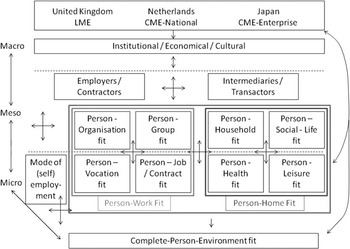
In order to illustrate the usefulness of our Complete-P–E Fit model, we apply this to our three country cases (United Kingdom, the Netherlands and Japan). We also derive a number of propositions to guide future research into the field of cross-national differences in how self-employed workers enact and experience the work–life interface (see Figure 3).
Complete-Person–Environment Fit model applied to a multi-level cross-national research design to explain self-employed workers work–life interface

By comparing the United Kingdom, the Netherlands and Japan, we argue that our model assists with the analysis and understanding of differences in the work–life interface of self-employed workers, by identifying where and on which level(s) there are opportunities and tensions for self-employment. As can be seen in Figure 3, the national economic, institutional and cultural contexts can influence the self-employed work–life interface directly. For example, an institutional (macro) influence on P–He Fit (micro), as well as indirectly, for example, certain economic conditions (macro) that influence employers (meso) influencing in turn P–O Fit (meso) and P–V Fit (micro).
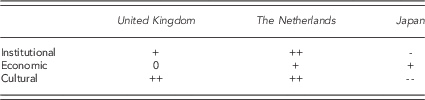
As described earlier, levels of self-employment are rising in the United Kingdom and the Netherlands and declining in Japan (Souren, Reference Souren2013; Central Bureau of Statistics [NL], 2016; Office for National Statistics [UK], 2016; Statistics Bureau of Japan, 2016). Culturally the United Kingdom and the Netherlands are more similar, when compared with Japan. In these countries it is possible that culture has led to the values associated with self-employment being more accepted thus increasing the P–V Fit for would-be self-employed workers. In contrast, Japanese culture is more likely to negatively influence P–V Fit for the self-employed. Economically, however, as CMEs, Japan and the Netherlands share an economic model that accommodates self-employment better, than that in the United Kingdom where there is a liberal market economy. Institutionally, the United Kingdom has provided some tax advantages for the self-employed, but is not otherwise heavily involved in promoting self-employment. The Netherlands is actively promoting self-employment on a national level and Japan only promotes self-employment for certain groups – the elderly, women returners and to some degree young workers (Rebick, Reference Rebick2005; SER, 2010; JILPT, Reference Jones and Urasawa2012; Prime Minister of Japan and His Cabinet, 2014). All these theoretical influences of the national macro-level contexts influencing the choice, on a micro level, to start working as a self-employed worker are summarised in Table 1
Theoretical illustration of national (United Kingdom, the Netherlands and Japan) macro contextual influences on opportunities to start working as a self-employed worker

Note. --=strong negative influence; -=negative influence; 0=neither positive nor negative influence; +=positive influence; ++=strong positive influence.
As shown in Table 1, combined, the national macro-level contexts can explain in part why self-employment rates are rising in the United Kingdom and in the Netherlands and why it is falling in Japan.
Examining meso and micro levels, these influences can be analysed to understand to what degree they influence (in)congruence on all the different aspects of the work and nonwork P–E Fit dimensions. Legislation is likely to enable or inhibit the needs of organisations and self-employed workers and the supplies they are able to give each other. Individuals pursuing certain values are thus encouraged or inhibited to achieve their preferred end-states, their preferred work–life interface conditions. For example, due to favourable economic, cultural and institutional conditions, there are multiple organisations in the Netherlands that act as brokers for self-employed workers and large companies. These brokers, help both to locate each other and increase the P–O Fit by trying to optimise one another’s needs and supplies. This in turn increases the P–V Fit for individuals considering starting working on a self-employed basis. In Japan, however, even though there are some economic opportunities to start working on a self-employed basis, this is significantly outbalanced by the negative cultural status of the self-employed and the lack of legislative support, making the work–life interface of self-employment rather unappealing and career and life success as a self-employed worker unlikely. This cross-national example leads to the following proposition:
Proposition 1: Cross-national differences in why individuals choose to be self-employed and pursue certain work–life interface end-states can be explained by using the Complete-P–E Fit model and integrating it in a multi-level, macro–meso–micro, approach.
The Complete-P–E Fit model can also explain ambiguous outcomes in the work–life literature of self-employment, such as a high satisfaction even though working hours are longer and income is lower. Only by looking at all levels of Person–Environment Pit, can it become clear that given the values an individual pursues, a self-employed worker can, for example, enjoy what (s)he is doing, due to an increased P–V Fit and P–C Fit, even though his/her P–O Fit is lower. At the same time they may enjoy a higher P–HH Fit and P–SL Fit, in spite of the possible risks to their P–He Fit and also maintain an adequate P–G Fit by becoming a member of a network of self-employed professionals. This leads to the second proposition:
Proposition 2: By taking into account all levels of P–E Fit, ambiguous outcomes can be explained/prevented by understanding how certain tensions are outweighed by other benefits.
Conclusion and Discussion
Using a multi-cross-level model in self-employment research can clarify current seemingly contradictory results and add structure to the field by providing a framework. The Complete-P–E Fit model is proposed as a dynamic design in longitudinal studies that is likely to provide more insights into why individuals choose to be self-employed and subsequently whether they choose to remain working in this way. Individuals might initially be tempted by a better P–C Fit and P–O Fit, but then be deterred by a skewed work–life interface and want to return to traditional employment or instead of being deterred they may be further enticed by a better overall Complete-P–E Fit and so remain self-employed.
There are many possibilities for further research on the self-employed using the Complete-P–E Fit model as a framework. By combining multiple research ideas, different environment fits, self-employed and traditionally employed workers, different perspectives can be achieved, combined and compared, increasing our understanding of the values that drive the self-employed and increasing our understanding of the work–life interface self-employed pursue as desirable end-states.
Using the model not only as a framework, but also as an exploratory engine to understand why certain work–life interfaces are pursued or not due to the perceived difficulties in achieving them, which values individuals prioritise and which values are discarded as a result of contextual factors, might be very useful to discover, existing and new, possibilities and tensions of self-employment. When combined in an international, multi-level model, both opportunities and perceived problems could be located in society and, respectively, made use of and solved. This broader perspective could unlock the true potential of self-employment as a means to enhance national and regional economic sustainability further and self-employment as a mode of employment with optimal work–life interfaces for self-employed workers.
Limitations and research implications
Shortcomings of the Complete-P–E Fit model are that by itself it does not explain anything, one might argue that specific themes within self-employed research are merely shifted around, financial rewards under P–O Fit and autonomy and flexibility under P–V Fit, for example, without solving any of the existing, sometimes paradoxal, results. The strength of the model, however, is its role as a framework, providing a ‘coat rack’ to better categorise certain findings so as to better compare and summarise findings in the field of self-employed research as a whole. Second, the model provides a springboard from which to hypothesise new research at the micro, meso and macro levels or a mixture thereof.
Another shortcoming might be that the model is broad and tries to cover too much ground. However, we argue that the strength of the model is that it functions as a framework. Not all aspects have to be used at the same time in each study. Another advantage of this broad model is that with its springboard function, the possibilities for research are substantial.
The model is theoretical and many parts require tested empirically, such as P–C Fit, or are yet to be developed, such as the Person–Home Fit measures. It is likely the model will evolve as problems and thresholds are encountered along the way, further adding to the self-employed research field and scholarly debate on self-employment and work–life interface.
Policy implications
Instead of focussing on the effect of social insurance or the lack thereof for the self-employed, P–He Fit could be included more fully by researching the influence on mode of (self) employment, its role within the Complete-P–E Fit model and its value in the work–life interface. This could lead to better adjusted forms of insurances, or other forms of social legislation, for self-employed.
P–HH Fit could influence child-care options or other forms of household support such as caring for an elderly family member or disabled or sick household member. P–SL Fit and P–L Fit are more likely to stay in the private sphere, although knowledge about their importance might influence legislation and human resources policy if, for example, it becomes clear these fits provide adequate buffers against burnout, depression or fatigue.
By identifying opportunities and tensions of self-employment in society, the Complete-P–E Fit model can be instrumental in informing human resource departments of organisations and businesses and for legislation enacted by governments to increase the competitiveness of their economies and by providing helpful legislation and policies for self-employed. The self-employed can benefit from such legislation and from up to date HR departments directly or use the results of research making use of the Complete-P–E Fit model for personal introspection, improving their positions and careers in society by finding their own (mis)fits and adjusting their work–life interface accordingly. On an international level, countries can learn from each other from the effects of the economy, legislation and culture on self-employment and individuals can again use this to their advantage.
Acknowledgement
The authors thank the anonymous reviewers and editors for their valuable comments regarding previous versions of this paper.