Introduction
Laryngeal cancer is considered a rare disease by the US National Institute of Health, yet the disease affects 200 000 people each year in the US. Its significant US morbidity and mortality (3740 deaths per year and 12 500 new cases annually) can largely be prevented by controlling behavioural risk factors.Reference Reiddy, Dedo, Rabah, Field, Mathog and Gregoire1 Cigarette smoking and heavy alcohol consumption are the commonest risk factors (in order of effect). Other cited risks include male sex and poor socioeconomic status – both of which are related to tobacco and alcohol use. The Human papillomavirus (HPV), which establishes productive infections in keratinocytes of squamous epithelial cells, has been associated with laryngeal cancer.Reference Su, Lu, Tian, Zhao, Li and Li2 Importantly, some patients have none of these predisposing factors, whereas others without strong risk factors present with particularly advanced, aggressive laryngeal carcinoma. Such cases mandate investigation of other possible causes or predisposing factors, such as blood group type.
Numerous studies have examined the effect of ABO blood grouping on the behaviour and prognosis of carcinoma. The relationships between blood grouping and cancer incidence, clinicopathological parameters and survival have been studied in oesophageal, gastric, pancreatic, bronchial, colorectal, gynaecological, testicular and skin cancers.Reference Tursen, Tiftik, Unal, Gunduz, Kaya and Camdiviren3 In some instances, decreased expression of the histo-blood group antigens A and B (due to aberrant expression) has been shown to be significant in human carcinoma progression from normal to malignant cells.Reference Dabelsteen4 However, few studies have examined the relationship between ABO blood grouping and head and neck cancers, particularly laryngeal lesions.Reference Celestino and Silvagni5, Reference Nowinska, Namyslowski, Scierski and Kocierz6
While the relationship between ABO blood grouping and particular cancers has not been clearly elucidated, numerous reports have shown that the expression of certain blood group antigens in tumours correlates with poor prognosis. The presence or absence of blood group antigens has been shown to increase cellular motility and to facilitate the interaction between tumour cells.7 To date, results have been inconclusive, with no proven association between any particular blood group and specific tumour.
Such findings led us to undertake a retrospective study to investigate the effect of ABO blood grouping in patients with laryngeal cancer. Laryngeal cancer can be successfully treated if diagnosed at an early stage, with typical therapeutic options including radiation, surgery or a combination of both. Therefore, determination of the effect of blood type on this tumour may have significant clinical relevance.
Patients and methods
We reviewed the medical records of our tumour registry, and identified 271 patients with histologically confirmed tumours of the supraglottic, glottic and subglottic regions, diagnosed and treated between 1 January 1997 and 31 December 2002 at the University Hospital in Cincinnati, Ohio, USA. These patients' electronic medical records were reviewed, including physician correspondence and treatment records from other hospitals.
We included patients with squamous cell carcinoma, and excluded patients with all other tumour types and tumours not primary to the larynx (e.g. base of tongue cancer extending to the supraglottis).
In addition to data on ABO and Rh blood groups, we recorded other factors of aetiological importance, including age, sex, racial origin (i.e. African American or Caucasian), cigarette smoking pack years, cancer stage and treatment type. We did not record medical comorbidity (e.g. diabetes or hypertension) that had no obvious causative role in the development of laryngeal cancer.
Information on patient mortality was also collected. We defined ‘disease cure’ as survival for five years without recurrence.
We also recorded patients' blood types. University blood bank records were available for 91 per cent of patients, while collateral sources (e.g. blood transfusion records, birth records and additional operative reports) were used for 9 per cent. Of the 271 patients identified in our tumour registry as having laryngeal cancer, we included 143 (53 per cent) patients with data on ABO and Rh blood groups. We excluded 128 patients because of duplicate entries, poor or incomplete medical records, or lack of blood bank type and cross-match data, or because the diagnosis was either non-squamous cell cancer (on the surgical pathology report) or non-primary laryngeal cancer.
Our control group included 450 000 healthy adults who had donated blood to the Hoxworth Blood Center, Hamilton County, Ohio, between 2002 and 2007. This centre served 17 counties in the Ohio, Kentucky and Indiana ‘tri-state’ area. Data on ABO and Rh blood group types were obtained for 373 500 (83 per cent) Caucasians and 76 500 (17 per cent) African Americans.
Statistical analysis
Statistical analyses were performed using the chi-square test and Fisher's exact test, utilising the Proc Freq procedure (SAS software, version 9.1). All tests were two-sided, and p values of 0.01 or less were considered significant. Univariate analysis was performed for the five-year survival outcome variable, to identify covariates for a multiple logistic regression analysis. Covariates with a p value of 0.15 or less were considered for logistic regression. However, age (p = 0.12) was the only covariate that qualified; therefore, multiple logistic regression was not performed.
Results
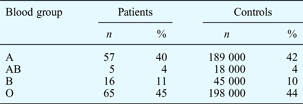
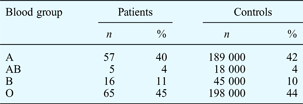
We observed no significant differences in ABO blood group frequency among the 143 laryngeal squamous cell carcinoma patients, compared with the 450 000 controls (Table I); differences in p value were almost entirely attributable to random error.
Additionally, no significant differences were noted in the relationship between laryngeal squamous cell carcinoma incidence and ABO blood group type, comparing African American patients (n = 37 (27 per cent)) and Caucasian patients (n = 106 (74 per cent)) (Table II). The incidence of blood type A was higher in African American laryngeal cancer patients (38 per cent) than African American controls (27 per cent), but not significantly so p = 0.45.

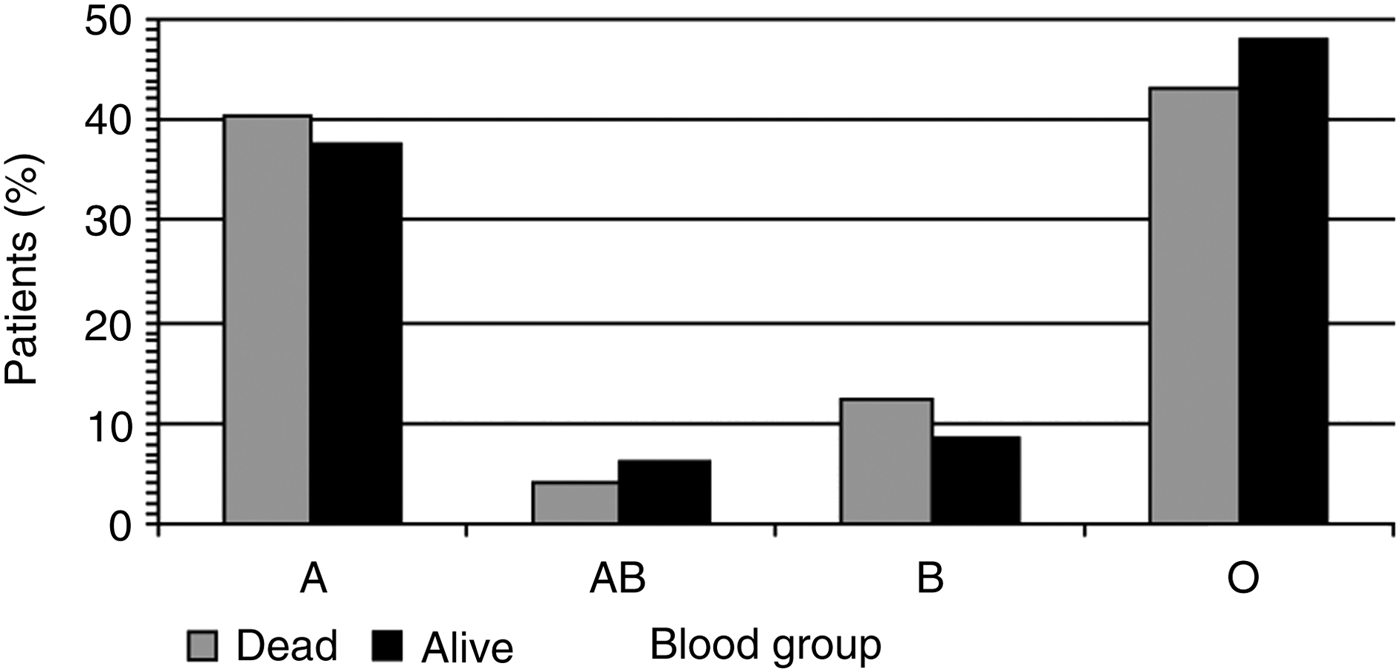
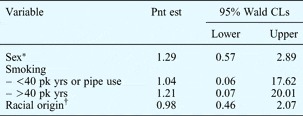
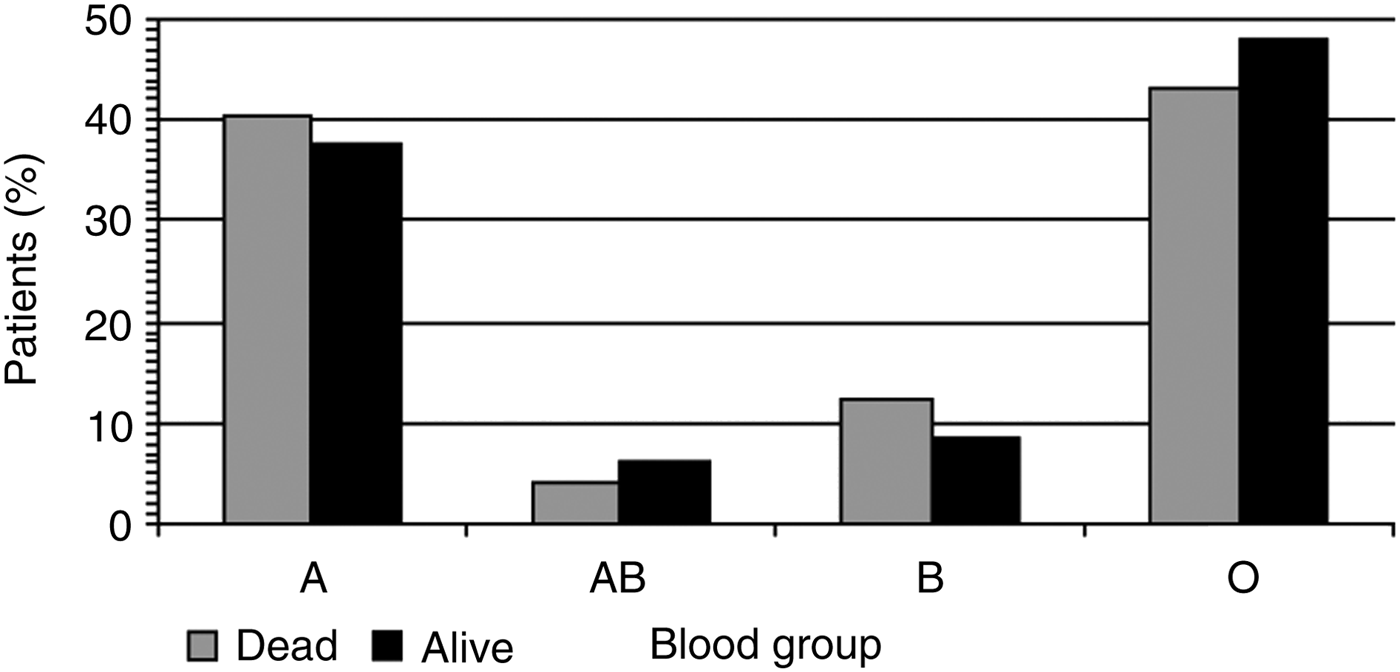
Figure 1 shows patient five-year survival and mortality by blood group (Figure 1). Univariate analysis showed no association between blood group and mortality. The effect of other co-variables on survival and mortality was also assessed. Five-year survival was not found to be affected by sex (Table III). Of the 143 patients, 76 (53 per cent) had a smoking history of more than 40 pack years, 48 (33.5 per cent) had a history of less than 40 pack years, two (1.5 per cent) smoked a pipe and 17 (12 per cent) had never smoked. Odds ratio analysis showed no significant difference in five-year survival, comparing smokers with more than 40 pack years versus less than 40 pack years, and comparing African American versus Caucasian patients (Table III). When comparing five-year survival and mortality in patients with different blood groups, age (p = 0.12) and cancer stage (p < 0.01) were the most influential variables. Patient mortality significantly increased with advancing laryngeal cancer stage. Lastly, there was no significant association between treatment modality and survival, for patients of any blood group type.
Five-year mortality and survival by blood group, in 143 patients with laryngeal squamous cell carcinoma.
Patients' 5-year survival odds ratio data for potential risk factors

*Female vs male; †Caucasian vs African American. Pnt est = point estimate; CLs = confidence limits; pk yrs = pack years
Discussion
In this retrospective study, no significant association was found between patients' blood group type and laryngeal squamous cell carcinoma incidence, or between blood group type and five-year survival. Furthermore, the lack of association between blood group and cancer survival rates was unaffected by patients' racial origin. Although some reports have found a higher incidence of type A blood in certain carcinoma types, we observed no significant difference in type A blood group incidence, comparing our patients and controls.Reference Anderson and Haas8
To the best of our knowledge, ours is the first US study to evaluate the relationship between ABO blood grouping and laryngeal squamous cell carcinoma.
Blood group and cancer
Histo-blood group antigens are glycoproteins and glycolipids with varying constituent carbohydrate chains, which determine their antigen specificity. Such antigens exist on erythrocytes and other cells throughout the body (predominately epithelial cells). The ABO blood group system is used to identify blood group antigens in tissues and on blood cells; however, the regulatory mechanisms of these antigens vary in different tissues. Individuals who have blood group O without either A or B antigens show correspondence between their erythrocyte and tissue blood groups (these individuals may express the H antigen, which is the immediate chemical precursor to the O antigen).Reference Dabelsteen4
Owing to the pervasive nature of the ABO system, numerous studies have examined its role in the behaviour and prognosis of different types of cancer, including oesophageal, gastric, pancreatic, bronchial, colorectal, gynaecological, testicular and skin cancers.Reference Pinkston and Cole9–Reference Ichikawa, Handa and Hakomori11 Decreased expression of histo-blood group antigens A and B (via a mechanism of aberrant expression) has been shown to be significant in human carcinoma progression from normal to malignant cells. In 1996, Dabelsteen described changes in the expression and synthesis of cell surface carbohydrate structures and ABO blood group carbohydrate structures during tumour development.4. This author reported that certain cell carbohydrates were involved in cell–cell interactions, and that expression of these carbohydrates in tumours directly correlated with poor prognosis. Dabelsteen concluded that carbohydrate–protein interaction may play a role in cell–cell adhesion, cell homing and tumour metastasis.
Few studies have assessed ABO blood grouping relative to head and neck cancers, particularly laryngeal lesions. This relationship was first examined in a 1964 Italian study by Celestino and Silvagni, but findings were inconclusive.Reference Celestino and Silvagni5 A similar study by Nowinska et al., conducted in 2000, found no significant association between blood group antigen expression and laryngeal cancer.Reference Nowinska, Namyslowski, Scierski and Kocierz6 In the one previous US study, Pinkston and Cole hypothesised that there was a strong association between salivary gland tumours and blood group A; however, they found no statistically significant increase in salivary gland tumour incidence in blood group A patients, compared with controls, across all histological tumour types.Reference Pinkston and Cole9
In a frequently cited 2001 study, Su et al. examined ABO blood grouping in patients with carcinoma of the oesophagus and gastric cardia, and found that blood group B was associated with a higher incidence of cardia and upper one-third oesophageal carcinoma in males.Reference Su, Lu, Tian, Zhao, Li and Li2 However, the authors attributed this result to selection bias, because the study was confined to a small geographical area in China; the distribution of ABO blood grouping is known to vary amongst different geographic locations and ethnic groups.
Our study identified no association between ABO blood group and laryngeal cancer. However, we cannot eliminate the possibility of such an association based on this study alone, and future research is needed to confirm or refute our findings.
Treatment and survival for laryngeal cancer
Some patients with laryngeal carcinoma may have none of the typical predisposing factors, or may present with a particularly advanced and aggressive carcinoma in the absence of strong risk factors. Of the 143 patients in our study, 12 had no history of smoking or alcohol consumption (data not shown for the latter), yet five of these patients had stage 3 or 4 disease. Such cases mandate the investigation of other possible predisposing factors for cancer, such as blood type.
Laryngeal cancer can be successfully treated if diagnosed at an early stage, with typical options including radiation, surgery or a combination of both. Our study findings confirm that laryngeal carcinoma stage directly influences patient survival: five-year survival was 89 per cent for patients with stage 1 cancer, versus 16 per cent for those with stage 4 cancer. Advanced cancers are usually widespread, and often require more aggressive means of treatment than less advanced cases, depending on tumour extent and the patient's wishes.
To identify any potential bias, our patient group had a broad spectrum of possible risk factors including age, sex, racial origin, cancer stage and smoking status. Our control group consisted of many thousands of healthy Caucasian and African American blood donors, from the same geographical area as our study population, precluding differences in blood group frequency based on geographical area or racial origin. Our univariate analysis of covariates influencing survival, with potential logistic regression, did not identify blood group as a factor which significantly affected survival.
Study limitations
Our study population of 143 patients may be adequate, but still remains less than ideal for a statistically powerful retrospective analysis. A larger population could yield increased statistical power and more conclusive findings. Because of inadequate patient records (e.g. no blood type or cross-match information), 45 per cent of 271 potential patients were excluded. Treatment categories were sometimes undifferentiated; for example, ‘surgery and radiation’ was used to describe both patients undergoing post-surgical radiation and those undergoing surgery after radiation had failed. Patients lost to follow up were also excluded. Patients' causes of death were often difficult to categorise (e.g. in the case of patients surviving cancer who later died of liver failure, stroke or myocardial infarction, within five years of cancer remission).
The importance of our study is evidenced by the few individuals who develop early stage laryngeal carcinoma with no predisposing factors, and the even rarer cases presenting with advanced, aggressive disease in the absence of strong risk factors. Because of the small number of patients in these categories (8.5 and 3.5 per cent of our patients, respectively), our future research will examine more patients over longer time periods.
• This retrospective, US study evaluated the association between ABO blood group and laryngeal cancer
• African American and Caucasian laryngeal squamous cell carcinoma patients were compared with healthy controls
• There was no significant correlation between blood group and cancer incidence or five-year survival
• Type A blood group incidence was higher in African American versus Caucasian patients; this difference was statistically insignificant
One form of comorbidity that we did not take into account was metachronous laryngeal cancer following a previous history of head and neck cancer. This parameter would have been of interest as regards laryngeal cancer risk factors and their effect on survival data, given the predisposition of head and neck cancer to recur at a second primary site.
Conclusion
This retrospective study identified no relationship between ABO blood group and laryngeal cancer. However, we do not eliminate the possibility of such an association. No association was observed between blood group and cancer survival rates, for either Caucasians or African Americans. Our findings confirm that laryngeal carcinoma stage directly influences survival: five-year survival was 89 per cent for our stage 1 patients, but 16 per cent for our stage 4 patients. A few patients presented with particularly advanced and aggressive laryngeal carcinoma in the absence of strong risk factors. Our future research will continue to evaluate the association between blood group and the development of laryngeal (and other head and neck) cancer.
Acknowledgements
We thank: Sheila Salisbury, Department of Biostatistics, Cincinnati Children's Hospital Medical Center, for her help in compiling the results of this study; Mary Kemper, University of Cincinnati Neuroscience Institute, for medical editing; and Kimberly Garret for coordinating manuscript production and tumour registry data.