How do political parties in Europe evaluate the performance of national democracies? While this question is regularly asked about citizens,Footnote 1 prior research rarely examines the stances that parties take on this issue. Perhaps the answer appears obvious: it is mostly parties at the electoral and ideological fringes that criticize existing institutions. However, mainstream (and even governing) parties can also be quite negative about democratic regimes, as was the case when the Liberal Democrats in the United Kingdom were in the governing coalition (see also Table 1 below). But few studies systematically consider the stances mainstream parties take on the performance of their institutions.Footnote 2 Given the gap in the literature about this topic, our first goal is to describe the stances of parties – especially those of mainstreamFootnote 3 ones – on the performance of democracies in twenty-four EU countries.
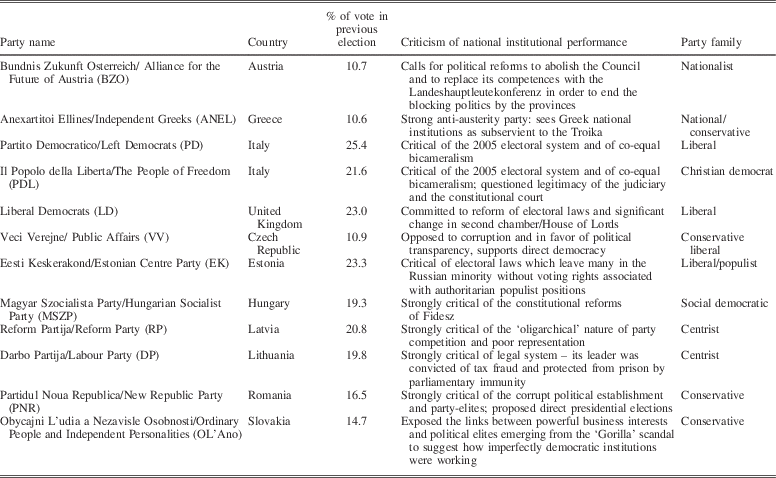
Examples of Parties that Are Critical of National Democratic Institutions in 2013 and Receive at least 10 per cent of the Vote

We then develop a perspective that explains the empirical variation we observe in parties’ evaluations. Our starting premise is that parties are vote seekers, either because they wish to get elected in order to pursue policies or for non-policy reasons.Footnote 4 On this basis, we consider two mechanisms of parties’ regime access that influence their evaluations of institutions.
The first mechanism emphasizes the odds that a party will become the incumbent in the near future – what we term governing prospects. The better these prospects are relative to their competitors, the greater the odds that parties will evaluate institutions positively, because incumbency provides the means and opportunity supplied by institutions to implement policies and reward voters. How can a party tell the odds that it may be included in the next government? We suggest that two party-level characteristics enhance their governing prospects. First, one clear indication of their future success is how successful they have been in the past: their prior governing record under a set of institutions. All else being equal, parties with a substantial governing record likely evaluate institutions more positively than parties that have rarely governed. These parties have a proven track record that a set of institutions does not prevent them from gaining access to governing institutions, and thus they tend to prefer it over uncertain alternatives. Secondly, parties with extensive mass organizations should be more positive about their governing prospects than parties that lack effective organizations, because mass organizations provide parties the resources needed to fight and win elections.Footnote 5 In a word, then, parties’ governing prospects – operationalized as parties’ incumbency record and degree of mass organization – should shape their stances on the performance of regimes regardless of the duration of a democratic regime, party ideology or other controls.
A second mechanism conceptualizing regime access also emphasizes the electoral fortunes of parties but explicitly accounts for the dynamic consequences of their regular regime access for their institutional evaluations. This mechanism is a habituation process: long-term experience of democratic governance teaches mainstream parties that they have access to governing institutions some of the time.Footnote 6 Viewed over multiple elections, an incumbent that loses one contest does not need to assume that the rules of the game prevent it from future regime access as long as it experiences some access to governing institutions. In short, viewed dynamically, habituation moderates the potential fallout of an election loss for a party’s institutional evaluations.
While the governing prospects and habituation mechanisms both conceptualize the consequences of parties’ regime access to institutions (or lack thereof), they capture different aspects of it. The governing mechanism focuses on the experience of individual parties relative to all other parties at a given point it time. It suggests that being a relatively successful party improves their regime evaluations regardless of a regime’s duration, and independently of other party-level traits. The habituation mechanism, in turn, explicitly takes time into account by focusing on the elasticity of this support when an incumbent loses an election. In this way, ‘loser’s consent’Footnote 7 among parties emerges via regular access to a political regime over time.
We do not suggest that political parties are exclusively office seekers or that regime access is the sole driving force behind parties’ evaluations of democracies. For example, the empirical analyses below show that parties in countries with poorly performing institutions tend to evaluate these institutions more negatively. We interpret this as a sign that parties are to some degree motivated by the policy goals regarding the performance of national democracies. While this is important, it is a less revealing finding than what we show – namely that even controlling for the quality of institutions, and regardless of parties’ general ideological centrism, the degree of regime access still influences mainstream parties’ evaluations of democratic performance.
We test four hypotheses derived from the governing and habituation mechanisms using two expert surveys that we conducted in twenty-four EU member states in 2007–08 and 2013. We supplement this dataset with information about parties’ electoral success, as well as a range of country contexts, such as institutional and economic indicators.
Consistent with the regime access model, we find in our cross-sectional analyses that a party with a significant record of prior incumbency relative to other parties or one with a well-developed mass organization is considerably more positive about national democratic institutions. These results emerge regardless of the duration of a country’s democratic experience, its economic and political performance, or a range of party-level characteristics. In addition, over time, we find evidence suggesting that a change in incumbency between 2008 and 2013 leads to a much more muted change in performance evaluations in older democracies, whereas the reduction is quite dramatic in newer ones. Finally, our analyses of parties’ policy statements reveal one extreme case – the Hungarian party system – that illustrates how, in conditions of relatively weak habituation, a party that has very negative institutional evaluations in opposition (Fidesz) can become very positive about the performance of a national institution if it is given access to it and therefore an opportunity to remake it. In short, regime access has a considerable influence on these stances even taking into account the country’s ‘objective’ performance and other party traits.
This summary highlights the need to know more about why parties are positive or negative about democratic institutions. According to our study, parties may be negative about institutions even if they work quite well, namely when they have limited access to the regime. They can also be quite positive about institutions even if the performance of democracies is poor, namely when they rule regularly. Neither scenario is ideal if the main goal is to strengthen the performance of democracy. In the former case, negative messages about a democracy’s performance may spawn a critical orientation among party followers,Footnote 8 and in the latter scenario, parties may just be content to accept institutions that provide them with access – or even to focus on cementing their regime position – even though a regime’s performance is troublesome.
PARTY STANCES ON THE PERFORMANCE OF DEMOCRACIES
Most academic research has paid fairly little attention to the stances that political parties adopt on the performance of democracies, in stark contrast to the literature on popular dissatisfaction with the performance of democratic regimes.Footnote 9 This gap is regrettable because we see numerous examples of critical parties. For example, British Liberal Democrats and Labour MPs hold strongly unfavorable views of the House of Lords as currently constituted.Footnote 10 Green parties in Germany (and elsewhere) were at least initially unhappy with the focus of national elections in representative democracies.Footnote 11 We observe more far-reaching efforts by the Bulgarian GERB to fight corruption,Footnote 12 and the periodic attempts by Italian elites to reform institutions.Footnote 13 As Table 1 shows, we can find many cases in 2013 across Western and Eastern Europe of mainstream parties, in ideology and in terms of significant electoral support, that advance critical views of national democratic institutions. Clearly, critical parties are sufficiently embedded and prevalent throughout Europe to make them an important object of study. However, beyond specific country and party studies, there is little comparative evidence about how parties – especially mainstream ones – evaluate the performance of existing regimes. One goal of our study, therefore, is to systematically describe the way that parties evaluate the performance of a regime.
Explaining Party Stances
Another goal is to explain variance in how parties evaluate institutions via two mechanisms: parties’ governing prospects and their habituation to democratic governance.
Governing prospects
We assume that politicians compete for public office in order to get elected, either for its own sake or to pursue policies.Footnote 14 This assumption is backed by empirical research about the beliefs of campaign activists and MPs showing that they typically want to win office.Footnote 15 Accordingly, we suggest that parties’ electoral prospects significantly shape their views on the performance of existing regimes. We argue that two factors help parties to identify the odds of governing in the near future: their record of past inclusion in governments and their organizational capacity.
A first factor is an extension of the notion of winning an election: if parties have a cumulative record of incumbency under a certain set of institutions, then they have incentives to remain positive about a regime, all else being equal. This expectation follows directly from the idea that parties want to win elections, and that the more often they have done so in the past, the more they can be assured that the existing rules will serve them well again in the near future. The mechanism is that incumbency provides parties with access to the regime via ministerial portfolios that provide the basis for policy implementation, by extracting resources from the state (‘cartels’) or by using administrative posts to satisfy specific clienteles. In turn, parties lacking a significant incumbency record are more likely to be critical of institutions, regardless of the democratic character of a regime or its duration. Note that the mechanism here stresses the incumbency record of parties relative to each other; below we will consider the link between democratic longevity and regime access. Thus, recurring incumbency relative to other parties matters as much as their current governing status.Footnote 16
Hypothesis 1: Parties with a record of prior incumbency relative to other parties are more positive about institutions than parties that lack this record, independently of other factors.
Another party-level factor that we argue helps parties gauge their governing prospects is their organizational capacity. Mass organizations are usually better equipped to attract diverse voters than parties that lack this capacity, both in the more mature democracies of Western EuropeFootnote 17 and newer ones in Central and Eastern Europe.Footnote 18 There are multiple mechanisms that link party organizations to their electoral success. Historically, mass parties made possible the integration of wide swaths of newly enfranchised voters into the democratic process by mobilizing individuals during election campaigns, communicating with voters between elections and forging linkages to other social groups from similar social milieus.Footnote 19 Empirically, one study analyzes data from the late 1950s and early 1960s and finds that parties with mass organizations obtain more electoral support than those lacking this capacity.Footnote 20 While some authors conclude that mass parties have disappeared because of membership decline, new forms of campaigning or the decline in party–voter linkages,Footnote 21 other analyses present evidence that mass organizations continue to be crucial in attracting diverse voters to this day.Footnote 22 In our own analyses, we also found a strong relationship between electoral success and organizational capacity.Footnote 23 All else being equal, we suggest that parties with mass organizations should have greater governing prospects and thus should be more positive about the performance of existing institutions.
Hypothesis 2: Parties with mass organizations are more positive about existing regimes than parties without mass organizations, regardless of their party ideology and regime duration.
Democratic habituation
The habituation model posits a mechanism whereby mainstream parties within a given country become integrated into a regime over time and thus evaluate democratic institutions positively, regardless of their governing prospects. The habituation perspective is cogently expressed by Linz and Stepan:Footnote 24
Constitutionally, democracy becomes the only game in town when all the actors in the polity become habituated to the fact that violations of these norms are likely to be both ineffective and costly. In short, with consolidation, democracy becomes routinized and deeply internalized in social, institutional, and even psychological life, as well as in calculations for achieving success.
This perspective is supported by a large literature on elite (and mass) socialization which shows that political actors tend to internalize institutional norms over time, at both the nation-stateFootnote 25 and European Union levels.Footnote 26 Easton similarly conceptualizes the development of diffuse regime support – defined as an ‘attachment to political regimes for their own sake’Footnote 27 – on the basis of both ‘socialization […] and direct experience […] with performance’.Footnote 28
There are then two pathways through which elites and parties can endorse democratic regimes: democratic learning and exposure to the positive performance of democratic regimes. Thus one possibility is that most parties in a durable democracy are more positive about a regime than parties in newer democracies.
Hypothesis 3: Independently of their electoral prospects, parties competing in older democracies are more positive about the performance of a regime than those competing in newer democracies.
Additionally, the habituation argument may primarily reveal its influence over time via a party’s regime access. In durable democracies, parties with a longer record of incumbency can rely on memories of victory in defeat. In newer regimes, by contrast, losing parties have fewer memories of re-emerging victorious in subsequent elections. The idea of ‘loser’s consent’Footnote 29 at the party level means that regime duration influences parties’ reactions to an election loss in the most recent election. When election losers have had a chance to experience over time that they need not fear a permanent exclusion from governing institutions, their views of a regime’s performance, all else being equal, should remain more positive than when parties lack this experience. If this dynamic argument applies, a change in status from government to opposition in a newer democracy should relate to a more significant drop in regime evaluations than in long-lasting regimes.
Hypothesis 4: A change in incumbency status leads to a more noticeable reduction in regime evaluations in newer democracies.
MEASUREMENT
We use two expert surveys conducted in twenty-four European nations in 2013 and 2008Footnote 30 that cover all EU member states as of 1 January 2014 (except Croatia, Cyprus, Luxembourg and Malta). Given the significant number of small parties that exist in many party systems, we use two criteria to determine their inclusion in this study: (1) they are represented in a national parliament and (2) they received at least 2 per cent of the national vote in the last election. Overall, the 2013 (2007–08) Central Eastern Europe (CEE) survey covers seventy-one (seventy-two) parties in ten EU member states in CEE, and the Western Europe (WE) survey covers 108 (114) parties in fourteen countries, for a total of 179 (186) parties in twenty-four nations. Appendix Table A1 lists the parties and countries included in the surveys, along with the number of experts for each country.
We recruited experts from a master list of scholars who published a peer-reviewed article or book on the party system in the past ten years. Our search generated a list of over 1,000 experts. For each country, we aimed to have ten completed questionnaires, which we achieved for most countries (details are available in the online appendix). We conducted several analyses following Steenbergen and Marks and Coma and van HamFootnote 31 to check whether the variance decomposition of indicators in our expert surveys parallels that found in other expert surveys.Footnote 32
To measure how parties evaluate the performance of democracies, one question asks experts: ‘What about the party’s view of how well democracy works in [country]? Do parties hold positive (7) or negative views (1)?’
In line with our theoretical interests, the indicator focuses on the way democracies work. It does not gauge constitutional ideals (for example, whether parties are committed to democratic principles); nor does it center on the policy performance of a single government. In contrast to the Chapel Hill surveys, which stress the positions of a party’s leadership, we felt that the image of the entire party is important even if there are intraparty differences between leaders and activists (or voters). Theoretically, this may introduce slight differences in expert judgments. Practically, however, this nuanced variation in the question wording in the two expert surveys seems to have had little effect on the estimates produced by each survey when nearly identical indicators are available. Merging the 2014 Chapel Hill estimates with our 2013 data, we find that, on general left–right ideology, estimates for party positions are virtually identical in the two surveys (r=0.97). The UNC cultural position indicator (‘Gal-Tan’) is also closely related to a cultural issue indicator based on migration, social policies and civil liberties in our expert surveys (r=0.93). Finally, we find a strong relationship regarding parties’ positions on European integration (r=0.93).Footnote 33 All told, these patterns suggest that these different expert surveys produce broadly identical estimates for party positions.Footnote 34
Another issue with our indicator is that experts may have evaluated the positions of parties based on the performance of the incumbent government, rather than the entire regime. To some degree, this overlap is appropriate when corrupt governing parties reflect the quality of the entire regime. However, analyses of mass satisfaction with democracies also show that the economic performance of incumbent governments influences popular evaluations of democracies.Footnote 35 Analogously, it is possible that the policy performance of the current government influences experts’ assessment of how parties evaluate the performance of a regime. We deal with this possibility by including several indicators about countries’ economic conditions, along with party positions on left–right policy issues and the governing status of parties (discussed below). Controlling for these variables means that the theoretically relevant predictors (also developed shortly) explain how parties evaluate the entire regime as assessed by experts.Footnote 36
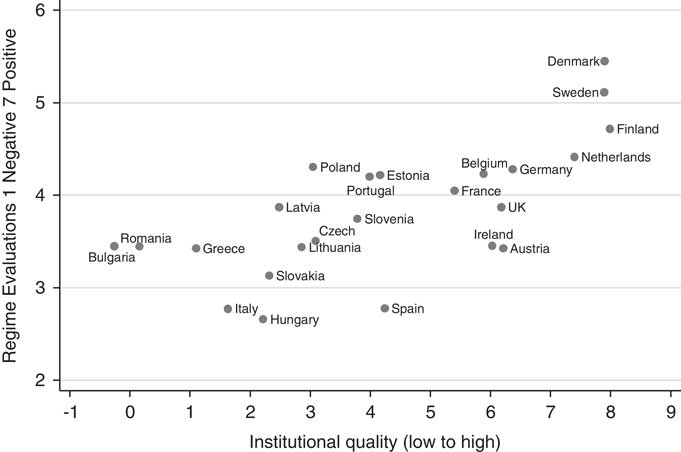
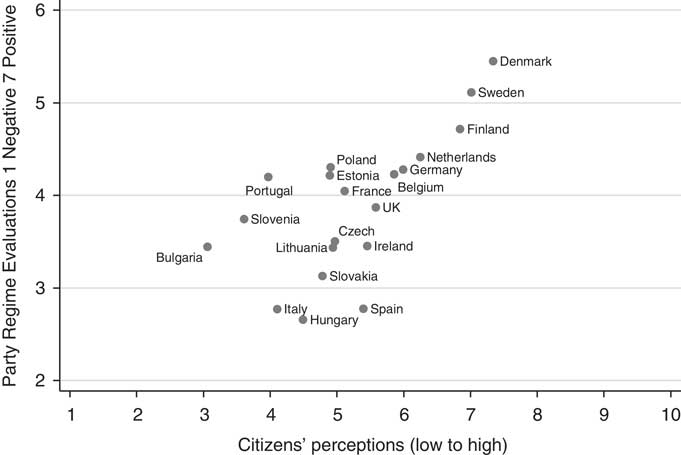
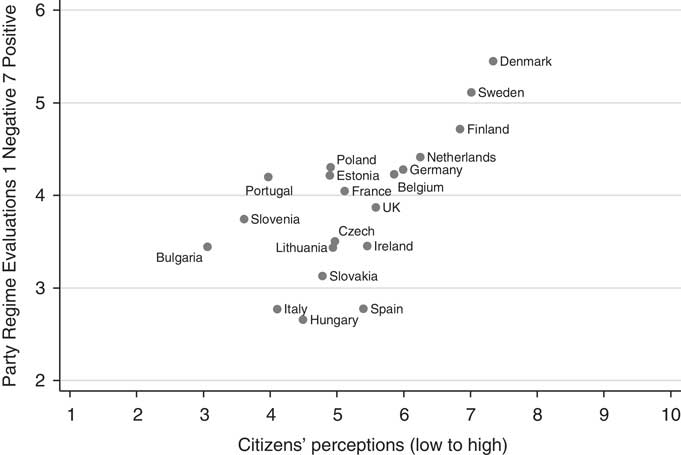
In an attempt to validate the indicator, Figure 1 presents evidence that meets our general expectations in light of prior knowledge. The y-axis in both figures displays the average regime evaluations of parties in each country. The x-axis in the top figure arranges countries on the basis of World Bank scores of institutional quality (corruption, rule of law, voice and accountability, and government effectiveness).Footnote 37 The patterns square nicely with the accounts from country studies and impressionistic evidence: parties in systems with higher institutional quality, on the whole, are quite positive about the performance of national regimes (for example, Scandinavia and the Netherlands). And where institutional quality is lower (for example, Bulgaria, Romania and Greece), we see that parties, on average, are the most negative about a regime. The bottom figure, in turn, indicates that mass publics, on average, agree with the average stances adopted by parties. The x-axis in the bottom figure arranges countries on the basis of the mean mass satisfaction of democracies (based on the 2012 European Social Surveys). The figure shows that parties and mass publics broadly agree in their evaluations of democracies at the national level (r=0.73). These patterns suggest that we have a reasonable measure of party stances on the performance of democracies.
Validating the party-level measure: parties’ average regime evaluations by institutional quality (r=0.71)

Validating the party-level measure: parties’ average regime evaluations by average public evaluations (r=0.73)
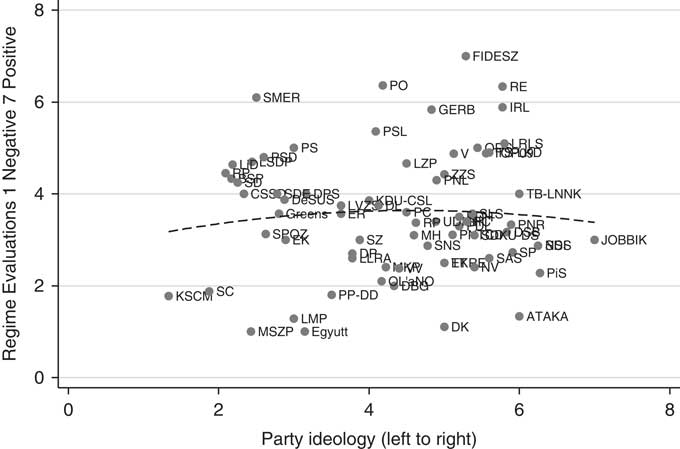
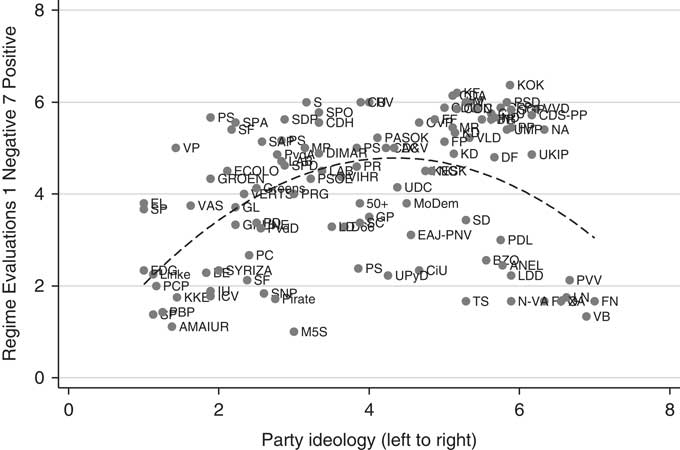
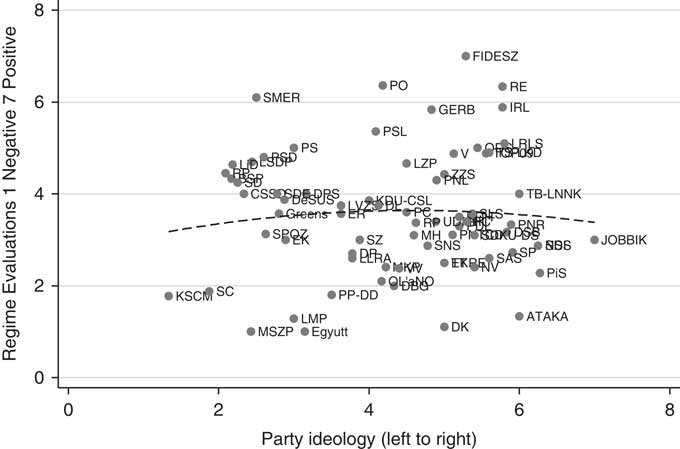
But country averages mask considerable variation across parties – the central focus in this study. Figure 2 describes the party-level patterns in light of our discussion about the degree to which parties from various ideological locations evaluate regimes positively or critically. On the y-axis, the figure presents parties’ regime evaluations, whereas the x-axis displays their ideological location (as perceived by experts) on a left (1) to right (7) scale (see the online appendix for the question wording). The figures also include squared fit lines to illustrate whether ideological extremism relates to their regime messages. We find a large number of parties – ninety-one out of 179 parties in the dataset – that are critical of the performance of national democratic institutions, defined as a rating of less than 4 on a seven-point scale where 7 means a positive assessment. While many of these parties have only minor levels of electoral support, even when the bar is set at having achieved over 10 per cent of the vote in the previous national election before the survey, there are still thirty-one parties that are highly critical.
Party evaluations of national regimes 2013, by left-right party ideology (with quadratic fit lines): Central-Eastern Europe
Party evaluations of national regimes 2013, by left-right party ideology (with quadratic fit lines): Western Europe
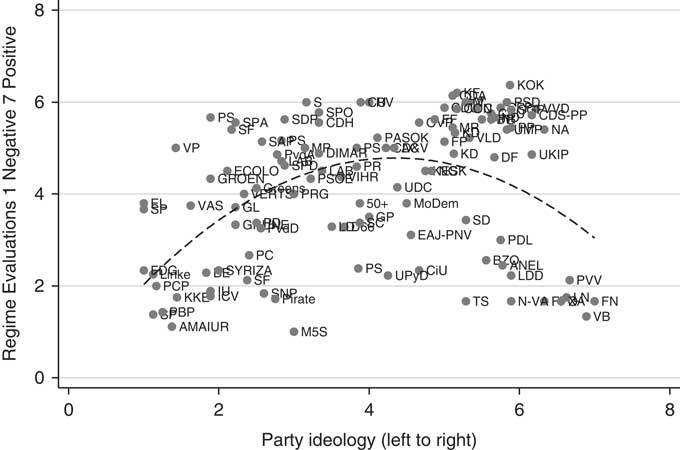
We also note that the way parties evaluate institutions is directly linked to their ideology in WE. This is as we would expect, as extreme parties often adopt ideological stances that can be either on principle antithetical to democracy or that are radically more demanding about greater levels of democracy. We therefore see a marked curvilinear relationship in the bivariate scatterplot, with the ideological extremes at the left and right polar ends adopting much more critical stances than parties in the ideological center.Footnote 38 Several extremist parties are quite critical of the existing democracy, for example, the Spanish separatist AMAIUR, the German Linke party, but also the French right-wing FN, the Belgian VB and FN, and Geert Wilder’s party (PVV) in the Netherlands. In contrast, many parties in the ideological center are quite positive about a regime, including the German CDU and CSU, the Irish Fianna Fial, the Scottish SNP and the Finish KOK. However, we also note that some parties in the ideological center can be quite negative as well, such as the newly founded Italian protest party M5S or the Dutch D66, suggesting that ideology is likely only part of what shapes performance evaluations.
The patterns in CEE are different, however. For one, the overall relationship between ideology and regime evaluations is nearly flat.Footnote 39 We can see, for instance, that parties with a critical stance include a number of communist and nationalist parties but also more mainstream parties such as the liberal EGYUT and the social democratic MSZP in Hungary, the Polish Civic Platform, along with the centrist DESUS in Slovenia. In turn, we find positive evaluations among mainstream parties, such as the liberal RE and conservative Pro Patria in Estonia, but also Fidesz. There is, in short, little evidence that mainstream parties are more positive than extremist parties in newer democracies. As our previous research has shown,Footnote 40 this is not because of an overall absence of ideological underpinnings to party stances in CEE countries. Rather, we interpret the lack of association of extremism and institutional evaluations in CEE countries in light of our broad theoretical approach. There is no doubt that the quality of the performance of democratic institutions is poorer than in the West, and that gives all parties policy-driven reasons to be critical of them (even parties that may support democracy in principle). Yet just as important from our theoretical perspective is the fact that (1) CEE parties in these new democracies, including those at the ideological center, lack the moderating influence of habituation to democratic institutions through repeated regime access and (2) the consequences of losing and winning in CEE party systems can be much greater for institutional evaluation than in WE, including for centrist parties. The confluence of these factors – lower quality and lack of long-term access across the board – means that parties at the extremes and mainstream can evaluate the performance of democratic institutions negatively.
Multivariate Analyses
What explains this variation across parties? Our theoretical argument suggests, first, that parties’ governing prospects significantly influence their regime evaluations. One indication of parties’ governing prospects is how often they have had access to governing institutions in the past (Hypothesis 1). Accordingly, we created a new variable measuring how many years a party had participated in a government since 1945, or a later year if a country democratized post-1945 (for example, Germany, Greece, Portugal, Spain and CEE countries).Footnote 41 To standardize this variable across nations with different democratic regime durations, we divided the length of parties’ government participation (counted in years) by the total number of years that the country was democratic since 1945. Accordingly, the measure captures how well parties fare compared to their competitors; it does not reflect regime duration, which we will measure separately (see below).Footnote 42 For example, by 2013, the German SPD had participated in a German government for twenty-seven years. This amounts to 42 per cent of all years since 1949.Footnote 43 Our expectation is that a stronger governing record improves evaluations of a regime’s performance.
A second measure of parties’ electoral prospects focuses on their ability to attract voters through their organizational capacity. We constructed an index based on four questions from the 2013 expert survey to measure this concept. Two items measure the importance of members and the party apparatus in shaping parties’ policy positions.
Would you please estimate the extent to which each ‘face’ of the party is strong in determining party policy?
Respondents rated the importance of a ‘party membership’ and the ‘party apparatus’ in shaping party policies. Experts use the response categories ranging from ‘1’ (unimportant) to ‘7’ (very important). A third question asks whether parties have a significant membership base:
And does the party have a ‘significant’ membership base in terms of numbers? We realize that the determination of a ‘significant membership base’ is somewhat arbitrary and may vary from country to country depending on its population. Our main concern is to distinguish between parties that have few members and those that relatively large numbers of members (‘Yes’ or ‘No’).
A fourth indicator gauges how many affiliations parties have with social groups:
Does the party have an organizational affiliation with any interest group or civil society group, such as trade unions, business associations, church groups, etc.? (Response categories are ‘Yes’ or ‘No’).
Together, these indicators measure whether parties have significant membership levels, an elaborate party apparatus and linkages to other social groups. We first re-scaled all variables to have a minimum of 0 and a maximum of 1 and then created an additive index that has a theoretical minimum of 0 (if no expert saw a party having any of the four characteristics) to 4 (if all experts saw all traits in a party).Footnote 44 Practically, the range is from 0.25 to 3.3 for parties in CEE (mean of 1.84), and ranges from 0.02 to 3.6 for parties in WE (mean of 1.91).Footnote 45
Lastly, based on the research literature on mass evaluations of the performance of democracies, we include several control variables. One argument about an individual’s regime evaluations likely applies to the party level as well: the political and economic performance of regimes surely influences parties’ regime stances. Politically, prior opinion research suggests that the quality of institutions – low corruption, the rule of law, independent bureaucracies and fair elections – influences the way that political actors evaluate institutions.Footnote 46 A straightforward extension is that underperforming institutions (for example, those with higher corruption levels) lower parties’ average regime evaluations, all else being equal. The variable partially controls for parties’ policy goals at the country level – when institutions underperform, then parties concerned with the development of democratic institutions become more critical of them, either by demanding more democracy or opposing democracy per se. Similarly, as mass-level studies suggest that regimes’ poor economic performance lowers mass satisfaction with the performance of democracies, we expect a similar effect among parties, such that higher unemployment and inflation rates lower parties’ evaluations of a regime.
Next, we control for the extent of majoritarian political institutions, using Lijphart’s executives–parties dimension.Footnote 47 Here we consider the possibility that proportional institutions, which maximize the access of multiple parties to regime institutions, receive better performance marks from parties than majoritarian institutions.Footnote 48 We also examine the possibility that the consequences of parties’ regime access are moderated by the institutional environment. When more parties have a chance to enter parliaments and to influence policies, they may be less negative about these institutions, all else being equal. We remain agnostic whether this effect emerges because we can also imagine a scenario whereby parties are equally happy to govern unrestrictedly for limited periods, in which case parties may not view majoritarian systems more negatively.Footnote 49
At the party level, we control for parties’ current governing status because current incumbents may for the time being be happier with the performance of the current regime than losers of the last election, just as at the level of mass publics supporters of incumbent parties are more satisfied.Footnote 50 Similarly, we include their popular support in the last election prior to our surveys. We control for party ideology by including the main and squared terms in the multivariate analyses because the descriptive patterns in Figure 2 show that the extremes are more negative about institutions in WE than in CEE. Since prior research also shows that party competition in newer democracies in CEE is often clientelisticFootnote 51 – meaning that electoral losses may lead to a clear-out of parties’ clients in state administration – we include an indicator from the expert surveys that measures whether parties target specific constituents with their appeals. Given the high organizational turnover of parties in CEE and South-Western Europe, we included a ‘stable party’ indicator because stable parties may be more positive about a regime than those that formed recently in response to new events (for example, the economic crisis).Footnote 52 Lastly, additional analyses by East-West regions (see Appendix 4 and the conclusion) suggest that two Hungarian parties – Fidesz and the MSZP – are clear outliers, so we include a dummy variable for each party. We will provide a substantive interpretation of this pattern below, so we just note here that they are extremely positive (Fidesz) or negative (MSZP) in 2013, respectively, which affects the pattern in CEE.
RESULTS
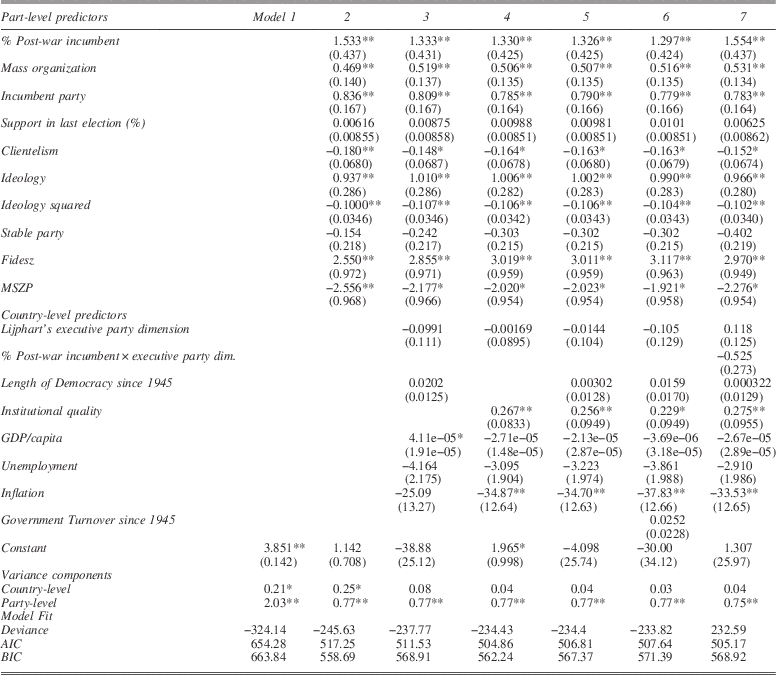
Model 1 in Table 2 confirms that most of the variance in party stances is located at the party level. The empty random intercept model, in which parties are nested within countries, shows that only about 9 per cent of the variance is located at the country level; about 91 per cent of the variance occurs at the party level. This confirms our approach to explaining the empirical diversity by considering the characteristics of parties in addition to those at the country level such as regimes’ performance.Footnote 53
Predicting Parties’ Regime Evaluations (2013)

Note: entries are multi-level coefficients using Stata 13’s xtmixed procedure. Standard errors in parentheses. Analyses are based on 179 parties in twenty-four countries. **p<0.01, *p<0.05
Model 2 shows that a party with a significant governing record in post-war decades has a statistically significant influence on regime evaluations.Footnote 54 Substantively, when we consider a change in governing record from one standard deviation below the mean (0) to above it (0.5), performance evaluations in the West improve from 3.6 to 4.5, and they improve from 3.2 to 3.9 in CEE. By comparison, moving from one standard deviation below the ideology mean to above corresponds to a change from 3.5 to 3.7 in CEE and from 3.8 to 4.2 in WE. In other words, having a significant governing record has a stronger effect in both regions as moving from ideologically leftist to ideologically rightist parties. When we add an interaction term between the regional dummy (East vs. West) and parties’ governing record, the interaction term is insignificant, suggesting that this effect is relevant in both the East and the West (not shown in Table 2; also see Appendix 4 and the discussion below). Note that parties’ governing records reach significance in all models regardless of which (and how many) contextual factors we include in Models 3–7. In short, parties’ prior incumbency record has a statistically and substantially relevant influence on parties’ stance on the performance of democracies.
Another consistent pattern across all models is that the indicator for mass organizations is highly significant. Substantively, the influence is as strong as that of a prior governing record: when we move from one standard deviation below to above the mean, performance evaluations in CEE increase from 3.1 to 3.9, and from 3.7 to 4.5 in WE. Evidently, parties with stronger mass organizations are considerably more positive about a regime regardless of a party’s ideology and prior governing record. What is more, this finding remains intact once we add country-level characteristics (Models 3–7), and we again find that this effect is highly significant in both CEE and WE.Footnote 55
Crucially, these findings emerge after controlling for a range of other significant party characteristics; in particular, parties’ ideological extremism is statistically significant in the pooled data. Additional analyses confirm (as Figure 2 suggests) that this pattern is primarily driven by the relationship in the West and not the East.Footnote 56 We also find that current government status increases evaluations of a regime; this parallels the findings from mass publics that winners of the most recent election trigger positive performance marks for a democratic regime.Footnote 57 Finally, there is some evidence that parties with clientelistic ties are a bit more negative about a regime – but the results are marginally significant, and do little to reduce the influence of theoretically focused predictors.
On the whole, the party-level model fits the data quite well as we observe that the residual variance in the empty Model 1 (2.03) is considerably higher than in Model 2 (0.77): this amounts to a 62 per cent reduction in the variance at the party level.Footnote 58 All of this suggests that these party-level traits make a significant contribution to explaining their regime evaluations.
Adding Context Indicators
Models 3–7 now add theoretically informed contextual variables. To test the direct influence of the habituation model on regime evaluations (Hypothesis 3), Model 3 adds the number of years that a country has had a democracy score of 8 or higher in the Polity IV dataset since 1945.Footnote 59 In order to control for socio-economic conditions, all models control for GDP per capita, inflation rates and unemployment levels (measures taken from 2012). We include the World Bank’s institutional quality measure in order to consider the influence of the ‘objective’ institutional quality on performance evaluations. For reasons discussed earlier, we include Lijphart’s recently updated parties–executive dimension.Footnote 60 We added the central contextual variables one by one in order to document the robustness of the results regardless of model specifications.
Model 3 shows that the length of democracy has no direct influence on parties’ stances (p=0.32), providing no support for Hypothesis 3, a finding that emerges in all models. In turn, Model 4 adds a country’s institutional quality indicator along with economic performance variables. The results confirm that parties competing in nations with higher institutional integrity are decidedly more positive about a regime regardless of national economic conditions.Footnote 61 This pattern may partly result from the policy motives of parties (they care about the performance of domestic regimes), and partly supports the regime access mechanism as institutions with low integrity unfairly bar some from accessing the regime. Note that despite this control, governing record and organizational traits remain significant. Model 5 includes both regime duration and institutional quality. Despite their overlap (r=0.80), institutional quality emerges as the dominant factor. As a robustness check for the direct effect of regime duration, Model 6 uses government turnovers since 1945 as an alternative indicator for habituation because alternations in governments feature prominently in the model about institutional learning.Footnote 62 Again, there is no evidence that government turnovers directly influence the stances that parties take about the performance of a regime: the coefficient is insignificant regardless of model specification, and the model fit does not improve.
We also note that Lijphart’s executives–parties dimension fails to reach statistical significance in any model, which means that the openness of institutions to parties does not directly influence parties’ performance evaluations. As a final test, Model 7 considers whether the executives–parties dimension moderates the influence of prior governing experience. While the coefficient just fails to reach statistical significance (p=0.06), the marginal coefficients indicate that the influence of prior governing is modestly larger in proportional regimes (Appendix 5). However, the confidence intervals of marginal coefficients indicate that the influence of prior governing experience is significant in nearly all but the most proportional regimes, and the overlap of the coefficient’s confidence intervals suggests that there is no significant difference across the executives–parties dimension. None of the other predictors measuring regime access is moderated by the executive–parties dimension.Footnote 63
Finally, we note that three of the four contextual control variables connect to parties’ regime stances as expected based on prior research. Higher inflation rates relate to lower regime evaluations, and higher unemployment tends to reduce regime evaluations (though this variable does not reach statistical significance). In contrast, higher income levels have little influence on parties’ performance evaluations.
All told, the two overarching theoretically relevant findings are that the two party-level variables measuring governing prospects – incumbency record and mass organizations – predict party stances on the performance of democracies in statistically and substantively significant ways. In contrast, we see no evidence in support of a direct influence of regime habituation on parties’ stances.
A Dynamic Perspective
The fact that the cross-sectional influence of regime duration is insignificant means that exposure to the performance of democracies alone does not enhance parties’ evaluations of a regime. A clear implication is that even mainstream parties do not improve their regime evaluations by virtue of exposure to democratic practices, thus undercutting a straight aggregation of a learning argument from elite research to the party context. However, our discussion of the dynamic relationship between habituation and governing prospects provides a more subtle mechanism through which habituation can affect parties’ regime evaluations (Hypothesis 4): parties that have been voted in and out of office regularly may learn that losing an election does not mean the end of their access to a regime.
To test this hypothesis, we merge the 2013 data with another dataset from a 2007–08 expert survey we conducted in the same countries with an identical expert questionnaire (see Appendix Table A1). Naturally, a comprehensive test of the dynamic argument requires longitudinal data covering multiple changes in governments and multiple measures of parties’ regime evaluations. While a full analysis of this sort is beyond the scope of our data containing two time points, an implication of Hypothesis 4 is that a change in governing status between 2008 and 2013 correlates with a change in parties’ regime evaluations, especially in newer democracies. The bivariate patterns clearly support Hypothesis 4: a loss of governing status correlates with a substantial reduction in performance evaluations in newer democracies (that is, since 1990) across the two time points on the seven-point indicator (d=−1.54). In contrast, when regimes have been democracies since 1945, this reduction is considerably more modest (d=−0.43; see Appendix Figure A6).
However, do these bivariate changes emerge primarily because extremist parties were ousted between the two surveys, like the Belgian Vlaams Belang and the Slovenian Conservative Party, or because of the dramatic turnover in Hungary? Do we observe the change primarily in countries with severe fiscal problems where a change in government may coincide with a general decline in trust in the performance of national institutions across all parties, as in Greece and Spain?Footnote 64 Alternatively, do non-crisis countries experience steep declines in evaluations of the performance of democracies? To control for these possibilities, we conducted a multi-level analysis of the panel data. We deal with the statistical complexity resulting from the panel data by estimating a multi-level model in which the observations per time point are nested within parties, which are in turn nested within countries.Footnote 65 In order to disentangle the impact of a change in parties’ incumbency status on a change in performance evaluations from pre-existing cross-party and cross-country differences in performance evaluations, this analysis requires the inclusion of three variables about incumbency at each level:Footnote 66 one variable captures the within-party change in incumbency status (that is, the change in incumbency status of a party between 2008 and 2013); a second variable captures the average cross-party differences in incumbency status (that is, some parties are never incumbents, while others nearly always are); a third variable captures the country-mean scores of the incumbency variable (for example, in some countries only a few parties ever gain access to governing institutions).The inclusion of information about incumbency at the three levels in the multi-level model means that the coefficient for the original incumbent dichotomy now captures the extent to which a change in incumbency relates to changes in performance evaluations between 2008 and 2013, controlling for cross-party differences in incumbency and country dependencies.Footnote 67
The analysis also includes an interaction term between the within-party change variable and the length of democracy indicator, which we centered at 1945Footnote 68 because Hypothesis 4 stipulates that incumbency changes have an especially strong influence on performance stances in newer democracies. We include indicators about an ideological extremism variable (main and squared terms) and a dummy variable capturing crisis countries (Greece, Italy, Ireland, Portugal and Spain).
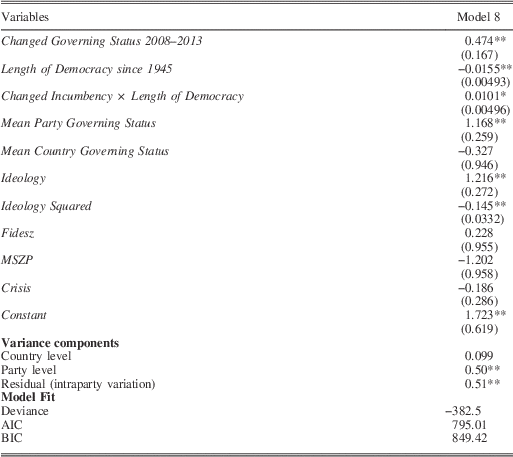
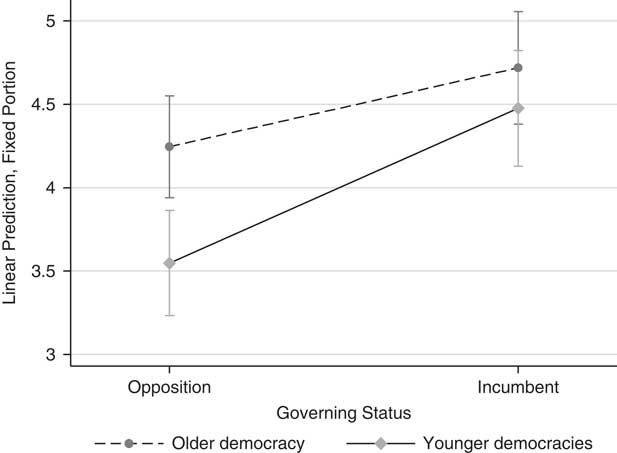
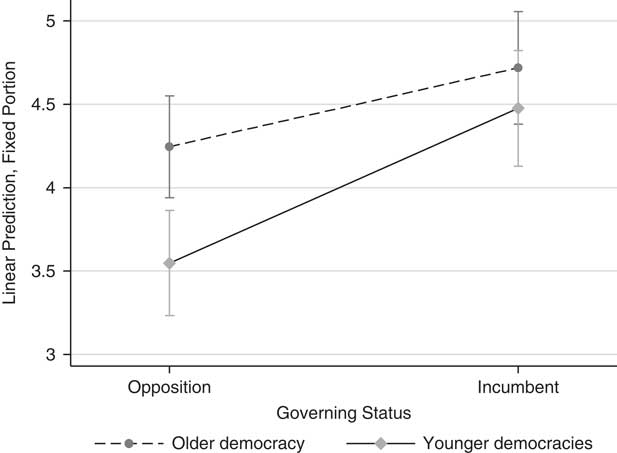
Table 3 shows the model results. The interaction term is statistically significant (p=0.04), suggesting that a change in incumbency status between 2008 and 2013 significantly alters a party’s performance evaluations depending on regime duration. Figure 3 illustrates that the changes are especially noticeable in newer democracies. Note that this result holds regardless of cross-party differences in incumbency, which also strongly influences performance evaluations (b=1.15). To reiterate, we do not wish to overly emphasize these dynamic patterns given our short time series. But this evidence does support the argument that the negative effect of an election loss for regime evaluations is tempered by habituation even when we control for extremism and crisis context.
The Effect of Changing Incumbency Status on Regime Performance Evaluations, 2008–13

Note: N=278 (139 per year) at party level; N=24 at country level. Standard errors in parentheses. **p<0.01, *p<0.05
Marginal effects of incumbency change on parties’ performance stances, 2008–13 Note: entries are predicted values of regime performance related to an incumbency change between 2008 and 2013 on the basis of Model 8 in Table 3.
CONCLUSION
Prior research has produced a large number of mass opinion studies about how citizens evaluate democracies, but ours is one of the first that moves this question to the level of political parties. We find considerable variation in regime evaluations across parties and, to a lesser degree, countries. We suggest a regime access model with two mechanisms that capture the way that party- and country-level conditions influence their evaluation of national institutions. The results from the cross-sectional analyses suggest that a record of incumbency across all prior elections (since 1945) provides victorious parties with the confidence that they have a reasonable chance to succeed again, thus boosting their evaluations of a democratic regime even if they currently constitute the opposition. In turn, parties that have had few chances to become incumbents are likely to be critical of national institutions even if they work well (for example, low inflation rates or low levels of corruption). This conclusion applies not just to smaller, extreme parties but extends to several centrist parties as well – and the pattern emerges in newer and more mature democracies. Thus one important finding of our study is that when regular regime access is absent, the incentives for permanent election losers to positively evaluate institutions are fairly dim even in a mature democracy.
From one vantage point, a positive implication of this research concerns our analysis of mass party organizations. In Western Europe, the fact that such organizations are associated with more positive democratic evaluations suggests that they continue to remain a pillar of liberal democracies, despite the findings of the ‘demise of party organization’ literature. In newer democracies, in turn, our findings suggest that mass organizations may grow into this role, as others have argued,Footnote 69 and that doing so may help boost support for a democratic regime.
Another important finding is consistent with a moderating influence of habituation: election losses lead to a less dramatic reduction in regime support the longer a democratic regime has existed. Viewing the cross-sectional patterns from a dynamic perspective, then, suggests that a loyal opposition forms mainly when parties can realize that their governing prospects are reasonable over time. We must remain tentative about this conclusion because we only have two time points at our disposal, so this is clearly an area in which more research is essential. But in this regard, the cases of two Hungarian parties, MZSP and Fidesz, are highly illustrative of the possible negative consequences for democratic institutions when parties lack the moderating impact of habituation. The former party, when in office at the time of our 2007 survey, was broadly positive about national democratic institutions (mean=4.86). On losing office, however, and faced with Fidesz in power, its evaluation fell to the lowest possible value on our scale: mean=1.0. Fidesz, by contrast, shifted from a highly critical position in 2007 when in opposition (mean=2.13) to the maximally positive position in 2013 when in power: mean=7.0. The switch in governing status and in democratic evaluations of these parties is matched, of course, by dramatic changes in the Hungarian constitution, in ways that many regard as motivated by the pursuit of partisan advantage by the current Fidesz incumbents. Our approach would lead us to think in a similar way about the victory of PiS in Poland: from being a highly critical party of national institutions in 2013 (mean=2.27), we expect that its victory in 2015 and subsequent reshaping of democratic institutions will have led to a shift to much more positive evaluations on its part – but much more negative ones on the part of many other parties. These two cases illustrate how quickly major parties can switch their views about the performance of institutions in newer democracies when parties lack regular access over time.
But we also see cause for concern in more stable democracies resulting from the potential effects on democratic evaluation of the growing fragmentation of Europe’s party systems. This phenomenon is worrisome because it may shrink the pool of parties that remains positively predisposed about a regime on the basis of its regime access. Clearly, a greater number of party competitors may mean that fewer have regular access to a regime, all else being equal. During the post-war decades, democracies in Western Europe have relied on a handful of parties that regularly alternate between government and opposition which had the opportunity to accumulate a significant record of governing participation and, moreover, experience over time that a single election loss does not mean their permanent demise. If more parties never win and fail to acquire governing experience, the likelihood is, based on our evidence, that their evaluation of democracy will decline, and demands for institutional change will grow.
Finally, we return to one implication of the results of ‘critical parties’ for the literature on ‘critical citizens’. While critical citizens evaluate democracies negatively for a range of reasons, including their preference for more democracy, we show the circumstances under which parties might be critical of democratic institutions as well.Footnote 70 One simple but important implication is that if both publics and political parties evaluate a regime negatively, then we would anticipate more demands for regime changes regardless of the underlying motives – either positively for better democracy or negatively to assail democracy itself – than when parties and citizens endorse the performance of regimes. Parties are cue givers, and an expanded choice set over the performance of a regime can potentially mobilize mass dissatisfaction. This possibility also calls for more empirical analyses of the reason why parties and citizens evaluate the performance of regimes critically, and how mass dissatisfaction with a democracy is articulated by political parties and linked to the views of publics about the performance of democracies – a topic that future research should attend to urgently.