Introduction
In general, the use of needs assessments to plan treatment has been shown to impact on health care use of patients diagnosed with severe mental illness (SMI) (Slade et al. Reference Slade, McCrone, Kuipers, Leese, Cahill, Parabiaghi, Priebe and Thornicroft2006; Robert et al. Reference Robert, Michel, Van Os, Altamura, Bobes, Gerlach, Hellewell, Kasper and Nabel2007; Van Os &Triffaux, Reference Van Os and Triffaux2008). However, the question is whether these changes are cost-effective.
The use of a simple patient-reported questionnaire on 20 perceived need areas in treatment plans was associated with higher satisfaction with care at 12-month follow-up, and treatment change was more likely in patients with more reported needs (Van Os et al. Reference Van Os, Altamura, Bobes, Gerlach, Hellewell, Kasper, Naber and Robert2004; Robert et al. Reference Robert, Michel, Van Os, Altamura, Bobes, Gerlach, Hellewell, Kasper and Nabel2007). Another study similarly showed that needs that came to light in an assessment were addressed before the next assessment, albeit not in all areas (Drukker et al. Reference Drukker, Van Dillen, Bak, Mengelers, Van Os and Delespaul2008). DIALOG, a tool to discuss 11 domains of clinical need, has been associated with improvement in quality of life and unmet needs for care after 12 months, although symptoms did not change (Priebe et al. Reference Priebe, Mccabe, Bullenkamp, Hansson, Lauber, Martinez-Leal, Rossler, Salize, Svensson, Torres-Gonzales, Van Den Brink, Wiersma and Wright2007). Furthermore, in subjects in which a monthly Routine Outcome Assessment tool was used, inpatient health care use was lower, but there were no differences in subjective outcomes (Slade et al. Reference Slade, McCrone, Kuipers, Leese, Cahill, Parabiaghi, Priebe and Thornicroft2006).
SMI is defined as all patients from ‘integrated care’ services treating patients with severe and enduring psychiatric illnesses (Drukker et al. Reference Drukker, Van Os, Bak, Campo and Delespaul2010b). Approximately, 75% of SMI patients are diagnosed with schizophrenia, other psychotic disorder or bipolar disorder (Drukker et al. Reference Drukker, Bak, Campo, Driessen, Van Os and Delespaul2010a). Recently, cost-effectiveness of evidence-based treatment has been identified as a knowledge gap in schizophrenia (Nasrallah et al. Reference Nasrallah, Tandon and Keshavan2011). The subgroup of SMI is often target group in research and treatment because it is a relatively homogeneous subgroup at the most severe end of the spectrum of mental disorders (Aagaar & Nielsen, Reference Aagaar and Nielsen2004). Therefore, this knowledge gap in cost-effective treatment can be extrapolated to the total SMI group.
In South-Limburg, the Netherlands (population 660 000), the Cumulative Needs for Care Monitor (CNCM) regularly assesses, among others, need for care in SMI patients (Drukker et al. Reference Drukker, Bak, Campo, Driessen, Van Os and Delespaul2010a). Using these data, systematic feedback on individual patient outcomes is provided to professional carers, with a view to induce tailored, needs-based treatment for individual patients (Drukker et al. Reference Drukker, Van Dillen, Bak, Mengelers, Van Os and Delespaul2008; Drukker et al. Reference Drukker, Van Os, Bak, Campo and Delespaul2010b). Mental health professionals (nurses, social workers, psychiatrists and psychologists) are trained to administer CNCM forms to all patients diagnosed with SMI, who are either outpatients or patients admitted to a general or psychiatric hospital. All patients receiving mental health care, both inpatients and outpatients, are assessed yearly and with every major change in treatment or setting (e.g. hospitalization, start of new treatment and discharge) by their professional carer. Of the yearly evaluations, 63% are performed within 15 months of the previous assessment and 25% between 15 months and 2 years. The main instrument is the Camberwell Assessment of Needs (CAN) (Drukker et al. Reference Drukker, Bak, Campo, Driessen, Van Os and Delespaul2010a). The CAN combines the ratings from both patient and interviewer using a priori decision rules. Quality of life and quality of care are scored by the patient, while the Global Assessment of Functioning (GAF) and other instruments are scored by the interviewer (Drukker et al. Reference Drukker, Bak, Campo, Driessen, Van Os and Delespaul2010a).
Previously, it has been shown that use of the CNCM was associated with an increase in functioning and outpatient care consumption as well as a small decrease in inpatient care consumption (Drukker et al. Reference Drukker, Van Os, Bak, Campo and Delespaul2010b, Reference Drukker, Van Os, Dietvorst, Sytema, Driessen and Delespaul2011a). However, policy makers need an estimation of the costs of improved functioning to decide on the use of the CNCM. Health technology assessment (HTA) methods have been developed to assess cost-effectiveness. Recently, these methods have been implemented in mental health research throughout Europe (Evers et al. Reference Evers, Salvador-Carulla, Halsteinli and Mcdaid2007).
The present paper used decision-analytic modelling to evaluate the costs, effects and cost-effectiveness of the CNCM as compared with care as usual (CAU) in patients diagnosed with SMI. The main outcome is life years without psychiatric dysfunction (GAF).
Methods
Psychiatric Case Registers and population characteristics
Psychiatric Case Registers (PCR) are anonymous cumulative registers of admissions (including duration), outpatient contacts and days in day care (e.g. from psychiatric hospital, community mental health centre and psychiatric department of university hospital). The PCR South Limburg includes the CNCM region.
In the CNCM region, approximately 1.6% of the adult population is diagnosed with SMI (Drukker et al. Reference Drukker, Bak, Campo, Driessen, Van Os and Delespaul2010a). Prevalence of SMI has been constant over the years. Yearly incidence figures are around 2–3 per 10 000 inhabitants (McGrath, Reference McGrath2006).
Treatment arms
In the present paper, addition of the CNCM to CAU was studied. Thus, treatment arms were CNCM and CAU. CNCM is described above. CAU primarily consists of hospital-based crisis intervention, sheltered living and follow-up case management after discharge. Some ambulatory patients went regularly to the outpatient clinic. Services were split between ‘cure’ and ‘care’. Long-term care services were almost entirely ‘care’ based and almost all the modern evident-based practices were not available. Medication is provided to prevent relapse and medication regimes are reviewed approximately once a year (if no crisis occurs).
Model description
A Markov model was constructed to simulate the course of events in CNCM and CAU in a hypothetical cohort of 1000 SMI patients. The cohort had the age (mean: 42 years) distribution as observed in the CNCM data.
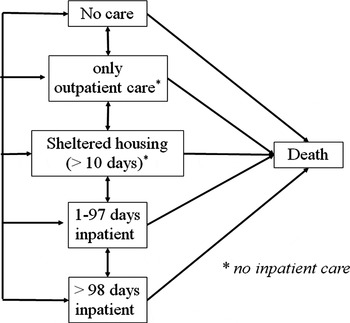
Health states were defined based on mental health care use, as a proxy for severity of illness. Health states included in the models were: no care (NOCA), outpatient care only (OU), sheltered housing (SHEL), short-term inpatient care (STIN; ≤97 days per year), and long-term inpatient care (LTIN >97 days per year). Figure 1 is a graphical presentation of the model structure.
Graphical representation of the model structure. A patient can transit from health state-to-health state (including remaining in the same health state). Death is the absorbing state.

The effectiveness of CNCM was determined based on data from two separate studies: a before–after study and a matched control study. This resulted in two model analyses: a before–after model and a matched-control model. The time-horizon was set at 5 year for both model analyses. The before–after model uses data between a maximum of 5 years before and a maximum of 5 years after the CNCM assessment (2155 subjects), and the matched-control model uses data between one year before and one year after the (hypothetical) assessment (n = 937). Extrapolation of the matched-control data to five years was thought to be plausible because figures are relatively constant over the years in an adult SMI population. Results of extrapolation to a life-time time horizon were deemed unrealistic. The cycle length was set at one year, because CNCM is assessed yearly in stable SMI patients. Future costs and effects were discounted to their present value by a rate of 4 and 1.5%, respectively, according to Dutch guidelines (College voor zorgverzekeringen, 2006; Council for Public Health and Health Care, 2006). Analyses to calculate the model inputs were performed in Stata version 11 (StataCorp., 2009). Models were built in Excel.
Transition probabilities
Mental health care use was obtained from the PCRs. Data were available until December 31st, 2008. CNCM and PCR data were matched anonymously at the level of individual patients using an encrypted identification code (Drukker et al. Reference Drukker, Bak, Campo, Driessen, Van Os and Delespaul2010a). For the before–after model, of each CNCM patient the first assessment after January 2007 (CNCM) as well as the first assessment ever (CAU) were matched with the PCR, to obtain mental health care use in the five year before and the five year after this specific CNCM date (as far as available).
For the matched-control model, CNCM patients were matched with control patients from the North of the Netherlands (population 1.7 million), using propensity score matching, as has been reported in a previous paper (Drukker et al. Reference Drukker, Van Os, Dietvorst, Sytema, Driessen and Delespaul2011a). Mental health care use in the year before and in the year after this date was obtained from the PCRs.
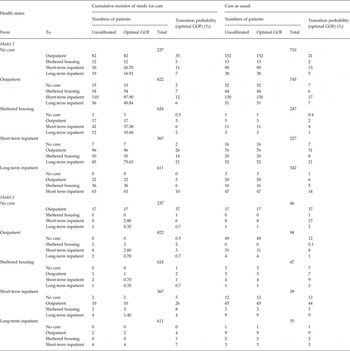
Transition probabilities were obtained from a cross-tabulation of patients in a health state in one year by the health state in the next year, stratified by CNCM and CAU. In Table 1, these numbers are presented in the column ‘uncalibrated’. The numbers after calibration are presented in the column optimal GOF (goodness of fit). Distribution of the cohort over the health states in year 1 was based on the percentages in the control region (NOCA = 50; OU = 600; SHEL = 50; STIN = 150; LTIN = 150).
Transition probabilities in model 1 (before–after) and model 2 (matched-control)

CAN, Camberwell Assessment of Needs
CAU, Care as Usual
CEA, Costs Effectiveness Analysis
CEAC, Costs Effectiveness Acceptibility Curve
CNCM, Cumulative Monitor of Needs for Care
FACT, Flexible Assertive Community Treatment
GAF, Global Assessment of Functioning
GOF, Goodness of Fit
HTA, Health Technology Assessment
ICER, incremental cost-effectiveness ratio
LTIN, Health state: Long-term inpatient care
NOCA, Health state: No care
OU, Health state: Outpatient care
PCR, Psychiatric Case Register
QALY, Quality adjusted life year
RCT, Randomised Controlled Trail
SHEL, health state: Sheltered housing
SMI, Severe mental illness
STIN, Health state: short term inpatient care
Mortality figures in SMI patients were obtained from Wijnand Laan (PCR Middle Netherlands, using PCR data as well as data from Statistics Netherlands, unpublished results).
Health effects
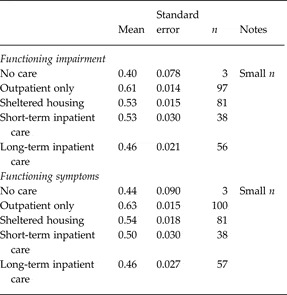
Outcome was psychiatric functioning as measured with the GAF (fifth axis of the DSM IV). Scores range from 0 (poor) to 100 (very good) (Ramirez et al. Reference Ramirez, Ekselius and Ramklint2008). The GAF used in the CNCM is divided into its Impairment component and its Psychopathological symptoms component (Jones et al. Reference Jones, Thornicroft, Coffey and Dunn1995). Thus, ‘life year without psychiatric impairment’ and ‘life year without psychiatric symptoms’ were the two outcomes in the present analyses. These outcomes represent a better alternative than QALYs, because instruments needed to calculate QALYs are invalid in psychiatry (Chisholm et al. Reference Chisholm, Healey and Knapp1997; Roick et al. Reference Roick, Thierfelder, Heider, Klemm, Paschke and Angermeyer2004; Van de Willige et al. Reference Van De Willige, Wiersma, Nienhuis and Enner2005; Konnopka et al. Reference Konnopka, Gunther, Angermeyer and Konig2006), while the life year without psychiatric dysfunction score approximates valid QALYs. GAF scores were only available from the CNCM database. These data were used to estimate average functioning per health state (Table 2). GAF-scores were transformed because scores between 85 and 100 indicate optimal functioning. Thus, all scores of 85 and higher were recoded into 1 and all scores below 85 were multiplied by 100/8500, resulting in transformed scales ranging 0–1. These scales were used as weights to calculate life years adjusted for psychiatric functioning (transformed scale *year = adjusted life year).
Functioning per health state
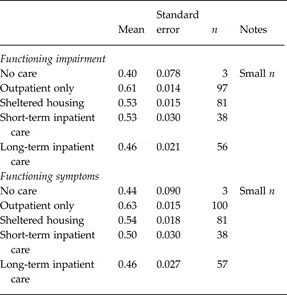
n, number of patients.
Costs
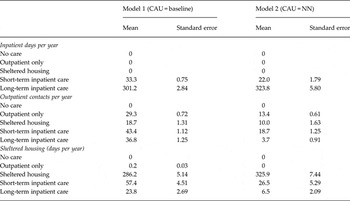
Mental health care use per health state is presented in Table 3. Mental health care costs were costs per unit X actual mental health care use. Costs per unit (year = 2003) were obtained from the Dutch costs manual (Oostenbrink et al. Reference Oostenbrink, Bouwmans, Koopmanschap and Rutten2004) and were calculated to their 2007 value using price index figures from Statistics Netherlands (CBS, 2009) (outpatient contact: €93.12; sheltered housing €105.82). Additionally, the administration of the largest institution in the CNCM-region supplied unit costs for short-term and long-term inpatients (personal communication, 07-12-2009, Richard Janssen, Petra Soeters; short-term days indexed to 2007: €250.72; long-term days indexed: €207.33).
Health care use per health state in model 1 (before–after) and model 2 (matched-control)
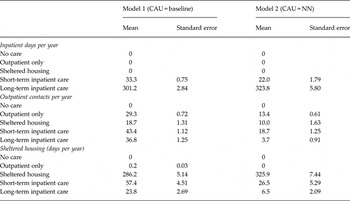
CAU, care as usual; NN, North of the Netherlands.
The local academic hospital serving Maastricht and surrounding areas (no other somatic hospitals in this region) provided hospital administration data on somatic health care consumption (procedures, admissions, laboratory, diagnostic techniques) during 5 years before and 5 years after the CNCM date, for all patients that were both in the CNCM and in the hospital database (329 CNCM patients). These data were matched using the same encrypted identification code as used above. Unit costs for hospital care from the year 2007 were used to calculate the somatic costs. This way, somatic costs per health state could be estimated in the subsample of patients in the catchment area of this hospital. This subsample can be assumed to be representative for the total sample.
Model assumptions, validation and calibration
In order to validate model outcomes, health care use as predicted by the model was compared to the observed data. In case the model predictions differ substantially from the data, the models should be calibrated so that output is more similar to reality (Vanni et al. Reference Vanni, Legood and White2010). This was done by improving goodness of fit (GOF), based on inpatient health care use, outpatient health care use and the two GAF outcomes, using a multiplication factor between 0 and 1 to calibrate transition rates (see results and appendix).
Analyses
Incremental cost-effectiveness ratios (iCERs) were calculated. Parameter uncertainty surrounding the iCERs was handled probabilistically (Weinstein, Reference Weinstein2006). Measures of variance were retrieved from the data as described above. Functioning was assigned a beta-distribution, mental health care consumption was assigned a gamma-distribution and transition rates were assigned a Dirichlet distribution. Parameter values were drawn at random from the assigned distributions, using Monte Carlo simulation with 5000 iterations. Whether CNCM is deemed efficient depends on how much society is willing to pay for a life year in perfect functioning, which is referred to as ceiling ratio (Briggs et al. Reference Briggs, Claxton and Sculpher2007). For further reading on the theory of willingness to pay for health gain we refer to the literature (Drummond, Reference Drummond2005; Briggs et al. Reference Briggs, Claxton and Sculpher2007). To illustrate the results of the simulation, cost-effectiveness acceptability curves (CEACs) were calculated (Van Hout et al. Reference Van Hout, Al, Gordon and Rutten1994; Fenwick et al. Reference Fenwick, Claxton and Sculpher2001). For different ceiling ratios, the net monetary benefit was calculated for each strategy by subtracting the costs from the effects, multiplied by the ceiling ratio.
As data were obtained from the CNCM data base, assessment of functioning in no-care patients was problematic; data from only 3 patients could be included. Therefore, one-way sensitivity analyses were performed to test consistency of the results. The level of functioning in this group was varied (0.1 and 0.2 higher than observed and 0.1 and 0.2 lower than observed).
Results
Without calibration, the number of inpatient days in CNCM was higher than in CAU, while the regression results showed a decrease in inpatient days. Therefore, all transition rates to health states with more inpatient care were multiplied by a multiplication factor, to obtain the best possible GOF (see appendix). Multiplication factor before–after model: 0.89, matched-control model: 0.35.
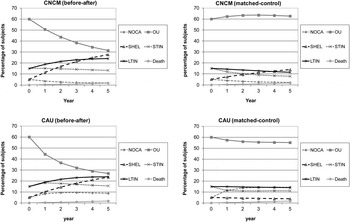
Figure 2 presents expected results based on transition rates. The lines represent the migration of a group of 1000 patients over the health states over 5 years in CNCM group and CAU group. Both models show an increase in patients in the no-care group in CAU and an increase in patients in sheltered housing in CNCM. The average costs per patient are higher in the CNCM strategy (before–after model difference: €2809; matched-control model difference: €5251).
Cohort migration. Model 1, before–after and model 2, matched-control. NOCA, no care; OU, outpatient care only; SHEL, sheltered housing; STIN, short-term inpatient care (≤97 days per year); LTIN, long-term inpatient care (>97 days per year).

Cost per life year without psychiatric impairment
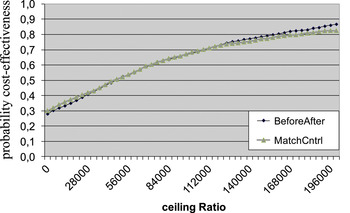
Patients in CNCM gain life years without psychiatric impairment as compared to patients in CAU (before–after model: 0.06, matched-control model: 0.10). This leads to iCERs of €45 127 and €52 991 per life year without psychiatric impairment gained. The bootstrap replicates in the iCER planes were mainly located in the North-East quadrant, indicating health gains and more costs. The uncertainty is considerable, as reflected in the CEAC curves presented in Fig. 3. When willingness to pay is €100 000, the probability that CNCM is cost-effective is 68% (in both before–after and matched-control model). The cost-effectiveness probability of CNCM asymptotically approaches approximately 90%.
Cost-effectiveness acceptability curve (impairment). BeforeAfter, before–after model; MatchCntrl, matched-control model.

Costs per life year without psychiatric symptoms
In the CNCM strategy, patients gain life years without psychiatric symptoms as compared with CAU (before–after model: 0.06, matched-control model: 0.09). ICERs were €45 944 and €57 839 per year, respectively. The bootstrap replicates in the iCER planes were again mainly located in the North-East quadrant. When willingness to pay is €100 000, the probability that CNCM is cost-effective is 65 and 62% (before–after and matched-control, respectively).
Sensitivity analyses
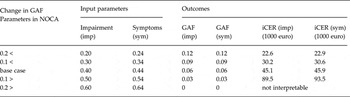
Only when patients in the NOCA health state function 0.2 points (or more) better than in the base case analysis (impairment = 0.40; symptoms = 0.44), functioning is no longer better in CNCM than in CAU (Table 4).
Sensitivity analyses: how do outcomes change when functioning in the no-care group varies
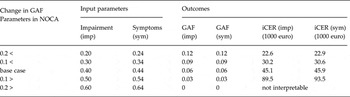
NOCA, no care health state; imp, impairment; sym, symptoms
Discussion
When need for care and other assessments are used in treatment plans, patients remain in care longer and have improved functioning. The small decrease in inpatient days does, however, not make up for the extra costs of the increase in outpatient contacts. Thus, although the intervention is relatively cheap (one hour salary of a professional carer per year per patient) the iCER is between €45 127 and €57 839 per functioning adjusted life year gained. Thus, CNCM is only cost-effective when willingness to pay for a life year without psychiatric impairment or symptoms exceeds €45 000 per life year without psychiatric dysfunctioning gained. The results are surrounded by considerable uncertainty.
The increase in outpatient costs in combination with a decrease in inpatients costs could be expected because tailored treatment would in theory lead to an immediate increase in extensive outpatient care consumption and, inducing, as a consequence prevention of future deterioration and admissions (Drukker et al. Reference Drukker, Visser, Sytema and Van Ossubmitted for publication).
A recent paper on crisis resolution teams also showed an increase in non-inpatient costs, also including GP-costs. This increase in non-inpatient costs co-occurred with a decrease in inpatient costs (McCrone et al. Reference McCrone, Johnson, Nolan, Pilling, Sandor, Hoult, Mckenzie, Thompson and Bebbington2009). In CNCM, the increase in outpatient care without a drop in inpatient care reduces cost-effectiveness. On the other hand, the long-term use of outpatient care theoretically prevents relapse. Thus, despite the fact that the present results are marginally positive, the increase in outpatient care potentially has much stronger positive results in the long run. This scenario could not be shown in this relatively short-term analysis. A randomized controlled trial (RCT) studying the use of Routine Outcome Monitoring showed a decrease in costs as a consequence of a decrease in inpatient health care use (Slade et al. Reference Slade, McCrone, Kuipers, Leese, Cahill, Parabiaghi, Priebe and Thornicroft2006). The decrease in inpatient care is in line with the present study, but the decrease in total costs is not. This may be a consequence of the patient group; the RCT also included non-SMI patients. Because in the RCT, monitoring was not effective, it was also not cost-effective (Slade et al. Reference Slade, McCrone, Kuipers, Leese, Cahill, Parabiaghi, Priebe and Thornicroft2006).
Systematic assessment of needs in SMI patients, as studied in the present paper, has been advocated (Van Os et al. Reference Van Os, Altamura, Bobes, Gerlach, Hellewell, Kasper, Naber and Robert2004; Priebe et al. Reference Priebe, Mccabe, Bullenkamp, Hansson, Lauber, Martinez-Leal, Rossler, Salize, Svensson, Torres-Gonzales, Van Den Brink, Wiersma and Wright2007; Robert et al. Reference Robert, Michel, Van Os, Altamura, Bobes, Gerlach, Hellewell, Kasper and Nabel2007; Van Os & Triffaux, Reference Van Os and Triffaux2008). Except for the above-mentioned RCT, previous cost-effectiveness research on systematic needs assessment, however, has only been performed in depressive patients (Gilbody et al. Reference Gilbody, House and Sheldon2003). ICERs in depressive patients were between €8649 and €15 234 ($11 341 and $19 976; Pyne et al. Reference Pyne, Rost, Zhang, Williams, Smith and Fortney2003), which is lower than iCERs in the present paper. However, the depressed patient group is less severely ill than the SMI patients and iCERs in the present paper were not based on QALYs (see methodological issues).
An economic evaluation of an intervention aimed to decrease drop-out has the limitation that dropped-out care avoiders per definition do not use inpatient or outpatient health care, resulting in health care costs that are close to zero during the period of drop-out. The hypothesized increase in health care use and other costs after deterioration (crisis admission because of risk for self or others) or relapse could not be assessed and, therefore, was not in our models. Although continuity of care is generally accepted as beneficial, models show low cost-effectiveness of the intervention. Models are a simplification of reality. It is almost impossible to assess long-term health care use after the intervention, unless the intervention is old. We feel that continuity of care is beneficial in the long run although our models could not prove this. In addition, parameters of model 1 and 2 differed substantially and reasons for these differences were difficult to allocate. However, both models lead to the same conclusions.
Methodological issues
The PCR uses data that all mental health care institutions also provide to insurers to claim treatment expenses. Thus, PCR data are accurate. In the years before and after the assessment, patients who lived and used mental health care outside the PCR region at that time were erroneously included in the no-care health state. This could have led to a slight overestimation of transition rates to NOCA. However, it is unlikely that results are substantially biased, because this overestimation is similar in both treatment arms.
When model output deviates from empirical analysis results, the model parameters need to be adapted (Vanni et al. Reference Vanni, Legood and White2010), because it seems illogical to choose the model output over real data. Methods from engineering have been proposed to efficiently search the best fit (Kong et al. Reference Kong, McMahon and Gazelle2009). However, these methods are still in their infancy and guidelines on calibration methods are lacking. Therefore, in the present paper, transition rates were adapted by adding a multiplication factor (manually) to obtain levels of inpatient care that were more similar to empirical results. Unfortunately, this multiplication factor was only 0.35 in the matched-control model. Although GOF after calibration was similar to GOF in the calibrated before–after model, the subset of transition rates were more different from the original data than in the before–after model.
In part of the CNCM region, a special version of assertive community treatment, flexible assertive community treatment (FACT) was in place (Van Veldhuizen, Reference Van Veldhuizen2007; Drukker et al. Reference Drukker, Van Os, Sytema, Driessen, Visser and Delespaul2011b). CNCM is an ingredient of FACT and, therefore, CNCM and FACT cannot be disentangled. FACT is partly responsible for the pattern of psychiatric care use in the CNCM region. However, similar increases in care consumption were found in the subregion where FACT was introduced later (Drukker et al. Reference Drukker, Van Os, Dietvorst, Sytema, Driessen and Delespaul2011a). A post hoc sensitivity analysis was performed excluding the FACT region (before–after model). In this model, ICERs were considerably lower: €25 700 (impairment) and €30 250 (symptoms). Thus, costs may be lower if CNCM is studied in non-FACT regions, but the conclusion remains that CNCM may be only cost-effective when willingness to pay for a life year without psychiatric dysfunction is relatively high.
The present paper has several limitations. First, in the NOCA group, functioning was estimated using data of only three patients, who are likely not representative for all NOCA patients. NOCA patients are not in contact with any mental health service and only patients in care are interviewed. NOCA patients do not necessarily function better than in-care patients, because a substantial part of the NOCA patients are drop-outs, who do need care (Schout et al. Reference Schout, De Jong and Zeelen2010). A previous paper showed that non-attenders (within the subgroup of patients being longer in psychiatric care with more serious mental illness) had more severe symptoms (Manchester scale score) and impairment (social adjustment scale score) than attenders (Killaspy et al. Reference Killaspy, Banerjee, King and Lloyd2000). Furthermore, 12 of the 13 drop-outs of standard care were still severely ill with the risk of further deterioration and admission (Sytema et al. Reference Sytema, Wunderink, Bloemers, Roorda and Wiersma2007).The present data showed that patients who dropped out of care in the next year had lower levels of depression and anxiety while other psychopathology and functioning did not differ (unpublished results). Thus, we had reason to believe that patients in the NOCA health state were as severely ill as inpatients. Using the three patients in NOCA, we found functioning levels similar to the patients using short- or long-term inpatient care (STIN and LTIN). Because this is what we expected, we used these estimates in the model and we conducted sensitivity analyses with higher and lower levels of functioning in the NOCA health state. These analyses show that the results are sensitive to changes in the level of functioning in the NOCA health state. Future research on characteristics and severity of symptoms in drop-outs is crucial, despite the difficulty to motivate these drop-outs to join a study.
Second, the EuroQol-5D is one of few instruments that can be used to calculate utilities (QALYs) for health outcomes for use in cost-utility analyses (EuroQol Group, 1990; Chisholm et al. Reference Chisholm, Healey and Knapp1997; Sculpher, Reference Sculpher2008). However, its validity in psychiatric populations has been questioned (Chisholm et al. Reference Chisholm, Healey and Knapp1997; Roick et al. Reference Roick, Thierfelder, Heider, Klemm, Paschke and Angermeyer2004; Van de Willige et al. Reference Van De Willige, Wiersma, Nienhuis and Enner2005; Konnopka et al. Reference Konnopka, Gunther, Angermeyer and Konig2006). Therefore, the present paper presents cost-effectiveness analyses with GAF as the outcome, rather than cost-utility analyses. The GAF is recognized as a valid and comprehensive measure of psychiatric functioning when used in routine clinical practice (Jones et al. Reference Jones, Thornicroft, Coffey and Dunn1995; Tungstrom et al. Reference Tungstrom, Soderberg and Armelius2005) and in research (Jones et al. Reference Jones, Thornicroft, Coffey and Dunn1995; Startup et al. Reference Startup, Jackson and Bendix2002). Precision of GAF scores at the group level is sufficient (Soderberg et al. Reference Soderberg, Tungstrom and Armelius2005).
Third, the present data sets do not include medication use. Most SMI patients use medication on a daily basis. Thus, costs are relatively high. Because each individual patient responds differently, psychiatric medication costs for HTA models can only be assessed by studying large patient cohorts (College voor zorgverzekeringen, 2011). However, amount and type of medication use in patient with severe mental illness do not vary primarily as a function of health states and symptom severity, in the Netherlands (as opposed to, e.g. the United States). In the present data, there are no differences between the health states (OU, SHEL, STIN and LTIN) in use (yes/no) of psychiatric medication (total χ 2 = 1.3, df = 3, p = 0.7; antipsychotics χ 2 = 1.6, df = 3, p = 0.7; antidepressants χ 2 = 1.0, df = 3, p = 0.8 and anxiolitica χ 2 = 6.1, df = 3, p = 0.11). Thus, virtually all patients are prescribed one or more maintenance medications and changes in health state/severity is accompanied by changes in medication not impacting on net medication costs. In addition, it is known that the medication factor most impacting on health states indicating severity of symptoms is not medication type and quantity, but medication compliance (Priebe et al. Reference Priebe, Sinclair, Burton, Marougka, Larsen, Firn and Ashcroft2010). If medication costs would be lower in the better health states, the iCER of CNCM v. CAU would decrease.
Furthermore, health states were based on mental health care use, as a proxy of severity, because this was the only indicator of the course of disease severity available in CAU data. In the before–after study, functioning was only assessed as part of the CNCM and thus not available in the ‘before’ dataset; functioning similarly was not measured in the control region. Although mental health care use is associated with severity of illness (Van Os et al. Reference Van Os, Gilvarry, Bale, Van Horn, Tattan, White and Murray1999), other factors are involved as well. In the future, longitudinal data on the study outcome need to be collected in all treatment arms. Furthermore, if future research benefits from the availability of comparative effectiveness data, health states can be based on indicators such as functioning, quality of life or severity of symptoms.
Finally, the present analyses were performed from the health care perspective, while a societal perspective would have been preferable. Owing to a lack of data on societal consequences in PCR and CNCM, this was not feasible. We chose not to collect data to assess the impact of the CNCM intervention, because this can be regarded as a minimal intervention and could have contaminated the effect. This study is one of the first economic evaluations in the field of SMI. Although not ideal, the fact that the study is based on the use of large sets of real world data adds to the practical relevance of the results. Nevertheless, in addition to real-life data as in the current study, complementary data from randomized controlled trials are also needed. As far as we know, this is the first study in SMI using the GAF to calculate life years without psychiatric impairment or symptoms. As a result, there is no benchmark for the maximum costs per ‘life year without psychiatric impairment or symptoms’ saved.
Conclusion
Although the use of CNCM impacts on mental health care consumption, the models used in the present paper suggest that CNCM is only cost-effective when willingness to pay for relief of 1 year without psychiatric symptoms or 1 year without impairment in functioning exceeds €45 100 or even 57 800.
Acknowledgements
The authors are grateful to all mental health care workers in the region, who administered CNCM forms for use in the individual treatment of patients. We thank Richard Janssen and Petra Soeters (Mondriaan) for giving an indication of inpatient costs for treatment and long stay separately.
Declaration of Interest
We gratefully acknowledge the financial support by ZonMW, the Netherlands Organisation for Health Research and Development (grant number 94507727). The authors declare that they have no competing interests.