Introduction
Sepsis is a leading cause of death, disability, and healthcare costs. Reference Rhee, Dantes and Epstein1,Reference Buchman, Simpson and Sciarretta2 Hospitals and policymakers in the U.S. have largely focused on improving early sepsis management by promoting compliance with the Centers for Medicare & Medicaid Services (CMS) Severe Sepsis/Septic Shock Management Bundle (SEP-1). Multiple longitudinal analyses, however, suggest that SEP-1 implementation has not catalyzed improvements in sepsis mortality rates. Reference Barbash, Davis, Yabes, Seymour, Angus and Kahn3–Reference Anderson, Moehring and Parish5 Experts and professional societies have therefore called for replacing SEP-1 with a risk-adjusted sepsis mortality measure in order to extend hospitals’ attention to the full breadth of sepsis care beyond initial resuscitation alone, facilitate meaningful hospital comparisons, and spur innovations in sepsis diagnosis and treatment. Reference Klompas, Rhee and Singer6,Reference Rhee, Strich and Chiotos7
To meet this need, the Centers for Disease Control and Prevention (CDC) is developing a community-onset sepsis mortality quality measure based on their Adult Sepsis Event (ASE) definition. Reference Prescott, Heath and Jayaprakash8 ASE defines sepsis as presumed infection with concurrent organ dysfunction, in accordance with current international consensus definitions (Sepsis-3) Reference Singer, Deutschman and Seymour9 , and uses structured electronic health record (EHR) data to facilitate widespread, objective, and automated surveillance without the bias and variability associated with diagnosis codes. Reference Rhee, Dantes and Epstein1,Reference Rhee, Dantes, Epstein and Klompas10–Reference Rhee, Jentzsch and Kadri18 Presumed infection is defined as drawing blood cultures and administering ≥4 days of antibiotics (or until ≤1 day before death, transition to comfort measures or hospice, or transfer to another acute care hospital). Organ dysfunction is defined as initiation of vasopressors, new invasive mechanical ventilation, elevated lactate, increased creatinine or bilirubin, or decreased platelets. 19 ASE has demonstrated good performance in medical record review-based validation studies, Reference Rhee, Dantes and Epstein1,Reference Rhee, Kadri and Huang17,Reference Karlic, Clouse and Hogan20,Reference Page, Klompas and Chan21 distinguishes between community-onset vs hospital-onset sepsis, Reference Page, Klompas and Chan21,Reference Rhee, Wang and Zhang22 and strongly predicts poor outcomes. Reference Dong, Tian and Zhou11,Reference Rhee, Zhang and Kadri23 These strengths make ASE a credible basis for national sepsis surveillance.
Nevertheless, updates to the ASE definition are needed to optimize its use as a national quality measure. In the near decade since ASE was first developed, clinical practices have evolved, the breadth of data available in EHRs has expanded, and regular use of ASE has identified areas for improvement. First, since ASE infection criteria are anchored on blood culture collection, the measure can miss transferred patients with cultures drawn at other facilities and may be vulnerable to bias from local variability and shifting thresholds for ordering blood cultures. Second, the requirement of ≥4 days of inpatient antibiotics excludes patients with milder forms of sepsis who recover quickly and are discharged within 3 days, potentially masking improvements in care. Third, ASE’s organ dysfunction criteria do not include patients with hypotension managed without vasopressors or respiratory failure managed with high flow nasal cannula (HFNC) or noninvasive ventilation (NIV) alone. These markers of organ dysfunction have strong face validity and may identify patients in whom timely sepsis care prevented progression to more severe organ dysfunction. They were not initially included in ASE because they were not routinely recorded as structured EHR data when ASE was first developed. Ongoing enhancements to EHR systems and data exchange protocols now make their inclusion feasible. Reference Brant, Kennedy and King24
Before modifying ASE to incorporate these criteria, it is important to understand their impact on ASE incidence, outcomes, and clinical validity. We therefore proposed and investigated potential modifications to ASE criteria and quantified their impact on estimated community-onset sepsis incidence and mortality rates using data from a large multihospital cohort. We also conducted targeted chart reviews to determine the frequency of clinically-defined sepsis in the additional patients identified by each modification.
Methods
Study design, population, and data source
We conducted a retrospective observational study including all adults (≥18 yr) admitted to 5 hospitals (including two academic and three community hospitals) within the Massachusetts General Brigham (MGB) network between June 2015 and December 2022. Detailed administrative and EHR data were obtained from the MGB Enterprise Data Warehouse. The study was approved by the MGB Institutional Review Board with a waiver of informed consent.
Original ASE definition and potential modifications assessed
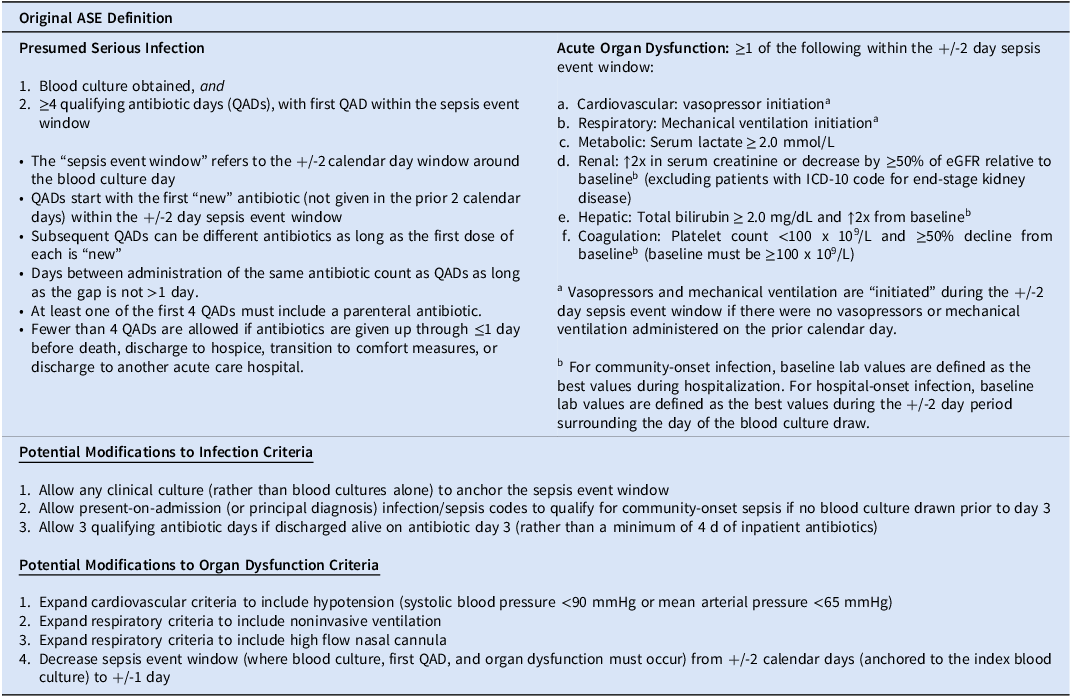
Amongst all hospitalized patients, we identified those who met original ASE criteria and those who met candidate modified definitions (Box 1). We focused on community-onset sepsis (presumed infection or organ dysfunction criteria present on the first or second hospital day) as this is the focus of CDC’s forthcoming mortality measure.
Original Adult Sepsis Event Definition and Potential Modifications Assessed

Potential modifications to presumed infection criteria
We evaluated three modifications to ASE’s presumed infection criteria: (1) expanding the culture criterion from blood cultures alone to any clinical culture (excluding surveillance cultures obtained for infection control purposes), mirroring the approach used by the Sepsis-3 task force and others Reference Seymour, Liu and Iwashyna25–Reference Ling, Zhang and Chang27 , (2) incorporating present-on-admission (POA) discharge diagnosis codes for infection or sepsis as an alternative to requiring blood cultures, and (3) reducing the minimum duration of inpatient antibiotics from ≥4 days to ≥3 days for patients discharged alive on the third antibiotic day. The first two modifications aim to mitigate ASE’s heavy reliance on blood cultures, which can serve as a single point of failure in the algorithm, while the third acknowledges that some patients with sepsis improve rapidly and are appropriately discharged within 3 days of antibiotic initiation. For POA infection codes, we further divided these into any secondary POA infection code vs those with an infection code as the principal diagnosis. We used infection codes identified by prior sepsis epidemiologic studies (Appendix, Supplement). Reference Biebelberg, Rhee, Chen, McKenna and Klompas28,Reference Kam, Chen and Kadri29
Potential modifications to organ dysfunction criteria
We evaluated three major modifications to ASE’s organ dysfunction criteria: (1) expanding cardiovascular criteria beyond vasopressors alone to include hypotension (systolic blood pressure <90mmHg or mean arterial pressure <65mmHg), given that hypotension is a key clinical manifestation of sepsis, (2) expanding acute respiratory failure criteria beyond invasive mechanical ventilation alone to include NIV or HFNC, given that these modalities are increasingly used and recommended for respiratory failure Reference Matthay, Arabi and Arroliga30 , and (3) shortening the sepsis event window during which the blood culture, first antibiotic day, and organ dysfunction must occur from +/-2 calendar days (anchored to the blood culture day) to +/-1 day to assure a tighter association between infection and organ dysfunction. We also examined two sets of minor organ dysfunction modifications: (1) fine tuning the laboratory criteria for elevated lactate, creatine, bilirubin, and low platelets, and (2) extending the rules for imputing baseline organ dysfunction from “patient’s best laboratory value during hospitalization” to also assume normal baseline laboratory values for patients who die or are discharged to hospice on the rationale that these patients’ laboratory values may not have improved during hospitalization thus precluding accurate estimation of their baseline organ function. Additional details and rationale for these changes are provided in Supplemental Methods 1.
Medical record reviews
To assess the clinical validity of each modification, we conducted medical record reviews on at least 30 randomly selected patients for original ASE and for each candidate modification (not including the minor organ dysfunction modifications). We limited these reviews to patients who met modified definitions but not original ASE criteria to isolate the marginal impact of each change.
Medical record reviews focused on adjudicating the likelihood of sepsis within the first 2 days of admission, incorporating both the likelihood of infection and the likelihood that organ dysfunction was related to infection, as per prior studies. Reference Rhee, Dantes and Epstein1,Reference Karlic, Clouse and Hogan20 Definite/probable sepsis required probable or definite infection plus at least one organ dysfunction definitely or probably caused by infection; possible sepsis included possible, probable, or definite infection with ≥1 organ dysfunction possibly related to infection; and no sepsis was assigned if there was no infection, or if organ dysfunction was clearly due to noninfectious causes (Supplement Methods 2). An initial 10 cases were reviewed independently by an internal medicine resident (L.M.), an infectious disease fellow (S.G.), and a senior infectious disease/critical care physician (C.R.), and each case was discussed as a group and differences reconciled to ensure a standardized approach. The remaining cases were then divided and reviewed independently by thesethree physicians.
Statistical analysis
We calculated the marginal impact of each potential ASE modification on the measured incidence of community-onset sepsis and in-hospital mortality relative to original ASE criteria using the entire hospitalized cohort. We also calculated the positive predictive value (PPV) for sepsis for each modified definition - considering “true positive” sepsis cases to be those adjudicated on chart review as definite, probable, or possible sepsis - focusing on just the marginal cases added by each modification. We compared the PPV for these marginal cases to the PPV for original ASE using the z-test for two proportions. Analyses were conducted in SAS version 9.4 (SAS Institute, Cary, NC).
Results
Study cohort and characteristics of patients meeting original ASE criteria
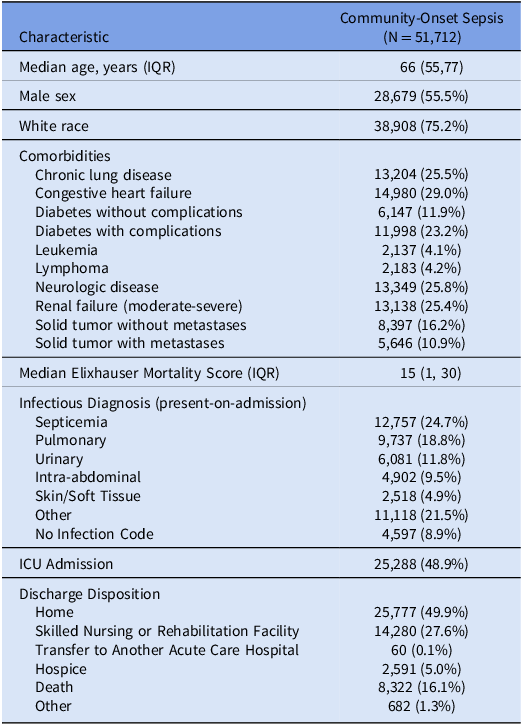
Among 1,101,252 adults hospitalized between 2015–2022, 51,712 (4.7%) met original community-onset ASE criteria, of whom 8,322 (16.1%) died in-hospital. Median age was 66 years (IQR 55–77), 55.5% were male, comorbidities were common (median Elixhauser score 15, IQR 1–30), and 48.9% were admitted to an ICU (Table 1 ).
Characteristics of patients with community-onset sepsis per original Adult Sepsis Event criteria

Impact of modifications on incidence and mortality
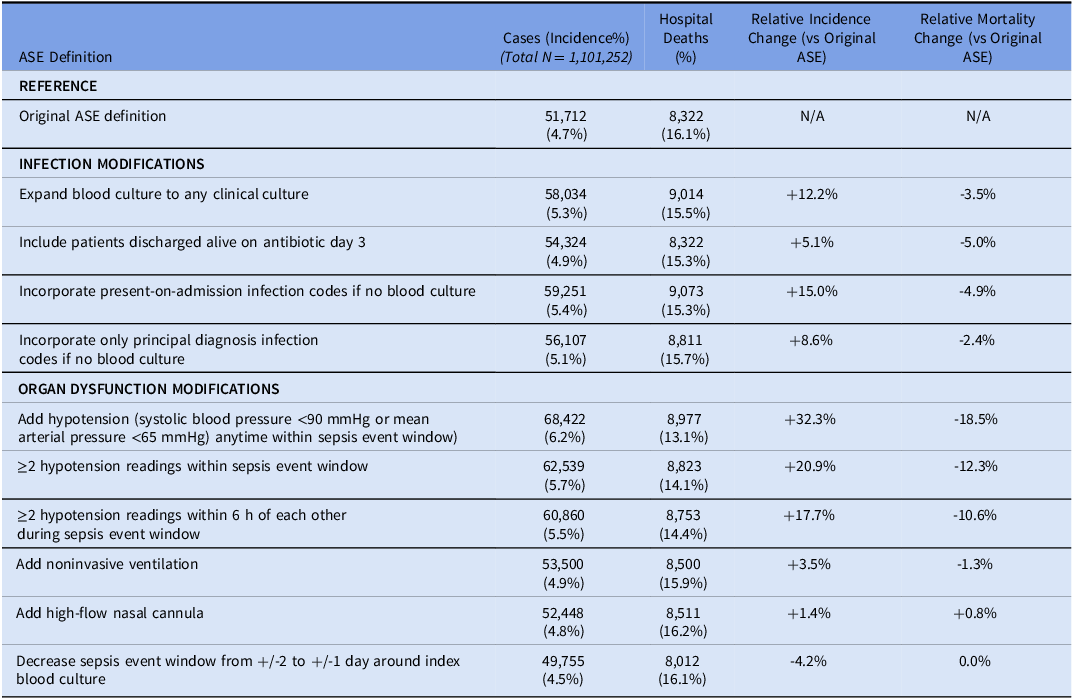
Expanding from blood cultures alone to any clinical culture increased community-onset sepsis incidence from 4.7% to 5.3% (+12.2% relative change) and decreased mortality from 16.1% to 15.1% (-3.5%) (Table 2 and Figure 1 ). Including patients without blood cultures but with POA infection codes increased sepsis incidence from 4.7% to 5.4% (+15.0%) and lowered mortality from 16.1% to 15.3% (−4.9%); these changes were attenuated when requiring principal diagnosis codes for infection (8.6% incidence increase, 2.4% mortality decrease). Adding patients discharged alive on the third antibiotic day increased sepsis incidence from 4.7% to 4.9% (+5.1%) and decreased mortality from 16.1% to 15.3% (-5.0%). Most patients added by this change had elevated lactate as their sole organ dysfunction (Figure 2).
Case counts and hospital mortality rates for community-onset sepsis per original and modified Adult Sepsis Event definitions

Relative change in community-onset sepsis incidence and hospital mortality rates with each modification (compared to original ASE definition). Abbreviations: POA, present on admission; QAD, qualifying antibiotic day; Dx, Diagnosis. HFNC, high flow nasal cannula.

Organ dysfunction distribution among patients meeting modified community-onset ASE criteria with discharge alive on the 3rd qualifying antibiotic day (N = 2,612) vs original ASE criteria (N = 51,712). Abbreviations: QAD, qualifying antibiotic day.

Expanding organ dysfunction criteria to include ≥1 low blood pressure increased sepsis incidence from 4.7% to 6.2% (+32.3%) and decreased mortality from 16.1% to 13.1% (-18.5%). These changes were attenuated when requiring ≥2 hypotension readings anytime during the sepsis event window (20.9% incidence increase, 12.3% mortality decrease) and even further when requiring ≥2 hypotension readings within a 6-hour window (17.7% incidence increase, 10.6% mortality decrease). Adding NIV and HFNC had minimal impact on sepsis incidence and mortality. Decreasing the sepsis event window from +/-2 days around the index blood culture to +/-1 day excluded relatively few patients (4.2% decrease in incidence) and had no impact on sepsis mortality. All of the minor laboratory threshold and baseline laboratory imputation modifications had minimal impact on incidence and mortality rates (Supplemental Table 1).
Clinical validity assessments
For original ASE criteria, 24/30 cases were adjudicated as sepsis (PPV 80%); in comparison, PPV was 15/30 (50%) amongst patients who met infection criteria based on non-blood clinical cultures alone (P = 0.02 vs original ASE) (Figure 3). The PPV for sepsis amongst patients discharged alive on the third antibiotic day was the same as original ASE (24/30, PPV 80%, P = 1.00). PPV amongst patients with POA infection codes but without blood cultures was similar (30/40 cases, PPV 75%, P = 0.49). However, pairwise comparison of those with infection codes as a principal diagnosis vs POA secondary diagnosis demonstrated higher PPV with the former (94% [16/17 cases] vs 61% [14/23 cases], P = 0.16). Of the 30 cases with a POA infection code (principal or secondary diagnosis) but no blood culture that were adjudicated as sepsis, the infection source was pneumonia in 13 (43.3%), intra-abdominal in 10 (33.3%), and urinary in 5 (16.7%).
Proportion of cases adjudicated to have community-onset sepsis among sample of patients meeting original ASE criteria vs additional patients captured by ASE modifications. Gray bars indicate definitions where the positive predictive value for sepsis was statistically different (with P < 0.05) compared to the reference original ASE definition. Black bars indicate definitions where there was no statistically significant difference. *Indicates modified definitions that are subsets of a parent definition. Abbreviations: QAD, qualifying antibiotic day; Bcx, blood culture; POA, present on admission; BP, blood pressure; NIV, noninvasive ventilation; HFNC, high flow nasal cannula.

For the major organ dysfunction modifications, PPV for clinical sepsis was lower for cases that met modified ASE based on hypotension alone (16/30 cases, PPV 53%, P = 0.03 vs original ASE criteria). This was driven by cases with exactly one low blood pressure reading (2/12 cases, PPV 17%, P < 0.001). PPV was similar to original ASE for those with ≥2 low blood pressure readings (14/18 cases, PPV 78%, P = 0.86). PPV was marginally lower for patients whose sole organ dysfunction was NIV (17/30 cases, PPV 57%, P = 0.05) but similar for ASE with HFNC alone (23/30 cases, PPV 77%, P = 0.76). For patients who met ASE criteria based on a +/-2 day sepsis event window but not a +/-1 day window, PPV was significantly lower compared to original ASE (9/30 cases, PPV 30%, P < 0.001).
Discussion
We assessed possible changes to ASE criteria by measuring their impact on population-level community-onset sepsis incidence and mortality within a large multihospital cohort as well as their PPV for clinical sepsis using targeted medical record reviews. These analyses suggest several changes may further optimize ASE to serve as a national EHR-based community-onset sepsis outcome measure.
First, using any clinical culture, not just blood cultures, to anchor the ASE infection criteria increases sensitivity and case counts but with lower PPV as only half of all cases captured by clinical cultures alone were adjudicated as sepsis by chart review. Furthermore, this change would substantially increase the complexity of implementing ASE in diverse hospitals given the wide heterogeneity in clinical culture sites and how they are documented in EHRs.
In contrast, allowing POA infection diagnosis codes to anchor ASE’s infection criteria when no blood cultures are drawn is a feasible strategy that will help capture sepsis cases transferred from outside institutions if the receiving institution does not repeat blood cultures on arrival, while mitigating the risk of bias from variable thresholds to draw blood cultures Reference Warren, Yarrington, Polage, Anderson and Moehring31 , emerging diagnostic stewardship initiatives Reference Fabre, Klein and Salinas32 , and shortages in blood culture supplies. Reference Humphries, Wright and Banerjee33 Chart reviews demonstrated good PPV amongst cases with POA infection codes but no blood cultures and confirmed that in some cases providers deliberately opted not to draw blood cultures, particularly for patients with community-acquired pneumonia or intra-abdominal infections where the yield is low. Requiring infection codes to be listed as the principal diagnosis (vs any secondary POA diagnosis) also resulted in better PPV for sepsis. Although a guiding principle of ASE was to minimize reliance on administrative codes because diagnosis and coding practices are continually changing and vary widely between hospitals, Reference Rhee, Dantes, Epstein and Klompas10 the majority of patients still meet the algorithm via blood cultures; furthermore, using a broad set of infection codes (rather than sepsis-specific codes) might mitigate this variability.
Including patients discharged alive on antibiotic day three is another important change because it allows the measure to capture milder sepsis cases where timely and appropriate treatment might have averted worse outcomes. Prior studies have shown that a non-trivial fraction of patients with sepsis diagnoses or who meet sepsis clinical criteria are discharged home within 3 days or sometimes even directly from the emergency department. Reference Peltan, McLean and Murnin34,Reference Kuye, Anand, Klompas, Chan, Kadri and Rhee35 On chart review, most of these patients did have clinical sepsis, albeit milder forms compared to those who met original ASE criteria (the majority had single organ dysfunction, most commonly elevated lactate levels). Adding a requirement for POA or principal infection diagnoses in patients discharged on antibiotic day three may further increase the credibility of this change.
Expanding organ dysfunction criteria to include hypotension without vasopressors is important for face validity and allows the measure to capture cases where timely and aggressive treatment may have averted progression to septic shock. This must be balanced, however, with the potential for false positives; chart reviews demonstrated that most cases flagged on the basis of a single low blood pressure alone were not sepsis. Furthermore, including patients with a single low blood pressure substantially increased case counts and lowered mortality rates. These changes were attenuated, and PPV was high, when requiring ≥2 low blood pressure readings (particularly within 6 h). Requiring multiple hypotensive readings within even shorter windows (eg, 1 or 3 h) might further ensure their clinical relevance.
Expanding respiratory criteria by adding NIV or HFNC had little impact on measured sepsis incidence or mortality but these additions could add face validity given that current guidelines recommend managing respiratory failure without intubation when safe and feasible. Reference Matthay, Arabi and Arroliga30 Providers and institutions differ, however, in the degree to which these recommendations have been implemented. Reference Garcia, Johnson and Sisson36 Requiring NIV or HFNC for a certain period of time (such as 2 consecutive calendar days) might further increase PPV and minimize cases flagged due to transient use.
Our population analyses demonstrated that very few cases met ASE criteria based on the +/-2 calendar day sepsis event window (as used in the original ASE definition) but not a +/-1 day window. Chart reviews indicated that most cases with the first antibiotic and organ dysfunction exactly 2 days before or after the infection onset date did not have sepsis, suggesting that decreasing the event window to +/-1 day increases PPV with minimal loss in sensitivity.
The “minor” changes in organ dysfunction thresholds had relatively small impacts on case counts and mortality rates. These modifications may nonetheless be worthwhile to reduce false positive cases (eg, thrombocytopenia in patients with cancer or elevated bilirubin in patients with severe liver disease or hemolytic anemia) and to align with other federal measures (eg, the minimum creatinine threshold used in the CMS hospital-onset acute kidney injury measure 37 ). The most significant change was modifying the lactate threshold from ≥2.0 mmol/L to >2.0 (4.2% decrease in incidence, 1.9% increase in mortality); this change has the benefit of aligning with CMS’s current lactate threshold.
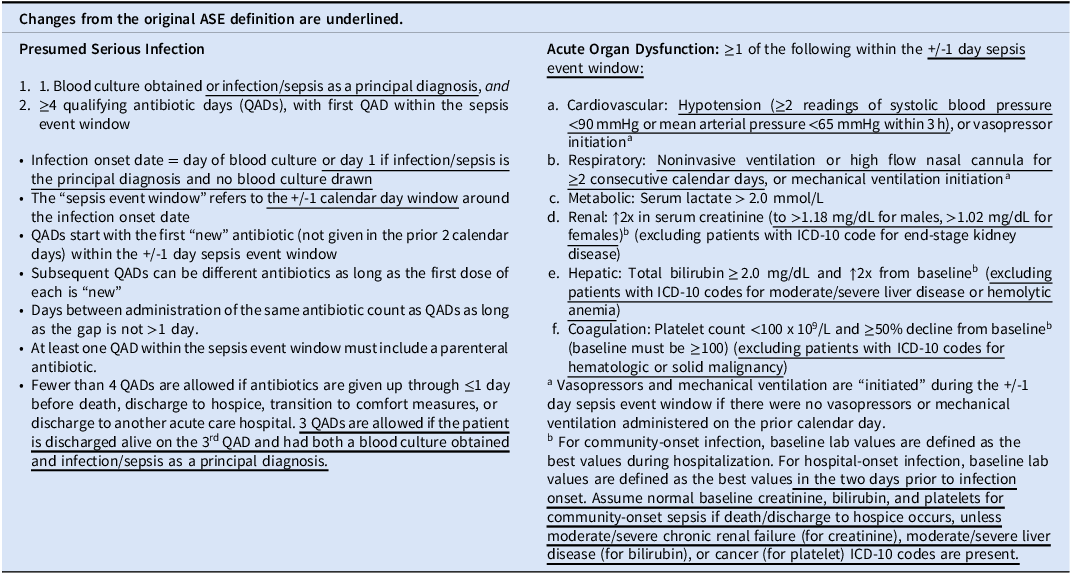
Based on our analyses, we propose an optimized ASE 2.0 definition (Box 2) that balances considerations around sensitivity, specificity, clinical face validity, and feasibility. These modifications will mitigate ASE’s reliance on blood culture draws, better capture sepsis cases in which timely and effective care may have prevented progression to more severe illness, and better align ASE with contemporary sepsis diagnosis and management practices.
Proposed Adult Sepsis Event 2.0 Definition

Our study has several limitations. First, we only included adults in one US hospital system, limiting generalizability. Future work should focus on validating ASE 2.0 across diverse healthcare settings. Second, only a small number of cases for each modification were reviewed thus limiting power; however, we were still able to demonstrate statistical significance for several comparisons. Third, adjudicating clinical sepsis is challenging and subjective. Reference Rhee, Kadri and Danner38 To mitigate this, we utilized a standardized chart review template and had all reviewers analyze 10 common cases followed by discussion to ensure a standardized approach amongst reviewers. Lastly, there is no gold standard for sepsis diagnosis making it difficult to interpret the significance of observed changes in sepsis incidence and mortality estimates.
Conclusion
CDC is developing a community-onset sepsis mortality quality measure based on the ASE definition. This study informs an optimized ASE 2.0 that can be used for improved national epidemiologic and quality monitoring and to drive improvements in sepsis care and outcomes.
Supplementary material
The supplementary material for this article can be found at https://doi.org/10.1017/ice.2025.10218
Acknowledgments
None.
Financial support
This work was funded by the Centers for Disease Control and Prevention (U54CK000611-04-01). Dr. Rhee and Dr. Klompas report grant funding from the Agency for Healthcare Research and Quality to conduct research related to sepsis. Dr. Rhee reports royalties from UpToDate, Inc. for chapters related to procalcitonin use. Dr. Klompas reports royalties from UpToDate, Inc. for chapters related to hospital-acquired pneumonia. Dr. Dantes has previously worked for the Centers for Disease Control and Prevention under the Intergovernmental Personnel Act Program.
Competing interests
The remaining authors disclose no relevant conflicts.