1. INTRODUCTION
In the second half of the 20th Century, maritime organisations became increasingly concerned about the need to reinforce maritime safety and prevent pollution. As a consequence, escort tugs were created. They were included in harbour operations so that higher safety standards could be achieved when oil tankers approached port. Escort tugs were designed to come into action when the towed vessel's main propulsion or steering systems failed.
In 1975, escort tugs were first used in operations with oil tankers at the harbours of Puget Sound. Maritime authorities from Washington State made escorts compulsory; using tugs for vessels over 40,000 Deadweight Tonnage (DWT). With this measure, the estimated power for tugs escorting loaded vessels (expressed in Horsepower (HP)) had to reach at least 5% of the value of its DWT. Other harbours on the West Coast of the USA adopted similar regulations for vessels carrying hazardous cargoes.
An accident involving the oil tanker Exxon Valdez off the coast of Alaska in 1989 led to a flood of regulations for oil tankers and gas carriers docking in American harbours (Gaston, Reference Gaston2009). This is reflected in the well-known 1990 Oil Pollution Act of 1990 (OPA 90), which confirms the idea that an escort tug must accompany those vessels carrying hazardous cargoes and docking in harbours with narrow access channels.
While on the Pacific Coast of the United States measures involving escort tugs came into effect through local or state authority regulations, the same was not true of Europe. Terminal Port operators determined what was required within programs to improve oil carrier safety and prevent pollution. In Norway, the foundations were laid for this process in 1981. The first tug was specifically designed to carry out an escort manoeuvre; the escort tug's own class was recognised by the classification society, Det Norske Veritas (DNV), in 1994 (Tanker Operator Magazine, 2003).
Another relevant factor in this process concerns the technological advances that occurred in harbour tugs. Here the focus is on the development of tug propulsion systems: azimuthal, azimuth stern drive (ASD) or a cycloidal, Voith Schneider propeller (VSP) (Jansen, Reference Jansen2000), which makes escort assistance possible even when the towed vessel is navigating at a high speed.
It is precisely speed that determines the two categories of assistance operations (Gaston, Reference Gaston2009. P.171; Hensen, Reference Hensen2003. P.139). The first one mostly occurs inside harbour areas, where reduced clearances make it advisable to lower vessel speed to below six knots (kt). The second case will occur in harbours with a wide inland waterway, whose width is suitable for a higher navigation speed (around 10 kt). It is therefore necessary to have the support of escort tugs specially designed to act at this speed. These can consequently achieve an exceptional degree of power. (Baniela and Diaz, Reference Baniela and Diaz2008).
2. OPERATING TUGS FOR ESCORT ASSISTANCE
There is widespread acceptance of using escort tugs for manoeuvring ships when they are approaching a harbour. This is especially the case for large vessels with hazardous cargoes docking in harbours whose access is made difficult by climatic or geographical factors. John Nielsen, manager at the time of the renowned Bukser og Bejing AS for towage and assistance operations in terminals, clearly states in Tanker Operator Magazine (2003) that the risk involved in approaching a harbour is reduced by 80% when tugs capable of “escorting” vessels are used.
With the aim of improving maritime and port safety, a growing number of key players in harbours have tried to reduce the margin of error in sea operations. This has led to a substantial change in the design and manoeuvring of port tugs. Baniela (Reference Baniela2003) outlines the basic operational principles on which a “broad concept of escort towage” is based:
– The tug will work at the stern of the vessel on tow. It will be tethered to the other vessel through a towline, to provide better assistance at the time of using the retaining force and carrying out steering operations.
– A constant speed will be kept for the tug-tow unit so that this value can be set at around six kt.
– There must be a quick response when facing emergency situations. Consequently, the tug will be permanently tethered to the vessel on tow.
Bearing these requirements in mind, it is possible to perceive that there are significant differences between escort and conventional harbour tugs (Carral Couce et al., Reference Carral Couce, Carral Couce, Álvarez Feal and Fernández Soto2011):
– The need to create strong lateral support resulting from the hydrodynamic forces acting along the vessel's hull and especially on the appendage or skeg provided.
– A high (80–100 Tonne) Bollard Pull (BP), making it possible to steer large vessels.
– A stronger righting torque to counteract the heeling torque created by the towline, resulting in a greater metacentric height (GM).
– To work with the towline in a suitable way, additional requirements are needed for the towing winch. (Gaston, Reference Gaston2009. P. 86). These include a remote control system for the towing winch and a high line speed mechanism to haul down the line.
All of these factors will mean greater vessel displacement. This is due to the need to install more power (Ter Haar, Reference Ter Haar2010. P.104). Moreover, installations will be increased, with consequences on the towing winch's weight. There is an increase in the waterline length, which provides a wider lateral surface for the necessary lift.
Some authors such as Gaston (Reference Gaston2009) and Ter Haar (Reference Ter Haar2010) refer to the dual possibilities of escort towing. They point to the passive escort of the vessel on tow as a variable, as opposed to a more usual active escort towing operation. Opting for one or the other of the concepts will depend on the specific situation of each case, and whether a taut towline is placed at the stern of the escorted vessel. Nevertheless an active escort mode will allow the tug to demonstrate its true assistance capabilities.
As for active methods, service circumstances are varied, making it possible to establish two different working modes: the direct escort mode and the indirect or dynamic escort mode (Hensen, Reference Hensen2003. P.140).
In terms of how the methods have been conceived, both will be determined by the traction that produces tension along the towline. In the first case, pulling is caused solely by the tug's propellers. Given the high speed at which assistance is being carried out in the second case, the towline causes tension mainly by the hydrodynamic forces acting on the hull of the escort tug. This effect is heightened when hydrodynamic profiles that maximize lift are added and minimize drag on the vessel's speed. (Gaston, Reference Gaston2009. P.163).
2.1. Direct mode
Escort tug manoeuvres following a direct mode mean that towline force on the towline is produced, due to the pull of the tug's propeller. Therefore, stopping or reducing the vessel's starting operations, as well as assisting during steering, will be performed by keeping the tug either parallel to the vessel's centreline or open to the corresponding ship side. With this manoeuvre, the following guidelines apply:
– This must be performed at a low speed. It is not possible to act at high speeds due to the lack of an additional thrust to the tug's propulsion.
– This is done to slow the movement of the escorted vessel while increasing revolutions on the ship's propeller to improve rudder steering forces.
A reference has already been made about using alternative propulsion systems for the tug's nozzle propeller, and how the development of these active escorting systems is affected. By adding azimuthal transmissions it will be possible to perform arrests either by opposing the propeller's force to the vessel's movement (Reverse arrest mode) or directing azimuthal propellers outwards at a 90° angle to the vessel's centreline. Should this be the case, an arrest will be produced by accelerating in a direction transverse to the flow direction (Transverse arrest mode) (Figure 1).
Direct method to control ship speed by means of ASD escort tug.

With these direct escort modes, retained forces can be estimated at around 1·5 times the Bollard Pull (BP) (Hensen, Reference Hensen2003. P.61). As seen in Figure 2, the reverse arrest mode will be feasible under seven kt. Engines will experience overload if these values are exceeded, producing a clear decrease in traction. The transverse mode will be employed from this speed onwards.
Variation of B.P. with speed, according to the direct escort mode employed (Baniela, Reference Baniela2003).
2.2. Indirect or dynamic modes
In this case the tug's propulsion is used to find an appropriate position to create lifting forces, which will be transmitted through the towline. Meanwhile, hydrodynamic forces will be created by the vessel's hull. These forces will be used to determine a high degree of arrest and steering forces. (Figures 3 and 4).
Indirect escort towing method for an ASD tugs.
An escort tractor Voith tug using the indirect escort towing method.
The consequences of this manoeuvre are presented by Baniela and Diaz (Reference Baniela and Diaz2008):
– Relatively high-speed navigation is required.
– Braking or braking and steering is controlled by the tug to maintain a reference angle corresponding to the water flow direction, as opposed to the direction taken by the vessel on tow.
3. OPERATING THE TOWING WINCH IN ESCORT TOWING MANOEUVRES
In harbour and deep sea towing, manoeuvres are produced by keeping a constant towline length that is held taut to the tug. In contrast, escort manoeuvres use the towing line's traction and hauled down or recovered length.
Consequently, harbour and deep sea towing control is based on actions exerted on the engine and its steering system. On the other hand, in escort towage, manoeuvre assistance control affects the vessel's engine and steering system, as well as its towing winch. This is the hauling exerted by the towing winch and the length of the hauled down line.
There are several ways in which the towing equipment or winch will behave. These are explained as follows:
3.1. Towing winch
In their diverse categories, harbour and deep sea towing tugs rely on a towing winch or device, equipped with a drum whose capacity can hold an entire towing line. This drum is powered by an electric or hydraulic motor. The motor's revolutions and torque are adapted to the required nominal and drum load speed for thrust and lifting; these values are generally specified before the tug is built. Here, a multi-stage gearbox is placed between the drum and the motor. The equipment is made complete with a band brake working to carry out towing manoeuvres. This block allows the tug to perform towing operations, as the towing winch will be kept in its braking position (known as brake traction).
Nevertheless, the way in which the towing winch had operated under such braking conditions changed when the escort tug appeared. As will be seen later in the text, classification societies have prevented these operations from being carried out.
3.2. Classification society requirements
A specifically designed escort tug was developed and its own class was recognised by classification societies.
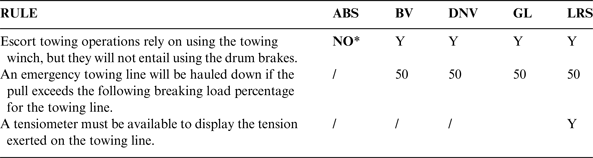
It is always interesting to know what is required by classification societies to determine the components for both the towing winch and tug boat. Moreover, despite sharing common goals, it is nevertheless surprising how regulations treat the same data in different ways. This is due either to contrasting prescriptions or to the silence kept on certain aspects, leaving it up to the ship owner to adopt a given procedure. In Carral Couce et al. (Reference Carral Couce, Carral Couce, Fraguela Formoso and Fernández Soto2013) and Allan (Reference Allan2006) the possibility of unifying regulations is discussed in depth.
Data record for American Bureau of Shipping (ABS), Bureau Veritas (BV), Det Norske Veritas (DNV), Germanischer Lloyd's (GL) and Lloyd's Register of Shipping (LRS) in terms of escort tugs (“ESCORT VESSELS” notation).
Marks to be employed:
− Not mentioned
− YES rule applicable for classification
− * ABS allows for escort towing on the towing hook.
3.3. Operating the towing winch on the escort tug
After the escort tug has received the messenger from the assisted vessel, the towline is released. The skipper uses the joystick from the system's control panel, adapting haul down speed to the assisted vessel's line retrieval speed. This is done simply by pushing the lever to reach higher speed, as release speed varies according to the lever's angle.
When the vessel has made the towline secure and the escort tug reaches the appropriate position to assist the vessel on tow, the skipper releases the lever so that the towing winch remains static and its brake is activated. This manoeuvre is usually carried out by positioning the escort tug and then turning the towing winch until the towline is taut.
Throughout the entire assistance service, the tow line will be subject to different tension levels. These levels change in response to the diverse variables that occur: propeller thrust, waves, wind and horizontal and vertical line angle, as well as other factors while the towing winch remains static and behaves like a brake. During this operation the towline may jerk when left loose.
At the end of the service and according to the vessel's instructions, the towline is held loosely. It acts either on the tug or the towing winch. Once the line of the assisted vessel is released, the crew will let it fall. The skipper must then use the joystick to retrieve the line as soon as possible to prevent it from being tangled in the propellers of the tug or vessel.
4. CONTROLLING TOWING MANOEUVRES BY OPERATING THE TOWING WINCH
There is a need to activate both the tug's propulsion and steering while manoeuvring with the towing winch. This involves the hauling exerted by the towing winch and length of the hauled down towing line. Escort manoeuvres are consequently more difficult to carry out. An effort has been made to develop what will soon be called “intelligent control systems”. These systems will work in conjunction with the tug and towing winch for escort towing manoeuvres. In the meantime, automatic control systems for the towing winch are an intermediate step towards automatic escort manoeuvres. They make escort operations more efficient and help tug operators do their jobs.
4.1. Automatic systems for manoeuvres
These computer applications make it easier to control and visually monitor the most characteristic parameters for towing winches that are being used in escort tugs. They act on the hoisting load and nominal speed of the towing winch during escort manoeuvres and serve as an aid to the skipper (Gaston, Reference Gaston2009. P.174; Carral Couce et al., Reference Carral Couce, Carral Couce, Álvarez Feal and Fernández Soto2011).
Automatic control systems for the towing winch pursue three main goals: firstly to simplify operations for the skipper when there is a reduced, highly qualified crew; secondly to increase safety when performing direct or indirect (dynamic) escort towing manoeuvres. Here, towline tension must be kept constant by the system, so that the distance between the tug and the vessel on tow will also maintain pre-established values. The final goal is to optimise the equipment's maintenance and energy consumption during manoeuvres, which will lead to the tug being used more efficiently.
By embracing classification society specifications, control systems must influence the towing winch (Figure 5) as defined by the functions stated in Langerak (Reference Langerak2009):
– The towing winch must have a load-control system to prevent overload caused by dynamic forces on the towing line.
– Active escort towing must be carried out by means of the winch rather than the drum brakes.
– The towing line must be controlled so that it can be hauled down by the towing winch if the traction exceeds 50% of the towing line's breaking strength.
Automatic control systems for the towing winch will facilitate manoeuvres through two specific modes. In these, different tasks are performed to control traction and equipment speed:
– TRACTION CONTROL is a constant tension mode whereby tension is controlled by the user, thus maintaining towline traction at a desirable value. Manoeuvre control is thanks to the equipment's traction (Figure 6).
– TRACTION AND TOWLINE HAUL DOWN CONTROL controls manoeuvres by keeping towline tension values and a tug-to-vessel distance within adjustable margins (Figure 7).
Other operational options include:
– EMERGENCY RELEASE with a free-turning drum, reaching the highest hauling down or light line speed, an interesting operation in emergencies.
– AUTOMATIC HAULING DOWN, in which the corresponding value for the hauled down line is introduced. Thus it is possible to control speed in manoeuvres. This will be useful at the beginning and end of manoeuvres, as operations can be performed in a controlled manner.
Together with applications that assist manoeuvres, displays and control, these systems include other functions such as checking breakdowns or displaying data related to the alarm and engine log, or the system's charts (Figures 8, 9 and 10).
Towing winch for a 75 Tonne Bollard Pull escort tug.
Control system screen for towing manoeuvres (Carral Couce et al., Reference Carral Couce, Carral Couce, Álvarez Feal and Fernández Soto2011).
Control system screen corresponding to traction and speed (Carral Couce et al., Reference Carral Couce, Carral Couce, Álvarez Feal and Fernández Soto2011).
Screen for maintaining hydraulic engines (Carral Couce et al., Reference Carral Couce, Carral Couce, Álvarez Feal and Fernández Soto2011).
Screen for breakdown diagnosis (Carral Couce et al., Reference Carral Couce, Carral Couce, Álvarez Feal and Fernández Soto2011).
Screen providing data on pulling force during manoeuvres. This information will be stored in the system's memory (Carral Couce et al., Reference Carral Couce, Carral Couce, Álvarez Feal and Fernández Soto2011).
4.2. Working mode for control systems
When a given control system is associated to a hydraulically operated towing winch, there is a Programmable Logic Controller (PLC) that receives signals from sensors placed at the towing winch and its Hydraulic Power Unit (HPU). This gives details about hydrostatic transmission pressure, as well as oil and temperature levels for the HPU. The drum's revolutions (RPM) are measured with an inductive sensor (Figure 11).
Variables and parameters to monitor in a manoeuvre control.
Data about the drum's geometry and the control algorithm that has been developed are introduced when the PLC is programmed. Updated information about the line's tension, distance and linear speed is thus provided.
The PLC processes signals and carries out control operations. It interacts with the pump's servo to regulate rotational flow and direction. It also deals with the proportional pressure limiter, to regulate drum load, as well as how much of the line is hauled down. This makes it possible to obtain an automatic control of line tension, compensate overload from the vessel's movements and, at the same time, keep a constant distance, programmed beforehand by the skipper (Carral Couce et al., Reference Carral Couce, Carral Couce, Álvarez Feal and Fernández Soto2011).
The flow chart corresponding to the control process (Figure 12) shows how the system basically consists of a charging cabinet to store the PLC; a touch screen on the bridge (Figure 13); pressure sensors measuring in bars; inductive sensors measuring rpm; level and temperature; load cells (drum load); a hydraulic block for tension control; hydraulic pumps and a towing winch.
Flow chart – Tow manoeuvre control.
Control panel with touch screen on the top for manoeuvring control in a tug with azimuthal propulsion.
The interface comprises a touch screen that lets the user measure parameters, as well as monitor and control the process. It is also possible to manage the system's operational modes and control parameters. There are various options for monitoring the parameters with a user interface that is both simple and intuitive (Figures 6, 7 and 8). Similarly the touch screen displays all of the data from sensors: cable length, winch speed in rpm and metres of cable per minute, cable load, hydraulic circuit pressure and other information. Other parameters displayed are the pump revolutions and oil-related data, tank level and temperature as well as alarm information. The setup goes beyond the control system (Figures 6 and 7); it also deals with equipment maintenance (Figure 8).
Users can carry out an approach to monitoring and managing the other equipment involved in the manoeuvring of the winch. These include the towing hook and/or the auxiliary winch.
4.3. Influence of the control system on manoeuvring
The operational mode has already been described in Section 3.3 and it is assumed that the operator controlling the winch will do so manually with the lever. However, it is necessary to consider the implications of using a control system for the manoeuvre. If a winch control system is used, the following aspects will vary:
• When it is time to haul and/or haul down the towline, the operator can rely on an AUTOMATIC RENDER. The value corresponding to the length of cable to be rendered, as well as the speed, is introduced. The manoeuvre is then carried out automatically. This prospect is particularly interesting at the start and end of manoeuvres given that the operation can be done quickly and in a controlled way.
• When towing is being done, there is TRACTION CONTROL. When the tug is in place and the tension is constant, this level will be maintained. This has already been established by the user and the control panel has been adjusted. The equipment's traction comes into play. If the traction value goes down, the winch will respond by hauling the line until the set-point tension value is reached. The opposite is true if the tension goes up. At any given moment, the skipper has a visual indication of the towline tension value, while the computer is storing this information (Figure 6).
• Again, in the towing phase, there is a TRACTION CONTROL and the HAULED DOWN TOWLINE LENGTH MARGINS. These control the manoeuvre because the values for line tension and the tug-tow distance have been adjusted. Once the skipper has used the system to adjust the desired values for traction and towline length, the winch will continue to render the line if the tension exceeds pre-established limits. The instant in which the tension falls below the pre-set value, the winch will render the line until the initial length established by the skipper.
With wave swells and or pitching, the tug moves in such a way that there is loose line or slack. The drum will automatically recover the line so that it does not break with the abrupt movement. However, in this case, the length will be less than the one that has been set. At a later point and with the line recovered, the system will correct the line length. If the skipper considers the length suitable, he or she must indicate this to the control panel to prevent the system from making further adjustments. The system's response would otherwise be to compare the desired and actual lengths, correcting the difference (Figure 7).
• EMERGENCY RELEASE through the free spinning of the drum means that the light line is achieved as fast as possible. This is crucial when there is a danger of the tug being dragged by the vessel it is towing. The tug could easily sink due to the effect of heel.
4.4. Influence of the control system on the balance of lateral forces acting on the tug in indirect systems
Figure 14 shows the balance of lateral forces acting on the escort tractor Voith tug involved in indirect operations. It is known that (Baniela and Diaz, Reference Baniela and Diaz2008; Van der Laan, Reference Van der Laan2002) three forces act on tugs involved in indirect operations. The balance between them will be represented in an equation for the tug's movement under these conditions:
– The resultant hydrodynamic forces for lift and drag of the skeg and hull, applied to the Centre of Lateral Pressure (COP) above the quick work of the tug: H f
– The resultant thrust related to the two cycloidal propellers, whose point of application varies according to the thrust of each propeller: Pt
– The tug force related to the towline action applied in the staple: T f
Balance of forces acting on the escort tractor Voith tug during the escort manoeuvre.
This study focuses on this Voith tractor tug (Figure 15) with the aim of finding equilibrium in the combination of forces and moments indicated in the lateral view. This situation is to be related to the case of indirect towing operations. The resultant equation (Baniela and Diaz, Reference Baniela and Diaz2008) indicates the relationship between towline forces (T f ) and the resultant hydrodynamic forces (H f):
 $$T_f = H_f *(1 - y/x)$$
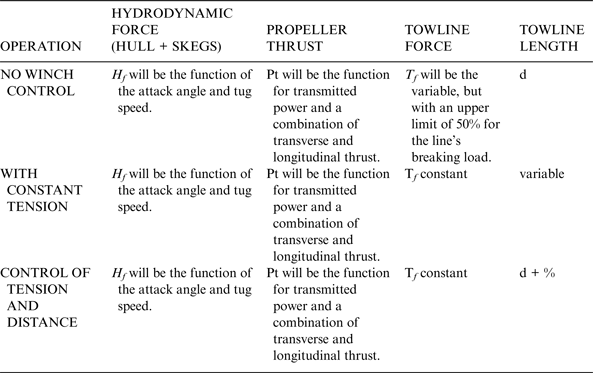
This study is intended to analyse what effect automatic manoeuvre control has on equilibrium in navigation. To this end, this table has been developed to relate the different operational modes (without winch control, with a constant tension and with controlled tension and distance, as seen in Table 2). The table also shows how the combination of resultant forces evolves, along with the towline length under dynamic conditions:
Escort tractor Voith tug. The elevation indicates the points in which forces and distances are applied. These intervene in the balance of lateral forces during the towing operation.
Effect of control system on the balance of lateral forces acting on the tugs in indirect operations.
4.4.1. In the mode without winch control
T f will constantly vary in value until it reaches a maximum that corresponds with 50% of the line's breaking load. The way in which the towline force varies along the line, in agreement with Equation (1), will make it necessary to adapt the resultant hydrodynamic and thrust forces. The skipper therefore needs to steer by constantly varying the intensity and direction of the tug's thrust. The intention here is to balance forces. On the other hand, the tug no longer pulls on the line while this manoeuvre takes place.
4.4.2. In the mode controlling tension
The tension along the towline will be constant as the winch renders and recovers the line in accordance with the set-value introduced into the system. At all times, equilibrium is maintained between the acting forces. On the other hand, the distance between tug and tow, represented by the line length, will vary over time and no limit will exist. Periodically, the skipper will see that it is necessary to correct the distance between vessels to reposition the tug. To this end, the propulsion will be activated. In turn, having the winch render and recover the line will affect the manoeuvre.
4.4.3. Operational mode with the tension and distance controlled
Now the variations in the tension that acts on the towline will be compensated by the winch. There will be slight, temporary variations in the value for the rendered line. In a short time span, it will return to the set value. As the distance between the vessels is maintained, the tension is adapted to the pre-established value. The effect on the manoeuvre will appear to be less than it is in other cases.
5. CONCLUSIONS
With harbour and deep-sea tugs, ship thrust and steering are the only ways to control towing manoeuvring. In contrast, with escort tugs, both the vessel and the winch can help carry out the manoeuvre. What comes into play is the traction which the winch exerts and the length of the line rendered. In this case, the tug winch gains importance as one of the main pieces of equipment on the tug.
Escort tugs may experience difficulties carrying out their manoeuvres; being so close to the towed vessel also has its risks. These considerations have led to control systems for manoeuvring. The systems comprise information technology applications that make it possible for users to monitor and control the working parameters that are most significant to the winches on escort tugs.
There are three main objectives when this system is implemented: increasing safety in the direct and indirect manoeuvres carried out by the escorts; simplifying the operation for the skipper and optimising energy consumption, which goes hand in hand with maintaining equipment.
In general the systems work by letting the towline maintain as constant the towline tension and length of the rendered line, as well as the distance between the tug and tow, between two pre-set values. In this way, once the manoeuvre is programmed, the skipper can concentrate on steering the tug.
Apart from display and control applications, the system presents various functions that could be of interest for the vessel's service to: check breakdowns; maintain a log for alarm systems, pulling power and engine performance; and monitor the electric and entire hydraulic system.
The classification societies have included the “escort vessel” in their regulations, defining its winch components and towing apparatus. The winches used for escort tugs have three basic aspects in common. First of all towing must be carried out over the winch; drum brakes are not used. It must have a fast rendering system in case of emergency and there must also be a device for monitoring the tension to which the towline is subjected.
When the control system is related to a hydraulically-operated tow winch, it will have a programmable controller (PLC). This device receives signals from the sensors located in the winch and its hydraulic power unit (HPU): one for the hydrostatic transmission pressure, another for the level and temperature of the oil in the HPU and a third from the inductive sensor that measures the drum's revolutions (RPM). Data are introduced concerning the drum's geometry and a control algorithm is developed. With these figures, it is possible to work out, at any given moment, the pulling force, distance and linear speed of the towline.
The PLC processes these signals and exerts its control. It interacts with the servo for the pumps to regulate flow rate and rotation direction. It also interacts with the proportional pressure-limiting valve so that the desired drum load is obtained. By controlling towline tension, one can compensate for the vessel's movements and, at the same time, keep the distance between tug and tow within the values pre-determined by the skipper. Similarly, the control systems for the tug make it easier to oversee and maintain the winch and the way it works.
The operational mode of the escort tug will facilitate the following phases: rendering and recovering the towline, controlling tension control and releasing it in an emergency.
From the balance of lateral forces acting on the tugboat in its indirect mode, the conclusion may be drawn that operating with the tension and distance controlled, the distance between tug and tow is maintained and the tension is set to a pre-determined value. As a result, the manoeuvre is affected less than it would be in the other cases studied.