After experiencing a sudden and striking increase in their representation in the United States Congress, fueled in no small part by a benevolent redistricting regime, it appeared that African Americans were on a linearly upward path towards full political incorporation. However, for only the second time in the twentieth century, the 1996 election resulted in a decreased number of African Americans serving in Congress. Though perhaps easy to dismiss as simply one Black Republican losing a tough re-election bid, in fact, a series of court decisions restricting the use of racial considerations in districting efforts, coupled with powerful demographic forces, now threatens the gains of the past several decades and suggests an emerging trend towards political retrenchment. Indeed, decades from now, the 1990s might be remembered as the pinnacle of Black political representation in the United States Congress.
The Supreme Court's recent decision in Georgia v. Ashcroft (2003) will likely intensify the retrogression of minority descriptive representation in national and state legislatures. In Georgia, the Court held that the practice of “unpacking” majority-Black legislative districts to produce so-called “influence districts,” where Black voters might impact outcomes but without necessarily electing African American representatives, is an acceptable application of the Voting Rights Act. In Georgia, the Court extended the logic of Thornburg v. Gingles (1986), by asserting that “the most effective way to maximize minority voting strength may be to create more influence or coalitional districts” because the elected legislator would accordingly be “willing to take the minority's interests into account” (Georgia v. Ashcroft 2003; Thornburg v. Gingles 1986). In other words, the Court's ruling in Georgia permits states to enact a distinct districting regime less likely to produce minority descriptive political representation.
Similarly, demographic changes, including the relative diminution of the Black population in many urban areas as compared to youthful immigrant populations, appear to further threaten the political gains of the past generation. Though future court rulings might affect these results, currently all four African Americans representing California and both from Texas have experienced sizeable decreases in their Black constituencies. In fact, neither of the Texas incumbents represents a Black majority district, and none of the California districts contains even a plurality of African Americans, the highest proportion being only 35.8%. And initial evidence in New York and Illinois suggests that, while Black incumbents might retain their seats in the short term, the rapid growth and urbanization of the Latino population will further imperil efforts to maintain existing levels of descriptive representation.
These trends pose perplexing strategic questions for Black political elites and voters alike. Is it sufficient to join multiethnic coalitions resulting in the election of non-Black candidates electorally indebted to Black voters? Or does adequate substantive representation require the election of African American candidates? Advocates for both positions abound, and academic research, though extensive, offers no clear prescription. More than three decades after the founding of the Congressional Black Caucus, scholars remain divided about whether its members do indeed represent substantive group political interests beyond the degree precipitated by raw electoral calculations. Perhaps, as some have suggested, the fact that African American members promote policies consistent with group interests might be attributable to the fact that they tend to represent districts that overwhelmingly comprise Black voters. In other words, it might be not that group members are more apt to advance particular group-specific policy issues, but that any similarly situated re-election maximizing representative would be equally inclined to do so. Conversely, Black members might act independently of geographic or electoral constituency demands, by pursuing group interests more vociferously and intensely than electoral considerations alone warrant. This controversy raises some of the most fundamental questions in political science: “What is the nature of representation? Why do some legislators seem to pursue their own policy agenda and others only vote for the wishes of a majority in their district?” (Uslaner 1999).
We have found the inconclusiveness regarding this fundamental issue disheartening, and we believe that it is largely due to conceptual and methodological shortcomings in the extant literature.2
Despite the lack of a resolution, recent research has moved beyond this fundamental question (Gay 2001, 2002; Hajnal 2001).
CONCEPTUALIZING SUBSTANTIVE REPRESENTATION OF BLACK INTERESTS
In his seminal discussion of the essential role of the “talented tenth” in facilitating the sociopolitical mobility of the Black community, W. E. B. Du Bois alludes to a conception of substantive group interests based upon “linked fates” (Du Bois 1903[1996]). Du Bois writes that those community members endowed with certain innate qualities enabling personal advancement have an obligation to serve the community as a whole. In his view, the mobility of individuals not only depends upon the support of the community, but also affects the life chances of other Blacks (Du Bois 1903[1996]; see also Marable 2002). This argument has been reformulated nearly a century later by contemporary scholars:
The political importance of group interests is a result of at least two historical aspects of American racism. First, until at least the late 1960s, individual African Americans' life chances were overdetermined by the ascriptive feature of race… [And] as long as African Americans continue to believe that their lives are to a large degree determined by what happens to the group as a whole … African Americans' perceptions of racial group interests [will] be an important component of the way individual Blacks go about evaluating policies, parties, and candidates (Dawson 1994, p. 57).
Scholars defend this notion of identity group interests by referring to systematic data indicating differences among groups. “A new wave of empirical research conclusively demonstrates that where one can live, for whom one is likely to vote, whether one is likely to encounter discrimination based on stereotypes when entering the labor market, and whether one's culture and intelligence are considered inferior were still structured by race in the 1990s” (Dawson 2001, p. 42). Because one's life chances are inexorably linked to race and gender inequalities, among other hierarchies of difference, including sexual orientation, disability status, and other social demarcations (Marable 2002; Jones 1997), members of a particular identity group share group interests. “Even though the experiences and preferences of marginalized group members are themselves diverse, the social positions of group members are sufficiently similar that there are good reasons to believe that members of marginalized groups, on average, are more likely to represent the concerns and interests of citizens from those groups than are nonmembers” (Williams 1998, p. 6).
Additionally, scholars emphasize the role of sociopolitical institutions in generating distinctive group interests. According to this perspective, “networks and institutions … help to reinforce a sense of group identity and group political consciousness and propagate a racialized view of the world in response to the racialized environment” (Dawson 2001, p. xii). For instance, Ronald Walters asserts that a “Black perspective arises from the experience of living as a minority in a social system dominated by Whites and in which there is racial isolation and hostility. Though some Whites have relationships with Blacks, this does not allow them to experience the intensity of racism and thus develop similar perspectives” (Walters 2003, p. 263). Rather, the unique institutions of the Black community are credited with forging a distinctive political identity. Thus, “over the years a more or less tentative African American identity has formed which, though hardly monolithic and not free of tensions and treasons which are endemic to the process of overcoming oppression and exploitation, can be seen in certain behaviors and preferences of the vast mass of this group” (Edelin 1990, p. 173). And “individuals develop a politicized sense of racial identification which influences both their ideological view of the social world as well as their political behavior” (Dawson 2001, p. 11).
These interests might be promoted several ways in the Congress. Within the realm of what might be termed “substantive representation,” relevant political behaviors take numerous forms, from constituent services to roll call voting, behavior in committees, and setting the policy agenda. Focusing more narrowly on legislative behaviors, Karen Tamerius argues that, because different activities require different levels of support, commitment, awareness, and expertise on issues, it is necessary to study an array of ways in which legislators promote the substantive interests of relevant constituencies to estimate the intensity of a legislator's preference for a certain policy issue and gain a more comprehensive perspective of this representational relationship (Tamerius 1995; Hall 1996). For instance, sponsoring legislation reveals a high degree of support for a policy, requires the greatest commitment of scarce political resources, indicates a high level of policy awareness, and necessitates expertise. Conversely, roll call voting requires the least amount of political capital and indicates the lowest intensity of support (Tamerius 1995, p. 103).
While casual observers of legislatures typically focus solely on the final phase of the legislative process, perhaps the most significant stage involves the setting of the policy agenda. In his classic work, E. E. Schattschneider (1960) maintains that agenda-setting, or deciding what is to be decided, might structure policy alternatives in a determinative manner. Similarly, Peter Bachrach and Morton Baratz (1963) launch a critique of the pluralist school of political science by suggesting that the ability to manage the agenda and prevent potential decisions from being reached represents a powerful “second face” of political power. Certainly these scholars would agree that managing a political agenda to further the interest of a group constitutes a form of substantive representation (Bachrach and Baratz, 1963; Schattschneider 1960; Kerr and Miller, 1999; Kingdon 1989; Miller 1990; Lusane 1994; Clayton 1999; Canon 1999; Thomas 1991, 1994; Bratton and Haynie, 1999; Leader 1977). Through bill introductions, legislators draw attention to policy problems, frame substantive policy debates, specify alternatives, and ultimately initiate the possibility of legally mandating a change in a group's welfare (Kingdon 1989).
Lawmakers introduce legislation “to gain attention for issues and ultimately to see their proposals incorporated into law” (Swers 2003, p. 32). They might be motivated to do so by the desire to make good policy, achieve re-election, or to demonstrate expertise. But bill sponsorship requires a substantial commitment of time and frequently involves securing cosponsors, attending hearings and lobbying other members for support. A legislator's decision to sponsor a bill is limited only by the degree to which she or he chooses to expend the requisite resources (Lusane 1994, p. 22). Legislators “have complete control over the number and the content of the bills they sponsor” (Swers and Caiazza, 2000, p. 1). And because all members “must suffer under the same resource constraints as everyone else, more or less … they cannot be more involved in everything” (Hall 1996, p. 206), the decision to sponsor a piece of legislation reveals a high degree of commitment to a policy issue. Therefore, bill sponsorships offer a reasonable approximation of the intensity of preference of a legislator and her or his commitment to representing a given interest (Canon 1999). Moreover, unlike recorded roll call votes, which only occur under extraordinary circumstances, bill sponsorships are not an electorally censured sample of behaviors.
Members of Congress attempt to shape the legislative agenda and promote their policy goals through other means as well. By co-sponsoring bills, members provide voting cues to their colleagues and attempt to influence the preferences of other actors. “When a Member is confronted with the necessity of casting a roll-call vote on a complex issue about which he knows very little, he searches for cues” (Matthews and Stimson, 1975, p. 45). And “research shows co-sponsorship serves two main purposes: it facilitates Members' electoral goals by allowing them to take a position on an issue and it acts as an internal legislative signal informing Members about the content of legislation and the level of support for a bill” (Swers 2003, p. 58). As Swers attests, the co-sponsorship of legislation is typically a staff-driven process and therefore is a relatively inexpensive act. (Swers 2003, p. 59). But this should not diminish its importance. Responding to the claim that co-sponsorships are purely symbolic actions that allow for ex post facto credit claiming, Keith Krehbiel explains that the decision to co-sponsor a bill might have both electoral and policy consequences. From a purely electoral standpoint,
cosponsorship is cited as an example of position-taking, and, upon first consideration, it appears to be a good approximation of costless legislative activity, if costless refers only to the effort required to take the action… Assuming, as Mayhew does, that constituents provide ‘electoral payments' to legislators on the basis of their ‘positions not effects,’ and assuming further that constituents like the position … it follows that re-election seeking legislators would all cosponsor legislation that embraces the position… The shortcoming of the pure position-taking hypothesis is that, contrary to its premise, constituents in all likelihood do care about the consequences of their legislator's actions, not just their positions. If so, then bill co-sponsorship, while nearly costless in terms of the act itself, is not necessarily costless in terms of the well-being of re-election seekers. Depending on constituency preferences and legislators’ corresponding induced preferences, co-sponsorship may be either costly or beneficial (Krehbiel 1995, p. 909).
Thus, co-sponsoring legislation is indicative of “high levels of policy endorsement” (Tamerius 1995, p. 103) because it signifies the willingness to bear the consequences of attaching one's name to a particular public policy. Swers calls this “loud voting” because “legislators are not forced to take a position as they are with a roll-call vote but they can choose to register their views on an issue by signing their names” (Swers 2003, p. 57).
The importance of roll call voting as an element of representation is clear. However, it is far from an exhaustive indicator of representation and can, on occasion, be a distorted one. Studies relying solely on voting behavior boil the representational relationship down to a handful of oversimplifying dichotomous choices, thus precluding an adequate measure of the intensity of support or level of commitment to the policy issue (Swain 1995; Whitby 1997; Nelson 1991; Herring 1990; Epstein and O'Halloran, 1999; Weissberg 1978). A single roll call vote provides no information about the intensity of the legislator's preference, nor the significance of his or her vote to the final outcome. Because roll call voting is relatively costless (particularly when proxy voting thrived, prior to its abolition in the 104th Congress) and is limited to a single dichotomous choice, it is impossible to infer from a particular vote the degree to which a given alternative is favored. The selection bias inherent in roll call analyses skews conclusions about race's impact on representation by systematically excluding the crucial proposals that might distinguish the preferences of Black and non-Black legislators (Hall 1996, p. 192). Because legislators are presented with a single choice, typically structured by party leaders to attract a majority of votes, more extreme proposals are filtered out. Indeed, it is the central objective of partisan legislative leaders to craft winning coalitions on issues that are important to the party as a collectivity and to derail those likely to split the party (Sinclair 1983; Cox and McCubbins, 1993; Sinclair 2000).
MEASURING SUBSTANTIVE REPRESENTATION OF BLACK INTERESTS
We use an inclusive definition of representation by considering four ways in which a member of Congress might represent Black interests. First, roll call voting behavior might reflect the position of the NAACP on material legislation. As a historically Black organization, the NAACP enjoys greater legitimacy within the Black community than do groups such as the Leadership Conference on Civil Rights (LCCR), Americans for Democratic Action (ADA), or the AFL-CIO (organized labor), whose support scores are frequently utilized by scholars for this purpose (Smith 1996).3
Votes utilized by the NAACP to craft their biannual report cards are available at 〈www.naacp.org〉.
Second, members might sponsor or co-sponsor legislation that promotes the material interests of African Americans. We consider legislation consistent with “Black interests” to be any measure that (1) disproportionately promotes the economic welfare of African Americans, (2) extends equal legal protections or rights to African Americans, or (3) opposes efforts to achieve the converse of either (1) or (2). Because the issue of representation also involves the entire agenda-setting process (Bachrach and Baratz, 1963; Canon 1999), the initial drafting and sponsoring of bills may be the most important form of representation, because it generates awareness of political problems and brings policy solutions to the legislative agenda. Moreover, by co-sponsoring bills, members provide voting cues to, and potentially influence the preferences of, other legislators (Kingdon 1989).
Third, members might sponsor or co-sponsor cultural legislation that promotes African American history and culture. Examples include authorizing stamps honoring prominent African Americans, funding civil rights memorials, and naming federal buildings after Black leaders. Political scientists often disregard cultural legislation because these measures tend to result in unanimous roll call votes. (See Canon (1999) for an exception.) However, the promotion of commemorative legislation in Congress embodies significant cultural conflict, whereby subordinate groups resist a dominant group's assertion to rule and challenge existing power relations (Merelman 1995, p. 3). Moreover, such acts by members of Congress can influence the public memory by declaring “a past worthy of public commemoration in the present,” thereby promoting racial pride and recognition among non-Blacks of African American achievements (Bodnar 1992, p. 13; Zaller 1992).
Fourth, members might make floor speeches promoting the cultural interests and achievements of African Americans. Because access to the floor is largely unconstrained, speechmaking allows individual members to participate selectively, and thus reflects the intensity of a member's preference (Maltzman and Sigelman, 1996; Hall 1996).
Model Specification
To improve on previous studies, we investigate the independent impact of members' racial background by controlling for the interests of and pressures exerted by their winning electoral coalitions. Studies of descriptive representation too often investigate the role of member characteristics without adequately controlling for constituency influences (Whitby 1997; Swain 1995; Lublin 1997; Lusane 1994; Herring 1990). This is problematic because demonstrating the link between Black descriptive and substantive representation requires evidence that African American members represent Black interests above and beyond the extent motivated by mere constituency pressures. However, because members seek to represent specific subconstituencies rather than the entire district population, election-minded members are principally concerned with the interests of their “election constituency,” or those voters who previously supported electoral bids (Bishin 2000; Fenno 1977, 1978; Fiorina 1974; Mayhew 1974).
We therefore improve on previous models by controlling for two characteristics of the winning electoral coalition that the member assembled in her or his most recent election. Both of these winning electoral coalition measures were constructed from ecological census and election data using procedures described in Appendix A. First, we expect support for Black interests to increase with the percentage of African Americans in the member's winning coalition. However, we parse this variable into two different variables to see if Blacks are more or less responsive to this constituency characteristic than are non-Blacks. If Black members represent group interests regardless of their winning coalitions' demands and traits, this will establish a clear link between descriptive and substantive representation.
Second, we control for the share of urban residents in the member's winning coalition. Previous scholarship indicates that urban residents are more likely to share the policy preferences of African Americans because urban residents experience similar material conditions to their Black neighbors, and because diverse neighborhoods, most frequently encountered in urban settings, provide evidence of “greater tolerance and agreement between whites and non-whites” (Cain et al., 2000, p. viii; Kinder and Mendelberg, 1995; Lublin 1997; Whitby 1997). Our models also include a variable indicating whether the member represents a southern district. Because of the South's more conservative ideology and history on racial issues, southern representatives tend to be less inclined to represent Black interests.
The inclusion of all these variables in each of our multivariate models places a large burden on the data by introducing a high degree of multicollinearity. Most importantly, correlations between the percentage of Blacks in the winning coalition and race of the member are extremely high, usually greater than .80. However, dropping one of these variables, as many scholars have done, is not a solution to the problem, for it changes the nature of the substantive questions that one can address. The other common “solution” to multicollinearity, collecting more data, is unavailable because there are, after all, only 435 members. Instead, we must conduct the analyses with the data that reality offers, recognizing that if statistically significant patterns exist even in the presence of such low statistical power, we can be rather confident that the empirical relationships are robust and meaningful.
Our multivariate analyses of legislative behavior include data for every member of Congress (including those who did not serve an entire term); there is no missing data or sample splitting. Some scholars have conducted their statistical assessments on a subsample of the House, including only members that represent districts with a certain critical mass of racial minorities (Hero and Tolbert, 1995; Kerr and Miller, 1999; Canon 1999). This procedure is inadvisable because it limits degrees of freedom and introduces selection bias. Assessing the impact of a member's race requires a comparison between Black and non-Black members, so it is crucial to include all members from both groups.
DATA AND METHODS
We examine congressional behavior from 1991 to 1998, spanning vastly different political-institutional arrangements: Democratic congress—Republican president (102nd), Democratic congress—Democratic president (103rd), and Republican congress—Democratic president (104th and 105th). A round of constitutionally mandated redistricting occurred during this period, and eight states subsequently redrew these lines so as to comply with court orders. Including this temporal variation rules out the rival hypotheses that observed patterns of racial representation exist only in certain circumstances of partisan control or under certain redistricting regimes.
We estimate one extended beta binomial model for each congress to assess the effect of race on roll call behavior and argue that this technique is more appropriate for analyzing a small number of roll call votes than has been the standard treatment of this question. Previous studies have relied heavily on interest group support scores, utilizing them as a dependent variable in a series of linear regressions (Kerr and Miller, 1999; Hero and Tolbert, 1995; Whitby 1997; Herring 1990; Nelson 1991; Canon 1999). Because these indices are constructed from a series of binary outcomes, treating them as continuous variables (as in linear regression models) ignores the actual process underlying the generation of these data. An improved technique would recognize that aggregate measures of roll call behavior are discrete variables equivalent to the sum of a series of binary trials.
A more appropriate statistical model for roll call analysis is based on the extended beta binomial (EBB) probability distribution (Prentice 1986; Palmquist 1999).4
Another possibility is to model each roll call vote separately, using a model for binary dependent variables, such as probit or logit. This method allows us to observe differences in the independent variables' impact across varied types of roll call votes. However, this approach is suboptimal because it limits the amount of information in each model. With only 435 cases, fewer than 40 Black members, and a high degree of multicollinearity, the standard errors in these models would be large. Moreover, probit and logit cannot estimate the coefficients on dummy variables when the dependent variable is constant for one of the dummy's values. This would prohibit inclusion of (1) the Black Republican dummy variable in most models and (2) a Black member variable when all Black members voted the same way (which occurred ten times). A second alternative, then, is to run a single probit on all roll call votes in a single session. This approach, however, biases the standard error estimates downward, for it assumes that each vote is an independent piece of information, an unrealistic assumption since several votes per member would have appeared in the data set. That is, the X matrix would still contain only 435 independent pieces of information because the vector of values for each member would be repeated Ni times. In short, a pooled binary probit model contains no more information than an EBB model. The better approach, therefore, pools all the roll calls while recognizing the dependence within members. The EBB does so, and the standard errors reflect both between-group heterogeneity (mean differences among members) and within-group heterogeneity (mean difference across roll call votes).
As in cases when the dependent variable is a simple binary outcome, one must specify the distribution of πi. We specify the cumulative normal, or probit, function. While the parameterization of the EBB assumes that π is constant across the binary trials within the cases or i's, the reported variance of the estimates reflects the added uncertainty introduced by deviations from this assumption.
Next, we conduct a series of negative binomial event count models (because the error variance is never underdispersed) to estimate the independent role of the member's race on the three other forms of representation: material bill sponsorships and co-sponsorships, cultural bill sponsorships and co-sponsorships, and speeches that celebrate Black culture. We run three models for each Congress, one for each form of representation. Material sponsorships and co-sponsorships is the total number of non-cultural racial bills that a member sponsored or co-sponsored, including all those considered in the roll call analysis and additional measures that failed to reach the floor. Cultural sponsorships and co-sponsorships is the total number of bills commending African American history or culture that the member sponsored or co-sponsored. Finally, the variable speeches is the number of instances in which a legislator celebrated African American culture, history, sociopolitical institutions, or achievements through individual floor speeches. For coding the variable, we consider an event to have occurred when a member spoke on such a topic during the general session, special orders, one- and five-minute addresses, or through the extensions of remarks on a single topic on a single day.6
In other words, if a particular member spoke more than one time on the same day, regarding the same topic, the effort is counted as a single event. However, if a Congress member spoke on two or more separate topics on the same day, we code these efforts as distinctive events.
HYPOTHESES
Our data analyses discern whether, ceteris paribus, Black members are more likely to pursue Black interests than all other members, including non-Black Democrats from liberal districts with significant minority support. To assess this, we have created four categories: Black Democrats, Black Republican(s), non-Black Democrats, and non-Black Republicans. By creating categories that are based on the interaction between race and party, we explore whether substantive representation depends on race alone or on race and party together. To test whether Black descriptive representation enhances Black substantive representation, we compare the coefficients for Black members to those of non-Black Democrats. We expect Black Democrats to be significantly more likely than non-Black Democrats to represent Black interests. Our expectations for Black Republicans, however, are more ambivalent. Because of the partisan nature of roll call votes, we expect Black Republicans to be less likely to vote in line with Black interests. However, where party pressures are less important, as in the case of sponsorship and speech behavior, Black Republicans may be more likely to represent the interests of their racial group. Therefore, we conduct a two-tailed test of the Black Republican coefficients for these latter behaviors.7
Admittedly, there are not enough Black Republican members in the data set (or the real world) to merit confident conclusions about their behavior. We include this dummy variable more as an accounting mechanism to explore properly the interaction between race and party.
RESULTS
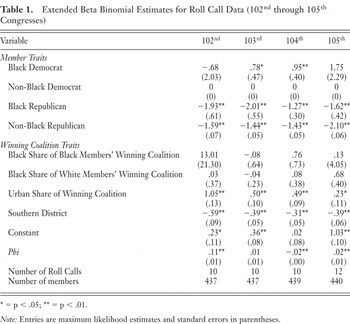
Table 1 presents EBB estimates for each of the four sessions analyzed.8
The EBB estimates were obtained using a Stata program written by Bradley Palmquist.
Extended Beta Binomial Estimates for Roll Call Data (102nd through 105th Congresses)

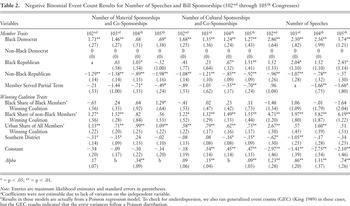
Table 2 contains results for the other three forms of interest representation. Again, to facilitate interpretation, we constrain the coefficients for non-Black Democrats to zero. With only one exception, Black Democrats were much more likely to engage in these forms of representation than non-Black Democrats, regardless of the makeup of their electoral constituencies. Moreover, Black member behavior is not correlated with the racial composition of its winning coalition traits, while that of non-Black members is in almost every case. This demonstrates that it is being Black per se, not re-election incentives, that drove African American members of Congress to pursue the material and cultural interests of their racial group, thus constituting strong evidence for the effectiveness of descriptive representation. Also of note in these results is that Black Republicans departed from their co-partisans by more frequently engaging in these three forms of Black representation, a very different pattern than that observed in the roll call data. In sum, then, the link between Black descriptive and substantive representation appears to be more consistently enacted through speechmaking and sponsorship behavior than through roll call behavior, indicating that these behaviors “provide those members whose views are largely ignored in a majoritarian institution such as the House the opportunity to participate, and may thus serve as something of an institutional safety valve” (Maltzman and Sigelman, 1996, p. 828).
Negative Binomial Event Count Results for Number of Speeches and Bill Sponsorships (102nd through 105th Congresses)

But Isn't This Still Re-election Seeking?
Evidence indicates, then, that in almost all cases, Black Democrats more actively represented Black interests than did non-Black Democrats, and they did so not as mere agents of their winning coalitions, but as advocates of their racial group's material and cultural welfare. Still, critics might argue that such behavior reaps future electoral payoffs by increasing visibility within the Black community or by gaining endorsements of important Black leaders.
A recent authoritative study of the electoral consequences of legislative behavior indicates that vociferous representation of Black interests may actually be irrational. Canes-Wrone, Brady, and Cogan (2002) demonstrate that, from 1956 to 1996, ideologically extreme members of Congress, as most Black Democrats would be classified, received smaller electoral margins in subsequent elections than did moderate members. While in isolation this result would seem to indicate that Black interest representation might actually be detrimental to electoral fortunes, we replicate their analysis, taking into account ideological extremity in our measures of Black interest representation, in order to see whether the former shapes future electoral margins.
The dependent variable is the member's share of the two-party vote in contested elections after the legislative behavior in question occurred.9
Elections won without a major party opponent were dropped from the analysis.
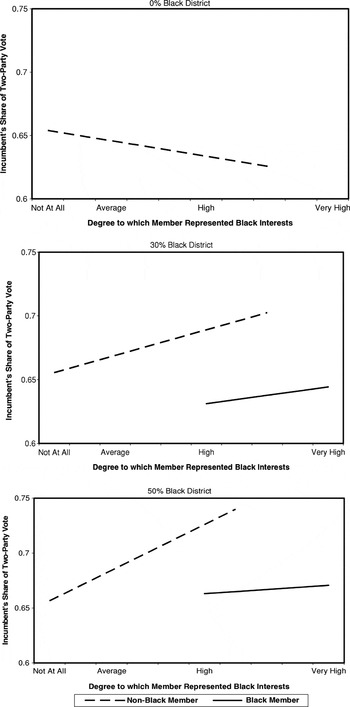
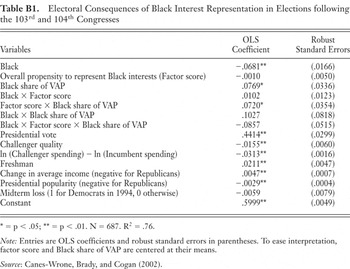
We measure legislative behavior as each member's score on a variable extracted from a principal factor analysis on the four representational variables analyzed above. All four behaviors loaded heavily on a single dimension, indicating that this extracted factor captures an underlying propensity to represent Black interests. The degree to which members benefit electorally from their commitment to Black interest representation should be a positive function of the share of African Americans in their districts, so we include the interaction between behavior and the Black share of district, and we estimate this coefficient separately for non-Blacks and Blacks. This requires the inclusion of a third-order interaction term (along with all three second-order multiplicative combinations and the three first-order variables), slightly complicating the substantive interpretation of the coefficients. Figure 1 graphically portrays the main substantive conclusions, and the model estimates are reported in Table B1 in Appendix B.

Electoral Margins as a Function of Legislative Behavior and Percentage of District that is Black
Figure 1 depicts a member's expected two-party vote share, predicted using Table B1 results, as a function of member's race, behavior, and district share of African Americans. To isolate the independent impact of these three variables, the values for all other variables are held constant at their mode (for dummy variables) or mean (for continuous variables). Lines are not drawn for cases that are not empirically observed, for example, non-Black members who rank “very high” in their degree of Black interest representation. The implications of this figure are striking. The relationship between legislative behavior and electoral margin is always stronger for a non-Black than for an African American member, indicating that voters respond to the former's activities while ignoring the latter's. For example, in both the “30% Black district” and the “50% Black district” panels, the non-Black member line is much steeper than the Black member line.
Moreover, electoral rewards and punishments accruing to non-Black members for representing Black interests vary, as expected, by the composition of their electoral constituencies. Non-Black members representing sizeable African American constituencies gain substantial electoral benefits from promoting Black interests, while those with exclusively non-Black constituencies (in the “0% Black district” panel) suffer electoral retribution. However, for African American members of Congress, roll call, sponsorship, co-sponsorship, and speechmaking activities yield no significant electoral results, as indicated by the relatively flat lines in the “30% Black district” and “50% Black district” panels. Indeed, the results indicate that Black members are less electorally secure (by 6%, on average) than their non-Black colleagues. In sum, the core electoral constituents of African American members are either not attentive to, or unimpressed by, these activities. Instead, it would appear that Black members utilize their scarce political resources to promote Black interests in spite of the negligible electoral advantages they supply. This further supports our findings that Black members promote Black interests to a far greater extent than expected and are motivated by policy, not electoral incentives.
CONCLUSION
Our analysis demonstrates that the race of members of Congress affects a broad array of representational behaviors. On average, Black members of Congress are far more likely than non-Black Democrats to propose legislation and make speeches that attempt to enhance the material and cultural welfare of African Americans. Indeed, it is being Black, independent of simple constituency characteristics or re-election maximization strategies that drives Black members to support and pursue the material and cultural interests of their ethnic group. It would be difficult to imagine more convincing evidence that African Americans in the U.S. House substantively represent the country's Black population at more pronounced rates than their non-Black colleagues. The shared experiences, culture, and linked life chances of African Americans as a group provide a compelling basis for Black legislators to pursue these interests within political institutions.
APPENDIX A. OBTAINING ESTIMATES OF WINNING COALITION CHARACTERISTICS
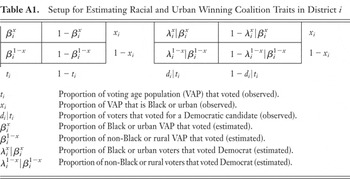
We estimated winning coalition traits using the ecological inference technique developed in King (1997) and the EzI software (King and Benoit, 2000). We estimated the values represented by Greek letters in Table A1 with observed data from census and election results, represented by Roman letters (U.S. Bureau of the Census 1993, 1995, 1997, 1999).
Setup for Estimating Racial and Urban Winning Coalition Traits in District i

The estimation procedure followed the 2 × 3, multiple imputation approach described in King (1997), first estimating turnout rates, then party choice, among Black/urban (βix and λix|βix) and non-Black/rural (βi1−x and λi1−x|βi1−x) citizens.10
For ease, turnout (ti) is percentage of the VAP voting for one of the two major parties. We assumed that members who had no major-party opponent in the previous election “defaulted” to their district's characteristics.

APPENDIX B: MODEL USED TO GENERATE FIGURE 1
Electoral Consequences of Black Interest Representation in Elections following the 103rd and 104th Congresses

APPENDIX C: NAACP REPORT CARD—BILLS INCLUDED IN THE ROLL CALL ANALYSIS
102nd Congress
Brady Bill—handgun waiting period (NAACP supported passage)
Civil Rights Act of 1991—anti-job discrimination legislation (NAACP supported passage)
Striker Replacement—prohibiting permanent scab hires (NAACP supported passage)
Banking Reform—anti-discriminatory lending amendment (NAACP supported passage)
Crime Bill—amendment prohibiting use of racial statistics (NAACP opposed passage)
Civil Rights Act of 1991—anti-job discrimination legislation (NAACP supported passage)
Balanced Budget Amendment—anti-job discrimination legislation (NAACP opposed passage)
Voting Rights Act—providing language assistance to non-English speakers (NAACP supported passage)
Motor Voter (NAACP supported passage)
Family and Medical Leave (NAACP supported passage)
103rd Congress
Family and Medical Leave (NAACP supported passage)
Motor Voter (NAACP supported passage)
Striker Replacement (NAACP supported passage)
Budget Reconciliation—including empowerment zones and Earned Income Tax Credit (NAACP supported passage)
Brady Bill (NAACP supported passage)
NAFTA (NAACP opposed passage)
DC Statehood (NAACP supported passage)
Elementary and Secondary Education Act—funding (NAACP supported passage)
Racial Justice Act—amendment prohibiting use of racial statistics (NAACP opposed passage)
Crime Bill Conference Report (NAACP opposed passage)
104th Congress
Balanced Budget Amendment (NAACP opposed passage)
Unfunded Mandates (NAACP opposed passage)
Self-employed Health Insurance Deduction (NAACP opposed passage)
VA-HUD Appropriations Bill—cuts HUD funding (NAACP opposed passage)
Sentencing Guidelines for crack cocaine (NAACP opposed passage)
Fiscal 1996 Continuing Resolution (NAACP opposed passage)
Commerce and Justice Appropriations (NAACP opposed passage)
Welfare Reform (NAACP opposed passage)
Health Insurance Reform (NAACP opposed passage)
Minimum Wage Increase (NAACP supported passage)
105th Congress
Juvenile Crime Bill (NAACP opposed passage)
Congressional Black Caucus Substitute Budget (NAACP supported passage)
Conservative Action Team Substitute Budget (NAACP opposed passage)
Fiscal 1997 Appropriations—census methodology (NAACP opposed passage)
Fiscal 1997 Appropriations—new funding (NAACP supported passage)
Budget Reconciliation—amendment for Medicaid assistance (NAACP supported passage)
Budget Reconciliation—amendment including Earned Income Tax Credit (NAACP supported passage)
Voter Eligibility Verification (NAACP opposed passage)
Affirmative Action in Department of Transportation construction—abolish (NAACP opposed passage)
DC Student Education Voucher Program (NAACP opposed passage)
Affirmative Action in admissions (NAACP opposed passage)
Affirmative Action in science and engineering programs (NAACP opposed passage)