Introduction
Pediatric traumatic brain injury (TBI) is a leading cause of long-term disability in children and adolescents worldwide, owing to its high prevalence and adverse functional consequences (Anderson et al. Reference Anderson, Catroppa, Morse, Haritou and Rosenfeld2005; Giza, Reference Giza2006; Keenan & Bratton, Reference Keenan and Bratton2006; Babikian & Asarnow, Reference Babikian and Asarnow2009; Congeni, Reference Congeni2009). Among the wide array of consequences known to occur after pediatric TBI, behavioral impairments are among the most widespread, with up to 50% of children being at risk for presenting such problems (Li & Liu, Reference Li and Liu2013). In particular, internalizing (e.g. depression and anxiety), and externalizing (e.g. aggression, conduct disorders and attention) problems, as well as personality changes, have been observed in children and adolescents after TBI (Li & Liu, Reference Li and Liu2013). In addition to their high prevalence, these problems appear to be persistent (Schwartz et al. Reference Schwartz, Taylor, Drotar, Yeates, Wade and Stancin2003).
Epidemiological data and registries indicate that children 5 years of age and under (i.e. ‘preschoolers’) are at especially high risk of sustaining TBI (Hawley et al. Reference Hawley, Ward, Long, Owen and Magnay2003; Rutland-Brown et al. Reference Rutland-Brown, Langlois, Thomas and Xi2006; Crowe et al. Reference Crowe, Babl, Anderson and Catroppa2009). The over-representation of preschoolers and high occurrence of behavioral problems after pediatric TBI is particularly concerning given evidence that the emergence of inappropriate behaviors in the first years of life places children on a pathway toward more serious conduct and mental health problems in later childhood, adolescence, and adulthood (Caspi et al. Reference Caspi, Moffitt, Newman and Silva1996; Emond et al. Reference Emond, Ormel, Veenstra and Oldehinkel2007). Despite this, relatively few studies of behavioral outcomes post-TBI have specifically targeted preschoolers, and existing studies in this youngest pediatric group offer conflicting results. Studies reporting increased behavioral problems (Keenan et al. Reference Keenan, Hooper, Wetherington, Nocera and Runyan2007; Chapman et al. Reference Chapman, Wade, Walz, Taylor, Stancin and Yeates2010) contrast with those reporting good behavioral outcomes (Goldstrohm & Arffa, Reference Goldstrohm and Arffa2005; Wetherington et al. Reference Wetherington, Hooper, Keenan, Nocera and Runyan2010). The latter findings are inconsistent with the expectations of ‘vulnerability theory’, which posits that the immature brain is particularly vulnerable to residual impairments after early insults (Anderson et al. Reference Anderson, Catroppa, Morse, Haritou and Rosenfeld2005). Studies of brain maturation indicate that there are sensitive periods for the development of cognitive and social functions and that brain insult sustained during one of these periods may impair the development of that particular function or skill (Anderson et al. Reference Anderson, Catroppa, Morse, Haritou and Rosenfeld2005; Werker & Tees, Reference Werker and Tees2005; Innocenti, Reference Innocenti2007; Anderson et al. Reference Anderson, Spencer-Smith, Leventer, Coleman, Anderson, Williams, Greenham and Jacobs2009). These functions are likely to underpin the establishment of appropriate behaviors (e.g. Schoemaker et al. Reference Schoemaker, Mulder, Deković and Matthys2013).
A number of methodological issues preclude clear conclusions about the impact of TBI on behavior after early brain injuries. First, in most cases, toddlers and preschoolers are grouped with school-age children, making it impossible to draw conclusions specific to the preschool period (e.g. Catroppa et al. Reference Catroppa, Anderson, Morse, Haritou and Rosenfeld2008). Second, limited incorporation of pre-morbid behavioral ratings limits the possibility of accounting for difficulties that may typically be present in the TBI population, placing children at higher risk of sustaining TBI, and thus pre-dating injury and confounding findings. Third, in many studies, comparison groups are composed of uninjured children, which may fail to control for the impact of generic injury effects (e.g. medical treatment and pain) (Emery et al. Reference Emery, Barlow, Brooks, Max, Villavicencio-Requis, Gnanakumar, Robertson, Schneider and Yeates2016). Finally, most studies focus solely on moderate or severe TBI (e.g. Chapman et al. Reference Chapman, Wade, Walz, Taylor, Stancin and Yeates2010) or confound severity levels (e.g. Goldstrohm & Arffa, Reference Goldstrohm and Arffa2005), despite the fact that 90% of injuries are classified as mild TBI (or ‘concussion’) (Cassidy et al. Reference Cassidy, Carroll, Peloso, Borg, von Holst, Holm, Kraus and Coronado2004).
A review conducted by Emery et al. (Reference Emery, Barlow, Brooks, Max, Villavicencio-Requis, Gnanakumar, Robertson, Schneider and Yeates2016) suggests that there is mixed evidence regarding psychiatric, psychological, and behavioral outcomes of mild traumatic brain injury (mTBI). Their report found problems in only a limited number of studies, some of which included methodological flaws. However, they conclude that psychological and psychiatric problems are more prevalent when the injury is sustained early in the course of development (<6 years old). Despite this claim, existing studies that target preschoolers also offer somewhat inconclusive results. A study by McKinlay et al. (Reference McKinlay, Grace, Horwood, Fergusson and MacFarlane2009) pertaining to adolescent psychiatric symptoms following preschool mTBI suggests that more severe cases of mTBI (i.e. those requiring hospitalization) are associated with an increase in psychiatric symptoms in mid-adolescence. Another study demonstrates that history of multiple mTBI during the preschool period is associated with internalizing and externalizing problems, while the history of a single injury is not related to adverse outcome (Liu & Li, Reference Liu and Li2013). In light of these somewhat contradictory findings and the methodological limitations of existing studies, there is a need to clearly establish the putative presence of behavioral problems after mTBI in the preschool years.
The main objective of this study was to investigate the presence of internalizing and externalizing behavioral problems 6 months after preschool (i.e. 18–60 months old) mTBI. We hypothesized that both internalizing and externalizing problems would be more prevalent in the mTBI group than in either typically developing children or children with orthopedic injuries. A second objective was to identify the pre-existing child and family characteristics and injury-related variables that predict behavioral outcome after preschool mTBI.
Methodology
The data presented here constitute a sub-study of a larger prospective longitudinal cohort study investigating cognitive and social outcomes of preschool TBI (LION study), which was approved by the local institutional ethics review board.
Participants
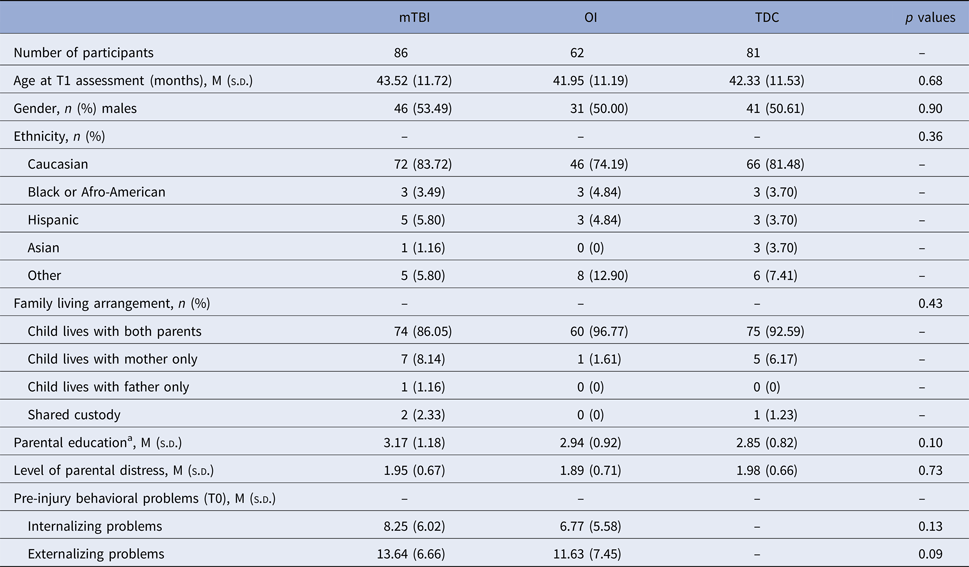
The current sample comprises 229 children recruited to one of three participant groups: mild TBI (mTBI; n = 86), orthopedic injury (OI; n = 62) and typically developing children (TDC; n = 81) (see descriptive variables in Table 1).
Participants’ sociodemographic and descriptive characteristics

a Parental education was obtained by averaging both parents’ educational qualifications on an eight-level scale ranging from ‘Doctoral degree’ to ‘Less than 7 years of school’.
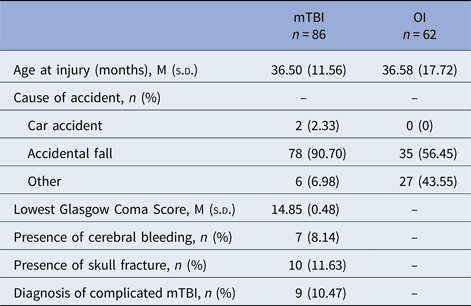
Inclusion criteria for the mTBI group were: (a) presentation to a single, tertiary care, pediatric emergency department; (b) age at injury between 18 and 60 months (to ensure more homogeneous injury factors and applicability of measures); (c) closed head injury with a score between 13 and 15 at admission on the Glasgow Coma Scale; (d) at least one of the following symptoms: loss of consciousness, excessive irritability, persistent vomiting (more than two times), confusion, headaches that worsen over time, drowsiness, dizziness, motor difficulties or balance problems, blurred vision, hypersensitivity to light, and/or the presence of seizures. Of note, participants who had a diagnosis of complicated mTBI (score between 13 and 15 on the Glasgow Coma Scale with evidence of an intracranial lesion on clinical CT or MRI) were included (n = 9). For the OI group, inclusion criteria were: (a) presentation to a single, tertiary care, pediatric emergency department; (b) age at injury between 18 and 60 months; (c) limb trauma leading to a final diagnosis of simple fracture, sprain, contusion, or unspecified trauma to an extremity. To compose the TDC group, non-injured children of equivalent age were recruited via daycare centers.
Exclusion criteria for the three groups were: (a) diagnosed congenital, neurological, developmental, psychiatric, or metabolic condition; (b) gestational age < 36 weeks; (c) child and parent not fluent in French or English; (d) history of prior TBI serious enough to warrant a visit to the ED; and (e) non-accidental injury (for the mTBI and OI groups).
Procedure
mTBI and OI groups
Children presenting to the Ste-Justine Hospital emergency department between 2011 and 2015 for either a mTBI or OI were screened by a research nurse based on the emergency department log. Participants fulfilling inclusion/exclusion criteria were invited to participate in the study. Families who agreed to participate were mailed a consent form and pre-injury questionnaires (time point 0, T0) within 1 week of injury. They were asked to answer the questions based on their child's functioning prior to the accident. The research nurse and pediatric emergency medicine physician (when necessary) systematically completed a standardized case report form. Information gathered in this report was used for descriptive purposes and to confirm inclusion/exclusion criteria. Any outstanding inclusion/exclusion criteria were confirmed by the study coordinator through a semi-structured telephone interview with parents. At 6-month post-injury (time point 1, T1), mothers were asked to complete another questionnaire booklet based on their child's current functioning.
TDC group
Children from the TDC group were recruited via information pamphlets distributed to parents in urban daycare centers. Daycare centers from a range of neighborhoods with varied socioeconomic conditions were targeted in order to optimize group comparability. As soon as consent was obtained, mothers were asked to complete the questionnaires (T1). To ensure that the three groups were of comparable age at T1 (i.e. 6 months post-injury for the two clinical groups), children in the TDC group were aged between 24 and 66 months at the time of recruitment.
Measures
Descriptive variables
The Case Report Form (CRF) was completed after enrollment for both the mTBI and the OI groups. It is based on the recommendations of Miller (Reference Miller2010) and comprises information such as the nature and the severity of the injury, the cause of the accident, the height of fall (if applicable), clinical neuroimaging findings (if applicable), the presence of a skull fracture, clinical details related to other trauma, the length of hospital stay, the presence of neurological signs and symptoms (e.g. loss of consciousness, headaches and excessive irritability) and the initial score recorded on the Glasgow Coma Scale (GCS), as well as the lowest GCS and the duration of time for GCS to return to 15 if multiple measures were available.
The ABCs Laboratory Sociodemographic Questionnaire was completed by the primary caregiver (the mother in 90.8% of cases) at the time of enrollment to collect information regarding demographics (e.g. sex, ethnicity, parental education, family living arrangement).
The Postconcussive Symptom Interview (PCS-I) (Mittenberg et al. Reference Mittenberg, Wittner and Miller1997) was completed at T1 for the mTBI and OI groups. It consists of a structured parent interview documenting the presence of 15 different post-concussive symptoms related to four domains: cognitive, somatic, sleep, and affective. Parents were asked if their child experienced these symptoms either in the past week or in the last 6 months (i.e. since the injury).
The Parental Distress scale from the Parenting Stress Index (PSI) (Abidin, Reference Abidin1990) was completed by the primary caregiver at T1 for all three groups. It consists of 12 questions using a five-point scale (1 = Strongly agree to 5 = Strongly disagree). This variable was included for descriptive purpose and to ensure that groups were equivalent in terms of parental distress at T1.
Behavioral outcome
The Child Behavior Checklist for ages 1.5–5 years (CBCL) (Achenbach & Rescorla, Reference Achenbach and Rescorla2000) consists of a 100-item checklist using a three-point scale (0 = Not true; 1 = Somewhat or sometimes true; 2 = Very true or often true). The CBCL generates an Internalizing Problems score including four subscales (Emotionally reactive, Anxious/depressed, Somatic complaints and Withdrawn), and an Externalizing Problems score including two subscales (Attention problems and Aggressive behavior). For the mTBI and OI groups, the primary caregiver completed the CBCL retrospectively at T0 to estimate pre-injury behavioral problems. At T1, mothers from all three groups were asked to complete the CBCL.
Statistical analyses
All analyses were conducted using IBM SPSS Statistic (version 21.0). First, preliminary analyses were performed to ensure that possible group differences on outcome measures (CBCL data at T1) were not attributable to pre-existing psychosocial and demographic factors. Chi-square analyses were conducted to determine whether there were group differences on categorical variables (i.e. sex, ethnicity, family living arrangement). Analyses of variance (ANOVAs) were conducted for continuous variables (i.e. age at assessment, parental education, parental distress). For the two clinical groups (TBI v. OI), independent t tests were computed for age at injury and pre-injury estimates of behavioral problems.
In the main analyses, the three groups were compared on mothers’ ratings of internalizing and externalizing behavior (CBCL) at T1 using two separate analyses of covariance (ANCOVAs). As recommended by Thurber & Sheehan (Reference Thurber and Sheehan2012), CBCL raw scores were used in the analyses and age was included as a covariate. Statistical significance was defined as p < 0.05. Effect sizes (Cohen's d) were defined as small (d = 0.2), medium (d = 0.5), or large (d = 0.8) (Cohen, Reference Cohen1992).
Additional chi-square (χ2) analyses were performed to determine whether there were group differences regarding the proportion of children whose scores were clinically elevated (borderline or clinical range, T ⩾ 60) (Achenbach & Rescorla, Reference Achenbach and Rescorla2000) on either the Internalizing or the Externalizing problems scales. Elevated scores on these two broad-band scales have been shown to be useful in predicting subsequent child psychopathology (Petty et al. Reference Petty, Rosenbaum, Hirshfeld-Becker, Henin, Hubley, LaCasse, Faraone and Biederman2008).
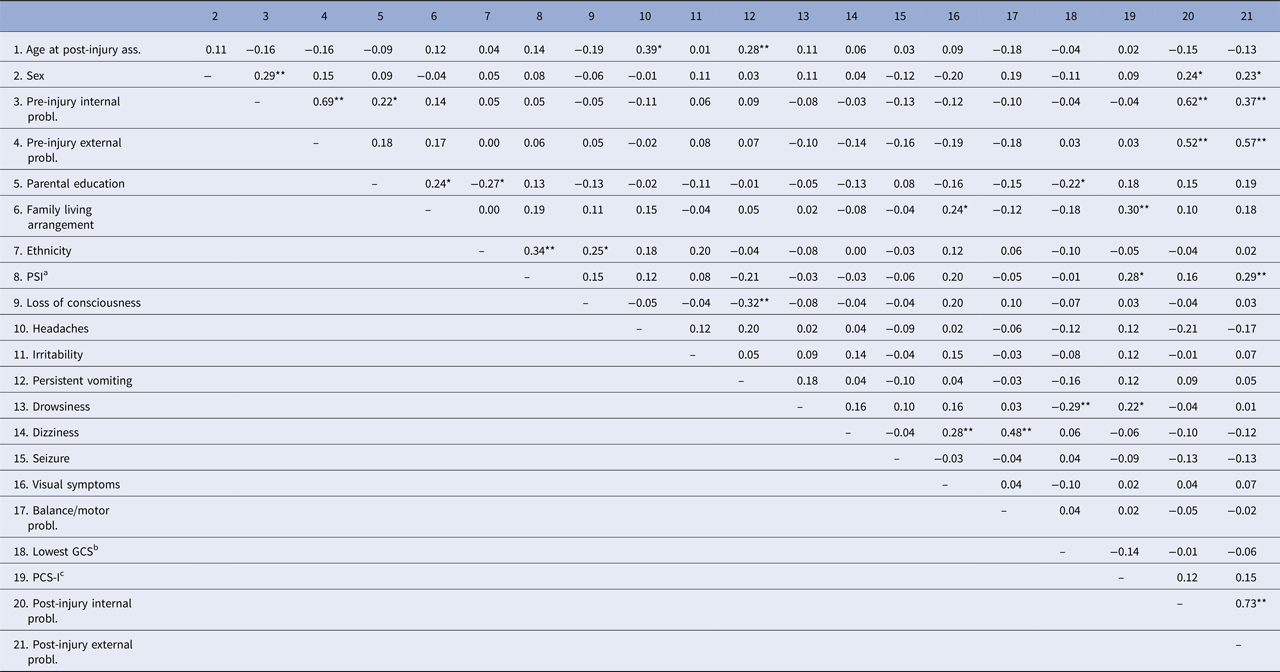
Hierarchical regression analyses were also conducted to identify variables that could predict behavioral problems in the mTBI group. As shown in Table 2, zero-order correlations were first run to identify multicollinearity and select potential predictors of the Internalizing and Externalizing Problems scores among relevant variables from the sociodemographic questionnaire, the CRF, the PCS-I, and the PSI. Variables that correlated with either the Internalizing Problems score or the Externalizing Problems score at a p-level < 0.20 were included in both models. Potential predictors were entered in three blocks. In the first block, variables related to participants’ pre-existing characteristics were entered (i.e. age, sex, and pre-injury behavioral problems). In the second block, family characteristics (i.e. family living arrangement, parental education, and level of parental distress) were added. In the third block, injury-related characteristics (i.e. headache as a symptom of TBI and long-term post-concussive symptoms) were entered to determine whether TBI markers explain behavioral outcomes above and beyond participant and family characteristics.
Zero-order correlations in the mild traumatic brain injury (mTBI) group among relevant study variables

Note: Variables correlated at a p-level < 0.20 were included in the regression models.
a PSI, Parenting Stress Index, Parental distress scale.
b GCS, Glasgow Coma Scale.
c PCS-I, Post-concussive Symptom Interview (symptoms since injury).
*p < 0.05. **p < 0.01.
Results
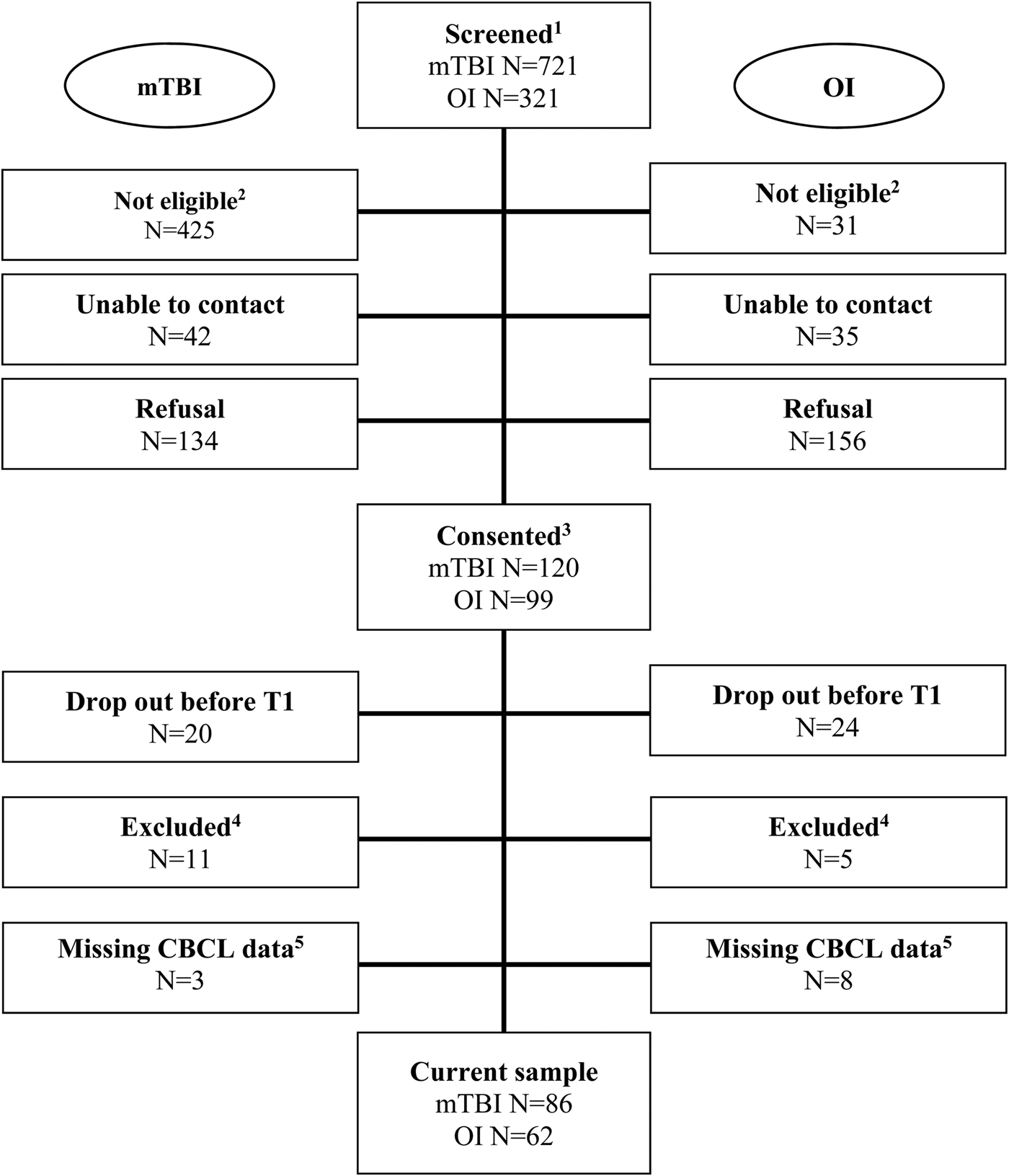
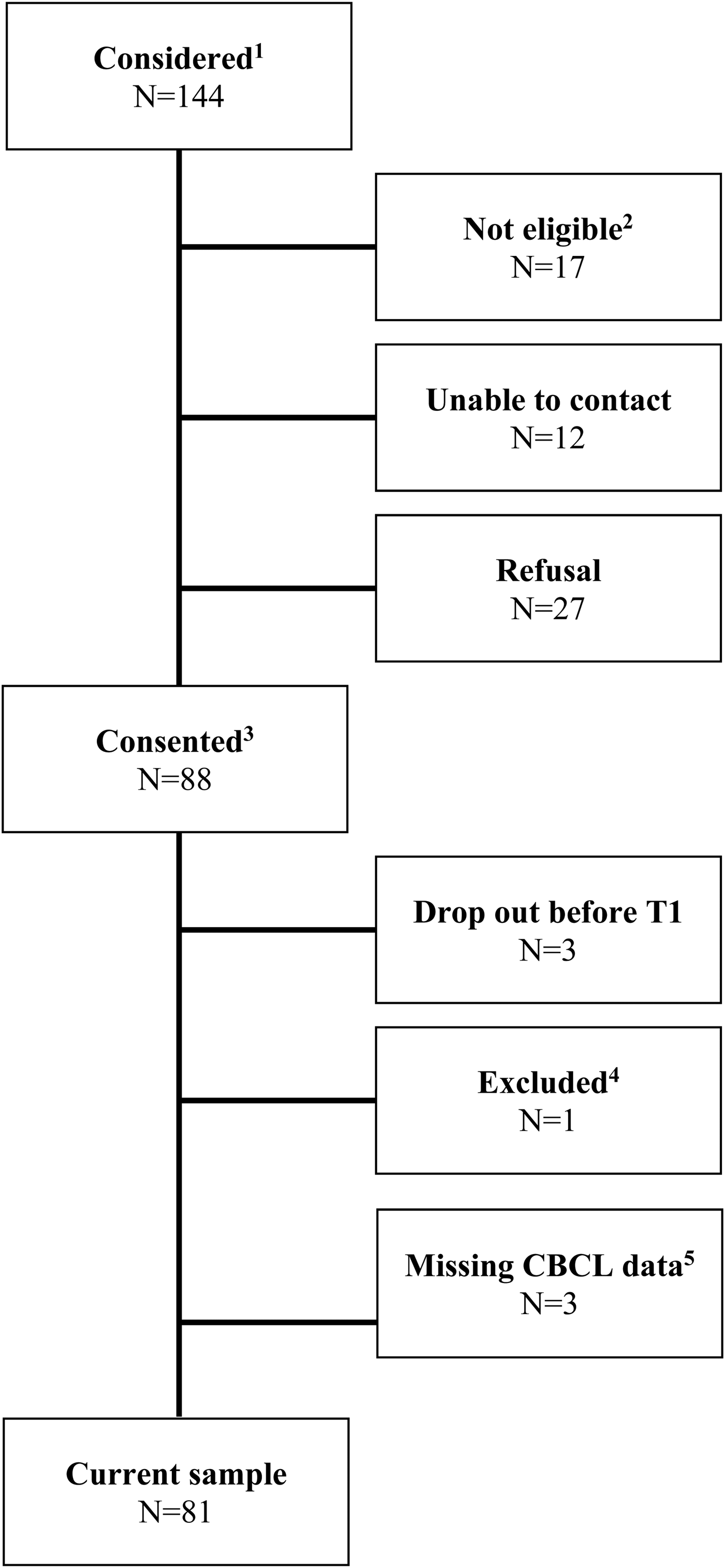
Recruitment and follow-up details for all three groups are presented in Figs 1 and 2. There were no differences between families who agreed to participate in this study and those who did not in terms of age, t(102) = 0.89, p = 0.38; t(427) = 1.08, p = 0.28, and sex, χ2 (1, n = 530) = 1.16, p = 0.28.
Recruitment and follow-up flowchart for the mTBI and OI groups.
(1) The following emergency department diagnosis was considered for participation in the study: mTBI group: traumatic brain injury, head fracture, concussion, intracranial bleeding/hemorrhage, polytrauma; OI group: limb trauma leading to a final diagnosis of simple fracture, sprain, contusion, or unspecified trauma to an extremity.
(2) Potential participants who were not eligible because they did not satisfy an inclusion and/or exclusion criteria.
(3) Consented refers to those participants whose parents signed a consent form.
(4) These participants were excluded at T1 because they did not satisfy an inclusion and/or exclusion criteria that had not been detected at recruitment.
(5) Missing CBCL data at T1 either because the questionnaire booklet was not returned or because too many questions were left unanswered.

Recruitment and follow-up chart for the TDC.
(1) Considered refers to participants whose parents were given a pamphlet of our study at the local daycare and who gave their verbal consent to be contacted by the research coordinator.
(2) Potential participants who were not eligible because they did not satisfy an inclusion and/or exclusion criteria.
(3) Consented refers to those participants whose parents signed a consent form.
(4) These participants were excluded at T1 because they did not satisfy an inclusion and/or exclusion criteria that had not been detected at recruitment.
(5) Missing CBCL data either because the questionnaire booklet was not returned or because too many questions were left unanswered.

Sample descriptives
Table 1 presents demographic, parental distress and pre-injury estimates of behavior problems by group and Table 3 presents injury-related characteristics. No group differences were found on age, sex, ethnicity, family living arrangement, parental education, and level of parental distress. The TBI and OI groups did not differ in pre-morbid estimates of internalizing and externalizing behavior problems. However, it is noteworthy that while not statistically significant, the pre-morbid estimate of externalizing behavior was higher for the TBI group.
Injury-related characteristics

Behavioral outcome
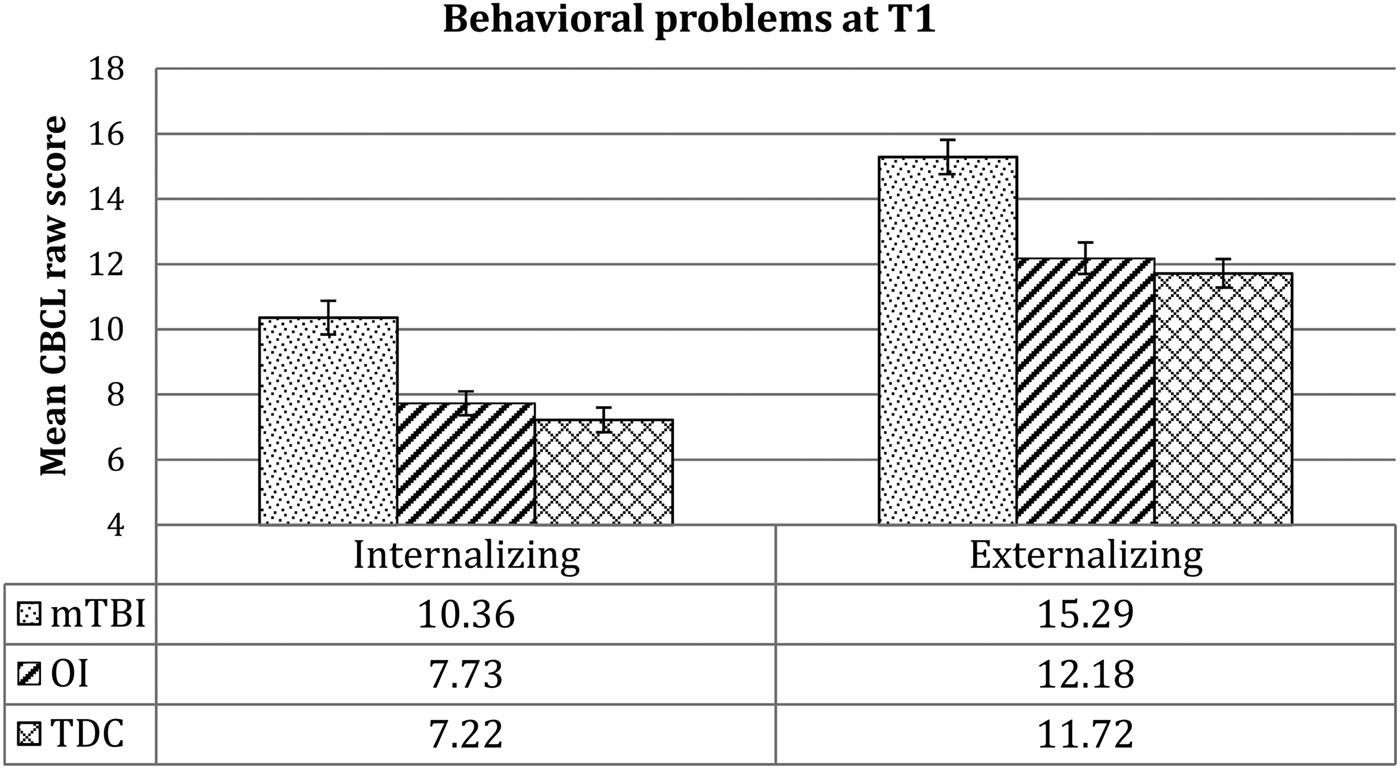
Figure 3 presents raw scores for mothers’ ratings on the CBCL at T1 for all three groups. There was a significant group difference for mothers’ ratings of internalizing behaviors [F(2, 229) = 5.53, p = 0.01, η 2 = 0.05], with higher ratings reported in the mTBI group than in both the OI [p = 0.02, 95% CI (4.87–0.53)] and the TDC groups [p = 0.002, 95% CI (1.17–5.20)]. Mothers’ ratings of externalizing behaviors also differed across groups [F(2, 229) = 6.10, p = 0.003, η 2 = 0.05] with significantly higher ratings in the mTBI group than in both the OI [p = 0.01, 95% CI (5.65–0.83)] and the TDC groups [p = 0.001, 95% CI (5.91–1.43)]. In order to confirm that the differences observed are not solely attributable to the nine participants with complicated mTBI, the analyses were repeated without this subgroup of participants. Results were still significant, F(2, 220) = 5.85, p = 0.003 (internalizing behaviors) and F(2, 220) = 6.87, p = 0.001 (externalizing behaviors), indicating that the inclusion of complicated mTBI participants does not account for the higher rate of problems overall in the mTBI group.
Mean raw scores on the CBCL internalizing and externalizing scales at T1 (errors bars represent standard error).

Furthermore, there was a significant group difference in the proportion of children with clinically elevated scores on either the Internalizing or the Externalizing problems scores, χ2 (2, n = 229) = 8.36, p = 0.02. In the mTBI group, 38.4% of children had at least one clinically elevated score, compared with 25.8% in the OI group and 18.5% in the TDC group. Since there were two pairwise comparisons of interest (mTBI v. OI and mTBI v. TDC), we conducted a 2 × 2 χ2 test for each and considered the Bonferroni-adjusted p value due to multiple comparisons. Results indicate that the proportion of children whose scores were clinically elevated was higher in the mTBI group compared with the TDC group, χ2 (1, n = 167) = 8.03, p = 0.01, p = 0.02, but not compared with the OI group, χ2 (1, n = 148) = 2.57, p = 0.11.
Predictors of behavioral problems
The results of the prediction model for internalizing behaviors show that participants’ pre-existing characteristics (first block) explained a significant 41.2% (p = 0.001) of the variance in post-injury internalizing problems. Pre-existing internalizing problems was a significant independent predictor of post-injury internalizing problems (β = 0.60, p = 0.001). Family characteristics (second block) and injury-related variables (third block) did not contribute to the model above and beyond participant characteristics.
The results of the prediction model for externalizing behaviors show that participants’ pre-existing characteristics (first block) explained a significant 38.4% (p = 0.001) of the variance in post-injury externalizing problems. Pre-existing externalizing problems was a significant independent predictor of post-injury problems (β = 0.56, p = 0.001). Moreover, family characteristics (second block) explained an additional and significant 9.5% (p = 0.01) of the variance in externalizing problems. Parental distress was found to be a significant independent predictor of post-injury problems (β = 0.28, p = 0.002). Finally, injury-related variables (third block) did not contribute to the model above and beyond participant and family characteristics.
Discussion
This is a prospective study examining behavioral outcomes in preschool mTBI. The findings were consistent with our initial hypothesis and indicate that mothers of children who sustain mTBI observe more internalizing and externalizing behavioral problems in their child compared with mothers of children with OI and TDC. The observed difference between the mTBI and the uninjured group suggests that children who sustain mTBI have greater behavioral difficulties than their peers, that is, the children with whom they interact and are compared with in everyday life. In addition to this, the difference between the mTBI and the OI groups indicates that reported behavioral difficulties are not explained by pre-existing psychosocial characteristics that place children at risk for the occurrence of injuries (e.g. lower socioeconomic status, parenting styles), nor are they the result of generic injury effects (e.g. ensuing medical treatment, stress related to the visit to the hospital, etc.). Rather, they appear to be brain-injury-specific and suggest that even in its mildest form, early brain injury may cause disruption to the developing brain serious enough to result in behavioral changes, which persist for several months post-injury. This is also supported by the fact that the mTBI and the OI group were comparable in terms of pre-injury estimates of behavior problems, thus signaling an increase in post-injury behavioral problems in the mTBI group.
Although the mean scores obtained by the children with mTBI fell within the normal range, almost 40% of children with mTBI presented with at least one score within the borderline or clinical range (above the 84th percentile) on either the Externalizing or the Internalizing problems scales. Therefore, for a considerable proportion of children with mTBI, behavioral difficulties are severe enough to warrant further clinical evaluation. The findings raise some concern for long-term outcome given that behavioral difficulties in the preschool years predict mental-health problems in later childhood, adolescence, and adulthood (e.g. Lerner et al. Reference Lerner, Inui, Trupin and Douglas1985; Shoda et al. Reference Shoda, Mischel and Peake1990; Caspi et al. Reference Caspi, Moffitt, Newman and Silva1996; Mesman & Koot, Reference Mesman and Koot2001; Hirshfeld-Becker et al. Reference Hirshfeld-Becker, Biederman, Henin, Faraone, Davis, Harrington and Rosenbaum2007).
Our findings contrast with those of previous studies in which adverse outcomes were only found in more severe forms of preschool mTBI that required hospitalization (McKinlay et al. Reference McKinlay, Grace, Horwood, Fergusson and MacFarlane2009) or were only associated with history of multiple mTBI (Liu & Li, Reference Liu and Li2013). Our findings also contrast somewhat with the idea that mTBI is associated with adequate psychosocial outcome with only a few children suffering negative consequences (Satz et al. Reference Satz, Zaucha, McCleary and Light1997; Carroll et al. Reference Carroll, Cassidy, Peloso, Borg, von Holst, Holm, Paniak and Pépin2004; Babikian & Asarnow, Reference Babikian and Asarnow2009). A possible explanation is that this cohort consists of the youngest and possibly most vulnerable age group. This aligns with conclusions from a meta-analytic review conducted by Babikian & Asarnow (Reference Babikian and Asarnow2009), concluding that the variability in reported outcomes across studies pertaining to pediatric mTBI may be due to age at injury, as prior studies have found poorer outcome in younger children (Anderson & Moore, Reference Anderson and Moore1995; Dennis, Reference Dennis, Yeates, Ris and Taylor2000; Emery et al. Reference Emery, Barlow, Brooks, Max, Villavicencio-Requis, Gnanakumar, Robertson, Schneider and Yeates2016). Our study supports the conception that the developing brain is vulnerable to early insult.
Our results also show that children who exhibit internalizing and externalizing problems before the injury are more likely to have poorer behavioral outcome post-injury. These findings align with those of several studies suggesting that pre-morbid status predicts TBI outcome (e.g. Novack et al. Reference Novack, Bush, Meythaler and Canupp2001; Babikian et al. Reference Babikian, McArthur and Asarnow2013) and are in line with the conclusions of the systematic review conducted by Emery et al. (Reference Emery, Barlow, Brooks, Max, Villavicencio-Requis, Gnanakumar, Robertson, Schneider and Yeates2016) pertaining to psychiatric, psychological and behavioral manifestations of pediatric mTBI, which states that adverse outcomes are more prevalent in individuals with pre-existing psychiatric illness.
Interestingly, however, the current findings additionally suggest that maternal distress predicts the emergence of externalizing problems after the injury. It is possible that the relation between children's externalizing problems post-injury and maternal distress is reciprocal. For example, stress in parents post-injury may lead to overprotectiveness, and children may react to this manifestation of stress through defiant behavior or aggressiveness, which in turn exacerbates parental distress. Previous work in preschoolers and school-aged children with and without developmental delays indicates that child behavior problems are both an antecedent and consequence of parenting stress (Neece et al. Reference Neece, Green and Baker2012). Another hypothesis to explain the predictive link between mother distress and mother-reported post-TBI behavior problems is that the psychological state of the mother might influence the way she perceives her child and fills out the questionnaire (Treutler & Epkins, Reference Treutler and Epkins2003). It is likely that a higher level of stress, especially if it is related to the injury burden, leads mothers to overestimate the presence of behavioral difficulties in their child.
Although injury-related characteristics did not predict outcome in the current study, it is possible that this is due to the measures used, which present limitations when used in very young children who may not always be able to effectively communicate their symptoms and discomfort (e.g. headaches, blurred vision) and who show limited introspective capacities. The validation of more appropriate measures to document neurological signs and post-concussive symptoms in this age group could address this limitation in future work in preschool TBI research (Beaudoin et al. Reference Beaudoin, Désiré, Landry-Roy and Beauchamp2017).
Limitations and future directions
The main limitation of this work is the reliance on a sole informant (the mother) for providing post-injury behavioral ratings. In addition to the fact that mothers could not be blinded to group status, this introduces personal bias and confounds related to fatigue, anxiety, and parental concerns (especially given the extensive press coverage of possible concussion effects). Future comparisons should seek to include both parents, especially as discrepancies in mother–father reports of behavior problems have previously been observed (Christensen et al. Reference Christensen, Margolin and Sullaway1992; Langberg et al. Reference Langberg, Epstein, Simon, Loren, Arnold, Hechtman, Hinshaw, Hoza, Jensen and Pelham2010; van der Veen-Mulders et al. Reference van der Veen-Mulders, Nauta, Timmerman, van den Hoofdakker and Hoekstra2016). Future studies may also benefit from the inclusion of other measures, other caregivers’ reports (e.g. preschool teachers) and/or direct observation. The retrospective reports used in this study to evaluate pre-morbid behavioral problems may lead to bias related to the current parental perception of child behaviors. However, there is no alternative way to circumvent the problem in this specific population in which true pre-injury baseline data are not collected. The inclusion of indirect pre-morbid measures could alternately be viewed as a methodological strength compared with studies that fail to consider pre-existing status, which has been shown to affect outcome after brain injury (Ponsford et al. Reference Ponsford, Willmott, Rothwell, Cameron, Ayton, Nelms, Curran and Ng1999; Yeates, Reference Yeates2010; Babikian et al. Reference Babikian, McArthur and Asarnow2013). Longer-term investigation of the evolution of the problems observed here could be useful to determine whether behavioral problems tend to decrease over time, or on the contrary, whether they place children on a pathway toward more serious problems during later childhood and adolescence.
Conclusion
Although several studies have investigated psychosocial outcomes in youth with mTBI, very few have targeted preschoolers despite the fact that the young developing brain is particularly vulnerable to such insults. By examining the behavioral outcomes of preschool mTBI, this study brings a significant contribution to the literature and improves on previous work in this area through methodological strengths, which include the use of two comparison groups and pre-morbid estimates of behavioral problems. Our findings show that children who sustain mTBI exhibit more internalizing and externalizing problems than their peers 6 months post-injury, and that these problems are brain-injury specific. Despite the injury being mild in nature, parental coaching, and other forms of preventive intervention from health practitioners could be beneficial given that preschoolers are vulnerable to adverse behavioral outcomes.
Acknowledgements
We are grateful for the work of Cindy Beaudoin and the members of the LION project. We also thank the Emergency Department team, in particular, Maryse Lagacé, Ramona Cook, and the ‘PIEUVRES’ group for their assistance with recruitment. All phases of this study were supported by the Canadian Health Research Fund (CIHR), grant number MOP111036.
Declaration of Interest
The authors have no potential conflicts of interest to disclose.