I
Robert Hatten’s article, ‘A1 Surfeit of Musics: What Goethe’s Lyrics Concede when set to Schubert’s Music’ reminded me once again how even today Goethe’s relationship to music is classified ambivalently.Footnote 1 Although anniversaries of the poet’s birth and death have inspired a flurry of publications on the theme of ‘Goethe and Music’, this literature has been marked by contradictory positions, with scholars arguing for or against the poet’s understanding of music.Footnote 2 Such equivocation is unsurprising when one considers the contradictory nature of the poet’s pronouncements on music: ‘Musik kann ich nicht beurtheilen, denn es fehlt mir an Kenntniß der Mittel deren sie sich zu ihren Zwecken bedient’ [I cannot judge music, because a knowledge of the means by which it reaches its objectives is lacking in me].Footnote 3 Often Goethe remarked that he lived ‘in keiner musikalischen Sphäre’ [I do not live in a musical atmosphere]Footnote 4 and to Zelter he admitted, ‘Ich kenne Musik mehr durch Nachdenken als durch Genuß und also nur in allgemeinen’ [I know music more by reflection than by enjoyment, and therefore only in a general sense].Footnote 5 Again to Zelter, he confided that he responded to music intellectually rather than practically and on this account believed, ‘Ich weiß recht gut, daß mir ein Drittel des Lebens fehlt; aber man muß sich einzurichten wissen’ [I know very well that on account of this I lose one third of life, but one must be able to adapt].Footnote 6
Before taking such comments at face value, however, it is important to contextualize Goethe’s words against the backdrop of the poet’s rich musical experience, for we also know another Goethe, who loved to live for a few moments through song,Footnote 7 and who retained a lifelong interest in music. In his childhood in Frankfurt Carl Friedrich Abel (1723–1787) and Johann Friedrich Armand von Uffenbach (1687–1769) were regular visitors to his home; for his fourteenth birthday his father took him to hear the child prodigy Mozart perform, and from 1763 he and his sister, Cornelia, regularly attended services at the Barfüßer- und Katharinenkirche, where Telemann became Director of Music. During these years Goethe studied piano with Johann Andreas BismannFootnote 8 and cello in Strasbourg (1770–71),Footnote 9 and he learned to play spinet well enough to perform with Maximiliane La Roche in 1774. In Leipzig he formed a close acquaintance with Johann Adam Hiller (1728–1804), through whom he was introduced to the oldest German music periodical, Wöchentliche Nachtrichten, die Musik betreffend, and whose Gewandhaus concerts he attended regularly. Through his association with Herder in Strasbourg, Goethe became interested in his native folk music, which inspired him not only to create numerous parodies to the folk tunes collected by Herder, but to travel out into the countryside, collect 13 German folksongs and transcribe the music on his return.Footnote 10
Goethe’s lifelong interest in song extended to opera and choral music. From 1791–1817 Goethe directed the Weimar Theatre, which, under his direction, became a mirror image of contemporary developments in Germany. During these years he wrote and revised over ten libretti in the hope of founding a German national opera, including a sequel to Die Zauberflöte.Footnote 11 His operatic aspirations are recorded in his correspondence with Philip Christoph Kayser (1755–1823) and Johann Friedrich Reichardt (1752–1814) while his passion for choral music was shared with Carl Friedrich Zelter (1758–1832) and with Kayser, whom he invited to Rome to study with him the music of Italian sixteenth-century church composers.Footnote 12 Goethe’s interest in choral music neither began nor ended in Italy. His first parodies were written to church chorales he heard under Telemann’s direction; his interest in vocal music led him to compose a rhythmic setting of ‘In te, Domine, speravi et non confundar in aeternum’ for four-part choir. Later in life, Goethe’s efforts to assure the presence of music in domestic social spheres, especially after the death of Anna Amalia in 1807, inspired him to found his own Hausgesangsverein (1807–1811) and appoint Carl Eberwein (1786–1868), Director of Music in his home.Footnote 13 When the choir disbanded, Goethe wrote ‘ich verlor dabei sehr viel’ [I lost a great deal because of it],Footnote 14 and he described his life as being ‘sang- und klanglos’ [bereft of all music].Footnote 15 One of the many visitors who broke this silence was the 12-year old Felix Mendelssohn, who, between the ages of 12 and 21, stayed with Goethe on four occasions in his home, a privilege offered to very few, as was the ‘Du’ form of address which Mendelssohn continued to enjoy as an adult. On his final visit, he played for Goethe every morning for two weeks a selection of pieces by Western canonical composers in chronological order explaining what each had done to further the art,Footnote 16 and in his eighty-first year, the ‘musically conservative poet’ was willing to learn from the composer.
Lea Mendelssohn, when she visited the poet in 1822, recognised the potency of Goethe’s engagement with music: an opinion which Zelter reinforced when he read the preface to Goethe’s translation of Diderot’s Neveu de Rameau (1805) and declared: ‘es hat mich nicht wenig gekränkt, daß Sie mehr von der Musik versteh’n als ich’ [it really hurt to realise that you know more about the art of music than I do].Footnote 17 Goethe’s research on the French composer awakened the poet’s interest in other theorists. In correspondence with Zelter on 4 January 1819, he mentions his discovery of the theoretician, Johann Mattheson, a contemporary of Bach, whose monumental folio Vollkommener Capellmeister he was reading.Footnote 18 Inspired by the acoustician, Ernst Chladni and the scientist Ernst Meyer, he sketched a treatise on acoustics in which he renames and reorders the musical classifications of the Middle Ages: musica mundana, musica humana, musica instrumentalis. Goethe’s Tonlehre is contained in his correspondence to Zelter of 6 September 1826,Footnote 19 and it hung on the walls of Zelter’s bedroom until his death in 1832.
Throughout his long life, Goethe’s poetic, literary and dramatic works bear testimony to the poet’s appreciation of music. So why, in view of the evidence of Goethe’s unceasing pursuit of music, the high value he placed on the art and the innate musical aspect of his writings, is he criticized so acutely? Although it lies beyond the scope of this article to discuss the myriad reasons for this in Goethean reception history, two prevailing reasons must be touched upon briefly: his response to Schubert and his perception of the nineteenth-century Lied.
Perhaps more than any other reason, Goethe’s ‘rejection’ of Schubert is continually cited as an example of Goethe’s lack of musical discernment. The basis for this belief lies in the two letters Schubert sent to Goethe, the first written by Josef von SpaunFootnote 20 and accompanied by a dispatch of 16 Goethe settings.Footnote 21 The letter remained unanswered and the book of songs was returned. Nine years later Schubert himself sent Goethe the opus 19 Lieder with a request to dedicate them to the poet. Goethe acknowledged receipt of the songs in his diary,Footnote 22 but made no reply. There are numerous reasons for Goethe’s silence – at the time of the first dispatch his wife Christiane was dying – and Goethe’s acknowledgement of Schubert in his diary is remarkable when one realizes that Hummel, Weimar’s most eminent musician, did not discover Schubert until 1827.Footnote 23 More significant is that under Metternich’s new censorship laws, Schubert could not have published his opus 19 Lieder with the dedication to Goethe on the title page without the poet’s written permission. At some stage a dispatch must have been sent from Weimar to Vienna in order for the music to have been published.Footnote 24 The presumed loss of this letter – coupled with the myth of the neglect Schubert allegedly suffered at the hands of an indifferent public – has fuelled misconceptions of Goethe’s ‘failure’ to acknowledge Schubert.
The second, related misunderstanding pertains to Goethe’s perception of song, which, like the pronouncements on his own musicality, is riddled with contradiction.Footnote 25 One unequivocal position is Goethe’s belief that poetry has its roots in music and is incomplete until it returns to its (original) musical form. Certainly this was true in Goethe’s early period, where many poems were written as parodies and returned to musical setting.Footnote 26 A second form of poetry intended for musical setting is found in his early Singspiele and opera, a genre to which he devoted enormous energy. His revisions of his early operatic works reveal his intimate knowledge of Italian opera buffa and his desire to write better librettos for composers. Even within his literary and dramatic works, the characters sing and accompany themselves. That the songs of Mignon and the Harper from Wilhelm Meisters Lehrjahre were always intended for musical setting is evident in Goethe’s decision to publish this novel with (anonymous) settings of both characters’ songs by Reichardt included as musical inserts. Gretchen’s songs from Faust 1 are one more of many examples of how Goethe’s literary works are laden with musical form and reference.Footnote 27
As Goethe has been rigidly associated with the theories of the second Berlin school of composers, it may come as a surprise to discover that Schoenberg’s ideas of music and text, which Hatten cites,Footnote 28 are not so far removed from the Goethean aesthetic of text setting. In Dichtung und Wahrheit, Goethe stresses the value of the substance of poetry:
Ich ehre den Rhythmus wie den Reim, wodurch Poesie erst zur Poesie wird, aber das eigentlich tief und gründlich Wirksame, das wahrhaft Ausbildende und Fördernde ist dasjenige, was vom Dichter übrig bleibt, wenn er in Prosa übersetzt wird. Dann bleibt der reine vollkommene Gehalt, den uns ein blendendes Äußere oft, wenn er gegenwärtig ist, verdeckt.
[I honour meter and rhyme, for that is what makes poetry poetry, but the part that is really, deeply, and basically effective, the part that is truly formative and beneficial, is the part of the poet that remains when he is translated into prose. The residue is the pure, complete substance, which a dazzling external form can simulate, when it is lacking, or conceal, when it is present.]Footnote 29
The poet believed that capturing an understanding of the Gehalt was the most important factor in a Lied, and he accepted a composer’s illustration of his verse when it accomplished this. Goethe’s deference to artistic import can be discerned in his Schriften zur Kunst und Literatur where he discusses this aspect of art, which he terms Gehalt.Footnote 30 The sound patterns, rhyme, rhythm, colour and shape are the artist’s material: his Stoff. Once all this heterogeneous material is fashioned by the artist it constitutes the Gestalt. The Gestalt, which is a work of art, is expressive of feeling, of the elusive but familiar patterns of our inner life, those transient experiences which Goethe believed were expressible in no other way. This is its Gehalt, implicit in it and never to be made explicit by a ‘transcendence’ into another art form. Contrary to received opinion, Schubert – as Hatten rightly remarks – did not translate but appropriated Goethe’s Gehalt into another set of terms. In doing this, he does not make the meaning explicit or transcend the poem but captures the essence of Goethe’s Gehalt in musical terms.
Thirdly, it must be stressed that Goethe believed that poetry carried multiple meanings, and he gradually allowed the composer more freedom of interpretation. As early as 1811 Goethe relates to Moritz von Dietrichstein:
Es gibt zu interessanten Betrachtungen Anlaß, wenn man sieht, wie der Komponist, indem er sich ein Lied zueignet und es auf seine Weise belebt, der Poesie eine gewisse Vielseitigkeit erteilt, die sie an und für sich nicht haben kann; woraus denn erhellt, daß etwas Einfaches und beschränkt Scheinendes, wenn es nur wirksam ist, zu den mannigfaltigsten Produktionen Anlaß geben kann
[It gives interesting grounds for contemplation when one observes how the composer appropriates the Lied, enlivens it in his own way, and thereby gives the poetry a certain versatility, which it cannot have by itself; when it is clear that something simple and seemingly limited, if it is effective, can give rise to a variety of productions.]Footnote 31
He repeats these sentiments to Tomašek on 18 July 1820:
Sodann wünschte [ich] mit einfachen, treuen Worten aussprechen zu können, daß ich meinen so mannigfaltigen, unter den verschiedensten Anlässen entstandenen Liedern nur dann eine innere Übereinstimmung und ideelle Ganzheit zuschreiben darf, als der Tonkünstler sie auch in die Einheit seines Gefühls nochmals aufnehmen und, als wären sie ein Ganzes, nach seiner Weise [hat] durchführen wollen.
[I wished only to express myself in simple diction, for only then could the songs resulting from various occasions gain an inner unity and totality. The musician, responding to this unity, appropriates it as a whole and develops it in his own way.]Footnote 32
And in 1820 he admits to Carl von Schlözer:
Ein tief gefühlter Anteil an irgendeiner poetischen Produktion kann nicht schöner ausgedrückt werden, als wenn der Musiker sich darein versenkt, um ihr erst das eigentliche Leben einzuhauchen und sie durch seine Persönlichkeit eigens zu individualisieren. Es entsteht dadurch ein neues Poem, welches den Dichter selbst überraschen muß.
[A deep emotional involvement in any poetic production cannot be expressed any better than when the musician absorbs himself in it, breathes life into it and individualizes it through his own personality. Through this [process] a new poem emerges which takes the poet himself by surprise.]Footnote 33
Finally, the Swiss composer Franz Xaver Schnyder von Wartensee gives us verification of Goethe’s convictions. In his memoirs of the poet, he recalls how he visited Goethe in 1829, presented the poet with two settings of ‘Heidenröslein’ and asked him, ‘welche Farbe, die sentimentale oder die humoristische, die rechte sei’ [Which colour – the sentimental or the humorous is correct?] To this Goethe replied:
Beides ist gut und recht, man kann das Gedicht nehmen, wie man will. Ich fordere bei meinen Sachen nicht, daß alle sie durch dasselbe Glas betrachten sollen, jeder mag daraus entnehmen was er darin findet, und dieses ist dann für ihn das Wahre.
[Both are correct; one can take the poem as one pleases. I do not demand that all my literary works should be observed through the same glass. Everyone can take from them what they find, and for them this is the truth.]Footnote 34
Whereas in the early years Goethe had a preference for the musical declamations of Reichardt and Zelter, his perception of the nineteenth-century Lied did not remain static and he did acknowledge Schubert’s achievement at a later date. In conversation with J.G. von Quandt in 1826, Goethe conceded:
Ihre Madame Devrient war auch vor kurzem hier und hat mir eine Romanze vorgesungen -nun, man muß sagen, daß der Komponist das Pferdetrappel vortrefflich ausgedrückt hat. Es ist nicht zu leugen, daß in der von sehr vielen bewunderten Komposition das Schauerliche bis zum Gräßlichen getrieben wird, zumal wenn die Sängerin die Absicht hat, sich hören zu lassen.
[Your Madame Devrient was also here recently and sang a romance to me – in which, one must admit, the composer had expressed the sound of horses superbly. It is not to be denied that in this much admired composition the fearful is pushed so far as to be horrific, especially if the singer intends to impose herself.]Footnote 35
Four years later, after hearing Schubert’s setting of ‘Erlkönig’ sung by the famous Wilhelmine Schröder-Devrient, he took her face in his hands and kissed her on the forehead, proclaiming:
Ich habe diese Komposition früher einmal gehört, wo sie mir gar nicht zusagen wollte, aber so vorgetragen, gestaltet sich das ganze zu einem sichtbaren Bild.
[I heard this composition once before, when it did not appeal to me. But performed like this, the whole song shapes itself into a visible image.]Footnote 36
When one considers that Goethe was 76 when he endorsed Schubert’s dedication and 81 when he praised Schröder-Devrient’s performance of ‘Erlkönig’, the traditional portrayal of a conservative poet is at least called into question. The openness of the 80-year old poet to new developments in music is recorded in Goethe’s letters to Zelter, where he writes ‘Who can understand any kind of occurrence if he is not thoroughly acquainted with its development down to the present time?’,Footnote 37 and he describes himself as ‘passionately active, aspiring, and keen to learn’ from the 22-year old Mendelssohn.Footnote 38 Perhaps the most surprising aspect about their friendship was that Goethe shared the composer’s experience of ‘the inadequacy of language’, which is ‘only a surrogate’,Footnote 39 and just a week before his death expressed how ‘our best convictions cannot be expressed in words. Language is not capable of everything’.Footnote 40
So I agree entirely with Hatten’s ‘caution against a tendency to approach text settings of the masters as though everything were calculated for the best possible intentions’,Footnote 41 and I believe one of the fascinating aspects of song is the way it can contradict a poem; I still must challenge the traditional belief that Schubert’s Goethe settings ran counter to the poet’s intent. Like many composers, Schubert was inspired by the richly informed musicality of Goethe’s poetry and appropriated the poetic Gehalt into his musical settings. In order to illustrate this argument and raise issues that Hatten’s reading did not address, I have selected the same two poems for discussion. My aim is to complement Hatten’s masterly analyses of ‘Wandrers Nachtlied II’ and ‘Erster Verlust’ and to enhance our appreciation of each setting.
II
‘Wandrers Nachtlied’ (‘Über allen Gipfeln ist Ruh’)Footnote 42 was written on the evening of 6 September 1780, while the poet stood alone on the Gickelhahn, the highest of the mountains around Illmenau.Footnote 43 He wrote the lyric on the wall of a wooden hunting cabin, where he often spent the night. Although Goethe later dated the poem 7 September 1783, a letter to Charlotte von Stein on 6 September 1780, written at Illmenau, echoes the mood and setting of his verse:
Auf dem Gickelhahn […] hab’ ich mich gebettet […] um die Wüste des Städtchens […] der unverbesserlichen Verworrenheit der Menschen auszuweichen. […] Es ist ein ganz reiner Himmel, und ich gehe, des Sonnenuntergangs mich zu freuen. Die Aussicht ist groß aber einfach. – Die Sonne ist unter […] Jetzt ist die Gegend […] so rein und ruhig, und so uninteressant, als eine große schöne Seele, wenn sie sich am wohlsten befindet. – Wenn nicht noch hie und da einige Vapeurs von den Meilern aufstiegen, wär’ die ganze Szene unbeweglich.
[I have lain down on the Gickelhahn […] to avoid the incorrigible confusion of men. It is a really pure sky and I go to enjoy the sunset. The view is great but simple. When the sun is down […] the area is […] so pure and peaceful, and so uninteresting, like a great beautiful soul when feeling at its best. If some vapours from charcoal did not rise here and there, the entire scene would be motionless.]Footnote 44
Knebel’s diary entry on 7 October 1780 where he writes ‘Morgens schön. Mond. Goethens Verse (“Über allen Gipfeln”). Die Nacht wieder auf dem Gickelhahn’ [A lovely morning. The moon. Goethe’s Verse (‘Über allen Gipfeln’). The night on the Gickelhahn again]Footnote 45 confirms this date. On the eve of his eighty-third birthday, Goethe returned to the Gickelhahn for the last time.Footnote 46 Berginspektor Mahr, who accompanied him on this visit, relates how moved Goethe was as he reread his verse:
Goethe überlas diese wenigen Verse und Tränen flossen über seine Wangen. Ganz langsam zog er sein schneeweißes Taschentuch aus seinem dunkelbraunen Rock, trocknete sich die Tränen, und sprach in sanftem, wehmütigem Ton: ‘Ja, warte nur, balde ruhest Du auch!’ schwieg eine halbe Minute, sah nochmals durch das Fenster in den dunkeln Fichtenwald, und wendete sich dann zu mir mit den Worten: ‘Nun, wollen wir wieder gehen’.
[Goethe read over these few verses and tears flowed down his cheeks. Very slowly he pulled his snow-white handkerchief out of his dark-brown coat, dried his tears, and spoke in gentle, melancholic tones, ‘Yes, wait, soon you too will be still!’ He remained silent for half a minute, looking through the window into the dark pine forest, and then turned to me with the words, ‘Now, let’s go again’.]Footnote 47
At Goethe’s request, the writing was renewed by Oberforstmeister von Frisch, who wrote underneath: ‘Renov., den 29 Oct, 1831’. The original Bretterhäuschen was burned down on 11 August 1870, but was replaced soon afterwards by an exact replica with the poem engraved.
While Sternfield does not list it in his study of Goethe’s parodies, many critics trace Goethe’s verse back to the following Volkslied:

A further parallel has been found in a fragment of a Sappho poem, which opens, ‘Schlummer liegt auf Bergeshöhn’ [Slumber lies on the mountain tops], to which the German translator, Mähty, gave the title, ‘Über allen Gipfeln ist Ruh’. Baumgart lists an additional source as the Greek lyric by Alman, which he cites in its German translation:

Despite similarities in Mähty’s title and with the early Volkslied, Goethe’s verse is not a parody: unlike Goethe’s parodies, ‘Wandrers Nachtlied’ does not share the rhythmic structures of these early poems. Furthermore, the circumstances in which it was written suggest an occasional poem. In a letter to the marchioness Branconi, Goethe related the immediate inspiration he received at Illmenau and spoke of the poetry he could have written if he had been assisted by:
ein halbduzzend Geister zu Sekretairs […] denen man zu Pferde, bey Tafel, in dem Vorzimmer und allenfalls auch träumend dicktiren könnte.
[a half dozen spirits as secretaries […] to whom one could dictate on horseback, at table, in the anteroom and also, perhaps, while dreaming.]Footnote 49
In the light of this admission, Goethe’s lyric would not appear to be a parody, but a momentary reflection of a certain and perhaps rare experience of Nature. Unlike the early sources, ‘Wandrers Nachtlied’ does not merely portray a natural scene, but records the poet’s intuitive comprehension of a specific reality.

‘Wandrers Nachtlied’ captures the serenity of the natural scene, which Goethe experienced on the evening of 6 September 1780. In three simple images the poet relates the tranquillity on the hilltops, the stillness of the treetops; the silence of the birds in the forest, and in the final lines of his verse he relates this to man: ‘Warte nur, balde/ Ruhest du auch’. By listing three aspects of the natural scene, moving nearer to himself with each step, the poet implies how man is part of this chain. The poet reinforces this connection through his language, where the peace of Nature (line two) is repeated in relation to man (line eight). This chiasmus endorses this parity and reveals an extraordinarily intimate permeation of Self and World. Goethe’s sequence also insinuates the inner processes of the mind. By presenting an entire scene through a few salient features, the poet relates the scene as he perceives it and expresses, as it awakens, his poetic response. Although Goethe’s language is simple, it is rich in association. The simplicity and concreteness of imagery is highly symbolic and alludes to the poet’s experience of Nature as Divine. The telescoping of images reinforces the primordial Unity in Nature, and the poet experiences the self as cradled in its embracing Presence. In ‘Wandrers Nachtlied’ Goethe advances through the individual phenomena to the idea whose symbolic representation is the ultimate objective.
Many critics have pondered the meaning of the verb ‘ruhen’ in Goethe’s closing couplet.Footnote 51 In conversation with Chancellor von Müller on 6 June 1830, Goethe used the term in relation to his own death, claiming: ‘Ich bin alt genug, um Ruhe zu wünschen’ [I am old enough to desire repose].Footnote 52 In ‘Wandrers Nachtlied’, Goethe’s use of the verb ‘ruhen’ to suggest death is closely concatenated to his attitude to death. By using the verb ‘to rest’, the poet does not imply inactivity and calling a halt to a process of development. Rest is linked with life; it alludes to the concept of circularity, as it effects regeneration. The poem portrays the capacity of art to grasp the changeful, death-bound beauty of life, while simultaneously surrendering any claim on its permanence. In a letter to Lavater, dated 3 November 1780, Goethe speaks of our return to Nature in death:
Die Zeit kommt doch bald, wo wir zerstreut werden, in die Elemente zurückkehren, aus denen wir genommen sind
[The time approaches when we will be scattered and return to the elements out of which we evolved]Footnote 53
And in ‘Wandrers Nachtlied’, he alludes to death as a function of the never-ending process of life. For Goethe life and death form a unity after the fashion of polar opposition; they are two functions that can only exist side by side and are interwoven with each other. In ‘Wandrers Nachtlied’, Goethe captures the tension between these countervailing forces in line five, where he writes ‘kaum einen Hauch’ [hardly a breath]. The image implies death and yet by introducing the word ‘kaum’, Goethe suggests signs of life. In Hermann und Dorothea, he relates how the picture of death should point man back to life and teach him to be active. He echoes these words in the prose hymn to Nature (1781), where life is the loveliest invention of Nature, ‘und der Tod ist ihr Kunstgriff, viel Leben zu haben’ [and death is her ploy to live fully].Footnote 54 Similarly, in ‘Wandrers Nachtlied’, new existence comes from the contemplation of death. Goethe’s experience of death reminds the poet that he must go beyond and that is the essential ingredient of progress and of life. As Nature is the source of his being, the poet recognizes it as his limit.
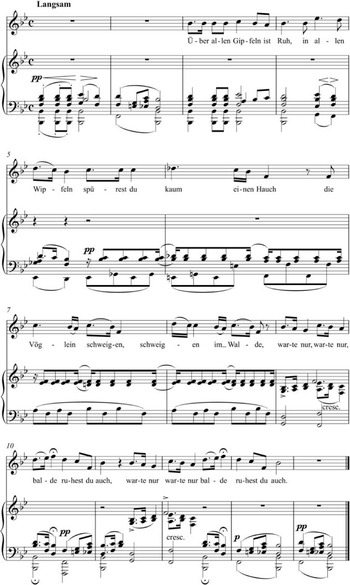
Schubert’s setting of ‘Wandrers Nachtlied’ (D. 768) Op. 96, No. 3

Schubert’s setting was composed before July 1824Footnote 55 and first published as a supplement to the Wiener Zeitschrift für Kunst, Literatur, Theater und Mode, Vienna, on 23 June 1827. The song was reprinted as Op. 96 No. 3 by the Lithographisches Institut during the summer of 1828 and dedicated to Karoline, Fürstin von Kinsky, neé Freiin von Kerpen. A month after Schubert’s death it was published posthumously by H. A. Probst in Leipzig, on 12 December 1828.Footnote 56
The interest awarded to Schubert’s setting in these early years has continued in the reception history of ‘Wandrers Nachtlied’. Reed considers it a finer song than its companion piece for ‘it matches the intellectual substance on equal terms’;Footnote 57 Bell regards it as ‘a miracle of tranquil beauty’;Footnote 58 Jack Stein concedes, ‘In this song, if anywhere in song literature, appears the ultimate refutation of the notion that great poems should not be used as texts for art songs’;Footnote 59 Einstein recognizes it as ‘die schönste der Hunderte von Vertonungen dieses Gedichts’ [the loveliest of hundreds of settings of this poem],Footnote 60 an opinion echoed by Graham Johnson who believes ‘nothing can compare to Schubert’s song, which captures the poignancy of this text like no other’.Footnote 61 For Johnson, ‘Wandrers Nachtlied
… is a conjunction of the purest genius: one of the greatest poems in the world, and one of the greatest single pages of music – only fourteen bars long but perfect in every way, the ideal combination of simplicity and deep feeling. It is extremely rare that we encounter at this exalted level a total unanimity of approach and understanding between poet and composer.Footnote 62
Only Hatten dares to questions Schubert’s achievement, arguing that
… the echoing cadence in the piano in bars 10–11 … its hymnlike character and resignational chromatic reversal from E to E flat suggest a moral reassurance that … is too comfortably pat in its conviction for Goethe’s more evocative ending. Goethe’s poem requires neither the verbal repetition nor the moralizing closure, and despite Schubert’s many felicities in his setting, I believe he has in this respect undermined the expressive force of Goethe’s eloquent lyric.Footnote 63
While I share Johnson’s perception of Schubert’s setting, Hatten’s argument made me question my interpretation. Knowing that Schubert had always turned to the mountains for recuperation and peace of mind had bolstered a recognition, which, for the first time, I began to doubt.
Like Johnson, I have always believed Schubert’s setting matches the multum in parvo miniaturism in Goethe’s poem. As Hatten, and before him Thrasybolos, Stein and Spillmann, have convincingly shown, Schubert’s musical epigram mirrors the speech rhythms and irregular metre of Goethe’s verse, which he scores in an almost syllabic setting. The changing metres of Goethe’s poem are realized through the varying phrase lengths of the song, while the poetic enjambment is reflected in the organization of these phrases. As Hatten’s quibble is with Schubert’s setting of the final phrases, it is worth mentioning that Goethe endorsed a threefold verbal repetition of ‘balde’ in Zelter’s concluding lines.Footnote 64 What Hatten hears as a ‘moralizing closure’, I read as an endorsement of Goethe’s notion of ‘nothingness’, which is not absolute negation but indifferentiation: in other words, the very absence of conflicts and contrasts evident in Schubert’s final lines clinches rather than negates Goethe’s Gehalt.
Like Goethe, Schubert identified with the figure of the German Romantic wanderer and continually returned to this theme in his art.Footnote 65 In contrast to evocations of the Wanderer trope in Schubert’s Goethe settings – ‘Der Musensohn’ being a prime example – only in ‘Wandrers Nachtlied’ peace is found. This difference is announced in the opening bars through Schubert’s choice of tonality as B-flat, Schubert’s key of repose. The suggested pavane rhythm of the accompaniment, one of Schubert’s favourite musical symbols for death,Footnote 66 seizes the quiescent mood of Goethe’s poem. The very slow sustained melody of the opening couplet (bars 3–4), which remains on or hovers around the tonic, the tonic pedal (bars 1–4), and quiet recitation of the vocal line, whose range lies within an octave and slow harmonic pace all capture the serenity of the poetic scene. Goethe’s chiasmus between life and death is also poignantly realized. Firstly, Schubert’s melody, which rises from B♭ (lines 1–3, bars 3–5) to C (line 4, bar 5) to D♭ (line 5, bar 6) – underscored by increased accompanimental movement and rising chromaticism in the bass (bars 5–6) beautifully points the key word ‘kaum’ (bar 6).Footnote 67 As in ‘Der Musensohn’, the movement of the syncopated accompaniment (bars 5–8) underscores how the Wanderer is precluded from the rest he seeks. In the ensuing bars, Goethe’s sense of repose is not only accentuated through Schubert’s reiteration of ‘schweigen’ (bar 8), but through the repetition this renders in the vocal line underscored by the repeated syncopated accompaniment figuration and perfect cadence. Schubert’s restatement not only of ‘Warte nur’ (bar 9) but also the closing couplet (lines 7–8, bars 11–13), the note of hope on ‘balde’ (bar 10) answered by a perfect cadence (bar 11), emphasises the Wanderer’s desire for repose.Footnote 68 By echoing the opening figure (E♮–E♭ moving into the dominant, bar 2) in the final bars (10, 13 and 14), Schubert heightens the chiasmus in Goethe’s poem, where the accent on ‘Ruh’ (line 2) is also echoed (line 8). By marking the long ‘u’ of ‘Ruh’ with a dotted crotchet (bar 4), which he echoes in the penultimate bar (bar 13), Schubert highlights the peacefulness of Goethe’s scene. The setting returns to the setting of the woods, mirroring musically the cycle of nature. Like Goethe, Schubert does not philosophize about the harmony between Nature and man: his setting states it as a basic experience of being.
In contrast to Stein and Spillman, who consider that the ‘repose, quiet and darkness of the short, slow-paced opening lines all symbolize the peaceful death that the poet seeks’Footnote 69 – an interesting interpretation, but a perception of Goethe I do not share – Hatten offers a more nuanced reading, claiming ‘the final two lines clinch the allegorical conceit, as the persona links images of peace in nature to the potential for inner peace – perhaps death, but not necessarily’.Footnote 70 Hatten locates reasons for Schubert’s ‘poetic miscalculation’ of Goethe’s closing lines in his composition of ‘Wandrers Nachtlied’ in late 1822, around which time the composer contracted syphilis. While I agree with Hatten that ‘Schubert’s reading of the poem might have been motivated by his own state of mind’, I don’t believe ‘he was desperately seeking inner peace in the face of a death sentence’ but that he had already reached some kind of acceptance by the time he wrote this setting.Footnote 71
Although the date of the Lied is uncertain, the range of dates certainly coincides with Schubert’s awareness of death as a very real aspect of his life. The first mention of illness is in a letter to Ignaz von Mosel, on 28 February 1823 where Schubert writes: ‘Verzeihen, daß ich schon wieder mit einem Schreiben lästig fallen muß, da meine Gesundheitsumstände mir noch immer nicht erlauben, außer Haus zu gehen’ [Apologies that once again I implore you by writing, but the circumstances of my health do not permit me to leave the house].Footnote 72 Although Schubert’s recovery is confirmed by the composer on 23 November 1823,Footnote 73 between February and May 1824 he was unwell,Footnote 74 during which time he wrote the famous letter to Kupelweiser of 31 March 1824:
Mit einem Wort, ich fühle mich als den unglücklichsten, elendsten Menschen auf der Welt. Denk Dir einen Menschen, dessen Gesundheit nie mehr richtig werden will, u. der aus Verzweiflung darüber die Sache immer schlechter statt besser macht, denke Dir einen Menschen, sage ich, dessen glänzendste Hoffnungen zu Nichte geworden sind, dem das Glück der Liebe u. Freundschaft nichts biethen als höchstens Schmerz, dem Begeisterung (wenigstens anregende) für das Schöne zu schwinden droht, und frage Dich, ob das nicht ein elender, unglücklicher Mensch ist?
[In a word, I consider myself the most unfortunate, most wretched person in the world. Think of one, whose health will never be restored and who, out of despair, only makes things worse instead of better; think of one, I say, whose brilliant aspirations have come to nothing, to whom the joy of love and friendship offers nothing more than unspeakable suffering, for whom the (at least inspiring) passion for the aesthetical threatens to disappear, and then ask yourself then, whether this is not the most dejected, most miserable of men?]Footnote 75
By the end of June 1824 he had entered a long period of remission,Footnote 76 during which time he composed this setting.
While Goethe, at 31 – the same age at which Schubert died – recognized at Illmenau the inevitability of his own demise, this confrontation with reality was not the same as it was for the composer who, when he wrote this setting, had been shocked into a realization of his own impending death. Like Goethe, Schubert expressed this realisation in a poem, ‘Mein Gebet’, composed in 1823, which – though it does not reveal the same peaceful acceptance of death – shares the Goethean polarities of life and death. Two years later, in a letter to his father, Schubert reveals a peaceful acceptance of death as part of Nature’s cycle, when he writes of his brother, Ferdinand:
Er wird … 9 Mal sterben zu müssen geglaubt haben, als wenn das Sterben das Schlimmste wäre, was uns Menschen begegnen könnte. Könnte er nur einmal diese göttlichen Berge und Seen schauen, deren Anblick uns zu erdrücken oder zu verschlingen droht, er würde das winzige [sic] Menschenleben nicht so sehr lieben, als daß er es nicht für ein großes Glück [sic] halten sollte, der unbegreiflichen Kraft der Erde zu neuem Leben wieder anvertraut zu werden.
[He will have believed he had to die 9 times, as if death were the worst thing that can happen to us! If he could only see these divine mountains and lakes, the sight of which threatens to overwhelm and engulf us, he would not love this petty human life so much as if he shouldn’t think it anything but great good fortune to be consigned to the earth’s mysterious power to create new life.]Footnote 77
Here Schubert’s letter reveals a more intimate relationship with death, a peaceful acceptance of the inevitability of death found in ‘Wandrers Nachtlied’, in which a mystic ‘nothingness’ is apparent in every abysmal crevice of existence. The poem suggests how in each transformation of reality, in each crisis, or moment of suffering, the Abyss of Nothingness is spanned and made visible for an instant. At the time he wrote this setting, Schubert – perhaps even more than Goethe at the age of 31 – knew that nothing can change without making contact with this region of absolute being. In this light, perhaps his reading of ‘Wandrers Nachtlied’ was in fact close to Goethe’s, who also recognized that his demise was certain, though not impending.
III
The second poem Hatten selects, ‘Erster Verlust’, is one of Goethe’s poems intended for musical setting.Footnote 78 The lyric dates from a period in the poet’s life where he was preoccupied with German music theatre and strove to elevate the Singspiel to a level commensurate with Italian opera buffa. The song is from his 1785 fragmentary Singspiel, Die ungleichen Hausgenossen, inspired by Carlo Gozzi’s comedy, Il secreto pubblico, translated and published by Friedrich Wilhelm Gotter as Das öffentliche Geheimnis in 1781.Footnote 79 A second source, of even greater influence, was Mozart’s setting of da Ponte’s libretto, Le nozze di Figaro. Goethe’s Arie Andantino was sketched on a separate sheet, along with a scenario for Mozart’s opera, in Goethe’s notes for this libretto; in this aria Goethe freely translated the texts of the Countess’s two arias (Acts II and III) from Mozart’s opera:
Porgi amor, qualche ristoro
al mio duolo, a miei sospir […]
Dove sono i bei momenti
di dolcezza e di piacer […]
The similarities between Goethe’s and da Ponte’s texts are extraordinary, especially since there is no model for this song in Beaumarchais’ stage comedy, La folle journée, ou le mariage de Figaro, on which da Ponte’s libretto is based, and, independently of each other, they placed this aria in similar positions in their librettos.
Goethe plans for Die ungleichen Hausgenossen are first announced in a letter to Charlotte von Stein, dated 7 November 1785, where he writes: ‘Ich habe […eine Operette wieder vorgenommen und sie reicher ausgeführt’ [I have started on a new operetta with a richer texture.]Footnote 80 In correspondence with Kayser on 23 December 1785, he mentions the centrality of the theme of love to his libretto:
Ich habe schon wieder eine neue [Operette] zu sieben Personen angefangen. […] In dieser werde ich auch für die Rührung sorgen, welche die Darstellung der Zärtlichkeit so leicht erregt und wornach das gemeine Publikum so sehr sich sehnt. Es ist auch natürlich, jeder Laffe und Läffin sind einmal zärtlich gewesen, und an diesen Saiten ist leicht klimpern; um höhere Leidenschaften und Geist, Laune, Geschmack mitzuempfinden, muß man ihrer auch fähig sein, sie auch besitzen.
[I have already begun a new operetta for seven characters again. […] In this operetta I will make sure it is moving – something which any presentation of tenderness achieves so easily and which the general public longs for so much. It is also natural. Every dandy and coquette has been tender, and it is easy to strum upon these strings; in order to empathize with passions, wit, mood and refined taste, one must also possess them.]Footnote 81
Despite his preoccupation with ‘diese reine Opernform’ [this pure operatic form],Footnote 82 Goethe abandoned the libretto and separated out arias, Lieder and partsongs into his lyrical collections.Footnote 83 The aria, ‘Ach, wer bringt die schönen Tage’, originally sung by the Baroness in Act II of Die ungleichen Hausgenossen,Footnote 84 was revised for publication in 1788Footnote 85 and published the following year in Goethe’s Schriften, under the title ‘Erster Verlust’.Footnote 86

Like all of Goethe’s Singspiele, the literary quality of the libretto is immediately evident, and the resulting lyric is richly dialectical. In ‘Erster Verlust’, the poet’s experience is characterized by two modalities or levels of being. Existence being contingent, love has put the poet in touch with the permanent character of things, though paradoxically the poem marks the transience of this love. Through this loss of love, the poet vacillates between past and present; the experience of a shared identity contrasts with individual autonomy and spiritual suffering goes hand in glove with physical longing. Throughout the poem he portrays love as a dynamic interfusion of Eros and Thanatos, yet his amalgamation of these forces is different from the Romantic concept of Liebestod. Far from identifying love with death, the poet reveals the precarious existence of the noble sentiments of human life – the harmony of opposites – the coincidentia oppositorum. Paradoxically, though ‘Erster Verlust’ is about the loss of love, it also suggests man’s unending search for it.
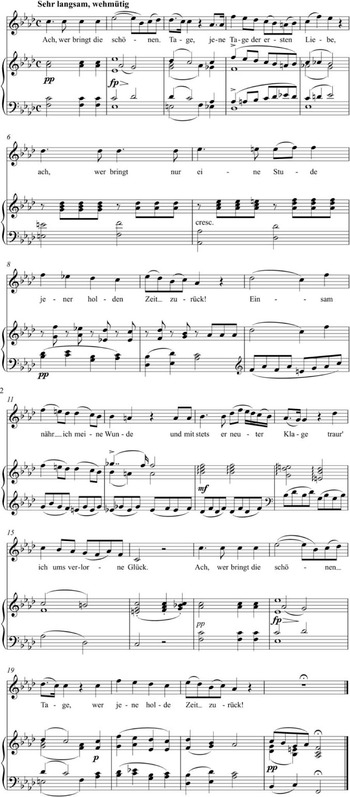
Schubert’s setting of Goethe’s ‘Erster Verlust’ (D. 226) Op. 5, No. 4

‘Erster Verlust’ is one of Goethe’s most frequently set poems.Footnote 87 Schubert’s setting was composed on 5 July 1815.Footnote 88 Almost ten years after he composed this setting, the composer cited Goethe’s opening couplet in a letter to Schober on 21 September 1824: ‘Ich möchte mit Goethe ausrufen ‘Wer bringt nur eine Stunde jener holden Zeit züruck”Footnote 89 This is one of the earliest manifestations of a theme that intensifies in the remaining years and that was appropriated in his posthumous reception. We find a similar nostalgia for one’s youth time and again in Schubert’s letters, as well as in the writings of friends.
In contrast to Lawrence Kramer’s belief that ‘Schubert’s wehmütig setting […] replaces Goethe’s classical coupling of ethos and pathos with an unconditional Romantic pathos’,Footnote 90 Schubert’s Lied emulates the dialectical process which Goethe’s poem describes and which became indicative of the Romantic soul. It is expressed in the notion of two souls in Goethe’s Faust – whose imprint is recognised in Kenner’s recognition of Schubert’s two soulsFootnote 91 – and in the proverb often quoted by European intellectuals from ‘Klärchens Lied’ – which Schubert set on 3 June 1815, one month before he composed ‘Erster Verlust’: ‘Himmelhoch jaunchzend/zum Tode betrübt’ [Rejoicing to heaven/grieving to death]. As Hatten’s insightful analysis has shown, through the interplay of F minor and A-flat major tonalities, dynamics and observation of echoed rhyme, Schubert accentuates these two modalities. The song captures those moments of strangeness, sudden landings and the poet’s intense intimations that this first circle of love is broken. The recognition is umheimlich and Schubert observes this unhoming through sudden shifts of tonality and dynamics, but also through the use of accompaniment and vocal register. This is announced at the very beginning of the Lied, where Schubert scores Goethe’s ‘Ach!’ to a meditative line of repeated crotchets underscored by a death motif that resounds in the opening bars of ‘Wandrers Nachtlied I’ (D. 224) composed on the same day and in ‘Der Tod und das Mädchen’ (D. 531, 1817). With this accompanimental gesture the music answers opening Goethe’s question, ‘Ach, wer bringt die schönen Tage?’: no one can recapture that time. The dichotomy of feeling in Goethe’s lyric poem is also evident in Schubert’s espressivo setting of the tercet which is more theatrical in nature with its sigh figurations on ‘Wunde’ (bar 12) and Klage (bar 14) and descent of a ninth through its closing line, ‘traur’ ich um’s verlorne Glück’ (l.7, bars 15–16). Here Schubert illustrates the divided self by using the chest and head register of the voice: his underscoring of ‘Glück’ with a C major chord is subverted by the vocal descent to middle C (bar 16), the ‘Grabestimme’ or nadir of the Lied. The futility of the poet’s desire to capture a vanished past, which can be renewed only in memory or transfigured in another pattern, is pronounced by an octave leap as the protagonist is divided not only psychologically but also musically. Schubert’s restatement of the music of lines 1 and 4 for Goethe’s closing couplet brings full circle the central idea of the poem: ‘with ever-renewed laments’ his setting acknowledges not only the antithetical nature of love but this hallucinatory state which stays with us for some time.Footnote 92
IV
In conclusion to his article, Hatten asks, ‘But why might Schubert (and Beethoven) have composed multiple settings of certain of Goethe’s poems, notably the lyrics from Goethe’s novel Wilhelm Meister?’ and he immediately endorses the rich musicality of Goethe’s poetry in his reply: ‘The continual resetting of these poems suggests awareness that one can never capture enough of the richness of their poetic music’. Where Hatten and I differ concerns the origins of this poetic music – which I believe was the result of the poet’s rich understanding of music – and our perception of what Goethe sanctioned in settings of his poems. Contrary to the traditional perception of the poet, Goethe did not demand a rigid adherence to the Gestalt but an understanding of the poetic Gehalt. In an attempt to unveil how ‘Wandrers Nachtlied II’ and ‘Erster Verlust’ are expressive of the elusive patterns of both artists’ inner lives, I offer complementary readings which examine poetic and musical contexts through which, I believe, we perceive and hear even more.
Hatten’s closing example of the Lehrjahre settings is, in fact, illustrative of this argument for it was not only the songs of Mignon and the Harper that attracted composers, but the literary context in which both characters are placed. From the moment Mignon enters Goethe’s novel, for example, she is a complex, conflicted character: a child born into a noble family who is now a homeless wanderer; a singer who is aphasic; a vulnerable girl on the brink of sexual maturity; an angelic being doomed to an early death who is given a secular funeral. She and her behaviour are repeatedly referred to as ‘geheimnisvoll’ (mysterious, secretive) or ‘seltsam’ (strange) and she keeps to herself a secret that is only fully uncovered after her death. Literally and dramatically when Mignon crosses Wilhelm’s threshold at the opening of Book Three that moment brings together in a single scenario her position between aphasia and expression, between different cultural worlds (Italian and German, untaught and polished), between childlike dependence on a father figure and the beginnings of erotic desire, between a child who communicates with difficulty and a young woman who has taken a mysterious oath of silence; between a worldly Sehnsucht and an aspiration to an unreachable higher sphere. The impact Mignon has had on readers and later composers (not to mention singers and their audience) depends on the co-existence of all these strands. More central to Hatten’s argument is that music’s ability to appropriate human truths is endorsed in Wilhelm Meisters Lehrjahre, where music is recognized as a higher form of communication, a symbolische Sprache, capable of expressing the emotions of its creator.Footnote 93 It is the expression of Mignon’s deepest self and, if her songs are merely seen as decorative inclusions in the novel, then their true nature, purpose, and value is misunderstood.
In striving to realise this Gehalt, composers have sought multiple solutions, for which there are multiple readings and interpretations. In songs that have invited over two centuries of commentary, where it might seem that nothing remains to be said, Goethe and Schubert, like all great artists, can never be fully understood and every generation must make these songs their own in new ways. In new readings of Wandrers Nachtlied II’ and ‘Erster Verlust’, Hatten locates the success of these settings in the rich musicality of Goethe’s poetic Gestalt, whereas for me it lies in Schubert’s ability to capture the essence of Goethe’s Gehalt in musical terms. When examining these settings, we find ourselves contemplating the human condition, the nature of the world in which we find ourselves, and what music can tell us about our place in the world. In my view, no song worth its salt is unconcerned with the world it answers for and answers to. That answering function to the Gehalt of Goethe’s poems is what makes Schubert’s settings in the deepest way responsible – capable of offering a response but a response on its own terms.