There is a growing interest in the study of the characteristics of entrepreneurial individuals (Covin & Wales, Reference Covin and Wales2012); the Global Entrepreneurship Monitor (2012) is the most ambitious international project with the participation of 59 countries worldwide. Furthermore, the Measure of Entrepreneurial Tendencies and Abilities (META) is the strongest and most consistent predictor of entrepreneurial activity (Almeida, Ahmetoglu, & Chamorro-Premuzic, Reference Almeida, Ahmetoglu and Chamorro-Premuzic2014). The idea underlying this and other projects is to learn which characteristics and conditions lead people to be entrepreneurs, whether in business, work or personal spheres. The present study focuses on personality aspects with the aim of ascertaining whether there are certain personality traits that facilitate enterprising activity. It is assumed that who is enterprising today will be an entrepreneur tomorrow. The study of the Personality of Entrepreneurs is a research line that has “taken off” in recent years (Hisrich, Langan-Fox, & Grant, Reference Hisrich, Langan-Fox and Grant2007), joining other approaches from the field of economics that explore the essential characteristics of the entrepreneurial spirit. However, it is far from being resolved in convincing fashion. Indeed, this perspective has been strongly criticized for dealing in a reductionist way with the complex world of entrepreneurship (Gartner, Reference Gartner1989). Undoubtedly for this and other reasons there is no univocal definition of the construct. Shane and Venkataraman (Reference Shane and Venkataraman2000) consider that entrepreneurship is a process that involves the discovery, evaluation and exploitation of opportunities to introduce new products, services, processes, organization or market forms. Despite this definition being one of the most popular (Baum, Frese, Baron, & Katz, Reference Baum, Frese, Baron, Katz, Baum, Frese and Baron2007), it is too general. Thus, attending to a more operative definition, different ways of approaching entrepreneurship have emerged, such as proposals by Chell (Reference Chell2008) or Sánchez (Reference Sánchez2011).
According to Sánchez (Reference Sánchez2011), current approaches to the study of characteristics and conditionants of enterprising individuals are basically conducted from three broad perspectives: personal (personality, cognitions, and genetic factors), social (social networks, sociocultural and institutional factors) and economic (transaction costs, benefits and innovation effects). From the personal context, and specifically, from the study of the enterprising personality on which the present study is mainly focused, it is possible to clearly distinguish two lines of research: a) studies that defend the presence of general personality factors (Big-Five and similar; Brandstätter, Reference Brandstätter2011), and b) those that propose more specific enterprising personality traits (Rauch & Frese, Reference Rauch and Frese2007a, Reference Rauch, Frese, Baum, Frese and Baron2007b).
Research in the line of general personality factors such as the Big Five, provide data that indicate that these explain around 13% of the variance of entrepreneurial intention, and 10% of entrepreneurial success (Zhao, Seibert, & Lumpkin, Reference Zhao, Seibert and Lumpkin2010). As Brandstätter (Reference Brandstätter2011) points out, when entrepreneurs are compared with company managers, the former obtain higher scores on openness, conscientiousness and extraversion and lower scores on neuroticism and agreeableness. All this allows establishing a clear relationship between the Big Five personality traits and entrepreneurship. Moreover, thanks to its long tradition in Psychology, its relative stability and its possible genetic bases (Jang et al., Reference Jang, Livesley, Ando, Yamagata, Suzuki, Angleitner and Spinath2006), the approach focusing on broad traits such as the Big Five currently constitutes an important research line in the study of the entrepreneurial personality (Obschonka, Schmitt-Rodermund, Silbereisen, Goslin, & Potter, Reference Obschonka, Schmitt-Rodermund, Silbereisen, Gosling and Potter2013). However, the magnitude of the relationship found until now seems to suggest that we are faced with traits that are too general to precisely predict entrepreneurial activity.
Regarding research on more specific personality characteristics, Rauch and Frese (Reference Rauch and Frese2007a) have conducted a meta-analysis where they collected the most important research. These authors find that, among the variables studied to date, only a few show a significant relationship with entrepreneurship. Innovativeness, proactive personality and self-efficacy have a significant and positive relationship with entrepreneurial success, whereas autonomy and internal locus of control have been established as valid predictors of both creation and entrepreneurial success (Rauch & Frese, Reference Rauch and Frese2007a). There is no consensus regarding which of these two approaches, general or specific, is better given that both approaches have never been studied together and there are no rigorous measurement instruments for the assessment of specific variables proposed in the literature. Rauch and Frese (Reference Rauch, Frese, Baum, Frese and Baron2007b) propose an entrepreneurial personality model that includes both approaches, considering that the essential specific traits of entrepreneurs would be six: achievement motivation, risk- taking, innovativeness, autonomy, locus of control and self-efficacy.
The proposal by Rauch and Frese (Reference Rauch, Frese, Baum, Frese and Baron2007b) has the advantage of offering a model that integrates the approximation of general traits with more specific ones for the first time; however, an exhaustive review of the literature suggests that, in addition to the six specific traits proposed, there are others that it would be reasonable to include in the model (Carraher, Buchanan, & Puia, Reference Carraher, Buchanan and Puia2010; Chell, Reference Chell2008; Hisrich et al., Reference Hisrich, Langan-Fox and Grant2007; Koellinger, Reference Koellinger2008; López & García, Reference López and García2011; Rauch & Frese; Reference Rauch and Frese2007a; Suárez-Álvarez, Campillo-Álvarez, Fonseca-Pedrero, García-Cueto, & Muñiz, Reference Suárez-Álvarez, Campillo-Álvarez, Fonseca-Pedrero, García-Cueto and Muñiz2013; Tyszka, Cieslik, Domurat, & Macko, Reference Tyszka, Cieslik, Domurat and Macko2011; Wincent & Örtqvist, Reference Wincent and Örtqvist2009a, Reference Wincent and Örtqvist2009b; Yordanova & Alexandrova-Boshnakova, Reference Yordanova and Alexandrona-Boshnakova2011). According to these previous results, nine specific variables are proposed in order to assess the different specific facets of entrepreneurial personality: achievement motivation, risk-taking, innovativeness, autonomy, self-efficacy, stress tolerance, internal locus of control, external locus of control and optimism.
Research studies are programmed in different stages, and in this first one, the main objective is to develop a measurement instrument that allows the rigorous assessment of the nine specific dimensions proposed. We believe necessary having a rigorous instrument for the assessment of specific enterprising personality trait, because this aspect is the cornerstone on which all research on entrepreneurial psychology must rest. To date, there is no such instrument, and thus, it is our main objective. We hope that this instrument can be used as a screening tool in young populations, to facilitate early detection of enterprising personality, which would aid in their academic and work guidance. The study of the entrepreneurial personality in adolescents is of crucial importance, since early detection can help improve and teach the entrepreneurial characteristics of these young people. Moreover, research can explore not only personal characteristics, but also certain contextual variables that may influence the development of entrepreneurial spirit. Nevertheless, despite the fact that there are some studies on entrepreneurship in adolescents (Bonnett & Furnham, Reference Bonnett and Furnham1991; Burges Sbicigo, & Dell´Anglio, Reference Burges Sbicigo and Dalbosco Dell´Aglio2013; Schmitt-Rodermund, Reference Schmitt-Rodermund2004), none of them focus as we do here on the specific traits of the entrepreneurial personality.
There are several reasons that justify the development of a new measurement instrument, among them, a) few instruments have been developed from a psychological perspective, and the existing ones are too general to assess specific personality traits connected to entrepreneurship (Brandstätter, Reference Brandstätter2011; Global Entrepreneurship Monitor, 2012; Rauch & Frese, Reference Rauch and Frese2007a, Reference Rauch, Frese, Baum, Frese and Baron2007b), b) several important specific traits related to entrepreneurship have not been included in previous measurement instruments (Carraher et al., Reference Carraher, Buchanan and Puia2010; Chell, Reference Chell2008; Hisrich et al., Reference Hisrich, Langan-Fox and Grant2007; Koellinger, Reference Koellinger2008; López & García, Reference López and García2011; Rauch & Frese; Reference Rauch and Frese2007a; Tyszka et al., Reference Tyszka, Cieslik, Domurat and Macko2011; Wincent & Örtqvist, Reference Wincent and Örtqvist2009a, Reference Wincent and Örtqvist2009b; Yordanova & Alexandrova-Boshnakova, Reference Yordanova and Alexandrona-Boshnakova2011), and c) most of research was developed using samples of adult individuals, so there are no instruments for screening potential enterprising personality in youth.
Method
Participants
The sample was composed of 416 students from the Principality of Asturias, a region in northern Spain, with a mean age of 17.89 years and a standard deviation of 3.26. The sample was obtained using an incidental sampling method and was composed of students in their last year of Compulsory Secondary Education, Post Compulsory Secondary Education (A-Levels), Vocational Training (Intermediate and Higher grades) and First Year University. Fifty-four percent were male and 46% female.
Instruments
With the aim of assessing the nine model dimensions, 161 items with a 5-point Likert type scale were developed, where value 1 meant being completely in disagreement with the statement and 5 completely in agreement. A five-category response system was chosen given that the psychometric literature indicates that it is between 4 and 6 categories when the best estimates of the test psychometric parameters are obtained (Lozano, García-Cueto, & Muñiz, Reference Lozano, García-Cueto and Muñiz2008). Apart from that, for the construction of the test, the recommendations provided in the current psychometric literature were followed (American Educational Research Association, American Psychological Association & National Council on Measurement in Education, 1999; Downing, Reference Downing, Downing and Haladyna2006; Moreno, Martínez, & Muñiz, Reference Moreno, Martínez and Muñiz2006). Next, the number of items generated for the assessment of each dimension are detailed, as well as their concise definition. Achievement motivation (20 items; for example: When I’m afraid of making mistakes I make extra effort, or I’m persistent when pursuing my goals) is defined as the desire to achieve standards of excellence, i.e. achieving and improving objectives (Rauch & Frese, Reference Rauch, Frese, Baum, Frese and Baron2007b; Suárez-Álvarez et al., Reference Suárez-Álvarez, Campillo-Álvarez, Fonseca-Pedrero, García-Cueto and Muñiz2013). Risk-taking (19 items; for example: I do what I believe in even if there’s some risk of losses, or I’m capable of renouncing things I already have in order to a achieve a better objective) makes reference to the tendency and willingness of people to take on certain levels of insecurity that will allow them to achieve a goal that presents greater profits than the possible negative consequences (Moore & Gullone, Reference Moore and Gullone1996). Innovativeness (19 items; for example: I’m prepared to incorporate new ideas in my tasks, or I see different solutions to problems) is defined as the willingness and interest in searching for new ways of doing things (Rauch & Frese, Reference Rauch, Frese, Baum, Frese and Baron2007b). Autonomy (21 items; for example: I like organizing my work time, or I like making my own decisions) refers to the motivation toward entrepreneurial creation as an attempt to achieve certain individual freedom (Van Gelderen & Jansen, Reference Van Gelderen and Jansen2006). Self-efficacy (21 items; for example: I take advantage of the resources I have around me, or I fell capable of dealing with any unforeseen circumstance) relates to the conviction that one can efficiently organize and execute actions as well as persist when faced with obstacles to produce the desired results (Costa, Ripoll, Sánchez, & Carvalho, Reference Costa, Ripoll, Sánchez and Carvalho2013). Stress tolerance (19 items; for example: I’m good at controlling my emotions, or I’m able to work under pressure) is defined as the resistance to perceive environmental stimuli as stressful thanks to the adequate use of coping strategies (Lazarus & Folkman, Reference Lazarus and Folkman1986). Internal locus of control (12 items; for example: Success depends on my efforts, or My future depends on what I do) makes reference to the causal attribution that the consequences of a behavior depend on oneself. This way, an expectation that individuals can control the consequences of their own behavior and, to a certain degree, their destiny and future is generated (Chell, Reference Chell2008; Rauch & Frese, Reference Rauch, Frese, Baum, Frese and Baron2007b; Suárez-Álvarez et al., Reference Suárez-Álvarez, Campillo-Álvarez, Fonseca-Pedrero, García-Cueto and Muñiz2013). External locus of control (17 items; for example: My failures are due to the people around me, or I trust to luck for having success in my life) is based on the causal attribution that the consequences of a behavior are due to events that are external to the person. Thus, expectations are generated that depend more on luck or causality than on oneself (Chell, Reference Chell2008; Rauch & Frese, Reference Rauch, Frese, Baum, Frese and Baron2007b). Optimism (13 items; for example: I’m confident of overcoming problems, or I see each challenge as an opportunity for success) is defined as a person’s belief regarding the occurrence of positive events in his life rather than negative ones (Shepperd, Carrol, Grace, & Terry, Reference Shepperd, Carroll, Grace and Terry2002).
In order to purify the items and obtain content validity evidence, a panel of ten experts from different Spanish universities participated in the study. First, the nine dimensions proposed in the model were presented to them, on which they were expected to indicate the level of pertinence of these in order to establish an enterprising personality profile. In addition, they were presented with all the item pool so that they would assign each item to the dimension they considered appropriate. The obtained data are presented in the results section.
There are four fundamental reasons for using new scales instead of existing ones, a) firstly, there are no scales available in Spain to evaluate the dimensions included in the test, b) existing scales are aimed at adults, whereas our interest is in young people and, while some of the items for adults could be used, the majority are not relevant, c) given that it was about developing a battery of nine subscales, it was important to maintain a homogeneity of style and format throughout, something which would not have been achievable by mixing pre-existing scales with others developed ad hoc, d) many of the existing scales were developed for specific educative or work contexts whereas we were aiming to develop a transversal battery of subscales regardless of the context in which they are applied. The items were designed so that they could be easily understood by the young people, using a vocabulary in accord with their understanding and coherent content in a youthful context. The pilot studies demonstrated that the young people understood the items perfectly, as those items which caused problems of comprehension and/or interpretation were removed during the pilot. In this way, references to specific work contexts, for example, which are very common in scales designed for adults, were not included. In addition the type of wording used allowed the generalization of the administration of the instrument for other populations and contexts.
The Oviedo Infrequency Scale (Fonseca-Pedrero, Lemos-Giráldez, Paino, Villazón-García, & Muñiz, Reference Fonseca-Pedrero, Lemos-Giráldez, Paino, Villazón-García and Muñiz2009) was included. This scale is composed of 12 items in a 5-point Likert response format (1 =”completely disagree”; 5 =”completely agree”). The main objective of this scale is the detection of those participants who respond in a random, pseudorandomly or dishonest fashion.
Procedure
The application of the tests was conducted in a collective manner in the classrooms provided by the Educational Centers. Psychologists trained in the application of psychological instruments applied all tests. In addition, participation was voluntary and previous consent from the principals of the Educational Centers was obtained. Participants did not receive any kind of compensation or reward for their participation in the study.
Data analyses
Firstly, the results of the expert judgment were assessed, eliminating those items that presented less than a third agreement rate among judges. Moreover, Aiken´s V coefficient was calculated for the assessment of the degree of agreement among judges regarding the pertinence of the model dimensions. In addition, the cosine was calculated among the assessments provided by the judges regarding the pertinence of the dimensions in order to observe is there was a consensus among their opinions. The cosine is used because the variability of the judges’ responses is very low and the Pearson correlation is not adequate under these conditions (Sánchez, Serradilla, Martínez, & Bodadilla, Reference Sánchez, Serradilla, Martínez and Bobadilla2008); however, its interpretation is similar to the Pearson correlation (Rius, Barón, Sánchez, & Parras, Reference Rius, Barón, Sánchez and Parras1997).
Second, participants who responded randomly or dishonestly to the infrequency scale were eliminated from the sample according to the instructions detailed in Fonseca-Pedrero et al. (Reference Fonseca-Pedrero, Lemos-Giráldez, Paino, Villazón-García and Muñiz2009). Next, the item discrimination indexes were calculated for each scale. Next, an exploratory factor analysis for each scale was conducted using the polychoric correlation matrix and the ULS method in order to study their dimensionality. The pertinence of the unidimensionality of each scale was established as a function of the percentage of explained variance, the goodness-of-fit index –GFI- and the standardized root-mean-square residuals –SRMR-. Subsequently, the reliability coefficient was estimated for each scale using Cronbach’s alpha. In addition, a factor analysis was performed following the Principal Axis Factoring method with the factorial scores obtained in the 9 subscales. The goodness-of-fit assessment was determined as a function of the GFI and the SRMR.
Finally, Differential Item Functioning according to sex was assessed by means of the logistic regression procedure (Hidalgo, Gómez, & Padilla, Reference Hidalgo, Gómez and Padilla2005; Zumbo, Reference Zumbo1999).
Results
Qualitative analysis
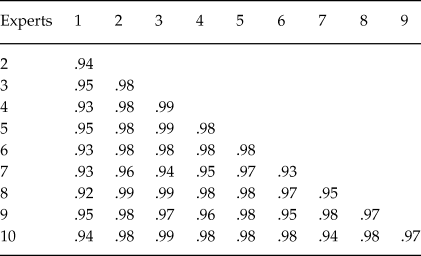
The mean expert judgment regarding the pertinence of the model dimensions was 3.85 on a 1–5 scale. The lower value was received by the External locus of control dimension (1.9) whereas Achievement motivation obtained the highest value (4.8). On the other hand, Aiken´s V content validity coefficient (Aiken, Reference Aiken1980) was equal to .71, with an interval [.56–.85] at the 95% confidence level, which indicates an acceptable degree of agreement with respect to the validity content (Penfield & Giacobbi, Reference Penfield and Giacobbi2004). Moreover, the value of the matrix of the cosines among the expert assessments regarding the pertinence of the dimensions to the model is very high (Table 1).
Matrix of cosines between the 10 experts´ assessments

The experts qualified the items in the expected categories in 67% of the cases. Two items were omitted from the original pool as no consensus was reached with respect to their location in the correct dimension.
Psychometric properties of the subscales
Regarding to the psychometric properties of the scales, the discrimination index of the items was calculated first for each of them. Based on this index, 15 items were eliminated from the total of nine dimensions for having discrimination indexes lower than .20 (Muñiz, Fidalgo, García-Cueto, Martínez, & Moreno, Reference Muñiz, Fidalgo, García-Cueto, Martínez and Moreno2005).
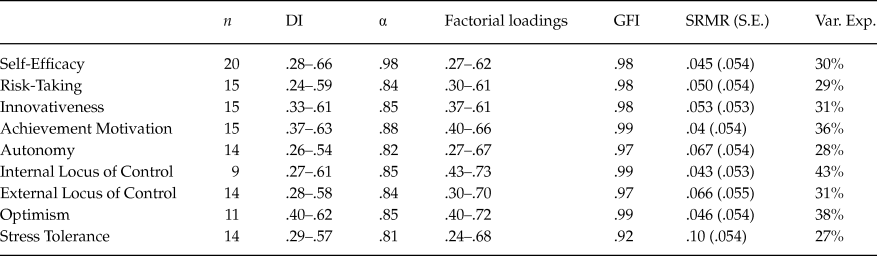
Second, the results obtained in the factorial analysis showed Kaiser-Meyer-Olkin (KMO) indexes above .80, as well as a statistically significant Bartlett´s sphericity index (p < .001). Next, in function of the factorial loadings of the items in the first factor of each scale, a total of 17 items were eliminated as they presented values below .20. Taking into account the values that are presented in Table 2, it seems reasonable to assert that the developed scales have an essentially unidimensional structure. As can be observed, the GFI is higher than .92 in all cases. According to the Kelly´s criterion, the SRMR index can be considered adequate in all cases with the exception of the Autonomy, External locus of control and Stress tolerance scales.
Psychometric properties of the subscales

Note: n: number of items; DI: Discrimination index; α: reliability coefficient; GFI: Goodness-of-fit Index; SRMR: Standardized Root Mean Square Residual; S.E.: Standard error; Var.Exp: percentage of variance explained by the factor
On the other hand, the alpha coefficients of the scales range from .81 to .98, which are high values of internal consistency.
Psychometric properties of the overall battery
Once the initial battery was purified in function of the previously specified criteria, a final battery composed of 127 items was obtained with discrimination indexes from .24 to .66. Moreover, the items presented factorial loadings between .24 and .73. The total reliability of the battery, estimated through Cronbach´s α and Carmines θ coefficients is, in both cases, equal to .96.
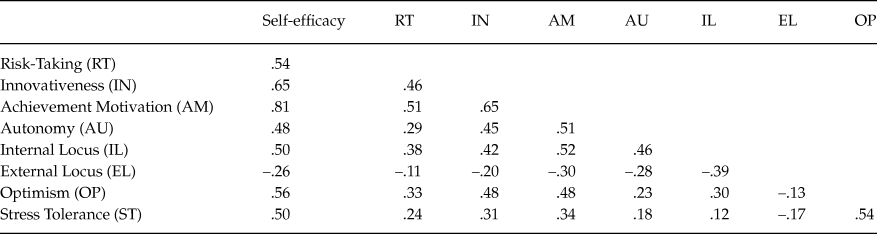
Table 3 presents the correlation matrix between the factorial scores obtained from the factorial analysis of each subscale. All correlations were statistically significant (p < .001).
Correlation matrix among factorial scores on each subscale

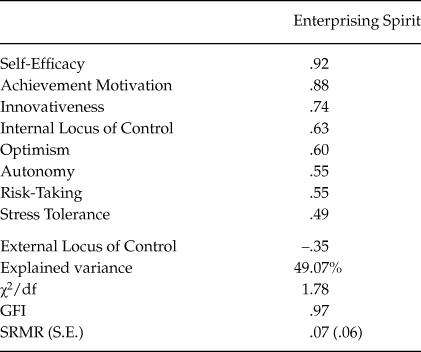
Following, the results of the factorial analysis conducted on the matrix of the correlations among the participant factorial scores on the subscales are presented. As can be observed in Table 4, the first factor extracted explains 49% of the total variance. Byrne (Reference Byrne2001) suggests that the GFI should be higher than .95 and the RMSEA lower to .06. Moreover, the value of the χ2/df ratio is lower than 2. Regarding all these indexes, it can assert that the fit of the model to the data is adequate, and therefore, it allows to accept an essentially unidimensional structure.
Factorial analysis of the subscales

Note: GFI: Goodness of Fit Index; SRMR: Standardized Root-Mean-Square Residual; S.E.: Standard Error.
Differential item functioning
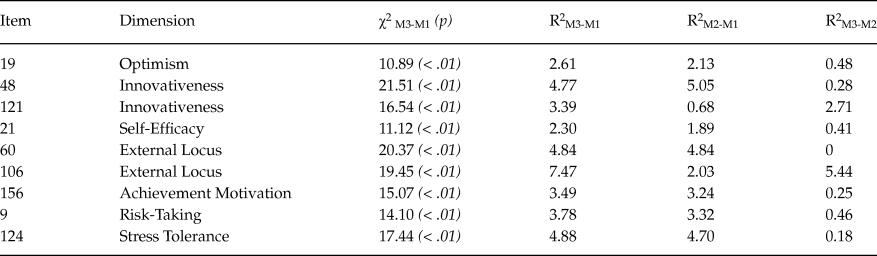
Finally, the differential functioning (DIF) of the 127 items was assessed as a function of gender. The logistic regression method was performed adjusting three models at different stages (Hidalgo et al., Reference Hidalgo, Gómez and Padilla2005). In the first stage, the individual total scores on the test are introduced in the equation, thus adjusting Model 1 (M1) according to the absence of DIF. In the second stage, the group variable is added (Model 2, M2). If the explanation of this model with respect to M1 were statistically significant (p<.01), it would indicate a uniform DIF. In stage 3, the interaction between the group and the total score is introduced (Model 3, M3). If the explanation added by this model with respect to the others were significant, there would be a non-uniform DIF (Hidalgo et al., Reference Hidalgo, Gómez and Padilla2005). Nine out of the 127 items showed DIF as a function of gender (p<.01) with a high effect size (R 2 >.035; Gomez-Benito, Hidalgo, & Zumbo, Reference Gomez-Benito, Hidalgo and Zumbo2013), of which 7 showed a uniform DIF and 2 a non-uniform DIF. These nine items appear distributed throughout seven dimensions (Table 5).
Differential functioning of items: probabilities (p) associated with regression models (M) and effect size (R2)

Note: R2 M2-M1 implies Uniform DIF; R2 M3-M2 implies Non-Uniform DIF.
Discussion
Recent reviews in the area of enterprising personality research (Brandstätter, Reference Brandstätter2011; Rauch & Frese, Reference Rauch and Frese2007a; Zhao et al., Reference Zhao, Seibert and Lumpkin2010) indicate the requirement of linking the contributions of broad personality traits (Big Five type) with other specific traits that will suggest greater precision in the predictions. Based on the entrepreneurial personality model proposed by Rauch & Frese (Reference Rauch, Frese, Baum, Frese and Baron2007b), and from the more recent literature review (Carraher et al., Reference Carraher, Buchanan and Puia2010; Chell, Reference Chell2008; Hisrich et al., Reference Hisrich, Langan-Fox and Grant2007; Koellinger, Reference Koellinger2008; López & García, Reference López and García2011; Rauch & Frese; Reference Rauch and Frese2007a; Suárez-Álvarez et al., Reference Suárez-Álvarez, Campillo-Álvarez, Fonseca-Pedrero, García-Cueto and Muñiz2013; Tyszka et al., Reference Tyszka, Cieslik, Domurat and Macko2011; Wincent & Örtqvist, Reference Wincent and Örtqvist2009a, Reference Wincent and Örtqvist2009b; Yordanova & Alexandrova-Boshnakova, Reference Yordanova and Alexandrona-Boshnakova2011), in the present study, a complementary model to this one is proposed, incorporating new specific variables of the enterprising personality.
This paper has focused on the development of an instrument to assess the nine specific dimensions proposed: achievement motivation, risk-taking, autonomy, self-efficacy, stress tolerance, innovativeness, internal locus of control, external locus of control and optimism. The results show that the test developed allows to precisely assessing these dimensions. Both, the different subscales as well as the overall battery show high reliability rates -alpha values above .81-, as well as adequate content and construct validity evidence. In addition, the high internal consistency of the battery permits the definition and assessment of a global factor that groups these nine dimensions.
The greatest novelty provided by these results is the possibility of empirically generating and assessing an enterprising personality profile in function of the specific traits proposed. In essence, a starting point can be established, both at the empirical and theoretical levels, from which to trace the road toward the early detection of entrepreneurial personality. The practical implications of having this valid and reliable instrument are maximized if it is directed at adolescents or individuals who are still in the process of academic formation. The reason for this is that it would imply two clearly positive aspects. First, it helps determine whether a person have a potentially entrepreneurial profile, and is therefore more prone to business success. This fact would allow the reduction, as far as possible, of the uncertainty and the perception of risk that anyone is faced with when starting a business. On the other hand, the early detection of the enterprising personality offers the possibility of focalizing academic training toward more specific spheres related to the business world. Thus, those adolescents who, trying to develop their enterprising spirit, have adequate conditions at the personal and contextual levels increase their probabilities of having business success. In sum, the specific traits presented here are modifiable and, therefore, open to change through the right form of intervention, such as specific education programmes (Chandler, DeTienne, McKelvie, & Mumford, Reference Chandler, DeTienne, McKelvie and Mumford2011; Peterman & Kennedy, Reference Peterman and Kennedy2003; Souitaris, Zerbinati, & Al-Laham, Reference Souitaris, Zerbinati and Al-Laham2007). The assumption is that entrepreneurial spirit can be promoted from adolescence onwards, providing the adult with effective psychological tools for business creation and success.
In future research it will be necessary to explore the extent to which these results obtained in a Spanish sample are comparable to those found in other cultures (Cheng, Cheung, Chio, & Chan, Reference Cheng, Cheung, Chio and Chan2013). From a bio-psycho-social approach to behaviour it would seem reasonable to think that socio-cultural conditioning factors will necessarily influence the constructs of the entrepreneurial personality. As a limitation of the study, it can be mentioned that it would be desirable to improve the sample in future research, both in the sampling and in the number of participants, for which we have to be cautious when making generalizations of the results. Future research lines are directed at completing the enterprising profile taking into account both, the assessment and the existing relationship between the remaining variables considered in the model. Moreover, it is necessary to incorporate an external criterion that allows to increase the validity evidence of the instrument developed. Finally, an item pool is intended to be developed that will allow, through the Item Response Theory, their computer adaptive application.
This research was funded by the FPU program of the Spanish Ministerio de Educación, Cultura y Deporte, and the FPI program of the Spanish Ministerio de Economía y Competitividad. References: PSI2011–28638, BES-2012-053488, IB-05–02, and AP2010–1999.