INTRODUCTION
Worldwide, the family Epialtidae has 11 species belonging to the genus Epialtus H. Milne Edwards, 1834, of which only Epialtus bituberculatus H. Milne Edwards, 1834 and Epialtus brasiliensis Dana, 1852 are found in Brazilian waters (Melo, Reference Melo and Young1998; Ng et al., Reference Ng, Guinot and Davie2008). Epialtus bituberculatus is found along the western Atlantic Ocean coasts from Florida through the Gulf of Mexico, Antilles, Colombia, Venezuela and Brazil (from Ceará to São Paulo) (Melo, Reference Melo and Young1998). This species is commonly found on hard bottom, mainly in intertidal shallow waters among algae, mainly in tide-pools (Melo, Reference Melo and Young1998).
The genus Epialtus seems to be adapted to inhabit the seaweed Sargassum cymosum (C. Agardh, 1820) during its entire post-larval life, because dense populations exist with individuals in all demographic categories (Negreiros- Fransozo et al., Reference Negreiros-Fransozo, Fransozo and Reigada1994; Teixeira et al., Reference Teixeira, Fransozo, Castilho, Costa and Freire2008). Among these adaptations, the pointed and curved dactyl of the pereiopods (Castaño & Campos, Reference Castaño and Campos2003) keeps the individuals attached to the seaweed, allowing them to resist the wave impact. The occupation of specific microhabitats by marine organisms, as well as the benefits that they provide (e.g. a refuge against predators, facilitation in capturing prey and less abiotic stress) are commonly reported in the literature (Baeza & Stotz, Reference Baeza and Stotz2001; Amarasekare, Reference Amarasekare2003; Wieters et al., Reference Wieters, Salles, Januario and Navarrete2009).
The wide geographical range of E. bituberculatus suggests that it is highly tolerant to different abiotic conditions. Differences among allopatric populations of this species should be expected because many population parameters, including, e.g. population structure and sex-ratio, can be modified through small and/or large spatial scales by the interaction of local biotic and abiotic processes (Guarnieri et al., Reference Guarnieri, Terlizzi, Bevilacqua and Fraschetti2009). Comparing the population biology of a species from different locations can provide information on intraspecific adaptations to different environmental conditions (Stearns, Reference Stearns1992). In addition, environmental pressures are often responsible for phenotypic and genotypic plasticity (Conde & Díaz, Reference Conde and Díaz1989; Baeza et al., Reference Baeza, Schubart, Zillner, Fuentes and Bauer2009, Reference Baeza, Bolaños, Fuentes, Hernandez, Lira and López2010).
Several biological features studied in South America on E. bituberculatus include its distribution (Coelho-Santos & Coelho, Reference Coelho-Santos and Coelho1995; Melo, Reference Melo1996, Reference Melo and Young1998), larval development (Negreiros-Fransozo & Fransozo, Reference Negreiros-Fransozo and Fransozo2001), and fecundity (Cobo & Barros, Reference Cobo and Barros2009). However, comparisons among different populations with respect to size–frequency distribution, sex-ratio and sexual maturity, among others are relatively few.
As reviewed by Jackson (Reference Jackson2010), rocky bottoms frequently have a complex topography, and some of the important environmental conditions may be influenced by the topographic structure. So, as a consequence of the variable topographic structures from one location to another, the wave exposure becomes an important factor that can modify the dominance patterns of species, depending on their size and ability to maintain themselves on the substrates (Denny et al., Reference Denny, Daniel and Koehl1985; Gaylord, Reference Gaylord2000). Therefore, the variation in hydrodynamic intensity may alter the dynamics of the community, the composition of the species and the structure of populations (Denny et al., Reference Denny, Daniel and Koehl1985; Denny & Wethey, Reference Denny, Wethey, Bertness, Gainess and Hay2001). Furthermore, environmental conditions such as the intensity of the wave impact on the organisms of the intertidal zone leads to consequences such as differences in growth rates, size at maturity, body size, fecundity and breeding period (Hartnoll, Reference Hartnoll and Abele1982; Denny et al., Reference Denny, Daniel and Koehl1985; Cobo & Barros, Reference Cobo and Barros2009). Based on these statements, it is possible to predict that, on locations with greater hydrodynamic intensity, the larger E. bituberculatus tend to be displaced. As a consequence, when populations under different hydrodynamic intensities are compared, there could be variations in density, mean size of individuals, mean size at which they reach sexual maturity and even in sex-ratio for species with sexual dimorphism related to size.
So, the aim of this study was to describe the population structure of E. bituberculatus associated with seaweed banks of S. cymosum, in south-eastern Brazil, in relation to population features (size-class distribution, sex-ratio, breeding period, sexual maturity and juvenile recruitment) and compare the population parameters above between two localities, Grande and Domingas Dias, that differ in hydrodynamic properties. According to Széchy et al. (Reference Széchy, Veloso and Paula2001) Grande is an exposed wave action site while Domingas Dias is considered a moderately exposed site.
MATERIALS AND METHODS
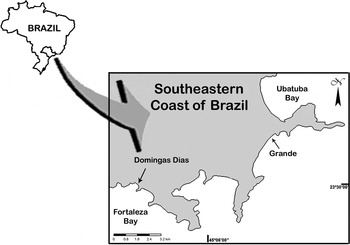
Sampling of crabs was conducted monthly from January through to December 2001 on seaweed banks of Sargassum cymosum in the intertidal zone of the rocky shores Grande (GR) (23°23′ S–45°03′W) and Domingas Dias (DD) (23°29′S–45°08′W) (Figure 1), north-eastern coast of São Paulo in south-eastern Brazil. The samples of S. cymosum were taken from the rocky bottom by the holdfast region, during low tide. The catch effort consisted of two hours/month, conducted by two people. The phytal samples were placed in plastic bags and transferred to the Marine Biology Laboratory at the University of Taubaté. In the laboratory, the crabs were removed from the Sargassum by hand. This process was carried out twice, in order to increase collection efficiency, especially for the presence of very small crabs. For each sample, the seaweed volume (L) was measured by the displacement of a water column. This measurement was used to obtain the crab density associated with the phytal (individuals/L).
Map of Brazil indicating the Grande and Domingas Dias rocky shores.

For each specimen of Epialtus bituberculatus, the greatest carapace width (CW) was measured with a Vernier caliper (0.1 mm). Sex and developmental stage (juvenile or adult) were identified from the external morphology of the abdomen and appendages, classified as: adult female, large abdomen, covering almost the entire ventral thorax surface; hairy pleopods; adult male, abdomen narrow, with two pairs of small gonopds; juvenile female; and male, triangular shape, 2 and 4 pairs of non-hairy pleopods for males and females respectively (see Haefner, Reference Haefner1990).
The individuals were grouped into eleven (1 mm) size-classes and into demographic classes: juvenile males (JM); adult males (AM); juvenile females (JF); adult females (AF); and ovigerous females (OF).
Normal distributions (modes) were identified and fitted to the monthly frequency distributions through the automatic least-squares method ‘Automatic Peak Detection and Fitting, Method I—Residuals', as performed by Pimenta et al. (Reference Pimenta, Barutot, D'Incao and Fonseca2005) and Keunecke et al. (Reference Keunecke, D'Incao and Fonseca2007). Recruitment of juvenile crabs to the benthic population during each month was identified by the presence of modes in the first size-classes. The presence of these small crabs indicates settlement of megalopae from the water column to the benthic environment (Negreiros-Fransozo & Fransozo, Reference Negreiros-Fransozo and Fransozo2001). The normality of the population size distribution was analysed by the Shapiro–Wilk test (α = 0.05). The Mann–Whitney test was applied to compare the length means of the demographic classes (α = 0.05). The proportion of males and females was analysed by the Chi-square (χ2) test (α = 0.05) (Zar, Reference Zar2010). The relative frequency of adult individuals (%) was plotted on a size-class graph in order to obtain the size at maturity. The data were fitted to a sigmoid curve, according to the results of the logistic regression, where: CW50 = carapace width at 50% of adult individuals; and r = slope of the curve. The equation was adjusted by the least-squares method (Sokal & Rohlf, Reference Sokal and Rohlf1995; Sampedro et al., Reference Sampedro, Gonzalez-Gurriaran, Freire and Muino1999; Mura et al., Reference Mura, Orru and Cau2005).
RESULTS
Population structure and density
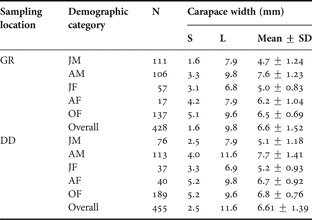
A total of 428 specimens of Epialtus bituberculatus were captured in GR, including: 111 juvenile males (25.93%); 106 adult males (24.77%); 57 juvenile females (13.32%); 17 adult females (3.97%); and 137 ovigerous females (32.01%). From DD, 455 individuals were obtained: 76 juvenile males (16.70%); 113 adult males (24.84%); 37 juvenile females (8.13%); 40 adult females (8.79%); and 189 ovigerous females (41.54%) (Table 1).
Descriptive data on Epialtus bituberculatus: number of individuals (N), the smallest (S) and the largest (L) carapace width, the mean carapace width, and the standard deviation (mean ± SD) from the sampling sites: Grande (GR) and Domingas Dias (DD) rocky shores.

JM, juvenile male; AM, adult male; JF, juvenile female; AF, adult female; OF, ovigerous female.
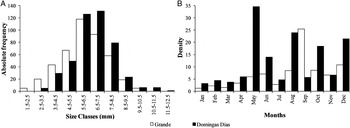
The size–frequency distribution analysis indicated a unimodal and non-normal distribution for the population of GR (W = 0.987, P < 0.001), and a unimodal and normal distribution for the population of DD (W = 0.995, P > 0.001) (Figure 2A). However, the crab density by month ranged from 1.27 to 25.45 ind./L at GR, in January and September, respectively; and from 3.11 to 34.67 ind./L at DD, in January and May, respectively (Figure 2B). No significant differences in density of E. bituberculatus between the two sampled localities were found (Mann–Whitney test; U = 52.00, P = 0.240).
Absolute frequency by size-class (A) and density by months (B) of Epialtus bituberculatus individuals from the rocky shores Grande and Domingas Dias, Ubatuba, Brazil.

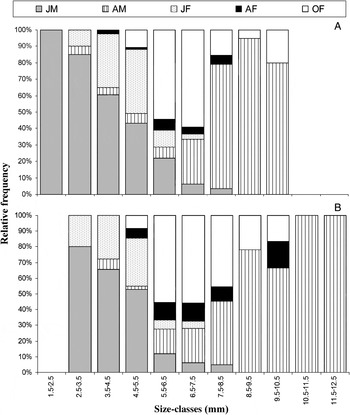
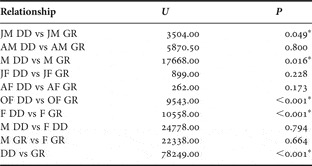
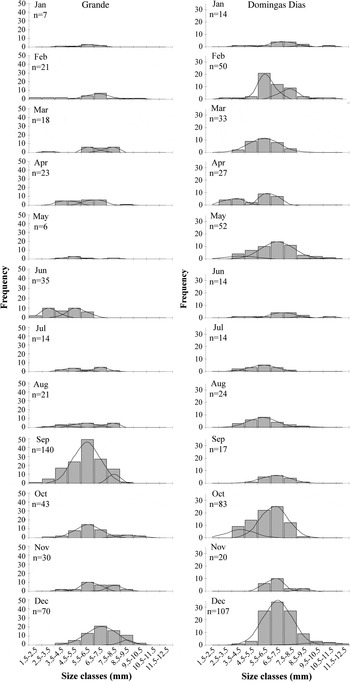
Concerning the size-class distribution, we found that differences range in body size between sites. From GR, no individual was observed in the size-classes from 9.5 to 12.5 mm CW (Figure 3A), while no specimen was recorded in the size-classes from 1.5 to 2.5 mm CW for DD (Figure 3B). Juveniles were observed within size-classes 7.5–8.5 mm CW and ovigerous females were registered between the size-classes 4.5–5.5 to 9.5–10.5 mm CW at both sampled sites (Figure 3). The average body size and the range in body size of E. bituberculatus differed between localities (Tables 1 & 2). No significant differences were found between size by males and females at both sites (Mann–Whitney test; U = 22338.0, P = 0.664) (Table 2).
Relative frequency by size-class of Epialtus bituberculatus from the rocky shores Grande (A) and Domingas Dias (B), Ubatuba, Brazil. JM, juvenile male; AM, adult male; JF, juvenile female; AF, adult female; OF, ovigerous female.

Results of statistical comparisons between the means for carapace width of Epialtus bituberculatus. Mann–Whitney test values (U).

vs, versus; M, male; F, female; DD, Domingas Dias; GR, Grande; JM, juvenile male; AM, adult male; JF, juvenile female; AF, adult female; OF, ovigerous female; *, significant values.
Population dynamics
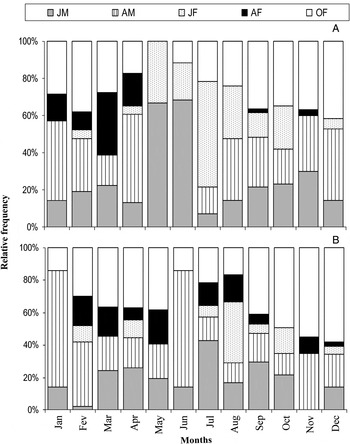
Juveniles were recorded over the entire sampling period at both sites, except in November at DD. The highest peaks of juveniles occurred during May and June at GR, with 100% and 90% of the individuals sampled during the respective months (Figure 4A). At DD, the main peaks of juvenile frequency were recorded from July to August, although these peaks were less marked than those observed at GR (Figure 4B). Ovigerous females occurred in all the samples from both sites, except in May at GR. There was also a period of lower frequency of ovigerous females from May to August (Figure 4). The modes of highest mean size for the first size-classes occurred in April and October at DD (Figure 5). The number of juveniles captured was 168 and 113 from the GR and DD, about 40% and 25% of the total, respectively. Juvenile recruitment was continuous during the year at both sites. This is supported by the presence of modes in the first size-classes through all months at both sites. Reproduction was continuous during the year at the two study sites (Figure 5).
Monthly relative frequency of Epialtus bituberculatus from the rocky shores Grande (A) and Domingas Dias (B), Ubatuba, Brazil. JM, juvenile male; AM, adult male; JF, juvenile female; AF, adult female; OF, ovigerous female.

Monthly distribution of Epialtus bituberculatus from the rocky shores Grande and Domingas Dias, Ubatuba, Brazil.

Size at first maturity
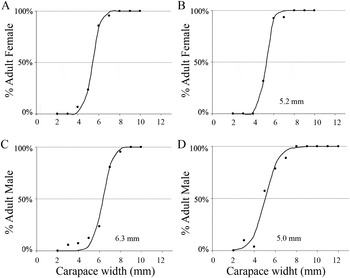
The carapace width at 50% of adult individuals was 5.4 and 5.2 mm CW for females from GR and DD, respectively, i.e. in the same size-class of 4.5 to 5.5 mm CW (Figure 6A, B). However, the smallest ovigerous female had 5.1 mm CW at GR and 5.2 mm CW at DD. For the males, the CW at 50% of adult individuals differed between the sites, 6.3 and 5.0 mm CW at GR and DD, respectively (Figure 6C, D).
Adjustment of the logarithmic function indicating the carapace width at 50% of adult individuals (CW50) of Epialtus bituberculatus. (A) Females from Grande rocky shore; (B) females from Domingas Dias rocky shore; (C) males from Grande rocky shore; (D) males from Domingas Dias rocky shore.

Sex-ratio
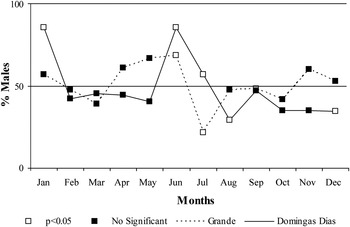
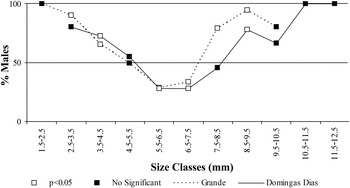
The sex-ratio (female/male) was 1:0.97 at GR (χ2 = 0.77, P = 0.084) and 1:1.41 at DD (χ2 = 13.03, P < 0.001). Thus, overall sex-ratio was male biased in DD but not in GR (i.e. higher number of females in relation to males at DD). Deviations from these ratios were observed in June and July at GR, and in January, June, July, August and December at DD (Figure 7). Deviations from a 1:1 sex-ratio were also recorded among the size-classes, with a concentration of males in the extreme classes, and females in the intermediate classes, the ovigerous females being the most numerous (Figure 8).
Monthly relative frequency of Epialtus bituberculatus males from the rocky shores Grande and Domingas Dias, Ubatuba, Brazil.

Relative frequency by size-class of Epialtus bituberculatus males from the rocky shores and Domingas Dias, Ubatuba, Brazil.

DISCUSSION
Population structure and density
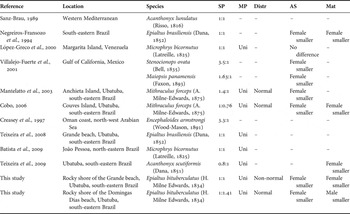
The unimodal distribution of both populations with the modes at intermediate size-classes suggests that the populations maintain constant rates of recruitment, mortality, and/or migration. This pattern is very common among majoid crabs (Table 3) and in general in decapods in tropical areas where marked climatic alterations do not occur (Warner, Reference Warner1967; Díaz & Conde, Reference Díaz and Conde1989; Hartnoll & Bryant, Reference Hartnoll and Bryant1990). At GR, the unimodal distribution was also a non-normal distribution. However, we suggest that a balance between inputs and outputs of individuals might occur in this population as well. Despite the observed differences in wave energy between the sites, the density of E. bituberculatus seems unaffected by this disturbance factor. We found no significant differences in crab density between the rocky shores. Therefore, the energy of wave impact seemed not be a limiting factor for the species occurrence, possibly because the individuals find a refuge in the Sargassum banks.
Review of the literature realized for this study of some population features between Epialtus bituberculatus and other species of Majoidea.

SP, sex proportion; MP, modal pattern; Distr, distribution; AS, average size; Mat, maturity; Uni, unimodal.
Males predominated in the largest size-classes, which according to Gherardi & Micheli (Reference Gherardi and Micheli1989) is to be expected, because males tend to attain larger dimensions, probably to ensure mating and to win intraspecific competitions, as reported for other majoid crabs in the review of the literature realized for this study (see Table 3). Christy & Salmon (Reference Christy and Salmon1984) and Abrams (Reference Abrams, Chelazzi and Vannini1988) reported that the energy allocated to growth is used for structural metabolism in males and for egg production in females, which determines sexual dimorphism in body size (males larger than females) and ultimately assures sex-specific optimization of fecundity and fitness.
The differences observed in population structure between the two E. bituberculatus populations seemed to be, at least partially, constrained by the different intensities of wave energy received at GR and DD. This hydrodynamic influence could be important for the establishment of patterns for some population features of E. bituberculatus, e.g. sex-ratio and sexual maturity relationships, which could be affected by hydrodynamic conditions.
Population dynamics
The presence of ovigerous females during the entire study period at both sites, except in May at GR, suggests that E. bituberculatus has continuous reproduction in the region. This reproductive strategy seems to be common among brachyuran species in tropical or subtropical areas (DeVries et al., Reference DeVries, Epifanio and Dittel1983; Pinheiro & Fransozo, Reference Pinheiro and Fransozo2002; Litulo, Reference Litulo2004; Cobo, Reference Cobo2006). The continuous production of larvae resulted in continuous recruitment of juveniles at both beaches. This may partially explain some features of both populations, such as the stable abundance and unimodal frequency distribution. Continuous recruitment was also observed for other majoid crabs, such as Mithraculus forceps (A. Milne-Edwards, 1875) by Cobo (Reference Cobo2006) in the region of Ubatuba, south-eastern Brazil.
Size at first maturity
At Grande beach females became mature at smaller sizes than males, as reported for other Majoidea species (Table 3), indicating that females can attain reproductive stages by accumulating energetic resources in size-classes, which are better for reproduction, delaying the somatic growth, as assigned by Hartnoll (Reference Hartnoll and Abele1982). In contrast, at Domingas Dias beach, both males and females attained morphological maturity at similar sizes. Wave exposure might be producing the observed differences in size at first maturity in females because they allocate energy to resist this strong wave exposure and cannot allocate in parallel energy to the female function at that particular site, since environmental parameters are important for determining energy allocation in decapod crustaceans (Jones & Simons, Reference Jones and Simons1983; Bertini et al., Reference Bertini, Teixeira, Fransozo and Fransozo2010).
In the other site with less exposure, females can mature earlier as they do not need to resist wave exposure and thus can invest to reproduction earlier in life than in the more exposed site. However, the wave action may generate either positive or negative effects on the reproduction of marine invertebrates exposed to it, according to a model proposed by Denny et al. (Reference Denny, Daniel and Koehl1985).
Sex-ratio
The skewed sex-ratio toward females in DD may be a result of early maturity of males rather than an investment for somatic growth. However, many populations of marine crustaceans exhibit deviations from this ratio of unity, which may be responses to several different factors such as mortality rates, longevity, growth, behaviour and differential migration between the sexes (Wenner, Reference Wenner1972; Gable & Crooker, Reference Gable and Crooker1977; Botelho et al., Reference Botelho, Santos and Souza2001). However, other species of Majoidea exhibit great plasticity in the sex-ratio (see Cobo, Reference Cobo2006; Teixeira et al., Reference Teixeira, Fransozo, Cobo and Hiyodo2009). These patterns could be adaptive, wherein populations show different sex-ratios due to limitations imposed by the environment. However, this hypothesis needs further confirmation.
Conclusion
The populations differed in the mean size and size-range of individuals, the size of the modal class, and at morphological maturity (CW50), in both sexes. These differences probably are determined by different hydrodynamic conditions. Therefore, it was apparent that the wave and tide action could dislodge crabs and more frequently move organisms away from the intertidal zone, as reported by many authors (see Gaylord et al., Reference Gaylord, Blanchette and Denny1994; Gaylord, Reference Gaylord2000; Denny & Gaylord, Reference Denny and Gaylord2002), besides causing physical injury (Denny et al., Reference Denny, Daniel and Koehl1985).
Nevertheless, additional studies, mainly experimental ones, should be accomplished in order to clarify the influence of the strong wave action over the spider crabs population associated with algae banks, also considering the potential influence of some other features such as food availability and space competition in algae, that could contribute to the development of these population differences.
ACKNOWLEDGEMENTS
The authors are indebted to Janet W. Reid, PhD for her constructive comments on early drafts of the manuscript and great help with the English language. We appreciate the helpful comments by Maria Lucia Negreiros-Fransozo, PhD. All sampling in this study has been conducted in accordance with applicable state and federal laws. This study was supported by the Universidade de Taubaté (Process # 251/2001-PRPPG) and the Conselho Nacional de Desenvolvimento Científico e Tecnológico–CNPq (Process # 134950/2007-0).