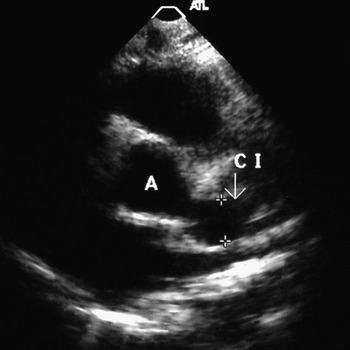
A 2-year-old boy was referred for fever which had persisted over 14 days, despite treatment with broad-spectrum antibiotics. On clinical examination, he had only mild conjunctival and pharyngeal erythema. There was no evidence of lymphadenopathy, cracked lips, rash, or peripheral oedema. Haematological tests revealed leukocytosis and thrombocytosis, with elevation of C-reactive protein and the globular sedimentation rate. Cultures, serologies, auto-immune studies, and tuberculosis screening were all negative. Because we suspected so-called incomplete Kawasaki disease, we performed transthoracic echocardiography. In the short axis view (Figure 1), this revealed the presence of an aneurysm with a diameter of 9 millimetres (white arrow) involving the main stem of the left coronary artery (CI) soon after its origin from the aorta (A), which had a diameter of 13 millimetres. Treatment with gamma globulin and aspirin was started, and 2 days later, the fever resolved.
Transthoracic echocardiography,short axis view, a 9-millimetre aneurysm (white arrow) is visualized in the left main coronary artery (CI) soon after its origin from the aorta (A), the diameter of which was 13 millimetres.

Coronary arterial aneurysms, or ecstatic changes, are known to develop in up to one-quarter of untreated children with Kawasaki disease, and may lead to myocardial infarction, rupture, or sudden death. The incidence of giant aneurysms is reduced to about 1% if gamma globulin is administered within 10 days of the onset of fever.Reference Newburger, Takahashi and Gerber1 Problems arise when 4 of the 5 necessary diagnostic criterions, and 5 days of fever, are not observed within this timeframe. Even lowering the threshold for treatment to three criterions and 3 days of fever may overlook patients such as ours, with the so-called incomplete variants of Kawasaki disease. The fact that coronary arterial involvement constitutes the major source of morbidity and mortality in this otherwise self-limited vasculitis, and that aneurysmal formation can be diagnostic without other clinical signs, might argue for early echocardiography in all infants and children with a high fever who are unresponsive to ibuprofen or acetaminophen.