Introduction
In China, where filial piety is one of the core family values and there is a lack of formal support regarding elderly care, frail older adults rely heavily on family members, particularly their adult children, for instrumental assistance (Li et al., Reference Li, Long, Essex, Sui and Gao2012; Lei, Reference Lei2013). Adult children's instrumental support, usually conceived of as help with household tasks and/or personal care, is notably important due to its connections with parental psychological wellbeing (Chen and Silverstein, Reference Chen and Silverstein2000; Djundeva et al., Reference Djundeva, Mills, Wittek and Steverink2015). Today, Chinese families are undergoing rapid social and demographic changes, necessitating intensive investigations into family arrangements of elderly care. Family strategies of providing support to older parents may be more complex in multi-child families, due to the fact that an adult child is not likely to care in complete isolation from his or her siblings (Tolkacheva et al., Reference Tolkacheva, Van Groenou and Van Tilburg2010). Different within-family patterns of instrumental support to older parents among multiple offspring can in some ways reflect how and whether elderly care needs are met across generations. Identifying and capturing prevalence or absence of those distinct family patterns in contemporary Chinese late-life families would provide important references to both family gerontologists and family service practitioners.
Ample research has examined adult children's instrumental support to older people by focusing on the relationship between an older parent and a specific adult child, variously termed the primary, focal or principal care-giving child, or by aggregating support given by all adult offspring (Ward, Reference Ward2008; Lei, Reference Lei2013; Chen and Jordan, Reference Chen and Jordan2018b). In multi-child families, a parent–child dyad is embedded in a larger family system where adult siblings share care responsibilities and affect each other's instrumental support to older parents. More importantly, within the whole family functioning system, different adult children might play distinct roles in the care-giving process due to their unique socio-economic characteristics and life experiences, leading to the differentiation of support provision among multiple adult children (Connidis and Kemp, Reference Connidis and Kemp2008; Lashewicz and Keating, Reference Lashewicz and Keating2009; Tolkacheva et al., Reference Tolkacheva, Van Groenou and Van Tilburg2010; Leinonen, Reference Leinonen2011). Thus, it is important to consider multiple offspring simultaneously to understand how they share, divide and allocate their energy and time to support older parents collectively.
In this regard, an emerging perspective emphasises the importance of within-family differences of parent–adult child support exchanges in late-life families, and characterises such interaction patterns and typologies at the family level (i.e. the within-family approach; Kim et al., Reference Kim, Fingerman, Birditt and Zarit2016; Pillemer and Gilligan, Reference Pillemer and Gilligan2018; Suitor et al., Reference Suitor, Gilligan, Pillemer, Fingerman, Kim, Silverstein and Bengtson2018; Chen and Zhou, Reference Chen and Zhouin press). So far, few studies have provided knowledge about various within-family patterns of multiple offspring's instrumental support to older parents in Chinese multi-child families. In addition, little is known about what kinds of Chinese multi-child ageing families are more conducive to certain within-family patterns in terms of shared filial responsibilities among multiple adult children. Composition characteristics at the family level (e.g. gender composition of multiple offspring), rather than characteristics of individual family members, may be helpful to predict distinct within-family support patterns as a whole functioning unit (Kim et al., Reference Kim, Fingerman, Birditt and Zarit2016). Therefore, to fill these research gaps, the current study aims to identify (a) different within-family patterns (i.e. latent classes) of instrumental support to Chinese older parents among multiple adult children, and (b) predictors of distinct within-family patterns. The social and demographic characteristics of family life in China are radically divergent from those of family life in Western countries. Such contextual differences make Chinese multi-child families an interesting subject for capturing distinct family dynamics of providing instrumental help to older parents. A better understanding of Chinese families could also offer theoretical references and practical implications for elderly care in other developing and underdeveloped countries with different cultural contexts.
Collective ambivalence and within-family patterns of multiple offspring's support
Applying a typology approach, previous literature distinguished various types of intergenerational relationship based on its multiple dimensions (e.g. affectual, structural, functional, etc.), mainly derived from the intergenerational solidarity theory (Bengtson and Roberts, Reference Bengtson and Roberts1991; Guo et al., Reference Guo, Stensland, Li and Dong2020). However, most of these typology studies focused on individual parent–child dyads rather than multiple parent–child relationships as a whole within families (Suitor et al., Reference Suitor, Gilligan, Pillemer, Fingerman, Kim, Silverstein and Bengtson2018). Furthermore, they distinguished patterns only based on differences in levels (e.g. amount or frequency) of support, overlooking the degree to which support to the same older parent was distributed unequally among multiple adult children. The latter point is particularly important when observing within-family patterns of receiving a specific type of support (e.g. instrumental support) from multiple adult children.
Drawing from the intergenerational ambivalence perspective (Luescher and Pillemer, Reference Luescher and Pillemer1998), Ward (Reference Ward2008) extended this dyadic concept to ‘collective ambivalence’, incorporating the mixed quality of parent–child relationships across multiple offspring. The collective ambivalence perspective suggests that within the same multi-child families, parent–adult child relationships tend to be positive for some adult children but negative for others (Ward et al., Reference Ward, Spitze and Deane2009). In Ward's studies (e.g. Ward, Reference Ward2008; Ward et al., Reference Ward, Spitze and Deane2009), parents were first asked to rate parent–adult child relationship quality and frequency of contact with each of their adult children. Then both highest and lowest reported quality and contact across multiple adult children were used to capture the collective ambivalence of both positive and negative parent–adult child relations within the same families. In addition, consistent with family systems theory, the collective ambivalence perspective also emphasises mutual influences and interdependence of family ties nested in a complex family network (Fingerman and Bermann, Reference Fingerman and Bermann2000). According to Ward et al. (Reference Ward, Spitze and Deane2009), some studies focused on parents’ relationship with one specific adult child or regarded multiple adult children as an undifferentiated composite; however, these approaches overlooked the way in which one parent–child tie fits within and is related to other parent–child ties in a family network with multiple relations. Although Pillemer and Suitor (Reference Pillemer and Suitor2008) raised serious concerns about the operationalisation and measurement of collective ambivalence in Ward's studies, they highlighted the core value of this collective perspective in supporting within-family designs for understanding the complexity of parent–adult child relationships in multi-child families.
Previous empirical studies on adult children's support of older parents in multi-child families have manifested collective ambivalence in one way or another, suggesting that some adult children may provide more support while others provide less to older parents within the same family. An individual adult child's support provided to an older parent cannot be fully understood without considering the care-giving efforts of siblings who are mutually stimulated (Matthews, Reference Matthews2002). Such interdependence among adult siblings leads to trade-offs of support provision to older parents through negotiations (Connidis and Kemp, Reference Connidis and Kemp2008), involving collaboration (Ingersoll-Dayton et al., Reference Ingersoll-Dayton, Neal, Ha and Hammer2003a) as well as tension and conflicts (Lashewicz and Keating, Reference Lashewicz and Keating2009). Though some adult siblings expect a fair share of caring tasks, the real situation is not always like this (Ingersoll-Dayton et al., Reference Ingersoll-Dayton, Neal, Ha and Hammer2003b). Based on a qualitative study, Matthews and Rosner (Reference Matthews and Rosner1988) identified five typical styles of sibling participation in parental care. ‘Routine care’ necessitated considerable co-operation among siblings, while ‘backup care’ involved less collaboration among siblings. In contrast, the remaining three styles (i.e. circumscribed, sporadic and dissociated care) entailed little collaboration among siblings.
Similarly, Leinonen's (Reference Leinonen2011) typology uncovered three sibling participation patterns in parental care-giving, including ‘absence’, ‘backup’ and ‘togetherness’. Leinonen studied 20 Finnish working carers’ perceptions of the sharing of the responsibility for taking care of parents across siblings and found that all the interviewed carers recognised the unequal division of care responsibilities. Some siblings were described as entirely absent while some provided occasional backup. In the other cases, the respondents reported that they could share the parental care responsibilities with their siblings, which was named as ‘togetherness’. The three patterns suggested increasing levels of potential collaboration among multiple adult children in sequence. Most relevant studies were qualitative. Despite limited representativeness, they clearly illustrated the variability of support to older parents among adult siblings, indicating their different roles in elderly care involvement within a family.
The sharing approaches of elderly care by multiple offspring also vary across different families, necessitating a holistic investigation of distinct within-family patterns. In some families, one adult child may provide considerably more support to an older parent than his or her siblings (Ingersoll-Dayton et al., Reference Ingersoll-Dayton, Neal, Ha and Hammer2003b), while in other families, multiple adult children negotiate to have relatively greater equity in terms of support provision to an older parent; this co-operative manner is known as the ‘togetherness’ pattern (Leinonen, Reference Leinonen2011).
Compared to relevant Western studies, Chinese multi-child families received less academic attention. Guo et al. (Reference Guo, Chi and Silverstein2012) found that the majority of older parents in rural China had different types of relational ties across their multiple children. Chen and Zhou (Reference Chen and Zhouin press) confirmed the existence of such within-family variability by examining parent–child emotional closeness in some Chinese multi-child families, which they described as ‘highly ambivalent’, despite a dominant proportion of ‘tight-knit’ Chinese families where older parents had equal emotional closeness across multiple offspring.
Factors related to within-family patterns of multiple offspring's instrumental support to older parents
Among relevant previous studies, individual characteristics of older parents and composition characteristics of multiple adult children at the family level (e.g. age intervals between children, child gender composition, have any proximate child, etc.) predicted different within-family patterns in relation to either parental support to adult children (Kim et al., Reference Kim, Fingerman, Birditt and Zarit2016) or intergenerational emotional closeness (Chen and Zhou, Reference Chen and Zhouin press) in multi-child families. Older parents’ characteristics may be closely related to the level of instrumental support provided by multiple adult children within a family. Specifically, at advanced ages, Chinese older parents are increasingly more likely to receive instrumental support from their adult children (Zuo et al., Reference Zuo, Wu and Li2011; Chen and Jordan, Reference Chen and Jordan2018a). Parental gender may not necessarily be related to older parents’ likelihood of receiving instrumental support in the Chinese families, but depending on the undergoing lifestages and different life events encountered by older fathers and mothers (Zuo et al., Reference Zuo, Wu and Li2011). The loss of a spouse will lead to a greater level of instrumental assistance from adult children (Utz et al., Reference Utz, Reidy, Carr, Nesse and Wortman2004). Lower income and poorer health conditions also increase parents’ likelihood of receiving instrumental support (Kalmijn and Saraceno, Reference Kalmijn and Saraceno2008). Last but not least, educational level may also be associated with receipt of instrumental support. Well-educated older adults tend to have better health outcomes through their better health judgement and health choices (Montez and Friedman, Reference Montez and Friedman2015; Zajacova et al., Reference Zajacova, Huzurbazar and Todd2017), which may influence their chances of receiving instrumental help from adult children.
Composition characteristics of multiple adult offspring may also be associated with the level and differentiation of instrumental support to older parents across multiple adult offspring within families. The number of children can indicate the potential availability of elderly care in families (Bonsang, Reference Bonsang2009). Guo et al. (Reference Guo, Chi and Silverstein2009) shared similar findings, observing that the total number of adult children was significantly associated with intergenerational support in rural Chinese families. A larger family size may increase the overall amount of instrumental support provided to older parents (Turcotte and Schellenberg, Reference Turcotte and Schellenberg2007) but reduce the amount of elderly care provided by each child on average (Parrott and Bengtson, Reference Parrott and Bengtson1999). Having proximate children contributed to the amount of potential support received by older parents, especially in terms of hands-on and instrumental support (Zimmer et al., Reference Zimmer, Rada and Stoica2014). Larger age intervals between adult offspring may indicate a higher possibility that the multiple adult children are in distinct lifestages with different levels of availability for support to older parents (Kim et al., Reference Kim, Fingerman, Birditt and Zarit2016). This may lead to greater differentiation of instrumental support to an older parent within a family. Having older adult children may increase older parents’ likelihood of receiving instrumental support in Chinese families (Chen and Jordan, Reference Chen and Jordan2018a).
The gender of the child also matters. Daughters usually provide more instrumental support to older parents compared with sons in both Chinese and Western studies (Tolkacheva et al., Reference Tolkacheva, Van Groenou and Van Tilburg2010; Chen and Jordan, Reference Chen and Jordan2018a). Having at least one sister within a mixed-gender family increases the chances that she will be the primary care-giver for an older parent (Matthews, Reference Matthews1995), probably leading to high levels as well as a high differentiation of instrumental support provision across multiple children. As sons and daughters tend to provide different kinds of care to older parents (Connidis and Kemp, Reference Connidis and Kemp2008), adult children may differentiate less in instrumental support to an older parent within families where all children are the same gender.
Multi-child families in the Chinese context
Before the one-child policy implemented in the early 1980s, extended families with multiple children were prevalent in China. As the one-child policy had its main effect on urban China, rural families could still have more than one child. According to the study report of the 2014 China Longitudinal Aging Social Survey, Chinese older adults (age ⩾ 60) currently have three children on average. Specifically, those above 80 years have three to four living adult children on average. Urban older adults have fewer children on average (2.5 children) than their rural counterparts (3.4 children). Today, most older parents, who gave birth before the strict implementation of the one-child policy, are still facing the multi-child family situation.
Deeply influenced for centuries by the Confucian culture of filial piety, adult children's instrumental assistance of older parents is not only reinforced by the law but also necessitated by the current shortage of relevant formal support for older adults in China (Wong and Tang, Reference Wong and Tang2006). On the one hand, traditional Chinese families particularly emphasised the collective cohesion and solidarity that are characteristic of collectivist family culture (Chuang, Reference Chuang2005; Lin and Chen, Reference Lin and Chen2018). Kinship ties and familial care responsibilities are highly valued in such collectivist systems of family elderly care (Pyke and Bengtson, Reference Pyke and Bengtson1996). On the other hand, the potential variability of multiple children's support provision within a family, which stems from the traditional Chinese patriarchal culture, cannot be overlooked. The (eldest) son is usually favoured in terms of filial commitment to Chinese parents in late life, an opinion encapsulated in the old Chinese saying ‘Raise sons to care for one's old age’ (yang er fang lao). Therefore, it remains to be seen how children with siblings in the context of today's Chinese ageing families fulfil their filial commitment collectively, and what determinant factors are associated.
In summary, in order to identify within-family patterns, we studied the family as a whole functioning system. Drawing on the collective ambivalence perspective and previous work (Kim et al., Reference Kim, Fingerman, Birditt and Zarit2016; Chen and Zhou, Reference Chen and Zhouin press), we considered two within-family indicators to describe the collective ambivalence regarding instrumental support provided to older parents across multiple adult offspring in the family context. The two indicators were (a) the mean level of instrumental support provided by multiple adult children to an older parent within a family, and (b) differentiation in levels of instrumental support across multiple adult children. First, we expected that although in most Chinse multi-child families, instrumental support might be provided to older parents with an equally high level among the different offspring, there would also be other within-family patterns, such as having high differentiation in such instrumental support across multiple offspring. Second, we expected that different characteristics of individual older parents and different composition characteristics of multiple adult children at the family level were associated with distinct within-family patterns to different extents.
Method
Sample
Data were derived from the China Family Panel Studies (CFPS), a national representative sample of families in 25 provinces in China. The CFPS started from the year 2010 (T1). Each family member of the sampled households was followed every two years from the first data collection (i.e. in 2012, 2014 and 2016). More details of the sampling approach and the study design can be found elsewhere (see http://www.isss.pku.edu.cn/cfps/).
In the CFPS, older adults aged over 60 with at least one living child were eligible for reporting intergenerational support exchanges with each of their living children. In our study, we used the data from the fourth wave (2016, T4) for analysis, as our key study interest – frequencies of children's instrumental support to older parents – could only be obtained from the fourth wave so far. At T4, 8,652 older adults (age ⩾ 60, range = 60–104) were eligible for reporting such information, with 23,820 children nested in 5,703 families. We first restricted the household samples to multi-child families in which all living children were adults (age ⩾ 18), and older parents reported details of instrumental support received from each adult child. This led to a sample of 5,848 older parents, with 17,296 adult children nested in 3,966 families. An additional 58 parents (0.99%) were omitted due to missing values for their demographic and socio-economic characteristics. After removing older parent cases with missing values (0.99%), we had a final working sample of 5,790 older parents, with 17,118 adult children nested in 3,917 families.
Measures
Instrumental support provision
Instrumental support was operationalised in the current study as support for housework and daily life. In the CFPS at T4, older adults (age ⩾ 60) with at least one living child were required to report whether each of their children had helped them with housework and daily life in the previous six months. If such help had been provided, its frequency was further collected for each specific child based on a six-point scale from 1 (almost every day) to 6 (one day every several months). We first formed a seven-point scale from 0 (none) to 6 (almost every day) by combining the reports for children who never provided housework and daily life help to older parents in the past six months. We then reversed the values of the scale, with a higher score indicating a higher frequency of instrumental support provision from a specific child to an older parent. Finally, referring to previous studies (Kim et al., Reference Kim, Fingerman, Birditt and Zarit2016; Chen and Zhou, Reference Chen and Zhouin press), we constructed two family-level indicators for each family: (a) within-family mean level, namely mean level support in the family: the average scores of frequencies of instrumental support provision to an older parent among all adult offspring within a family (mean = 0.95, standard deviation (SD) = 1.41), and (b) within-family differentiation: the within-family coefficient of variation (mean = 0.51, SD = 0.75), equal to within-family SD divided by mean level support in the family. We used the coefficient of variation instead of using the SD directly to make the within-family differentiation scores comparable, given the relative influence of family means across different multi-child families.
Characteristics of older parents
We considered older parents’ demographic and socio-economic characteristics, including age, gender, educational levels, household income per capita, partnership status, physical health and residential area. Age was a continuous variable centred at 60 years. Gender was dichotomous (1 = male, 0 = female). Educational level was categorised into three groups: 1 = low level (reference group, i.e. illiterate/semi-illiterate and primary school), 2 = middle level (i.e. junior middle school and senior middle school) and 3 = high level (i.e. junior college, college, master's degree and doctoral degree). Household income per capita in the previous 12 months was a composite continuous variable constructed by the CFPS. Due to its skewed distribution, we transformed it into natural logarithms of the income values plus one. Partnership status was managed as a dummy variable (1 = having a marriage/co-habitating partner, 0 = unmarried/divorced/widowed), making parents who were unmarried, divorced or widowed the reference group. Self-reported physical health was originally rated on a five-point scale from 1 (excellent) to 5 (poor). We reversed the scale with a higher score indicating better health conditions. Residential area was a dummy variable (1 = urban residence, 0 = rural residence).
Composition characteristics of adult children
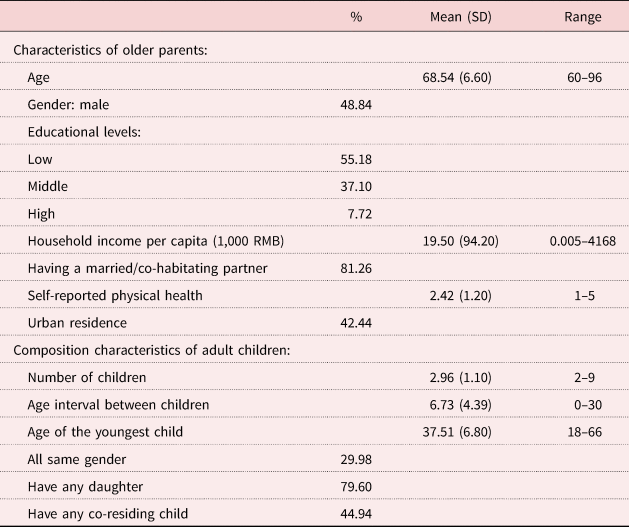
We included the number of living adult children, the composition of the children's age and gender, and the existence of any co-residing children. Specifically, the composition of the children's age included: (a) the age interval between the eldest and youngest adult child, and (b) the age of the youngest adult child. Gender composition of multiple adult children included: (a) whether all adult children were the same gender (1 = same gender, 0 = mixed gender), and (b) whether there was a daughter (1 = have daughter, 0 = no daughter). Finally, we also considered whether there were any adult children living with older parents (1 = have co-residing child, 0 = no co-residing child). Table 1 shows sample characteristics of older parents and composition characteristics of adult children within multi-child families.
Sample characteristics of older parents and adult children

Notes: N = 5,790 parents. Unweighted sample. SD: standard deviation.
Analytical strategies
Classification of within-family patterns of instrumental support to older parents
Based on the within-family mean level and within-family differentiation, we classified within-family patterns of multiple adult children's instrumental support to older parents. We employed LPA for continuous indicators using Mplus version 8.3 (Muthén and Muthén, Reference Muthén and Muthén2012). Meanwhile, the sample weight was used in the analysis. Referring to previous research (Kim et al., Reference Kim, Fingerman, Birditt and Zarit2016; Chen and Zhou, Reference Chen and Zhouin press), we first transformed and standardised the original scores of within-family mean level and differentiation (T-scores; mean = 50, SD = 10) for ease of interpretation. We then applied LPA and selected the best model based on the model fit indicators, including Akaike's information criterion (AIC), Bayesian information criterion (BIC), entropy, and the Lo–Mendell–Rubin likelihood ratio test (LMR LRT). A better model was generally presented with lower values of AIC and BIC and higher entropy values, indicating a clearer distinction between latent classes. In addition, the LMR LRT test evaluates whether a model solution with more latent classes performs better than a simpler model.
Prediction of within-family patterns of instrumental support to older parents
After determining the optimal number of within-family patterns derived from LPA, we investigated what characteristics of older parents and adult children were linked to different family patterns in relation to multiple adult children's instrumental support provided to older parents. For the dependent variable (i.e. latent family patterns), we used the ‘most-likely’ class variable constructed from the latent class posterior distribution. We assigned each observation to the class into which they had the highest probability of falling. A multinomial logistic regression model with a weighted sample was carried out in Stata version 15.0, considering characteristics of older parents and composition characteristics of multiple adult children within families. In addition, the cluster option was used to adjust standard errors (SE) considering interdependence of parents’ observations in some families where the older father and mother were both sampled.
Results
Classification of within-family patterns of instrumental support to older parents
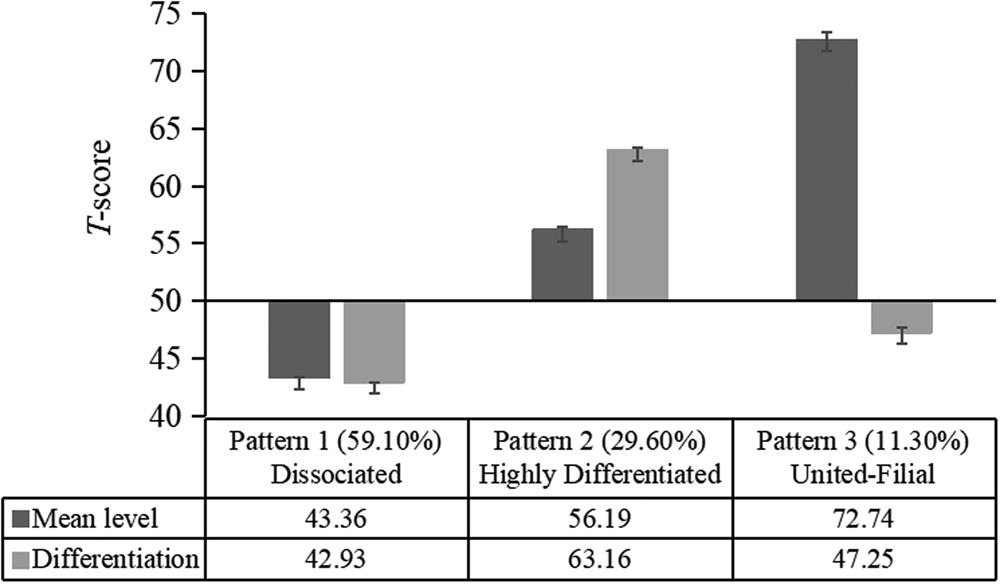
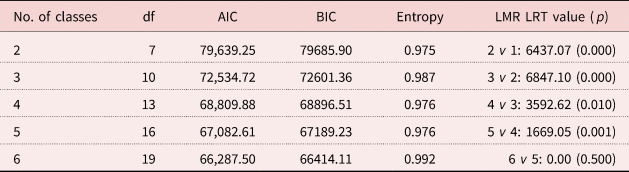
We identified different family patterns by applying LPA based on the average level and differentiation of instrumental support provision to older parents within families. Table 2 provides detailed information comparing different LPA models from two- to six-class solutions. With each additional latent class added, the results showed a gradual decrease in AIC and BIC, with a significant drop between a two-class and a three-class solution. The entropy was good for three classes and even better for six classes. However, the LMR LRT test demonstrated that the six-class solution was not significantly better than the five-class model. Taking them all together, in our study we used the three-class model that had relatively low AIC and BIC values as well as good entropy, suggesting three highly distinctive classes. Figure 1 displays the mean scores of the two within-family indicators for each pattern.
Three latent patterns of within-family mean level and differentiation in multiple adult children’s instrumental support to older parents. The original mean level and differentiation scores were standardized (T-scores, M = 50, SD = 10) for the ease of interpretation. Parents, N = 5,790; Weighted.

Model fit for the optimal number of classes in the latent profile analysis

Notes: N = 5,790 parents. Weighted sample. df: degrees of freedom. AIC: Akaike's information criterion. BIC: Bayesian information criterion. LMR LRT: Lo–Mendell–Rubin likelihood ratio test: 2 v 1 means a two-class solution compared to a one-class solution; 3 v 2 means a three-class solution compared to a two-class solution; 4 v 3 means a four-class solution compared to a three-class solution; 5 v 4 means a five-class solution compared to a four-class solution; 6 v 5 means a six-class solution compared to a five-class solution.
The first pattern, ‘dissociated’ (59.10%), showed a low within-family mean level (mean = 43.36, SE = 0.03) and low differentiation (mean = 42.93, SE = 0.01). Multiple adult children in these families rarely provided instrumental support to an older parent without much differentiation among siblings. The second pattern, ‘highly differentiated’ (29.60%), was characterised by a medium mean level of instrumental support to older parents (mean = 56.19, SE = 0.25) and high differentiation among siblings (mean = 63.16, SE = 0.25). In this family pattern, instrumental support from multiple adult children was differentiated considerably in comparison to each other within a family. Some adult children might provide instrumental support to an older parent very frequently, while others might provide little instrumental support to the older parent. The latter might be counted on as backup care-givers when the routine care-giving siblings were not available. The third pattern, ‘united-filial’ (11.30%), displayed a very high mean level of instrumental support (mean = 72.74, SE = 0.67) and low differentiation (mean = 47.25, SE = 0.38). Adult offspring in these families tended to provide instrumental support to older parents with equally high frequency.
Prediction of within-family patterns of instrumental support to older parents
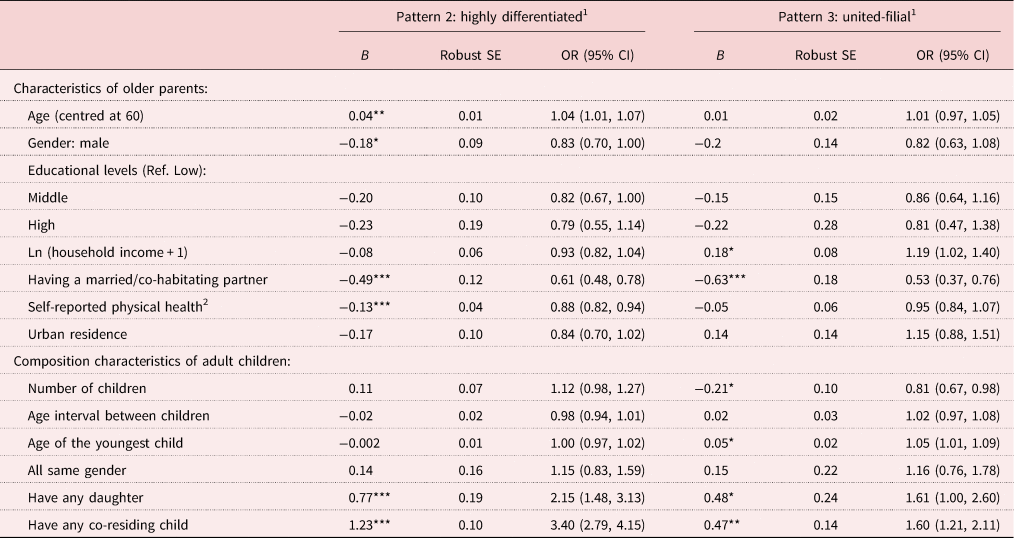
We conducted a multinomial logistic regression to examine family profiles with respect to family types of multiple adult children's instrumental support to an older parent, considering characteristics of both older parents and adult children. Table 3 presents the associations between these characteristics and membership of the three family patterns. The reference pattern was the dissociated within-family pattern.
Multinomial logistic regression model predicting within-family patterns of instrumental support to older parents

Notes: N = 5,790 parents. Weighted sample. 1. Pattern 1 (dissociated) is the reference pattern. 2. Rated on a five-point scale from 1 (poor) to 5 (excellent). SE: standard error. OR: odds ratio. CI: confidence interval. Ref.: reference group.
Significance levels: * p < 0.05, ** p < 0.01, *** p < 0.001.
Compared to the dissociated pattern, the highly differentiated pattern of families showed significant differences in both older parents’ and adult children's characteristics. Specifically, in these families, older parents were more likely to be older, mothers, divorced/widowed and to have poorer physical health. In terms of adult children's characteristics, families with the highly differentiated pattern tended to have at least one adult daughter and one co-residing adult child.
In the united-filial pattern of families, older parents were more likely to be divorced/widowed and to have higher household income per capita, compared to their counterparts in the dissociated families. In addition, they were more likely to have fewer adult children, at least one adult daughter and at least one co-residing adult child. Additionally, the youngest adult children tended to be older in the multi-child families with the united-filial pattern.
As a post hoc analysis, we also applied the ordinary least squares regression in separate models to investigate how characteristics of older parents and adult children were related to the within-family mean level and within-family differentiation, respectively (for results, see Table S1 in the online supplementary material). The results generally showed consistency with the prediction for memberships of the three within-family patterns.
Discussion
Classification of within-family patterns of instrumental support to older parents
In our study, we found that Chinese multi-child families in late life presented three distinct within-family patterns. We classified them based on the within-family mean level and differentiation of multiple adult children's instrumental support to older parents. The three within-family patterns were ‘dissociated’, ‘highly differentiated’ and ‘united-filial’ family styles. Specifically, a majority of Chinese older adults in the dissociated and united-filial patterns of families (approximately 70% in total) had low within-family differentiation in terms of instrumental support provision across adult siblings. In contrast to our findings, Connidis's (Reference Connidis1992) study of sibling participation styles showed that a highly differentiated family pattern characterised the largest proportion (55%) of Western families, where one adult child might provide primary and intensive care with some backup help at lower levels from other siblings. High differentiation of support may lead to conflicts and tensions within the family (Ingersoll-Dayton et al., Reference Ingersoll-Dayton, Neal, Ha and Hammer2003b). In the Chinese context of family collectivism, where harmony and unity are highly valued, one of the strategies for Chinese adult children to reduce possible conflict might be to maintain equity in the allocation of care-giving tasks. Nevertheless, as expected from the perspective of collective ambivalence (Ward, Reference Ward2008; Ward et al., Reference Ward, Spitze and Deane2009), we also observed that approximately 30 per cent (29.60%) of Chinese older parents experienced high differentiation when receiving instrumental support from multiple adult children within the highly differentiated pattern of families. Congruent with prior literature (Ingersoll-Dayton et al., Reference Ingersoll-Dayton, Neal, Ha and Hammer2003b; Kim et al., Reference Kim, Fingerman, Birditt and Zarit2016; Chen and Zhou, Reference Chen and Zhouin press), our study highlights the importance of considering the dimension of within-family differentiation in addition to family mean level when exploring instrumental support to older parents in multi-child families.
Contrary to our expectation, the dissociated within-family pattern of instrumental support to older parents gained most popularity among Chinese multi-child families in late life. Today, as is shown by the united-filial within-family pattern, only a little more than 10 per cent (11.30%) of older parents with multiple offspring received highly intensive instrumental support from each of their adult children. For one thing, it might be due to the relatively young ages of the ‘older’ parents sampled in our study, who were 68.5 years old on average. As these older parents might still be active and capable of taking care of themselves, they might not have high demands for instrumental help from their adult children. For another, because contemporary China is experiencing a transitional period of social development, Chinese families are undergoing the struggle between traditional Chinese family collectivism and Western individualism (Chen, Reference Chen2015; Ji, Reference Ji2017). The former emphasises collective filial responsibility of adult children, while the latter highlights independence and the individual interests of family members. The coexistence of these distinct family values might increase the complexity and mixed quality of intergenerational relationships in Chinese multi-child families, such as those presented in the highly differentiated within-family pattern. Moreover, the changing family values might give rise to serious challenges to family elderly care systems, calling for more academic attention.
Prediction of within-family patterns of instrumental support to older parents
As expected, we found that individual characteristics of older parents and composition characteristics of multiple adult children at the family level predicted different latent within-family patterns of instrumental support to older parents. In general, older parents’ potential needs and resources matter more in forming the highly differentiated within-family pattern, while the composition characteristics of multiple adult children play more important roles in determining whether they are sufficiently united to be filial and capable of co-operating closely to support their older parents instrumentally.
In the highly differentiated pattern of families, compared with their counterparts in the dissociated families, older parents with no married/co-habitating partners and poorer health conditions were more likely to receive instrumental support from multiple adult children. On the one hand, this is consistent with previous literature suggesting that parents with worse and few physical and social resources rely more on their children (Utz et al., Reference Utz, Reidy, Carr, Nesse and Wortman2004; Kalmijn and Saraceno, Reference Kalmijn and Saraceno2008; Zuo et al., Reference Zuo, Wu and Li2011); on the other hand, our study suggested that impaired social and physical resources of older parents in general would also lead to an uneven division of filial responsibility among multiple offspring within families, despite a higher family mean level, potentially intensifying the so-called ‘distributive injustice’ (Connidis and Kemp, Reference Connidis and Kemp2008) of family elderly care.
Moreover, parental gender has a significant association with the highly differentiated within-family pattern, distinct from the other two family styles. It was mothers who were likely to receive a relatively higher than average level of instrumental support from all adult children, but with higher differentiation among multiple offspring. Older mothers’ higher average level of support receipt is probably due to the difference between fathers’ and mothers’ manners of reporting parent–child relationship-related issues. Ward (Reference Ward2008) found that compared with fathers, mothers reported more positive relationship quality across multiple children, as well as greater support exchange within families. In addition, women are often described as kin-keepers who assume more care responsibilities in their families (Zuo et al., Reference Zuo, Wu and Li2011; Ward and Linn, Reference Ward and Linn2020). Pillemer and Suitor (Reference Pillemer and Suitor2002) argued that mothers in the kin-keeping roles might encounter greater collective ambivalence across children, and are likely to yield highly differentiated involvement of elderly care from multiple children. Parental gender differences are expected to garner more academic attention in future investigations of different family patterns of elderly care.
Regarding adult children's characteristics, consistent with prior studies (Ghazi-Tabatabaei and Karimi, Reference Ghazi-Tabatabaei and Karimi2011; Ren and Treiman, Reference Ren and Treiman2015), having at least one co-residing child is an important factor in predicting the highly differentiated within-family pattern. A co-residing child may provide primary and routine care to older parents, raising the average family level and inevitably widening the gap of care involvement from siblings as backups. The gender composition of adult children also matters. In contrast with previous literature (Matthews, Reference Matthews1995; Connidis and Kemp, Reference Connidis and Kemp2008), we found that whether there is heterogeneity in the gender composition of multiple adult children does not matter for within-family patterns of instrumental support provided to Chinese older parents. What matters is whether a family has any daughters. We found that in multi-child families with at least one daughter, multiple adult children tended to provide more instrumental support on average in the highly differentiated pattern of families than in the dissociated pattern of families. Despite traditional Chinese family culture and prior studies that emphasise the role of the son in elderly care in Chinese families (Cong and Silverstein, Reference Cong and Silverstein2014), our study highlights the particular importance of daughters in the provision of instrumental support (Chen and Jordan, Reference Chen and Jordan2018a).
These two composition characteristics of adult children in multi-child families also influence the united-filial pattern of families, but less significantly compared to their associations with the highly differentiated family pattern. In the united-filial within-family pattern, other characteristics of multiple adult children also play salient roles. In comparison with the dissociated pattern, families with fewer and older adult children were more likely to show a united-filial pattern of instrumental support provided to older parents. A larger number of adult children is likely to reduce average contribution to elderly care from each of them (Parrott and Bengtson, Reference Parrott and Bengtson1999). In addition, Ward et al. (Reference Ward, Spitze and Deane2009) demonstrated that having more children increased collective ambivalence of multiple parent–child relations within a family. Fewer adult children may help to reduce conflict when discussing and negotiating how to allocate filial responsibilities among adult siblings, leading to the development of strong filial unity and considerable co-operation in the provision of instrumental support. Multiple adult children who are older may have already retired and have more time and flexibility to provide daily care to older parents or help with housework, leading to a higher level of average support to older parents within families. This finding warrants future studies to investigate how different lifestages of adult children may predict their instrumental support behaviours.
Apart from the adult children's characteristics, our study found that older parents in the united-filial families were more likely to have higher household income per capita, compared to their counterparts in the dissociated families. When older parents were wealthier, they did not necessarily receive less instrumental support (Kalmijn and Saraceno, Reference Kalmijn and Saraceno2008), but experienced enhanced filial commitment among multiple offspring with equally high involvement. For one thing, under the logic of reciprocity, older parents having abundant financial family resources may attract children to contribute more to elderly care in return for parental financial support. For another, wealthier older parents do not need much financial support from children. Therefore, adult children deeply influenced by the norm of filial piety in Chinese multi-child families may instead provide more collective instrumental support as an alternative way of fulfilling their filial commitment. Our findings call for particular academic and practical attention to be given to family dynamics of poor older adults with multiple children, who may experience dissociation or high differentiation in parent–child relationships in late life.
Our work is not without limitations. First, we relied on older parents’ estimates of how much instrumental support was provided by each adult child, which were likely to be overestimated. The intergenerational stake hypothesis suggests that parents tend to rate intergenerational relationships more positively than their children (Birditt et al., Reference Birditt, Hartnett, Fingerman, Zarit and Antonucci2015). Future studies might need to incorporate reports from both older parents and adult children. In addition, only frequency of instrumental support was reported in the current study, overlooking its amount and quality. Second, the current study focuses on within-family patterns of a specific type of support, namely instrumental support to older parents, ignoring the potential interplay between different types of support among multiple children. Children who did not provide instrumental support might provide financial or emotional support as compensation. Therefore, to some extent, the current study limits our ability to capture a comprehensive picture of intergenerational interactions and sharing characteristics of filial commitment across multiple adult children within families. Third, our study did not consider other family-level characteristics that may predict different family styles of multiple offspring's instrumental support, including but not limited to emotional closeness among siblings and between older parents and adult children, and family values and beliefs regarding elderly care. These factors could help researchers to understand further the formation of a family care strategy among siblings. Last but not least, as the present study shows, family-level patterns of instrumental support provided to older parents are not static but dynamic and changing over time. Within-family patterns may be renegotiated and adjusted to changing circumstances depending on adult siblings’ resources and older parents’ needs. Further studies are warranted to uncover detailed stories about how multiple children negotiate and shift their filial care responsibilities in different lifestages.
Despite these limitations, this study is one of only a few to have applied a within-family difference approach to uncovering family dynamics in multi-child ageing families in contemporary China. It contributes to existing literature by highlighting the importance of distinguishing family patterns of providing instrumental support to older parents among multiple offspring. From the collective ambivalence perspective, it not only emphasises the within-family mean level of instrumental support, but also sheds light on within-family differentiation in instrumental support provision across multiple adult children. We also investigated associated factors of older parents and adult children, extending the existing knowledge and improving the explanation of how and why Chinese multi-child families are different from each other in terms of intergenerational instrumental support from multiple offspring. Practically, elderly care services can be enhanced by specific efforts to understand family dynamics among multiple children in relation to their family-level patterns of instrumental assistance. Community-based family care and institutional support should be established as viable alternatives, particularly for those dissociated multi-child families in which physical and cognitive functioning declines for older parents. Respite care services may be particularly important for the highly differentiated pattern of families where one adult child is routinely involved in taking care of older parents and experiences heavy care stress. Finally, since China is relaxing the one-child policy, deeper investigations of the current cohort of Chinese ageing families with multiple children can provide a reference for relevant policy making for elderly care in the future.
Supplementary material
The supplementary material for this article can be found at https://doi.org/10.1017/S0144686X21000283
Acknowledgement
The authors thank the public dataset – China Family Panel Studies (CFPS), designed by Peking University (PU) research team, supported by PU 985 funds and implemented by the Institute of Social Science Survey (ISSS) PU.
Author contributions
JC planned the study, performed statistical analyses and wrote the paper. XZ contributed to writing and revising the paper. NL contributed to revising the paper.
Financial support
This work was supported by the National Social Science Fund of China (grant number 19CSH034).
Conflict of interest
The authors declare no conflicts of interest.
Ethical standards
Ethical approval was not required for the secondary data analysis.