Introduction
As populations continue to age, successful ageing is an increasingly critical issue that affects all aspects of society. Increasing life expectancy coupled with declining physical functions mean that older people are spending more time at home. The living environment can maintain and promote older adult independence as well as improve health and quality of life (QOL) (Adams Reference Adams2008; Regnier and Denton Reference Regnier and Denton2009). Housing quality is thus important for older people, their families and health-care providers. While recognition of a link between housing and health has grown among professionals and the lay population over the past two decades (Adams Reference Adams2008; National Center for Health Housing 2009), information on older peoples’ residences falls far short of that on residences of other age groups.
Background
A house is not only a place to live in but it also has a beneficial effect on the residents. Scholars and professionals have identified the relationship between housing and health and provided insight into how physical environments affect people. However, a majority of published studies have focused on children and young adults (Gardner, Browning and Kendig Reference Gardner, Browning and Kendig2005; Joseph et al. Reference Joseph, Zimring, Harris-Kojetin and Kiefer2005). Therefore, higher-quality research into the relationship between place of residence and health in later life has been strongly recommended (World Health Organization 2006).
Older people spend considerably more time in the home in comparison to other segments of the population. Environmental gerontology is a gerontology subfield dedicated to studying relationships between older people and their environments and related factors. Findings from this discipline have improved residence designs (private homes and institutions), suggested modifications and helped create age-friendly communities (Wahl and Weisman Reference Wahl and Weisman2003). Environmental Gerontology research themes often target the private home environment (such as enhancing outdoor mobility), planned environments (such as institutional settings) and residential decision-making (such as relocation). Lawton (Reference Lawton1989) proposed three basic environmental functions, including maintenance (the meaning of home), support (the potential of the environment to compensate for reduced or lost competency) and stimulation. Stimulation function of an environment refers to the array of stimuli and their effects on behaviour. In other words, the person–environment interaction will impact on the behaviour and emotion of residents, because it will affect their abilities to live in the environment. Thus, identifying behavioural patterns caused by different physical-spatial changes is the key issue of stimulation function.
Important objectives in societies that are ageing include maintaining/promoting positive behaviour of older people in their residential environment and supporting healthy ageing. Encouraging participation in physical activity (PA) and maintenance of an active lifestyle is an important strategy to promote health and QOL in older people (Cheng et al. Reference Cheng, Tsai, Lii, Yu, Cho and Chen2009). Apart from adhering to good construction principles and aesthetics, residences should also address the psychological and behavioural needs of residents (Francis Reference Francis1992). Tung (Reference Tung2003) reported that environmental space has the potential to induce or obstruct individual behaviour. Thus, the main goal of older peoples’ residence design is to create and promote an appropriate environment space that supports lifelong PA (Joseph et al. Reference Joseph, Zimring, Harris-Kojetin and Kiefer2005).
An investigation into the associations and effects of residential space can begin from various perspectives, including health, city planning, architecture and environmental psychology. Universal design is the most frequent spatial design-related issue mentioned in the literature (Joines Reference Joines2009; Safran-Norton Reference Safran-Norton2010; Torrington Reference Torrington2006). Privacy, home modification, layout, environmental barriers (such as outdoors, entrances and communications) and universal designs are the focus of interior space designs in nursing homes, long-term care facilities and private homes (Dijkstra, Pieterse and Pruyn Reference Dijkstra, Pieterse and Pruyn2006; Joines Reference Joines2009; Nishita and Pynoos 2005; Torrington Reference Torrington2006; Ulrich Reference Ulrich2006). Calkins (Reference Calkins2009) described the satisfaction status of aged populations related to their living space. Joseph (Reference Joseph2006) also reported on the positive effects of private and social spaces on social interactions in long-term care settings.
Few studies, however, were found that address the association between space and PA. Space perceptions have been associated with mobility and activity type (Aberg Reference Aberg2008; Peel et al. Reference Peel, Baker, Brown, Bodner and Allman2005; Wahl and Weisman Reference Wahl and Weisman2003). Benjamin, Edwards and Caswell (Reference Benjamin, Edwards and Caswell2009) also reported that lack of space and limitations on spatial design are primary barriers to long-term care resident participation in physical activities.
Nowadays, urbanisation in developing countries and urban redevelopment in developed countries takes place in reduced land mass. There is a trend in housing designs toward smaller tracts of land and increasing vertical volume (Lin Reference Lin2007). Choi (Reference Choi2004) reported that high- and medium-rise housing facilitates social interaction. Liu and Kwan (Reference Liu and Kwan2001) documented that high-rise housing constrains connections outside the building, although they concluded that further research was needed to verify their observations. While Safran-Norton (Reference Safran-Norton2010) suggested that single-storey homes may be the optimal choice for older people, they did not explore further the effects on health of horizontal and vertical spatial designs. Understanding the space issue is critical with changes in housing design. Thus, there is an urgent need to gather information on the impact of using high-rise buildings as older peoples’ residences.
Providing residential environments that facilitate older adult participation in PA and maintenance of active lifestyles is a critical task in promoting the health and QOL of this important population (Cheng et al. Reference Cheng, Tsai, Lii, Yu, Cho and Chen2009). However, few articles in the health and Environmental Gerontology literature address spatial design and PA, especially in terms of comparing the effects of vertical living spatial designs. We thus conducted a prospective cohort study to explore the effects of high-rise residence on PA and QOL in older people with leprosy in a retirement community in order to expand knowledge on the stimulation function of this environment.
Methods
Design
A prospective cohort research design using two groups explored the effects of a high-rise residence on PA and QOL among older residents in a retirement community.
Setting
The Leprosy Residential Community was the only government sanatorium for the forced isolation of victims of leprosy prior to 1965. As residents aged, the residential centre gradually evolved into a retirement community. Two new high-rise buildings were built in 2001 on the centre's campus. One is a hospital and the other an eight-floor residence. Prior to this construction, the centre's housing consisted of ground-level housing of the traditional san-ho-yuan or szu-ho-yuan type. The traditional and new eight-floor buildings were the comparative settings used in this study.
Each ground-level housing and each floor from the fourth to the eighth in the high-rise residence comprised a single residence unit consisting of a living room, kitchen, laundry, and several bathrooms and bedrooms. Between 2004 and 2005, Leprosy Residential Community residents who were not bedridden chose unit co-habitants, and preferred floors, room and residence location before moving in 2006.
Both ground and high-rise residences met universal and barrier-free design requirements. Housing features and equipment were duplicated in both resident types. Elevators and barrier-free access to the outdoor campus in the high-rise residence within and between the facilities and the centre's campus settings were also provided. Personnel, administrative and social services, assisted living services, home-care services and medical service programmes were the same before and after relocation. The Leprosy Residential Community administration office provided all equipment (such as scooters, walkers, wheelchairs, washing machines and stoves) and services free of charge to all residents. Thus, environmental (e.g. outdoor space, facilities and equipment) and organisation factors (e.g. medical and social services personnel) were all controlled variables in this study.
Participants
This study targeted all 312 residents aged 60 years and over who were living in the Leprosy Residential Community in 2005 to participate. Inclusion criteria included residents with normal cognitive function who could live fully or mostly independently and were willing to participate in the study. Residents who were bed-ridden or could not communicate were excluded. Residents who had voluntarily moved from a ground-level residence to the high-rise residence were assigned to the relocation group (RG). Residents remaining in ground-level residences were assigned to the comparison group (CG). RG and CG basic data were compared to reveal potentially confounding factors and control for their influence on the analysis.
Ethical considerations
The study was conducted after receiving permission from the Research Ethics Committee of the National Department of Health and receiving informed consent from subjects. Participants were informed of study aims and procedures, that they could withdraw at any time without repercussion and that personal information would be kept confidential.
Procedure
A trained research assistant collected data using face-to-face interviews. In order to eliminate the effect of extra packing and unpacking on PA of RG subjects during their relocation, researchers collected pre-test personal information, PA and QOL data six months prior to residence relocation procedures and six months post-relocation. CG pre- and post-test questionnaires were also concurrently administered.
Measurements
The personal information that was collected included data on residential floor level, demographic characteristics, health conditions, social factors (i.e. relationships with family members and friends) and life satisfaction. Health status addressed disease number, perceived health status, activity of daily living (ADL), use of assistance devices and amputation history. This study used the Barthel Index, an index frequently used to measure basic self-care abilities, to represent ADL. The index includes ten daily activities (excluding feeding, toileting and bathing) with a total possible score range between 0 (totally dependent) and 100 (independent). Scores correlate positively with degree of independence. Internal consistency coefficients and criterion validity have been adequately demonstrated (McDowell and Newell Reference McDowell, Newell, McDowell and Newell1996).
The Modified Baecke's Questionnaire (MBQ) was designed to indicate different PA levels and has been applied in both western and Asian settings. The MBQ has demonstrated good validity and reliability when assessing the physical condition of older people (Chen Reference Chen2006). It consists of 12 items distributed between the two categories of household activity (HA) and leisure-time and sport activities (LTA). The LTA score is calculated by adding the value (time×intensity) of all sports and leisure-time activities. The total PA score (TPA) is the sum of the HA and LTA score, with a score of 0 indicating no participation in PA and increasing scores correlating with increasing PA. Reliability (Cronbach's α=0.94) and criterion validity (0.72) of the Chinese version of the MBQ have been previously reported (Chen Reference Chen2006).
This study used the Chinese brief version of the World Health Organization Quality of Life assessment (WHOQOL-BREF) to collect QOL data. This assessment has demonstrated good reliability (internal consistency and test–retest) and validity (content, criterion and discrimination) (Yao et al. Reference Yao, Chung, Yu and Wang2002). Researchers collected overall, physical, psychological, social and environmental aspects of QOL. The score range was 2–10 for the overall aspect and 0–100 for other aspects, with a higher score indicating better QOL. Scores were computed according to the Chinese version of WHOQOL-BREF scoring guidelines (Yao et al. Reference Yao, Chung, Yu and Wang2002).
Data analysis
Data were analysed using the SPSS 17.0 software package. Mean, standard deviation (SD), percentage and range were calculated as descriptive variables for personal information, PA and QOL, respectively. Researchers used a t-test and Mann–Whitney test to determine pre-test differences between RG and CG personal information. An analysis of covariance (ANCOVA) tested differences in PA and QOL between pre- and post-test RG and CG assessments. Residential floor level and variables with significant pre/post-test differences between RG and CG were analysed as covariates using ANCOVA. Discontinuous variables were transformed into dummy variables prior to analysis.
Results
Demographics
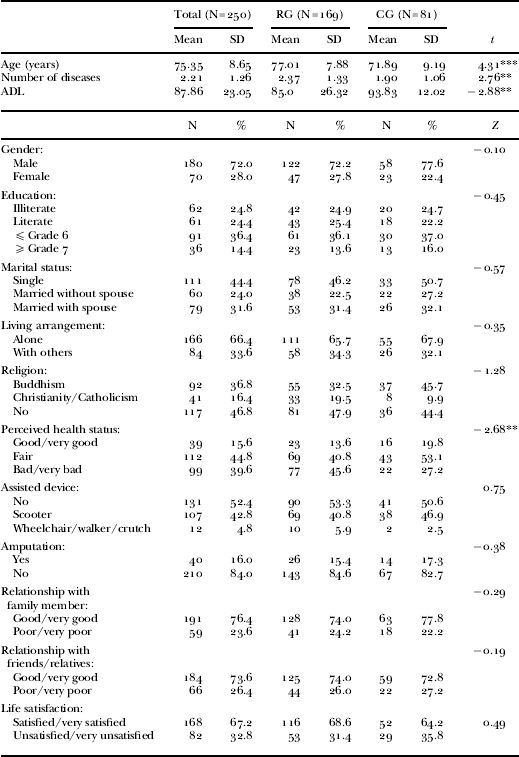
A total of 250 individuals were enrolled as subjects. Sixty-two Leprosy Residential Community residents were excluded from participation because they did not meet criteria (N=41), died (N=3) or provided incomplete questionnaires (N=18). Average subject age was 75.35 years (SD=8.65, range=59–99); almost three-quarters (72%) were male; subjects had a mean 2.21 diagnosed diseases (SD=1.26); over half lived independently (N=138), with a mean ADL score of 87.86 (SD=23.05); 40 subjects (16%) had experienced a leg amputation; slightly over half (52.4%, N=131) could walk without device assistance; and scooters were used by 42.8% (N=107) as an assistance device. Relationships with family members and friends/non-immediate family relations were good or very good in 76.4 and 73.6 per cent of subjects, respectively. A total of 168 were satisfied or very satisfied with their life before relocation. In terms of RG relocation choice, 35, 32, 30, 26 and 46 moved to the fourth, fifth, sixth, seventh and eighth floor, respectively. RG subjects were older (t=4.31, p<0.000), with more diseases (t=2.76, p=0.006), lower ADL (t=−2.88, p=0.004) and poorer perceived health (z=−2.68, p=0.007) than their CG peers. Thus, the subsequent ANCOVA identified age, number of diseases, ADL, perceived health status and residential floor level as covariates. Table 1 shows aggregate personal data on study subjects.
Personal information of subjects before relocation

Notes: RG: relocation group. CG: comparison group. SD: standard deviation. ADL: activity of daily living.
PA level
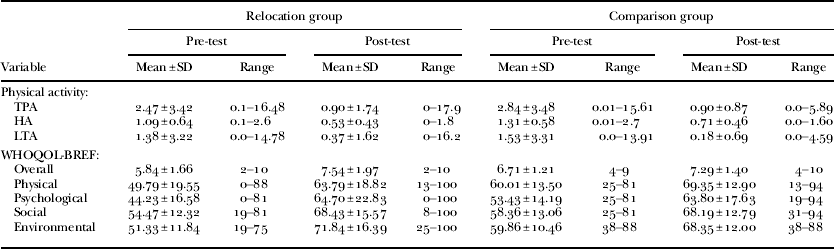
For the residential group, mean TPA, HA and LTA pre-test scores were 2.47 (SD=3.42), 1.09 (SD=0.64) and 1.38 (SD=3.22), respectively. Post-test scores for the same group were 0.90 (SD=1.74), 0.53 (SD=0.43) and 0.037 (SD=1.62), respectively. For the comparison group, mean TPA, HA and LTA pre-test scores were 2.84 (SD=3.48), 1.31 (SD=058) and 1.53 (SD=3.31), respectively. Post-test scores for CG were 0.90 (SD=0.87), 0.71 (SD=0.46) and 0.18 (SD=0.69), respectively. See Table 2 for PA score details.
Physical activity and quality of life before and after relocation in relocation and comparison groups
Notes: SD: standard deviation. TPA: total physical activity. HA: household activity. LTA: leisure-time and sport activity. WHOQOL-BREF: brief version of the World Health Organization Quality of Life assessment.
QOL level
Mean RG pre-test scores for overall, physical, psychological, social and environmental aspects of WHOQOL-BREF were 5.84 (SD=1.66), 49.79 (SD=19.55), 44.23 (SD=16.58), 54.47 (SD=12.32) and 51.33 (SD=11.84), respectively. Mean RG post-test scores were 7.54 (SD=1.97), 63.79 (SD=18.82), 64.70 (SD=22.83), 68.43 (SD=15.57) and 71.84 (SD=16.39), respectively. Mean CG pre-test scores for overall, physical, psychological, social and environmental aspects of WHOQOL-BREF were 6.71 (SD=1.21), 60.01 (SD=13.50), 53.43 (SD=14.19), 58.36 (SD=13.06) and 59.86 (SD=10.46), respectively. Mean CG post-test scores were 7.29 (SD=1.40), 69.35 (SD=12.90), 63.80 (SD=17.63), 68.19 (SD=12.79) and 68.35 (SD=12.00), respectively. See Table 2 for QOL score details.
The effect of relocation on PA and QOL
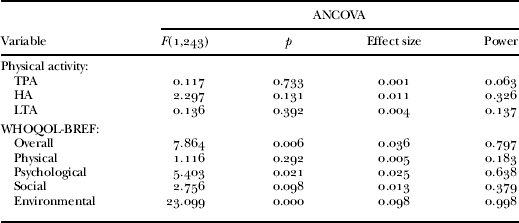
Researchers used ANCOVA to test differences between RG and CG in terms of PA and QOL using residential floor level, age, number of diseases, ADLs, perceived health status and pre-test scores as covariates. We found no significant differences in TPA (F=0.117, p=0.733), HA (F=2.297, p=0.131) and LTA (F=0.136, p=0.392). Thus, the impact of relocation on the PA seemed not to be supported by these results as shown in Table 3. Lower effect sizes, ranging from 0.001 to 0.011, with lower powers of 0.063–0.326 were found.
The impact of high-rise residence on physical activity and quality of life
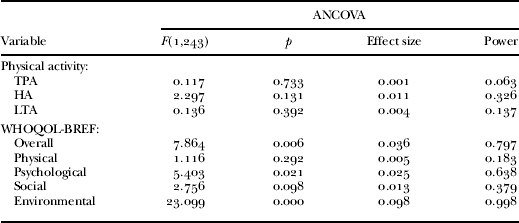
Notes: ANCOVA: analysis of covariance. TPA: total physical activity. HA: household activity. LTA: leisure-time and sport activity. WHOQOL-BREF: brief version of the World Health Organization Quality of Life assessment. Age, number of diseases, activity of daily living, perceived health status, floor of living residency and pre-test score of each variable were covariates in the ANCOVA analysis.
An exploration of differences in the overall score (F=7.864, p=0.006) and psychological (F=5.403, p=0.021) and environmental (F=23.099, p<0.001) aspects of the WHOQOL-BREF identified no differences in the physical (F=1.116, p=0.292) and social (F=2.756, p=0.098) aspects. This finding partially supported the impact of high-rise residence living on QOL. Lower effect sizes, ranging from 0.005 to 0.098, with low to high power of 0.183 to 0.998 were found. Results are displayed in Table 3.
Discussion
The effect of high-rise residency on PA
The data indicated that relocation to the high-rise residence did not affect subject PA. The different proportion of PA in older and younger people might be a possible explanation, with household activities comprising the bulk of PA undertaken by older people. Household activities are carried out in personal living areas and are not affected by residence type. Sports and recreational activities that require larger indoor or outdoor space comprise a small portion of PA in older people (Chen Reference Chen2006; Washburn Reference Washburn2000). This study did not examine the location of the subjects’ leisure-time activity, hence it is impossible to assess this hypothesis further. Considering place and setting of leisure-time activities is suggested in future studies on the effects of older peoples’ residency type on PA.
Findings by Chen (Reference Chen2005) that community-dwelling older people living in vertical apartment residences participated less frequently in activities suggests a floor-level effect on activity participation. In order to examine the potential effect of floor level, this study conducted the analysis of variance of RG subjects to identify potential floor-level effects on HA (F=2.137, p=0.082), LTA (F=0.585, p=0.674) and PA (F=0.448, p=0.774). The results identified no significant effects of floor level on PA of older retirement community adults which contradicted Chen's (Reference Chen2005) observations. RG subjects in this study had well-designed barrier-free access to familiar campus facilities. Familiarity and ease of access, thus, may have contributed to this study's result. In addition, whether the ‘high-rise housing effect’ on PA differs between institutional and personal home type is a question that would be worth pursuing in future research.
PA levels were lower in post-test than pre-test for both RG (HA: t=10.99, p<0.001; LTA: t=3.75, p<0.001; PA: t=5.50, p<0.001) and CG (HA: t=6.66, p<0.001; LTA: t=2.74, p=0.008; PA: t=3.86, p<0.001). The provision by the administration office of free meal services to all residents after relocation may have had the effect of decreasing opportunities for HA participation and may help explain lower post-test PA scores for both groups. Also, the negative effects of ageing and disease on physical functions and activity participation reported by Chen (Reference Chen2006) may also help explain the reduced scores. The lower effect size and power suggest that other unrevealed factors also affected the subjects’ participation in PA. However, offering PA programmes to older community residents is strongly suggested to improve PA participation and health.
The effect of high-rise residency on QOL
Research into the effect of housing on older residents typically focuses on the status and factors that influence QOL in different settings (hospital, nursing home or other long-term care facilities) or after relocation (Joseph et al. Reference Joseph, Zimring, Harris-Kojetin and Kiefer2005; Wahl and Weisman Reference Wahl and Weisman2003). Other housing issues, such as spatial design, are seldom mentioned. Scant research has been published on the effects of high-rise housing on QOL, especially with regard to older people. Architects thus have little research evidence to draw upon to support the design of buildings for older people. Therefore, we recommend that health professionals devote greater attention to understanding the effects of housing on older adults’ QOL to provide architects with appropriate guidance (Sheppard Reference Sheppard2009; Ulrich Reference Ulrich2006).
The positive effect of high-rise residence living on QOL overall, psychological and environmental aspects demonstrated by this study indicated that moving into new high-rise residence helps promote psychological and environmental aspects that promotes overall QOL. However, the effect of moving into a brand-new or refurbished residence on the subjects’ QOL cannot be ruled out. Further study to establish the influence of refurbishment is recommended.
Several characteristics of high-rise residence living were mentioned that might contribute to the findings of this study. Crans and Young (Reference Crans and Young2005) reported that visual use (not only direct physical use) of open space provides psychological health benefits; Dijkstra, Pieterse and Pruyn (Reference Dijkstra, Pieterse and Pruyn2006) also reported that the windows and views of nature have positive health effects. Window views from a high-rise building may be comparable or even better than those from ground-level housing. Future studies to explore the relationships between QOL and windows and visual contact with nature are suggested.
Wahl and Weisman (Reference Wahl and Weisman2003) reported the strong influence of physical-spatial structure on social interaction to be a key stimulation function of environment. Ulrich (Reference Ulrich1992) identified seeing people smile and hearing the sound of activity as effective positive environmental stimuli. Each floor of a high-rise residential building provides more centralised common living space than ground-level residences, therefore the influence of increased opportunities for sensory stimuli on residents’ QOL of such buildings should not be ruled out.
Methodology issues
One consequence of the complex nature of housing is that designing research that is sensitive to the effects of housing on health is difficult. The level of scientific evidence in housing-related studies is low compared to that of medical research. Several related methodological shortcomings include lower levels of evidence, limited size and duration, lack of control group use and randomised intervention (Jacobs et al. Reference Jacobs, Wilson, Dixon, Smith and Evens2009; Joseph et al. Reference Joseph, Zimring, Harris-Kojetin and Kiefer2005; Kyle and Dunn Reference Kyle and Dunn2008). Heywood and Turner (Reference Heywood and Turner2007) also stated that more work is needed to distinguish the effects of a single intervention. Therefore, this study represents a relatively rare opportunity for researchers to observe and participate in a natural relocation event in an independent community. Even though subjects were part of a minority group (leprosy sufferers), their reactions to moving into a new high-rise residency in terms of PA and QOL provided valuable insights that may suggest conditions that are prevalent in the broader population of older people. This study used a controlled cohort design with two groups and pre- and post-testing to investigate the effect of high-rise residence on older people. The study used a research design that controlled environmental and organisational factors and ANCOVA to control personal factors such as demographics, health conditions and social factors. The effect of high-rise residency could thus be isolated for study, as services and amenities were the same for all subjects.
Study limitations
Study results indicated a low effect size. This may be attributable to our administration of the post-test six months after relocation, which could have allowed subjects sufficient time to adapt to their new environment. We identified acceptable power for overall QOL and higher power for environmental aspect, but lower power for physical and social aspect scores. This implied that our sample size (N=250) was appropriate to predict the effect of QOL overall and environmental aspects and inadequate to predict the effect of relocation on QOL physical and social aspects.
Self-reporting rather than direct measurement of PA is another study limitation. While this study examined the effects of high-rise residence living on leprosy patients who voluntarily relocated to a high-rise building in their retirement community, their mobility and health needs were similar to community-dwelling older people as reported in other studies (Wu et al. Reference Wu, Cheng, Lee and Chen2010). Nevertheless, study generalisability remains limited to individuals with leprosy and results should be applied with caution.
Conclusions
The primary contribution of this study is its use of relatively high evidence-level research design and controlled cohort design to measure PA and QOL differences between traditional and high-rise building residency. The findings expand current knowledge regarding environmental gerontology, especially with regard to the stimulation function of environment. This study found that moving into a high-rise residence did not decrease PA participation and actually promoted QOL overall, psychological and environmental aspects in older leprosy residents. The results provide evidence-based information for older leprosy clients, their families, policy makers, architects and health professionals in order to facilitate better construction and spatial designs for communities of ageing residents. We recommend that further studies explore the effects of place and setting on leisure-time activity participation, differences in effect on PA between institutional and private residence high-rise housing, and effects on QOL of windows, visual contact with nature and residency remodelling. We also strongly recommend that health professionals continue to research older peoples’ housing to expand knowledge concerning physical activities programmes for institutionalised residents.
Acknowledgements
This work was supported by the Ministry of Education, Aim for the Top University Plan (grant number 98A-C-97D2); and Department of Health, Executive Yuan, Taiwan (grant numbers DOH94-TD-05 and DOH95-TD-01).