





Impact statement
Grazing of livestock is an important land use in dry rangelands (drylands), but is often associated with land degradation. In extensive pastoral systems, uncontrolled livestock grazing often leads to overuse of preferred areas and underuse of others. Self Herding is a conceptual term describing a strategy that allows managers to alter animal behaviour using a range of olfactory, sight and sound cues to influence how animals move across the landscape. This reduces the use of stressful activities that lead to reduced livestock condition. The potential benefits of Self Herding include lower animal stress, improved landscape condition (less erosion and overgrazing), and fewer attacks and herd interference by predators. In Australia, Self Herding has been trialled for more than a decade, with clear land management benefits. However, further work is needed to validate Self Herding strategies using more rigorous scientific methods, and to explore a greater number of situations with various landscapes and soil types, showing where it can have maximum benefit.
Introduction
Livestock grazing is the predominant land use over extensive areas of Earth’s terrestrial land area (Steinfeld et al., Reference Steinfeld, Gerber, Wassenaar, Castel and De Haan2006). Livestock provide a range of ecosystem goods and services, ranging from meat, milk, hide, transport, and a means of exchanging capital (Steinfeld et al., Reference Steinfeld, Gerber, Wassenaar, Castel and De Haan2006; Teague and Kreuter, Reference Teague and Kreuter2020). Thirty-eight percent of the world’s protein is ultimately derived from livestock grazing, including dairy (Ritchie et al., Reference Ritchie, Rosado and Roser2017), and much of this is produced in rangelands, i.e., semiarid, arid and dry subhumid areas dominated by native and naturalised grasslands with few external inputs. There are many grazing ‘styles’ or systems, and these range from transhumance systems on the African and Asian continents (Timpong-Jones et al., Reference Timpong-Jones, Samuels, Sarkwa, Oppong-Anane, Majekodumni and Wario2023) to continuous grazing where animals are left to graze for long periods (e.g., Australia), time-controlled grazing, industrial-style factory feedlots (Sayre, Reference Sayre2024), and specialist grazing systems where for example, habitat restoration or fire hazard control is the primary objective, with livestock use as a secondary consideration.
In dry rangelands (drylands), livestock are managed to varying degrees by people (pastoralists, shepherds, herders, producers, land managers, ranchers), and in many situations this can be extremely time-consuming and costly. Managing livestock is critical for landscape function because animals do not graze evenly across the landscape (Squires, Reference Squires1981), leading to areas of excessive disturbance (e.g., Vidal-Cardos et al., Reference Vidal-Cardos, Fàbrega and Dalmau2025). Rather, they have preferred grazing patches (Teague and Dowhower, Reference Teague and Dowhower2003) based on considerations such as accessibility, digestible energy and protein needs, closeness to water, and fear of predation (Miller and Schmitz, Reference Miller and Schmitz2019). However, all grazing in drylands depends on watering points where sufficient quality and quantity of water are within walking distance. This water-centred grazing often leads to soil and pasture degradation (piosphere effect, Lange, Reference Lange1969; Andrew, Reference Andrew1988), where substantial changes in plants and soils occur due to habitual congregation of animals (James et al., Reference James, Landsberg and Morton1999).
To mitigate these effects, a form of livestock management known as Self Herding works to alter livestock behaviour by combining incentives such as supplements (e.g., rewards) with sensory signals. Self Herding relies on using signals that have been previously linked to the habitual expectation of rewards. These signals are then used to direct the animals around the landscape. Signals (cues) linked to the expectation of reward provide the positive feedback tools to establish addictive and long-lasting habits that land managers can implement to alter decisions made by livestock. These decisions lead to more effective livestock management. Self Herding relies on the application of directed choice options that the land manager has reinforced by antecedents linked to specific and clear signals that offer ‘reward’ (sight, sound, smell, scratch – the sensory quad – or any combination) (Revell and Maynard, Reference Revell and Maynard2017). When implemented under field conditions, there is potential for improved animal and herd performance coupled with better land management (Revell and Maynard, Reference Revell and Maynard2017. Practices that replace or alter entrenched animal behaviours towards more beneficial behaviours are embodied in the term ‘Self Herding.’ Thus, Self Herding can be seen as a suite of strategies and techniques to initiate beneficial habitual behaviours that lead to more sustainable land management and greater animal performance.
Here we describe the main principles embodied in Self Herding and provide three examples of its application designed to: (i) influence the positive movement of animals under rangeland management systems; (ii) repair and reduce soil erosion; and (iii) modify predator fear reactions for increased monitoring or lethal control. The material reported here is the result of more than two decades of on-farm application and experience from many large pastoral stations in Australian arid and semi-arid rangelands.
The concept of Self Herding
Self Herding encompasses strategies, techniques and tools that allow land managers to positively influence the way that animals interact with plants, water and the landscape. It uses signals (sight, sound, smell and scratch/touch), reinforced by rewards (food, group socialising and tactile tools) to replace existing habitual behaviours with alternative addictive habits. Self Herding uses well-understood animal training and behavioural analysis principles to change ‘usual,’ often entrenched, animal behaviour, to achieve greater landscape and production benefits without animal stress or discomfort. Using combinations of techniques and tools, Self Herding can encourage animals to remain in one location for longer, move to another location, or avoid particular parts of the landscape. It is therefore more active than set stocking where animals are left to graze where they want, because greater monitoring and attention is required. Self Herding is most effective over large pastoral landscapes where animal behaviours have historically been unconstrained, and resource use and overuse are reinforced by terrain, vegetation and water access.
The seven key principles of Self Herding
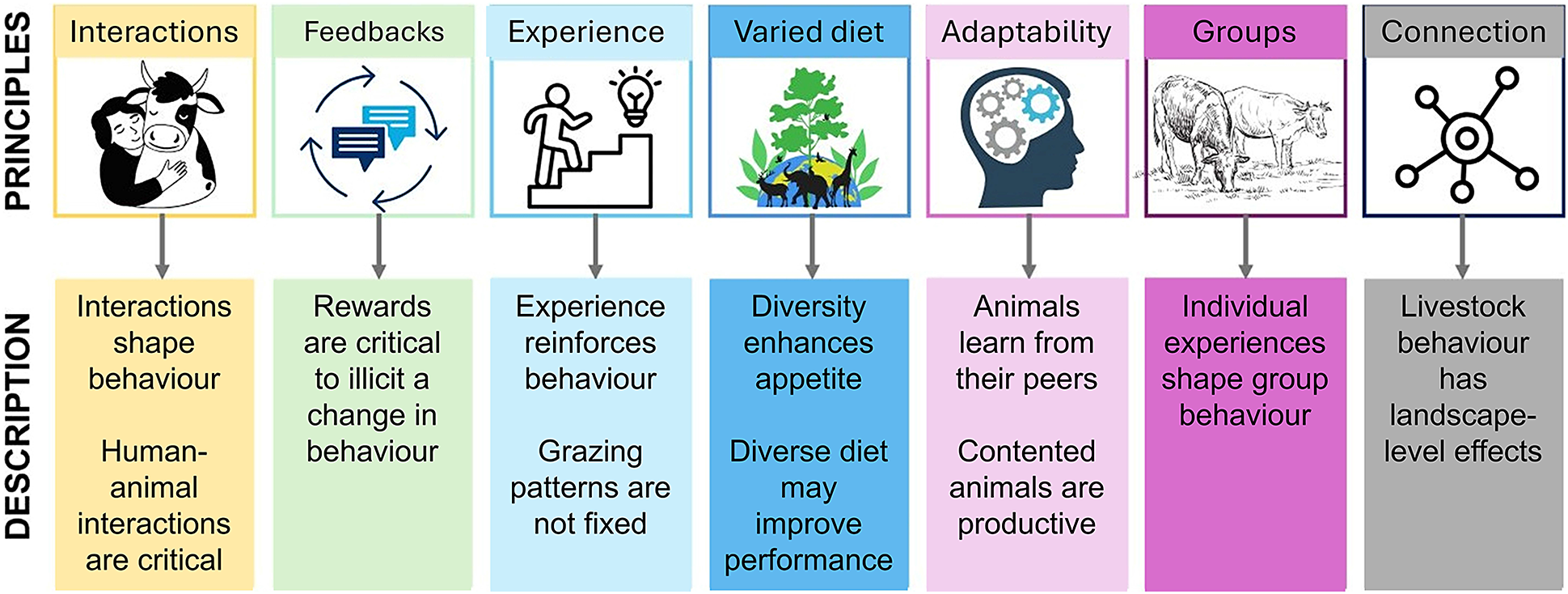
Seven key foundational principles of Self Herding have evolved from research and applied development by synthesising information on animal nutrition, animal behaviour and rangeland management (Figure 1). These principles relate to the complex interactions and feedback among people and animals (and the effects that this has on feed quality and quantity within diverse ecosystems), the importance of animal nutrition, particularly growth stage and diet requirements, and positive reinforcement of animal behaviour that is necessary to effect affirmative change.
The seven principles of Self Herding.

Figure 1. Long description
The diagram is organized into seven vertical columns. The top row is labeled PRINCIPLES and the bottom row is labeled DESCRIPTION. Each column is color-coded.
1. Interactions (Yellow): Icon of a person hugging a cow. Description: Interactions shape behaviour. Human-animal interactions are critical.
2. Feedbacks (Light Green): Icon of two speech bubbles in a circular arrow loop. Description: Rewards are critical to illicit a change in behaviour.
3. Experience (Light Blue): Icon of a person climbing stairs toward a flag. Description: Experience reinforces behaviour. Grazing patterns are not fixed.
4. Varied diet (Blue): Icon of various wild plants and flowers. Description: Diversity enhances appetite. Diverse diet enhances performance.
5. Adaptability (Pink): Icon of a human head profile with gears and a percentage symbol inside. Description: Animals learn from their peers. Contented animals are productive.
6. Groups (Purple): Icon showing a silhouette of a herd of cattle. Description: Individual experiences shape group behaviour.
7. Connection (Grey): Icon of five circles connected to a central hub. Description: Livestock behaviour has landscape-level effects.
Principle 1: Human-animal interactions shape outcomes
Systems involving Self Herding are adaptive, with humans actively directing livestock and non-domesticated animals to interact differently with their natural environment (Revell et al., Reference Revell, Maynard, Erkelenz, Thomas and Friedel2015; Revell and Maynard, Reference Revell and Maynard2017). Human behaviour is the strongest driver of these interactions. For example, initiating flight responses from livestock on approach by humans reinforces and then strengthens that reaction, which then leads to increased stress on livestock and a tendency to repeatedly avoid human engagement. Encouraging livestock to move slowly and in a preferred direction with the expectation of a reward at the destination has long-lasting positive benefits (Revell and Maynard, Reference Revell and Maynard2017). Misapplied or misunderstood principles of animal behaviour are often the largest contributing factor to why particular results (positive or negative) are achieved. Positive reinforcement can become either neutral or negative if the manager is unaware of the clear behavioural signals they present to the animals.
Principle 2: Internal feedback sets behaviours
Foraging behaviour of animals is driven by the multiple nutritional needs at the individual animal level. Improving animal nutrition leads directly to improved production outcomes for livestock (Ginane et al., Reference Ginane, Bonnet and Revell2015). Internal preferences are established as early as the third trimester in utero as flavour and taste flow through the developing foetus (Garrett et al., Reference Garrett, Marshall, Beck, Fleming, Maxwell, Logan, Greer and Gregorini2021). These material dietary choices can be further reinforced post-birth in association with nurturing from the matrilineal connections that underlie dietary mixing behaviours. Animals can be encouraged to move to a particular location by initiating the expectation of rewards linked to intermittently reinforced signals. These new behaviours can become permanent habits that do not require additional reinforcement. Dietary reinforcements include high-value nutritional feeds as attractants, but importantly, these are variably provided along with low-value (or no dietary value) dietary rewards to amplify the expectation of reward, rather than the reward substance itself (Provenza and Balph, Reference Provenza and Balph1988). At all times, the provision of reinforcers (dietary or otherwise) is linked to one or more of the clear signals from the Sensory Quad (Revell and Maynard, Reference Revell and Maynard2017). Once behaviours are clearly being repeated in response to signals, the need for external reinforcers (such as the provision of dietary rewards) diminishes towards little or no human intervention (Hirata and Takeno Reference Hirata and Takeno2014).
Animals can be encouraged to forage in a particular location by initiating the expectation of reinforcement linked to signals, and these new behaviours can become permanent habits that do not require additional reinforcement. Dietary reinforcements, as described above, are important. At all times, the provision of reinforcers (dietary or otherwise) is linked to one or more of the clear signals from the Sensory Quad. Once behaviours are clearly being repeated, then reinforcement via applied signals is the dominant pathway with dietary reinforcement only necessary if the desired behaviours begin to recede (Hirata and Takeno, Reference Hirata and Takeno2014).
Principle 3: Experience reinforces behaviour
Most currently applied tools that influence behaviour are based on force pathways (aversion to negative stimulus) to deter activities (e.g., electric fencing to prevent access to sensitive sites) (Aaser et al., Reference Aaser, Staahltoft, Korsgaard, Trige-Esbensen, Alstrup, Sonne, Pertoldi, Bruhn, Frikke and Linder2022). An underlying foundation of all the Self Herding principles and practices is that choice rather than force is the behavioural pathway most likely to bring about behavioural change. Existing behaviours are replaced by expanding the positive experiences in a beneficial reinforcement spiral (initial rewards drive an expectation of further and varied rewards). Experience is a key evolutionary adaptation extending across generations. New or more desirable (from a social, landscape or business perspective) behaviours can be habitually imprinted by repetition of positive experiences.
Principle 4: Animals seek dietary diversity
Like humans, all animals prefer a diverse diet (Zanon et al., Reference Zanon, Komainda, Ammer, Isselstein and Gauly2022). Different food items provide different levels of nutrition and satiation to meet the diverse requirements of livestock at different stages of growth and development, often leading to more contented animals (Beck and Gregorini, Reference Beck and Gregorini2020). The Satiety Hypotheses (Villalba et al., Reference Villalba, Provenza, Catanese and Distel2015) contend that even plants that occur at very low abundances may be critically important components of an animal’s diet because of digestible micronutrients, including vitamins and phytochemicals. A more diverse diet can be used to encourage animals to move towards or away from specific areas (Zanon et al., Reference Zanon, Komainda, Ammer, Isselstein and Gauly2022), and this diet can lead to healthier animals and potentially greater animal weight gain (Provenza, Reference Provenza1996). This productivity gain can be accomplished concurrently with redistributing animals to enable maximum landscape function.
Principle 5: Adaptability is required to support change
Animals subjected to a wider range of experiences (and feeds) are more willing to face new circumstances and challenges when they arise, as demonstrated by the effect of exposure of ewes to different feeds on the response of their lambs (Simitzis et al., Reference Simitzis, Bizelis, Deligeorgis and Feggeros2008). Early life exposure is a very formative influence, occurring both in utero and post-birth. Locally adapted ‘peer’ animals can be used to accelerate the range of learned activities that animals new to that landscape engage in. An important foundation for this is ensuring that ‘experienced’ animals actually socially integrate with ‘novice’ animals. If groups of animals are not actively integrated, then associative learning is less likely. Animals with greater behavioural ‘plasticity’ at a young age are likely to adopt new behaviours more rapidly than older animals. Older animals transfer experiential aspects by habitual behaviours that have accrued over time.
Principle 6: Individual experiences shape group behaviour
All grazing animals are individually inquisitive to varying degrees and experiment with new diets and new locations and explore the resources available to them. The degree of dietary choice can be expanded by active Self Herding interventions that lead to increases in experimental activity that transfers to group behaviours. One such intervention is the use of a cocktail of minerals and a detoxifying agent. When provided as a recurring part of attractant stations moved throughout a landscape, it provides the opportunity for animals to repeatedly sample both the mineral cocktail and plants high in aversive compounds (Revell and Maynard, Reference Revell and Maynard2017).
Principle 7: Broad consequences – everything is connected
Livestock behaviour affects ecosystems directly and indirectly, with feedback effects on the livestock themselves and other animals through trophic waves (depending upon time exposed, severity and frequency). Animals alter plant communities (Squires, Reference Squires1981), which affects foraging preferences, directional flock movement, and how animals respond to their environment. Livestock are not the only animals in these large rangeland systems, which contain free-ranging native herbivores and predators, but they are the tools by which manipulation of ecosystems can be economically achieved. Self Herding can change how livestock can more proactively avoid predators (Miller and Schmitz, Reference Miller and Schmitz2019).
Anticipation of the reward rather than the reward itself can drive landscape impact
Self Herding seeks to strengthen animal responses to a range of stimuli, such as sight, sound, smell and novel objects, to an addictive and repetitive level. Reinforcement need only be infrequent and intermittent once the behaviour has a strong repetitive outcome. This insight allows Self Herding techniques to be practical, affordable and achievable for humans applying them. The rapidity of response is heightened by group dynamics where observational learning is expressed (if underlying human/animal anxieties are addressed). In rangeland situations, nutritious feedstuffs and attractants have been used to change behaviour (Ginane et al., Reference Ginane, Bonnet and Revell2015). These include molasses blocks, phosphorus and other supplements, coarse salt, mineral licks and hay (Bohnert and Stephenson, Reference Bohnert and Stephenson2016). This can alter animal occupation of areas, but the effect is often lost when the supplements are removed. Self Herding works by combining supplements with sensory signals. Olfactory cues are the most effective signals for all animals (Nielsen et al., Reference Nielsen, Jezierski, Bolhuis, Amo, Rosell, Oostindjer, Christensen, McKeegan, Wells and Hepper2015), and tactile objects such as scratching poles and hanging chains are useful to highlight that reinforcement is not only reliant on dietary supplements.
Below we describe three scenarios where Self Herding has been used to improve the management of rangelands.
Managing cattle movements between watering points in arid rangelands
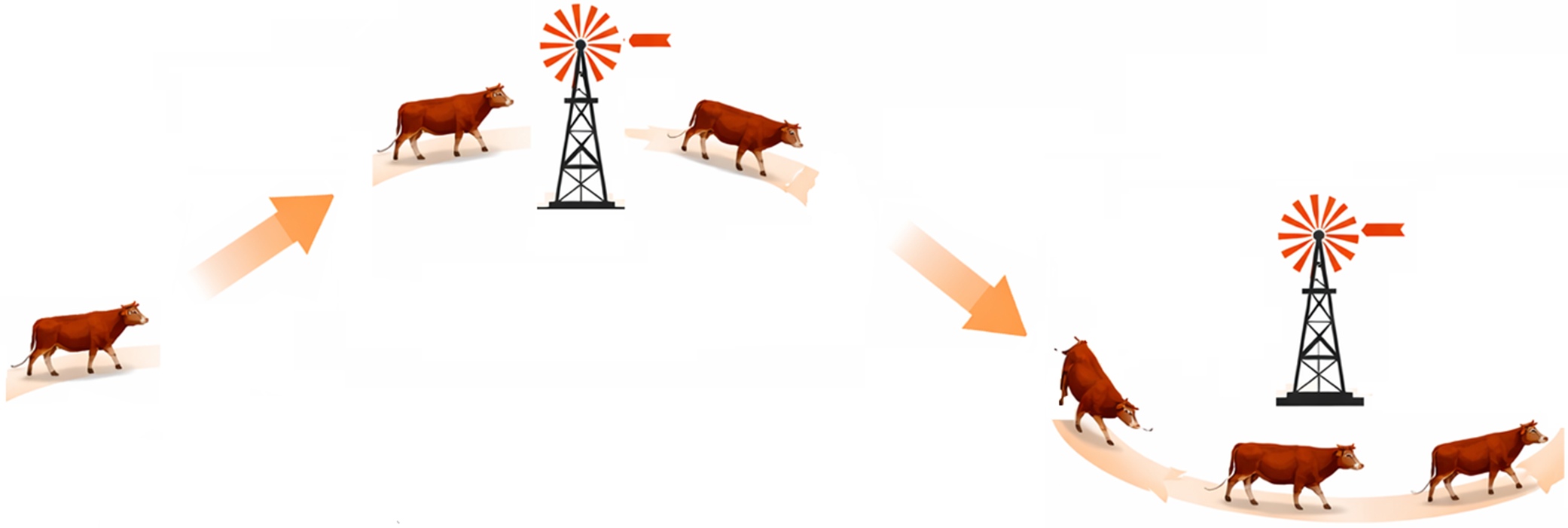
Understanding the movement and influence of grazing pressure is extremely important in arid areas, which are vast, often sparsely vegetated, and where degradation can more easily occur where animals congregate. Without active management, some areas will be underutilised, and others overutilised. Livestock tend to congregate around watering points in rangelands (Lange, Reference Lange1969), yet these are centres of biological activity and richness (James et al., Reference James, Landsberg and Morton1999), so moving animals along is an important consideration. One practice, water wheeling (Figure 2) encourages livestock to move from one water point to the other using attractant stations or signals, but it needs to include behavioural changes. Without behavioural change, animals can perish waiting for water to be available. Water wheeling can move animals out from their habitual water point to the next water point in succession. For rangeland management, the option to begin turning off artificial watering points in a rotational grazing approach reduces total grazing pressure by also encouraging other grazing animals (e.g., kangaroos) reliant on permanent water sources to move on (Fensham and Fairfax, Reference Fensham and Fairfax2008).
Water wheeling. Animals move around a water point following attractants, then move onto another water point without staying long at the previous water point.

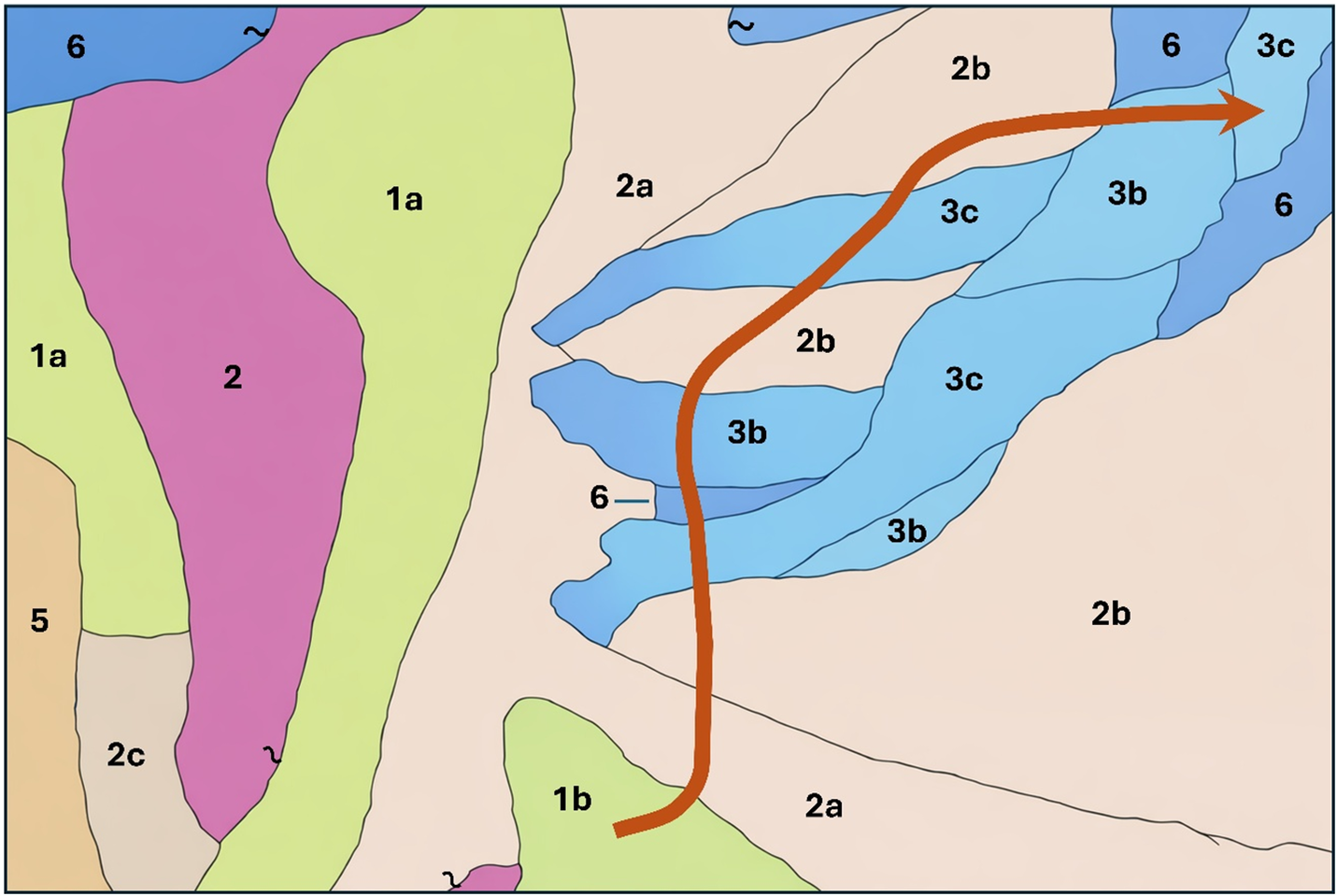
Moving animals sequentially to a new water point allows previously used watering points to recover from grazing. Signals are placed close to an existing water point and then gradually moved in a spiralling direction around the water point towards the new water point (Figure 2). This encourages animals to move through different parts of the landscape to promote a more even distribution of grazing, trampling, and urine/manure deposition. This movement can be planned using a landscape jigsaw (Figure 3), which identifies parts of the property to be avoided or utilised more. The jigsaw allows the manager to plan where animals are grazing, particularly across mixed landscapes (Turner and Hiernaux, Reference Turner and Hiernaux2002). The landscape jigsaw approach is a planning and recording tool to visualise how and when different parts of the paddock are being used.
Landscape jigsaw. A pictorial representation of different parts of a rangeland pastoral lease showing the planned route for moving animals through the property in order to avoid land classes 1a and 2. The red line represents the intended route for moving livestock.

Figure 3. Long description
A pictorial map divided into irregular polygons representing different land classes.
* The Western side contains vertical bands of land classes 5 (tan), 1a (light green), 2 (pink), and another 1a (light green).
* The Southern edge features a small section of 1b (green) and 2c (tan).
* The Central and Eastern regions are dominated by land classes 2a and 2b (beige), interspersed with blue-shaded areas labeled 3b, 3c, and 6.
* A thick red arrow indicates the planned livestock route. It begins in the South within land class 1b, travels North through a narrow corridor of 2a, crosses through blue zones 3b and 3c, and finally turns Northeast to end in zone 3c at the top right corner.
* The route is specifically designed to navigate through the beige and blue zones while avoiding the large pink zone 2 and the light green zones 1a on the West side of the property.
Self Herding to repair degraded landscapes
Self Herding can be used to direct animals to areas where the herd effect (via hoof action, faecal and urinary deposition) might have a role in promoting soil surface roughening, slope abatement, incorporation of vegetable matter or addition of biologically stimulating organic fertilisers. When used judiciously, these can have positive benefits for soil function or erosion control. Most Self Herding techniques have only a small potential for negative outcomes, but attracting animals to repair eroded watercourses should be guided by an understanding of hydrological function (Wilcox and Thurow, Reference Wilcox and Thurow2006). However, the extent to which livestock can induce soil recovery depends on many factors such as the extent of abiotic damage, the evolutionary history of grazing, antecedent conditions of the soil, slope, the rainfall intensity and water movement and erodibility of soil, the type of grazing animal, and the pressure and time over which the site is subjected to grazing (herd effect). Empirical studies with sound research design including control sites and appropriate replication are required to test the applicability of applying Self Herding in watersheds and riparian areas.
Managing wild dogs and livestock to prevent depredation
Livestock-animal conflict is common in many rangelands globally (Ugarte et al., Reference Ugarte, Moreira-Arce and Simonetti2019), particularly in mosaic landscapes where the home ranges of carnivores intersect with extensive grazing systems (Balme et al., Reference Balme, Slotow and Hunter2010). Dealing with predators with defined territories such as dogs has conventionally relied on population reduction (lethal controls), or aversion (active hunting or harassing).
Self Herding offers another potential avenue by implementing managed movement of livestock around the landscape. This relies on encouraging livestock to move en masse so that greater protection from wild dogs is achieved by eliminating vulnerable, isolated animals. Signals linked to the expectation of dietary rewards can encourage livestock to move through the home-ranges of dogs as a group in ‘convoy’ style. Isolated animals allow predators to gain hunting experience and be positively reinforced for further attacks by the avoidance reactions of those isolated animals.
Conclusions
Self Herding is an expanding set of strategies, tools and techniques that offer new and innovative ways to implement landscape and production goals. The range of options that can be implemented is not limited, as the combinations of techniques and tools available are multiplied by the range of situations and outcomes desired. Self Herding also enables the implementation of established principles and practices that may otherwise be difficult, dangerous or impossible to apply. Many benefits of Self Herding can ensue, such as lower animal stress, improved landscape condition (less erosion, overgrazing), reductions in runoff and overland flow (due to managed ground cover), and fewer attacks and less herd interference by predators. Novel applications to manage other livestock or feral animals will rely on altering animal behaviour to improve the management of livestock or the animals with which they interact. Many of these novel practices are in the evolving proof-of-concept stage with landholders as the key innovators.
The outcomes of Self Herding have so far not been extensively examined within a rigorous reductionist framework, but the indicative field results from over a decade demonstrate that the underlying scientific hypotheses (from a variety of science fields), apply in real-world situations. To further validate the strategies, tools, tactics and techniques applied will require quantitative measures and monitoring to determine whether any findings of improved rangeland management due to the Self Herding practice are repeatable and predictable. Humans are central to the cascade of effects throughout rangeland agroecosystems. The continued uptake of Self Herding principles will help us to build up a larger set of situations that can be evaluated, monitored and continuously improved using rigorous scientific methods.
Open peer review
For open peer review materials, please visit https://doi.org/10.1017/dry.2026.10046
Acknowledgements
We thank David Eldridge for encouraging us to prepare this manuscript and for providing comments on previous iterations.
Author contribution
B.M. and D.G.: conception, structure, original draft preparation, review and editing.
Declaration of interest
The authors declare no competing interests.
Data availability statement
This manuscript has no associated data.
Funding statement
We declare no financial conflict of interest.

 Open access


Comments
No accompanying comment.