Introduction
Non-suicidal self-injury (NSSI) is the direct and intentional destruction of one's body tissue without suicidal intent (Nock & Prinstein, Reference Nock and Prinstein2004; Nock et al. Reference Nock, Joiner, Gordon, Lloyd-Richardson and Prinstein2006; Shaffer & Jacobson, Reference Shaffer and Jacobson2010). These behaviors range from self-cutting, scratching and burning to implanting objects under the skin. Although no national estimates of NSSI exist, prevalence estimates from individual community studies show that NSSI seems to be more common in adolescents [~15% (Ross & Heath, Reference Ross and Heath2002; Muehlenkamp & Gutierrez, Reference Muehlenkamp and Gutierrez2004)] and young adults [17% (Whitlock et al. Reference Whitlock, Eckenrode and Silverman2006)] than in adult populations [4% (Briere & Gil, Reference Briere and Gil1998) and 6% (Klonsky, Reference Klonsky2011)].
The knowledge base regarding NSSI is limited in part because of methodological limitations of existing studies. For example, the majority of studies have used cross-sectional designs and clinical samples. The few prospective studies of NSSI with community samples did not sort out the temporality between constructs, were exploratory due to small sample size (Hankin & Abela, Reference Hankin and Abela2011), or focused on one developmental pathway (e.g. parental criticism on NSSI, peer influences on NSSI) without assessing a broad range of predictors (Yates et al. Reference Yates, Tracy and Luthar2008; Prinstein et al. Reference Prinstein, Heilbron, Guerry, Franklin, Rancourt, Simon and Spirito2010). Studies of college students have used convenience samples from psychology courses without appropriate control groups and typically have low response rates. Additionally, the assessment of NSSI has varied widely between studies; many include wound-picking, which inflates the prevalence of NSSI. Lastly, most studies have not followed their sample past the peak period of risk for NSSI.
Moreover, studies have investigated a narrow range of potential correlates for NSSI based on models of adolescent suicidal behaviors, despite evidence that those who engage in NSSI without prior suicide attempts have different characteristics and psychiatric profiles from suicide attempters (Muehlenkamp & Gutierrez, Reference Muehlenkamp and Gutierrez2004). Jacobson et al. (Reference Jacobson, Muehlenkamp, Miller and Turner2008) found that the participants who engaged in NSSI without prior suicide attempts were more similar to their non-self-harming peers than their peers who had attempted suicide.
Several studies have examined individual-level characteristics that might place an individual at risk for NSSI in the face of adverse environmental or familial stressors. Stressful experiences such as family conflict and sexual or physical abuse are the most commonly cited environmental risk factors for NSSI (Weierich & Nock, Reference Weierich and Nock2008; Bureau et al. Reference Bureau, Martin, Freynet, Poirier, Lafontaine and Cloutier2010). Linehan (Reference Linehan1993) proposed that the interaction of biologically based vulnerability to intense emotion and early environments characterized by adversity and the stifling of emotional expression is associated with emotional dysregulation, which can lead to maladaptive behaviors such as NSSI. Other important environmental risk factors for NSSI include interpersonal problems with family and peers, such as more conflict, less cohesion and less support (Adrian et al. Reference Adrian, Zeman, Erdley, Lisa and Sim2011); alienation from parents; and parental criticism (Yates et al. Reference Yates, Tracy and Luthar2008). With respect to personal factors, Crowell et al. (Reference Crowell, Beauchaine, McCauley, Smith, Vasilev and Stevens2008) found more opposition/defiance and less positive affect among self-injuring adolescents as compared with adolescents who do not self-injure. The link between NSSI and depression is well established (Garrison et al. Reference Garrison, Addy, McKeown, Cuffe, Jackson and Waller1993; Jacobson & Gould, Reference Jacobson and Gould2007) but has not been adequately studied in prospective studies of community-residing young adults. In a small-scale study, Hankin & Abela (Reference Hankin and Abela2011) found that the onset of maternal depression predicted NSSI.
Albeit limited, studies of small clinical samples have suggested genetic or physiological mechanisms of NSSI linked to maladaptive stress responses (e.g. Kaess et al. Reference Kaess, Hille, Parzer, Maser-Gluth, Resch and Brunner2011). Deliberto & Nock (Reference Deliberto and Nock2008) found that those with NSSI had more family members with impulsivity-related psychopathology. Herpertz et al. (Reference Herpertz, Sass and Favazza1997) found that NSSI was associated with impaired serotonergic function, a condition associated with impulsivity and aggression. Crowell et al. (Reference Crowell, Beauchaine, McCauley, Smith, Vasilev and Stevens2008) also found that adolescents with NSSI had lower levels of peripheral serotonin (5-HT); however, in adolescents with higher levels of 5-HT, parent–child negativity was associated with NSSI.
The motives for engaging in NSSI are crucial for guiding treatment decisions and designing preventive interventions (Lloyd-Richardson et al. Reference Lloyd-Richardson, Perrine, Dierker and Kelley2007; Peterson et al. Reference Peterson, Freedenthal, Sheldon and Andersen2008). The most commonly reported motive for NSSI in community samples is related to regulating negative affect states (Laye-Gindhu & Schonert-Reichl, Reference Laye-Gindhu and Schonert-Reichl2005; Klonsky, Reference Klonsky2009). This temporary relief from distress may reinforce NSSI and make repetition likely. Other motives for NSSI are to stop disassociation and to draw parental/peer attention (Nock & Prinstein, Reference Nock and Prinstein2004), or as a means of self-punishment or eliciting care (Peterson et al. Reference Peterson, Freedenthal, Sheldon and Andersen2008).
The purpose of the present study was to investigate a wide range of potential individual and familial unique predictors of NSSI among a large cohort of young adults originally sampled as part of the College Life Study, a longitudinal study of health-risk behaviors. Qualitative data were used to examine motives for NSSI and whether NSSI was disclosed to others.
Method
Participants and procedures
Sample selection took place in two stages. First, a screening survey was administered to 3401 (response rate=89%) incoming first-time, first-year students aged 17–19 years, during new-student orientation in 2004 at a large, public university in the mid-Atlantic region of the USA. Second, purposive sampling strategies were used to oversample students who had used an illicit drug or non-medically used a prescription drug at least once prior to college. This stratified random sample of screener participants was selected to participate in a series of annual follow-up assessments (n=1253, response rate=87%). The sample was representative of the first-year class with respect to race, gender and socio-economic status (SES) (Arria et al. Reference Arria, Caldeira, O'Grady, Vincent, Fitzelle, Johnson and Wish2008a). Sampling weights were computed to produce prevalence estimates that represent the general population of screened students; however, the results did not differ appreciably, so unweighted results are presented in this report. Additional details regarding recruitment and sampling can be found elsewhere (Arria et al. Reference Arria, Caldeira, O'Grady, Vincent, Fitzelle, Johnson and Wish2008a; Vincent et al., unpublished observations).
The baseline assessment consisted of self-administered questionnaires and an interview administered by a trained interviewer during the participants' first year of college (‘Year 1’). Similar follow-up assessments were administered annually thereafter. After a complete description of the study was given to the participants, written informed consent was obtained following Institutional Review Board (IRB)-approved protocols. A federal Certificate of Confidentiality was obtained. Participants received cash incentives for each assessment. Annual follow-up rates were 91% (n=1142/1253), 88% (n=1101) and 88% (n=1097). The current sample consisted of 1081 participants who provided complete NSSI data and were enrolled in college for at least one semester during the study period (2004–2008). Most (94.4%) were still enrolled in college in Year 4. Sixteen participants were excluded due to missing data on NSSI.
Measures
NSSI
In Year 4, a self-administered module to measure NSSI was adapted from Whitlock et al. (Reference Whitlock, Eckenrode and Silverman2006). The following question assessed lifetime occurrence of NSSI: ‘Sometimes people do things to hurt themselves on purpose, like cutting, scratching, burning, or injuring themselves in other ways. Have you ever done something like that with the intention of hurting yourself? (Please do not count suicide attempts).’ Answer choices were ‘No’, ‘Yes’ or ‘Don't know’. NSSI frequency and past-year NSSI were assessed by asking, ‘How often in your life have you done these kinds of things with the intention of hurting yourself (but without the intention of committing suicide)?’ and ‘When was the last time you did something like this with the intention of hurting yourself (but without the intention of committing suicide)?’ respectively. Participants were asked about NSSI motives (‘What were your reasons for doing these things to hurt yourself?’) in an open-ended way; later, responses were coded using the method reported by Polk & Liss (Reference Polk and Liss2009). Participants were also asked, ‘Have you ever told anyone else that you did things to hurt yourself on purpose? If so, whom did you tell?’ Multiple responses were permitted and options included ‘physician’; ‘other health care professional’; ‘therapist, counselor, or other mental health professional’; ‘parent’; ‘other family member’; ‘clergy’; ‘friend’; ‘boyfriend, girlfriend, or significant other’; ‘someone else’ (and were asked to specify); and ‘no one’.
Demographics
Sex was coded as observed during Year 1. Data on race were self-reported, and later dichotomized as White versus non-White. SES was estimated by the mean adjusted gross income of participants' home ZIP codes in the last year before college (MelissaDATA, 2003). Sexual orientation was self-reported annually, with response options of ‘heterosexual’, ‘homosexual’, ‘bisexual’ or ‘unsure’, and later dichotomized into heterosexual versus other.
Suicide ideation and attempt
Self-administered questions on suicide ideation and attempt were adapted from the Composite International Diagnostic Interview (Robins et al. Reference Robins, Wing, Wittchen, Helzer, Babor, Burke, Farmer, Jablenski, Pickens, Regier, Sartorius and Towle1988) in Year 4: ‘When was the last time you seriously thought about committing suicide?’ and ‘When was the last time you attempted suicide?’ Responses were later dichotomized as ‘Never’ versus ‘Less than 24 hours ago’ to ‘More than a year ago’.
Depression, victimization, and exposure to domestic violence
In Years 3 and 4, participants were asked, ‘Have you ever been diagnosed with depression?’ and, if yes, they were asked their age at diagnosis. Victimization, exposure to domestic violence and age at first occurrence were assessed during Years 2 to 4 as part of a self-administered life events questionnaire based on two widely used life events scales (Sarason et al. Reference Sarason, Johnson and Siegel1978; Compas et al. Reference Compas, Davis, Forsythe and Wagner1987). For the lifetime NSSI analyses, data for these variables were collapsed into three levels: ‘never’, ‘prior to college’ and ‘during college’. For the prospective analyses on past-year NSSI at Year 4, data from Years 2 and 3 were collapsed into ‘never’ and ‘by Year 3’.
Affective dysregulation
Affective dysregulation was assessed during Year 1 using the Dysregulation Inventory (Mezzich et al. Reference Mezzich, Tarter, Giancola and Kirisci2001). Participants were asked to indicate how often each statement is true in describing their behavior. Examples include: ‘It is very difficult for you not to think about your fears and worries’, ‘You slam the door when you are mad’ and ‘When you are emotionally upset, it lasts for one or two hours even if the problem is gone’. Responses are scored from 0 for ‘never true’ to 3 for ‘always true’. Items were summed for the 28 items comprising the affective dysregulation subscale (Cronbach's α=0.884, range 0 to 84). Higher scores indicate higher self-reported emotional reactivity and low control over one's emotional state. A binary variable was created representing the highest quartile compared to the other quartiles.
Parental history of depression
During Year 4, a self-administered family tree questionnaire assessed family history of depression (Mann et al. Reference Mann, Sobell, Sobell and Pavan1985). Participants were asked to categorize each biological parent regarding the presence or absence of depression; for example (1) Definitely No: this person definitely does not have depression; (2) Maybe Yes: this person could possibly have depression; (3) Definitely Yes: this person has been diagnosed with depression. A definite or possible diagnosis of depression was coded as present, ‘Definitely No’ was coded as absent, and ‘Don't know’ and ‘Don't remember’ were coded as missing.
Perceived social support
In Year 3, participants completed the Social Support Appraisals Scale, a 23-item self-administered assessment measuring subjective perceptions of social support currently received, such as feeling loved and esteemed, and feeling involved with family, friends and others (Vaux, Reference Vaux1986). Items are scored on a four-point Likert scale and summed (after reverse-coding five items) to derive a total score (Cronbach's α=0.916). Scores range from 23 to 92, with lower scores indicating stronger perceived social support.
Conduct problems and impulsive sensation seeking
Early conduct problems were assessed in Year 1 with the Conduct Disorder Screener (Johnson et al. Reference Johnson, Arria, Borges, Ialongo and Anthony1995; Nurco et al. Reference Nurco, Blatchley, Hanlon and O'Grady1999), which asks about the frequency of 18 conduct problems that may have occurred before age 18, and which correspond to the DSM-IV conduct disorder symptoms (APA, 1994), with the sole exception of forgery. An index of the number of conduct problems experienced was computed with a maximum possible score of 18. Participants self-administered the Zuckerman–Kuhlman Personality Questionnaire – Short Form (Zuckerman, Reference Zuckerman, de Raad and and Perugini2002) in Year 1, which includes a seven-item subscale measuring impulsive sensation seeking (Zuckerman, Reference Zuckerman, de Raad and and Perugini2002; Arria et al. Reference Arria, Caldeira, Vincent, O'Grady and Wish2008b).
Cannabis use disorder (CUD)
During Years 1 to 4, participants who used cannabis five or more times in the past year were assessed for CUD, using questions based in part on the National Survey on Drug Use and Health (NSDUH) interview (Substance Abuse and Mental Health Services Administration, 2003). Items in this series correspond to DSM-IV criteria (APA, 1994) for abuse and dependence. Students who used cannabis less than five times in the past year skipped this series and were automatically coded for the absence of CUD, similar to procedures used in the NSDUH.
Alcohol use disorder (AUD)
AUD was assessed using the same procedures as CUD with the exception that withdrawal symptoms were also assessed for alcohol dependence.
Statistical analyses
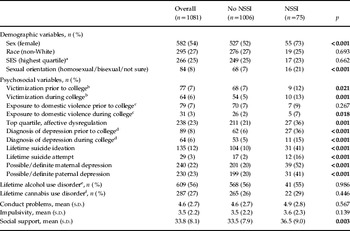
Analyses were conducted in three steps. First, bivariate logistic regression models were conducted of lifetime NSSI with the four demographic and 13 independent variables (see Table 1). Second, a multivariate logistic regression model (and negative binomial regression of NSSI frequency) was used to estimate cross-sectional associations between 11 independent variables (those listed in Table 1 except suicide ideation and attempt) and lifetime NSSI, adjusted for demographic variables. Third, a multivariate logistic regression model was used to predict prospective associations between the 11 independent variables assessed by Year 3 and past-year NSSI at Year 4, adjusting for demographic variables and excluding individuals whose most recent NSSI occurred more than a year ago. Lifetime suicide ideation and attempt were not included in the multivariate models because temporality could not be resolved for the prospective model, and we wanted the cross-sectional and prospective models to include the same constructs. For all multivariate models, we retained only those variables that were significantly associated with NSSI in bivariate analyses. To obtain a more parsimonious ‘final’ model, we eliminated all non-significant variables, and then re-entered them one by one to retain any that might achieve statistical significance. Only the ‘final models’ are presented in the tables. Statistical analyses were performed using Stata version 10.0 (StataCorp, 2007).
Characteristics of the sample

NSSI, Non-suicidal self-injury; SES, socio-economic status; s.d., standard deviation.
Bold values are significant at p<0.05.
a The mean adjusted gross income reported by the Internal Revenue Service for each participant's home ZIP code during their last year in high school.
b Victimization by Year 3 was reported by 120/1028 (12%) individuals overall [104/962 (11%) without NSSI, 16/66 (24%) with NSSI, p=0.003].
c Exposure to domestic violence by Year 3 was reported by 95/1028 (9%) individuals overall [86/963 (9%) without NSSI, 9/65 (14%) with NSSI, p=0.396].
d Depression diagnosis by Year 3 was reported by 122/1040 (12%) individuals overall [88/966 (9%) without NSSI, 34/74 (46%) with NSSI, p<0.001].
e Alcohol use disorder by Year 3 was reported by 521/967 (54%) individuals overall [484/902 (54%) without NSSI, 37/65 (57%) with NSSI, p = 0.610].
f Cannabis use disorder by Year 3 was reported by 267/967 (28%) individuals overall [247/902 (27%) without NSSI, 20/65 (31%) with NSSI, p=0.555].
Results
Seventy-five individuals (7%) reported NSSI and 24 individuals (2%) reported past-year NSSI. Of these, 26 (35%) had their most recent episode of NSSI during college; 34 (45%) prior to college; and for 15 (20%) the timing could not be determined. Five (7%) self-injured once and 51% self-injured six or more times (data not shown in table).
Overall, 54% of participants were female, 73% White, and 8% non-heterosexual (Table 1). In bivariate models, lifetime NSSI was significantly associated with being female, non-heterosexual, victimized, exposed to domestic violence during college, and having high affective dysregulation, low social support, and a depression diagnosis. Individuals with NSSI were also more likely to have experienced suicide ideation, a suicide attempt and maternal and/or paternal depression. Of the 75 individuals with lifetime NSSI, 12 (16%) ever made a suicide attempt, 31 (41%) reported lifetime suicide ideation, and 38 (51%) were ever diagnosed with depression. Lifetime NSSI was not associated with AUD or CUD.
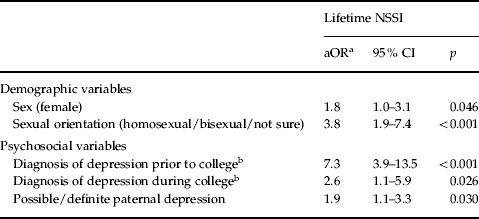
In the multivariate logistic regression analyses for lifetime NSSI (Table 2), female sex [adjusted odds ratio (aOR) 1.8, 95% confidence interval (CI) 1.0–3.1, p=0.046], non-heterosexual orientation (aOR 3.8, 95% CI 1.9–7.4, p<0.001), paternal depression (aOR 1.9, 95% CI 1.1–3.3, p=0.030) and depression diagnosis both prior to college (aOR 7.3, 95% CI 3.9–13.5, p<0.001) and during college (aOR 2.6, 95% CI 1.1–5.9, p=0.026) were all independently associated with lifetime NSSI. These variables maintained statistical significance after adjustment for lifetime suicide attempt.
Multivariate analyses for lifetime non-suicidal self-injury (NSSI) compared to those without lifetime NSSI

aOR, Adjusted odds ratio; CI, confidence interval.
a Estimates were adjusted for all independent variables shown, as well as race and SES.
b Reference group was individuals who were never diagnosed with depression.
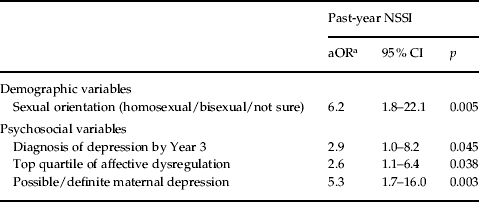
Prospective analyses for past-year NSSI (Table 3) showed that the following variables were independent predictors of past-year NSSI: non-heterosexual orientation (aOR 6.2, 95% CI 1.8–22.1, p=0.005), maternal depression (aOR 5.3, 95% CI 1.7–16.0, p=0.003), affective dysregulation (aOR 2.6, 95% CI 1.1–6.4, p=0.038) and depression diagnosis by Year 3 (aOR 2.9, 95% CI 1.0–8.2, p=0.045). These same four variables were independently associated with lifetime NSSI frequency; 67% of those with past-year NSSI self-injured 10 or more times, compared with 44% of those whose most recent NSSI was prior to college. All variables maintained statistical significance after adjustment for lifetime suicide attempt, except depression diagnosis by Year 3 (aOR 2.7, 95% CI 0.9–7.6, p=0.058).
Prospective multivariate model for past-year non-suicidal self-injury (NSSI) compared to those without lifetime NSSI

aOR, Adjusted odds ratio; CI, confidence interval.
a Estimates were adjusted for all independent variables shown, as well as sex, race, and SES.
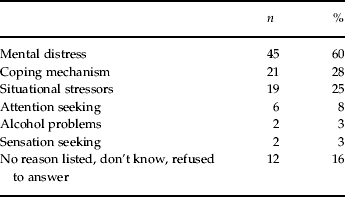
Table 4 lists the motives for NSSI. Free text was recorded by interviewers on 107 motives from the 75 participants with NSSI. The most frequently reported motive was mental distress (60%; e.g. ‘anger, anxiety, sadness’; ‘mental illness’; ‘I was unmedicated with bipolar disorder’), followed by coping (28%; e.g. ‘physical pain blocks emotional pain’; ‘release mental pain’; ‘felt like it would make me feel better’; ‘calmed me when I was upset’; ‘distraction, expulsion of nervous energy’; ‘to try and centralize my pain’; ‘makes me focus’; ‘very overwhelmed and needed a release’), situational stressors (25%; e.g. relationship, parental divorce, school), and attention seeking (8%); 16% did not know or cite a motive, or refused to answer. Alcohol problems and sensation seeking were the least frequently reported motives (3% each). Motives were endorsed with similar frequency with regard to past-year NSSI.
Motives for non-suicidal self-injury (NSSI)Footnote a

a Response options were not provided, free text was recorded by the interviewer, participants often reported more than one motive for NSSI; 107 motives were provided by 75 participants.
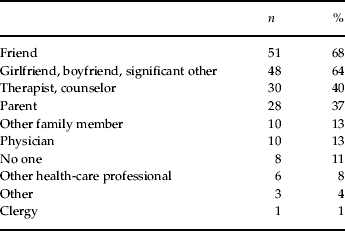
A minority (11%) told no one about their NSSI (Table 5). Most told a friend and/or significant other (68% and 64% respectively), followed by therapist (40%), parent (37%), other family member (13%), physician (13%), another health-care professional (8%), and clergy member (1%).
Persons to whom participants disclosed their non-suicidal self-injury (NSSI)Footnote a

a Multiple responses were permitted.
Discussion
In this study, 7% of the sample engaged in NSSI at least once in their lifetime and 2% in the past year (>70% were female for lifetime and past-year NSSI). Five (7%) with lifetime NSSI self-injured once and 51% self-injured six or more times. Although suicide attempt was independently associated with lifetime NSSI, most individuals with NSSI (84%) never attempted suicide, consistent with the literature from community samples of adolescents and college students (Muehlenkamp & Gutierrez, Reference Muehlenkamp and Gutierrez2004; Whitlock & Knox, Reference Whitlock and Knox2007).
Non-heterosexual orientation and a diagnosis of depression predicted past-year NSSI and had independent associations with lifetime NSSI. Maternal depression and affective dysregulation predicted past-year NSSI whereas lifetime NSSI was associated with female sex and paternal depression. Those with past-year NSSI were more likely to have self-injured 10 or more times than those whose last episode with NSSI was prior to college (67% v. 44% respectively); the same independent predictors of recent NSSI were independently associated with lifetime NSSI frequency. Jacobson et al. (Reference Jacobson, Muehlenkamp, Miller and Turner2008), in a chart review of out-patient adolescents attending a depression and suicide clinic, noted the importance of examining the frequency and recency of deliberate self-harm behaviors (including NSSI) as they are associated with more severe psychopathology. The three most commonly reported motives for NSSI were mental distress, as a means of coping, and situational stressors; consistent with other studies. This study provides some evidence that NSSI in college students is likely to be repetitive and persistent, with motives involving emotional regulation in response to situational stress and mental distress.
Several study limitations merit attention. Although the entire sample size of the cohort was large, the subsets of individuals with lifetime (n=75) and past-year NSSI (n = 24) were fairly small, as is reflected in the broad CIs for the past-year analyses. These data are based on self-report and thus subject to bias. We do not know when or why participants told others about their NSSI. The NSSI and maternal and paternal depression variables were collected during Year 4 and the exact timing of onset could not be determined. It is possible that individuals with depression were more likely to be aware of a parental history of depression than those who were not depressed. Because our sample was limited to individuals from a single public university, the results may not be generalizable to students in other areas of the country or at smaller, private settings.
Despite these limitations, this study has several counterbalanced strengths. The overall design is prospective and longitudinal, the sample was large, and the assessment battery was extensive. The cohort had passed through the peak period of risk for NSSI (Jacobson & Gould, Reference Jacobson and Gould2007). Our emphasis on the prediction of past-year NSSI limited biases associated with retrospective recall. Instead of constraining response choices regarding motives, we allowed free expression of their reasons (similar to Polk & Liss, Reference Polk and Liss2009). The sample was recruited as a cohort, so the comparison group comprised individuals in the cohort without NSSI, which is an improvement over many existing studies.
Lifetime prevalence of NSSI in our sample was 7%, much lower than in other college samples, such as 17% found by Whitlock et al. (Reference Whitlock, Eckenrode and Silverman2006) and 38% found by Gratz et al. (Reference Gratz, Conrad and Roemer2002), but similar to the 5.9% (n=26) reported by Klonsky (Reference Klonsky2011) on a sample of 439 adults in the USA recruited by random-digit dialing. This discrepancy might be explained by differences in sampling, differing NSSI definitions (inclusion of wound-picking) and varying assessment time-frames (past year, lifetime). Our lower estimate cannot be explained by bias from interviewer-administered format because we used self-administered reports, but could be related to characteristics of our sample (older age) or a cohort effect. Moreover, we cannot rule out the possibility of recall bias (i.e. participants forgetting NSSI episodes).
The link between non-heterosexual orientation and NSSI is in agreement with several other studies (e.g. Whitlock et al. Reference Whitlock, Eckenrode and Silverman2006; Deliberto & Nock, Reference Deliberto and Nock2008). Our results suggest that NSSI that persists into young adulthood may be different from adolescent-limited NSSI, given that it has different correlates (e.g. affective dysregulation and maternal depression) and greater frequency. Mental distress, coping and situational stressors were the main motives for NSSI, suggesting that there is a mechanism driving NSSI that persists into young adulthood. Stress reactivity may be impaired in those with frequent or persistent NSSI, with some studies showing increased physiological arousal while completing a distressing task compared with those without prior NSSI (Nock & Mendes, Reference Nock and Mendes2008). Additionally, preliminary evidence suggests that NSSI might occur in response to hyperactivity of the neuroendocrine system (Sachsse et al. Reference Sachsse, Von der Heyde and Huether2002). Thus, biological vulnerabilities could be important risk factors for frequent or persistent NSSI in addition to stressful environmental factors that could trigger physiological vulnerabilities.
Similar to the 86% found by Heath et al. (Reference Heath, Ross, Toste, Charlebois and Nedecheva2009), 89% of individuals in our sample with NSSI told others about it, most commonly their friends (68%). A recent longitudinal study by Prinstein et al. (Reference Prinstein, Heilbron, Guerry, Franklin, Rancourt, Simon and Spirito2010) suggests that peers might influence some individuals' engagement in NSSI among younger females. Nock & Prinstein (Reference Nock and Prinstein2004) reported that internal and social motives are the most commonly endorsed. Community studies of adolescents have found social factors to be influential (e.g. ‘to try to get a reaction from someone’ or attention seeking; Lloyd-Richardson et al. Reference Lloyd-Richardson, Perrine, Dierker and Kelley2007), but these motives were endorsed by only 8% in our sample. Our data provide strong support for internal rather than social motives underlying NSSI. It could be that motives for NSSI change over the course of development (Lloyd-Richardson et al. Reference Lloyd-Richardson, Perrine, Dierker and Kelley2007) or that those with NSSI that persists into adulthood have different motives.
Although drug and alcohol abuse has been observed to co-exist with NSSI among clinical populations (Nock et al. Reference Nock, Joiner, Gordon, Lloyd-Richardson and Prinstein2006), AUD and CUD were not observed to be significant risk factors for NSSI in our sample. Our findings comport with Jacobson et al. (Reference Jacobson, Muehlenkamp, Miller and Turner2008), who found, among out-patient adolescents, that the prevalence of substance use disorder was not significantly elevated among individuals with NSSI as compared to individuals without NSSI.
These findings have important implications for accurate identification, prevention and treatment of NSSI. Campus-based mental health professionals who treat students with NSSI may not be aware of clinical management strategies. Some may view NSSI as a manipulative act and disregard its clinical relevance. NSSI has been proposed to appear in DSM-5 (APA, 2010). Currently, NSSI is part of the criteria for borderline personality disorder (BPD), but frequently those with NSSI do not meet criteria for BPD; thus clinical management and treatment recommendations are often obscured (APA, 1994). Despite the prevalence and significant consequences of NSSI, few intervention approaches for NSSI have been supported empirically (Prinstein, Reference Prinstein2008). Other than dialectical behavior therapy (DBT), an intensive treatment program for self-injurers with BPD (Kliem et al. Reference Kliem, Kroger and Kosfelder2010), no empirically supported treatment for NSSI exists. Evidence supporting DBT's efficacy in adolescents and college students is scarce. If mental distress is indeed a primary motive for NSSI, coping strategies for tolerating and regulating intense emotions could be an intervention target for NSSI prevention.
Longitudinal research following larger community samples through the peak period of risk for NSSI is needed to sort out the course and temporal sequencing of NSSI and other suspected risk and protective factors that could be targets for intervention. This study identified predictors of NSSI that might provide clues to its etiology and have implications for intervention.
Acknowledgements
Special thanks are given to L. Garnier-Dykstra, L. Stern, E. Winick, the interviewing team, and the participants. We acknowledge funding from the National Institute on Drug Abuse (R01DA14845, Dr A. M. Arria, PI) and the American Foundation for Suicide Prevention.
Declaration of Interest
None.