Hospital-acquired viral infections are a notable source of morbidity and financial burden.Reference Hansen, Stamm-Balderjahn and Zuschneid 1 – Reference Macartney, Gorelick, Manning, Hodinka and Bell 4 Respiratory viral infections, particularly RSV and influenza, are associated with significant morbidity and mortality.Reference Dare and Talbot 5 , Reference Hall 6 These organisms may be introduced into the hospital environment by hospital staff, patients, or visitors. In the pediatric setting, a visitor includes any individual who is not a patient or a member of a professional healthcare team and could include a parent or guardian, a sibling, or a family member with care responsibilities for the pediatric patient. A visitor may have had exposure to the patient prior to the hospital setting and could be a symptomatic or asymptomatic source of a pathogen. Alternatively, a visitor may be at risk for infection following exposure to the pathogen.
Family-centered care is a model that involves family members in healthcare decisions and procedures and encourages the bedside presence of family members.Reference Kuo, Houtrow, Arango, Kuhlthau, Simmons and Neff 7 In particular, the benefits of sibling visitation have been described.Reference Rozdilsky 8 , Reference Shuler and Reich 9 While positively impacting care, bedside presence of visitors may increase opportunities for transmission of pathogens from family member to patient, from family member to staff, and/or subsequently, from staff to other patients. Visitor restriction policies and practices (VRPP) are often implemented with the intent to limit transmission of community-acquired pathogens in the hospital environment by restricting the presence of visitors.Reference Garcia, Raad and Abi-Said 10 , Reference Snydman, Greer, Meissner and McIntosh 11 In many instances, VRPP are not supportive of a family-centered care model. Age-based VRPP are often based on chronological age and not developmental stage of the visitor.
Few studies have evaluated the impact or effectiveness of VRPP on the prevention of transmission of pathogens in the hospital setting. The Centers for Disease Control and Prevention (CDC) recommends screening visitors for illness but does not provide specific guidance regarding implementation or parameters for VRPP.Reference Siegel, Rhinehart, Jackson and Chiarello 12
We developed and distributed an electronic survey to characterize VRPP in pediatric healthcare facilities prior to the 2016–2017 North American viral respiratory season.
Methods
The Infectious Disease Society of America’s Emerging Infections Network (EIN)Reference Pillai, Beekmann, Santibanez and Polgreen 13 is a provider-based sentinel network of infectious disease clinicians who regularly engage in clinical practice and are members of either the Infectious Diseases Society of America (IDSA) or the Pediatric Infectious Disease Society (PIDS). The EIN was established in 1995 through a cooperative agreement with the CDC. From July 12 to August 15, 2016, staff at the EIN coordinating center (Iowa City, IA) distributed a survey via e-mail to 334 physician members of the EIN who provide infectious disease care for children. Nonresponding members received a second query 2 weeks later, followed by a third query after 4 weeks. Respondents were asked about their familiarity with their primary institution’s VRPP, the specifics of their VRPPs, including whether restrictions are symptom-based, age-based, seasonal-based, and/or outbreak-based, the units where policies were enacted, how they were communicated to patients, visitors, and staff, and how compliance and effectiveness was assessed. Statistical analyses were performed using SAS version 9·4 software (SAS Institute, Cary, NC).
Results
We received responses from 170 pediatric physicians (a 51% response rate), and 44 (27%) indicated that they were unaware of their institution’s VRPP. Table 1 shows demographic characteristics of respondents. Among the 170 responses, all US Census Bureau Divisions were represented (Table 1). Survey respondents (86 of 170, 51%) were more likely than nonrespondents (57 of 164, 35%) to have>15 years of postgraduate clinical experience (P=·029).
Practice Data for All 170 Respondents

Note. ID, infectious diseases.
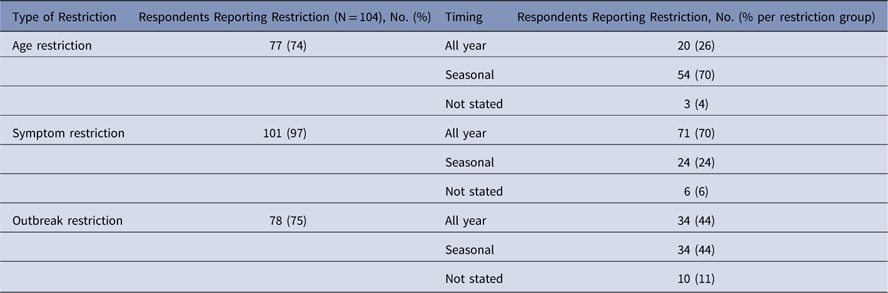
Of those who responded, 104 (61%) reported being at least somewhat familiar with the details of their institution’s VRPP. Subsequent analyses are based on the responses of these individuals. A form of visitor restriction was in place on all inpatient units in the facilities of 92 (88%) of respondents (Table 2). A form of visitor restriction was in place in the outpatient clinic of 9 respondents (9%), in the emergency department of 5 respondents (5%), in the day surgery department of 6 respondents (6%), and the radiology department of 3 respondents (3%). Furthermore, 12 years of age was the most common age below which age-based restrictions were in place (9 of 14 respondents specified an age limit). Upper-respiratory infections, rash, fever, cough, and diarrhea were identified as symptoms for which visitors were excluded. Outbreak-based visitor restrictions were reported by 78 (75%) for seasonal influenza, enterovirus D68, and for other local outbreaks.
Reported Types and Timing of Visitor Restrictions in Pediatric Healthcare Facilities

The incidence of respiratory syncytial virus (RSV) and influenza was a primary factor impacting seasonal VRPP. Specifically, 21 respondents (20%) reported using RSV and influenza incidence to begin the implementation of seasonal restrictions, and 17 respondents (16%) used incidence of influenza only. Communication of VRPP to families occurred upon admission according to 89 respondents (87%) and periodically throughout hospitalization through signage placed in patient care areas according to 65 respondents (64%). Most respondents (n=76, 75%) reported>1 mechanism for communicating VRPP. Communication to staff regarding VRPP occurred by e-mail according to 79 respondents (77%), whereas in-person meetings were used for staff communication according to 56 respondents (55%) and signage use was reported by 50 respondents (49%). Most respondents (n=69, 68%) reported the use of>1 communication mechanism.
In addition, 63 respondents (62%) reported that the effectiveness of their VRPP was monitored through active surveillance of hospital-acquired infections. In addition, 29 respondents (28%) reported using healthcare worker exposures to monitor effectiveness of VRPP, and 30 respondents (29%) reported that patient or family satisfaction assessments were used to assess effectiveness of VRPP. Moreover, 38 respondents (37%) reported that either no mechanism was used to monitor effectiveness (n=12, 12%) or that they were not sure whether the effectiveness of VRPP was monitored (n=26, 25%).
Respondents felt that the enforcement of VRPP was the responsibility of the nursing and ancillary staff, including nursing staff or charge nurse (n=82, 80%), registration clerk (n=59, 58%), and unit clerks (n=54, 53%). The infection prevention team was involved in enforcement of VRPP at 32 sites (31%). Furthermore, 16 respondents (16%) identified physicians and other advanced practice providers as enforcers of VRPP.
Finally, 35 respondents (34%) did not feel that their VRPP was ideal. One-third of respondents who were not satisfied with their VRPP stated that their ideal VRPP would consist of fewer age- and symptom-based restrictions, without a change in their facilities’ outbreak-associated visitor restrictions.
Discussion
Our study demonstrates that VRPP in place prior to the start of the 2016–2017 respiratory virus season in pediatric healthcare facilities in North America varied with respect to scope, timing, communication, awareness, satisfaction, and monitoring for effectiveness. The rationale for VRPP is based upon theoretical risks of limiting transmission of pathogens in the healthcare setting. Visitor restriction policies are present in most hospitals;Reference Liu, Read, Scruth and Cheng 14 however, few studies have evaluated the effectiveness of age-based, seasonal, or symptom-based VRPP. Furthermore, many VRPP interfere with components of family-centered care by excluding family members and visitors from being present at the bedside based on presumptive risk factors.
Assessment of the effectiveness of VRPP is challenging due to this variation and to the difficulty associated with monitoring adherence, exceptions, and outcomes. Departure from family-centered care and challenges related to enforcement often result in dissatisfaction by both family and/or visitors and the healthcare team responsible for enforcement.
Age-based VRPP may not prevent exposure events in pediatric healthcare environments, which may be as likely attributable to an adult family member or visitor as to a young child. In addition, chronological age does not always correspond with developmental age, excluding or including individuals who may present a greater risk for pathogen transmission due to their ability or inability to conform to hygienic practices while in the healthcare environment. The practice of setting a numerical visitor limit, as is often done in adult healthcare facilities, is a more direct way of preventing overcrowding and potentially interference with the delivery of healthcare. Washam et al Reference Washam, Woltmann, Ankrum and Connelly 15 reported a 37% decrease in healthcare-acquired respiratory viral infections following a change in their visitor restriction policy to limit the number of visitors allowed per patient.
Although two-thirds of respondents reported that their facilities tracked hospital-acquired respiratory infections, variation in organisms assessed and diagnostic modalities makes interpretation of effectiveness of VRPP in these settings challenging. Tracking identical organisms with comparable laboratory methods and standard definitions of healthcare-associated infections may be a systematic way to measure and compare effectiveness of VRPP. Our results are limited by recall bias inherent to survey-based research as well as the possibility that respondents’ knowledge may not represent actual policy. However, these results reflect the informal surveys regarding VRPP that have been done to guide practice. Because our results included 104 respondents familiar with their VRPP from 74 unique institutions, we performed an analysis of the results including only the first respondent from each healthcare system (n=74). Multiple responses from the same institution were deleted while maintaining the same set of institutions represented in the original analysis. This analysis yielded essentially identical proportions and findings related to respondent demographics and survey results.
In addition to the variation in VRPP reported by respondents, the dissatisfaction with VRPP reported by one-third of respondents reflects the absence of evidence as a basis for restrictions that are challenging to implement and assess. Support for a multisite evaluation of VRPP components with standardized tracking of outcomes would aid in the development of uniform guidance that could be adapted to inform this challenging aspect of pediatric infectious disease care.
Acknowledgments
The authors thank Dr Natasha Halasa for her invaluable help in reviewing the survey and recommendations.
Financial support
This publication was supported by Cooperative Agreement 1 (U50 CK000477) funded by the Centers for Disease Control and Prevention. Its contents are solely the responsibility of the authors and do not necessarily represent the official views of the Centers for Disease Control and Prevention or the Department of Health and Human Services.
Potential Conflicts of interest
All authors report no conflicts of interest relevant to this article.