Sir Thomas Stamford Raffles died in July 1826 from a cerebral hemorrhage.Footnote 1 This was the beginning of the second phase of his career in service to Empire. While he had been an influential employee of the East India Company since 1795 — playing key roles in the British invasion of Java, the founding of colonial Singapore, and even the establishment of the London Zoo — the commemoration of this imperial figure after his death was vital in developing not only how we understand and see him today, but also how Singaporean history is framed. It was, after all, following his death that the man became an icon that Britons used to articulate their justifications and explanations for their presence in Southeast Asia and, more specifically, Singapore. The legacy of this veneration continues to echo some two hundred years later.
The creation and valorisation of heroes was a fundamental characteristic of the Victorian era. Edmund Gosse has written that Victorians ‘carried admiration to the highest pitch. They marshalled it, they defined it, they turned it from a virtue into a religion’. This affinity was in full bloom in the second half of the nineteenth century and can be seen in Heroes of Britain in War and Peace, in which Edwin Hodder exclaimed that the nineteenth century ‘produced more great men than any age in the world's history’. Through their actions, thoughts and writings, these new idols reflected national goals and mirrored imperial achievements, making each of these individuals worthy of placement on pedestals and plinths as symbols of the vast reach of the Empire and its values. According to Hodder, they were ‘leaders of their fellows, modelers of opinion, harbingers of results to which the world aspires, of higher knowledge, more solid peace, better days’.Footnote 2
The great pantheon of heroes of this new religion included Clive of India, Rhodes of Africa, and — most importantly for us — Raffles of Singapore. They were gods in imperial mythology, and history. Through biographies, statues, and continual reference in the press and society, the actions of these men came to represent British understandings of their presence throughout the world at the height of modern imperial power. These men became an ideal, as Thomas Carlyle proclaimed, ‘a living light-fountain, which it is good and pleasant to be near,’ from which flows ‘insight, of manhood and heroic nobleness.’Footnote 3 While their lives, or their philosophical interests, often became distorted as complex stories filtered down into tales of exceptionalism, it was the development of their iconic status that was most important. After all, these were ‘Great Men’, which Carlyle called upon to develop his theory that history is the result of the actions of extraordinary individuals, who created a British Empire on which the sun never sat. They represented the stories Britons wished to tell themselves to explain their global power, eventually permeating colonial societies and their histories.Footnote 4
A number of exceptional individuals could have become the focus of British imperial mythology in Southeast Asia. William Marsden and John Crawfurd, like Raffles, were celebrated administrators and wrote encyclopedic and groundbreaking publications on the region — ultimately creating the English language survey of Southeast Asia, which was linked to Enlightenment and Romantic Era notions of scholarship and sensitivity to local histories — while William Farquhar was a highly respected early official in Singapore and British Malacca.Footnote 5 The mantle of greatness, however, was placed on Raffles. He became the key figure for newly arriving British officials and merchants in the region, and the keystone for how their activities were justified. His role in the founding of colonial Singapore and early death also helped reinforce this status. Crawfurd and Marsden, conversely, had returned to England and lived long and productive lives, while Farquhar had participated in a nasty dispute with the great man himself, which meant that any romantic notion of their roles was diminished through time, place and circumstance.Footnote 6 Raffles, in contrast, had died young, leaving behind numerous writings as well as his own efforts to enhance his status within early nineteenth-century British society. He was an ideal candidate for a hero.
Such heroes, ultimately, are created, and it is this act of creation that helps shed light on how colonial society functioned, and its relationship within the larger context of empire. Singapore, after all, was a colonial society, and the centre of British activity, trade and administration in Southeast Asia from which radiated all other imperial endeavours in the region. In this manner, Britons needed a founding figure on which the developing cloak of ideals of the society could be draped. This article will focus on the creation and maintenance of the heroic image of Sir Thomas Stamford Raffles in Singapore in the first century of colonial rule over the island, and how this helped clarify and justify, as well as reflect, this growing British imperial presence. Raffles was created and memorialised into a manifestation of these ideals, which resulted in monuments as well as histories that framed his role, and its basic ideas, as fundamental to understanding the development of the society. This was the result of the efforts of individuals and society to place him on a pedestal for all to admire, along with the role the British had played in the region.Footnote 7
Funerary monuments
Raffles died under numerous clouds of controversy. The founding of Singapore had been against the direct orders of his superiors, and his relationship with many administrators in the East India Company had been contentious. At the time of his death, Raffles also was in debt and most of his estate went to the Company to cover these obligations.Footnote 8 By the late 1820s, his reputation was in tatters. Under such circumstances — in which he was the subject of a number of criticisms of how he had created diplomatic crises, handled staffing decisions and, what was perceived as, his arrogant behaviour — Raffles’ second wife, Sophia, took the first steps in re-establishing the image of her late husband as a noble, Enlightened administrator that he had cultivated meticulously upon his return from Java in 1816. Much of this rehabilitation began with the publication of the first quarto of The Memoirs of Sir Thomas Stamford Raffles in 1830, which eventually came out as a two-volume tome in 1835 as written by ‘his widow’. It contained the letters and accounts of his time in Southeast Asia, and, to no surprise, portrayed his actions in a positive light. As Sophia Raffles described the work, it was an effort to achieve ‘justice to her husband's memory … and procure for her the indulgence of which she stands so much in need.’Footnote 9
The efforts of Sophia Raffles to rehabilitate the image of her husband went beyond the publication of his writings to the display of funerary monuments, a form of tribute that was quite common throughout eighteenth and early nineteenth-century Britain. These shrines consisted of statues and busts, or even plaques, and were scattered throughout the globe, although they were centred, particularly and predictably, in the United Kingdom. They were vital in articulating an image of empire in its earliest phases with the honour reserved for well-known figures that promoted trade and British notions of liberty. As the construction of such monuments became more routine, they shifted from glorifying political and military leaders to commemorating merchants and administrators who, in the words of imperial historian Joan Coutu, ‘invested significantly in the new empire, people who were for the most part new money’.Footnote 10 This is an apt description of Raffles, who rose from impoverishment to high Company administrator in his first two decades of service.
The centre of such funerary structures was Westminster Abbey, which was the ‘de facto Valhalla and showcase of British imperial strength until it was overflowing with monuments’, before the practice shifted to St. Paul's Cathedral.Footnote 11 To create an enduring image of Raffles and his place in the larger concept of empire, Sophia and other supporters commissioned a seated, white marble statue of Raffles, and arranged for its placement in Westminster Abbey in 1832. The inscription on the plinth reads:
To the memory of Sir Thomas Stamford Raffles, L.L.D. F.R.S. Lieut. Governor of Java and the First President of the Zoological Society of London. Born 1781 Died 1826. Selected at an early age to conduct the government of the British conquests in the Indian ocean, by wisdom, vigour, and philanthropy, he raised Java to happiness and prosperity unknown under former rulers. After the surrender of that island to the Dutch, and during his government in Sumatra he founded an emporium at Singapore, where in establishing freedom of person as the right of the soil, and freedom of trade as the right of the port, he secured to the British flag the maritime superiority of the eastern seas. Ardently attached to science, he labored successfully to add to the knowledge and enrich the museums of his native land, in promoting the welfare of the people committed to his charge, he sought the good of his country, and the glory of God.
It can still be found in the north choir aisle of the Gothic cathedral, the traditional site of coronation and burial of British monarchs and other numerous funerary monuments dedicated to glorifying the nation and empire.Footnote 12
The sculptor of the funerary monument was Francis Chantrey, one of the most famous purveyors of the practice in Britain. From his studio in Pimlico, Chantrey was a master of public art in which he would, in the words of Clyde Binfield, ‘capture in marble the intelligences of the men, less of their women, who had transformed British society without ever slackening their control of it’. In this regard, Chantrey became famous for giving his subjects a ‘public air. A marble bust elevated the sitter to the realm of heroes and rulers of antiquity.’Footnote 13 Ultimately, his reputation as a famous sculptor made Chantrey a respected choice for the creation of Raffles’ funerary monument, for which he normally charged 200 guineas during this period.Footnote 14
Chantrey had created a bust of Raffles in 1817, which the administrator himself had commissioned following his return from Java with the goal of enhancing the image he was tirelessly cultivating, that of a knowledgeable elite nobleman with insight into Southeast Asian cultures and societies, which allowed him to govern them with practices steeped in Enlightenment rationality.Footnote 15 Portrait busts were often paid through subscriptions, and Chantrey treated each of these commissions as a business transaction, using his membership in the Royal Academy, as well as his reputation, to justify payment for his work, which he recorded in ledgers, along with the person who commissioned the work. Raffles, for example, paid £126 for his marble visage in 1817, and thus placed himself alongside such titans of the period as Joseph Banks, James Watt and Horatio Nelson.Footnote 16
Prior to his work on the funerary monument she commissioned for Westminster Abbey, Sophia had contacted Chantrey in 1827 to enquire about the bust he had completed for her husband a decade earlier. Raffles had carried the original to Southeast Asia, with the goal of placing it in the Batavian Society of Arts and Science, an institution in which he had played an active role during his Lieutenant Governorship of Java. In the tensions following the transfer of British and Dutch sovereignty over Malacca in 1818, that ultimately led to the founding of colonial Singapore, Raffles realised that the statue would be an unappreciated gift to the Society. He kept the bust among his belongings during this stint in the region, and it was lost in the sinking of the Fame in 1824.Footnote 17
Chantrey still had a model plaster cast of the bust he created in 1817. Sophia commissioned several additional copies, and also gained ownership over the cast. Over the subsequent decades other copies were created from it, including one that can be found in the foyer of the Zoological Society of London, which was presented to the institution in 1877, as well as a bronze bust that made its way — finally — to the Batavian Society for the Arts in 1929. The most important bust for our purposes, however, was one that Sophia commissioned soon after 1827. Lady Raffles sent this plaster statue to Singapore sometime in the early 1830s, with the purpose of displaying it at the Singapore Institution.Footnote 18
The arrival of the Raffles Bust forced Company officials in the young port to revisit their memories of the man. News of Raffles’ death had only reached Singapore in January 1827. In this context the editor of the Singapore Chronicle proclaimed that it was vital that the community erect a memorial to their ‘founder and benefactor’, and merchant Alexander Johnston headed a committee that raised $2,264 for such a purpose. These funds, however, remained untapped for many years and they were only referred to sporadically, such as when a suggestion was floated to build a reading room and designate it ‘The Raffles Library’ in 1829.Footnote 19
Any concern for the development of an appropriate Raffles memorial had, for the most part, faded when the bust arrived in the harbour. Lingering on past events was not part of the culture of the port, which was developed for commerce, a precept that was followed to an obsessive degree.Footnote 20 Focusing on any topic other than trade and its flow was perceived as trivial among merchants and Company officials, and any memorial commemorating the leader of the expedition that founded it in 1819 had quickly evaporated. By gifting the bust to the Singapore Institution, however, Sophia Raffles began the process of forcing the elite of the port to consider his legacy beyond the initial burst of sympathy that had followed news of his death.
The intended home for the bust was the Singapore Institution, which Raffles created in 1823 for the development and training of local youths, with the objective being ‘the cultivation of the languages of China, Siam, and the Malayan Archipelago; and the improvement of the moral and intellectual condition of the inhabitants of those countries’.Footnote 21 Despite such lofty goals, the school was an utter failure by the early 1830s due to unfinished construction of the main building and disinterest among the administrative leadership of Singapore society in the late 1820s and early 1830s.Footnote 22 This led one newspaper account of the time to describe the facilities as ‘dilapidated’ and an ‘eye sore’, which made the Singapore Institution ‘a convenient shelter for thieves’.Footnote 23 The trustees met throughout 1835 and 1836 to consider solutions to these issues, and the possibility of redeveloping the school. During one meeting it was proposed that contributions raised almost ten years earlier following the death announcement be used for the construction of buildings, ‘to which can be added the prefix of Sir Stamford's name, in honor of the founder’. In many accounts during this period, the fund was referred to as ‘Raffles Institution and Raffles Monument Fund’, and the school as ‘Raffles’ Institution’, with the emphasis on the possessive. Notwithstanding this burst of energy, and the eventual reconstruction of the buildings, the name was not changed and it was commonly known as the Singapore Free School for the next two decades.Footnote 24 Any possibility of renaming the school was not raised publicly again for at least ten years.
The gift that provided the impetus for re-examining the state of the Singapore Institution also did not find a home in its reconstructed premises, which were completed in 1837, as intended. It was reported that the statue ‘some how a other has found its way to the Court House’, and little concern or attention was directed toward it. When a new plan was drawn up for a school library in 1841, one of its main features was to be an entire room dedicated ‘for the reception of the bust of the late Sir Stamford Raffles’. When the library opened in 1844, however, the bust still remained at the Court House. The next year this was brought to the attention of government officials, who heard proposals that it would be more appropriate if it was transferred to the Library. The trustees publicly announced that they took this to heart and would arrange for the placement of the Raffles Bust in the Library Room of the reconstructed Singapore Institution, where it would become a ‘pleasing and appropriate feature’, while Governor William Butterworth agreed to pay for a ‘handsome pedestal’ for the statue.Footnote 25
Despite these pronouncements, the Raffles Bust remained outside its designated place for decades. In 1865, the Municipal Commissioners had to reply to enquiries on why it was now displayed at the Town Hall, which had been completed in 1856. Their response was that they were unable to trace ‘under what circumstances it was brought here’. The Trustees of the Singapore Institution then requested that the Raffles Bust be returned, which led to several legal challenges. The solution agreed upon was that the statue would remain in the Town Hall, ‘provided the Commissioners will give a distinct acknowledgement that the Bust is the property of the Trustees, and that they may reclaim it at their pleasure’.Footnote 26
This particular honour, which Raffles began with his commission of a bust in 1817 as part of his own self-promotion, which his widow continued after his death, nevertheless, reflects his status in the port in the first few decades of imperial rule. In the words of Charles Buckley, a chronicler of the first century of British rule in Singapore, there was ‘little public spirit in the place’ during this period.Footnote 27 The role that Raffles played in developing Singapore was understood, but not exalted. The absence of any monuments, his minimal presence in public discourse, and the reluctance to deal properly with the bust, runs contrary to the overflowing honorifics and testimonies the merchant community supposedly presented to Raffles upon his departure from Singapore, which Sophia emphasised in the memoir. This reflects the power that such a text would eventually have in the development of his image.Footnote 28 Ultimately, he was little thought of and only occasionally referred to within the British community in the decades that followed his return to England and subsequent death. If Raffles was mentioned, it was most closely associated with the Singapore Institution, a school that had done little to live up to his goals for it. The message that was engraved on the funerary monument at Westminster Abbey had yet to permeate understandings and arguments about his contributions to the port.
An often-ignored bust of Raffles and the writings of a widow that sought redemption for her husband, however, had laid the groundwork for his future veneration. Raffles was in the process of transforming into a malleable political tool, in which the early stages had been hinted in the inquiries made on the placement of the bust in the 1840s. As new merchants and officials arrived in Southeast Asia, often armed with the Memoirs that Sophia had published as their guide, the descriptions and memorials would expand in their ambition to justify and explain the place Singapore held in the Empire, and correspondingly transform the man into an imperial god in the pantheon of heroes. Thomas Stamford Raffles was to become a divine figure that envisioned free trade flowing through the region under British auspices, and was not beholden to officials in India, thus establishing Singapore as an integral element within the Empire, and not simply an appendage to interests in other parts of Asia.
The divine light(house) of free trade
When William Butterworth agreed in 1845 to pay for the pedestal upon which the Raffles Bust was to be displayed, he had been governor of the Straits Settlements for two years, a position in which he would serve until 1855. This seemingly innocent sponsorship of a base for a statue was part of a contest over the role that Singapore would play within the larger British administration and empire in Asia. Butterworth, after all, was an official appointed from Calcutta to oversee a developing port that served British and Company interests in the China–India trade. In Singapore, however, many long-time merchants and officials viewed him as an elitist blowhard representing distant and detached administrators who cared little about Southeast Asia. He was, in the words of John Thomson, a man whose ‘government responsibility is considered to lie in keeping the natives quiet, and the Europeans in good humour’, with the added distinguishing characteristic of complete ignorance of local cultures and languages.Footnote 29 Among many resident European merchants in Singapore, his leadership was such a disappointment they appealed for his removal to officials based in India. This was echoed by the former British Resident of Singapore, John Crawfurd, who also was increasingly disappointed from his home in England with how Singapore was being governed.Footnote 30
Despite controversies surrounding his tenure, Butterworth led the Straits Settlements during a period in which its status was rising within the East India Company and the expanding British Empire. The primary focus of the Company in earlier decades, when Raffles had served, had been on developing its position in India, as well as the opium trade to China. Singapore was simply an extension of this commerce, acting as a stopover where ships could be replenished and repaired, not central to imperial concerns. This also occurred alongside the entrenchment of Liberal policies in Britain, which made Raffles’ earlier support of free trade appear to be prescient. With the increased acceptance of the concept of free trade as a cornerstone of British policy for the nation as well as international commerce, the importance of Singapore and Raffles grew.Footnote 31 This also corresponded with the First Opium War and the establishment of British trade posts on the outskirts of China, and the growth of the Southeast Asian port as an emporium for trade goods produced in the region. Singapore was developing into a vital link in the chain of British interests in Asia, and an example of the importance of commercial ports in its global economic policy.
Further reinforcing the strategic importance of Singapore was Dutch expansion in the Indonesian Archipelago. Raffles was well known for his abhorrence of VOC ([Dutch] United East India Company) monopolistic practices, which led Sophia to write in the Introduction to the Memoir that his hatred was not toward the Dutch people ‘generally’, but ‘intended exclusively to apply to the Colonial Government and its officers’.Footnote 32 In the aftermath of the founding of Singapore in 1819, Dutch and British diplomats had signed the Treaty of 1824, which defined their spheres of influence in the region. For the remainder of the century, from a British perspective, Dutch colonial officials violated the limits of the agreement as they consolidated their authority over all of the polities in Sumatra through treaties and conquest.Footnote 33 Observing these developments, many British officials raised the spectre of Raffles and what they considered to be his foresight in opposing expansion in the region from this particular European rival.
The 1840s and 1850s, thus, coincided with a radical change in Singapore's place in Empire, and perceptions of it. The name of Raffles began to be invoked with religious fervour as representative of how Singapore was a beacon of British interests and policy as they expanded into new areas throughout Asia, and particularly Southeast Asia. In an emporium where trade company officials oversaw governance, Raffles also became a powerful symbol for the merchants who dominated society, particularly as they chafed at what they considered to be unnecessary supervision from Calcutta, which led to a variety of complaints, ranging from the type of currency used for trade to land use policies.Footnote 34 Raffles was transformed from one of several early administrators in Singapore into a visionary leader who set the young port on the track that followed future policy and opposed Dutch expansion in the region, while championing free trade and the development of local knowledge. His ideas and writings began to take on a nobility and dignity that supported a variety of British perspectives with regard to their presence in the region, and references to Raffles began to permeate public speech in the port. When writing about the founding of the Scientific and Literary Association, which would develop a museum linked to the Library, for example, an anonymous contributor called out to his hero when he wrote, ‘The remembrance and name of Raffles ought to act forcible in rousing the dormant energies of those who cannot but retain vivid recollections of one, whose life, character, and pursuits were intimately blended with the foundation and advancement of the Settlement.’ In the process the ideas of ‘foundation of the Settlement’, ‘founder’, ‘local interests’, and ‘free trade’ became conflated and equated with the personage of Raffles.Footnote 35
An example of these changing perceptions was how Butterworth used Raffles’ image in the portrayal of his own administration of the port. While his sponsorship of the pedestal was an early effort to link himself to Raffles and become more acceptable to the local merchant community, some residents continued to think of Butterworth as a stooge from Calcutta. To counter these notions in subsequent years, the governor consistently invoked the name of the now respectable icon, most often equating it with free trade. This quickly entered the rhetoric of most public speeches given in Singapore. Leaders of the Chinese community described the governor in 1851, mirroring many descriptions of the time of Raffles, as having provided ‘a great light; the encouragement of commerce, the rewarding of merit, the restraining the wicked, these are the means employed’.Footnote 36 When Butterworth left Singapore in 1855, The Straits Times even linked his leadership style to that of Raffles. As the editors described the departing governor, he ‘wisely laid aside the military conventialisms of India for the plain and simple rules which govern a mercantile community. Adopting Raffles as his model, he determined to follow in his footsteps.’Footnote 37
The glorification of Raffles can be seen not only in statements in local newspapers about contemporary Company officials, but also in writings that English residents of the port sponsored and later held up as proof of the greatness of the man. The most famous of these is Hikayat Abdullah, the autobiography of Abdullah bin Abdul Kadir, a language teacher and scribe for missionaries and other officials in Singapore, which was written in 1845 and first published in 1849. In the memoir, an often-quoted passage describes Raffles as possessing the physical characteristics of intelligence (‘a projecting forehead’) and thoroughness (‘broad of brow’) combined with a nobility and kindness of heart.Footnote 38 While much of the praise, and perhaps the subtlety of the criticism, for the man may have been lost in the translation, editing, and interpretation of the text from fawning British admirers, as Amin Sweeney has argued, the key point is that colonial society promoted the acceptance of such descriptions of Raffles as a virtuous and flawless individual worthy of veneration.Footnote 39
The growing intensification in promoting Raffles’ divine merit complemented the Victorian need to create heroes. Any mention of the man now used superlatives that bordered on the holy. Among these portrayals, which serves as an example of these developments, was one that claimed that Raffles ‘was a giant, reveling and glorying in that strength by means of which he was able to defy all opposition, to overthrow all competitors at the rival Dutch marts — he dreaded no rivalry, and at the same time was incapable of the slightest feeling of jealousy at other men's claims and victories ….’Footnote 40 In such an atmosphere, the British resident community believed he deserved a memorial, one in which they had projected their understandings of the place that Singapore held within the larger Empire.
The desire to create a public monument was raised in The Straits Times in 1848, when the editors wrote:
Now that the Esplanade is nearly closed in and the green sward protected from the incursions of pony-racing-drunken sailors, we trust the crowning improvement will not be forgotten. In the centre of the Esplanade there ought to be placed a suitable monument to mark the achievements of the founder of this settlement, Sir Thomas Stamford Raffles. The example of that great and good man ought prominently to be set forth, and where so appropriately as the scene of his labours? What is so attractive to the imagination, as the memorial raised to a great man by his admiring fellow citizens. Monuments are the appropriate rewards of Virtue, the evidences of a country's gratitude. We throw out this hint in the hope that some of the influential members of society will take the initiative.Footnote 41
This continued two weeks later with claims that all who supported such a proposal were ‘being sensible of the propriety and desirableness of some sufficient testimonial being raised to mark the achievements of Raffles’. The Straits Times called for a general meeting, which would surely receive the support of ‘local authorities, the government of India, and the Court of Directors’, to discuss an appropriate memorial for their hero. While the tribute would have to meet the approval of government officials, it was argued ‘the design ought to emanate from the mercantile body, since the tradal interest has benefitted principally by the labours of that great and good man who laid the foundation and provided for the growing prosperity of this Settlement’. Such a monument would not ‘mark the achievements of a warrior, whose valour obtains victory and renown at the cost of human life,’ but instead would celebrate ‘the arts of peace, the extension of commerce, the promotion of civilisation, the good of his fellow creatures [that] were the objects of Raffles peculiar study and delight.’Footnote 42 While no progress was made at this time, the need for such a monument continued in public rhetoric for decades.
The lack of a monument to Thomas Stamford Raffles in Singapore also made the port a poor example of a British imperial city. After all, ‘Calcutta, Madras and Bombay have their monuments to note the achievements of British warriors and the deeds of statesmen, and we who are stationed in the far south — the southern-most extreme of the vast Indian Empire — ought to possess some lasting monument of the benefactor who laid the foundation of the Settlement's advancement, and greatness.’ Supporters who were using Raffles to project their understanding of the role British influence radiating from Singapore played within the empire believed that ‘Justice demands that something be commenced upon which shall record our sense of the enterprise, patience and untiring zeal of the Founder of the Free Port of Singapore.’Footnote 43 This issue would come to a head following a visit of the Governor-General of India, Lord Dalhousie (technically Marquess Dalhousie at this time), to whom Butterworth reported as part of the administrative structure of the East India Company and its quasi-governance of British interests in Asia.
Lord Dalhousie called on Singapore in February 1850. All aspects of the trip, apparently, went well. He returned to India satisfied with the role that East India Company officials played in the entrepôt, and the next year the administration of the Straits Settlements transferred from the Governor of Bengal to direct control of the Governor-General of India, thus reflecting a growth of its status within the empire.Footnote 44 In the wake of the visit, and to mark the coming change of status, as well as an immediate administrative need to curry favour with those currently in power, officials decided, ‘the most proper mode of commemorating the Governor General's visit to Singapore would be by the erection of an Obelisk or Triumphal Column on some part of the Esplanade (the centre being reserved for the intended monument to Sir Stamford Raffles).’Footnote 45 This monument would be the first government-created public memorial in Singapore.
Construction on an obelisk in remembrance of the Dalhousie visit proceeded throughout the remainder of 1850 and into the next year, leading to ire among the supporters of a Raffles Monument. As one complained in the press, ‘Another month has passed away and still no step has been taken towards raising a Monument to the memory of the distinguished Raffles. Why the listless apathy where an act of justice is necessary, we are at a loss to know.’ It is needed ‘to show our appreciation of those labors which raised Singapore from a mere fishing village to the proud emporium of the Archipelago’.Footnote 46
With the increasingly revered status with which Raffles was being bestowed rhetorically, from both residents and officials, the lack of a proper monument was becoming a glaring embarrassment. To distract from complaints that the Dalhousie Obelisk was an affront to the port's unmemorialised true hero, Butterworth began sponsoring scholarships at the Singapore Institution in the name of its founder.Footnote 47 This did little to mollify the merchant community, and backfired as it created opportunities to highlight problems that had continued to persist. One critic even claimed the institution had become a ‘wretched day school’, whose graduates did not live distinguished lives, beyond working as ‘copying clerks or trustworthy cashiers’, despite having ‘a founder whose very name was a sure prognostic of success’.Footnote 48
Matters become further muddled following the construction of the Horsburgh Lighthouse, on the spit of islands known as Pedra Branca, and named after a Scottish cartographer who had mapped the region decades earlier. The lighthouse was completed in 1852 and, to help fund its construction as well as that of other lighthouses in the vicinity, there was a proposal to tax all square-rigged vessels that entered the harbour at a rate of 3 cents per ton. The merchant community opposed this new tax on principle, as it was antithetical to the status of duty-free port that Singapore enjoyed and one that had been interlinked with the image of Raffles. Eventually, at the celebration of the 35th anniversary of the founding of the British settlement, and to appease these critics, Butterworth announced that he intended to designate ‘the Lighthouse, about to be erected on the Coney, at the entrance of the harbour, the “Raffles Light-house” in memory of the Founder of Singapore’. On Queen Victoria's birthday (24 May) in 1854, its foundation was ‘laid with Masonic honours’. The Raffles Lighthouse began operating on 1 November 1855.Footnote 49
The Raffles Lighthouse seems to have momentarily placated the mercantile community of Singapore. When ‘Episcopalian’ proposed in the press that an Anglican Church be built in the middle of the Esplanade as ‘a monument to Raffles’, it was immediately condemned. ‘The Government has already done its part in honouring the founder of Singapore,’ it was argued, ‘by naming the Light House on the Coney after him.’Footnote 50 Raffles status as an icon of Singapore may have resulted in few physical monuments by the 1850s, but his image had transformed into the incarnation of British imperial dogma in its expanding territorial and economic interests, and much of it was enhanced further with the increasingly important status that Singapore held in the British Empire. Raffles had become a vessel for ideas revolving around free trade and local representation in Southeast Asia. It was only when Singapore broke free from the bonds of the East India Company, however, that this veneration would be taken to another level, resulting in how Britons framed their position in the region and its relation to the larger empire, as well as the history of the island.
Monumental institutions
In 1858, with the abolition of the East India Company, the India Office in London assumed direct administration over the Straits Settlements. This change of status required new ways of administering the British-controlled ports scattered along the Malacca Straits. To signify this transformation, residents of Singapore turned to the popular image of Raffles as, among the mercantile community, he had become the manifestation of their goals and ideals for his championing of free trade and curiosity for local culture and the natural world. This began a period in which the commemoration of their hero shifted to the creation of physical memorials and the use of his name on sites that represented British ideals for the region. The first of these efforts to memorialise the man was announced in the same month that the Company was abolished. Officials in Singapore proclaimed that the Commercial Square, which was the centre of British mercantile offices and activity, would be known officially as ‘Raffles Place’. It was to become an enduring location for a figure that had been revered as a champion of free trade practices that the empire held high, and from which these merchants benefited.Footnote 51
The official renaming of Raffles Place was the first step in establishing monuments and places that honoured an idealised imperial hero for Southeast Asia, and occurred during a period in which Singapore became established officially as the main base for British interests in the region. The announcement or unveiling of these monuments often coincided with a major event linking the port to the larger empire, and were a celebration of the centrality of Britain and its ideals for the island that mirrored the popular practice of erecting funerary monuments. They were an opportunity to praise British imperialism and turn Singapore into a model of its ideals. As described on the plinth under his statue in Westminster Abbey, Raffles would become romanticised as a promoter of ‘freedom of trade as the right of the port’, who ‘secured to the British flag the maritime superiority of the eastern seas’, and was a champion of ‘science’, who ‘labored successfully to add to the knowledge and enrich the museums of his native land’.
After renaming the Commercial Square, the next major site that became associated formally with Raffles was the Singapore Institution. The various iterations and branches of the school, and what role it was to play in society, had been a subject of periodic debates since the 1830s, although little progress was made in improving it. Reformers would invoke Raffles’ name for their goal of expanding the curriculum and governmental support — citing the initial proposal, the gift of land, and his ‘noble vision’ — to berate officials for the ‘difficulties’ the institution faced. By the 1860s, these rumblings increased with backers of the school claiming ‘educational and other institutions founded by him for the improvement of intelligent natives have become effete for want of gubernatorial patronage’. At the same time, in an attempt to further rally support, defenders of the school began to refer to it as ‘Raffles Singapore Institution’. In 1867, the trustees formalised these efforts when they renamed the school ‘Raffles Institution’.Footnote 52
The establishment of Raffles Institution occurred when the government of the Straits Settlements was — once again — shifting in its relationship within the larger empire. In 1867 the Straits Settlements officially became a Crown Colony, and Singapore was to be the focus of British power in Southeast Asia. Along with the renaming of the school came governmental support in a reconstituted colony with enhanced status. In the decades that followed, colonial files were filled with scattered mentions and appeals for staffing requests and funding, and its role as a governmental school was validated further in 1903 when British colonial authorities formally took responsibility for its operation.Footnote 53 With such care and focus, the Raffles Institution developed into the primary school for the elite during the colonial era, an establishment that was linked to the great man and his vision for the port, playing a key role in creating and perpetuating a British imperial vision for Singapore. It supplied clerks and other officials that worked for the Empire, all under the guidance of British schoolmasters and officials who infused their charges with a pride in service to the society and the institutions their imperial rulers had created.Footnote 54
Among the other institutions in society that enhanced imperial control and supported Western approaches to knowledge and learning, and working alongside the Raffles Institution in this larger context, were the Singapore Botanic Gardens and the Raffles Library and Museum, which were proposed in 1873 and discussed for much of the next year. In the documents advocating the development of these establishments — with the goal of gathering ‘not only the commercial products, but objects of interest of whatever kind, illustrating the ethnology, antiquities, natural history and physical character of the country’ — the legacy of Raffles and his interest in the natural history of the region was invoked as a justification for their existence. Much of this culminated in July 1874, when a proposal was heard to name the library after Raffles. This was initially rejected in favour of the ‘Singapore Library and Museum’, but after a brief discussion it was given the appellation ‘Raffles’. It would become the base from which British scientists and scholars collected colonial knowledge about the cultures and fauna of the region, helping document the imperial conquest of the natural world of Southeast Asia, as Raffles had originally envisioned.Footnote 55
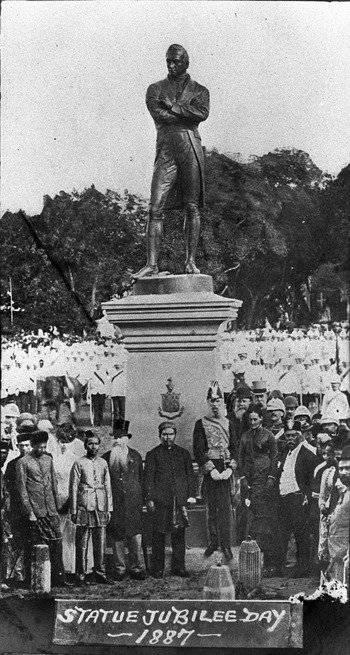
While the establishment of the Raffles Institution, Raffles Library and Museum, and Raffles Place provided a fitting tribute to the man who had come to embody British imperial ambitions in Southeast Asia, and in appropriate venues that were rooted in his stated goals, the society was still missing a physical memorial to the man, as the Raffles Bust had become a simple addition to the foyer of the museum and library created in his name. In 1887, the Jubilee year for Queen Victoria, things came to a head as the formal building for the Raffles Museum was inaugurated and a new lodge was opened on Beach Road, which went by the designation ‘Raffles Hotel’.Footnote 56 In the midst of this celebratory drive to honour Britain and its expanding role in Southeast Asia, a statue also was unveiled, which came to be the physical manifestation for all of the veneration with which the man was held. It echoed back to the early funerary monuments that distinguished the commemoration of British imperial activities throughout the globe. It was a large public statue of the exceptional individual.
Numerous supporters of the British position in Southeast Asia had mooted the creation of a statue memorialising Raffles since his death. While the possibility of having one created had periodically been raised in subsequent decades, it was only in 1884 that the colonial government began taking the task seriously. In a speech at the Royal Colonial Institute in London in July that year, Governor Frederick Weld spoke of the ‘genius of Sir Stamford Raffles’ when he ‘selected’ Singapore as the site of a British settlement, ‘which he rightly judged would one day be the queen of a most beautiful portion of the globe, upon which Nature has lavished all her gifts, and placed at the cross roads of the central highway of commerce.’ This foresight and wisdom, Weld proclaimed, echoing the rhetorical veneration of Victorian heroes, merited the erection of ‘a statue to my great predecessor, one of the best and ablest men of those to whom England owes her Imperial position in the East’.Footnote 57
This announcement sparked a flurry of activity among officials, while the public was encouraged to offer suggestions for the best site and material for the statue through a contest, ‘a puzzle’ with a $5 prize. Among the submissions were proposals that the statue be placed in the grounds of the Raffles Institution, the under-construction museum, the main post office, the passenger pier in the harbour, and even an approximation of his original site of landing. The majority of submissions, however, advocated that it be placed at ‘the centre of the Esplanade on the ground of the old (but now disused) band-stand’. Most participants in the contest also proposed that the statue be made of bronze, as ‘marble will soon lose its colour under the effects of the climate’.Footnote 58
Following these suggestions, Frederick Weld wrote to the Colonial Office in 1885 requesting approval for funds to commission a statue of Raffles made of bronze, which would be located on the Esplanade. At the same time Weld ordered the Colonial Secretary for the Straits Settlements, Cecil Clementi Smith, to engage Thomas Woolner for the task.Footnote 59 Woolner, one of the premier sculptors of his day, was told that he had ‘carte blanche’ for the construction of the statue, with the only request being that it be ‘8½ or 9 feet’ (2.6 to 2.75 metres) in height. He accepted the commission for a fee of £2,000, and later commented that the entire process was ‘pleasing’, as it was one of the few times he did not have to deal with a committee that continually offered suggestions on the execution of a piece, due to the distance between England and Southeast Asia.Footnote 60 Despite the freedom that Woolner was given, newspapers in Singapore followed the progress of the work eagerly. When the sculptor finished a clay model in June 1886, The Singapore Free Press and Mercantile Advertiser reported, ‘The statesman's figure is at full height. He stands bareheaded, with his arms folded. The dress chosen is that of Sir Stamford's time — the knee-breeches stocking, and shoe period.’ Woolner, in contrast, simply described the statue as ‘colossal and of bronze’.Footnote 61
In November 1886, even before the statue was cast, there was such anticipation at its arrival that some British residents raised the possibility that it could be unveiled in February during celebrations around Raffles’ initial landing on the island, and work on the pedestal was prioritised to enable such a distinction. The bronze effigy was cast, however, at Thames Ditton, near London, only in January 1887. Despite the delay, the statue was ‘considerably improved during the process of firing’. It was dispatched to Singapore shortly thereafter, and ‘was successfully hoisted and lowered upon a pedestal’ on 17 June.Footnote 62
Governor Frederick Weld unveiled the eight-foot-tall Raffles Statue in the centre of the Padang on 27 June 1887 as one of the highlights of the celebrations to mark the Golden Jubilee of Queen Victoria. ‘A large number of the chief Government Officials’ as well as ‘the principal residents of Singapore’ attended the ceremony alongside ‘several’ Malay princes and the Sultan of Johor. In his speech, which was ‘a fitting tribute,’ Weld highlighted that Raffles was ‘an illustrious administrator and statesman, whose sagacious foresight laid foundations upon which have been built up a great centre of commerce, a focus from which British influence, carrying with it the light of civilization, radiates far around.’Footnote 63 Singapore now had a proper memorial for a figure that was considered to embody all that British rule had to offer.
The Unveiling of the Raffles Statue, June 1887. Courtesy of National Archives of Singapore.

Framing an icon, creating history
The commemoration of Thomas Stamford Raffles since the unveiling of the statue in 1887 is mirrored in text. The first full biography following his death appeared in 1897, reflecting how this imperial icon had travelled back to his homeland to become a figure of importance, representing Singapore within imperial rhetoric.Footnote 64 Dozens of biographies of the East India Company official followed, each seemingly in a competition of verbiage to pen near-hagiographic descriptions. Raffles was no longer a man, but an imperial god alongside Robert Clive and Cecil Rhodes, embodying the Great Men who created history and made Britain and its empire radiant. He was — to quote one account — a figure of ‘amazing and sterling virtues’, a ‘great soul whose permanent monument is a living and noble city, and whose memory will abide as a true empire builder and a great Christian statesman, in the name of Raffles of Singapore’.Footnote 65
Such descriptions of Raffles as an indispensable and inspiring figure not only were present in biographies, but also soon came to permeate broader histories of Singapore. The island and its past, in such a conceptualisation, could only begin with his arrival and the policies he supported. Raffles became the fount from which all history originated in a tale of free trade, commerce and administration that was intimately connected to a British legacy in the region. Raffles and his story, no matter how exaggerated, became the Singapore story, one to be cherished, honoured and celebrated for encapsulating the basic values of the society. It was the frame from which the past of the island was bounded and understood, containing a blank canvas that allowed for different pictures to be painted, but ultimately limiting the extent of the portrayal or what was considered relevant.
In such an atmosphere, the veneration of Raffles continued throughout the colonial era in Singapore. On the centennial of his arrival on the island, which was celebrated on 6 February 1919, the Raffles Statue, which had overseen the Padang for 30 years, was moved to Empress Place. It now was at the forecourt of Victoria Memorial Hall, inside ‘a colonnade and raised parterre in Italian Renaissance style’, which was ‘ornamented with a marble-lined fountain pool surrounded by semicircular seats and flower-vases’. To commemorate this valuable addition to the architecture of Singapore,’ a tablet was placed on the plinth, hailing the role that the English administrator had played in the establishment of colonial rule in the region.Footnote 66 The Raffles Statue was now the ultimate funerary monument to a man who had come to personify imperial ideology and British colonial rule.
Raffles remains a powerful symbol in the independent nation-state of Singapore, with his name attached to a variety of businesses hoping to be equated with the excellence that the image implied and, perhaps, a romantic and misguided notion of imperialism. While opposition to its prominent position, literally and metaphorically, occasionally arose — for example, government officials discussed taking the statue down in 1959 in the wake of achieving limited self-rule and it was splattered with white paint on 9 August 1970 — the monument remains, along with the various other institutions that were linked to his venerated image during the height of colonial power.Footnote 67 Much of this was at the behest of Albert Winsemius, an advisor to the Singaporean government on issues related to economic policy and development in the 1960s and 1970s. In this regard, Winsemius recommended to Lee Kuan Yew, the prime minister of Singapore, that the Raffles Statue be retained as a ‘symbol of public acceptance of the legacy of the British’, which would attract investment. Following discussions with his cabinet, Lee decided that the statue would remain, and with it a visible representation of how colonialism continues to oversee the historical narrative the society told itself.Footnote 68 Its persistent presence frames a historiography that limits the Singaporean past to a focus on commerce, administration and Great Men. The influence of such ideals remains strong in Singapore today, much like the bronze monument that can still be found standing outside Victoria Concert Hall, the renovated theatre originally constructed to celebrate another imperial figure.