INTRODUCTION
Collaboration between business and the state is a globally encouraged phenomenon because it shapes the direction and content of economic development. Business groups play a key role in providing critical information to enable governments to make decisions and create policies for a country's development agenda. On the other hand, the policies of a state, and its action in response to market failures, safeguard against corruption and support the development of the business sector (e.g. Coleman Reference Coleman1988; Maxfield & Schneider Reference Maxfield and Schneider1997; Schneider & Doner Reference Schneider and Doner2000; Sen & te Velde Reference Sen and te Velde2009; te Velde Reference te Velde2009; Schneider Reference Schneider2013).
In Uganda, business (collectively termed the private sector) is considered an engine of growth, employment creation and socio-economic transformation. For these reasons, the views of the private sector ought to demand the attention of government (Government of Uganda (GoU) 2010). However, the events of 2011 and 2012 called for a critical examination into state–business relations. In particular, there was increased dissatisfaction in the business sector, deadlocks in negotiations and clashes with government over what was regarded as an unfavourable business environment and government's failure to address the conditions that gave rise to the problems (e.g. Ojambo Reference Ojambo2011; Kagola et al. Reference Kagola, Ssenyonga and Mayanja2012; Nangayi Reference Nangayi2012).Footnote 1
Recognising these poor relationships, the government, in the budget speech of 2012, emphasised the need for better engagement with the private sector to ensure that regulations could be flexibly designed to fit the changing constraints and opportunities facing the business sector (Ministry of Finance, Planning and Economic Development (MoFPED) 2012). Improving engagement depends on understanding the capabilities and interactions of government and business organisations. At present, the national development plan (NDP) identifies capacities within the public and private sector as weak, and as limiting constructive input and coordination in policy engagement and participation (GoU 2010). According to the Competitiveness and Investment Climate Strategy (CICS) II 2011–2015, enhancing these abilities will promote public–private sector cooperation, something that is crucial to delivering an appropriate competitive response (MoFPED 2011).
This study seeks to assess the capabilities of business associations to engage meaningfully over policy formation. The literature asserts that the extent to which business groups productively engage with the state depends on their level of autonomy and ability to coordinate and order their interests. Such abilities are in turn determined by several features that characterise the association system and structure of individual associations within the sector; and by their resources which include finance, membership support, means of obtaining information, balance between staff and member expertise, and ability to receive state privileges (Coleman Reference Coleman1985; More & Hamalai Reference Moore and Hamalai1993; Brautigam et al. Reference Bräutigam, Rakner and Taylor2002; Leftwich & Sen Reference Leftwich and Sen2011; Schneider Reference Schneider2013). We use these features to identify and explain the range of capacities. The investigation relies on primary data from a small sample of business associations and interviews with government ministries and agencies. The lack of substantial records from business associations favoured an exploratory, rather than the comparative historical approach that has dominated research into business and public policy issues.
The following section provides an overview of business mobilisation in Uganda. This is followed by a discussion of literature pertaining to state–business relations, and then by a description of the conceptual framework, methods and data. The assessment of business association capacities is followed by a conclusion that discusses their policy implications and how they can be improved.
ON THE MOBILISATION OF BUSINESS ASSOCIATIONS IN UGANDA
The total number of business associations in Uganda is unknown. However, the general consensus from expert knowledge and key informant interviews from various business association chairpersons and the Ministry of Trade, Industry and Cooperative (MTIC), is that the number has increased over the past two decades. The first signs of business mobilisation in the country date back to the pre-independence era when the Uganda National Chamber of Commerce and Industry (UNCCI) was formed in 1933. At the time, the purpose of UNCCI was to facilitate the collective action of businesses and help firms learn from each other. Later, its role transformed to one of reconciling business issues for policy action. It has continued to pursue this function to this day. The creation of UNCCI also stimulated the formation of other associations such as the Uganda Manufacturer's Association (UMA) which was founded in the 1960s. UMA was formed with the objective of promoting and coordinating interests of industrialists in Uganda. This role has now expanded to one of an overseer and advisor to government on policy issues affecting the different industrial sectors.
Following independence in 1962, Uganda suffered a great deal of political turmoil, which resulted in severe economic crises. The early 1970s to mid-1980s saw the collapse of the private sector, while the public sector became grossly inefficient. The breakdown of the economic and physical infrastructure, inadequacies in state departments and the ineffectiveness of UNCCI to handle the various issues prompted the founding of several business associations. Among these is the Uganda Small Scale Industries Association (USSIA), which started in 1979. During the 1970s to mid-1980s, the country lacked raw materials for manufacturing and had to source them from abroad. It was costly for individual businesses to import and transport these materials. As a result, small-scale manufacturers came together for collective purchasing. This association has since grown to more than 800 active members across the country and includes a number of manufacturing trades.
Most of the other business organisations appeared after 1990 when the country underwent economic liberalisation. The liberalisation policies and state agency divestiture were meant to revive the economy. However, the policies also resulted in market failures and prompted businesses to organise. Liberalisation led to the transfer of market power from the state to the private sector, which at the time did not have the capacity to respond to the change. Agricultural marketing boards and cooperatives became defunct, leaving several agricultural businesses prone to risk and losses. Prime examples were coffee businesses, which were facing extinction as a result of new price challenges and a lack of marketing channels. In the past, the organisations were supported by a coffee marketing board that collected and marketed the produce and reduced business risk. This state agency was closed during privatisation. To fill this gap, 50 coffee farmers came together in 1992 to form the Uganda Coffee Trade Federation (UCTF). The UCTF still exists today and offers the same, and additional, services.
Liberalisation also created opportunities for new products and services, but these prospects were not matched by appropriate public infrastructure. For instance, agriculture witnessed diversification into horticulture and flower-growing, but this was not accompanied by supporting institutions to facilitate market information, strengthen capacities, or offer investment incentives and inputs. To mitigate these challenges and strengthen their sectors, organisations such as the Uganda Floricultural Association (UFA) and the Horticultural Exporters' Association (HORTEXA) came into being in 1992 and 1993, respectively.
In some situations, liberalisation promoted business growth in previously unregulated sectors. Firms in some of these sectors formed organisations to take on a regulatory role and network to facilitate business growth. For instance, the Association of Chartered Certified Accountants (ACCA) was formed in 2000, primarily to strengthen accounting skills that were lacking in the country. With more people acquiring skills and engaging in private business, it became important to organise and regulate the professional accounting sub-sector.
In other sectors, it was a combination of both growth in business and inefficiencies in state institutions in delivering and enforcing services such as quality standards that forced firms to organise. This was the case for the Uganda Fish Processors' and Exporters' Association (UFPEA), which emerged in 1993 to promote and enforce quality standards among individual fish exporters and processors. At the time, state regulation of the fish sector was weak and market demand for high-quality products was rising. The Uganda Association of Consulting Engineers (UACE) was born in a similar manner to regulate and build industry professionalism. Other organisations, such as the Kampala City Traders' Association (KACITA), emerged in 2000 out of the need to protect members' property rights and business interests. KACITA is the largest and most influential wholesale and retail traders' association.
By 1995, a variety of business groups had been formed. These groups had diverse interests and policy positions. Sometimes these positions conflicted, making it difficult for the government to prioritise business needs for development. Faced with this dilemma, business associations conceived the idea of uniting under one association to reconcile these positions before they were presented to government. The Private Sector Foundation Uganda (PSFU) was formed with the primary purpose of creating one voice to advocate for the variety of business interests. PSFU is now the most prominent business association and engages with government and other organisations to address the constraints on doing business. The organisation has seats on various national policy and investment committees, which it uses to promote business demands. However, increasing clashes between other associations and government raise questions about PSFU's approach in articulating member interests and getting government support.
The mobilisation of business shows the capability of Ugandan businesses to recognise and respond to market conditions. Institutional and market failures appear to be the incentives for firms to organise and act collectively. Their effectiveness in working with public functions depends, however, on their proficiency in thinking strategically about problems in the sector.
STATE–BUSINESS RELATIONS: A LITERATURE REVIEW
Discussions around state–business relations centre on the need for strong institutions on both sides to ensure constructive relationships that promote development. Such institutions are able to remedy the failures of the state and imperfections in the market, and clarify policy for the private sector (Lucas Reference Lucas1997; Schneider & Doner Reference Schneider and Doner2000; Leftwich & Sen Reference Leftwich and Sen2011). In pursuing relationships with the state, business groups aim to encourage public action for private sector objectives and issues. Good institutional mechanisms will foster positive synergies between the state and business. Such interactions limit the potential for businesses to prey on society and for the state to prey on the private sector. They also make it harder for powerful private interests to wield undue influence on the state (Maxfield & Schneider Reference Maxfield and Schneider1997; te Velde Reference te Velde2009; Calì et al. Reference Calì, Mitra and Purohit2011; Schneider Reference Schneider2013).
So, in view of state–business relations, state capacity extends beyond the mere enforcement of institutional goals and beyond the collective nature of business institutions in governing sector linkages (Weiss Reference Weiss2000). Rather, it is the extent to which state organisations or bureaucracy is autonomous from business organisations (Atkinson & Coleman Reference Atkinson and Coleman1989; Schneider Reference Schneider2013; Savoia & Sen Reference Savoia and Sen2015). The pursuit of transformation requires that this autonomy be entrenched in distinct social ties linking the state to society to facilitate meaningful information exchange, authoritative allocation and policy implementation. Heberer (Reference Heberer2003) further adds that the capacity of the state must also include its ability to incorporate all associations in bargaining processes and find balance between the varied interests.
Good state–business interactions are encouraged when state institutions are provided with benefits such as salaries and performance rewards competitive with those offered in the private sector. This is because such provisions motivate state bureaucrats to do well and shield them from negative influences and potential collusion with the private sector (Rauch & Evans Reference Rauch and Evans2000; Savoia & Sen Reference Savoia and Sen2015). Coupled with this is the strong expertise and merit-based reward for public officials, which encourages the proper collection of information and monitoring of firms, and insulates state institutions from the potential rent-seeking behaviour of associations (Maxfield & Schneider Reference Maxfield and Schneider1997).
Moreover, the national policy style and institution structure that determine the access private sector groups have to policy-makers will define the nature of interactions between the government and business associations (Streeck Reference Streeck1983; Maxfield & Schneider Reference Maxfield and Schneider1997; Schneider Reference Schneider2013). Where a state allows multiple and uncoordinated points of access with businesses, collusion is likely to arise. Where there is coherent policy and consistent objectives within the state, multiple points of access promote effective policy relations with business sector groups. On the other hand, if the state structure is complex and there is reduced transparency, interest group control over policy is reduced.
On the private sector side, there is a need for business to be organised into groups or associations that act collectively (Doner & Schneider Reference Doner and Schneider2000). In developing countries, business groups are formed as a result of state failures, state and non-state corporatist activities, threats to property rights, liberalisation and the emergence of the new business class (Moore & Hamalai Reference Moore and Hamalai1993; Lucas Reference Lucas1997; Ryterman & Recanatini Reference Ryterman and Recanatini2000; Kraus Reference Kraus2002; Schneider Reference Schneider2002; Leftwich & te Velde Reference Leftwich and te Velde2010). These groups facilitate coalitions from which state–business relationships can be built (Tangri Reference Tangri1992; Lucas Reference Lucas1997; Bräutigam et al. Reference Bräutigam, Rakner and Taylor2002).
Once formed, business groups must be able to coordinate interests and achieve autonomy to facilitate productive relations with government. This requires business associations to provide incentives and to build organisational capacities to overcome the problems of collective action, making it easier for them to consult and negotiate with government (Coleman Reference Coleman1985; Maxfield & Schneider Reference Maxfield and Schneider1997; Doner & Schneider Reference Doner and Schneider2000; Schneider Reference Schneider2013). Coleman (Reference Coleman1985) identified several external and internal structural properties that equip associations with institutional power to pursue successful relationships with the state.
Externally, associations that are organised into a bigger ordered system of associations acquire capabilities to process and coordinate complex information that enhances successful engagements with policy-makers. This is particularly so when the system is horizontally differentiated by product or service, vertically integrated, geographically encompassing and has binding ties. Associational systems that possess these characteristics will help sector member associations overcome capacity and information problems imposed by their territorial domains. Lucas (Reference Lucas1997) concurs that being part of a decentralised system with a peak association enhances a unified business position on important issues and promotes influence at sector, regional and national levels.
Internal organisational features that promote institutional strength include finances, membership commitments, professional expertise and membership privileges. These resources offer the association the autonomy it needs to pursue productive relationships away from the influence of its members and the state, should the need arise. Policy-capable institutions will have the ability to mobilise sufficient amounts of these resources from diverse sources. Associations that have adequate funds and professional expertise will have the ability to generate unique information that can be used to broker agreements with policy-makers. Moreover, strong associations will have a balance of professional expertise from member firms and from the state.
The variation in membership solidarity to support the work of the association's shared experiences, the political agenda and the authority to make binding decisions make it easier for organisations to pursue productive relationships with the state. Besides this, when associations have a lot of members, they can earn trust and implement activities on behalf of the state (Doner & Schneider Reference Doner and Schneider2000). Furthermore, groups with a large membership appear more legitimate and are likely to influence policy-makers (Dür & de Bièvre Reference Dür and de Bièvre2007; Mahoney Reference Mahoney2007).
The possession of valuable and exclusive membership privileges, which Olson (Reference Olson1982) termed selective benefits, compensate members for their investment in collective action. These benefits help overcome individual behaviours and result in distributive efforts. Some of these privileges are offered by the state (Coleman Reference Coleman1985; Doner & Schneider Reference Doner and Schneider2000; Schneider Reference Schneider2013; Savoia & Sen Reference Savoia and Sen2015). Doner & Schneider (Reference Doner and Schneider2000) further add that association capacity is strengthened when internal mediations result in solving problems with collective action and lowering of transaction costs.
Policy-capable institutions will cultivate a variety of these characteristics and develop a strong voice to articulate business interests in a manner that helps policy-makers discern the most effective economic policy. Associations will use these resources to develop the strategies by which they are perceived as effective in engaging policy-makers. Depending on the level of capacity, groups may develop direct contacts with parliamentarians and their committees and with the administrative services. They may also develop indirect methods for mobilisation, including debates and conferences, strikes and demonstrations, conducting petitions and engaging the media through press conferences and publicising research reports (Maloney et al. Reference Maloney, Jordan and McLaughlin1994; Jordan & Maloney Reference Jordan and Maloney1997; Binderkrantz Reference Binderkrantz2005).
Business and trade groups in developing countries have mostly used direct methods, particularly direct lobbying of state officials (Schneider Reference Schneider2002; Leftwich & te Velde Reference Leftwich and te Velde2010; Booth et al. Reference Booth, Cooksey, Golooba-Mutebi and Kanyinga2014). Indirect methods, particularly demonstrations and coalitions with other groups, have also been employed (Bräutigam et al. Reference Bräutigam, Rakner and Taylor2002; Kraus Reference Kraus2002; Schneider Reference Schneider2002). Associations with many members have the advantage of organising public demonstrations and have the volunteers to carry out activities. Those with large budgets have more capacity to influence the election of key decision-makers. Sometimes they may hire professionals such as consultants and lawyers who are skilled in influencing policy processes and in mobilising support or opposition to policy initiatives.
Given a state and business groups with high capacity, productive interactions will always be reinforced when there is transparent and reliable information exchange that adds to the credibility of government actions and reduces policy uncertainty for investors. Reciprocity from the business sector in responding to set agreements with government will add to these efforts. Moreover, the credibility of the state in committing to specific policies and trust that each party will carry out their side of the bargain further enhance effective, collaborative partnership between the state and businesses. In situations where there are insufficient resources and institutions are weak in addressing collective problems, interactions between the state and business agents fail to yield a desired outcome (Leftwich & te Velde Reference Leftwich and te Velde2010; Cali et al. Reference Calì, Mitra and Purohit2011; Schneider Reference Schneider2013).
CONCEPTUAL FRAMEWORK
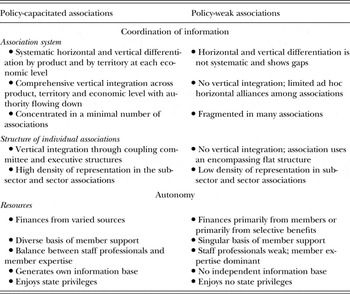
This study borrows the conceptual framework set out by Coleman (Reference Coleman1985, Reference Coleman1988) to evaluate the ability of businesses to negotiate with government. The model has been used to assess capability to coordinate complex information and autonomy of business-policy networks, particularly in developed countries. Table I illustrates the features that this study examines.
Properties for policy engagement capacities.

Source: Coleman (1985).
According to the framework, comprehending the coordination of complex information requires that associations belong to a specialised field/sector (e.g. coffee, textiles, tourism) which defines the range of firms that can organise under it. The sector is definitive of the structural (type of product/service; ownership – public/private), territory/geography (services a city, region or nation) and function (bargains collectively with government or markets, supports firms). It also restricts the complexity of the association system assumed by a collection of associations, e.g. a manufacturers' association is limited to only associations that engage in manufacturing business such as textiles, pharmaceuticals, beverages etc. This kind of arrangement permits an individual association to connect its interests with those of other associations, which encourages information coordination. Furthermore, the sector also limits the nature of information the association or system is asked and able to process for the state. For example the coffee association will deal with issues regarding coffee while textile association will handle issues concerning textiles.
Under this model, association systems that pursue systematic policy-making are characterised with horizontal differentiation whereby the specialised separate sub-sector associations are allowed to voice their specific and relevant interests. Because the system is comprehensive (i.e. encompasses different products, services and geographic locations), concerns from all individual territorial associations, e.g. different city associations, are heard at higher levels of the economy.
The system also exhibits vertical differentiation whereby the specialised associations are grouped into more general levels of the economy by product, service and territory. At this stage the associations are responsible for aggregating and speaking generally about business interests across economic levels of the groups. For instance, the manufacturers' association will speak for all sub-sector manufacturing associations grouped under it. This allows for reconciling differences between associations. This differentiation will be integrated through committees and executive structures that cut across and aggregate the differences among the various product/service, territorial and functional branches. The state is keen to negotiate with such organisations where the representation of interests is concentrated into very few organisations. Associations organised in this manner have mutually exclusive fields and thus will not compete amongst each other for members. Weak systems exhibit fragmented interests among associations, making it difficult for the government to determine what and for whom an issue is important.
Like association systems, individual associations are differentiated by divisions based on product or functional tasks or territorial responsibility within their organisational structures. These divisions are integrated through committees and executive structures that also cut across and aggregate the differences among the various branches facilitating information coordination. In addition, policy-capable associations display high membership representation of their sectors. Policy-weak associations are not differentiated in structure by product, service, territory or function. They have rather flat structures, with all information being channelled to a central executive which will deal with problems on an ad hoc basis.
Having resource diversity in terms of financing is essential to association autonomy. Associations must have a variety of ways to raise funding, some of which include member dues, voluntary supplementary donations by members, the sale of selective goods and services, the payment of interest on various investments, and grants from other organisations, particularly the state. These methods are institutionalised and offer stable funding. The advantage is that it helps the association to preserve its autonomy from the state. Policy-weak associations rely heavily on membership fees which can be constraining to organisations' operations. Some may divert their interest away from the association to the sale of selected goods and services.
Similarly, the diversity of membership support of an association is also an important resource to help it pursue its objectives independently. Members may support an association because it facilitates the purchase of needed goods and services; can press the state and society to provide them with the much needed public goods; has authority and can make binding decisions governing their choices; and offers them solidarity and meaning to experiences in their particular economic niche. Policy-capable associations will cultivate a mix of this support, unlike the weak institutions.
Developing the right policy positions demands the right technical staff, which can be acquired through hiring, or from firms within the association or from the state and other organisations within their environment. Balancing the knowledge derived from all these groups enables the association to reflect upon policy and technical issues, and engage well in dialogue with its members and the state. Moreover, associations may use these resources to generate technical information not readily available but demanded by the state. This repository of information is more than the sum of its member inputs and is sufficiently refined to complement expertise of the state. Weak associations are unable to merge interests and cannot generate the information needed for policy development.
In addition, such associations cannot balance between the authority of the administrative head and the elected executive of the association. The administrative head is limited to the daily running of the organisation and managing executive activities. The elected executive, which constitutes the elected board and chief executive officers, handles issues of policy. In policy-skilled organisations the latter will delegate power to the former, allowing the individual to independently voice issues of public concern.
According to this framework, the state may provide associations with certain privileges such as licences to produce certain goods, e.g. licences to market and promote national specification codes, power to set market prices and make associations' decisions binding to non-members. State privileges allow associations to balance the influence of their members with that of the state, giving them a measure of organisational autonomy.
In investigating the above characteristics, we note that in practice associations combine these features differently and develop varying policy-making capabilities. Associations with the most developed policy capacity will be able to effectively process, coordinate and order a broad range of detailed information for policy-making. Organisations are able to function in their own right with a sufficient diverse resource base. Where business associations have the required attributes and there are no obstacles to collaboration, policy-making and business interests will be progressively integrated.
DATA AND METHODS
Uganda suffers from a lack of comprehensive data on business associations. This, to a great extent, challenges our ability to effectively examine state–business relations. To get around this obstacle, a sample of business associations was drawn from the membership list of the Private Sector Foundation Uganda (PSFU). PSFU is a comprehensive/peak association that regularly registers and updates all associations working with it. The major drawback of focusing on the PFSU list is that it contains only formal groups and raises the question of representativeness. That said, the selected sample of associations provides insights into business–state relations, as will be discussed in the next section.
PSFU categorises its member associations by sector – namely agriculture, manufacturing, engineering, ICT and energy; banking and finance; health, education and other professional services; and tourism trade and commerce. These sectors were used as the strata. A sample of 30 associations was drawn using a stratified random sampling technique from each stratum in sampling. The selection did not take into account the type of association and whether it was a sub-sector or sector association. Sub-sector associations are those that specialise in a particular product, such as flowers or fish, or a service such as accountancy under a particular sector. Sector associations are those that comprise several sub-sector associations. The study also selected PSFU to gain deeper insights into organisational structure. Thirty-one associations were contacted.
Information from the sampled associations was captured using a questionnaire. The information collected included the foundation of the group (when and why the organisation started); structure and areas represented (domains); intra- and inter-organisational structures; institutional resources (including the finances, memberships, professional staff and selective benefits); interaction with policy-makers (in particular the types of issues, access to the agencies, networks and strategies employed to influence policy-makers and any challenges).
Target respondents were the chairpersons and board members of the association. In situations where neither was present, they were replaced by other members recommended by the executive committee members and considered most knowledgeable about the organisation's activity. The primary data collection from business groups was supplemented with data from various documents on the association's activities with the state.
Since the policy process is a two-way process, key informant interviews were conducted with officials at different government levels and from various government ministries, departments and agencies that had a lot of contact with business groups. These included the Ministry of Trade Industry Cooperatives and Industry (MTIC), Uganda Investment Authority (UIA), Uganda Revenue Authority (URA), Uganda National Bureau of Standards (UNBS) and commercial officers of local government, including those in Amuru, Gulu, Busia, Kabaale, Jinja, Rwakai and Kasese. The districts were selected based on their large volume of business activity and group interaction with government agents. Although Kampala is the major centre of business and association activity, the recent restructuring process by KCCA left divisional offices without commercial officers and made it impossible to gather the relevant information. The information gathered from these officials includes the roles their institution played in supporting business-related policies, how they related to the private sector, and the problems they encountered.
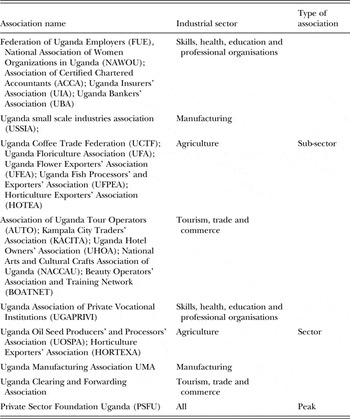
Fieldwork was conducted between November 2012 and January 2013. Response rates from business associations were relatively low, with many agents citing time constraints. Non-responsive associations were replaced by other associations to achieve a total response rate of two-thirds (22 business groups). Table II displays the associations and their sectors. The information obtained was analysed qualitatively to obtain insights into state–business relations, and their capacities in the policy process.
Associations interviewed by sector.

RESULTS
Capacity of business associations to coordinate information
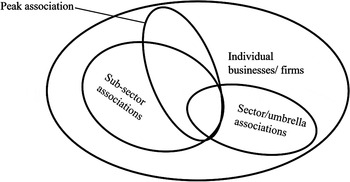
As stated earlier, the ability to coordinate information is intrinsic to the system and structure adopted by an association. We found that business associations were organised at different and interlinked levels, including sub-sector, sector and national, revealing a system that is vertically differentiated and integrated. Figure 1 illustrates the various relationships between groups in the sector. As observed, some sub-sectoral organisations are joined under the sector association while also being members of the peak association. For example USSIA, a sub-sectoral association of small scale manufacturers, belongs to UMA, a sector association that supports various types of manufacturing associations and is itself a member of the peak association, PSFU. Figure 1 also shows the multiple memberships, whereby some sub-sector associations can simultaneously belong to both the peak association and sector associations. In addition, individual companies can simultaneously be direct members of sub-sector and sector associations and the peak group.
Organisation of business groups in Uganda, 2013.

The fact that the sub-sector and sector associations are specialised implies some form of horizontal differentiation by product and sector. The two types of groups are functionally and geographically broad. Geographically, these associations are open to firms throughout the country. Functionally, they take on various tasks that include the provision of information, capacity-building and training, business promotion, policy advocacy and participation, although the degree to which they carry out these activities varies. Our findings revealed that groups prioritise capacity-building over policy participation.
This kind of arrangement implies that there is some level of ordering and reconciliation of information and activities among firms and business groups. It provides a mechanism for merging business interests and reducing complex information into single debate positions for policy engagement. In several cases where challenges and information needs have developed in the market or policy arena, PSFU has directly reached out to various member associations at different levels directly through meetings, mail, emails and phone calls to gather their views and ascertain their interests. These views are reconciled into a single policy position, which is then communicated to policy-makers or other interested parties.
A crucial example is the budget process, where government reaches out to various stakeholders including the business community to obtain information to facilitate the balanced allocation of resources towards national development. During this time, PSFU reaches out to member associations who identify the sector demands and priorities. The needs are reconciled under its ‘Platform for Action’Footnote 2 and presented to the leaders of government and its committees through structured dialogues, which constitute direct meetings. In 2012 the government increased budgetary support to rehabilitate and construct key access roads including the Gulu-Atiak-Nimule, Kabale-Kanungu-Butogota-Buhoma and Kabale-Bunyonyi roads. This was after PSFU, based on data from its associations, had determined that these roads would boost competitiveness of the market and tourism and presented them before government (MoFPED 2012).
Sometimes the process is reversed, whereby affected member associations reach out to PSFU. PSFU then studies the matter before attempting a meaningful resolution with policy-makers. In the 2009 budget, the government committed to several measures including registering of property, enforcing contracts and review of various policies. This was after the associations had identified the issues as limiting to business development and reported to PSFU. PSFU in turn proceeded to press government to act on the matters. The instituted policy reviews led to the elimination of 27 redundant licences under the Trade (licensing) Act of 1969 in 2012 (MoFPED 2009, 2012).
Other cases have involved PSFU and its member associations jointly pursuing government for a policy action change of issues impeding their sectors. The leaders of the organisations together with PSFU act as part of a coalition or an ad-hoc committee addressing a particular policy; or are part of a round table discussion with policy-makers. In this case policy demands are very specific, requiring detailed information beyond what PSFU can readily supply. On occasion, the associations by themselves may not have access to or influence the actions of policy-makers. An example is the formulation and implementation of the Pre-Export Verification of Conformity Programme (PVoC) – 2013. The programme aimed at ensuring compliance to quality standards of goods imported into and exported out of the country. The process enlisted the joint action of PSFU and its members, in particular UCIFA, UMA and KACITA whose activities would be impacted by the effecting of the programme. The organisations worked together with government bodies, mainly the Uganda National Bureau of Standards (UNBS) and MTIC, to address the differences and assume fair conditions for both the state and the businesses.
As revealed, the association system offers an advantage to sub-sector and sector associations to overcome the structural information limitations imposed by their sectors. Often, these organisations cannot keep track of market and policy developments affecting their lines of trade and have to rely on the watchful eye of PSFU. Furthermore, the active member associations benefit from the services and capacity for policy negotiation that they would not have were they functioning alone.
Nevertheless, the arrangement is not without challenges. Interviews with the various business groups revealed that membership ties between associations were not strong. The presence of multiple memberships depicted in Figure 1 suggests weakness in relationships and reveals gaps in the association system. This weakens the relevance and strength of sector associations when it comes to coordinating information. At times, sub-associations have bypassed their sector organisations and communicated directly with the peak association, and vice versa. At other times, some sub-sector and sector associations have side-stepped the peak organisation and approached government, parliament or executive directly.
This is usually the case when dialogue through the peak association breaks down or when the process becomes too slow to yield a timely result. At times business demands are time dependent and linked with high costs. For example, following the tremendous increase in interest rates in 2011, business associations through PSFU sought the attention of government to request banks to lower their interest rates. However, the process failed to yield a meaningful result. KACITA approached the parliament committees, which later demanded action from the government.
Some sub-sector and sector associations cite that directly approaching the ministries places additional pressure on government about their interests, which produces more effective results. In 2012, the Uganda Coffee Trade Federation (UCTF) was involved in promoting various issues concerning the coffee sector. It directly approached and pressed government to recognise the Coffee Research Centre to facilitate more coffee exports. Similar ideas were being fronted by the PSFU on their behalf. This course of action has in some instances resulted in finding a common policy position between business and state actors. As in this case, the issues presented by UCTF were recognised and adopted by government. Other subsector and sector associations allude their bypassing of PSFU to having close contacts within the policy arm in particular ministerial persons to whom they can directly relay sectoral interests. Some state that the approach quickens the state response to their sector problems.
In terms of the structural links within individual associations, our findings were that sub-sector associations were very weak and insufficiently developed for effective advocacy. Most were characterised by a flat structure, comprising an executive head (often the founding member) and one or two administrators who handled all the organisation's duties. They generally lacked committees and, where present, these were often powerless or non-functional. This kind of structure limits an organisation's ability to develop a comprehensive information base for meaningful policy participation and influence. In fact, most such associations indicated that many decisions were taken centrally on an ad hoc basis by the executive head.
Some of the sector associations, such as UMA and the peak organisation PSFU, fare better, given that they have specific departments designated to different activities and tasks – a marketing department, finance department, policy department and so on. These departments are integrated through various directorates and have an executive director who oversees the various activities. Staff are elected by the board members, making it possible for them to independently pursue policy-oriented goals that benefit their organisations without being held to ransom by members. The internal arrangement of these associations implies that the organisations are well equipped to pursue meaningful policy participation. Indeed, the two mentioned here are major players in the private sector–government policy arena. However, their activities are concentrated in the city centre and nearby areas, and their inability to draw in and keep up with business agent and group demands elsewhere in the country diminishes their impact. Several association members of PSFU located in remote parts of the country highlighted their detachment from the centre and, as a result, sought other means to deal with their problems.
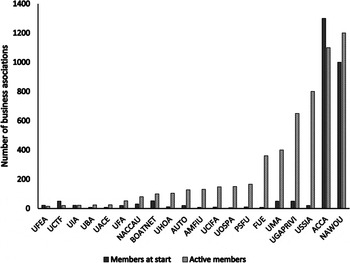
The lack of detailed data on firms that characterise these sub-sector and sector associations makes it difficult to estimate the membership densities in each sector. However, the analysis of trends in association membership reveals that numbers have generally increased in nearly all groups, as shown in Figure 2. For example, the Uganda Manufacturers' Association, which started with 50 members in 1986, grew to 400 active members in 2012. Associations attribute increased membership to two main developments. First is the exclusive benefits (discussed in the next section) that these groups provide for their members. Second is the national attitude that demands that firms belong to an association to gain government attention. Increasing membership implies an increasing internal institutional strength for associations and more penetration in their respective sectors. The pattern also suggests that most associations are in a better position to attain their lobbying goals today than in the past. This follows the assertion that groups with a large membership convey a greater degree of legitimacy to policy-makers.
Membership by business association.

The existing integration of associations provides opportunities for ordering and coordinating information, but the relatively underdeveloped business association system – characterised by weak ties and poor horizontal integration – compromises the capacity to coordinate complex information within the sector. For most associations, the internal structures remain relatively weak and fragile.
Business association capacity for autonomy
This study examined the resources of associations in terms of sources of finance, expertise of professional staff, membership commitment and selective benefits, including those received from the state. A diversity of resources promotes organisational autonomy, which builds a business group's capacity to successfully pursue a policy-making role.
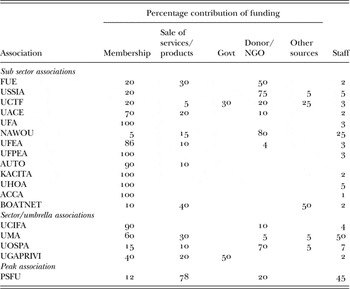
Generally, associations strongly expressed their lack of sufficient funds to run group activities. However, most exhibited some form of diversity in their sources of finance. Most associations had three sources of funds, as shown in Table III. Financial support came largely from membership fees and, to a lesser extent, from the sale of innovative products and services and from grants from donor agencies. Only two of the associations received government funding, which was directed towards capacity-building for business actors. Although diversity of finances indicates some capability for gaining autonomy, in the case of the sub-sector and sector associations, this is greatly compromised by over-reliance on membership fees. This suggests that it is not easy for these groups to pursue policy-oriented issues away from the social base, which are the members. However, even membership fees are not guaranteed: associations generally indicated that members had limited willingness and commitment towards paying. Often members had to be reminded of the fees due, and this led to ill-feeling. Some groups have tried to mitigate the impact of this by diversifying membership categories, with corporate, associate and ordinary members, but this has had little effect.
Association resources.

Note: Govt, Government; NGO, Non-government organisations.
Source: Authors' calculations (2013).
In terms of professional staff, the organisations (especially the sub-sector associations and sector associations) are very weak. The number of staff handling association activities is shown in Table III. Except for UMA and NAWOU, sub-sector and sector organisations depend on a small staff to handle the various organisation tasks, which leads to inefficiency. The reason for the limited staff numbers is the lack of sufficient association funds. Many of the associations lack policy personnel and cannot afford to hire outside expertise, even on a temporary basis. Often, the CEO or secretary takes on the policy and administrative roles, thereby reducing the organisation's effectiveness in policy advocacy or participation.
Some have left policy advocacy entirely to PSFU, but the organisation, which hires technical personnel dedicated to policy roles, complains of understaffing. The organisation has only two permanent staff responsible for various policy-related duties, including collecting and reconciling membership interests, attending multiple (sometimes simultaneous) meetings, advocating and educating members about new developments. These tasks are at times overwhelming and their efficiency is affected. Hiring more policy-related personnel requires additional funding, which the organisation does not have.
The limited expertise has implications, especially for sub-sector associations. While many are able to aggregate and gather policy demands, they are unable to organise information to the depth and specificity needed for policy negotiations. In fact, state agencies allude to the uninformed nature of sub-sector and some sector organisations, and there are misunderstandings and frustrations on both sides.
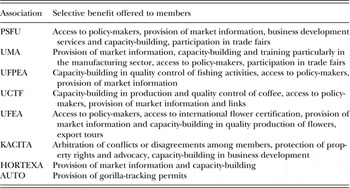
Associations have various benefits, some of which are listed in Table IV. Most of the incentives are self-determined, except for AUTO, which receives special privileges from government to issue gorilla-tracking permits to member associations, giving it power to carry out monitoring on behalf of the state. Additionally, PSFU has special privileges to access government. Specifically PSFU is part of several ministerial committees and the Presidential Investment Round Table (PIRT) which allow it to present and exchange business ideas with government agents and the executive. The PIRT was established to enable government to get advice directly from members of the business community and international experts. While being a member of PIRT offers PSFU a voice for business, influencing government on this platform demands that its collective views outcompete those voiced by powerful individuals of the business community who also sit on the PIRT. This is particularly the case when there is an overlap of issues. Other weaknesses of the PIRT are extensively discussed elsewhere (see Booth et al. Reference Booth, Cooksey, Golooba-Mutebi and Kanyinga2014). Nonetheless, in a majority of cases organisations that attempt to approach state agencies directly are advised to first consult PSFU, which increases its status as a representative.
Exclusive incentives of some member associations.

Source: Authors' compilation (2013).
Most of the selective benefits offered by these organisations are self-determined. Common among them is their commitment to building the capacity of members to deliver, monitor and upgrade quality standards. Low quality was perceived to jeopardise the sales and market share of firms. Associations such as UFEA have gone as far as obtaining international certification to ensure safe, sustainable and high-quality products, which has promoted the survival of many firms in the flower sector.
In a country that overwhelmingly lacks adequate business information systems, firms have had to rely on associations to provide business data. Nearly all sub-sector and sector associations and the peak association cited this as a major service to businesses. Firms attached to these groups often receive information on product prices and quality, markets, training and government policies (especially regarding taxation). Information is distributed in a number of ways, including quarterly or annual reports, brochures, the internet, SMS, direct consultations with secretariat members, trade fairs and training or workshops. Others attached to PSFU and UMA hold annual trade exhibitions. These activities facilitate business networking, improve market awareness and help companies tap into new markets and equip themselves with bargaining power to better compete in a rapidly changing local and global economy. In addition, the service significantly reduces the information search costs that would be incurred by individual businesses and leaves more time for firms to conduct their trade.
Other associations facilitated exclusive market links between member firms at different levels of the value chain. Kawacom, a member company under UCTF, benefited from direct links to farmers, for example. Likewise, trained member farmers of UFEA were offered opportunities to team up with member flower firms that provided skills acquisition and marketing of their product. In all these cases, farmers were assured of a market, protected from price fluctuation and incurred minimal transaction costs, while the companies/exporters obtained a timely, high-quality and reliable supply of their products.
Other sub-sector associations, in particular KACITA, have offered private arbitration services for business transactions involving their members. This initiative came after many businesses had their cases delayed in the law courts. In view of the need to promote speedy resolution, organisations developed a set of rules by which parties could reach an adjudication. This applies only to low-cost disputes, such as fraud and theft.
Many of these self-determined incentives are aimed at improving the sector as a whole, and it is this, coupled with the collective action of associations, that has attracted government to form alliances with several organisations. Recently, the government has increasingly relied on associations to deliver certain programmes and ensure compliance with its policies. The delivery of new tax policies and practices is one such example, in which the Uganda Revenue Authority (URA) partnered with associations such as PSFU, UMA and KACITA to educate business actors about tax applications, thereby promoting compliance. Uganda Investment Authority (UIA) has also sought the active participation and cooperation of the same three organisations to facilitate the operation of its business development services programme.
Because of its comprehensive representation, the peak association PSFU is accorded special privileges by government and is a partner in the policy process. The organisation has seats on various national committees and regularly consults with government on policy matters. This recognition implies that organisations must balance the influence of members with that of the state. Achieving this stability will offer some degree of autonomy to associations and strengthen their relations with the government.
Overall, business groups remain under-capacitated, particularly in terms of financial and professional resources, and this limits their ability to interact with policy-makers. While increasing membership may offer greater opportunity for successful lobbying, it is compromised by the low commitment of members.
CONCLUSIONS AND POLICY IMPLICATIONS
This study set out to examine the current capacity of business associations to engage in meaningful policy engagement. We focused on the ability to coordinate and order their interests and the level of autonomy. The analysis of organisation structures revealed a vertically interlinked system composed of sub-sector and sector associations and the peak association. At the lowest level, firms organise around their business product in a particular sector. While the arrangement provides a means by which business is able to order its interests for policy, this capability is compromised by gaps in the system. Findings showed that membership ties were not binding, which allowed sub-sector associations to approach policy-makers directly. The result is that, at times, government has rejected the position of associations in policy-making. The ability to develop and coordinate information for policy-making is further undermined by the weak internal structures of sub-sector associations that have a central command – executive heads who take decisions on an ad hoc basis. As long as sector and peak association activities are reliant on the actions of sub-sector groups, their effectiveness to pursue policy-oriented goals is also limited.
This investigation also revealed that groups offer several selective benefits to members, which gives them authority over firms in their sectors. These selective roles and the collective nature of associations have encouraged government to build alliances with some groups who take on the delivery of public services. Nevertheless, groups that are financially constrained have limited capacity to gather and process information for policy advocacy. Associations, particularly the sub-sector groups, cannot afford to hire policy personnel, and the sector and peak group have small staffs for the volume of business interests requiring policy advocacy. Although the organisations demonstrated their capability to mobilise and diversify resources, their over-reliance on membership funds, particularly for the sub-sector associations, compromises their autonomy. Moreover, members' commitment to pay their fees is very low.
Given the weak association system, it is suggested that business associations should create self-regulatory rules to make membership binding. This will greatly assist in processing and reconciling interests, which will further reduce the risk of their being rejected by the state and increase the relevance of sector and peak associations. The weak internal structures of the sub-sector associations call for stronger capacity-building in organisational management from the peak association and the more established sector groups.
The weak resource position of associations calls for more aggressive strategies for mobilising financial resources. Associations, particularly the sub-sector groups, could consider partnerships with the state, in which government would offer policy training to staff and members. This would improve the relevance of the state to these groups and promote longer-term development. This type of partnership would be free of financial obligations. It is also recommended that government continue to identify and take advantage of the public service role of business associations to further the delivery of more business sector programmes.
FUTURE WORK
Our results are based on an exploratory analysis. It is suggested that future work consider in-depth research into how business groups apply their ability to influence governments, especially in the case of Uganda. Such investigations often focus on a particular policy process and require time and resources, which were lacking at the time of this study. New studies on state–business relations are increasingly undertaking quantitative analyses of the impacts of business and state interactions on economic development. Accounting for capacities will not only deepen the meaning of these studies, it may also guide priorities for capacity-strengthening when resources are limited.