Introduction
The evolution of pesticide resistance has been identified worldwide as the most serious threat to the development of sustainable integrated pest management practices (Labbe et al., Reference Labbe, Lenormand and Raymond2005). The development of resistance is an evolutionary (Dobzhansky, Reference Dobzhansky1951) and multi-disciplinary process, which is influenced by several interacting factors, such as the initial resistance allele frequency, inheritance of resistance, relative fitness of the various genotypes, management practices, among other factors (Georghiou & Taylor, Reference Georghiou and Taylor1977a,Reference Georghiou and Taylorb).
The fall armyworm, Spodoptera frugiperda (J.E. Smith), is a migratory pest, which is endemic to the Western Hemisphere. The high adult dispersal capacity of this pest allows it to quickly spread along its range of host plants (Sparks, Reference Sparks1979; Johnson, Reference Johnson1988). Spodoptera frugiperda has a highly polyphagous feeding behaviour, which includes the consumption of different cultivated host plants, such as maize, cotton and rice (Yu et al., Reference Yu, Nguyen and Abo-Elghar2003). Two morphologically indistinguishable strains of S. frugiperda, one associated with maize (maize host strain) and the other associated with rice (rice host strain), have been identified already in the USA (Pashley et al., Reference Pashley, Johnson and Sparks1985; McMichael & Prowell, Reference McMichael and Prowell1994; Levy et al., Reference Levy, Garcia-Maruniak and Maruniak2002; Meagher et al., Reference Meagher, Nagoshi, Stuhl and Mitchell2004; Meagher & Nagoshi, Reference Meagher and Nagoshi2004) and also in Brazil (Busato et al., Reference Busato, Grutzmacher, Garcia, Giolo and Martin2002, Reference Busato, Grutzmacher, Oliveira, Vieira, Zimmer, Kopp, Bandeira and Magalhães2004).
Spodoptera frugiperda is the most destructive and economically important insect pest in maize fields in Brazil (Sena et al., Reference Sena, Pinto, Queiroz and Viana2003). Insecticide resistant strains of S. frugiperda have already been identified by Pitre (Reference Pitre1988), Yu (Reference Yu1991) and Diez-Rodriguez & Omoto (Reference Diez-Rodriguez and Omoto2001). In addition, S. frugiperda has been observed injuring cotton plants in the Midwest region of Brazil.
The variation of genetic structure of a pest population in space and time and gene flow among its sub-populations are greatly responsible for the rate of resistance evolution (Fuentes-Contreras et al., Reference Fuentes-Contreras, Figueroa, Reyes, Briones and Niemeyer2004). The estimation of gene flow derived from the use of molecular markers can serve as an index of dispersal rates (Slatkin, Reference Slatkin1985; Roderick, Reference Roderick1996). Molecular markers have been extensively used to evaluate the genetic similarity and to estimate the gene flow among insect populations (Figueroa et al., Reference Figueroa, Loyayza-Muro and Niemeyer2002; Fuentes-Contreras et al., Reference Fuentes-Contreras, Figueroa, Reyes, Briones and Niemeyer2004, Sosa-Gomez, Reference Sosa-Gomez2004; Martinelli et al., Reference Martinelli, Montrazi, Zucchi, Silva-Filho and Omoto2006). Amplified fragment length polymorphism (AFLP) markers have been successfully used to investigate the genetic similarity and population structure of different insect species (Meldenson & Shaw, Reference Meldenson and Shaw2002; Timm et al., Reference Timm, Pringle and Warnich2005; Zhang et al., Reference Zhang, Zhang, Zhang, Wu, Xu and Xu2005), including S. frugiperda (McMichael & Prowell, Reference McMichael and Prowell1994; Busato et al., Reference Busato, Grutzmacher, Oliveira, Vieira, Zimmer, Kopp, Bandeira and Magalhães2004).
Insect population genetic structure describes how populations are subdivided into finite breeding units (Roush & Daly, Reference Roush, Daly, Roush and Tabashnik1990) and can be correlated to local selection, patterns of mate selection and gene flow (McKenzie, Reference McKenzie1996). Therefore, the comprehension of insect population genetic structure and intraspecific gene flow is essential for designing management practices to delay the evolution of resistance to any control method (Tabashnik, Reference Tabashnik1991; Caprio & Tabashnik, Reference Caprio and Tabashnik1992).
The objective of this research was to estimate the genetic variability and structure of S. frugiperda populations associated with maize and cotton crops from different geographic regions in Brazil.
Materials and methods
Insect material
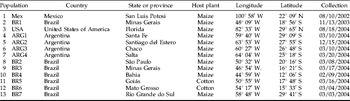
Spodoptera frugiperda adults and larvae were collected from maize and cotton fields at seven locations across Brazil. Additionally, four maize populations collected across Argentina, one population in Mexico and another one in the USA, were included in the analysis as outgroups (table 1). The collected larvae and adults were frozen and stored at −80°C.
Identification of the populations of Spodoptera frugiperda obtained for AFLP analysis.

DNA extraction and quantification
Spodoptera frugiperda genomic DNA was extracted using a CTAB method (Black & Duteau, Reference Black, Duteau, Crampton, Beard and Louis1997). Larvae were prepared for DNA extraction by removing the gut and the head. Larvae and adult thoraces were homogenized in 500 μl extraction buffer (100 mm Tris-HCL pH 8.0, 1.4 m NaCl, 0.02 m EDTA, 2% CTAB, and 0.2% beta-mercaptoethanol). Proteinase K (concentration of 200 μg ml−1 extraction buffer) was added to the homogenate for 2 h at 65°C. RNase A (500 μg ml−1) was added to the homogenate and held for 3 h at 37°C. After RNA and protein were removed from each sample, the homogenate was centrifuged at 13,000 rpm for 5 min at room temperature. The supernatant was extracted with 500 μl of chloroform:isoamyl alcohol (24:1) by centrifugation at 14,000 rpm for 20 min to separate the phases. The aqueous phase was transferred into an autoclaved 1.5 ml microcentrifuge tube and the chloroform:isoamyl step was repeated. DNA was precipitated by adding 400 μl chilled (−20°C) isopropanol to the aqueous phase and incubated at 4°C for 8 h. After incubation, the precipitate was centrifuged at 13,000 rpm at 4°C for 30 min. The isopropanol was decanted off; the DNA pellet was rinsed with 500 μl 100% ETOH and centrifuged at 13,000 rpm at 4°C for 5 min and repeated a second time. The ETOH was decanted off and the pellet was air dried (24°) for 45 min. Fifty μl 1×TE buffer (10 mm Tris-HCL pH 8.0; 0.1 mm EDTA) was poured onto the DNA pellet and stored at 4°C for 8 h. After the DNA was re-suspended in 1×TE buffer, each sample was quantified by running a 1% agarose gel with a λ DNA marker (22.2 ng μl−1). TE buffer (1×) was added to DNA samples until they reached a concentration of 22.2 ng μl−1 concentration of genomic DNA. The agarose gels were visualized under UV light using Genomics Solutions software. The quantified DNA product was stored at −80°C until used for AFLP analysis.
The DNA samples were diluted down to the concentration of 22.2 ng μl−1 concentration of genomic DNA by adding TE buffer (1×). The agarose gels were visualized under UV light by using the Genomics Solutions software. The quantified DNA product was stored at −20°C until used for AFLP analysis.
AFLP methods for genetic analysis
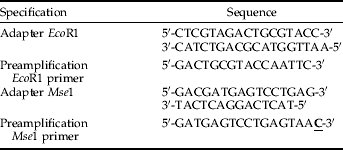
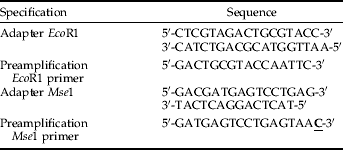
A modified AFLP protocol (Vos et al., Reference Vos, Hogers, Bleeker, Reijans, Van de Lee, Hornes, Frijters, Peleman, Kuiper and Zabeau1995) was used to assess the genetic variability of S. frugiperda populations. It used the DNA extracted from seven individuals per population of S. frugiperda in order to keep consistent with the lowest number of insects available in a given population. The AFLP procedure was completed out in three basic steps: (i) DNA template preparation, (ii) DNA template preamplification, and (iii) selective amplification. The DNA extracts were digested with EcoR1 and Mse1 restriction enzymes and ligated with specific adapters (table 2). The samples were diluted ten-fold and used as a template for the preamplification and selective amplification. The selective primers selected for this analysis had three additional nucleotides at the 3′ end of the preamplification primers and were end-labelled (table 3). The AFLP products were separated in 6.5% denaturing polyacrilamide gels visualized in a Li-Cor Gene Read IR 4200 DNA sequencer (LI-COR, Lincoln, Nebraska). The following electrophoresis conditions were used: 1500 volts, 40 watts, 40 mA of current, at 45°C for 2.5 h.
Sequences of specific adapters and preamplification primers.
Sequence of the primers used at the selective amplification step at the AFLP protocol.

Data collection and analysis
AFLP bands were visualized using IRD-700 labeled 50–700 bp markers as a reference and scored using SAGA Generation 2 Software version 3.2 (LI-COR, Lincoln, Nebraska). Visibility and sharpness of bands were used as criteria for marker selection. The bands were identified by scoring the presence (1) or absence (0) of the bands among the S. frugiperda populations for every selective primer pair combination.
A binary data matrix (1 or 0) was created from the selected markers to estimate the Jaccard similarity index by using the SINQUAL procedure available in the Ntsys-2.1 software (Rohlf, Reference Rohlf2000). Dendrograms were constructed using methods described by Sneath & Sokal (Reference Sneath and Sokal1973). A bootstrap procedure was used to evaluate the reliability of the dendrograms using 10,000 pseudo-replicates (BOOD-P software, version 3.1, Coelho, Reference Coelho2001). The goodness of fit of the dendrograms to the data was estimated by using the procedures COPH and MAXCOMP in Ntsys 2.1 (Rohlf, Reference Rohlf2000). The correlation of geographical distance to genetic distance was performed using the Mantel test with 999 permutations (Mantel, Reference Mantel1967). The analysis of molecular variance (AMOVA) was performed to access the genetic structure and gene flow among populations of S. frugiperda. The AMOVA procedure partitioned the total variation both between and within S. frugiperda populations by the use of the squared distances as described by Excoffier et al. (Reference Excoffier, Smouse and Quattro1992) and by using the Arlequin program (Schneider et al., Reference Schneider, Kueffer, Roessli and Excoffier2000).
Results and discussion
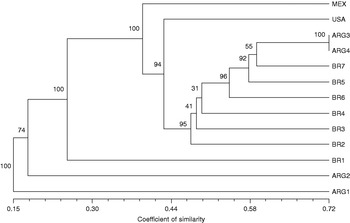
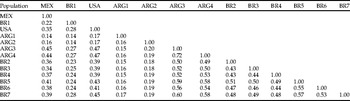
The results showed that four primer pair combinations (table 3) provided unambiguously scorable, clear, consistent, polymorphic and reproducible banding patterns. The mean genetic similarity among the populations obtained from the Jaccard similarity matrix was 0.45. The unweighted pair group method with arithmetic mean analysis (UPGMA) dendrogram, based on the Jaccard algorithm, did not indicate a molecular classification of the populations of S. frugiperda associated with the host plant in which the insects were collected (fig. 1). For example, BR5 collected in cotton plants and BR7 collected in maize were the most similar populations from Brazil (table 4, fig. 1). The similarity matrix showed that ARG3 and ARG4 were the most similar S. frugiperda populations (0.72) (table 4). The lowest genetic similarity value was observed between the BR1 and ARG1 populations (0.14). The Mantel test of genetic isolation by distance showed that genetic dissimilarity and geographical distances were not significantly correlated (n=78, r=0.04, P=0.3917).
Mean genetic similarity pattern obtained for the thirteen Spodoptera frugiperda populations. UPGMA clustering criteria based on the Jaccard similarity index through AFLP analysis. Cophenetic correlation=0.98.

Matrix of genetic similarity obtained through AFLP markers based on the Jaccard index among populations of Spodoptera frugiperda.

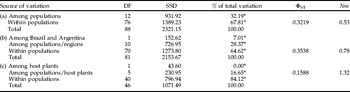
The overall non-hierarchical AMOVA test (table 5a) revealed that 32% of the total variation could be attributed to the variability among the tested populations. The hierarchical AMOVA (table 5b,c) analysis revealed that the local populations were the major reservoir of genetic variability. Approximately 7% of the total variation was related to the arbitrary subdivision within the Brazilian and Argentine populations (table 5b). In addition, the AMOVA results revealed no molecular variation between the maize and cotton groups of populations of S. frugiperda collected in Brazil. This information indicated no significant structuring within the S. frugiperda populations associated with maize and cotton crops (table 5c).
Analysis of molecular variance (AMOVA) to explore geographical and host plant associated subdivision in populations of Spodoptera frugiperda.

* P<0.001.
The AFLP analysis provided appropriate results to assess the genetic variability and population structure of populations of S. frugiperda associated with maize and cotton in Brazil. Moreover, high values of molecular similarity were found between the populations of fall armyworm collected in Brazil and USA (Florida). Similar results were found with the velvetbean caterpillar, Anticarsia gemmatalis (Hübner) (Lepidoptera: Noctuidae) (Sosa-Gomez, Reference Sosa-Gomez2004). The results obtained from the present study and those gathered by Sosa-Gomez (Reference Sosa-Gomez2004) suggest that certain populations of Noctuidae insects in South America may be composed in their majority by non-migratory or permanently resident genotypes. Nevertheless, migration is a complex attribute with great evolutionary flexibility in its own appearance and disappearance. The balance between migratory and resident individuals may even occur in populations of the same species (Alerstam et al., Reference Alerstam, Henderstrom and Akesson2003).
None of the dendrograms showed a branch or a major cluster that could separate the populations of S. frugiperda into distinctive groups associated with the maize or cotton crop. This result has suggested that different lineages of this pest associated with maize and cotton plants have not been established in Brazil. Moreover, it could not be detected as a significant portion of genetic variability associated with the geographical origin of the populations. However, the detection of few differences among S. frugiperda populations may also be due to the limited resolution of the AFLP markers or high gene flow rates. Both processes would result in the lack of an association between genetic differences and geographic distance, and they could hardly be distinguished from each other.
The higher values of variation (ΦST) are common in species characterized by a closed population structure. The hierarchical AMOVA (table 5b,c) analysis confirmed that the local populations are the major reservoir of genetic variability. Gene flow is the evolutionary force which counteracts the effects of genetic drift and selection, ultimately resulting in homogenization of the genetic background of populations at greater geographical scales (Vandewoestijne et al., Reference Vandewoestijne, Neve and Baguette1999). When the homogenization effect doesn’t take place, higher values of variation among populations can be detected. The percentage of variation found in the present study was most likely to be due to the non-hierarchuical AMOVA analysis taking into account populations from South America (Brazil and Argentina) and North America (Mexico and USA). These populations were collected in areas with different agro-ecosystems. The large geographic area and the different cropping systems that were used for sampling are most likely to be contributing factors to the observed differences in the genetic structure of S. frugiperda in this study. The majority of molecular markers studies performed with S. frugiperda have been focused on the maize and rice host strains issue (Nagoshi & Meagher, Reference Nagoshi and Meagher2003a,Reference Nagoshi and Meagherb; Prowell et al., Reference Prowell, McMichael and Silvain2004). Recently, genetic variation within and between S. frugiperda host strains has been assessed by analysing the ITS-1 region (Lewter et al., Reference Lewter, Szalanski, Nagoshi, Meagher, Owens and Luttrell2006). The authors also found high values of overall ΦST values which combined with the hierarchical analysis output suggested structuring of S. frugiperda populations between states in the USA. According to Lewter et al. (Reference Lewter, Szalanski, Nagoshi, Meagher, Owens and Luttrell2006), this variation was possibly due to the distribution of fall armyworm strains. In order to further understand the genetic structure of an organism across a larger geographical scale, efforts should be made to approach the issue by combining landscape ecology and population genetics (Manel et al., Reference Manel, Schwarz, Luikart and Taberlet2003).
The hierarchuical AMOVA (table 5c) revealed a significant value of immigrants (Nm=1.32) between maize and cotton. In population genetics studies, the values of Nm>1 are considered sufficient enough to make gene flow overcome genetic drift (Wright, Reference Wright1931) and consequently acts in favour of the homogenization of the genetic background of populations. Different papers have addressed the estimation of gene flow and dispersal rates by using molecular markers and their impact on population genetics (Milligan et al., Reference Milligan, Leebens-Mack and Strand1994; Bossart & Prowell, Reference Bossart and Prowell1998a), but there has been a heated debate about the usefulness of these estimates (Bohonak et al., Reference Bohonak, Davies, Roderick and Villablanca1998; Bossart & Prowell, Reference Bossart and Prowell1998b). Indirect estimates of gene flow and dispersal rates have been extensively criticized. Particularly since those estimates rely on a mathematical relationship between the genetic structure and the rate of gene flow, such estimates implicitly assume that the ecological properties of the populations from which the genetic data were taken match the often unrealistic assumptions of the theoretical model upon which that mathematical relationship was based (Whitlock & McCauley, Reference Whitlock and McCauley1999).
Despite the limitations of the traditional approaches for indirect estimation of gene flow, they still provide a first scenario for many cases (Bohonak et al., Reference Bohonak, Davies, Roderick and Villablanca1998). The information reported herein provided insight to integrated pest management scientists because S. frugiperda is well known to feed on both crops. The AMOVA results also showed a 0% variation in Brazil among those populations of S. frugiperda. The results of this study are particularly important when considering the potential for a mixed agro-ecosystem of Bt maize and Bt cotton. This study will help researchers to more clearly define insect resistance management techniques for conventional agricultural practices, as well as for genetically modified crops. The constant genetic mixing of resident and immigrant populations of S. frugiperda has the potential to impact insect resistance management programmes (Roush & McKenzie, Reference Roush and McKenzie1987; Roush & Daly, Reference Roush, Daly, Roush and Tabashnik1990). Therefore, further studies should be concentrated on the estimation of the gene flow rate between S. frugiperda populations associated with different crops and wild hosts over the crop seasons in Brazil.
Acknowledgements
The authors acknowledge Capes, FAPESP and CNPq for funding this research and the Brazilian Insecticide Resistance Action Committee (IRAC-BR), Dr David Isenhour, Dr Jaime Molina-Ochoa and Claudia Gianni for providing the logistic support for collecting populations.