During recent studies on the revision of the genus Usnea in Turkey, some specimens morphologically close to U. subfloridana Stirt. were found with ±stipitate soralia (i.e. soralia produced on small tubercles) and with baeomycesic acid in the medulla. They were collected in several localities in north-east Turkey. These specimens proved to be U. pacificana, known hitherto from Oregon, Washington (USA) and British Columbia (Canada) (Halonen Reference Halonen2000).
Morphological characters were studied on freshly collected specimens using a CARL ZEISS Stemi 2000-C dissecting microscope. Selected specimens were analyzed for secondary metabolites by high performance thin-layer chromatography (HPTLC) in accordance with Arup et al. (Reference Arup, Ekman, Lindblom and Mattsson1993), using a CAMAG Nanomat 4 sample applicator and a CAMAG horizontal development chamber. We also sequenced ITS regions from DNA samples obtained from several Usnea species collected from Turkey, but these sequences will be discussed in a forthcoming paper.
Usnea pacificana P. Halonen
Bryologist 103: 39 (2000).
A detailed description of the species is provided by Halonen (Reference Halonen2000).
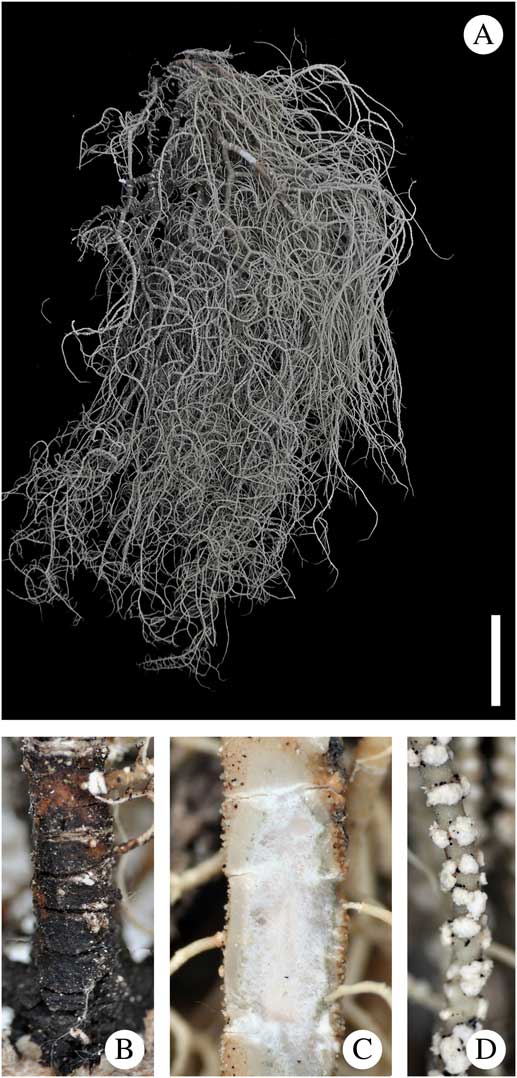
Description (based on three Turkish specimens). Thallus shrubby to subpendulous (specimens up to 15 cm, Fig. 1A). Base slightly to distinctly blackened with 5–9 annular cracks on the first half centimetre (Fig. 1B). Branching pattern mostly anisotomic-dichotomous. Branches tapering with cylindrical segments; lateral branches not constricted at ramification points. Papillae verrucose, abundant on main branches, but sometimes not apparent or even lacking on secondary branches. Fibrils normally sparse, occasionally abundant. Soralia punctiform to enlarged, usually ±stipitate (Fig. 1D). Isidiomorphs short to relatively long, occurring at least on young soralia, but becoming easily abraded and usually lacking in old soralia. Cortex thick and matt, 10–11%; medulla generally dense to loose and relatively thin, 25–28%; central axis relatively thick, 23–31% (Fig. 1C).
Usnea pacificana. A, subpendent form; B, basal part with annular cracks; C, longitudinal section of main branch with thick cortex and dense to loose medulla; D, stipitate soralia. Scale: A=2 cm. In colour online.

Chemistry. Usnic, baeomycesic and squamatic acids.
This species is characterized by a shrubby to subpendulous thallus, a thick cortex (>10%), punctiform to enlarged ±stipitate soralia and the presence of baeomycesic acid in the medulla. The most closely related species seems to be U. subfloridana Stirt. However, that species has non-stipitate soralia and produces thamnolic and/or squamatic acids in the medulla, never baeomycesic acid. Usnea silesiaca Motyka might look similar but its medulla is much thinner and more compact, the blackish pigmentation of the basal part is usually more extended, the mature soralia are not stipitate but level with the cortex or ±concave, and the diagnostic secondary substance is salazinic acid.
Short morphotypes of U. dasopoga (Ach.) Nyl. might superficially resemble U. pacificana. However, U. dasopoga has a thinner cortex (<10%), usually abundant fibrils, soralia that are not stipitate with many isidiomorphs, and produces salazinic acid in the medulla.
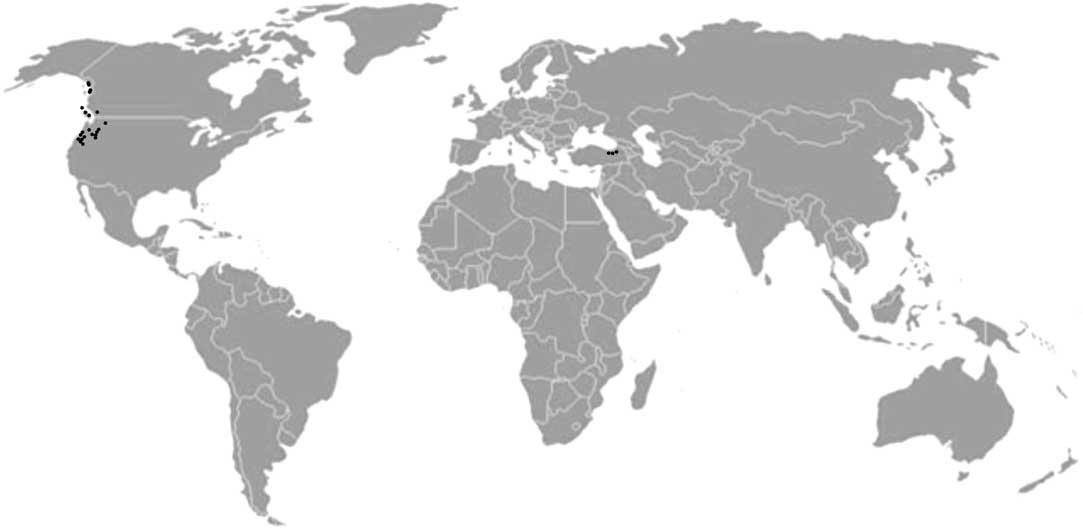
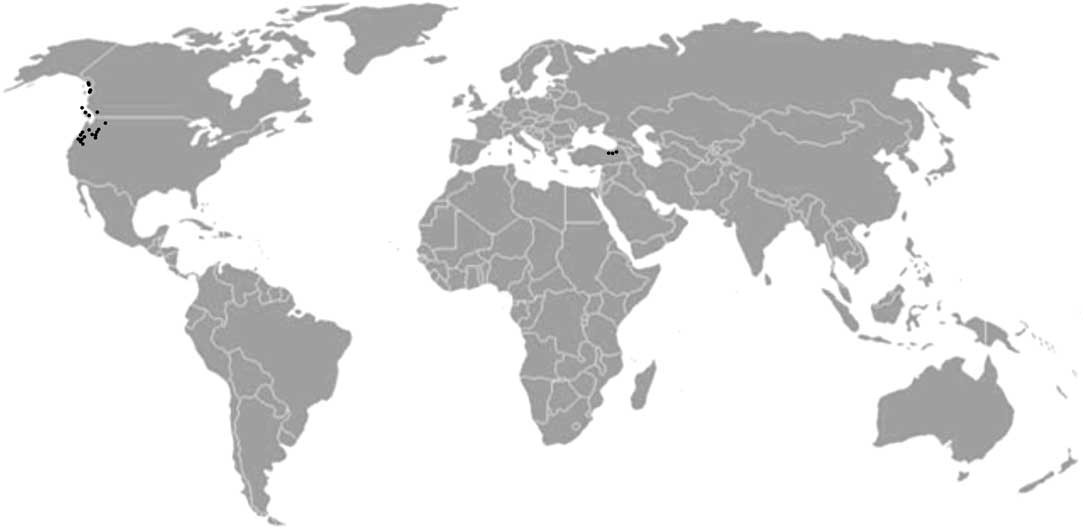
Usnea pacificana was previously known from Oregon, Washington State and British Columbia (Fig. 2), where it is restricted to moderately open and humid forests from about sea level to c. 1100 m (Halonen Reference Halonen2000) and from Alaska (Dillman et al. Reference Dillman, Ahti, Björk, Clerc, Ekman, Goward, Hafellner, Pérez-Ortega, Printzen and Savic2012).
The Turkish specimens were collected from moderately open and humid forests in the north-eastern part of Turkey, the East Black Sea Region. The annual rainfall is higher than 2200 mm and the area is covered by snow for several months with frequent fog occurrence. Contrary to Halonen (Reference Halonen2000), our specimens are known from altitudes of 1660 m to subalpine zones of 1970 m (the highest point in the area is Mt Kaçkarlar with its summit at 3932 m) with an oceanic climate. Species of the genus Usnea do not live close to sea level in Turkey unlike those found on the Pacific Coast of Canada and north-west USA. Indeed, except for some sporadic appearances from 400–1000 m, well-developed populations are found at altitudes >1000 m.
All three specimens were collected on Picea orientalis. The specimens from Rize were accompanied by U. barbata, U. dasopoga, U. glabrescens var. fulvoreagens Räsänen, U. hirta (L.) F. H. Wigg. and U. intermedia (A. Massal.) Jatta while specimens from Trabzon were accompanied by U. dasopoga and U. florida (L.) F. H. Wigg.
The distribution range of U. pacificana (Fig. 2) shows a major disjunction between North America and Central Eurasia. This type of distribution of North American and European species is discussed in detail by Kärnefelt (Reference Kärnefelt1980) and Aragón et al. (Reference Aragón, Martínez and Otálora2004), and is known for U. flavocardia Räsänen (Clerc & Diederich Reference Clerc and Diederich1991, as U. wirthii P. Clerc).
World distribution of U. pacificana.
Specimens examined (all deposited in the private herbarium of the first author). Turkey: Giresun: Karagöl Mountain, between the village of Güzyurdu and the city of Giresun, just below the alpine zone, 40°40'17·14''N, 38°15'2·38''E, 1970 m, on Picea orientalis, 2011, Şenkardeşler, Lőkös & Calba 4569. Rize: Kaçkar Mountains, between the town of Ayder and Kaçkarlar National Park, 40°55'48''N, 41°8'34·98''E, 1660 m, on dried Picea orientalis, 2011, leg. Şenkardeşler, Lőkös & Calba 4570. Trabzon: Zigana Mountain, 1 km S of Kayabaşı Village, 40°50'47·73''N, 39°28'12·49''E, 1780 m, on Picea orientalis, 2011, leg. Şenkardeşler, Lőkös & Calba 4571.
This research was supported by the Scientific & Technological Research Council of Turkey (TÜBİTAK, Project number 210T022). The first author thanks Dr László Lőkös (Budapest) and Orçun Fuat Calba for their help with field studies.