1. INTRODUCTION
The European Commission and Member States have observed that transport in Europe is growing at a high rate and that by 2020, the figures for inter-European transport including the EU new Member States, will show a growth of over 50% in volume and that these values would be absorbed mostly by road transport. However, road transport poses rather more environmental problems than maritime transport, including a higher rate of congestion, pollution, noise, and accidents. Although Europe needs all modes of transportation to ensure the necessary mobility for people and business, short sea shipping integrated into an efficient transport chain appears to be a potential choice to avoid congestion, improve accessibility and to provide seamless transport routes.
There are certain commodities and routes, where the higher cost of sea transport within an intermodal transport chain (due to legal systems, infrastructure differences or less developed transport vehicles) (Blonk, Reference Blonk2003), could be assumed by using more expensive transportation units such as high speed vessels.
The main aim of this paper is to show an analysis of the sea conditions in Western Europe, in order to assess the provision for fast vessels in five feasible routes and to compare their competitiveness with road transport. The paper has been divided into two main sections. Firstly, a description of the selected short sea shipping routes in SW Europe and some previous research are provided. Secondly, an analysis of the sea conditions that would affect the proposed routes, mainly regarding significant wave height, and their effects on high speed vessels.
2. STATE OF THE ART OF SHORT SEA SHIPPING IN EUROPE
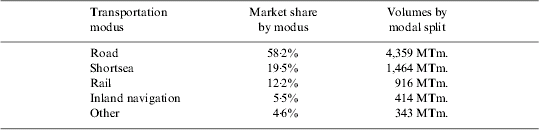
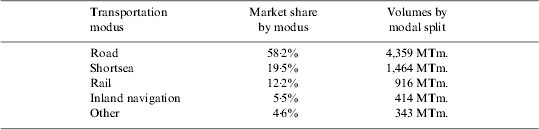
The current state of short sea shipping within Europe is briefly reviewed in this section. Short sea shipping accounted for 19·5% of the entire volume of goods transported by sea within the EU-25 in 2005. The total amount of goods transported by sea was of 1·46 billion tonnes (NEA Institute, 2006) whilst 4·36 billion tonnes (58·2% by volume) was carried by road. In terms of tonne-kilometres, intermodal rail, barge and shipping transport only accounted for 5%. But based on an analysis of transport flows and the development of transport demand according to the type of freight, the aforementioned study forecasts that between 2005 and 2015 the total short sea tonnage will increase by 31%. The complete distribution by modus in 2005 is shown in Table 1. The expected evolution points to a slight increase in the short sea share with road transport losing only 1% of its market dominance. In spite of this, there is a long way to go to reach a sustainable transport network in an enlarged Europe (now 27 states). There are major concerns related to transport, such as pollution or congestion in the Western territories and proper accessibility in the others.
Transportation modus share by market and volumes in EU-25, 2005. Source: Own based on NEA.
2.1. Motorways Of The Sea
This concept was first introduced in the White Paper on European Transport Policy towards 2010. According to this document, sea transport is not just a means of carrying goods from one continent to another but a real competitive alternative to land transport. For this reason, certain shipping links should be included as part of the trans-European transport network, just like motorways or railways, in an effort to reduce road congestion and/or improve access to peripheral and island regions and countries. In addition to land transport connections, sea connections, or ‘the Motorways of the Sea’, are now included in the TEN-network. This enables the logistics connection of different priority land transport projects, which will contribute to the improvement of the overall efficiency of EU transport network operations. The Motorways of the Sea are different from other priority transport projects and their rules have been described in Article 12a of the TEN-guidelines. Basically, the TEN-Guidelines provide three main objectives for sea motorways:
• Increasing freight flow concentration on sea-based logistical routes
• increasing cohesion
• reduce road congestion through modal shift.
The network shall consist of facilities and infrastructure concerning at least two ports in two different member countries. Bearing in mind the closeness of the date for publishing the list of ports included in the network we analyse which type of vessel is going to fit best into some of the proposed ports to best ensure a real modal shift. Additionally, although freight transport should be dominant, the Motorways of the Sea should not exclude the combined transport of people and goods. (DGTren, 2001).
3. PREVIOUS RESEARCH AND SELECTED ROUTES
The previous research carried out by the TRANSMAR research group within the Polytechnic University of Catalonia was the INECEU project, proposed after an exhaustive study of alternative multimodal lines against road transport (Olivella & Martínez de Osés, 2006). Bearing in mind the road traffic figures across the Pyrenean borders, the group analysed most of the cargo volume transported between Spain and France. Among all the Spanish regions we should note the activity of Catalonia, the Basque country, Valencia and Andalusia. The French counterpart comprises the Pyrenean regions of Aquitaine, Languedoc-Roussillon and Midi-Pyrenees together with Ile-de-France, Rhone-Alps and Provence-Alps-Côte d'Azur. The French territory is also crossed by important traffic flows moving southbound from Westafalia, Baden-Würtemberg and Bayern in Germany and the northern part of Italy. From Spain, it is possible to identify the main traffic towards Westfalia and Baden-Würtemberg in Germany, Lombardia in Italy and destinations more spread out in Great Britain, Holland and Belgium. Regarding the nature of the cargo, we note that the South and South-East of the Iberian Peninsula together with the Valencia coast are big producers of fruit and vegetables. Manufactured or canned food and alcoholic drinks are one of the larger cargo groups that is exported from Spain. Important foodstuff flows arriving in Spain as iceberg lettuces, tomatoes and hickory, which now come from Benelux to Barcelona, instead of from Almeria and Murcia. In addition there is important traffic involving solid bulk such as building materials or scrap iron for re-rolling as reinforced bars or beams, together with oil and chemical products from nearby ports with refineries that are firmly committed to removing trucks carrying dangerous or toxic substances from the road and making use of ships with specially-designed containers, or Ro/Ro's, that will benefit transport activity as a whole. The study concluded that:
• It is economically justified for industry to use short sea shipping for destinations further than 800 kilometres with road legs of less than 200 kilometres.
• While Mediterranean traffic is consolidated, the Atlantic basin traffic, which mainly specialises in bulk traffic, should take advantage of the official policies by using multi-purpose ships capable of accepting return freight and thus reduce the imbalance of freights flows.
• Fast ships in this kind of traffic could be justified for trips of less than 12 hours and when cost is not as important as providing a shorter guaranteed delivery time.
• Weather conditions need to be considered when fast vessel traffic is considered.
4. ANALYSIS OF MORE SUITABLE ROUTES
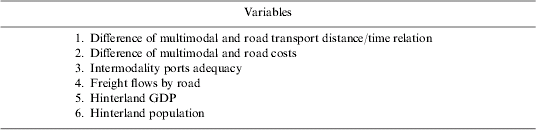
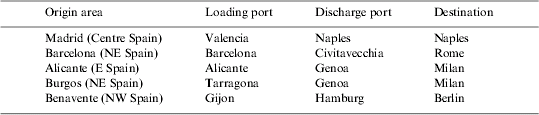
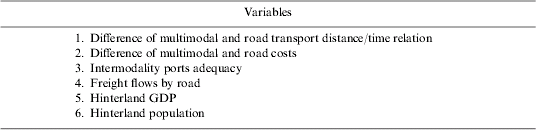
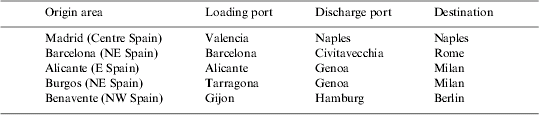
From the previously mentioned study, up to 15 routes were obtained, based on estimated time and cost between multimodal and road transport. However a deeper analysis was initiated after the preliminary results, using more parameters and data, to confirm the real efficiency of multimodal chains over the use of road-only transport. The additional variables are summarised in Table 2. In a further phase the information was collected and selected, proposing a weighting factor for the main parameters established, depending on the importance empirically considered by the researchers. In a third phase the preliminary results were obtained and just five routes were considered as practical alternatives to road transport, four in the Western Mediterranean and only one in NW Europe. These five routes are shown in Table 3.
Variables.
Multimodal chains found more efficient than road transport. Source: Own analysis, 2006.
Weather limitation is an important factor when analysing a sea route, and its importance grows when the route could be served by high speed vessels. These are subject to restrictions derived from the significant wave height as the HSC Code points out. This means that in certain meteorological conditions, a ship will not be able to sail or will need to look for shelter whilst at sea. It then becomes necessary to know the potential time this type of ship would be out of service on those routes where the wave height recorded exceeds the significant limit.
From a study carried out by Austal Ships on board the high speed vessel Stena HSS en route in the Irish Sea, a cancellation rate of only 0·3% on the basis of 5000 sailings was obtained, a good result if we consider that a 1% rate would be acceptable for those ships. We note that the Saint George's and North Channels are sheltered from westerly gales, but are subject to erratic waves caused by gusting winds. This is the case with southerly winds having a funnelling effect, developing heavy seas with winds from that quarter in the southern part of the channels and heavy seas also with westerly and northwesterly gales of Force 9 in the northern part (Irish Sea pilot book, 1985).
In our study we considered the following conditions:
• Conventional ships, those developing up to 23 knots.
• Fast ships (23 to 30 knots) that can operate without speed or course restrictions with wave heights up to 3 metres (Beaufort 7).
• High speed vessels that follow the operational manual, where the operational limitations are scheduled even in the worst possible conditions, establishing the speed reductions of:
∘ Half a knot per each half metre of wave up to 2 metres.
∘ One knot per each half metre of wave between 2 and 3 metres.
∘ Two knots per each half metre of wave from this point.
• For conventional ships (speed less than 23 knots), days when the significant wave height would be higher than 4 metres.
• For fast ships: days when the significant wave height would be higher than 3 metres.
• For high speed vessels:
∘ Seasickness: days when the significant wave height would be higher than 1·5 metres and would affect a sailing period for more than 2 hours. The trip would be done but 90% of the passengers would get seasick.
∘ Cancellation: days when the significant wave height would be more than 2·5 metres and would affect a sailing period greater than 2 hours.
We note that oceanic waves fall into three categories as ripples, seas and swells. Waves form from energy imparted to the sea from wind force and they do not undergo deflecting forces such as the earth's rotation or the Coriolis Effect. They begin as ripples when wind begins blowing across the ocean's surface. As ripples form, they disappear if wind ceases or grow into seas and further seas will mature as swells (Chesneau, Reference Chesneau and Carr2000). Seas, or wind sea, is understood as the wave disturbance caused by the prevailing wind. Swell is defined as a wave system not caused by the prevailing wind but generated possibly in a storm that passed some days before in an area 2000 miles away (Burgess, Reference Burgess1963). We know also that swell travels at nearly half the speed of the wind in the generating area and waves lose about one third their height every time they travel a distance in miles equivalent to their wave length measured in feet. But short (generally wind) waves have an insufficient store of energy to enable them to travel long distances against the dissipating action of friction.
In our analysis we have considered the wave age as a criteria to classify wind and sea waves. The rule used says that swell waves have a slope between 1/30 to 1/100 and wind waves between 1/30 and 1/10. However as the considered safety parameter has been the significant wave height, only in the case of the Atlantic basin need we consider seriously the possibility of distant generated swell. The direction, height and period of the sea wave may be quite different from that of the swell wave, but it will happen (particularly with winds of Beaufort Force 8 and above) that the sea and swell waves will both come from the same direction (HMSO Press, 1977).
Another point to consider is the extreme wave's existence, whose height is confirmed by satellites with a tolerable degree of accuracy. If significant waves comprise the higher observed third, the highest 10% of waves in an area have a significant height of 129% and an extreme wave could reach 187% significant height. That is to say that one out of ten waves can be 30% higher that the significant spectrum height and one out of five hundred waves can be almost double the significant spectrum height. There are examples of encounters as in wartime between Queen Elizabeth and a vast wave that set in her bridge front and damaged her foredeck or the pictures of the Bencruachan and Neptune Sapphire, the first bent and the second broken, off South Africa, endorses the fact that extreme waves are one of the most frightening phenomena that a mariner can meet.
A vessel heading into an abnormal wave may be heading at a reduced speed, although with a large vessel there is often a tendency to consider she is able to plough her way at full speed through the normal seas being experienced. But suddenly the bow falls into a long sloping trough, probably greater than the length of the ship, so that she virtually ends up by steaming down hill with increased momentum. At the bottom of the sloping trough a very steep mountain of water, probably more than 60 feet high and almost about to break, is racing towards the ship at, say, 30 knots. Under these circumstances nothing can be done to help the ship overcome the tremendous pressures that are to be exerted on the hull. The ship's head has no time to lift to the onrushing mountain of water, hence it buries itself into the wave, which then becomes unstable and crashes down with an extraordinary force on to the deck, usually striking it in the vicinity of the break between number 1 and 2 hatches (depending on the ship's size) or about 30 metres abaft the stem. This seems to be an example of the situation suffered by the bulk carrier Derbyshire, after the 1995 survey. The vessel would be in the dangerous sector of the Orchid typhoon system where high waves prevailed and very high waves of low probability of occurrence (as freak waves) could have been encountered (DETR, 1998). A train of oceanic waves has a potential energy due to the elevation and depression of the surface and also has a kinetic energy due to the movement of every particle in a vertical circular orbit. The amounts of potential and kinetic energy are equal and proportional to the wave length times the wave height squared per unit of crest length affecting the ship (Kotsch, 1984). Alternatively we can express that energy as one eighth of sea water density times the gravity value per wave height squared, being expressed in Joules per square metre. The amount of energy applied to the ship structure is the exposed area (in square metres) times the energy value and considering the wave angle of incidence.
5. RESULTS FROM THE ANALYSIS
The weather component was obtained from the comparison of the ship particulars and the wave height data provided by the different oceanographic buoys placed along the selected routes. Data were obtained mainly from the following addresses:
• In Spain data is available in the weather and oceanographic information folder on ‘Puertos del estado’ website. There is a link to the physical wave parameter measurement network such as wind, currents, temperature inter alia, etc. distributed in six different nets depending on the data measured.
• Weather conditions on the German coasts are displayed in the ‘Bundesamft fur Seeschiffahrt und Hydrographie, BSH’ carrying out wave measures in their area of responsibility.
• On the French coasts, wave measurements are carried out by the ‘Centre d'etudes techniques maritimes et fluviales’ and the ‘Centre d'Archivage Nacional de Donnés de Houles In Situ’, CANDHIS, and also from www.meteofrance.com.
• The Italian coasts are surveyed by the institution ‘Idromare’, providing information on wave heights and wind.
• Information on the waves in the Western Mediterranean is available at http://www.eurometeo.com, (data obtained the 08/02/2006).
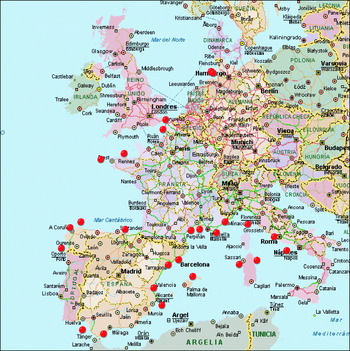
The data used has been mainly the significant wave height (Hs) for all routes, from the information of the selected meteorological buoys shown on the before mentioned websites. (See Figure 1.) The significant wave height H1/3 is the mean height of the upper observed third. In the NW Europe route we have also classified on swell waves and sea waves depending on their slope.
Situation of meteorological buoys close to the selected routes. Source Eurometeo.

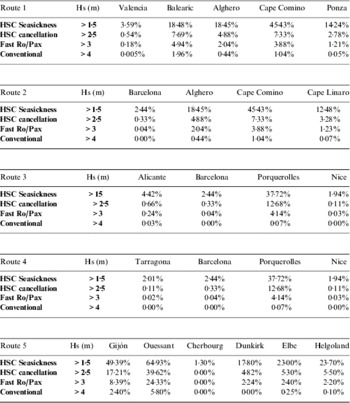
We have registered the different wave height ratios in each of the selected routes, using the probable route the ship would follow. The probability of the wave height at each buoy along the selected route is shown in Table 4. Route 1 from Valencia to Naples is 710 nautical miles and passes the Balearic, Sardinia, Cape Comino and Ponza buoys. Route 2 from Barcelona to Civitavecchia, 439 nautical miles long, passes close to the Sardinia, Cape Comino and Cape Linaro buoys. Route 3 from Alicante to Genoa is 560 nautical miles long and passes close to the Alicante, Barcelona, Porquerolles and Nice buoys. Route 4 from Tarragona to Genoa is 399 nautical miles long and passes close to the Tarragona, Barcelona, Porquerolles and Nice buoy. Route 5 from Gijón to Hamburg is 987 nautical miles long and passes close to the Gijón, Ouessant, Cherbourg, Dunkirk, Elbe and Helgoland buoys. In this last case we have split the sea wave data into wind and swell waves, based on the information obtained from each buoy, being the limit the figure 1/30. For example, in Gijón's buoy we have found that 79% are swell waves, the rest were waves with a slope less than 1/30.
Routes 1–5. Probability of wave height at selected buoys.

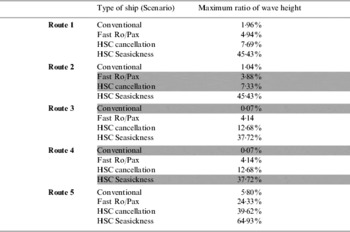
From the analysis of this data, we obtained the maximum percentage of probabilities for each type of ship to encounter the selected wave height on each route (see Table 5). The table provides some conclusions, linking the type of ship and its possibility of encountering adverse weather conditions that would force them to reduce speed or even cancel the trip. The data suggests that:
• Route 2 between Barcelona and Civitavecchia offers the best scenario for fast Ro/Pax and for high speed vessels, with an annual ratio of waves higher than 3 metres of 3·88% and a cancellation level of about 7% but with a seasickness ratio of 45%. In this analysis we have not considered the possible use of a diversion route to avoid the worst weather; this action would reduce those percentages.
• Routes 3 and 4 show the best conditions for conventional ships with only 0·07% of cases of wave heights bigger than 4 metres. The seasickness value for high speed vessels is the lowest of the five routes.
• As was expected, the Atlantic route shows the worst weather conditions. The cancellation ratio grows to 39·62% and the seasickness ratio to 65%. However the ratio of 79% of swell might not cause trouble for ships the length of modern HSC.
Maximum probability for each ship type to meet the limiting wave height.

6. PROPOSED FREQUENCIES FOR THE SELECTED ROUTES
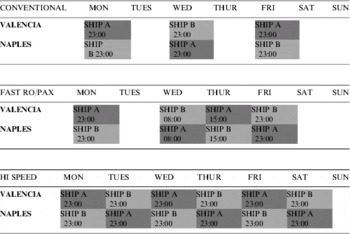
We considered the routes and proposed different frequencies according the distances, speeds and weather conditions to enable us to draft a proposed schedule. This is illustrated by way of an example on Route 1 between Valencia and Naples. The schedules are shown in Table 6.
Proposed departure and sailing schedule for two ships of varying type on Route 1.

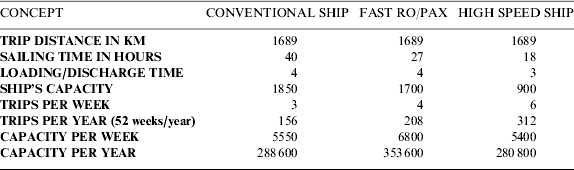
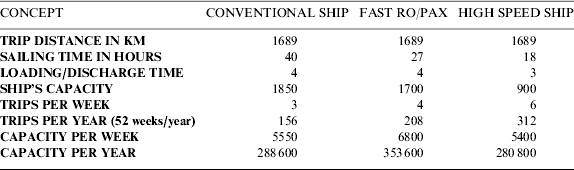
Route 1 served by a conventional ship at 18 knots, would mean that the sea distance would be covered in 40 hours. The schedule allows two hours for loading and two hours for discharging and sails every single night of the week at 23:00 hours. The schedule designed for a fast ship at 27 knots would cover the sea distance in 27 hours, and could maintain the sailing departure at 23:00 hours. In this case the night trip could cruise at 25 knots instead of 27, reaching the Naples port at 04:00 hours, still maybe too soon for the truck drivers and stevedoring services. The departure time proposal would be at 23:00, 08:00 and 15:00 hours, offering up to 4 sailings per week arriving on Sundays in port at 04:00 hours and resting there until the next sailing at 23:00 hours. Table 6 shows the schedule for two ships. A high speed ship developing 40 knots, would cover the sea distance in 18 hours, carrying out the port operations in only 3 hours because the ship would have a smaller cargo capacity. A ship departing daily at 23:00 hours except on Sundays to allow for maintenance activities. Table 6 shows the operation schedule for a pair of high speed ships each sailing six trips per week. A summary of the operational Route 1 with typical capacities for each different type is shown in Table 7 which demonstrates that the best fitting ship type for this route is the fast Ro/Pax capable of carrying the greater volume.
The annual capacity for the different ship types on the Valencia to Naples route.
7. CONCLUSIONS
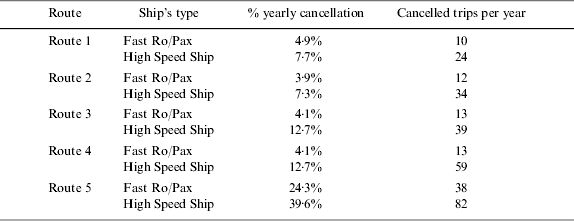
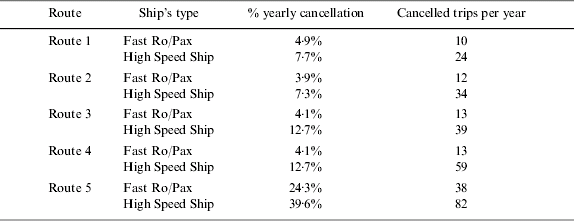
Our research and calculations lead to the following conclusions and recommendations for each of the five routes (see Table 8). We must to point out that the fast ship maximum height level has been considered as a theoretical trip cancellation, but from a practical point of view the ship might sail at a reduced speed or avoid the adverse wave conditions by rerouting. On route 1 two ships would sail three times per week from each port with four hours between trips and no service on Sunday; 2% of the time there would be wave heights higher than 4 metres. The fast ship developing 27 knots offers more cargo capacity after one year because she can do more trips per week but the time schedule is not so convenient for truck drivers. In this case we have reduced the ship's speed from 27 to 25 knots in order to delay the port arrival, having even one hour at port together with the chosen 3 hours for loading and discharging operations. This ship has a ratio of wave height higher than 4 metres of only 4·9%. For the high speed vessels they must assume a yearly cancellation ratio of 7·7% together with a high percentage of seasickness. On the other hand the ship stays 3 hours more than the time required for cargo operations. This could be used as time to recover from delays. Among the three possible types of ships in the second route we can say that the conventional and HSC ships have less capacity on a weekly basis. The weather has less effect on the fast Ro/Pax as these ships can do more trips per week.
Route number 2 between Barcelona and Civitavecchia, is served by fast Ro/Pax because the ship stays at port for 7 hours each day, so that there is a time allowance in front of possible weather delays. In this case there is a 3·9% of time affected by significant wave height higher than 3 metres.
Route number 3 between Alicante and Genoa provides a good scenario for the conventional ship as she only faces a 0·07% of time with some trouble due to weather. Fast ships have a tight schedule for completing six trips per week, so it would be better to reduce them to 5 in order to have room to assume the 4·1% of time sailing at a reduced speed in case of not cancelling the trip. High speed ships have 7 hours at port even by sailing at less than 40 knots, so a reduced schedule could be studied.
Route number 4 between Tarragona and Genoa has a very slight weather influence, so that the ship selection could be based on the market needs. The fast Ro/Pax suffers a 4·1% chance of speed reduction (or cancellation) because of weather, being 5 hours at each port and having a time margin to recover. The high speed ship can offer up to 9 trips per week and a good yearly loading ratio; however, her time schedule is very tight.
Finally route number 5 between Gijón and Hamburg, logically suffers the worst weather conditions as a conventional ship faces up to a 5·8% of time wave heights higher than 4 metres with one day possibility to recover the line. The fast ship faces up to a 24·3% chance of significant waves higher than 3 metres, but she is at port for 7 hours each trip. The high speed ship stops for 14 hours one time per week, but the cancellation ratio reaches 39·6% per year. Generally the fast Ro/Pax seems to be the best option. In spite of having a superior transit time she has best reliability level, compared to a high speed ship. The yearly cancellation ratio becomes bigger as the ship speed increases.
The annual ratio and number of cancelled trips for fast and high speed ships.