





Impact statement
This study shows that in resource-constrained health systems, perinatal mental health research may function as a temporary form of care rather than a purely observational activity. For women in Pakistan, participation provided access to investigations, information, and relational support that were otherwise unavailable in routine services. These findings highlight a critical ethical and structural gap in maternal healthcare, where research unintentionally compensates for absent services. Recognizing this dynamic has direct implications for global mental health practice: research design in low- and middle-income countries must account not only for data generation but also for the care it inadvertently delivers and the consequences when that care is withdrawn. The study underscores the need to integrate basic perinatal mental health screening, psychosocial support, and respectful communication into routine antenatal care through scalable, system-level approaches. Without such integration, research risks reinforcing temporary solutions to persistent structural failures in maternal mental health care.
Introduction
Perinatal mental health conditions, particularly depression and anxiety, are among the leading contributors to maternal morbidity worldwide, with a disproportionate burden in low- and middle-income countries (LMICs) (Fisher et al., Reference Fisher, Cabral de Mello, Patel, Rahman, Tran, Holton and Holmes2012; Howard et al., Reference Howard, Molyneaux, Dennis, Rochat, Stein and Milgrom2014). Systematic reviews estimate that up to one in four women in LMICs experience clinically significant depressive or anxiety symptoms during pregnancy or the postpartum period (Roddy Mitchell et al., Reference Roddy Mitchell, Gordon, Lindquist, Walker, Homer, Middleton, Cluver, Tong and Hastie2023), rates substantially higher than those reported in high-income countries (Fisher et al., Reference Fisher, Cabral de Mello, Patel, Rahman, Tran, Holton and Holmes2012; Woody et al., Reference Woody, Ferrari, Siskind, Whiteford and Harris2017). In Pakistan, recent meta-analyses report prevalence estimates for perinatal depression ranging from 25% to over 40%, reflecting the convergence of poverty, structural gender inequality, nutritional deficiencies, and limited access to mental health services (Atif et al., Reference Atif, Halaki, Raynes-Greenow and Chow2021; Padhani et al., Reference Padhani, Salam, Rahim, Naz, Zulfiqar, Ali Memon, Meherali, Atif and Lassi2024).
Despite this burden, perinatal mental health remains largely absent from routine maternal healthcare in many LMICs. Antenatal services in public-sector facilities are typically oriented toward obstetric risk management, with limited attention to psychological well-being, social stressors, or relational contexts (Patel et al., Reference Patel, Chisholm, Parikh, Charlson, Degenhardt, Dua, Ferrari, Hyman, Laxminarayan, Levin, Lund, Medina Mora, Petersen, Scott, Shidhaye, Vijayakumar, Thornicroft and Whiteford2016). In Pakistan’s overstretched public health system, mental health screening is not systematically integrated into antenatal or postnatal care, and referrals for psychological support are rare (Pervez et al., Reference Pervez, Bukhari, Chhapra, Baig, Martins, Pirzada, Rizvi, Aamdani, Ayub and Rehman2024). As a result, many women encounter maternal health services that are episodic, biomedical, and narrowly focused, leaving psychosocial distress unrecognized and untreated. These gaps are not incidental but embedded within broader structures of gendered power, financial dependence, and family-mediated access to care.
In this context of constrained provision, research increasingly functions as a substitute entry point to health services. Over the past decade, global mental health research in LMICs has expanded rapidly, including observational studies, biomarker investigations, and intervention trials embedded within public hospitals and community settings (Kohrt et al., Reference Kohrt, Mendenhall, Brown, Cockerham, Dingwall and Quah2018; Tol et al., Reference Tol, Murray, Lund, Bolton, Murray, Davies, Haushofer, Orkin, Witte, Salama, Patel, Thornicroft and Bass2019). While this expansion has generated critical epidemiological and biological insights, it has also produced ethically complex encounters in which research participation may provide access to investigations, information, or attention otherwise unavailable through routine care. Empirical studies have shown that participants in resource-poor settings often experience research not as a neutral data-generating activity, but as a form of care, support, or protection (Molyneux et al., Reference Molyneux, Mulupi, Mbaabu and VJBme2012; Kamuya et al., Reference Kamuya, Theobald, Munywoki, Koech, Geissler and Molyneux2013).
This blurring of boundaries between research and care raises fundamental ethical and structural questions. Classical research ethics frameworks emphasize voluntariness, informed consent, and the separation of research from clinical obligation (Council for International Organizations of Medical Sciences [CIOMS], 2016). Yet in settings where basic investigations, respectful communication, or continuity of care are scarce, these distinctions may collapse in practice. Participants may evaluate research primarily through its immediate material and relational benefits, including free tests, transport facilitation, time spent listening, or perceived advocacy within clinical hierarchies. Such dynamics complicate conventional interpretations of consent and raise a critical question: whether participation can be fully voluntary when it constitutes the only accessible form of care. Moreover, the temporary nature of research interventions means that the withdrawal of study services may be experienced not as study closure but as withdrawal of care, an ethical consequence that remains underexamined.
Perinatal mental health research is particularly susceptible to the very ethical and structural problems described above. Pregnant women in LMICs often occupy structurally constrained positions marked by limited autonomy, restricted mobility, financial dependence, and strong family mediation of healthcare decisions (Mallick et al., Reference Mallick, Zafar, Juan and Useem2020; Khalid et al., Reference Khalid, Irahola and Salifu2024). Within such contexts, research encounters may simultaneously enable disclosure of distress and reproduce vulnerability, especially when trust is built through tangible acts of support rather than formal assurances. Yet women’s own interpretations of these encounters are rarely foregrounded in the literature, and the perspectives of clinicians and experts navigating the gap between research provision and systemic failure remain largely absent.
This study addresses this gap by examining how perinatal mental health research is experienced, interpreted, and ethically negotiated within a resource-constrained public hospital in Pakistan. Drawing on in-depth qualitative interviews with mothers enrolled in a biomarker-based longitudinal study, alongside attending clinicians and maternal mental health researchers, we ask how research participation becomes constructed as substitute care, how trust is built through tangible acts of support and the ambiguities that accompany it, how family dynamics shape disclosure and autonomy, and how clinicians and experts understand the sustainability and limits of short-term research interventions.
By centering participant, clinician, and expert perspectives, this study argues that understanding research as substitute care, trust as earned through action, and withdrawal as loss is not an ethical add-on but a necessary analytical lens. This lens reveals how perinatal mental health research, in contexts where care is absent, functions both as a critique of systemic failure and as a site of constrained possibility, illuminating not only what research can temporarily provide, but what routine care should, but does not, deliver.
Method
This qualitative study was nested within a larger longitudinal biomarker investigation conducted at the same tertiary hospital between January 2024 and January 2025 (Malik et al., Reference Malik, Liaqat, Suleman, Etyemez and Ahmed2026). The parent study enrolled 150 pregnant and postpartum women to examine associations between nutritional biomarkers (including vitamin D and hemoglobin) and perinatal anxiety and depression. As part of that study, participants received free blood investigations that are not routinely available in public-sector antenatal care. Following completion of biomarker data collection, a subset of 12 mothers from the parent cohort was purposively sampled for in-depth qualitative interviews to explore their lived experiences of research participation. The present analysis focuses exclusively on these qualitative data, using the biomarker study as the structural and ethical context within which research participation was experienced as a form of temporary care.
Research design
A qualitative descriptive-interpretive design was employed to explore how women, clinicians, and maternal mental health researchers construct the meaning, value, and ethical implications of participation in perinatal mental health research within a tertiary public hospital setting in Pakistan. This approach allowed for an in-depth examination of relational, structural, and systemic dimensions of research engagement that cannot be fully captured through quantitative measures alone. The study forms the qualitative component of a larger biomarker-based longitudinal investigation examining associations between nutritional biomarkers and perinatal anxiety and depression.
Setting and participants
The study was conducted between February 2025 and September 2025 at the Obstetrics and Gynecology Department of Federal General Hospital (FGH), Islamabad, a major public-sector tertiary care facility serving a socioeconomically diverse population. A total of 19 semi-structured interviews were conducted, encompassing three participant groups to ensure multi-perspective insight: 12 mothers enrolled in the parent biomarker study examining associations between nutritional biomarkers and perinatal anxiety and depression, four senior consultant gynecologists currently practicing at FGH, and three maternal mental health researchers with over 10 years of research experience in the field, including peer-reviewed publications. This purposive sampling strategy allowed for triangulation across experiential, clinical, and researcher perspectives.
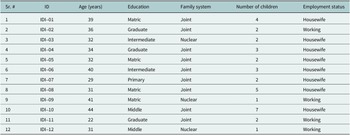
Eligible mothers were participants in the parent biomarker study and were approached purposively to ensure diversity in educational background, family structure (joint and nuclear), and employment status. Inclusion criteria included being aged 18–45 years, fluent in Urdu, and having participated in the biomarker study, with written informed consent provided for qualitative follow-up. Women with active psychosis, severe cognitive impairment, or immediate need for psychiatric hospitalization were excluded. Senior consultant gynecologists were identified through hospital administration and approached directly, while maternal mental health researchers were selected based on their extensive experience and publication record in maternal mental health. All participants provided written informed consent prior to the interview. Detailed demographic characteristics of all study participants are presented in Tables 1 and 2
Demographic characteristics of participating mothers (n = 12)

Table 1. Long description
The table contains 12 rows of data with the following columns.
* Row 1: Sr. 1, I D I 01, 39 years, Matric, Joint family, 4 children, Housewife.
* Row 2: Sr. 2, I D I 02, 36 years, Graduate, Joint family, 2 children, Working.
* Row 3: Sr. 3, I D I 03, 32 years, Intermediate, Nuclear family, 2 children, Housewife.
* Row 4: Sr. 4, I D I 04, 34 years, Graduate, Joint family, 3 children, Housewife.
* Row 5: Sr. 5, I D I 05, 32 years, Matric, Joint family, 2 children, Housewife.
* Row 6: Sr. 6, I D I 06, 40 years, Intermediate, Joint family, 3 children, Housewife.
* Row 7: Sr. 7, I D I 07, 29 years, Primary, Joint family, 2 children, Housewife.
* Row 8: Sr. 8, I D I 08, 31 years, Matric, Joint family, 5 children, Housewife.
* Row 9: Sr. 9, I D I 09, 41 years, Matric, Nuclear family, 1 child, Working.
* Row 10: Sr. 10, I D I 10, 44 years, Middle, Joint family, 7 children, Housewife.
* Row 11: Sr. 11, I D I 11, 22 years, Graduate, Joint family, 2 children, Working.
* Row 12: Sr. 12, I D I 12, 31 years, Middle, Nuclear family, 1 child, Working.
Demographic characteristics of clinician and researcher participants (n = 7)

Table 2. Long description
The table consists of eight columns: Participant group, I D, Age in years, Gender, Years of experience, Specialty or role, Highest qualification, and Clinical versus research focus. All seven participants are female.
* Participant D-01: Doctor, 45 years old, 18 years experience, Gynecology, F C P S, Clinical focus.
* Participant D-02: Doctor, 40 years old, 22 years experience, Gynecology, F C P S, Clinical focus.
* Participant D-03: Doctor, 38 years old, 12 years experience, Gynecology, F C P S, Clinical focus.
* Participant D-04: Doctor, 42 years old, 15 years experience, Gynecology, F C P S, Clinical focus.
* Participant E-01: Researcher, 38 years old, 12 years experience, Maternal mental health, P h D, Research focus.
* Participant E-02: Researcher, 35 years old, 12 years experience, Maternal mental health, Master, Research focus.
* Participant E-03: Researcher, 36 years old, 14 years experience, Maternal mental health, Master, Research focus.
Thematic framework

Table 3. Long description
The table consists of two columns: Themes and Subthemes.
Theme 1: Research as substitute care in a constrained health system. Subthemes include:
* Material access: Free investigations as meaningful care.
* Relational care: Support, guidance, and a sense of protection.
* Beyond the individual: Research as collective hope and future benefit.
Theme 2: Trust, respect, and the ethics of interaction. Subthemes include:
* Being heard: Respect as recognition.
* Trust through action: Explanation, time, and presence.
* Trust enabling disclosure of hidden experiences.
* When trust becomes complicated: Ethics under constraint.
Theme 3: Knowledge, awareness, and the biomedical reframing of maternal health. Subthemes include:
* Mental health as newly visible and legitimate.
* Biomarker knowledge and the biomedicalization of maternal health.
* Research as a site of informal health education.
* The limits of knowledge without structural capacity.
Theme 4: Family power, structural inequality, and the limits of intervention. Subthemes include:
* Negotiating privacy and disclosure within family systems.
* Family as both constraint and enabler of participation.
* Gendered power, fear, and uneven autonomy.
* Structural limits of short-term research interventions.
Data collection
Data were collected through semi-structured in-depth interviews conducted in Urdu by trained female researchers with experience in qualitative interviewing. The interviewers had no prior clinical or personal relationship with participants. Participants were informed about the researchers’ roles and the purpose of the study before interviews commenced. Interviews with mothers lasted approximately 45 min, allowing for detailed exploration of research participation experiences, perceptions of clinical care, understanding of health concepts, and reflections on ethical and structural aspects of research. Interviews with gynecologists and maternal health experts lasted 30–35 min, focusing on systemic integration, sustainability, ethical tensions, structural constraints, and the broader implications of conducting biomarker-based research in public hospital settings. The interview guides were pilot-tested and refined for cultural and contextual clarity. All interviews were conducted in private rooms within the hospital to ensure confidentiality and were audio-recorded with consent. A distress protocol was implemented, including referral pathways for participants requiring psychological support.
All clinicians, maternal mental health researchers, and interviewers were women. This was an intentional methodological decision. In Pakistan, antenatal care is routinely provided by female obstetricians, and discussions about pregnancy, mental health, and family relationships are culturally sensitive. Female interviewers were therefore considered essential to facilitate rapport, ensure participants’ comfort, and promote open disclosure. This gender-concordant approach is recommended in qualitative research on sensitive topics to enhance participant trust and the depth of data collected (Liamputtong, Reference Liamputtong2013).
Data management and translation
All interviews were transcribed verbatim in Urdu and analyzed in the source language to preserve semantic and cultural nuance. Selected excerpts presented in the manuscript were translated into English by bilingual researchers. To ensure fidelity, a random subset of excerpts underwent independent back-translation, and any discrepancies were resolved through team discussion. Culturally specific terms were retained where conceptually necessary, with explanatory notes provided to ensure clarity for broader audiences.
Data analysis
Data collection and analysis proceeded concurrently, adopting an iterative and reflexive approach. Thematic analysis was conducted following Braun and Clarke’s six-phase framework (Braun and Clarke, Reference Braun and Clarke2006). Initial open coding was conducted independently by two researchers and documented in a shared analytic framework, which was refined through systematic comparison within and across transcripts. Codes were progressively clustered into broader categories and overarching themes through constant comparison. To ensure analytic rigor, 25% of transcripts were double-coded; discrepancies were resolved through discussion or adjudication by a senior qualitative researcher, and analytic memos were maintained throughout. Systematic within-case and cross-case comparisons were undertaken to examine convergence and divergence across mothers, clinicians, and experts. Special attention was given to identifying tensions, contradictions, and deviant cases to avoid overly harmonious interpretations. All analytic decisions were carefully documented to maintain transparency and auditability.
Reflexivity and trustworthiness
Interviewers were trained in qualitative methods and had prior experience in maternal mental health research. The research team engaged in ongoing reflexive discussions to critically examine how their professional backgrounds and assumptions might shape data collection and interpretation. Reflexive discussions were conducted throughout data collection and analysis to address assumptions regarding gender norms, clinical hierarchies, research ethics, and constraints within public-sector healthcare. Trustworthiness was enhanced through triangulation across participant groups, team-based coding, detailed audit trails, inclusion of divergent perspectives, and transparent documentation of analytic decisions.
Sample size and thematic saturation
A total of 19 interviews were conducted. Code saturation was monitored throughout the analytic process, and a marked decline in novel codes was observed by the sixteenth interview. No new higher-order themes emerged in the final three interviews, indicating that thematic saturation was achieved across all participant groups.
Ethical considerations
Ethical approval was obtained from the National Bioethics Committee of Pakistan, Islamabad, and the Institutional Review Board (IRB) of Health Services Academy. The study prioritized participant welfare: informed consent procedures were meticulously followed, confidentiality was ensured through data anonymization, and referral pathways to psychiatric and obstetric services were established for participants with severe symptoms, nutritional deficiencies, or disclosures of violence.
This study is reported in accordance with the Consolidated Criteria for Reporting Qualitative Research (COREQ) guidelines (Tong et al., Reference Tong, Sainsbury and Craig2007). A completed COREQ checklist is provided as Supplementary Material.
Results
This qualitative analysis draws on 19 semi-structured interviews with mothers (n = 12), clinicians (n = 4), and maternal mental health researchers (n = 3). Across accounts, four interrelated themes were developed: (1) Research as Substitute Care in a Constrained Health System; (2) Trust, Respect, and the Ethics of Interaction; (3) Knowledge, Awareness, and the Biomedical Reframing of Maternal Health; and (4) Family Power, Structural Inequality, and the Limits of Intervention (see Table 3).
Rather than being experienced as a neutral research process, participation was consistently described as something far more embedded. It was a form of care, a space of recognition, and at times the only point of meaningful engagement within an otherwise fragmented maternal healthcare system.
Theme 1: Research as substitute care in a constrained health system
For most women, participation in the study was not understood as “research” in an abstract sense. Instead, it was experienced as a rare opportunity to access care that was otherwise unavailable, unaffordable, or difficult to navigate. The study effectively became a temporary substitute for gaps in routine antenatal services.
Material access: Free investigations as meaningful care
Women repeatedly emphasized that the free laboratory tests were the primary reason participation was possible. These were not perceived as optional benefits, but as services they simply could not afford otherwise. One participant explained “If we had to do these tests outside, it would cost a lot. They told us it could cost thousands. Here it was free, so it made a big difference for us” (Mother, IDI 6). Another described her initial hesitation, rooted in assumptions about cost: “At first, we thought this lab is very expensive. We were thinking, how would we even manage to get tests done here? They usually charge high fees” (Mother, IDI 1). For these women, the value of participation was inseparable from financial relief. “Benefit” did not mean general satisfaction. It meant access to something otherwise out of reach.
Clinicians reinforced this reality: “Most of my patients cannot afford even basic investigations. For example, a vitamin D test is expensive, so I often hesitate to recommend it” (Gynecologist, IDI 3). Taken together, these accounts show that participation was structurally shaped by economic constraints. It was not simply a voluntary engagement, but one made possible because research temporarily removed financial barriers that define routine care.
Relational care: Support, guidance, and a sense of protection
Beyond financial access, women described the study as providing a level of support they had not experienced before, particularly in navigating hospital spaces that often felt confusing and unwelcoming. “The research assistant took us to the hospital and brought us back herself. She took full responsibility for us” (Mother, IDI 3). This was not just logistical help. It carried emotional meaning. “When I saw them taking us and guiding us there, I felt safe, like someone was there for us” (Mother, IDI 11).
The feeling of being safe or protected reflected more than physical accompaniment. It signaled a shift in how women experienced care, from being ignored or rushed to being guided and supported. Several women implicitly contrasted this with routine services, where interactions were brief and impersonal. In this context, even small acts like explaining procedures, walking with participants, and waiting with them became meaningful forms of care. At the same time, these experiences remained bounded by structural realities. Women still needed permission from family members to travel, and their movement was not entirely within their control. Research could ease navigation within the system, but it could not remove the constraints surrounding it.
Beyond the individual: Research as collective hope and future benefit
Women did not interpret their participation as benefiting only themselves. Many framed it as something that should extend to others, especially women who lacked awareness or access. “Even if these facilities are not available in hospitals, at least doctors should tell women about these tests so that others can also benefit” (Mother, IDI 8). Another participant emphasized the importance of sharing knowledge: “The results should be shared with people. If others know about these things, they can be more careful” (Mother, IDI 2).
Here, participation becomes a moral act, contributing to future care rather than just receiving it. Women positioned themselves as part of a larger community of mothers who could benefit from similar knowledge and services. However, experts pointed to a less visible consequence: “People get used to these services. When they stop, there is disappointment” (Research Expert, IDI 1). This introduces a critical tension. While research provides meaningful and valued care in the present, it is temporary. When it ends, the absence of those services can feel like loss rather than completion. In this way, research simultaneously fills and exposes gaps in the healthcare system.
Theme 2: Trust, respect, and the ethics of interaction
Trust did not emerge automatically through consent procedures. Instead, it was built slowly through interaction, through how participants were spoken to, listened to, and supported. This trust became central to women’s engagement, but also raised important ethical questions.
Being heard: Respect as recognition
Many women described research encounters as fundamentally different from routine care because, for the first time, they felt heard. “Here, no one usually talks to us properly. But the way she explained everything in detail made us feel good.” (Mother, IDI 10) Another participant reflected: “They really listened to what we were saying. It felt like what we said actually mattered” (Mother, IDI 1).
Feeling valued in this context meant being taken seriously, not dismissed, rushed, or ignored. For women accustomed to limited engagement in clinical settings, this recognition carried significant emotional weight. Trust, therefore, was not abstract. It was built through everyday interactions that signaled respect.
Trust through action: Explanation, time, and presence
Participants consistently pointed to specific actions that built trust, especially clear explanations and the willingness to spend time with them. “They explained everything properly and patiently. No one does that normally” (Mother, IDI 4). Here, “everything” referred not only to the study itself but also to test results and health conditions that had previously gone unexplained.
The act of accompaniment also reinforced trust: “She stayed with us, took us around, and made sure everything was done properly” (Mother, IDI 3). These actions transformed the research encounter into something relational rather than procedural. Trust was not derived from forms or signatures, but from consistency, presence, and care.
Trust enabling disclosure of hidden experiences
As trust developed, women began to share experiences they had not previously disclosed, including emotional distress and difficult home situations. “If you make them feel safe and assure them that nothing bad will happen to them, then they can tell you things, like if they are being mistreated or abused at home” (Mother, IDI 12).
Here, “feeling safe” referred to both confidentiality and reassurance that disclosure would not lead to negative consequences. Under these conditions, research became a rare space where women could speak openly. However, this raises a difficult question: what happens after disclosure? Clinicians acknowledged that while research could create space for expression, it did not always provide ongoing support. The encounter, therefore, was both enabling and incomplete.
When trust becomes complicated: Ethics under constraint
Experts cautioned that trust, in this context, cannot be understood as purely positive. “In settings like this, informed consent is not straightforward. When services are free, it affects how people decide.” (Research Expert, IDI 1) Another added: “Sometimes women don’t feel they can refuse, especially if family decisions are involved” (Research Expert, IDI 2).
Trust here operates within conditions of constraint, including financial need, limited options, and family control. As a result, participation may not be entirely free in the way ethical frameworks assume. Rather than a simple indicator of ethical success, trust becomes layered and complex, shaped by both care and dependency.
Theme 3: Knowledge, awareness, and the biomedical reframing of maternal health
This theme examines how participation in the biomarker-based study functioned as an epistemic intervention, reshaping women’s understanding of maternal health while simultaneously revealing the limits of knowledge in the absence of structural capacity to act. Across accounts, research participation did not simply provide information; it redefined what counted as a legitimate health concern. However, this shift remained constrained by broader gendered and economic realities, exposing a gap between awareness and actionable agency.
Mental health as newly visible and legitimate
Prior to participation, psychological distress was largely unrecognized as a legitimate component of maternal health. Women described an absence of language, awareness, or clinical attention to mental well-being within routine antenatal care. “We don’t even realize that mental health has any worth, that there is even a checkup for it” (Mother, IDI 6). “I had no idea such a thing existed” (Mother, IDI 4).
Engagement with the study introduced mental health as a valid and necessary domain of inquiry. Women began to articulate connections between emotional well-being and both maternal and fetal outcomes: “One should ask about it. Because it affects the mind, it affects everything, and also the baby” (Mother, IDI 7).
Clinicians corroborated this absence within routine care: “Postpartum anxiety and depression are common, but they are often missed” (Gynecologist, IDI 2). These accounts suggest that research encounters functioned as sites of epistemic recognition, where previously normalized distress was reframed as clinically meaningful. This shift did not originate within the health system itself, but was introduced through the research process, highlighting systemic neglect of maternal mental health.
Biomarker knowledge and the biomedicalization of maternal health
Participation also exposed women to new forms of biomedical knowledge, particularly regarding nutritional biomarkers such as vitamin D, calcium, and hemoglobin. For many, this represented their first encounter with laboratory-based understandings of health. “We gained knowledge about our health as well as the health of the baby, so these tests are essential” (Mother, IDI 9).
Biomarker results were not interpreted as abstract data but as concrete indicators of bodily status, shaping how women understood risk, deficiency, and responsibility. This reflects a process of biomedicalization, in which maternal well-being becomes increasingly defined through measurable biological parameters. At the same time, this knowledge carried normative implications. Women began to internalize expectations around monitoring and maintaining optimal biological states, even in contexts where such monitoring is not routinely available. Research participation thus extended biomedical logics into everyday understandings of pregnancy, reframing maternal health as something that can and should be quantified.
Research as a site of informal health education
Beyond specific biomarkers, the study functioned as a broader educational space in which women acquired information about nutrition, mental health, and maternal care practices. “There are many women who don’t know anything about these things; this kind of work should continue” (Mother, IDI 3).
This knowledge was often described as empowering, particularly in enabling women to engage more actively with healthcare providers or to recognize symptoms previously dismissed or ignored. However, this empowerment was uneven and context-dependent, shaped by women’s ability to translate knowledge into action within their households. Clinicians implicitly acknowledged this gap, noting that awareness alone does not ensure uptake of care recommendations, particularly when constrained by cost, time, or family decision-making structures.
The limits of knowledge without structural capacity
Despite the perceived benefits of increased awareness, participants and experts highlighted a critical limitation: knowledge did not automatically translate into improved health outcomes. Structural barriers, including financial dependency, restricted mobility, and gendered decision-making mediated the extent to which women could act on newly acquired information. “Clinical outcomes are important, but they don’t capture women’s empowerment or decision making” (Research Expert, IDI 2).
For example, awareness of nutritional deficiencies did not guarantee access to supplements or dietary changes if these required financial resources or family approval. This reveals a fundamental disjunction between epistemic change and material capacity. In this sense, the study simultaneously expanded and constrained women’s agency. While it enabled new ways of understanding the body and mind, it did not alter the structural conditions that shape health behavior. Knowledge, therefore, functioned as a necessary but insufficient condition for change.
Theme 4: Family power, structural inequality, and the limits of intervention
This theme examines how family dynamics shaped every stage of research participation, from access and consent to disclosure and follow-up, and why short-term research cannot resolve deep structural inequities. Participation unfolded within layered family hierarchies where women’s autonomy was negotiated rather than assumed.
Negotiating privacy and disclosure within family systems
Women described a tension between the need for privacy in discussing sensitive issues and the reality of family presence during healthcare interactions. “Some matters are private; a woman will feel hesitant” (Mother, IDI 1). “If you conduct the whole interview with a family member present, she won’t be able to share everything” (Mother, IDI 10). These accounts indicate that research designs premised on individual autonomy do not align with the lived realities of family mediated participation, where privacy must be actively negotiated.
Family as both constraint and enabler of participation
Family members, particularly husbands, played a decisive role in enabling or restricting participation. “The husband must be included, because he is the one who decides whether to take a step forward” (Mother, IDI 7). At the same time, some women noted that family approval was easier to obtain when participation involved no direct cost: “Since it is beneficial and also free, they would not create any problem” (Mother, IDI 4). Family involvement was therefore neither uniformly restrictive nor supportive, but situational, at times facilitating access and at other times limiting autonomy.
Gendered power, fear, and uneven autonomy
Women’s ability to engage with the study varied significantly depending on household dynamics and levels of autonomy. “What if the family does not agree? Most women don’t respond because they are afraid of their families” (Mother, IDI 8). In contrast, another woman stated: “I didn’t even tell my husband” (Mother, IDI 2). These variations reveal that autonomy is not a fixed trait but is negotiated, and sometimes exercised covertly, within constrained circumstances.
Clinicians contextualized these variations structurally: “Many women live under constant family pressure. Their stress is social, not just medical” (Gynecologist, IDI 1). These findings demonstrate that research participation both reflects and is shaped by gendered power relations, offering limited and temporary spaces for autonomy without fundamentally altering underlying constraints.
Structural limits of short-term research interventions
Across participant groups, there was strong recognition that research alone cannot address structural inequalities. “Biomedical interventions alone cannot address deep gender inequalities” (Research Expert, IDI 3). “Research often proves that an intervention works, but there is no plan for what happens after the study ends” (Research Expert, IDI 2).
Experts emphasized the need for integration into existing systems, such as community health worker programs, alongside broader reforms in education and economic empowerment. Without such integration, research risks functioning as a temporary patch rather than a mechanism for sustained change.
No consistent differences emerged between employed and housewife participants regarding perceptions of research participation, although the study was not designed to compare experiences by employment status.
Discussion
This study examined how perinatal mental health research was experienced, interpreted, and ethically negotiated within a resource-constrained public hospital in Pakistan. Across mothers, clinicians, and maternal mental health researchers, research participation was not perceived as a neutral or purely procedural activity. Instead, it was consistently experienced as a temporary form of care embedded within a health system characterized by gaps, economic precarity, and gendered constraints. The findings complicate conventional distinctions between research and care and highlight how ethical, relational, and structural dimensions intersect in perinatal mental health research conducted in LMIC settings.
A central finding of this study is that research participation functioned as a form of substitute care in a context where routine antenatal services were perceived as incomplete or inaccessible. The biomarker component of the parent study likely contributed to these experiences. Free laboratory investigations represented tangible healthcare resources that were otherwise difficult to access, increasing the perceived value of participation. Receiving biomarker results also reinforced biomedical understandings of pregnancy and may have strengthened perceptions of research as healthcare rather than solely data collection. Although relational aspects of care, such as respectful communication and attentive listening, are likely to remain relevant across studies, research without a diagnostic component may generate different participant experiences. Women’s accounts did not frame research benefits as optional; access to investigations, explanations, and facilitated navigation of hospital services was experienced as addressing needs otherwise unmet. This aligns with prior work showing that in resource-poor settings, research often intersects with service provision, particularly when studies offer diagnostics or support unavailable through routine care (Molyneux et al., Reference Molyneux, Mulupi, Mbaabu and VJBme2012; Kamuya et al., Reference Kamuya, Theobald, Munywoki, Koech, Geissler and Molyneux2013). The persistence of these dynamics underscores ongoing gaps in routine care rather than reflecting the capacity of research to fully substitute for systemic provision.
Importantly, this substitution extended beyond material support. Time, explanation, and accompaniment emerged as equally salient, indicating that care was experienced relationally as much as biomedically. This challenges narrow interpretations of undue inducement that focus primarily on financial incentives; in this context, participation was shaped by structural absence rather than extraordinary benefits. Ethical concerns therefore stem not from research generosity but from the inadequacy of routine services against which research is evaluated, a critique echoed in global mental health scholarship on the limitations of conventional ethics frameworks in LMICs (Dove et al., Reference Dove, Kelly, Lucivero, Machirori, Dheensa and Prainsack2017).
The temporary nature of this substitute care further complicates its ethical status. Clinicians and experts highlighted the possibility that the cessation of study-related services following completion of the research could be experienced by participants as the loss of an important source of care because these services were unavailable within routine health care, particularly when research fills visible gaps. These findings suggest that ethical review processes should more explicitly consider not only consent at entry but also the implications of exit in contexts where research temporarily stabilizes fragile care pathways. Responsible exit planning, including mechanisms for continuity, resource stability, and integration with local services, remains underdeveloped in many LMIC studies (Milenova et al., Reference Milenova, Thusini, Gronholm and Salisbury2025). Without such planning, temporary research support risks being experienced as discontinuity rather than care.
Trust emerged as a second core analytic theme, built through concrete practices such as respectful communication, patient explanation, accompaniment, and logistical facilitation rather than through formal assurances alone. These findings challenge procedural models of ethical engagement that assume trust follows automatically from consent processes. Comparable evidence from Ghana demonstrates that trial participants construct trust through relational interactions, social networks, and validation of institutional reputation, rather than regulatory paperwork (Chatio et al., Reference Chatio, Ganle, Adongo, Ansah, Nonterah, Mensah, Akazili and Beisel2025).
At the same time, trust operated within a context of structural vulnerability. Practices that enabled disclosure and engagement also created interdependencies, particularly in low-literacy settings, or where family mediation constrained women’s autonomy. Experts’ concerns about constrained consent highlight that trust, when embedded in structural vulnerability, cannot be assumed to be ethically uncomplicated. Our findings extend critiques of individualistic consent models by illustrating how trust is relationally produced and conditioned by context, rather than freely given in isolation (Dove et al., Reference Dove, Kelly, Lucivero, Machirori, Dheensa and Prainsack2017).
Clinicians’ reflections further underscored the labor involved in sustaining ethical engagement. Explaining tests, addressing fears, and negotiating family dynamics required time and effort rarely feasible in routine practice. Research temporarily enabled these practices, revealing both what ethical engagement looks like and why it is difficult to sustain within overstretched systems. Implementation science approaches cannot resolve structural challenges such as workforce shortages, limited funding, or broader gender inequalities. However, they can help identify practical strategies for embedding feasible interventions, including mental health screening, referral pathways, and task-sharing models, into routine maternal healthcare while accounting for local contextual barriers.
Participation in the study functioned as a site of epistemic shift, particularly regarding perinatal mental health and nutritional status. These findings also highlight a longstanding public health ethical principle that screening should be accompanied by accessible pathways for treatment or support. While participants valued increased awareness of their mental health, identifying distress without realistic opportunities for follow-up risks creating awareness without meaningful access to care. Information alone cannot substitute for treatment, reinforcing the need to integrate mental health screening with referral and support mechanisms. Women’s accounts suggest that psychological well-being was largely invisible prior to participation, reinforcing evidence that maternal mental health remains marginal within routine antenatal care in Pakistan and similar LMICs (Rahman et al., Reference Rahman, Malik, Sikander, Roberts and Creed2008; Atif et al., Reference Atif, Lovell and Rahman2015). Research encounters created space for learning, reframing distress as legitimate, and linking maternal mental health to child outcomes. This resonates with findings from task-sharing interventions, where respectful inquiry and information provision are themselves experienced as therapeutic (Zhu et al., Reference Zhu, Ma, Wang, Xu, Xu and Du2022; Cuncannon et al., Reference Cuncannon, Seitz, Brar and Dosani2024).
However, clinicians and experts cautioned against equating knowledge gain with structural empowerment. While participants valued explanations and biomarker results, knowledge alone did not resolve barriers such as affordability, restricted mobility, or family-mediated decision-making. These findings reinforce critiques of biomedical reductionism in global mental health: biological indicators capture only a partial picture of women’s lived realities. A context-dependent, welfarist perspective suggests that mental health problems arise from mismatches between psychological traits and environments, highlighting that well-being cannot be indexed solely to biomedical metrics (Patel et al., Reference Patel, Saxena, Lund, Kohrt, Kieling, Sunkel, Kola, Chang, Charlson, O’Neill and Herrman2023).
Family dynamics shaped nearly every aspect of research participation, including access, consent, disclosure, and privacy. Women navigated complex negotiations, balancing the need for privacy with strategic inclusion of family members to enable participation. This challenges binary assumptions that family involvement is uniformly supportive or oppressive.
At the same time, gendered power relations constrained autonomy unevenly. Longitudinal evidence from Pakistan indicates that female agency, including freedom of movement, is lower during pregnancy and associated with increased depression risk (Sikander et al., Reference Sikander, Ahmad, Atif, Zaidi, Vanobberghen, Weiss, Nisar, Tabana, Ain and Bibi2019; Haight et al., Reference Haight, Shartle, Kachoria, Hagaman, Gupta, Carias, Bibi, Bates and Maselko2025). Our participants’ narratives align with this evidence: autonomy is life-stage dependent, and research encounters occur precisely when agency is most constrained. Research both reflected and reproduced these dynamics, offering temporary spaces for disclosure without fundamentally altering underlying power relations. Experts emphasized that broader reforms in education, economic independence, and system-level change are necessary to address structural gendered vulnerabilities.
Implications for research ethics, design, and system integration
These findings carry several practical implications:
-
1. Ethical frameworks should address research within systems of absence. Planning for sustainability, integration with existing services, and responsible exit strategies is essential. When continuation of research-funded services is not feasible, investigators should establish referral pathways, plan for transition, and communicate clearly about the limits of research support. The Council for International Organizations of Medical Sciences (CIOMS) guidance on post-trial availability remains particularly relevant in LMIC settings (CIOMS, 2016).
-
2. Trust should be recognized as a relational practice. Ethical engagement requires time, relational labor, and institutional support. Community-engaged research, local partnerships, and capacity building are not ancillary but core ethical requirements.
-
3. Integration into routine care can reduce ethical burden. Mental health screening and basic psychosocial inquiry could be embedded in antenatal care via task-sharing with nurses or community health workers. Evidence from the Thinking Healthy Programme and its peer-delivered adaptations supports feasibility and acceptability (Zhu et al., Reference Zhu, Ma, Wang, Xu, Xu and Du2022; Cuncannon et al., Reference Cuncannon, Seitz, Brar and Dosani2024).
-
4. Dissemination should target policy and system impact. Policy briefs, engagement with health administrators, and alignment with national priorities are critical for translating research into practice and ensuring sustainability (Erismann et al., Reference Erismann, Pesantes, Beran, Leuenberger, Farnham, Berger Gonzalez de White, Labhardt, Tediosi, Akweongo, Kuwawenaruwa, Zinsstag, Brugger, Somerville, Wyss and Prytherch2021).
Strengths of the study
A key strength of this study lies in its multi-perspective design, integrating the experiences of mothers with the insights of clinicians and maternal mental health researchers to generate a layered understanding of how research participation is embedded within routine care. By situating qualitative inquiry within an ongoing biomarker-based longitudinal study, the analysis captures experiences of research participation in real time rather than relying on retrospective accounts, strengthening the ecological validity of the findings. The study further benefits from in-depth, Urdu-language interviews analyzed in the source language, preserving cultural nuance and allowing participants’ voices to be represented with greater fidelity. The reflexive, team-based analytic approach, including iterative coding, cross-case comparison, and attention to deviant cases, enhances the credibility and interpretive depth of the findings. Importantly, the study moves beyond descriptive accounts to foreground the ethical and structural implications of research functioning as a form of provisional care in a resource-constrained health system, an area that remains underexamined in perinatal mental health research in low- and middle-income countries.
Limitations of the study
Several limitations should be considered when interpreting the findings. The study was conducted within a single public-sector tertiary hospital, and the organization of services, patient population, and research infrastructure may differ from other settings, limiting transferability. The findings primarily reflect the experiences of women receiving care in a public-sector tertiary hospital, many of whom described significant financial constraints. Women receiving care in private healthcare settings or from higher socioeconomic backgrounds may experience research participation differently and may be less likely to perceive research as a substitute for routine care. Future research should examine whether similar ethical dynamics exist across diverse healthcare settings and socioeconomic groups. The relatively small number of clinicians (n = 4) and maternal mental health researchers (n = 3) limits the diversity of professional perspectives represented. Their views should therefore be interpreted as illustrative rather than representative of all professionals working in maternal mental health. Additionally, participants were drawn from an existing research cohort, which may have shaped their expectations and experiences of care, potentially amplifying the perceived benefits of research participation. Although efforts were made to ensure privacy during interviews, the broader context of family-mediated decision-making and constrained autonomy may have influenced disclosure, particularly around sensitive issues. Finally, while reflexive practices were employed throughout, interpretations remain situated within the perspectives of the research team and the specific socio-cultural and institutional context in which the study was conducted.
Conclusion
In resource-constrained settings, perinatal mental health research is experienced as more than research. It functions as provisional care, a site of trust-building, and a lens on structural gaps in routine services. Recognizing these dynamics does not diminish research value; it calls for ethical honesty regarding whom research serves and what happens when it ends. By centering women’s experiences alongside clinical and expert perspectives, this study advocates for research that is scientifically rigorous, structurally responsive, ethically reflexive, and aligned with sustainable maternal health system strengthening. In contexts where absence of care is a defining condition, researchers’ responsibilities extend beyond publication to engagement with systems, policy, and the structural inequities that make temporary repair necessary.
Open peer review
To view the open peer review materials for this article, please visit http://doi.org/10.1017/gmh.2026.10304.
Supplementary material
The supplementary material for this article can be found at http://doi.org/10.1017/gmh.2026.10304.
Acknowledgments
The authors would like to thank the participating mothers for their time and trust in contributing to this research. We also extend our appreciation to the field research team and data collection staff for their dedicated efforts. We are grateful to the staff of the Federal General Hospital, Islamabad, for their cooperation throughout recruitment and data collection.
Author contribution
R.L. led the study, conducted the formal analysis, and drafted the manuscript. A.M. conceptualized the study and provided overall supervision. N.A. contributed to data analysis and provided critical input on the manuscript. A.N. supported data transcription. N.S. and I.A. contributed to review of the manuscript. All authors reviewed and approved the final manuscript.
Competing interests
The authors declare no conflicts of interest.
Data availability statement
The qualitative data generated and analyzed during this study are not publicly available due to the sensitive nature of participant narratives and the confidentiality agreement with participants. De-identified excerpts are presented within the manuscript. Requests for further access may be directed to the corresponding author.
Ethics and approvals
Ethical approval for this study was obtained from the National Bioethics Committee of Pakistan, Islamabad, and the Institutional Review Board of the Health Services Academy, Islamabad. All procedures performed were in accordance with the ethical standards of the institutional research committees and with the 1964 Helsinki Declaration and its later amendments. Written informed consent was obtained from all individual participants included in the study. For mother participants, additional consent was obtained for the qualitative interviews following their participation in the parent biomarker study.
Funding statement
This study was supported by the International Brain Research Organization (IBRO) through the Neuroscience Capacity Accelerator for Mental Health, awarded to Dr. Abid Malik (Application ID: IW-6827570252). No additional external funding was received for this research.


 Open access

