INTRODUCTION
Delirium is a neuropsychiatric disorder characterized by an abrupt onset; a fluctuating course; an underlying physiological etiology; and disturbances of consciousness, attention, cognition, and perception (American Psychiatric Association, 2000). Delirium is a common event in the course of medical hospitalization depending upon the age of the patient and the severity of the illness. In a general hospital setting, the occurrence of delirium in medically ill patients can be 15 to 30%, in the hospitalized elderly, 10 to 40% (Lipowski, Reference Lipowski1989; Bucht et al., Reference Bucht, Gustafson and Sandberg1999), in cancer patients, 57 to 85%, and in terminal illness, up to 85% (Massie et al., Reference Massie, Holland and Glass1983; Breitbart & Strout, Reference Breitbart and Strout2000; Bond et al., Reference Bond, Neelon and Belyea2006). Delirium is associated with poor functional outcome, increased morbidity and mortality, and prolonged hospitalization (Inouye, Reference Inouye1998).
The standard approach to the pharmacological treatment of delirium involves the use of typical antipsychotics, in particular, haloperidol (Trzepacz et al., Reference Trzepacz, Breitbart and Franklin1999). The benefits of haloperidol usually appear in the first day of treatment (Platt et al., Reference Platt, Breitbart and Smith1994). However, typical antipsychotics, such as haloperidol, often cause side effects including extrapyramidal symptoms (EPS) (Arnt, Reference Arnt1998; Kane, Reference Kane2001). Because of lower rates of side effects and similar efficacy, atypical antipsychotics represent an alternative as off-label, first choice treatment of delirium (Boettger & Breitbart, Reference Boettger and Breitbart2005; Lonergan et al., Reference Lonergan, Britton and Luxenberg2007). Atypical antipsychotics cause fewer extrapyramidal side effects (EPS) because they have different mechanisms of action (Factor, Reference Factor2002; Miyamoto et al., Reference Miyamoto, Duncan and Marx2004).
Aripiprazole is a quinolone derivate and is described as a partial dopamine agonist. In areas of the brain with high dopamine levels, aripiprazole acts antagonistically at the dopamine receptor site, whereas in areas of the brain with low levels of dopamine, aripiprazole may act agonistically at the dopamine receptor site (DeLeon et al., Reference DeLeon, Patel and Crismon2004). Such partial dopamine agonist properties may theoretically provide more benefit to patients with hypoactive delirium.
Aripiprazole has been shown to be safe and efficacious in a number of psychiatric disorders (Taylor, Reference Taylor2003), but the safety and efficacy of aripiprazole in the treatment of delirium has not yet been adequately demonstrated. Case reports and case series have suggested safety and efficacy: Alao et al. (Reference Alao, Soderberg and Pohl2005) reported two cases of delirium successfully treated with aripiprazole (Delirium Rating Scale [DRS]: 28/6, 18/6), and Straker et al. (Reference Straker, Shapiro and Muskin2006) reported 14 cases of delirium treated with aripiprazole with 12 patients having a DRS reduction >50% and 13 patients showing an improvement in the Clinical Global Impressions Scale (CGI).
In order to further explore the efficacy and safety of aripiprazole in the treatment of delirium, we analyzed the Memorial Sloan-Kettering Cancer Center (MSKCC) Clinical Delirium Database in respect to hospitalized cancer patients treated with aripiprazole for delirium. We hypothesized that treatment of delirium with aripiprazole is effective and safe, and that aripiprazole may convey treatment advantages in hypoactive delirium because of its unique pharmacology.
METHOD
Subjects
Subjects in this trial included patients referred for delirium management to the MSKCC Psychiatry Service from July 2004 to June 2006. Clinical data, including serial Memorial Delirium Assessment Scale (MDAS) ratings, etiologies of delirium, medications and dosages used, adverse events and co-morbid medications, and medical conditions, were recorded in an Institutional Review Board (IRB)-approved MSKCC Psychiatry Service Clinical Delirium Database.
The criteria used for eligibility to be considered for the delirium database were broad; patients who met the DSM-IV criteria for delirium were deemed candidates for the database. Exclusion criteria included objections from the patient or family to psychiatric intervention, inability to comply with delirium ratings, or severe agitation interfering with full assessment. All patients and families gave oral consent to be evaluated and treated for delirium. In patients with limited capacity to provide consent because of delirium, the patient's primary caregiver provided oral consent with the patient's assent to treatment. All data were obtained on patients treated for delirium in an open-label, naturally assigned, prospective manner, and entered in our delirium database for later retrospective analysis.
Measurements
Sociodemographic and medical variables were collected at the baseline assessment. This included age, sex, cancer diagnosis, stage of cancer (localized, metastatic, or terminal), current psychiatric diagnosis, past psychiatric diagnosis, history of dementia, presence of brain metastases, and delirium etiologies.
Delirium severity was measured with the MDAS, a 10-item, four-point clinician-rated scale (Breitbart et al., Reference Breitbart, Rosenfeld and Roth1997). The MDAS items reflect the diagnostic criteria for delirium in the DSM-IV-TR and assess disturbance in arousal and level of consciousness, cognitive functioning (memory, attention, orientation, and disturbances in thinking) and psychomotor activity. A MDAS score >10 identified the presence of delirium (Lawlor et al., Reference Lawlor, Nekolaichuk and Gagnon2000). As proposed by Meagher, the subtyping of delirium was based on the motoric subtype (Meagher et al., Reference Meagher, O'Hanlon and O'Mahony2000; Reference Meagher, Moran and Raju2008a,Reference Meagher, Moran and Rajub). Because of the current evolvement of subtypes and limitations in understanding of the phenomenology of subtypes, only the hypoactive and hyperactive type were taken into account. Further scales used were the Karnofsky Performance Rating Scale Status (KPS) (Karnofsky DA, Burchenal JH Reference Karnofsky and Burchenal1949), indicating physical performance ability, and an abbreviated version of the Udvalg for Kliniske Undersogelser (UKU) Side Effect Rating Scale (Lingjaerde et al., Reference Lingjaerde, Ahlfors and Bech1987).
Procedures
Data on cancer diagnosis, cancer stage, presence of brain metastases, delirium etiology, history of dementia, and sociodemographic data were collected at baseline (T1). MDAS and KPS, as well as side effect rating, were performed at baseline (T1) and repeated at 2–3 days (T2) and 4–7 days (T3). After 7 days the observation period ended, and patients were continued on medication as necessary.
Because of the potential for the utility of aripiprazole in the treatment of delirium suggested by early case reports, we made a concerted effort during the period of July 2005 to June 2006 to treat a cohort of delirious patients with aripiprazole and assess the effects prospective in our MSKCC Clinical Delirium Database. Selection of patient for treatment with aripiprazole was based on lack of contraindications (e.g., prior allergic or adverse reaction to aripiprazole, inability to take oral medication). Aripiprazole treatment for delirium was typically started at 5–20 mg daily and, as determined necessary by clinical response, subsequently titrated up to a maximum of 30 mg once daily. The standard approach was to treat delirium and continue the necessary medical treatment, including addressing the etiologies of delirium such as opiates or corticosteroids. Reversible underlying causes such as infection were treated.
Previous antipsychotic medication was discontinued when the patient was switched from another antipsychotic medication. No other standing antipsychotic medication was administered; in only one case of severe hyperactive delirium with agitation, rescue doses of haloperidol were administered to maintain the safety of the patient. Other concomitant psychotropic medication (i.e., selective serotonin reuptake inhibitors [SSRIs], benzodiazepines) included medication taken prior to the onset of delirium, which was not deemed necessary to be discontinued. When the patient showed clear signs of worsening of delirium either clinically or by MDAS scores, treatment of delirium with aripiprazole was stopped and another antipsychotic medication was initiated (seen in two cases described subsequently).
Statistical Analysis
Analyses of the database were performed with the SPSS 16 statistical software package for Windows. The sample was not normally distributed regarding MDAS and KPS scores and nonparametric tests were used. For multiple, related measures the Friedman test, for pairwise comparison of independent samples the Mann–Whitney U test, and for categorical variables the χ2or Fisher exact test were used. Exact tests were used when available.
RESULTS
Sample Characteristics
We examined 21 delirious patients from our delirium database who had been treated with aripiprazole. The mean age of the patients was 69.6 (36–85, SD 11.9) years, and gender was evenly distributed with 11 women and 10 men (52.4 and 47.6%). The ethnic composition included Caucasians (90.4%) and African-Americans (9.5%). Cancer diagnoses were diverse, with percentages as follows: gastrointestinal (23.8%), genitourinary (19%), brain (19%), lung (14.3%), gynecological (9.5%), sarcoma (9.5%), and endocrine (4.8%). Most patients (47.6%) had cancer at an advanced stage, 38.1% had localized cancer, 14.3% had terminal cancer, and 14.3% exhibited the presence of brain metastases. Etiologies of delirium were diverse and included delirium caused by opioids (90.5%), corticosteroids (52.4%), infection (9.5%), hypoxia (38.1%), metabolic abnormalities (100%), central nervous system (CNS) disease (33.3%), CNS event (38.1%), and other medications (71.4%). On average, 4.9 (3–7, SD 1.0) etiological factors were found in the patient population. Regarding past psychiatric diagnoses, 23.8 % had had dementia, 4.8% had cognitive disorder “not otherwise specified”, and 9.5% had had a diagnosis of mood disorder caused by a general medical condition. The level of functioning, characterized by the KPS score, was 28.1 (20–40, SD 6.8) at baseline (T1), representing a severely ill population in need of hospitalization and active treatment.
The severity of delirium, characterized by the MDAS score, showed that most of the patients had moderate delirium (52.4%; MDAS 16–22), whereas mild delirium (MDAS <16) was found in 28.6% of the patients and severe delirium (MDAS >23) was found in 19% of the patients. Out of the 21 patients treated, 42.9% were diagnosed with hypoactive delirium and 57.1% were diagnosed with hyperactive delirium. Patients with hypoactive and hyperactive delirium were different in respect to age, baseline MDAS scores, and the presence of a documented history of dementia. Patients with hyperactive delirium were older than patients with hypoactive delirium (72.5 years ([36–85, SD 13.4] and 65.8 [46–76, SD 8.7]), Mann–Whitney U: 23.50, z = −2.17, p < 0.05), had significantly higher MDAS scores at baseline (15.6 [11–20, SD 2.8] and 19.9 [12–25, SD 4.3], Mann–Whitney U: 22.00, z = −2.29, p < 0.05) and more frequent cognitive deficits in form of dementia and cognitive disorder “not otherwise specified” (11.1% and 41.7%) (Fisher exact: p < 0.05).
Treatment with Aripiprazole
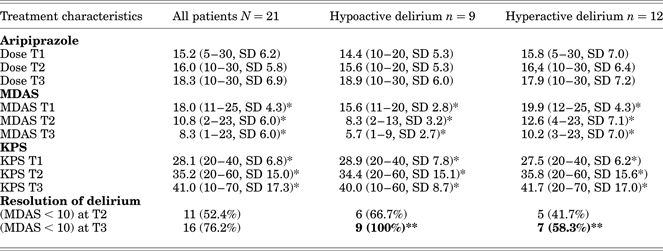
The mean aripiprazole starting dose was 15.2 mg. Mean doses at T2 and T3 were 16.0 mg and 18.3 mg, respectively. Aripiprazole was administered in a single daily dose, usually in the morning. There was no significant difference in dosing for hypoactive and hyperactive delirium (Table 1).
Aripiprazole open trial: treatment sample characteristics

*Friedman p < 0.001
**χ2 p < 0.05
MDAS = Memorial Delirium Assessment Scale; KPS, Karnofsky Performance Scale
Efficacy
A significant improvement in MDAS scores was observed in the entire cohort of delirious patients receiving aripiprazole. At baseline (T1), the mean MDAS score was 18.0, at T2 it was 10.8, and at T3 it was 8.3 (Friedman: χ2 31.87, df = 2, p < 0.001). The mean improvement in MDAS scores was 9.76. With delirium resolution defined as MDAS scores < 10, 52.4% of patients had resolution of delirium at T2 and 76.2% of patients had resolution of delirium at T3. In the course of treatment, functional status, as measured by the KPS, improved significantly. KPS scores were 28.1 at baseline, 35.2 at T2, and 41.0 at T3 (Friedman: χ2 20.11, df = 2, p < 0.001). Overall, five patients (23.8%) did not achieve delirium resolution (MDAS < 10) in the course of treatment with aripiprazole.
Nonresponders were characterized by having the hyperactive subtype of delirium, more severe delirium at baseline, and pre-existing cognitive deficits. Compared to the group of responders, this subset of five patients all had the hyperactive subtype of delirium, and more severe delirium with higher MDAS scores at baseline (21.6, 17–24, SD 2.7 vs. 16.9, 11–25, SD 4.1, Mann–Whitney U: 15.00, z = −2.08, p < 0.05), T2 (19.2, 11–23, SD 4.8 vs. 8.1, 2–14, SD 3.4, Mann–Whitney U: 4.00, z = −2.98, p < 0.01) and T3 (16.8, 11–23, SD 6.0 vs. 5.6, 1–9, SD 2.4, Mann–Whitney U: 0.00, z = −3.31, p < 0.001), and had cognitive deficits prior to treatment with aripiprazole (80% in nonresponders versus 6.2% in responders, Fisher exact test: p < 0.05). A history of dementia was associated with poor treatment response in hyperactive delirium (Fisher exact: p < 0.01) in our patient sample. There was no significant difference in age between the responders and nonresponders (67.4, 36–80, SD 11.7 and 76.8, 61–85, SD 10.2)
Differential Treatment Response to Aripiprazole Based on Delirium Subtypes
In patients with hypoactive delirium, MDAS scores improved from baseline (T1): 15.6 to T2: 8.3 and T3: 5.7 (Friedman: χ2 16.91, df =2, p < 0.001), and in patients with hyperactive delirium, MDAS scores improved from baseline (T1): 19.9 to T2: 12.6 and T3: 10.2 (Friedman: χ2 15.27, df = 2, p < 0.001). There was no difference in MDAS scores between the hypoactive and hyperactive delirium cohorts at T2 or T3. The reduction in MDAS scores was similar in both groups (9.9 and 9.7). However, what was most noteworthy was that the resolution of delirium as defined as MDAS < 10 occurred in 66.7% of patients with hypoactive delirium at T2 and in 100% at T3, whereas in patients with hyperactive delirium, resolution rates were 41.7% at T2 and 58.3% at T3 (Fisher exact test: p < 0.05). There were no significant differences in KPS scores.
Safety/Side Effects
Extrapyramidal side effects were only observed in patients initially treated with haloperidol prior to switching to aripiprazole, or receiving haloperidol as needed, and were related to haloperidol administration. At baseline, 19% had parkinsonian symptoms (i.e., mild tremor and/or mild cogwheel rigidity) and 14.3% reportedly experienced sedation. In the course of treatment with aripiprazole, parkinsonism and sedation disappeared in three patients (14.3%) and parkinsonism continued in one patient (4.8%) receiving haloperidol as needed because of agitation. Two patients (9.5%) had to be switched to risperidone because of worsening of delirium through the course of treatment with aripiprazole.
DISCUSSION
This open trial of a cohort of 21 hospitalized cancer patients with delirium provides preliminary evidence for the efficacy and safety of raipiprazole in the treatment of delirium. Furthermore, our results suggest that aripiprazole may be particularly more effective in treating patients with hypoactive delirium, while being less effective in treating patients with hyperactive delirium and pre-morbid cognitive impairment.
From the analysis of the prospectively collected measures used in our MSKCC Clinical Delirium Database, we have been able to observe a significant improvement of MDAS scores in this cohort of patients receiving aripiprazole, an atypical antipsychotic with a unique mechanism of action. More than 50% of patients treated with aripiprazole achieved delirium resolution as defined by MDAS < 10 in 2–3 days, and > 75% of patients achieved delirium resolution after 1 week of treatment. This delirium resolution rate was comparable to results with other atypical antipsychotics (Boettger & Breitbart, Reference Boettger and Breitbart2005) and similar to the existing aripiprazole case report (Alao & Moskowitz, Reference Alao and Moskowitz2006) and series (Straker et al., Reference Straker, Shapiro and Muskin2006).
The dosing in this trial, with a mean dosage of 18.3 mg (range of 10–30 mg) aripiprazole at T3 was similar to that in the case reports of Alao & Moskowitz (Reference Alao and Moskowitz2006) who used 15 and 30 mg aripiprazole, and higher than that in Straker's (2006) case series, with a mean of 8.9 mg (5–15 mg) aripiprazole.
Given that dosing regimens of aripiprazole for delirium have not been established, we chose to start treatment at 5–10 mg daily with our initial patients; however, as the trial proceeded, we began starting patients on 10 to 20 mg daily and titrated up to 30 mg as needed. Although aripiprazole does not have a described dose–response relationship in respect to dopamine antagonism, our dosing strategy was informed by the long half-life and resulting plasma levels of aripiprazole (DeLeon et al., Reference DeLeon, Patel and Crismon2004).
Straker et al. (Reference Straker, Shapiro and Muskin2006) reported maximum improvement at 6.2 days in their case series, whereas in our open label trial, maximum improvement occurred within the first 48 to 72 hours, which corresponds to the findings in Breitbart's and Platt's studies (Platt et al., Reference Platt, Breitbart and Smith1994; Breitbart et al., Reference Breitbart, Marotta and Platt1996).
A striking aspect of the results of this trial is the finding that aripiprazole may be more effective in treating patients with hypoactive delirium than those with hyperactive delirium. Our subjects showed a difference in treatment response between hypoactive and hyperactive delirium with response rates of 100% in hypoactive delirium and of ~ 60% in hyperactive delirium, based on the MDAS scores. Aripiprazole may show superior effect in the treatment of hypoactive delirium because of its unique, partial dopamine agonistic effect (DeLeon et al., Reference DeLeon, Patel and Crismon2004). Both the current pathogenetic model for delirium (Trzepacz, Reference Trzepacz1999) and the use of dopaminergic agents in the treatment of hypoactive delirium (Gagnon et al., Reference Gagnon, Low and Schreier2005) may suggest a role for partial dopaminergic agents in the management of hypoactive delirium.
The lower response rates in the management of hyperactive delirium may have two reasons: the mechanism of action of aripiprazole with its dopamine partial agonistic properties, and certain characteristics within the subset of patients with limited response. Although the dopaminergic activity of aripiprazole is limited in extent and restricted to areas of the brain with lower dopaminergic activity (DeLeon et al., Reference DeLeon, Patel and Crismon2004), adverse effects such as lack of improvement or worsening could be possible, similarly to exclusively dopaminergic agents, which may worsen delirium (Sommer et al., Reference Sommer, Wise and Kraemer2002). Also, both patient groups with hypoactive and hyperactive delirium differed significantly in age and baseline MDAS scores treatment, but did not differ in MDAS scores at T2 and T3.
Of interest, all nonresponders had a more severe, hyperactive delirium and cognitive deficits. Dementia is associated with a higher risk for delirium in the medically ill population and possibly poorer response to the treatment of delirium (Platt et al., Reference Platt, Breitbart and Smith1994). It is to be considered that cognitive deficits could bias the MDAS toward higher scores, as the MDAS uses cognitive tests (MDAS 2 – MDAS 6) and, therefore, might false positively overrate delirium in the presence of preexisting cognitive deficits. Using a higher MDAS score of 13 as the cutoff point for delirium resolution, which was also done in Breitbart's validation study for the MDAS (Breitbart et al., Reference Breitbart, Rosenfeld and Roth1997), would increase the delirium resolution rate for all patients to 85.7% (n = 18), to 75% (n = 9) for patients with hyperactive delirium, and to 60% (n = 3) for patients with dementia. Higher scores through perceptual disturbances (MDAS 7 and 8), however, also confirm an independent process and a less robust response in patients with cognitive disorders to the treatment of delirium with aripiprazole; therefore, both effects may be present and further studies are needed to further explore the context of dementia and treatment response. As a limiting factor, we have to mention that the numbers of patients with dementia were unequally present in both groups, which may explain our findings.
Significant or treatment-limiting side effects caused by the use of aripiprazole were not encountered. Observed side effects, such as parkinsonism, occurred mostly early in the trial and in the context of haloperidol administration. Akathisia, which is the most frequent extrapyramidal side effect of aripiprazole, was not observed, although this might also be because of the long half-life and resulting plasma levels of aripiprazole, and the rather short length of the trial (DeLeon et al., Reference DeLeon, Patel and Crismon2004).
This study has important and significant limitations that need to be noted, not the least of which is the small sample size. The design of the data collection was naturalistic, and investigators were not blinded to the medication. The assignment was not random, resulting in the exclusion of severely agitated, delirious patients, posing immediate danger to themselves or others, very critically ill patients, and patients unable to take oral medication. The study did have several strengths, including its prospective nature, differentiation between hypoactive and hyperactive delirium, recording of side effects, indication of severity of medical illness through KPS scores, and serial measurements of delirium severity using the MDAS.
Despite the stated strengths and limitations, this open trial is an important step in demonstrating the efficacy and safety of aripiprazole in the management of delirium; and suggesting that aripiprazole may be superior in the management of hypoactive delirium. The future of antipsychotic medication management of delirium may in fact be highlighted by the elucidation that specific agents may be better in treating specific subtypes of delirium, and populations of delirious patients (e.g., those with prior cognitive impairment) (Breitbart et al., Reference Breitbart, Tremblay and Gibson2002).
CONCLUSION
In summary, aripiprazole may be a safe and effective treatment for delirium, possibly with advantages in the treatment of the hypoactive type, at 10–30 mg daily, with limitations in the treatment of more severe hyperactive delirium in patients with cognitive deficits. Further research, particularly double-blind, randomly assigned, controlled designs of aripiprazole and other atypical and typical antipsychotics will be needed to confirm our findings and further elucidate the role of psychopharmacological management in delirium.
ACKNOWLEDGMENTS
This article was presented in part at the Annual Meeting of the Academy of Psychosomatic Medicine, Amelia Island, FL, November 14–18, 2007.