It has been estimated that up to 10% of traumatically brain injured (TBI) patients go on to experience symptoms of psychosis (Achte, Hillbom, & Aalberg, Reference Achte, Hillbom and Aalberg1969; Davison & Bagley, Reference Davison and Bagley1969; Fujii & Ahmed, Reference Fujii and Ahmed2001; Fujii, Ahmed, & Hishinuma, Reference Fujii, Ahmed and Hishinuma2004), with a range spanning from 1.35% (median estimate provided by Davison & Bagley, Reference Davison and Bagley1969) to 9.2% (Fujii et al., Reference Fujii, Ahmed and Hishinuma2004). These patients suffer a clinically complex dual diagnosis that is often accompanied by substantial distress and disability. Both the effect of TBI on new psychotic symptoms and the phenomenology of psychosis following TBI remain controversial. For instance, although cause-and-effect has not been established, ‘Psychotic Disorder Due to Traumatic Brain Injury (PDTBI)’ has been used previously to refer to dually diagnosed patients (e.g., Fujii & Ahmed, Reference Fujii and Ahmed2002a; Fujii et al., Reference Fujii, Ahmed and Hishinuma2004).
In line with existing evidence, the current article refers instead to ‘Psychosis Following Traumatic Brain Injury (PFTBI)’. It was the intention of this review to identify consistencies in PFTBI phenomenology from peer-reviewed publications of the highest quality. This is an important first step in elucidating the nature of PFTBI. A number of perspectives germane to PFTBI phenomenology are reviewed, including: the potential for psychotic symptoms post TBI, aetiological propositions, prevalence, the significance of onset latency and injury severity, clinical presentation, cognitive neuropsychological profile, and neuroimaging and localisation data. Finally, a discussion devoted to the shortcomings of this literature highlights important methodological limitations likely to explain phenomenological inconsistencies.
Method of Literature Review
Electronic searches of the PUBMED, psycINFO and the National Center for Biotechnology Information (NCBI) databases were conducted biannually between March 2009 and July 2012 with the keywords psychosis and traumatic brain injury, schizophrenia and traumatic brain injury, delusion and traumatic brain injury, or hallucination and traumatic brain injury. Fifty-two initial publications were found, of which 26 were considered relevant to the review. Additional citations from review articles were retrieved, including earlier publications not found by the database searchers, and work that had covered psychotic syndromes under psychiatric sequelae post TBI.
Peer-reviewed articles reporting on a selection of case histories were favoured where available, and duplicates were removed. Two large literature reviews were included: the first from Davison and Bagley (Reference Davison and Bagley1969), because their work represented a novel and influential study at the time of publication; and the second from Corcoran and Malaspina (Reference Corcoran and Malaspina2007), because their review describes data from the subsequent four decades. A stand-alone epidemiological study was included because, while the use of standardised diagnostic criteria is compromised, this methodology affords a large sample size (i.e., N = 5034; Silver, Kramer, Greenwald, & Weissman, Reference Silver, Kramer, Greenwald and Weissman2001). By contrast, work from Buckley et al. (Reference Buckley, Stack, Madigan, O'Callaghan, Larkin, Redmond and Waddington1993) provided valuable neuroimaging data and standardised clinical assessments of a select group of cases where the development of psychotic symptoms clearly followed cerebral trauma (i.e., N = 5). The remaining studies were chosen for review on the basis that they made a contribution to one or more of the domains of interest, and were not already covered by existing reviews summarised in this work.
Defining Psychosis
Psychotic symptoms are generally categorised as positive, negative and cognitive. These include delusions, hallucinations, disorganised language and behaviour, poverty of speech, emotion and/or motivation, and impairments in executive function, memory and insight (American Psychological Association (APA), 1994, 2000; Andreasen & Olsen, Reference Andreasen and Olsen1982; Henry & Crawford, Reference Henry and Crawford2004; Kay, Fiszbein, & Opler, Reference Kay, Fiszbein and Opler1987; Liddle, Reference Liddle1987). To meet DSM-IV (APA, 2000) criteria for schizophrenia, any two symptoms must be present for a significant part of 1 month, continue for at least 6 months, and interfere with personal hygiene, occupational functioning or social interaction. Cases of psychosis (Burg, McGuire, Burright, & Donovick, Reference Burg, McGuire, Burright and Donovick1996; Koponen et al., Reference Koponen, Taiminen, Portin, Himanen, Isoniemi, Heinonen and Tenovuo2002, Reference Koponen, Taiminen, Kurki, Portin, Isoniemi, Himanen and Tenovuo2006), schizophrenia (Fujii et al., Reference Fujii, Ahmed and Hishinuma2004; Malaspina et al., Reference Malaspina, Goetz, Friedman, Kaufmann, Faraone, Tsuang and Blehar2001; Silver et al., Reference Silver, Kramer, Greenwald and Weissman2001), and isolated symptoms such as hallucinations (Stewart & Brennan, Reference Stewart and Brennan2005) and delusions (Butler, Reference Butler2000; Feinberg, Eaton, Roane, & Giacino, Reference Feinberg, Eaton, Roane and Giacino1999) have been identified in the PFTBI literature to date.
The Potential for Psychosis Post TBI
Cohorts at Risk
TBI and psychotic disorders share risk factors that may help to explain dual diagnosis in some cases. Male gender, substance use and abuse, and/or existing psychiatric sequelae are highly correlated with both head injury and psychosis. Young males injured in road-traffic accidents show the highest rates of TBI (Bruns Jr & Hauser, Reference Bruns and Hauser2003), and a higher incidence of psychosis has been established in young, but not middle-aged or elderly, males (Abel, Drake, & Goldstein, Reference Abel, Drake and Goldstein2010; Jablensky et al., Reference Jablensky, Sartorius, Ernberg, Anker, Korten, Cooper and Bertelsen1992; McGrath, Saha, Chant, & Welham, Reference McGrath, Saha, Chant and Welham2008). Higher-than-average rates of substance use, especially alcohol and cannabis abuse, and other psychopathologies, such as comorbid mood and anxiety disorders, are also shared by both cohorts (Gould, Ponsford, Schönberger, & Johnston, Reference Gould, Ponsford, Schönberger and Johnston2011; Hartley, Haddock, & Barrowclough, Reference Hartley, Haddock and Barrowclough2012; Ponsford, Draper, & Schönberger, Reference Ponsford, Draper and Schönberger2008; Rossler, Hengartner, Angst, & Ajdacic-Gross, Reference Rossler, Hengartner, Angst and Ajdacic-Gross2012; West, Reference West2011; Westermeyer, Reference Westermeyer2006; Wisdom, Manuel, & Drake, Reference Wisdom, Manuel and Drake2011).
Increased Vulnerability as a Consequence of the TBI
Post-traumatic amnesia (PTA) follows emergence from coma in the majority of TBI cases. This state, in which there is confusion and disorientation, impaired new learning and generalised cognitive disturbance, is frequently associated with the development of symptoms that may be interpreted as psychosis, such as delusions and hallucinations (Snow & Ponsford, Reference Snow, Ponsford, Ponsford, Sloan and Snow2012). Although these generally resolve with emergence from PTA, there is potential for this condition to be labelled a psychosis, especially in cases where this continues for weeks or months, as it may in cases of very severe TBI. This would account for some reported cases of PFTBI.
Continuing cognitive and behavioural impairments and their impact on functional outcomes following TBI may also mediate the development of psychotic symptoms. Cognitive impairments are most common in the domains of attention, information processing speed, working memory, new learning and memory, and executive functions (Beauchamp et al., Reference Beauchamp, Catroppa, Godfrey, Morse, Rosenfeld and Anderson2011; Lezak, Reference Lezak1979; Ponsford & Kinsella, Reference Ponsford and Kinsella1992, Rios, Perianez, & Munoz-Cespedes, Reference Rios, Perianez and Munoz-Cespedes2004). Reduced behavioural control, with irritability, aggression, impulsivity, disinhibition and/or lack of initiative is also common, as is a lack of awareness of these changes (Ponsford, Sloan, & Snow, Reference Ponsford, Sloan and Snow2012). These impairments affect the injured individual's capacity for employment or study, leisure activities, and social and personal relationships, creating increasing dependency on family and social isolation.
Similar cognitive and behavioural dysfunction is documented in psychotic disorders, during the prodromal phase and post onset. Neurocognitive deficits are well established across domains of language and memory, processing speed, attention and executive function (Broome et al., Reference Broome, Fusar-Poli, Matthiasson, Woolley, Valmaggia, Johns and McGuire2010; Evans, Chua, McKenna, & Wilson, Reference Evans, Chua, McKenna and Wilson1997; Henry & Crawford, Reference Henry and Crawford2004; Joshua & Rossell, Reference Joshua and Rossell2009; Rossell & David, Reference Rossell and David2006). Behavioural changes are also apparent, especially in disinhibition and amotivation (Gard, Fisher, Garrett, Genevsky, & Vinogradov, Reference Gard, Fisher, Garrett, Genevsky and Vinogradov2009; Hughes, Fulham, Johnston, & Michie, Reference Hughes, Fulham, Johnston and Michie2012; Medalia & Brekke, Reference Medalia and Brekke2010; Nakagami, Hoe, & Brekke, Reference Nakagami, Hoe and Brekke2010), and psychosocial problems are common, including emotion perception, communication and self-care. As in TBI, these typically result in social isolation (Goreishizadeh, Mohagheghi, Farhang, & Alizadeh, Reference Goreishizadeh, Mohagheghi, Farhang and Alizadeh2012; Nakagami et al., Reference Nakagami, Hoe and Brekke2010; Switaj et al., Reference Switaj, Anczewska, Chrostek, Sabariego, Cieza and Chatterji2012).
Psychiatric Illness
Cognitive and behavioural changes of this kind result in long-term psychological stress post injury. Significant emotional distress, pre-injury substance abuse and post-injury psychosocial stressors, may constitute further risks for psychiatric illness (Kim et al., Reference Kim, Lauterbach, Reeve, Arciniegas, Coburn, Mendez and Coffey2007; Ponsford et al., Reference Ponsford, Draper and Schönberger2008). Indeed, numerous studies have documented elevated rates of psychiatric disorder following TBI (Gould et al., Reference Gould, Ponsford, Schönberger and Johnston2011; Hoofien, Gilboa, Vakil, & Donovick, Reference Hoofien, Gilboa, Vakil and Donovick2001; Koponen et al., Reference Koponen, Taiminen, Portin, Himanen, Isoniemi, Heinonen and Tenovuo2002; Whelan-Goodinson, Ponsford, Johnston, & Grant, Reference Whelan-Goodinson, Ponsford, Johnston and Grant2009). These may be as high as 70% prevalence of both depression and anxiety post injury (Kim et al., Reference Kim, Lauterbach, Reeve, Arciniegas, Coburn, Mendez and Coffey2007; Lewis, Reference Lewis1942), although some studies have reported much lower rates (e.g., Anson & Ponsford, Reference Anson and Ponsford2006; Hiott & Labbate, Reference Hiott and Labbate2002; Jorge et al., Reference Jorge, Robinson, Moser, Tateno, Crespo-Facorro and Arndt2004; Rutherford, Merrett, & McDonald, Reference Rutherford, Merrett and McDonald1977). A recent prospective study showed that 45.8% of participants without any psychiatric history developed a post-injury psychiatric disorder (Gould et al., Reference Gould, Ponsford, Schönberger and Johnston2011). However, the rates of psychotic disorders in this study were not higher than those in a comparison sample from the general population. Nevertheless, psychiatric illness, depression and anxiety, in particular, have recently been associated with the development of psychosis, especially in cases with comorbid substance misuse (Hartley et al., Reference Hartley, Haddock and Barrowclough2012).
Structural and Functional Cerebral Abnormalities
Brain regions and associated circuitry implicated in the neurogenesis of psychotic symptoms overlap substantially with those commonly affected by TBI (McAllister & Ferrell, Reference McAllister and Ferrell2002; Rao & Lyketsos, Reference Rao and Lyketsos2003). Due to the internal structure of the skull, the frontal lobe (posterior base) and temporal lobe (anterior pole) have an especially increased vulnerability to traumatic injury, as does the hippocampal formation, with added vulnerability due to the mechanical force of the blow, intracranial pressure and/or hypoxia (Bigler, Reference Bigler2007; DeKosky, Kochanek, Clark, Ciallella, & Dixon, Reference DeKosky, Kochanek, Clark, Ciallella and Dixon1998; Gennarelli & Graham, Reference Gennarelli and Graham1998; McAllister & Ferrell, Reference McAllister and Ferrell2002). Similarly, fronto-temporal pathology and hippocampal dysfunction are implicated in the neurogenesis and persistence of psychotic symptoms (Bachus & Kleinman, Reference Bachus and Kleinman1996; Borgwardt et al., Reference Borgwardt, Riecher-Rossler, Dazzan, Chitnis, Aston, Drewe and McGuire2007; Ellison-Wright, Glahn, Laird, Thelen, & Bullmore, Reference Ellison-Wright, Glahn, Laird, Thelen and Bullmore2008; Friston, Liddle, Frith, Hirsch, & Frackowiak, Reference Friston, Liddle, Frith, Hirsch and Frackowiak1992; Zierhut et al., Reference Zierhut, Grabmann, Kaufmann, Steiner, Bogerts and Schiltz2013). Hippocampal dysfunction has been demonstrated during language and memory encoding in schizophrenia (Jessen et al., Reference Jessen, Scheef, Germeshausen, Tawo, Kockler, Kuhn and Heun2003; Zierhut et al., Reference Zierhut, Bogerts, Schott, Fenker, Walter, Albrecht and Schiltz2010), with recent evidence suggesting that hippocampal morphology may further underlie positive symptoms such as hallucinations and delusions (Csernansky et al., Reference Csernansky, Wang, Jones, Rastogi-Cruz, Posener, Heydebrand and Miller2002; Zierhut et al., Reference Zierhut, Grabmann, Kaufmann, Steiner, Bogerts and Schiltz2013).
Variable degrees of cerebral atrophy are shown following TBI, the degree and progression of which is not necessarily related to injury severity, and may continue for years following the trauma (Belina & Kovacic, Reference Belina and Kovacic2011; Ross, Reference Ross2011; Ross et al., Reference Ross, Ochs, Seabaugh, Demark, Shrader, Marwitz and Havranek2012; Tate, Khedraki, Neeley, Ryser, & Bigler, Reference Tate, Khedraki, Neeley, Ryser and Bigler2011). Cortical white and grey matter loss, with reduced medial and middle frontal, medial and superior temporal gyri, and dorsolateral prefrontal cortex volumes, is further considered characteristic of schizophrenia (Borgwardt et al., Reference Borgwardt, Riecher-Rossler, Dazzan, Chitnis, Aston, Drewe and McGuire2007; Fusar-Poli, McGuire, & Borgwardt, Reference Fusar-Poli, McGuire and Borgwardt2011; Ho et al., Reference Ho, Andreasen, Nopoulos, Arndt, Magnotta and Flaum2003; Mathalon, Sullivan, Lim, & Pferrerbaum, Reference Mathalon, Sullivan, Lim and Pfefferbaum2001; Pantelis et al., Reference Pantelis, Velakoulis, McGorry, Wood, Suckling, Phillips and McGuire2003; Pridmore & Bowe, Reference Pridmore and Bowe2011). These grey matter changes have been shown in ‘at risk’ healthy individuals (Lawrie et al., Reference Lawrie, Whalley, Kestelman, Abukmeil, Byrne, Hodges and Johnstone1999; Mathalon et al., Reference Mathalon, Sullivan, Lim and Pfefferbaum2001; Pantelis et al., Reference Pantelis, Velakoulis, McGorry, Wood, Suckling, Phillips and McGuire2003), isolated from the effects of antipsychotics (Pridmore & Bowe, Reference Pridmore and Bowe2011; Steen, Mull, McClure, Hamer, & Lieberman, Reference Steen, Mull, McClure, Hamer and Lieberman2006) and moderated by chronicity (Horn et al., Reference Horn, Federspiel, Wirth, Muller, Wiest, Walter and Strik2010; Mathalon et al., Reference Mathalon, Sullivan, Lim and Pfefferbaum2001).
Aetiological Theories of Dual Diagnosis
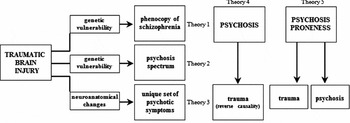
Five prominent theories have been proposed for PFTBI aetiology (Figure 1). The first suggests that brain injury activates an existing hereditary susceptibility to schizophrenia (i.e., as the ‘stress’ component in stress–diathesis theory (Corcoran & Malaspina, Reference Corcoran and Malaspina2007; Kim, Reference Kim2008)). In the second theory the relationship is identical, but allows for the development of any symptom/s along the continuum of psychosis (Corcoran & Malaspina, Reference Corcoran and Malaspina2007; Kim, Reference Kim2008; for review of the continuum see Verdoux & van Os, Reference Verdoux and van Os2002). The third proposes that TBI initiates the development of a unique set of psychotic symptoms via a chain reaction of structural and/or functional changes in the brain (Kim, Reference Kim2008). In this account, genetic vulnerability is less influential, and current DSM-IV (APA, 1994, 2000) criteria allow for the diagnosis of cases fitting this type under ‘psychotic disorder due to a general medical condition’.
Schematic depicting five prominent conceptualisations of the traumatic brain injury and psychosis/schizophrenia relationship.

Fourth, a case for ‘reverse causality’ has been proposed, where the existence of psychosis increases the likelihood of trauma (David & Prince, Reference David and Prince2005; Nielsen, Mortensen, O'Callaghan, Morsa, & Ewald, Reference Nielsen, Mortensen, O'Callaghan, Morsa and Ewald2002). This acknowledgement of increased injury rates in the psychotic population is not confined to head trauma, and does not explain neurological insult prior to the development of psychotic symptoms. Even so, reverse causality has been proposed as an explanation for PFTBI (e.g., David & Prince, Reference David and Prince2005), and researchers continue to look to rates of injury in schizophrenia for PFTBI prevalence estimates (e.g., Nielsen et al., Reference Nielsen, Mortensen, O'Callaghan, Morsa and Ewald2002). Finally, the potential for a spurious relationship has been noted, whereby psychosis-proneness increases the likelihood of both psychosis and trauma. In this explanation genetic proneness is a causal mediating factor that accounts for the erroneously observed relationship between brain injury and psychosis (Corcoran & Malaspina, Reference Corcoran and Malaspina2007).
The first three models agree that TBI demonstrates causality in the ensuing psychotic symptoms, yet differ in their definition of the subsequent psychosis and, thus, the importance of heritable vulnerability. For instance, DSM-IV-diagnosed schizophrenia has established heritability (model one), which is not necessarily a prerequisite for the manifestation of psychotic symptoms generally (model two) (Egan et al., Reference Egan, Hyde, Bonomo, Mattay, Bigelow, Goldberg and Weinbereger2001; McGuffin, Asherson, Owen, & Farmer, Reference McGuffin, Asherson, Owen and Farmer1994). However, heritability need not be a requirement of the model, given that existing literature has demonstrated PFTBI both in those with (e.g., AbdelMalik, Husted, Chow, & Bassett, Reference AbdelMalik, Husted, Chow and Bassett2003) and without (e.g., Fujii & Ahmed, Reference Fujii and Ahmed2001) a heritable predisposition. The hypothetically ‘unique’ symptom profile proposed by the third model is impractical given that psychotic outcome can only be informed by the thorough standardised clinical and neuropsychological assessment of PFTBI cases in the first instance. The fact that more than one theoretical model exists serves as evidence that sufficient empirical research is yet to be published. Further, and as identified by the second theoretical model, the past decade of research has reconceptualised psychosis generally, whereby psychotic thoughts, experiences and behaviour, exist on a continuum (i.e., a psychosis spectrum), rather than as categorical distinctions per se (Badcock & Dragovic, Reference Badcock and Dragovic2006; Myin-Germeys, Krabbendam & van Os, Reference Myin-Germeys, Krabbendam and van Os2003; Verdoux & van Os, Reference Verdoux and van Os2002). In this sense, the proposed categorisation of symptoms in the first model is also somewhat theoretically out-dated.
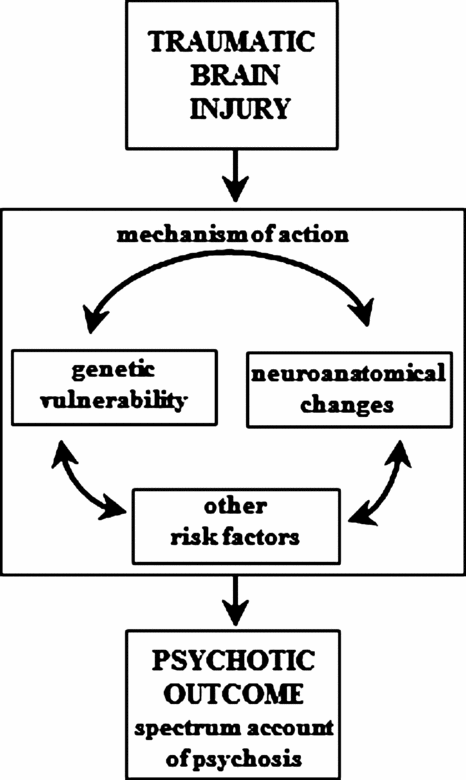
Claims of reverse causality offer an incomplete, and subsequently inadequate, picture of dually diagnosed patients. Similarly, a spurious relationship relies on the genetic liability (i.e., heritability) of a patient, and can therefore be discounted by existing evidence. Thus, provided the requirement for heritability is removed, the second theoretical model most accurately reflects the existing PFTBI literature (Corcoran & Malaspina, Reference Corcoran and Malaspina2007; Kim, Reference Kim2008). Figure 2 depicts a model of PFTBI conceptualised according to the existing empirical evidence. It appears that TBI may be associated with the development of psychosis, but that the mechanism of action may occur via multiple pathways, including pre-existing heritability, changes in structural and functional brain neuroanatomy, and/or other risk factors already empirically established (e.g., environment, socio-economic status).
Schematic depicting the hypothesised model of the traumatic brain injury and psychosis relationship based on the available literature to date.

Evidence for the Increased Risk of Psychosis following TBI
The inconsistency in prevalence rates is, in part, due to the fact that prevalence has been estimated from either a TBI or psychotic cohort. The latter is more likely to include individuals who have experienced both head trauma and psychotic symptoms over the course of their lives, rather than PFTBI specifically. Even where strict criteria are applied, this method makes it difficult to determine the timing of the head injury relative to the first onset of psychotic symptoms. However, given the limited data, publications that have used this methodology cannot be discounted.
Prevalence of Psychosis in a TBI Cohort
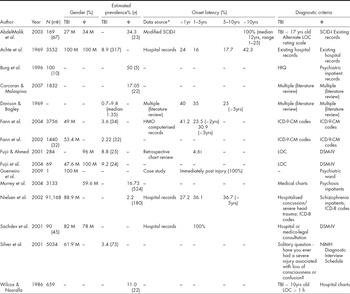
In an influential review, Davison and Bagley (Reference Davison and Bagley1969) reported both the lowest (0.7%) and highest (9.8%) estimates of psychosis in a TBI cohort to date. According to data reported between 1917 and 1964 the risk of schizophrenia was between two and three times greater in the TBI population than in the general population (Davison & Bagley, Reference Davison and Bagley1969). Other studies report estimates in the range of 3.4 (Silver et al., Reference Silver, Kramer, Greenwald and Weissman2001) to 9.2% (Fujii et al., Reference Fujii, Ahmed and Hishinuma2004), although a prevalence of approximately 8–9% is most common (Newburn, Reference Newburn1998) (Table 1).
Estimates of PFTBI Prevalence and Onset Latency

TBI, Traumatic Brain Injury Cohort; Ψ, Psychosis Cohort; M, Male; HMO, Health Management Organization; ICD-9-CM, International Classification of Diseases, Ninth Revision, Clinical Modification; ICD-8, International Classification of Diseases, Eighth Revision; LOC, Loss of Consciousness; DSM-IV, Diagnostic and Statistical Manual of Mental Disorders – Fourth Edition; HIQ, Head Injury Questionnaire (HIQ; Solomon & Malloy, Reference Solomon and Malloy1992); SCID, Structured Clinical Interview for DSM-IV Axis I Disorders.
†Represents mean value of all participants in years, SD = 4.4 (range 1–23 years).
*Source pertaining to onset latency data only.
Prevalence of TBI in a Psychotic Cohort
Where psychotic patients are screened for their history of TBI the rates are typically much higher, some work suggesting the presence of a prior TBI in 34–50% of the psychotic population (AbdelMalik et al., Reference AbdelMalik, Husted, Chow and Bassett2003; Burg et al., Reference Burg, McGuire, Burright and Donovick1996). However, this method is more likely to provide an inflated estimate given that: (i) injury rates tend to be higher in psychotic populations when they are unwell; and (ii) as already mentioned, pooling lifetime rates of TBI distorts the timing of injury and psychotic onset, and thus, may not capture cases of PFTBI. In examples of this method, where cases were restricted to those where injury occurred prior to the first psychotic symptoms and/or admission, the rates are lower (e.g. Nielsen et al., Reference Nielsen, Mortensen, O'Callaghan, Morsa and Ewald2002; Wilcox & Nasrallah, Reference Wilcox and Nasrallah1986; see Table 1).
Prevalence of Schizophrenia and Psychotic Disorders in the General Population
Worldwide studies estimate the prevalence of schizophrenia between 0.3 and 1% (David & Prince, Reference David and Prince2005; Saha, Chant, Welham, & McGrath, Reference Saha, Chant, Welham and McGrath2005; Sutterland et al., Reference Sutterland, Dieleman, Storosum, Voordouw, Kroon, Veldhuis and Sturkenboom2013), with variations demonstrated in both incidence and prognosis cross-culturally (Kulhara & Chakrabarti, Reference Kulhara and Chakrabarti2001; Myers, Reference Myers2011). Lifetime prevalence of psychotic disorders is thought to be higher, at 0.7–2.07% (Kendler, Gallagher, Abelson, & Kessler, Reference Kendler, Gallagher, Abelson and Kessler1996; Perala et al., Reference Perala, Suvisaari, Saarni, Kuoppasalmi, Isometsa, Pirkola and Lonngvist2007). These include schizophrenia, schizoaffective disorder, schizophreniform disorder, nonaffective psychosis, delusional disorder, substance-induced psychotic disorders and psychotic disorders due to a general medical condition (Kendler et al., Reference Kendler, Gallagher, Abelson and Kessler1996; Perala et al., Reference Perala, Suvisaari, Saarni, Kuoppasalmi, Isometsa, Pirkola and Lonngvist2007). Thus, even at the highest rates of lifetime prevalence, it appears that psychotic disorders occur at a much greater frequency following TBI than in the general population. With reference to the highest estimates taken from a TBI cohort (i.e., 9.2%, Fujii et al., Reference Fujii, Ahmed and Hishinuma2004) and those of psychotic disorders in the general population (i.e., 2.07%, Perala et al., Reference Perala, Suvisaari, Saarni, Kuoppasalmi, Isometsa, Pirkola and Lonngvist2007), psychosis following TBI may occur at a rate at least three times that of the general population.
Onset Latency
The details of studies reviewed for estimates of onset latency are contained in Table 1 alongside the prevalence estimates. Temporal information related to the injury and onset of psychotic symptoms is not always collected (e.g., Silver et al., Reference Silver, Kramer, Greenwald and Weissman2001), and the source of reported data is often unknown (e.g., Davison & Bagley, Reference Davison and Bagley1969). Yet, this information is imperative in the establishment of causal factors associated with the emerging psychosis and, indeed, an accurate diagnosis of PFTBI. Without it, the direction of the PFTBI relationship (i.e., whether the TBI occurred before or after the emergence of psychotic symptoms), and the duration of the time period in between (i.e., onset latency) remain unclear.
These limitations may at least partially explain why the literature reporting onset latency is inconsistent. Rates of onset occur with similar frequency across time bands; between 40 and 50%Footnote 1 during the first year (Davison & Bagley, Reference Davison and Bagley1969; Fann et al., Reference Fann, Burington, Leonetti, Jaffe, Katon and Thompson2004), 1–5 years (Fujii & Ahmed, Reference Fujii and Ahmed2001; Nielsen et al., Reference Nielsen, Mortensen, O'Callaghan, Morsa and Ewald2002; Sachdev, Smith, & Cathcart, Reference Sachdev, Smith and Cathcart2001), 5–10 years (Achte et al., Reference Achte, Hillbom and Aalberg1969; Davison & Bagley, Reference Davison and Bagley1969; Nielsen et al., Reference Nielsen, Mortensen, O'Callaghan, Morsa and Ewald2002), and greater than 10 years post TBI (Achte et al., Reference Achte, Hillbom and Aalberg1969; Bamrah & Johnson, Reference Bamrah and Johnson1991). If these rates are presumed accurate, one must conclude that: (i) there is no reliable onset latency post TBI; and/or (ii) variability may reflect the influence of factors unrelated to the injury, such as, for example, familial support, environmental stressors and resilience.Footnote 2 Fujii and Ahmed (Reference Fujii and Ahmed2002b) reported that a shorter time lag between injury and psychotic onset was evident in cases with mild, relative to severe, brain injury. However, it should be noted that the majority of the cases they reviewed had unspecified injury severity, with their final assessment drawn from 22 moderate–severe cases, and only seven mild cases.
The Significance of Injury Severity
The development of psychotic symptoms is further likely to be mediated by the specific injury; severity, lesion location, the directional force of the blow and/or rapid head movement, and internal secondary injury such as swelling, bleeding and apoptotic and necrotic cell death (Raghupathi, Reference Raghupathi2004; Rink et al., Reference Rink, Fung, Trojanowski, Lee, Neugebauer and McIntosh1995). Indeed, altered neuronal apoptosis has been linked to the progressive loss of grey matter associated with psychotic onset (Glantz, Gilmore, Lieberman, & Jarskog, Reference Glantz, Gilmore, Lieberman and Jarskog2006). A handful of findings have suggested that greater injury severity may be associated with an increased risk of post-injury psychosis (Fujii & Ahmed, Reference Fujii and Ahmed2002b; Hillbom, Reference Hillbom1960; Sachdev et al., Reference Sachdev, Smith and Cathcart2001). For instance, Sachdev et al. (Reference Sachdev, Smith and Cathcart2001) found that injury severity determined according to the duration of loss of consciousness predicted PFTBI (although no other measures of injury severity reached significance). However, conflicting findings have also been published. In fact, Fujii and Ahmed (Reference Fujii and Ahmed2001) found that their nonpsychotic TBI cohort showed relatively more moderate to severe injuries. In line with their later work reporting a shorter time lag before psychotic onset for cases with mild brain injury (Fujii & Ahmed, Reference Fujii and Ahmed2002b), greater severity may not necessarily be associated with greater risk.
Clinical Presentation
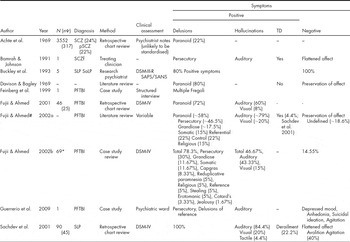
A comprehensive and systematic assessment of the clinical presentation of PFTBI is yet to be published. However, according to the modest clinical data available, all diagnostically salient symptoms characteristic of schizophrenia have been observed in patients with PFTBI (see Table 2). This includes positive and negative symptoms, as well as marked cognitive impairment (already defined; APA, 1994). As such, it appears that PFTBI may be clinically indistinguishable from schizophrenia.
Available Data on the Symptom Profile of PFTBI

Ψ, Psychosis; TD, Thought Disorder; SCZ, Schizophrenia; pSCZ, Paranoid schizophrenia; SCZf, Schizophreniform; SLP, Schizophrenia-like psychosis; SaLP, Schizoaffective-like psychosis; PFTBI, Psychosis following traumatic brain injury; DSM, Diagnostic and Statistical Manual of Mental Disorders; SAPS, Scale for the Assessment of Positive Symptoms; SANS, Scale for the Assessment of Negative Symptoms.
* N = 55 for data on negative symptoms.
# Percentage values drawn from the mean of reviewed studies providing statistics.
This is not without controversy. Preliminary work from Fujii and Ahmed (Reference Fujii and Ahmed2002a) highlighted the ‘absence’ of negative symptoms in PFTBI. Their initial report indicated that three of the six studies they reviewed recorded negative pathology (Fujii & Ahmed, Reference Fujii and Ahmed2002a), and a further case study review noted that negative symptoms were generally reduced (i.e., 8 of 55, 14.55%; Fujii & Ahmed, Reference Fujii and Ahmed2002b). However, seven of the nine publications in the current review reported negative symptoms in PFTBI at a mean rate of approximately 52% (see Table 2). Given that schizophrenia is notoriously heterogeneous in its clinical presentation, and negative symptoms are not a requirement for diagnosis (APA, 1994, 2000), there is no definitive evidence for a profile that is diagnostically distinct from schizophrenia as it is currently conceptualised.
Another significant gap in the literature is the lack of statistical comparison between clinical profiles of matched PFTBI and schizophrenia patients. Systematic examination of the clinical presentation of PFTBI using standardised clinical interviews is vital for accurate diagnosis and treatment. Definitive conclusions with respect to the clinical presentation of PFTBI, and its likeness to functional schizophrenia, are thus premature.
Cognitive Neuropsychological Profile
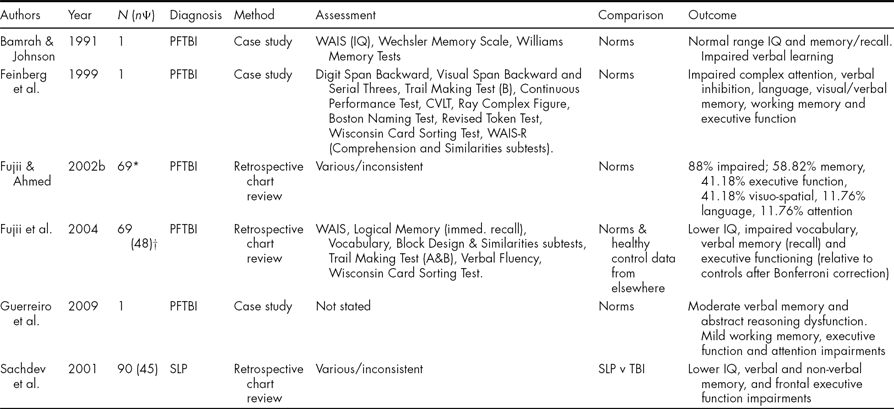
Similarly, very little research has detailed the cognitive neuropsychological profile of patients with PFTBI. A summary of the available data is contained in Table 3. From this work it appears that some common deficiencies in language and vocabulary (e.g., Fujii & Ahmed, Reference Fujii and Ahmed2002b; Fujii et al., Reference Fujii, Ahmed and Hishinuma2004; Sachdev et al., Reference Sachdev, Smith and Cathcart2001), verbal memory (e.g., Fujii et al., Reference Fujii, Ahmed and Hishinuma2004; Sachdev et al., Reference Sachdev, Smith and Cathcart2001) and verbal learning (e.g., Bamrah & Johnson, Reference Bamrah and Johnson1991) may characterise PFTBI. These impairments have been shown relative both to norms provided by standardised measures (e.g., Bamrah & Johnson, Reference Bamrah and Johnson1991; Fujii et al., Reference Fujii, Ahmed and Hishinuma2004) and to matched TBI groups (e.g., Sachdev et al., Reference Sachdev, Smith and Cathcart2001). There is also some evidence for generalised cognitive impairment (e.g., Fujii et al., Reference Fujii, Ahmed and Hishinuma2004; Sachdev et al., Reference Sachdev, Smith and Cathcart2001).
Available Data on the Cognitive/Neuropsychological Profile of PFTBI
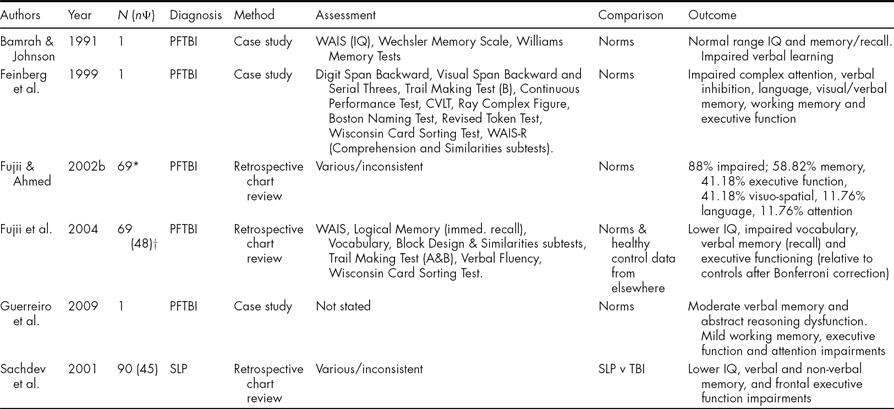
Ψ, Psychosis; PFTBI, Psychosis following traumatic brain injury; SLP, Schizophrenia-like psychosis; TBI, Traumatic brain injury; WAIS, Wechsler Adult Intelligence Scale; CVLT, California Verbal Learning Test
* N = 17 for cognitive neuropsychological data.
† Consists of 24 PFTBI and 24 schizophrenia patient charts (remainder = 21 TBI).
Neurocognitive impairments of this kind may contribute to disortions of reality and, especially, the development of delusions, in vulnerable cases. Cognitive models for the formation, content and maintenance of delusions have been discussed extensively in the literature, usually pertaining to reasoning and/or attributional biases (Bell, Halligan, & Ellis, Reference Bell, Halligan and Ellis2006; Gilleen & David, Reference Gilleen and David2005), and, more recently, semantic memory impairment (Rossell, Batty, & Hughes, Reference Rossell, Batty and Hughes2010). A case reported by Ponsford (Reference Ponsford, Ponsford, Sloan and Snow2012) presented with temporal lobe damage associated with slowed verbal processing, and related poor verbal memory. This resulted in the misinterpretation of his social environment and, in the context of social isolation, the development of paranoid delusions.
Preliminary evidence has further suggested that the presence of psychosis in PFTBI exacerbates cognitive neuropsychological impairments beyond the effects of the injury (Fujii et al., Reference Fujii, Ahmed and Hishinuma2004; Sachdev et al., Reference Sachdev, Smith and Cathcart2001). Sachdev et al. (Reference Sachdev, Smith and Cathcart2001) reported that PFTBI patients had reduced verbal/non-verbal memory and executive function relative to a TBI control group matched for injury severity and lesion location. Similarly, Fujii et al. (Reference Fujii, Ahmed and Hishinuma2004) reported reduced performance by PFTBI cases on a range of neuropsychological tests, with the exception of the Trail Making Task (TMT, Forms A and B; Reitan & Wolfson, Reference Reitan and Wolfson1985) (see Table 3 for the list of tests reported).Footnote 3 This was despite milder injury in the PFTBI patients, compared with TBI patients, who generally had moderate to severe injuries. Unfortunately, however, the authors inspected scores against available norms, instead of performing group-wise analyses on these data.
The work from Sachdev et al. (Reference Sachdev, Smith and Cathcart2001) did, however, report greater left/bilateral temporal, and right parietal injury in the PFTBI cohort. Although these differences were no longer significant following Bonferroni correction, this may explain reduced verbal memory in some PFTBI patients, given the association between verbal memory and the left temporal region. However, since Sachdev et al. (Reference Sachdev, Smith and Cathcart2001) are the first authors to have published cognitive data on statistically matched patient groups, and lesion location differences did not reach statistical significance, this suggestion is made only tentatively. By contrast, for instance, the case study presented by Bamrah and Johnson (Reference Bamrah and Johnson1991) also showed deficits in verbal learning in particular, yet the computed tomography (CT) scan of this patient's brain indicated a generalised (and especially frontal) atrophy, rather than localised left hemisphere lesions.Footnote 4
Lesion Localisation and Neuroimaging
Electroencephalography (EEG)
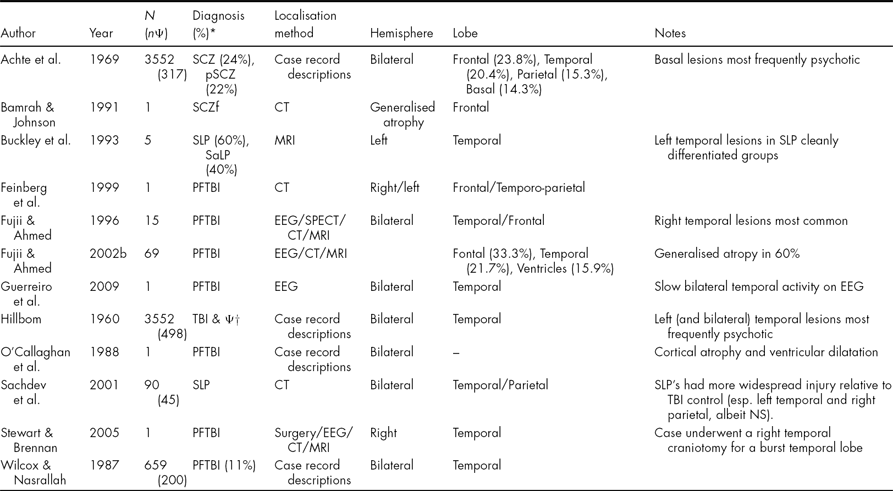
Table 4 compiles the lesion localisation and neuroimaging data. Comprehensive empirical event-related potential (ERP) investigations have not been published in PFTBI. Existing electroencephalograms in dually diagnosed patients have typically been obtained for diagnostic purposes, where seizures have occurred and/or the extent of injury is unclear (Fujii & Ahmed, Reference Fujii and Ahmed1996; Hillbom, Reference Hillbom1960). Approximately 53% of Hillbom's (Reference Hillbom1960) substantial collection of post-war cases (N = 3552) had undergone EEG assessments of this kind, with the majority of these obtained for patients with mild to moderate brain injuries. Hillbom (Reference Hillbom1960) did not detail EEG outcome according to case diagnosis and so findings specific to dually diagnosed PFTBI patients are not available.
PFTBI Lesion Localisation to Date
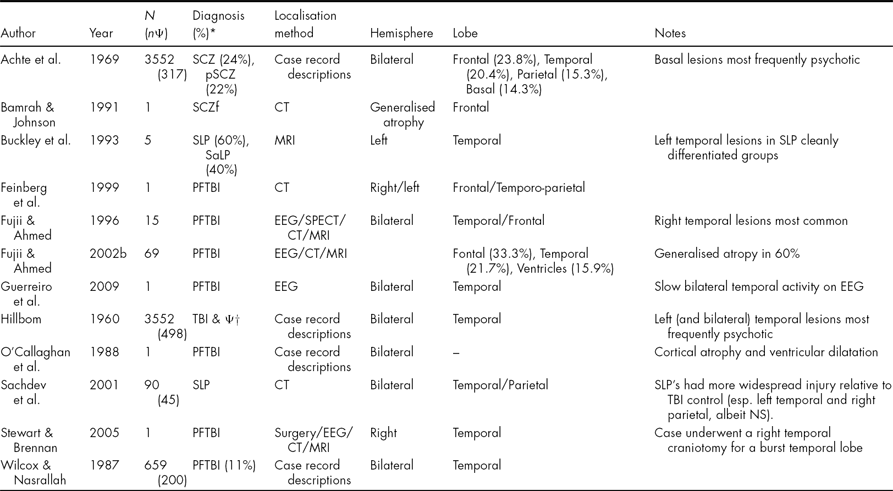
Ψ, Psychosis; SCZ, Schizophrenia; pSCZ, Paranoid schizophrenia; SCZf, Schizophreniform; SLP, Schizophrenia-like psychosis; SaL, Schizoaffective-like psychosis;
PFTBI, Psychosis following traumatic brain injury; TBI, Traumatic brain injury; CT, Computerised tomography; MRI, Magnetic resonance imaging; EEG, Electroencephalography; SPECT, Single-photon emission computed tomography; NS, Not significant.
* The percentage value is provided in the ‘Diagnosis’ column where this number differs from (nΨ).
† Case histories of men with war injuries. Temporal order of psychosis and injury unclear.
The research from Fujii and Ahmed (Reference Fujii and Ahmed1996, Reference Fujii and Ahmed2002b) has probably been the most informative with respect to EEG data. In both case history reviews, the authors reported a predominance of temporal lobe abnormalities in PFTBI patients (Fujii & Ahmed, Reference Fujii and Ahmed1996, Reference Fujii and Ahmed2002b). A history of seizures was apparent in the majority of cases (1996), and more than 70% of the 41 patients in their second review (2002b) showed evidence of EEG abnormalities. The majority of these evidenced slowing; however, spiking and dysrhythmia, which are common indications of seizure activity, were also reported (Ahlskog et al., Reference Ahlskog1991). Temporal abnormalities were most common (45.71%), although Fujii and Ahmed (Reference Fujii and Ahmed2002b) also described instances of frontal (14.29%), parietal (5.71%), occipital (14.29%), central (2.86%) and diffuse (17.14%) impairment, with no hemispheric differences in the source location of these EEG abnormalities across their sample. Their work is possibly the first to provide an indication of the common neurophysiological abnormalities in PFTBI.
On the other hand, normal EEG was reported on two occasions for the patient described by Bamrah and Johnson (Reference Bamrah and Johnson1991), where substantial psychiatric and psychotic sequelae were experienced over the patient's lifetime post TBI. It is unclear how these data compare statistically with neurophysiological function following TBI without psychosis. Slowing, as well as spiking and dysrhythmia during epileptiform activity, is characteristically shown on EEG scans taken of TBI patients (Hillbom, Reference Hillbom1960; Ronne-Engstrom & Winkler, Reference Ronne-Engstrom and Winkler2006; Wallace, Wagner, Wagner, & McDeavitt, Reference Wallace, Wagner, Wagner and McDeavitt2001). Focal abnormalities in the frontal and temporal regions are also shown most frequently following TBI, and, less commonly, in the parieto-occipital regions (Ronne-Engstrom & Winkler, Reference Ronne-Engstrom and Winkler2006; Wallace et al., Reference Wallace, Wagner, Wagner and McDeavitt2001).
Structural Neuroimaging
The magnetic resonance imaging (MRI) and CT data presented in Table 4 indicate mean PFTBI injury localisation rates in the order of 50% frontal, 82.5% left temporal, 75% right temporal, 71.8% left parietal, 71.8% right parietal and 14.3% basal injury. Thus, both left and right frontal and parieto-temporal lesions are most commonly associated with PFTBI (Buckley et al., Reference Buckley, Stack, Madigan, O'Callaghan, Larkin, Redmond and Waddington1993; Fujii & Ahmed, Reference Fujii and Ahmed1996, Reference Fujii and Ahmed2002b; Sachdev et al., Reference Sachdev, Smith and Cathcart2001). Reduced volume in these regions has been identified in schizophrenia for some time (McAllister & Ferrell, Reference McAllister and Ferrell2002). As with EEG, comparisons of injury localisation rates between PFTBI and non-psychotic TBI groups are lacking, however. Work from Sachdev et al. (Reference Sachdev, Smith and Cathcart2001) may stand alone in this respect, reporting statistically matched locus of injury across their groups.Footnote 5
Existing work, therefore, fails to highlight region(s) associated with an elevated risk for the development of psychosis post TBI. It is possible that the data reflect common injury localisation in TBI generally. As previously discussed, this is likely, as frontal and temporal sites have an increased vulnerability to injury due to the position of the brain within the skull. The relationship between structural neuroanatomy and psychotic symptoms evidently remains largely unclear. Empirical neuroimaging data in PFTBI are, overall, extremely limited, and as with the other aspects of investigation in PFTBI, considerable further research is required to take the evidence beyond speculation.
Methodological Limitations
Substantial methodological weaknesses abound in the PFTBI literature. Intrinsic complexities in the identification, recruitment and assessment of PFTBI patients have meant that the available literature is notoriously incomplete. The pooling of discordant, and often unverified, information represents one of the more flawed practices. Chart review-based studies constitute the majority of research, and tend to draw conclusions about phenomenological trends even where substantial amounts of data are missing on measures of interest (Burg et al., Reference Burg, McGuire, Burright and Donovick1996; Fujii & Ahmed, Reference Fujii and Ahmed2002b). Similarly, critical literature reviews have typically pooled data from studies with incompatible methodologies and attempted to draw meaningful conclusions about PFTBI generally (e.g., Davison & Bagley, Reference Davison and Bagley1969). While considerable case-study reports of both single (e.g., Bamrah & Johnson, Reference Bamrah and Johnson1991) and groups of cases (e.g., Rossell et al., Reference Rossell, Batty and Hughes2010) have been published, analyses of these have their own empirical shortcomings. For example, the comparability of assessment protocols where single cases are pooled in analysis is questionable, and small-group case studies compromise statistical power, making it difficult to draw definitive conclusions with confidence. Further, injury and symptom variability across patient groups are often disregarded, despite the influence these may have on outcome measures.
Recruitment
Recruitment has often been confined to hospital inpatients or chart information taken from inpatient wards, and in one circumstance potential cases were sought from a list of TBI patients referred for further neuropsychological testing (Fujii & Ahmed, Reference Fujii and Ahmed2001). Such sources miss mild to moderately brain-injured patients who may be experiencing psychotic symptoms (Burg et al., Reference Burg, McGuire, Burright and Donovick1996; Fujii & Ahmed, Reference Fujii and Ahmed2001; Malaspina et al., Reference Malaspina, Goetz, Friedman, Kaufmann, Faraone, Tsuang and Blehar2001), or other psychiatric symptoms that may be inadvertently concealing symptoms of psychosis (i.e., symptoms of depression may co-occur with affective flattening; see Fleminger, Reference Fleminger2008; Koponen et al., Reference Koponen, Taiminen, Portin, Himanen, Isoniemi, Heinonen and Tenovuo2002; Mainio et al., Reference Mainio, Kyllönen, Viilo, Hakko, Särkioja and Räsänen2007 for rates of post-injury depression). On the other hand, long-term PTA may be misdiagnosed as psychosis following severe TBI.
Investigations across the range of injury severity are warranted, given that the literature has provided a number of indications that the development of psychosis may follow mild head trauma (Achte et al., Reference Achte, Hillbom and Aalberg1969; Fujii & Ahmed, Reference Fujii and Ahmed2002b; Fujii et al. Reference Fujii, Ahmed and Hishinuma2004). Related to a bias in recruitment, a number of earlier studies reported on servicemen/war veterans with penetrating skull injuries (Achte et al., Reference Achte, Hillbom and Aalberg1969; Corcoran & Malaspina, Reference Corcoran and Malaspina2007; David & Prince, Reference David and Prince2005; Davison & Bagley, Reference Davison and Bagley1969). While these data are valuable because of their robust sample sizes, there are obvious limitations in their generalisability to other PFTBI populations. Of concern in these populations are inflated rates of skull-penetrating injuries, and the introduction of additional confounding psychopathology that may be specific to war injuries, such as post-traumatic stress disorder (PTSD).
Clinical Tools
Unstandardised diagnostic criteria have been used to identify, and rate, both TBI and psychosis (e.g., Achte et al., Reference Achte, Hillbom and Aalberg1969). Unsubstantiated cases of self-reported injury are simply not reliable as a basis for defining the phenomenology of PFTBI (e.g., Silver et al., Reference Silver, Kramer, Greenwald and Weissman2001). Moveover, the use of common classifications of TBI (i.e., ICD codes) may only provide a broad indication of injury severity. For instance, Nielsen et al. (Reference Nielsen, Mortensen, O'Callaghan, Morsa and Ewald2002) classified cases broadly under the category of ‘concussion’ (i.e., ICD code 850). Various methods have been used to define TBI severity, including the Glasgow Coma Scale (GCS; Teasdale & Jennett, Reference Teasdale and Jennett1974) (e.g., Max et al., Reference Max, Lindgren, Knutson, Pearson, Ihrig and Welborn1997), duration of loss of consciousness (Buckley et al., Reference Buckley, Stack, Madigan, O'Callaghan, Larkin, Redmond and Waddington1993; Hoofien et al., Reference Hoofien, Gilboa, Vakil and Donovick2001), length of coma, duration of post-traumatic amnesia (Koponen et al., Reference Koponen, Taiminen, Kurki, Portin, Isoniemi, Himanen and Tenovuo2006) and ICD-10 codes (Fujii & Ahmed, Reference Fujii and Ahmed2002b; Harrison et al., Reference Harrison, Whitley, Rasmussen, Lewis, Dalman and Gunnell2006). There is a need for greater consistency in the use of injury severity measures to allow for comparison across studies. Possibly the most reliable measures of severity are prospectively recorded, including the duration of loss of consciousness, post-traumatic amnesia and Glasgow Coma Scale score, where available (Fujii & Ahmed, Reference Fujii and Ahmed2001; Fujii et al., Reference Fujii, Ahmed and Hishinuma2004). These are typical yardsticks in the literature (Buckley et al., Reference Buckley, Stack, Madigan, O'Callaghan, Larkin, Redmond and Waddington1993; Hoofien et al., Reference Hoofien, Gilboa, Vakil and Donovick2001), and allow for the most specific determination of injury severity besides neuroimaging data. Psychotic patients are also more likely to want to attribute their psychiatric disturbances to a physical cause, and thus, to report a TBI.
In some cases, diagnoses of psychosis have been made from available chart notes alone (Corcoran & Malaspina, Reference Corcoran and Malaspina2007; Kim, Reference Kim2008), or psychosis has been labelled grossly without recording individual symptom information (e.g., Burg et al., Reference Burg, McGuire, Burright and Donovick1996; Koponen et al., Reference Koponen, Taiminen, Portin, Himanen, Isoniemi, Heinonen and Tenovuo2002, Reference Koponen, Taiminen, Kurki, Portin, Isoniemi, Himanen and Tenovuo2006). Unsubstantiated and inconsistent diagnoses are especially problematic in prevalence estimates. Where some studies have confined their estimates to DSM diagnostic criteria for schizophrenia (e.g., Fujii et al., Reference Fujii, Ahmed and Hishinuma2004; Silver et al., Reference Silver, Kramer, Greenwald and Weissman2001), others have included cases with one or more psychotic symptoms (e.g., Achte et al., Reference Achte, Hillbom and Aalberg1969; Fann et al., Reference Fann, Burington, Leonetti, Jaffe, Katon and Thompson2004). Those using broader definitions of psychosis may have also included diagnoses not traditionally considered psychotic. For instance, Achte et al. (Reference Achte, Hillbom and Aalberg1969), who estimated a relatively high prevalence of 8.9% psychosis in men injured during the Finnish war, included diagnoses of Korsakoff's syndrome, ‘grave dementia’ and borderline psychotic cases in their estimate. Disparity has also been shown in the concepualisation of the subsequent psychotic symptoms; some research has focused on elucidating the potential for schizophrenia (e.g., AbdelMalik et al., Reference AbdelMalik, Husted, Chow and Bassett2003; Corcoran & Malaspina, Reference Corcoran and Malaspina2007; Kim, Reference Kim2008; Malaspina et al., Reference Malaspina, Goetz, Friedman, Kaufmann, Faraone, Tsuang and Blehar2001; Nielsen et al., Reference Nielsen, Mortensen, O'Callaghan, Morsa and Ewald2002), whereas others have conceptualised a relationship with psychotic symptoms along a continuum (Buckley et al., Reference Buckley, Stack, Madigan, O'Callaghan, Larkin, Redmond and Waddington1993; David & Prince, Reference David and Prince2005; McAllister & Ferrell, Reference McAllister and Ferrell2002; Wilcox & Nasrallah, Reference Wilcox and Nasrallah1986).
Further inconsistencies arise in the recording and assessment of personal and family history of psychosis. Research has both: (i) failed to assess the personal history of psychosis in those presenting with PFTBI (Burg et al., Reference Burg, McGuire, Burright and Donovick1996; Fujii & Ahmed, Reference Fujii and Ahmed2002b); and (ii) collapsed groups with and without psychoses prior to a TBI in their investigations (Fann et al., Reference Fann, Burington, Leonetti, Jaffe, Katon and Thompson2004). It is essential that these are reliably recorded and separated in analyses to work toward understanding the nature and/or direction of the relationship between psychoses and TBI. Because genetic, especially heritable, liability in schizophrenia is well established (Kim, Reference Kim2008; Kumar et al., Reference Kumar, Christodoulou, Vyas, Kyriakopoulos, Corrigall, Reichenberg and Frangou2010), family history should also be reliably ascertained as a basis for assessing potential aetiological (i.e., genetic) similarities between PFTBI and schizophrenia. To date, research has relied on retrospective recall, especially when collecting data relating to personal and family history (e.g., Burg et al., Reference Burg, McGuire, Burright and Donovick1996). This is a particular limitation in large community-based prevalence investigations that use questionnaires (Fann et al., Reference Fann, Burington, Leonetti, Jaffe, Katon and Thompson2004; Silver et al., Reference Silver, Kramer, Greenwald and Weissman2001). The risk of unreliable recall is exacerbated within brain-injured and potentially psychotic populations, who are known to have cognitive deficiencies, particularly in memory (Malaspina et al., Reference Malaspina, Goetz, Friedman, Kaufmann, Faraone, Tsuang and Blehar2001; Silver et al., Reference Silver, Kramer, Greenwald and Weissman2001).
Conclusion
The existing PFTBI literature has documented a handful of consistent findings with regard to the various domains reviewed here. Many of the prevailing limitations of this work are, at least partially, a consequence of inherent difficulties with PFTBI recruitment and assessment. Despite controversies surrounding claims of causation, rates of psychosis following TBI appear to exceed those of the general population threefold. Still, this is a relatively small number of patients when considered within the TBI population, explaining the prominence of case-study and retrospective chart or database reviews in the literature. The onset of psychotic symptoms, which may be matched in profile to schizophrenia, can occur any time, from within the first year following injury to more than 10 years post injury. Verbal memory impairments are relatively common, and a predominance of frontal and temporal injury has been noted. However, these trends are based on extremely limited work. It is not yet possible, on the basis of the available evidence, to definitively establish that TBI causes psychosis. Theorised conceptual models of the relationship between TBI and psychosis, and the phenomenology of PFTBI itself, are premature until comprehensive and standardised investigations addressing the methodological confounds discussed in this review are published. Multicentre prospective, longitudinal studies of large cohorts including mild, moderate and severe injuries, the assessment of pre-injury psychiatric function, structured clinical diagnostic interviews at regular intervals, cognitive assessment, neuroimaging and genetic data are required to achieve this.