Introduction
Wild radish (Raphanus raphanistrum L.) is a global weed species that is considered to be the most problematic broadleaf weed in Australian dryland cropping systems (Alemseged Reference Alemseged2001), resulting in negative effects on crop yields (Blackshaw et al. Reference Blackshaw, Lemerle, Mailer and Young2002; Cheam and Code Reference Cheam and Code1995; Cousens et al. Reference Cousens, Warringa, Cameron and Hoy2001; Eslami et al. Reference Eslami, Gill, Bellotti and McDonald2006; Hashem and Wilkins Reference Hashem and Wilkins2002). Due to the widespread occurrence of multiple herbicide-resistant R. raphanistrum biotypes in response to past herbicide use (Owen et al. Reference Owen, Martinez and Powles2015; Walsh et al. Reference Walsh, Owen and Powles2007), nonchemical tactics such as harvest weed seed control (HWSC) are relied upon to reduce the seedbanks of this weed species.
HWSC targets multiple weeds in crops, including R. raphanistrum, by intercepting and destroying their seeds (in the chaff fraction) during the crop harvest process, before they can enter the soil weed seedbank (Walsh et al. Reference Walsh, Newman and Powles2013). A number of tactics have been developed, including: (1) chaff carts pulled behind the combine harvester, which collect the chaff that contains the weed seeds; (2) narrow windrow burning that concentrates chaff and straw residues into narrow bands for subsequent burning; (3) the harvester bale-direct system that bales weed seed–containing chaff and straw residues directly into bales for export from the field; (4) chaff tramlining, in which the weed seed-containing chaff is deposited onto confined areas that are conducive to weed seed mortality, such as compacted wheel tracks in controlled traffic farming systems; (5) chaff lining, in which chaff is funneled into a narrow band behind the harvester and allowed to decompose or emerged weed seedlings are herbicide treated; and (6) integrated mill systems (e.g., integrated Harrington Seed Destructor) (Norsworthy et al. Reference Norsworthy, Korres, Walsh and Powles2016; Shirtliffe and Entz Reference Shirtliffe and Entz2005; Walsh and Powles Reference Walsh and Powles2007; Walsh and Newman Reference Walsh and Newman2007; Walsh et al. Reference Walsh, Newman and Powles2013).
Evolution in weeds has demonstrated that recurrent use of any single management tactic (herbicidal or non-herbicidal) will inevitably result in selection for resistance or evasion (Powles and Yu Reference Powles and Yu2010), especially in genetically diverse weed species like R. raphanistrum (Conner et al. Reference Conner, Franks and Stewart2003; Madhou et al. Reference Madhou, Wells, Pang and Stevenson2005). Earlier flowering is regarded as a potential survival strategy to escape HWSC (Ashworth et al. Reference Ashworth, Walsh, Flower, Vila-Aiub and Powles2016; Walsh et al. Reference Walsh, Newman and Powles2013). Earlier-flowering biotypes will have a longer period to mature and shed their seed pods before harvest, thereby reducing seed interception at harvest (Ashworth et al. Reference Ashworth, Walsh, Flower, Vila-Aiub and Powles2016; Walsh et al. Reference Walsh, Newman and Powles2013). Previous studies have shown that plants can rapidly adapt their flowering time in response to selection (Chuine Reference Chuine2010; Elzinga et al. Reference Elzinga, Atlan, Biere, Gigord, Weis and Bernasconi2007). Therefore, the continuous use of HWSC can potentially select for plant phenological adaptation such as early-flowering time.
Flowering time is a crucial life-history trait for annual plants (Mazer Reference Mazer1987; Vermeulen Reference Vermeulen2015). Correlations between flowering-time changes and some fitness components have been reported (Ehrlén Reference Ehrlén2015; Vermeulen Reference Vermeulen2015). As there has been widespread adoption of HWSC in Australia (Walsh et al. Reference Walsh, Newman and Powles2013) and increasing interest in HWSC globally (Walsh et al. Reference Walsh, Broster, Schwartz-Lazaro, Norsworthy, Davis, Tidemann, Beckie, Lyon, Soni, Neve and Bagavathiannan2018b), it is likely that selection will occur for HWSC-evading biotypes, such as early-flowering time in R. raphanistrum (Ashworth et al. Reference Ashworth, Walsh, Flower, Vila-Aiub and Powles2016). Therefore, it is important to determine whether an early-flowering biotype will incur a growth or ecological penalty in a highly competitive cropping situation, which then may be exploited to counter the advantage of the adaptation. For example, crop competition has been demonstrated to be highly effective at reducing the seed production of weeds exhibiting herbicide-resistance mutations associated with a fitness cost (Han et al. Reference Han, Vila-Aiub, Jalaludin, Yu and Powles2017; Menchari et al. Reference Menchari, Chauvel, Darmency and Délye2008; Pedersen et al. Reference Pedersen, Neve, Andreasen and Powles2007; Roux et al. Reference Roux, Gasquez and Reboud2004; Tardif et al. Reference Tardif, Rajcan and Costea2006; Vila-Aiub et al. Reference Vila-Aiub, Neve and Powles2009; Walsh et al. Reference Walsh, Maguire and Powles2009). Crop competition reduces the photosynthetically active radiation (PAR) available to shade-intolerant annual weeds like R. raphanistrum, resulting in a more erect, slender, and elongated phenotype (Morgan et al. Reference Morgan, Finlayson, Childs, Mullet and Rooney2002; Vandenbussche et al. Reference Vandenbussche, Pierik, Millenaar, Voesenek and Van Der Straeten2005) that retains seeds at a greater height on the plant. Reduced PAR has also been demonstrated to delay the initiation of flowering compared with the same biotype in the absence of competition, likely resulting in increased seed retention before harvest (Vermeulen Reference Vermeulen2015). The objectives of this study were to: (1) investigate the effect of the early-flowering adaptation on R. raphanistrum growth and (2) determine whether an early-flowering R. raphanistrum population exhibited reduced biomass production and altered phenology and/or morphology when in competition with wheat (Triticum aestivum L.).
Materials and Methods
Plant Material
Two R. raphanistrum populations previously selected for substantial differences in flowering time were used in this study (Ashworth et al. Reference Ashworth, Walsh, Flower, Vila-Aiub and Powles2016). The WARR7 population (referred to hereafter as G0) was originally collected in 1999 from Yuna, WA, Australia (28.34°S, 115.01°E), before exposure to agronomic practices such as HWSC (Walsh et al. Reference Walsh, Newman and Powles2013). In the study by Ashworth et al. (Reference Ashworth, Walsh, Flower, Vila-Aiub and Powles2016), an early-flowering population EF5 was produced following five generations of recurrent early flowering time selection from the basal G0 population in the absence of moisture or nutrient stress. Importantly, for this study, the EF5 population had a similar genetic background, as it was directly selected from the original G0 population (Ashworth et al. Reference Ashworth, Walsh, Flower, Vila-Aiub and Powles2016). To maintain viability, both populations were stored at <4 C at a relative humidity of <22% for 2 yr before this study. For crop competition studies, the wheat cultivar ‘Scepter’ was used (Australian Grain Technologies, Glen Osmond, SA, Australia).
Assessment of the Initial Seedling Growth
The initial seedling growth (as measured by biomass) of the two R. raphanistrum populations was evaluated under controlled conditions for the first 14 d after emergence (DAE). Seeds of similar size were selected and sterilized using 70% ethanol and 4% NaClO before being germinated on MS medium (Murashige and Skoog Reference Murashige and Skoog1962) (MS Basal Salt Mixture, M5524, Sigma Chemicals, Sydney, NSW, Australia) at room temperature (20 C), in darkness for 2 d. Seedlings with radicles of similar length were individually transplanted into a closed sterilized vessel (66-mm diameter, 86-mm depth, Lavserv container, 250ml, PC natural PP screw cap, Thermo Fisher Scientific, Melbourne, VIC, Australia) containing 30 ml of MS medium (one seedling per vessel). Seedlings were incubated at alternating 25/20 C day/night temperatures, with a 12-h photoperiod and PAR of 530 μmol m−2 s−1. Six seedlings per population were removed from the media and fresh weight was determined at 3, 9, and 14 DAE.
Assessment of Seedling Growth Rate
Two studies (either without competition or in competition with wheat) were conducted under glasshouse conditions at the University of Western Australia plant growth facility (31.98°S, 115.82°E). First, R. raphanistrum seeds were pregerminated on water-solidified agar (6 g L−1) at 25/15 C in the dark for 2 d, and then 40 seedlings with radicles of similar length (five replicates and four sampling times for each of the EF5 and G0 populations) were individually transplanted into pots (180-mm diameter, 150-mm depth) containing standard potting mixture (25% peat moss, 25% sand, and 50% mulched pine bark). All plants were fertilized weekly using 1 g of Scotts Cal-Mg grower plus TM soluble fertilizer (N 19%, P 8%, K 16%, trace elements; Campbells Fertilisers, Laverton North, VIC, Australia). They were irrigated every 6 h to field capacity using an automated irrigation system and periodically re-randomized. At 14, 18, 22, and 26 DAE, plants were harvested aboveground by cutting at the soil level. The leaf area (L A) was determined using a digital leaf area meter (LI-COR 3100C, Biosciences, Lincoln, NE, USA). The leaf biomass (WL) and remaining total aboveground biomass (WNL) were separated, dried for 72 h at 65 C, and weighed. At 25 DAE, leaf CO2 assimilation rates (μmol m−2 s−1) were assessed for each population using a portable infrared analyzer (LI-6400XT, Li-Cor BioSciences, Lincoln, NE, USA). The gas exchange measurements were carried out at a photon flux density of 1,500 μmol m−2 s−1. The leaves were exposed to 500 µmol CO2 mol−1 air during measurements using the built-in LI-6400XT CO2 controller, and the block temperature was set to 20 C.
Secondly, 10 wheat seeds (equivalent to a crop density of 200 plants m−2; Figure 1E) were planted (1-cm depth) into each pot (250-mm diameter, 230-mm depth), using a seeding template to ensure uniform plant spacing and distances from each plant to the center of the pot. At 14 d after wheat seedling emergence, a single pregerminated R. raphanistrum seedling was transplanted into the center of each wheat-containing pot. All plants were fertilized and watered as previously described. At 14, 18, 22, and 26 DAE, aboveground biomass, L A, WL, and WNL were assessed as previously described.
Overview of the target neighborhood experimental design to assess competitive responses of early flowering–selected (EF5) and unselected (G0) Raphanus raphanistrum populations to increasing wheat competition. Closed circles represent individual Raphanus raphanistrum plants, and open circles represents “neighboring” wheat plants at different densities.

Assessment of Plant Performance in the Presence and Absence of Competition
During the normal growing season for R. raphanistrum in the Southern Hemisphere (June to November), a target neighborhood competition study was conducted in outdoor conditions at the University of Western Australia Shenton Park research station (31.95°S, 115.80°E) to assess the effect of increasing densities of wheat competition on the growth of flowering time–divergent R. raphanistrum populations. In this study, the EF5 and G0 populations were germinated and transplanted into similar-sized pots as previously described. Wheat seeds were sown as previously described at increasing densities (0, 40, 80, 160, and 200 plants m−2, corresponding to 0, 2, 4, 8, and 10 wheat seeds per pot) at the same time as the R. raphanistrum seedlings were transplanted (Figure 1). Each treatment (flowering time by wheat density) was replicated five times. Plants were fertilized with a slow-release fertilizer (Osmocote® Plus Trace Elements Landscape Formula, N 16.3%, P 4%, K 10%, trace elements, Scotts Australia, Bella Vista, NSW 2153, Australia) at a rate of 759 mg kg−1 soil to ensure adequate nutrition. Pots were maintained in outside conditions and irrigated every 12 h to field capacity to reduce the potential for water stress to induce early flowering.
For the duration of the trial, the date at which the first flower opened (as determined by the protrusion of the corolla beyond the calyx) and the height of the first flower in R. raphanistrum were recorded. When wheat plants reached anthesis (Z69) (Zadoks et al. Reference Zadoks, Chang and Konzak1974), R. raphanistrum and wheat plants were harvested separately (by cutting at the soil level) and dried for 72 h at 65 C before aboveground biomass assessment.
Statistical Analysis
The data were checked for normality and homogeneity of residual variances using the Shapiro-Wilk and Bartlett tests, respectively, and transformations where required. Seedling growth of G0 and EF5 populations was compared at 3, 9, and 14 DAE. The variances were not homogeneous, so the data were transformed using loge(x + 1). A linear regression was then conducted using the transformed fresh weight against DAE, with the populations considered as groups (Genstat, VSN International v. 19.1.021390, Hemel Hempstead, UK, www.vsni.co.uk).
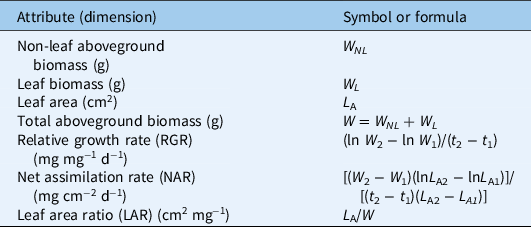
For the growth rate experiments conducted both with and without wheat competition in the glasshouse, growth parameters, including relative growth rate (RGR), net assimilation rate (NAR), and leaf area ratio (LAR), were calculated for each sampling date using the growth analysis equation of Hunt et al. (Reference Hunt, Causton, Shipley and Askew2002):
 $$ {dW \over Wdt} = {dW \over {L_{A}dt}} \times{L_{A} \over W} $$
 $$(RGR) (NAR) (LAR)$$
where t is time, W is total dry weight per plant, and L A is total leaf area per plant. The calculations for the estimated growth variables (Hunt Reference Hunt1982; Poorter and Nagel Reference Poorter and Nagel2000) are described in Table 1. This was followed by one-way ANOVA (completely randomized design) to test whether the early-flowering EF5 population had reduced growth compared with the unselected G0 population. The fixed effects were the populations.
Measured and estimated vegetative plant growth variables for the early flowering–selected (EF5) and unselected (G0) Raphanus raphanistrum populations.

For the outdoor experiment with different levels of wheat competition, linear regression was conducted using time to flower, height of first flower, or aboveground biomass of R. raphanistrum as the dependent variable against wheat density, with the populations as groups. Wheat biomass was also regressed against wheat density, with the two R. raphanistrum populations considered as groups. Lack-of-fit F-tests were used to confirm the suitability of the linear regressions.
Results and Discussion
Early Growth of Flowering Time–Selected Raphanus raphanistrum Populations
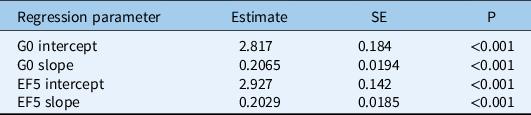
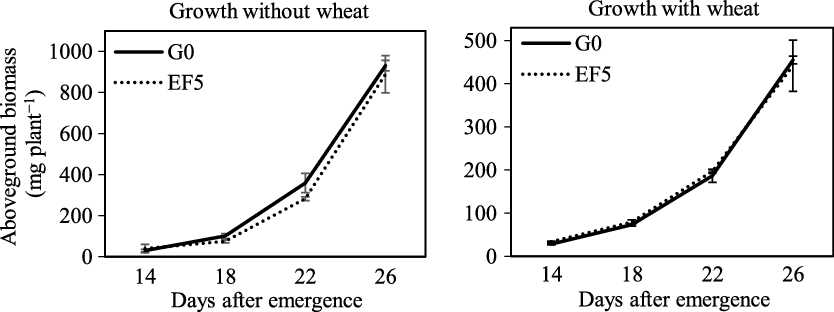
Linear regression of plant biomass (fresh weight) during the seedling stage (up to 14 DAE) indicated that there were no significant differences between the growth rate (slopes) or initial biomass weights (intercepts) of the two flowering time–divergent populations (Table 2). Similarly, at 26 DAE, there were no significant differences in biomass (P > 0.05) between the EF5 and G0 populations when grown with and without wheat competition (200 plants m−2) (Figure 2). Analysis from 14 to 26 DAE showed, as expected, a reduction in the RGR in plants competing with wheat versus plants grown in the absence of competition, regardless of the population (Table 3). The observed reduction in RGR under wheat competition was mainly driven by reductions in NAR (Table 3). However, analysis showed that individuals from both the EF5 and G0 populations exhibited comparable RGR, NAR, and LAR under similar growing conditions (i.e., with or without wheat competition) (Table 3). When measured at 25 DAE without wheat competition, the photosynthesis rate of both the EF5 and G0 populations were similar (22.8 ± 1.9 and 21.0 ± 2.1 μmol CO2 m−2 s−1, respectively, P > 0.05).
Linear regression for fresh weight of Raphanus raphanistrum seedlings for the unselected population G0 and early-flowering population EF5. a

a Plants (n = 6) were grown in MS medium (24/20 C day/night, 12-h photoperiod) and sampled at 3, 9, and 14 d after emergence (DAE). Data were loge(x + 1) transformed.
Changes in aboveground biomass in the early flowering–selected EF5 and unselected G0 Raphanus raphanistrum populations over time, without and with wheat competition between 14 and 26 d after emergence. Vertical bars denote standard errors of the mean of five replicates.

Mean estimates of relative growth rate (RGR), net assimilation rate (NAR), and leaf area ratio (LAR) of the early flowering–selected (EF5) and the unselected (G0) Raphanus raphanistrum populations when grown under temperature- and nitrogen-controlled conditions with and without wheat competition. a

a Growth parameters were estimated between 14 and 26 d after emergence. P-values are from one-way ANOVA on individual traits (values in parentheses denote standard errors of the mean, n = 5).
Effect of Wheat Competition on Raphanus raphanistrum Flowering Time
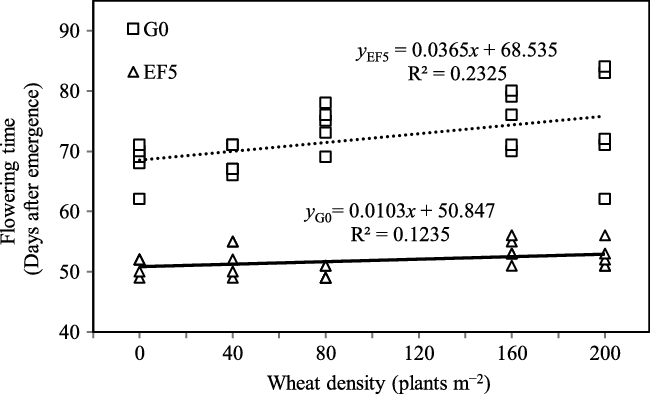
The EF5 population flowered 17 d earlier (P < 0.001) than the G0 population in the absence of wheat competition (Figure 3). However, EF5 and G0 populations were found to respond differently to increasing wheat competition. Increasing wheat density significantly (P = 0.001) delayed flowering time in the G0 (Figure 3). Similar results were also found in other weed species such as common lambsquarters (Chenopodium album L.) and barnyardgrass [Echinochloa crus-galli (L.) P. Beauv.] (Bastiaans and Drenth Reference Bastiaans and Drenth1999). Delayed flowering under increasing wheat competition is expected to compromise seed production and overall fitness of the G0 population, as extended flowering time is unlikely due to proximity of wheat harvest time. However, the EF5 population exhibited no change (P = 0.334) in flowering time when grown under increasing wheat competition. Population EF5 has been shown to have a significant reduction in thermal time requirement for flowering (269 cumulative growing degree days [GDD] for the EF5 compared with 446 cumulative GDD for G0) (Ashworth et al. Reference Ashworth, Walsh, Flower, Vila-Aiub and Powles2016). Thus, early flowering in plants from the EF5 population is associated with a reduced thermal time requirement, regardless of crop competition.
Response of flowering time of the early flowering–selected (EF5) and unselected (G0) Raphanus raphanistrum populations (n = 5) under increasing competition with wheat.

Effect of Wheat Competition on Raphanus raphanistrum Height at Flowering
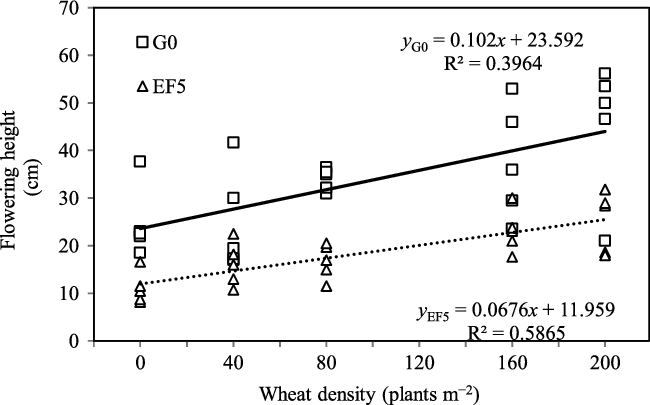
The height of the first flower varied between EF5 and G0 populations (P = 0.002). In the absence of wheat competition, the height of the first flower for the EF5 population was 55% lower (11.1 cm) than that of the G0 population (24.8 cm) (Figure 4). Seed retention height at harvest is vital to the efficacy of HWSC, as it determines how many weed seeds can be potentially intercepted by the harvest operation (Walsh and Powles Reference Walsh and Powles2014). The decreased height of the first flower in the EF5 population compared with the G0 population indicates that the early-flowering adaptation in R. raphanistrum may result in more seeds being located below the practical harvest cutting height of about 15 cm (Walsh and Powles Reference Walsh and Powles2014). As a result, a population adapted for early flowering is more likely to evade HWSC and replenish the soil seedbank.
The mean height at flowering for the early flowering–selected EF5 and the unselected G0 Raphanus raphanistrum populations grown under increasing wheat plant densities (n = 5).

Reductions in PAR due to crop competition result in more erect growth and elongated forms in shade-intolerant annual weeds (Morgan et al. Reference Morgan, Finlayson, Childs, Mullet and Rooney2002; Vandenbussche et al. Reference Vandenbussche, Pierik, Millenaar, Voesenek and Van Der Straeten2005). Under increasing wheat competition, the height of the first flowers increased in a similar manner for both R. raphanistrum populations, as there were no significant differences (P = 0.238) in the slope of the two regression lines for both the G0 and EF5 populations (Figure 4). Specifically, the height of the first flower in the EF5 population changed from being below the average harvest cutting height (15 cm) to being approximately 8 cm above the cutting height when in competition with wheat at ≥160 plants m−2 (Figure 4). This indicates that increasing crop competition using higher wheat seeding rates is likely to increase the height of the lowest pod in the early flowering–time R. raphanistrum population, thereby increasing its susceptibility to HWSC interception. This effect of wheat competition on increasing the seed retention height has previously been demonstrated in rigid ryegrass (Lolium rigidum Gaudin) (Walsh et al. Reference Walsh, Broster, Aves and Powles2018a).
Effect of Wheat Competition on Raphanus raphanistrum Biomass
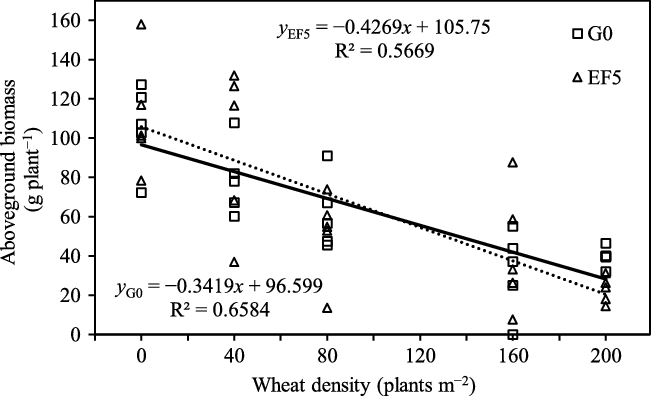
As expected, aboveground vegetative biomass decreased with increasing wheat densities for both the EF5 and G0 populations (P < 0.001). As there were no significant differences between the slopes (P = 0.254) or intercepts (P = 0.401) of the two regression lines, the biomass response to increasing wheat densities was similar between EF5 and G0 populations (Figure 5).
Biomass of the early flowering–selected EF5 and the unselected G0 Raphanus raphanistrum populations at wheat anthesis when grown with increasing wheat plant densities (n = 5).

Previous studies have demonstrated that evolved changes in life-history traits may result in suboptimal reproduction timing or low vegetative growth, which may affect reproductive fitness (Baucom Reference Baucom2019; Vila-Aiub et al. Reference Vila-Aiub, Neve and Powles2009). In annual species like R. raphanistrum, changes in the growth rate and plant size have been shown to correlate positively with changes in fecundity (Campbell and Snow Reference Campbell and Snow2007; Weiner Reference Weiner2004; Weiner et al. Reference Weiner, Campbell, Pino and Echarte2009). However, when grown both with and without wheat competition in the same environment, the EF5 population did not exhibit a reduced growth rate during the vegetative growth stage compared with the G0 population (Table 3), indicating that early-flowering time in R. raphanistrum did not reduce early vegetative competitive ability (Figure 5). Collectively, these results may indicate that there is little fitness cost associated with an early flowering time adaptation in R. raphanistrum.
Ecological Significance and Management of Early-flowering Raphanus raphanistrum
Raphanus raphanistrum has shown sufficient genetic variability for rapid adaptive changes in flowering time (Ashworth et al. Reference Ashworth, Walsh, Flower, Vila-Aiub and Powles2016). Under recurrent selection for early flowering, notable phenotypic changes have been observed. Associated with a decrease in 344 Cd in flowering time thermal requirement, early-flowering plants have been shown to exhibit a prostrate growth form with significant reductions in plant biomass at flowering and height of flowering compared with unselected plants (Ashworth et al. Reference Ashworth, Walsh, Flower, Vila-Aiub and Powles2016).
It has been speculated that these phenotypic changes associated with early-flowering time are likely to compromise overall fitness due to small plant size–based lower fecundity (Ashworth et al. Reference Ashworth, Walsh, Flower, Vila-Aiub and Powles2016). However, plant fitness is always dependent on the environment (Vila-Aiub Reference Vila-Aiub2019), and thus reduced time from germination to flowering can result in an ecological advantage ensuring more time to produce mature viable seed (Yaish et al. Reference Yaish, Colasanti and Rothstein2011) under stressful conditions imposed by climate change (Johansson et al. Reference Johansson, Bolmgren and Jonzén2013), herbicide treatment (Mortimer Reference Mortimer1997), herbivory (Juenger and Bergelson Reference Juenger and Bergelson2000), and application of HWSC (Ashworth et al. Reference Ashworth, Walsh, Flower, Vila-Aiub and Powles2016).
In this contribution, we show that under increasing wheat competition, early flowering in EF5 remains a stable trait contrary to the observed further delay in flowering time in unselected G0 plants. However, as demonstrated here, under wheat competition, increase in the height of flowers in early-flowering plants is evident, and this would enable seed capture and therefore a return to HWSC susceptibility (Walsh et al. Reference Walsh, Broster, Aves and Powles2018a).
However, within the highly genetic variation present in R. raphanistrum, wheat competition and HWSC will select for not only early-flowering time but also lower flower height, seed shattering, and prostrate growth forms in plants with impaired fecundity. The combination of these phenotypic changes will encompass the best survival strategy under recurrent selection of HWSC, which is an undesired outcome for weed management. With this in mind, this study highlights the need for increased attention to be given to weed life cycle adaptations and cropping systems that not only increase herbicide use diversity but also diversify the timing of non-herbicidal weed control tactics.
Acknowledgments
This research was funded by the Australian Herbicide Resistance Initiative (AHRI) and the Grains Research and Development Corporation (GRDC). No conflicts of interest have been declared.