This paper analyses the effects of New Deal commodity market intervention by examining its impact on winter wheat, using Kansas as a case study. In 1930 Kansas was easily ranked first among states for both the quality and value of its winter wheat crop.Footnote 2 The outcome of this pioneering policy which attempted to raise wheat prices will be explored by placing a special emphasis on extensive statistical information available at county level. A reliance on data collected for all 105 Kansas counties is important because it reveals striking variations in farmer reaction to the incentives offered by policy makers which the aggregate figures conceal.
Wheat cultivation was highly mechanised and even during the depression machinery purchases were surprisingly buoyant. There are several studies which analyse the growth and diffusion of tractor ownership during this period, with the work of Sally Clarke being the most relevant to this study.Footnote 3 Clarke, focusing on the Corn Belt, compares the costs of farming with mules and horses with the use of tractors. She concludes that New Deal programmes created an incentive for farmers to purchase tractors by providing them with a cash income (or allotment payments) and by restoring their shattered confidence. The allotment payments which farmers received from the Department of Agriculture were conditional on their agreement to reduce the acreage on which they grew corn.
This paper analyses the effectiveness of the attempt to regulate wheat output and raise prices. It also uniquely examines the role that allotment payments played in persuading farmers to invest in tractors and combined harvester-thresher ownership. Using the county as a unit, the paper offers an explanation for marked regional variations in the adoption of machinery. Finally, the influence of that unpredictable variable, the weather, is scrutinised and the gap between the anticipated and the unanticipated effects of market intervention is emphasised. This case study illustrates the complexity of the farm sector even when the analysis is restricted to a single crop, and the difficulties involved in assessing both New Deal policy inputs and outcomes.

The Background
A full understanding of farm problems, and the response of Kansas growers to them, is impossible without an explanation of the massive expansion of wheat cultivation during the 1920s. United States wheat prices were always heavily influenced by world demand and that was specially the case during World War One.Footnote 4 However, many farmers in the eastern part of the state, who had responded positively to the high war time prices, moved out of wheat cultivation soon after the hostilities ceased. By 1930 the wheat acreage in the three eastern crop reporting districts (see map 1) was less than one third of its postwar peak. In this relatively moist area, cultivators judged that the returns from other crops, most prominently corn, or crop/livestock mixes, were superior to that of wheat. In the central region wheat reigned supreme but it already had such a high presence that a more than marginal increase in acreage was difficult to achieve. Most of the acreage expansion, therefore, came in the west. Between 1920 and 1930 the west central district ploughed under an additional 370,000 acres but the south west trumped this figure with an extra one million acres as short grass country was transformed into new wheat fields (see map 1). During this period there was a noticeable increase in non-resident or suitcase farming. Cultivators from neighbouring states bought cheap land in western Kansas, then ploughed and planted. They were joined by growers from the central and south central Kansas districts who found it impossible to expand acreage in a region already so heavily committed to wheat. By the early 1930s, about thirty per cent of the wheat farms on the most south westerly Kansas counties were operated by farmers who lived elsewhere.Footnote 5
However, growing wheat was not risk free since the proportion of the crop lost, i.e. abandoned, because of disease, insect infestation or, most usually, poor weather, could be considerable.Footnote 6 County data reveal the impact of abandonment, which made its mark differentially across the state. Not only was abandonment more of a threat to western farmers, yields became both lower and more variable as one moved west across the state.Footnote 7 Western growers faced a double risk: high levels of abandonment and relatively poor yields, which characterised the region as agriculturally marginal and therefore highly vulnerable.
The main reason why farming in the west was fraught with risk is simply that the region was so arid. The most important factor determining crop output in Kansas is rainfall which decreases markedly from east to west. On the Missouri border to the east, the annual average precipitation is normally over forty inches; four hundred miles west on the Colorado border only sixteen to eighteen inches falls. The western section is also sunny, elevated and very windy, consequently evaporation is rapid. Where rainfall is less than fifteen inches wheat becomes a vulnerable crop, a difficulty which is present even when the annual rainfall appears sufficient but does not coincide with the growing season. The difficulties of farming in the west were well documented but in spite of the potential problems, an additional 2.4 million acres of Kansas soil was ploughed for wheat during the twenties.Footnote 8 What explains the attraction of wheat growing in the region with the lowest and the most variable yields and where the risk of drought was greatest?
Western farmers acted rationally. The weather restricted the choices available to them and they were convinced that wheat was more economically rewarding than the alternative activity, cattle ranching, which was also affected by aridity. Mechanised farming seemed to offer a good return on investment, especially in the remote west where land once ploughed and planted with wheat rose sharply in value. Furthermore, the twenties was an unusually moist decade and, as a result, abandonment levels were historically low and yields relatively high. Indeed, rainfall was so abundant that many residents became convinced that the Kansas climate had undergone a permanent change, destroying for ever the curse of destabilising drought.Footnote 9 They convinced themselves that rain had followed the plough. In the east, heavier rainfall ensured flexibility and the region's farmers could choose from a variety of livestock and crop options.Footnote 10
Unfortunately some western cultivators were seduced by the apparent advantages of monoculture. Once planted in the fall, winter wheat required no further attention until harvested in June. It was the ideal speculative crop. Cultivators need not even live on the farm on which they raised wheat. On the other hand, mixed farming which incorporated livestock rearing and the cultivation of a range of crops demanded the constant care of the operator and his family. In the west, maximising wheat acreage seemed to make economic sense.
It was foolish of cultivators to assume that the cycle of drought had been broken. The wheat economy in the west was delicately poised and more than one bad harvest would be disastrous for many of the farmers who had heavy machinery and land indebtedness. Furthermore, the soil had been stripped of the sod which had always provided a protective cover and there was a risk of dust storms once drought had rendered the surface unstable. The assault on the short grass plains by mechanised farming, in order to raise a speculative crop, had lured farmers into a dependence on wheat from which there was no escape if the rains failed.
Kansas wheat growing was not merely a story of expansion, it was also one of technological transformation which resulted in the state's farms becoming among the most heavily mechanised in the nation.Footnote 11 The strongest incentive to mechanise was to reduce labour costs especially at harvest time when, for just a few weeks, many thousands of transient hands were required. With a tractor farmers could plant five hundred acres of wheat with just family assistance, far more than was possible with a team of horses.Footnote 12 The problem of how to harvest a large crop was resolved once the combine, drawn by a tractor and with direct power drive from the tractor itself, was introduced in 1926. The combine gave farmers with very large wheat acreages (that is over 500 acres) the greatest cost saving advantages.Footnote 13 Trucks took grain to elevators cheaply and quickly. Operators in the central and south central districts, where wheat was long established, mechanised to reduce costs. Further west the unimproved empty grasslands which were flat, stone free and treeless made ideal combine country. This region, where on average farms were the largest in the state, was furthest from the urban centres which provided many of the harvest hands. Mechanisation was seen as an obvious way of reducing dependence upon the most costly harvest labour in the state. In 1930 the central district had 4,863 combines, the south central 6,707 and the south west 3,329. These were the districts where the commitment to wheat cultivation and to combine ownership was greatest. By contrast, total combine ownership in the three eastern districts was a mere 274.
Combines could cost up to $3,000 and the owner had also to purchase a tractor, and a truck to haul grain to the elevator. It is not surprising that levels of debt were highest in the west where there was a scramble to buy both land and the machinery to break the sod.Footnote 14 Sometimes farmers economised by sharing machinery (custom combining) and suitcase farmers would move equipment between their holdings. However, an indication of how committed western farmers were to mechanisation can be demonstrated by the fact that in 1930 there was one tractor for every six farms in the east but in the west, there was one tractor for every two farms.
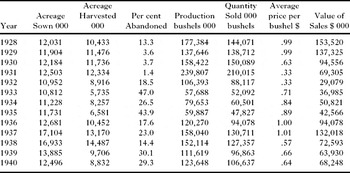
Table 1 shows that between 1928 and 1931 the problem facing producers was the coexistence of very high output and very low prices. Favourable weather had ensured bumper harvests and only a small proportion of the crop was abandoned. Indeed, the 1931 harvest was the largest ever, but the average price per bushel had fallen to only one third of the 1929 level. In 1932 wheat prices remained depressed even though output fell. Abandonment became a particular problem for western growers. Haskell County farmers, for example, planted 159,000 acres in the fall of 1931 but harvested only 48,000 in the following year. Sherman County growers planted 129,000 acres but harvested only 60,000. The increased level of crop abandonment, and relatively low yields per harvested acre provided the first sign of the serious drought which was to become the Dust Bowl and have a profound effect on farming for several years.Footnote 15 As table 1 shows, the value of wheat sales in 1932 reached a particularly low trough.
Kansas winter wheat: 1928–1940

Source: Kansas State Board of Agriculture, (38th Biennual Report 1951–52) 403.
The amount of wheat retained for farm use accounts for the difference between the quantity produced and the quantity sold.
By late 1932 wheat prices had fallen below the cost of production and the onset of drought was causing high levels of abandonment and low yields. Many farmers were in debt to banks or insurance companies, and also to farm machinery suppliers. The depression brought sustained pressure on the complex set of relationships that linked the price of farm products, their costs of production, indebtedness, land values and bank stability.
The New Deal and Wheat
New Dealers gave agriculture a high priority in the drive towards full economic recovery and the Agricultural Adjustment Administration (AAA) was chosen as the vehicle to restore farm purchasing power by establishing a mechanism through which farmers could be persuaded to reduce the acreage that they dedicated to certain ‘basic’ commodities prone to surplus.Footnote 16 The scheme offered to wheat growers was entirely voluntary. However, although farmers were not compelled to participate, Congress hoped that the powerful inducement of substantial cash payments and entitlement to other benefits would persuade the vast majority of producers to do so.Footnote 17 This was not an attempt to directly regulate prices but to do so indirectly through production control.
The aim was one hundred per cent parity for the ‘basic’ products. In other words, farm prices would increase until they achieved the same relationship to non-farm prices that had prevailed during the years 1910–14, which was the base period of the Parity Ratio. Parity would be achieved through a planned reduction in output to a level consistent with domestic demand plus a small surplus for export. Participating farmers would receive ‘allotment’ or ‘benefit’ payments on their 1933, 1934 and 1935 wheat crops if they promised to restrict their acreage for the 1934 and 1935 crops. A plan to plough up growing wheat was abandoned when it was clear that drought had significantly reduced output.
For the 1933 crop year, participating farmers were promised an initial payment of twenty cents per bushel on fifty-four per cent of their average wheat production during the base period, 1930–32.Footnote 18 A second payment of approximately ten cents per bushel of allotment was due in mid 1934. The figure, fifty-four per cent, represented the amount of the marketed wheat crop that would be consumed nationally by people rather than livestock and would be subject to the new processing tax. Initially the AAA called for a wheat acreage reduction of twenty per cent but after taking the effects of drought into account, this was soon reduced to fifteen per cent. In order to receive benefit payments each farmer signed a contract with the AAA agreeing to reduce wheat acreage by fifteen per cent of the 1930–32 average. To meet the costs of the allotment payments, a new tax, set at thirty cents per bushel, was levied on the processing of wheat used for domestic food production.
The ‘free rider’ problem is often a destructive force in any voluntary scheme. Some producers might come to the conclusion that it was in their best interests not to sign a wheat allotment contract. Instead they would strive to increase output in order to take advantage of the rise in prices that the wheat programme was designed to foster. In doing so, they could undermine the entire attempt to raise prices by acreage reduction. Mass participation was essential if the allotment initiative was to succeed and fortunately the early signs were encouraging. By late September 1933, over 51,000 Kansas wheat farmers had signed allotment contracts, more than in any other state.Footnote 19 By February 1934, ninety-one per cent of the Kansas farmland seeded for wheat was covered by allotment contracts.Footnote 20 This gives a clear indication of the enthusiasm with which the state's wheat farmers were willing to sign up for the programme. It was clear, however, that cultivators who had a large proportion of their land in wheat during the base period signed up quickly, while those who were less committed took time over the decision, or did not sign at all.Footnote 21 Moreover, since producers with the largest wheat base received the biggest payments, western cultivators, whose farms were the largest in the state, were heavily in favour of the scheme. Indeed, the significance of wheat cultivation during the base period was the key factor inducing farmers to sign up.Footnote 22 Most farmers had to wait until the beginning of 1934 before they could enjoy this eagerly awaited cash injection but 9,145 lucky growers were able to share $1.3 million in December.Footnote 23 For those who received it, the December payment represented, on average, 19.6 per cent of total income from wheat.Footnote 24 Adjustment payments were, therefore, substantial sums.
Participating farmers received two income streams. First was the adjustment payment which was expressed as the difference between the average price paid to growers for wheat at the start of the marketing year and the parity price. The farmer's wheat allotment was fifty-four per cent of the average production during the base period 1930–32, and for each allotment bushel he received a payment which was the difference between the parity price and the price at which the wheat was sold. The second income stream came from the sale of the wheat crop. It is important to remember that the adjustment payment was not related to the quantity of wheat harvested, or sold. These payments expressed as a proportion of the total income from wheat sales varied considerably across the state. Farmers in western Kansas, where the drought was becoming severe and where abandonment levels were extraordinarily high, could immediately see the advantages of the allotment programme. Imagine a worst case scenario where adverse weather resulted in the total loss of the wheat crop. If the farmer had signed up to the programme, at least he could look forward to an adjustment payment calculated on his base acreage and paid in cash. These sums performed the function of crop insurance and were especially attractive to cultivators most at risk.
The most significant factor that determined the size of the crop in the short term was the weather. A sudden freeze could cause abandonment but it was a combination of drought and wind that had the most devastating effect on wheat harvests, especially if aridity persisted over several years.Footnote 25 As table 1 shows, the eight year period from 1933 to 1940 contains six years when the level of abandonment was over twenty per cent, and two where the figure reached over forty per cent. Between 1933 and 1935, the quantity of Kansas wheat reaching the market was historically low and even steadily rising prices could only push up the total value of sales to no more than one-third of the 1929 level. Table 1 also traces a marked rise in wheat prices from a low of thirty-three cents per bushel in 1932 to around one dollar in 1936 and 1937. In the latter year a savage recession enveloped the entire economy and wheat prices could not escape a dramatic decline from which there was little recovery over the next few years. 1937 stands out as one of massive planting, high output and good prices. How can the dramatic fluctuations in wheat planting be explained? What role, if any, did the domestic allotment programme play in the movement of wheat prices? How significant was the drought of the 1930s in determining wheat output? What does a county study tell us of farmer reaction to the incentives offered to limit their wheat planting? Were there any major unintended consequences arising from this early attempt at commodity regulation?
Not only was 1933 exceptionally hot, it was also one of the driest years the state had ever experienced. 1934 was even worse, as average temperatures broke all records and crops that could be harvested were often of poor quality. Dust storms were becoming increasingly severe. Corn, which was more susceptible than wheat to excessive heat and drought, failed virtually everywhere. A marginal area at the best of times, western Kansas was devastated by a serious rainfall deficiency, especially in 1934 and in 1936. In 1936, blazing sun, continuing drought, dust storms and plagues of grasshoppers ensured despair. However, in spite of all its difficulties, wheat was more drought resistant than any other major crop. An apparent break in the drought during the fall of 1936 encouraged the largest planting of wheat in the state's history and, although abandonment was heavy in western Kansas where the drought continued, the 1937 harvest was the most bountiful since 1931. Fortunately, wheat prices in 1937 were three times as high as they had been after the dismal harvests of 1931 and 1932. Better weather in 1938 also helped improve yields but the decline in prices was a bitter blow to growers, leaving them both deeply frustrated and despondent. Their gloom did not lift in 1939 and 1940.
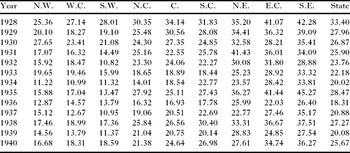
As table 2 shows, the drought was highly selective in its impact. In 1934, one of the worst years, the north west region had 11.22 inches of rain, the west central region 10.99 inches and the south west region 11.32 inches. With such low figures for precipitation it is not surprising that yields suffered badly. In the east, however, the picture was very different. The north east region had 23.57 inches of precipitation, the east central region 28.42 inches and the south east region 33.81 inches. The state average for 1934 was 20.02 inches. In 1936, another disastrous year, the average precipitation for the three western regions was 13.74 inches, the average for the three eastern regions was 24.8 inches and the state average was 18.31 inches.Footnote 26 Even in years of state-wide severe drought, the eastern region had levels of precipitation that would have produced an excellent wheat crop in the west. However, relatively low levels of moisture in the east adversely affected the cultivation of corn, and the crop was almost a total loss.
Annual precipitation in Kansas 1928–1940 (Inches)

Sources: Kansas State Board of Agriculture, 38th Biennial Report (1951–2), 409.
In 1934, three western counties were surveyed by the Bureau of Agricultural Economics. Hodgeman, Meade and Sherman counties were strongly rural and relied heavily on wheat as a cash crop. It was clear that the wheat crop in Hodgeman County was poor. Just to break even farmers needed a yield of ten bushels per acre at a price of seventy cents per bushel but aridity had ensured that for the previous two years the crop had been produced at a loss.Footnote 27 Wheat harvested in 1934 sold at eighty-two cents per bushel, but as the yield was a dismal four bushels for each acre harvested, producer's losses continued.Footnote 28 Local farmers were also in difficulty because they had purchased expensive machinery on credit and were now unable to pay for it. In addition, persistent poor harvests had led to heavy borrowings on chattels, real estate and life insurance policies. A further problem was that sixty-five per cent of county farms were mortgaged.
In good years it had been the practice of Meade County farmers to buy more land rather than keep a cash reserve for lean times; however, since 1930 operators had received no income from wheat with which to pay either taxes, or the interest on their debts and, as a result, some farms had been foreclosed. For the 1934 wheat crop, 212,000 acres were planted of which only sixty per cent was harvested with a crop value of a mere $113,000. A yield of only four bushels per harvested acre spelled disaster for cultivators.Footnote 29 Sherman county farmers, too, had run up high levels of debt in the good times which now hung like a millstone round the necks of cultivators. In the summer of 1933, 151,000 acres of wheat were planted but drought ensured that only 71,000 acres could be harvested. Farm labourers and tenant farmers dominated the county relief rolls but although no owner was in receipt of relief, given the level of debt none was confident about the future.Footnote 30
In December 1933, participating farmers in Hodgeman County received $286,248 for their first wheat allotment payment, which enabled them to purchase food, fuel, feed, seed and pay their taxes. Responses to a state-wide Extension Service questionnaire suggested that approximately forty per cent of the first adjustment payment was devoted to clearing debts, twenty-six per cent was committed for home supplies including food, clothing and repairs to farm and home equipment and twenty-three per cent was earmarked for taxes.Footnote 31 An indication of the significance of this payment to Hodgeman County farmers can be gained if it is compared to relief expenditure at a time when there were great demands on the welfare services. This first payment was greater by $200,000 than all the relief payments in the county from federal, state and private sources between October 1932 and June 1934.
The first wheat allotment payment in Meade County, $334,000, became available for farmers in January 1934 with a further payment of $135,000 due in August. It is interesting to note that some farmers who had signed wheat contracts immediately attempted to rent additional land in order to plough and plant more wheat as a compensation for the acreage they had willingly reduced. Wheat allotment payments to Sherman County contract holders in early 1934 totaled $138,000.
An examination of wheat planting for the 1934, 1935 and 1936 harvest shows that in each of these years Hodgeman and Meade county farmers kept their acreage below the 1930 to 1932 base period. However, Sherman County cultivators exceeded the base period target in 1934, and did so again by a considerable margin in 1936. Obviously, non-participating growers thought that the benefits from extending acreage exceeded the gains that would come following restriction. Farmers who did sign contracts found that substantial cash payments helped to keep them on their farms and off the relief rolls. This was especially true in those parts of the state where the drought had ensured that there was little to harvest. However, both the recipients and New Deal officials were quick to stress that these payments were not relief and should not carry the stigma of charity. Secretary of Agriculture Henry A. Wallace emphasised that the sums simply constituted payments to farmers for agreeing to comply with restrictions that had been introduced to reduce output and raise taxes.Footnote 32 Although the allotment payments usually had a revitalising effect on the local economy, the precise economic impact of this cash injection is impossible to calculate. This problem arises because of the large number of non-resident farmers, particularly in the western Kansas, which ensured that the payments were not always spent in the county to which they were sent. In 1935, for example, thirty per cent of Haskell County (south west) farmers lived in another county. It is a safe to assume that a significant proportion of the $512,000 received by participating growers as wheat allotment payments was spent in other counties.Footnote 33
In June 1935 the Bureau of Agricultural Economics surveyed the provision of rural relief in thirteen Kansas counties. Virtually all had experienced migration from the open countryside to towns and villages as farm labourers and tenants in particular moved to be near relief offices. The drought had lessened the need for farm labour which, in any case, was already under threat from mechanisation. Moreover, hard pressed farmers frequently exchanged work with their neighbours whenever they could in order to economise on paid labour. One of the surveyed counties, Neosho (south east) was in a relatively moist part of the state. However, recent flooding had imposed great hardship on farmers and in June 1935, thirteen farm owners, fifty-five tenants and 167 labourers were amongst those receiving relief.Footnote 34 Recorded levels of precipitation can disguise the fact that cultivators need rain to come in the right quantities and at the right time. Leaving the difficulties of mid 1935 on one side, it is clear that wheat cultivation expanded in Neosho County during the period up to 1936. The base acreage (1930–32) for the county was approximately 24,000 acres but in 1934, 36,000 acres of wheat was planted, in 1935, 39,000 acres and in 1936, 45,000 acres. Clearly in this South Eastern county acreage restriction was not being observed.
The Neosho County example is not an isolated one. Following the adoption of the wheat allotment programme there were sharp regional differences in the fluctuations in wheat planting, as there were also differences in the incidence of abandonment. In the eastern region wheat planting doubled between 1933 and 1935 and doubled again by 1938, followed by a reduction of thirty per cent by 1940. This region enjoyed not only low levels of crop losses but also the highest yields in the state. The fluctuations in the central region were not nearly so dramatic: a slight decrease in acreage between 1932 and 1934 was followed by a surge to a new planting peak in 1937 and 1938. The western district presents a sombre picture of very high levels of abandonment which, for the south west in particular, contrast sharply with the 1920s. Aggregate wheat acreage in the west declined in 1932 and then remained steady until the pronounced increases of 1937 and 1938. High abandonment, poor quality crops and yields so low that they were little in excess of seed requirements took a fearful toll on western farmers, even when the worst of the drought had passed.
During the 1930s, the pressures on Kansas farmers had changed significantly from those of the previous decade. The principal cause was a combination of drought and the searing heat which affected the whole state and restricted the options of farmers who were most in need of flexibility. Corn, for example, was far less drought resistant than wheat. In 1932 and in 1933, about 7.7 million acres of corn were planted; for 1937, and for the following year, the figure had fallen to less than three million. The value of the corn crop had reached $129 million in 1928, but in 1934 and in 1936, years of especially severe drought, producers received around $13 million. The price of feed for hogs rose to crippling levels. How could corn growers minimise their serious losses?
In a nutshell, farmers in the western counties faced serious problems with wheat cultivation but they found that during the drought livestock rearing, or switching to alternative crops was even more problematic. In the east, aridity made corn growing and hog rearing increasingly unsustainable activities but wheat now presented a lifeline. In spite of the drought, wheat yields in the east were relatively high and losses low. Little wonder that eastern farmers expanded their wheat acreage as corn cultivation was such a disaster. Drought encouraged a shift of acreage and farmers in the east returned to wheat cultivation levels which had not been seen since before 1920. They might also have been influenced by the adoption of the wheat allotment programme and hoped, as ‘free riders’, to exploit the scheme.
As a device for restricting output the wheat programme had serious defects. It was entirely voluntary. Any decline in output brought about by acreage reduction could be offset by an increase from non participating growers, or from new entrants who were free to plant as much as they pleased, or by farmers retiring their least fertile land and concentrating their planting on the most productive soil. Although there is some evidence of acreage reduction, as the following examples illustrated on map 1 show, the pattern is very complex. Growers in Barton County (central) planted an annual average of 317,500 acres of wheat in the three years between 1930 and 1932. In 1934 and 1935 the planted area had declined to 277,000 acres, which increased in the following year to 301,000 acres. In Haskell County (south west) an average of 174,600 acres was planted during 1930 to 1932. This figure increased to over 197,000 acres in both 1934 and 1935 before declining to 143,500 for the following year.
By 1936, the north west district was the only one in which growers had reduced wheat acreage, and that by less than four per cent. Taking the west and central regions together, by 1936 the acreage sown to wheat had risen by about two per cent. In sharp contrast, planting in the eastern districts increased by seventy-three per cent, with the largest rise coming in the south east district. Cowley County (south east) farmers planted an average of 44,400 acres in the base period but during the three years 1934 to 1936 planting rose from 55,000 to 97,400 acres. In Morris County (north east), optimistic growers increased acreage from a base period average of 24,000 to 41,400 in 1936. These examples are quite typical of what was happening to wheat cultivation during the first AAA. As one farm leader astutely observed:
We have all heard of pulling white rabbits out of a hat. Here is one of them. The Kansas farmer has accomplished the miracle of conforming to a program of benefit payments and reduced acreage, and simultaneously increased seeding over five million acres.Footnote 35
Any analysis of agricultural income in Kansas during the 1930s must heed the significance both of yields and of wheat payments. The 180,000 acres planted in Haskell County (south west) produced a crop in the bumper year of 1930, worth $1.1 million. The 143,000 acres planted for the 1936 crop in this drought stricken county realised a mere $181,000. Fortunately, in 1936 participating Haskell County farmers shared $584,000 in wheat allotment payments. These payments, which in some years exceeded the value of the wheat crop, were crucial to farmers in the west. In sharp contrast, the 97,000 acres planted for the 1936 crop in Cowley County (south east) was valued at $1.5 million. Only a few farmers participated in the wheat allotment scheme which brought a mere $73,000 to the county. Since all eastern counties had relatively high yields, each harvested acre produced more bushels of wheat and hence a more valuable crop than farms in the west.
In the most arid regions, where large scale wheat farming had predominated during the 1920s, allotment payments ensured survival. In 1937, for example, the average yield from farms in the south west and west central districts was just over four bushels per acre. In the north east and east central areas, however, the average yield was eighteen bushels per acre. In the eastern districts, wheat allotment payments were not a significant proportion of farm income; in this region the value of the crop was of prime importance. It must be emphasised that wheat prices for 1934–37 inclusive were attractive. If these prices are expressed in real rather than in nominal terms the average for these four harvests is almost identical with the average real price for 1924–29. To take advantage of these favourable prices, however, the farmer had to be able to harvest a crop; many in the western part of the state could not.
H.L. Stewart's detailed analysis of the impact of the AAA programmes on south-west Kansas showed that the biggest gainers were the large scale operators, some of whom were able to increase the size of their holdings at the expense of the small. Between 1933 and 1936, the payments received by those he interviewed averaged $165 per farmer per year on farms with less than three hundred crop acres but $1,264 on farms with nine hundred or more crop acres. This distribution helps explain why the largest decline in Kansas farm property values occurred on the smallest holdings. These crop subsidies were not like relief payments which were means tested and went only to those who had exhausted all means of support. They were available to all participating farmers regardless of financial circumstances. In a convincing argument, Stewart maintains that production control payments prevented the insolvency of big operators, made possible a continuing market in land and provided a flow of working capital. Even though land values declined precipitously in the south west during the thirties, without AAA payments the fall would have been even more pronounced.Footnote 36 Thanks to government assistance, farmers found it possible to maintain their homes and to operate farms at a time when their income was sometimes close to zero. They had little incentive to acquire machinery, however, and there was a marked reduction in the quantity and the quality of capital goods in the south west district.Footnote 37 Unfortunately, the drought made it impossible for farmers to reorganise their businesses and diversify into other crops, a move some commentators had heralded as one of the great advantages of allotment payments.Footnote 38
In January 1936, the Supreme Court declared the AAA unconstitutional. To replace it Congress passed the Soil Conservation and Domestic Allotment Act (SCDAA) which emphasised soil conserving techniques and relaxed attempts at acreage restriction as drought had removed the wheat surplus. Indeed, during 1936 the United States became the fourth largest wheat importer in the world. The result of improved prices and the slackening of acreage controls was a great surge of planting, since benefit payments could be earned by observing approved soil conservation practices while ignoring pleas from the Department of Agriculture for restraint.
The high levels of production in 1937 and in 1938 were a combination of a large acreage and the return of relatively moist conditions. Indeed, the 1937 wheat harvest was by far the most financially rewarding crop of the 1930s to the eastern districts where farmers who were not yet convinced that the alternatives to wheat were risk free. Congress, perturbed by the expansion in planting across the nation and keen to reduce it, reacted by passing a new AAA in 1938.Footnote 39 Following this new legislation, Kansas received the largest wheat allotment of any state, but to comply with this 12.5 million acre target farmers would have to reduce planting by about five million acres from the average levels of 1936 and 1937. Wheat farmers who agreed to participate in this scheme received Commodity Credit Corporation nonrecourse loans, conservation payments and parity payments, but in return they had to observe new acreage allotments. These were calculated for individual farms based on the average seeding for wheat over the preceding ten years. Such a lengthy base period penalised eastern farmers whose devotion to wheat cultivation was recent and whose farmers faced a greater proportionate acreage contraction to comply with the new legislation. Moreover, there was now the threat of compulsion. If the Secretary of Agriculture considered production was too high, marketing quotas could be imposed if they had been approved in a referendum. Since the 1938 crop had already been planted when the AAA became law, its impact was not felt until the following year. A significant acreage reduction ensured that the marketing quotas, and their attendant penalties for excess production, were not invoked during 1939 and 1940.
The 1938 legislation caused a considerable degree of bitterness on the part of eastern farmers who felt that it unfairly penalised them and benefited the large wheat producers to the west. They also resented the attempt by the Department of Agriculture to force traditional corn counties to return to the cultivation of that crop, especially as their recently purchased machinery was suitable only for wheat.Footnote 40 Even though there was a great deal of antagonism between farmers in different parts of the state, the acreage reductions which are so apparent in 1939 and 1940 were experienced in every region. Although the sought after acreage reductions had been achieved, the Kansas wheat economy closed the decade in an extremely depressed state as low prices ensured a poor return. It could be argued, however, that without the wheat programmes introduced in 1938, prices would have plunged to even more depressing levels. Perhaps regulation did modify the impact of the 1937–38 depression but it is difficult to say by how much.Footnote 41
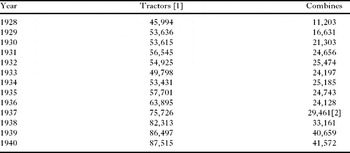
Tractors and Combines
Table 3 shows that between 1931 and 1940 the number of tractors on Kansas farms rose by 30,970; during the same period, combine-harvester numbers increased by nearly 17,000. As most of the state's farmers faced extremely difficult circumstances throughout the 1930s, this considerable investment in farm machinery calls for an explanation. Any analysis must note that the annual census organised by the State Board of Agriculture which records tractors and combines on farms was taken on 1st March each year. It is safe to assume that practically all new combines had been purchased in order to harvest the previous year's wheat crop.
Tractors and combines on Kansas farms
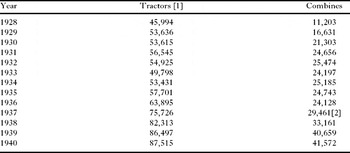
Source: Various issues if Biennial Report of Kansas State Board of Agriculture.
[1] Compared with the returns shown in the 16th Census of the US (1940) Agriculture, Vol. 1, State Reports, Kansas Table 11, p. 713, this source consistently under-reports the number of tractors on farms. The Census figures are: 1930: 66,275; 1940: 95,139. Combine numbers are not recorded in the Census. Numbers for tractors and combines as on 1 March each year.
[2] From 1937 the numbers of combines and threshing separators are aggregated. I have subtracted 5,000 from each total, which is a safe estimate for the number of threshers. See P. Reitz and E.G. Heyne ‘Wheat Planting and Wheat Improvements in Kansas’, Kansas State Board of Agriculture, 33rd Biennial Report, 1941–42, Table 2, p. 170.
Making use of the county data on machinery ownership reveals some interesting local fluctuations that are disguised by the aggregate numbers. In the north east district the number of tractors declined steeply after 1931 but then underwent a sustained rise from 1935 until the end of our period. Numbers more than doubled between 1931 and 1937; they had nearly tripled by 1940. East central Kansas also saw a decline in tractor ownership between 1931 and 1933, but from that point there was an increase each year until 1940. The rise between 1931 and 1940 in this region was two and a half fold. The pattern of ownership in the south east was very similar. From 1931 to 1933 there was a decline but from that trough there was a sustained rise to peak in 1939 by which time numbers had more than tripled.
An examination of tractor ownership in the sub-divisions of the central region shows a modest decline after 1931, followed by growth from 1934. By the end of the decade in the central and south central regions, which were the most heavily mechanised in the state, tractor numbers had risen by about fifty per cent. The north central district experienced more vigorous growth and, as a result, by 1940 the number of tractors had approximately doubled. The most sluggish movement in tractor purchases can be seen in the west. There was an increase of about one-third in the north west between 1932 and 1940; in the west central district there was a slightly more modest growth during the same period. However, in the south west district, where drought was at its most severe, the number of tractors was almost exactly the same in 1940 as it had been in 1931.
Farmers in the eastern part of the state were the most active purchasers of combines. In 1930 there were fewer than three hundred combines in this region but by 1940 numbers had swollen to about 8,850, a figure which represented half the increase in the state as a whole. Growth was a feature in every eastern sub-division, but it was especially rapid from 1937, a year when the wheat crop was especially valuable. The pattern in the central regions was very similar; numbers held fairly steady between 1932 and 1936 and then increased. The western region as a whole saw a marginal decline in combine numbers between 1932 and 1940. However, the region's position is heavily influenced by the drought ridden south west. Of seventy-nine enterprises studied in the district, half of the tractors and three quarters of the combines recorded in 1931 were still on farms in 1937. By 1940 the number of combines had actually declined by nearly twenty per cent.Footnote 42
Farmers in the east were fully aware of the advantages which wheat growers in other parts of the state had secured from mechanisation. Moreover, the pressure to substitute man and horse power with machines was acute for them during the 1930s. Drought conditions had increased the price of foodstuffs making the horse more expensive and the intense heat often made it impossible to work draft animals for long hours. The number of horses and mules working on Kansas farms, which had been in decline for some time, fell by over fifty per cent during the 1930s.Footnote 43 Acreage that had previously been dedicated to the production of oats for feed could now be switched for other use, which would include growing more wheat.Footnote 44
In spite of continuing high unemployment labour was not cheap, as can be seen from a series which provides daily farm wage rates with board for 1st July each year from 1929.Footnote 45 Daily wages, which had reached $2.65 in 1929, tumbled to $1.05 in 1933 and then they climbed steadily, then more steeply, to a thirties peak of $1.90 in 1937. The rapid rise of money wages in 1936 and 1937 is particularly marked, although from 1937 wages declined, and by 1940 the daily rate had reached $1.55. If this series is deflated it is clear that the average real wage from 1936 to 1940 was twenty-five per cent higher than the average for the years 1931–35. An index of annual average Kansas farm wage rates (1910–14 = 100) shows rates rising from a trough of 88 in 1933 to a peak of 138 in 1937. Surprisingly, this calculation shows that the 1937–8 recession, which had a powerful deflationary effect on farm prices, had only a marginal impact on farm wage rates.Footnote 46 Although neither nominal nor real rates reached the levels of 1929 or 1930, the increases during the middle and late thirties must have acted as a powerful stimulus persuading farmers to mechanise.
Any explanation of mechanisation must stress the importance of the introduction, in 1930, of the small combine-harvester operated by power take-off from an all-purpose tractor. In central and western regions wheat growers used combines ranging from ten to sixteen feet which were too large for most eastern farms. With the introduction of a combine having a five foot cut, the way was open for mechanisation by eastern growers, who generally had smaller farms than westerners, and they seized the opportunity.Footnote 47 Decisions taken to increase wheat acreage at a time when labour costs and animal power costs were rising, and when a new small combine was available, explain the incentive to mechanise eastern farms. In central Kansas, a combination of government price support payments and the lack of alternatives to wheat were sufficient to persuade farmers to plant and to mechanise. This seemed a sensible policy when the rains returned in 1937. But for farmers in the south-west, which became part of the ‘Dust Bowl’, the outlook was persistently bleak.Footnote 48
An analysis of combine numbers in the counties selected as representative of their region gives a clear indication of the changes in wheat growing in Kansas. The data present some difficulty because, starting in 1937, the annual State Board of Agriculture census adds together combine and threshing separator numbers instead of treating them as distinct entities. However, taking into account the number of threshing separators on farms before 1937 it is possible to provide a reasonable estimate of combine numbers after that date. Barton County, in the heart of wheat country, had 959 combines in 1933, a figure which had risen modestly to just over one thousand in 1938 and to slightly more in 1939. In Morris County, the growth in combine ownership for these years was striking: from twenty-three in 1933, to over 160 in 1938, and about 190 in 1939. Cowley County also experienced a steep increase: the rise from sixty-six in 1933 to three hundred in 1938 and to over four hundred in 1939 is very impressive. It is evident that the new wheat farmers spearheaded the drive to investment in power machinery during the 1930s. These farmers did not rely on allotment payments to fund their machinery purchases as very few participated in the programme.
Conclusion
The New Deal ushered in a period of unprecedented public spending and the farm programme was one of the most costly Congressional initiatives. In the four years 1933 to 1936 the combined value of Kansas wheat sales amounted to $151,000 million. During the same period, cultivators who had signed up to the wheat programme received approximately $92 million in allotment payments. To put this sum in perspective, the total amount of federal funding for the CWA and FERA Emergency Work Relief projects in Kansas between November 1933 and early 1936 was $38.7 million.Footnote 49 The significance of allotment payments cannot be appreciated by merely taking note of the total amount. Farmers who had planted all the wheat that they could in the 1930–32 base period stood to gain most from this programme and the maximum benefits went to owners who operated large farms. In the drought savaged south west, where large holdings were the norm, cultivators with little or no crop to harvest at least received a cash income (for some, a substantial cash income) if they had agreed to join the programme.
Pamela Riney-Kehrberg found that in the sixteen southwestern Kansas counties that she studied, the average value of crops per farm per year between 1933 and 1940 was $1,664. During this period the average federal benefit payment per year was $674. This might seem a generous payout to a region that was not amongst the nation's most poverty stricken. However, Riney-Kehrberg is correct in drawing our attention to the high costs of farming in the area, especially if one includes the expenses incurred in controlling blowing soil. Farm incomes, further compromised as attempts by families to raise their own food were foiled by the weather, failed to meet the costs of production.Footnote 50
The objective of acreage restriction was not merely to raise the price of wheat but to increase the farmer's return to one hundred per cent parity. Unfortunately, although Kansas farm prices were systematically recorded at this time, details on farmer's expenditure were not. An index of the prices that Kansas farmers received for food grains (1910–14 = 100) moved from 115 in 1929, to a trough of thirty-nine recorded in 1932, and from that low point to a peak of 126 in 1937. The impact of the 1937–8 depression was serious for growers and the index slid to seventy-seven in 1938 and to seventy-four a year later. Did acreage allotment cause the significant rise in wheat prices that occurred during 1933–7? The answer is a resounding no. In the first place, wheat prices were strongly influenced by international markets and were not determined by fluctuations in the Kansas crop. Furthermore, acreage restrictions were not observed. The widespread national drought caused a sharp reduction in wheat output and encouraged a price rise. When the rains returned, so did bumper crops and low prices. Indeed, for a while the drought had disguised the fact that wheat output had a tendency to surplus which had not been brought under control.
New Deal farm policies helped to deliver a political dividend. In 1936, the Governor of Kansas, Alf Landon, was Roosevelt's Republican opponent for the White House. Even though the Kansan favoured generous federal assistance to farmers he not only lost his own state, he also failed to hold his own county. Wheat allotment payments helped swing Kansas farmers to the Democrat standard in 1936 but there were other aspects of the all-embracing agricultural and relief programmes that were attractive to them. These included the devaluation of the dollar, international marketing deals to assist exporters, bank stability, the purchase of drought stricken cattle by the federal government, the provision of loans for the purchase of seeds and feed, assistance with refinancing debts via the Farm Credit Administration, and the opportunity of work relief under the auspices of the Federal Emergency Relief Administration, the Civil Works Administration and the Works Progress Administration. All these initiatives assisted farmers but none explains the diffusion of both tractors and combines during this troubled decade.
Paradoxically, wheat growers who did not sign allotment contracts could see benefits from the 1933 and 1936 schemes. The fact that participation was entirely voluntary enabled, indeed encouraged, new entrants to grow wheat. They relied entirely on the income from their crop whilst participants received both allotment payments and the return from whatever they could harvest. As a result, the income flowing into Kansas was greater than it would have been if the scheme had been more restrictive. To this unanticipated benefit we can add another. The expansion of wheat planting had a favourable impact on the depressed farm machinery sector. Purchases of combines and tractors created much needed jobs in factories and sales rooms. Machinery purchases in the eastern districts were not reliant on income from wheat allotment payments. However, in the central, but especially the west, allotment payments were a high proportion of farm income. AAA regulation, and the cash that went with it, could well have provided participating farmers, especially in the central districts, with the crucial financial base from which the machinery drive was launched.Footnote 51
This paper also highlights the importance of disaggregating state data. The changes in wheat planting, for example, are revealed as far more dramatic if intra-state comparisons are made. These complexities also reveal the difficulties facing policy makers in creating and implementing commodity regulation. The advantages of using county figures as a basis for understanding and analysing are clearly demonstrated. The impact of the weather, the implementation of agricultural programmes, the rationale behind power machinery purchases, and the consideration of alternative planting strategies are all vital for our comprehension of farmers’ response to policy, which can only be fully understood if historians are prepared to explore the local variations.