Introduction
India has a unique amalgamation of geographically distinct, six breeds of horses namely Marwari, Kathiawari, Bhutia, Spiti, Manipuri and Zanskari registered by the Indian National Bureau of Animal Genetic Resources (Kaura, Reference Kaura and Kaura1961; Singhvi, Reference Singhvi2001; Yadav, Ghei and Tandon, Reference Yadav, Ghei and Tandon2001; Anonymous, 2008; Singh, Pal and Gupta, Reference Singh, Pal and Gupta2009, 2010; Gupta, Reference Gupta2010). Kathiawari and Marwari are the horses of North-western plain region (Kachhiapatel, Reference Kachhiapatel2010), Spiti and Zanskari of high altitude temperate areas of the Northern Himalayan hills, while Bhutia and Manipuri of Eastern region. These area-specific horses are well adapted to different agro-climatic zones in India in their home tracts and have acquired certain unique characteristics which make them suitable to that particular zone. During the last five decades, overall population of the horses and animals true to breed in particular have decreased at an alarming rate due to indiscriminate breeding, poor availability of good quality stallions, their decreased demand and utility as well as poor health and management. Some of the equine breeds namely Zanskari, Manipuri, Bhutia and Spiti breeds are now endangered, as their populations are very limited (Gupta, Pal and Tandon, Reference Gupta, Pal and Tandon2010; http://ahdhp.nic.in/chamurthi.pdf, Animal Husbandry Department, Arunachal Pradesh, http://www.e-pao.net/GP.asp?src=23..221011.oct11). Kathiawari breed also has been considered as an endangered breed as its population is <10 000 (Kachhiapatel, Reference Kachhiapatel2010). This has recently attracted the attention of the government institutions and stakeholders to adopt a strategic breeding plan and to conserve these breeds, as future requirement of these precious genetic resources is not known. Selection of true to breed stallions and mares on the basis of their phenotypic characteristics is quite important in the above endeavour.
Most of the early information on phenotypic characterization is confined mainly to Marwari, Kathiawari and Spiti breeds (Pundir et al., Reference Pundir, Vij, Shukla, Vyas, Bhavsar and Nivasarkar1997; Pundir, Reference Pundir2001, Reference Pundir2004; Singh, Yadav and Mehta, Reference Singh, Yadav and Mehta2002a, Reference Singh, Yadav and Mehtab). Further detailed studies on high-quality phenotypes can also give direct insight into genetic quality of these highly structured populations. In the present genomic era, it is feasible to work on genotyping and sequencing with available robust tools and softwares; however, morphological studies require direct involvement with the animals including identification of animals true to breed and extensive work to record their phenotypic characteristics. The data generated will be helpful in correlating phenotypic traits with genetic parameters responsible for these complex traits. Many breed registries select animals on the basis of their morphology/utility/functions and work for the continuous improvement of those selected animals. Body shape, size and conformation are some of the pointers of utmost importance for selection of horses for breeding purposes. The acquisition of high-quality true to breed animals will be highly valuable as the future requirement of this animal power is not known.
The present study is an effort to phenotypically characterize all the Indian equine breeds together based on their different biometric indices and specific breed characters for selection and conservation of stallions and mares for breeding purpose by private breeders, to help the government departments to maintain good quality stallions for semen collection for artificial insemination (AI), and to facilitate their multiple uses by the horse owners viz in sale and purchase, for use as pack and transport animals as well as for the socio-economic development of their owners.
Materials and methods
Animals
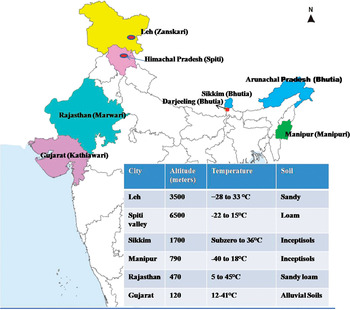
Fifty adults at 3–6 years old, healthy, unrelated and true to breed equines of all the six breeds registered by the Indian National Bureau of Animal Genetic Resources (NBAGR) of the Indian Council of Agricultural Research (ICAR), Karnal, India (Table 1), except Bhutia (35), were selected on the basis of their morphological features in their home tracts from different parts of India. The selected animals either belonged to the government organizations or private equine breeders maintaining the animals for breeding purpose. Kathiawari equines were selected from the state government equine farms at Junagadh and Inaz, Police horses with Junagadh, Rajkot, Sundranagar as well as some private breeders in different parts of Kathiawar (Gujarat); Marwari equines from private breeders of Jodhpur, Pali, Marwar, Udaipur, Dundlod, Nawalgarh, Jalore, Nagore, Bikaner and Pushkar (Ajmer) in Rajasthan; Manipuri equines from Manipur Polo and Riding Club as well as from private breeders of nearby area in Imphal, Manipur; Zanskari horses from the two government farms namely Zanskari Equine Breeding Farm, Chuchot and Russian Marino Sheep Breeding Farm, Mathoo (Leh) and from private equine breeders of Zanskar valley, Ladakh; Bhutia equines from different local areas including Yumthang and Katao in Lachung, ITBP camps both at Dambong and Chunthang in Sikkim; and Spiti horses from the government livestock farm at Lari (Kaza) and private equine breeders from Lahaul and Spiti valley in Himachal Pradesh. Breeding tracts of all these breeds are presented in Figure 1. Efforts were made to select animals from different parts of their home tract to include adequate representatives of the breed. For phenotypic characterization, both biometric indices and some of the salient qualitative morphological characteristics of the breeds were recorded.
Home tract of indigenous equine breeds in India.

Registration number of horse and pony breeds of India.

The above breeds of horse have been registered by National Bureau of Animal Genetics and Breeding (NBAGR), India (Anonymous, 2008).
Biometric indices and breed characteristics
Fifteen biometric indices were recorded for phenotypic characterization of each breed viz., height at wither (HW), body length (BL), heart girth (HG), face length (FL), face width (FW), ear length (EL), ear width (EW), hoof length (HoL), hoof width (HoW), fore leg length (FLL), hind leg length (HLL), height at knee (HK), height at hock (HH), canon and pole. Animals of both sexes were included in this study. Coat colour, texture of hairs and the age of individual equine were also recorded. Besides these data, good quality photographs were also taken along with typical breed characteristics for their documentation.
Statistical analysis
Physical characteristics and coat colour were expressed in percentage/frequency. Data on different body measurements was analysed by using standard statistical SPSS package (SPSS Inc., 1998).
Results and discussion
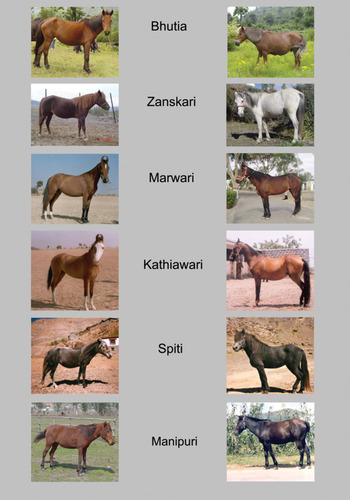
All the six breeds are well acclimatized to their geographical conditions over generations and have acquired certain unique traits such as stamina, sturdiness, endurance, adaptability to harsh climatic conditions, their speed, sure footedness, load carrying capacity on steep and narrow hilly terrains, disease resistance etc. This is the first report on the comparative phenotypic characteristics of all these registered equine breeds together based on their biometric indices and specific breed characteristics. Some of the representative animals of each breed are presented in Figure 2.
Representative animals of all the six equine breeds in India.

Marwari horses are quite heavy, smart, nice looking, tall, fast moving with high endurance capacity and thrive in sandy Thar desert (Rajasthan) where temperature is as high as 48–50 °C during summer but as low as −3 °C during winter. Kathiawari horses are also smart, good looking, hardy and sure footed, suitable for traversing the stony, rough and broken countryside in Kathiawar region, Gujarat. Similar observations to some extent have also been reported by Kachhiapatel (Reference Kachhiapatel2010) and Zala (Reference Zala2010). Zanskari and Spiti horses belong to the Northern Himalayan terrains having cold climate and mountainous regions termed as cold desert. These breeds are quite adapted to very low temperature conditions (−20 to −40 °C) with low feed and fodder availability. Both breeds are slow moving but surefooted on difficult and steep terrains. They are very hard working animals with high stamina. Zanskari horses very seldom fall sick due probably to the neat and clean environment. Manipuri and Bhutia equines are also extremely tough, quick mover, sure-footed with high pack load and placid capable of extreme endurance.
Biometric characteristics
Comparison of biometric indices in different indigenous breeds
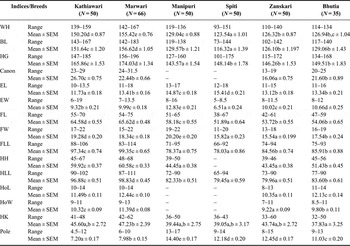
Ranges and mean values of the 15 biometric indices along with standard error of mean of all the six indigenous equine breeds are presented in Table 2. Out of the six indigenous equine breeds, Marwari and Kathiawari had mean HW equivalent to 150 cm or more while equines of Manipuri (129 cm), Spiti (124 cm), Zanskari (126 cm) and Bhutia (127 cm) breeds had their mean HW less than 150 cm. HW is an important biometric index mainly for categorizing equines under horse or pony category. Horses less than 150 cm are grouped under pony category and those above 150 cm are considered as horses, while the International Federation for Equestrian Sports defines the official cut-off point at 148 cm without shoes and 149 cm with shoes (http://en.wikipedia.org/wiki/Pony). Among all the indigenous equine breeds studied, horses of both Marwari and Kathiawari breeds were around 150 cm or more in height and as such come under ‘horse’ breeds, while Zanskari, Spiti, Manipuri and Bhutia equids fall under ‘pony’ breeds. It was quite interesting to record that the average HW of the Kathiawari horses was around or less than 150 cm. If suitable breeding measures are not taken by the Gujarat Government or concerned breeders, this breed may be reclassified as a pony breed. Among both horse breeds, Marwari horses were significantly higher than Kathiawari horses. Singh, Yadav and Mehta (Reference Singh, Yadav and Mehta2002a, Reference Singh, Yadav and Mehtab) pointed out a lower HW of Kathiawari horses than that of Marwari horses, while Zala (Reference Zala2010) also described Kathiawari as a pony breed. Further, it was interesting to note that among all these breeds, animals of Marwari and Spiti breeds were observed to be significantly (P < 0.05) the tallest and the shortest, respectively.
Range, mean and standard error of mean (SEM) values of different biometric indices in Indian equine breeds (values in cm).

Different alphabets given along with numerical values indicate significant (P < 0.05) differences between breeds in each row. – not recorded.
Similar to HW, a very similar pattern was observed in the BL of all these breeds. Differences in HG were also significant (P < 0.05) between Kathiawari and Marwari breeds. HGs in Spiti, Zanskari and Bhutia animals were not significantly different from each other but they were significantly (P < 0.05) higher than that in Manipuri equines. Canon length of Kathiawari equids was significantly (P < 0.05) higher than that of Marwari, Zanskari and Bhutia breeds while Bhutia ponies had a longer canon than Zanskari ponies. Some of the features reported are in agreement with earlier observations (Pundir et al., Reference Pundir, Vij, Shukla, Vyas, Bhavsar and Nivasarkar1997; Pundir, Reference Pundir2001; Singh, Yadav and Mehta, Reference Singh, Yadav and Mehta2002a, Reference Singh, Yadav and Mehtab).
EL and EW were recorded to be maximum and significantly (P > 0.05) higher in Spiti and Manipuri ponies than in the other four breeds. Further, EW of Spiti ponies was significantly (P < 0.05) the lowest compared with other horse and pony breeds. Among Kathiawari and Marwari horses, both these indices were significantly (P < 0.05) higher in Marwari animals.
FL is an important feature depicting animal grace. It also varied significantly (P < 0.05) among the breeds with a minimum in Spiti ponies and a maximum in Kathiawari animals. FLs of Kathiawari and Marwari animals were almost at par but FW was significantly (P < 0.05) higher in the former than in the latter, indicating that face of Kathiawari horse is broader than Marwari horse. However, face of Manipuri ponies was the broadest among these breeds.
Both FLL and HLL were significantly (P < 0.05) higher in Marwari animals, but the lowest values were detected in Spiti ponies compared with other breeds. Similar to leg length, HH and knee height were maximum and significantly higher in Marwari animals than pony breeds. The HoL was observed to be maximum and significantly (P < 0.05) higher in both Marwari and Bhutia equines than in the remaining four breeds. However, the HoW was maximum and significantly (P < 0.05) higher in Marwari animals than pony breeds. Among all the breeds, pole (gap between ears) was significantly (P < 0.05) the lowest in the animals of Kathiawari breeds compared with other breeds. Maximum pole was observed in Manipuri breed.
Coat colour
Different coat colours were observed in all true to breed animals selected for this study irrespective of their sexes. In Marwari horses, bay (56 percent), chestnut (18 percent), grey (14 percent) and pie/skewbald (12 percent) were the prominent colours, while in Kathiawari, chestnut (40 percent) was the most prominent colour followed by bay (38 percent), grey (16 percent) and pie/skew bald (6 percent). In Spiti ponies, common coat colours were grey (32 percent), brown (28 percent), piebald (22 percent) and black (18 percent). In Spiti ponies, animals having black body with white patches were taken as piebald. In Zanskari ponies, grey was the most prominent coat colour (54 percent) followed by bay (26 percent) and black (20 percent). In Bhutia ponies, bay was the most common colour (69 percent) followed by chestnut (23 percent), grey and other colours (8 percent). In Manipuri breed, bay, chestnut, brown, grey and cream were quite common, but black and roan were extremely rare. Beside these, other colours (local names) such as palomino, cream, dun and pinto were also available.
In general, no particular colour trend was observed in animals of both sexes in all the breeds. Colour varies from region to region depending on breeder's choice. Some more information on other coat colours also has been given under breed characteristics.
Comparative biometric indices in mares and stallions of different equine breeds
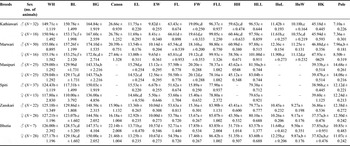
Sex-wise evaluation of biometric indices in all six breeds indicated significant differences between and within some of the breeds (Table 3).
Sex-wise comparative mean values of various biometric indices in Indian equine breeds (values in cm ± SEM).

Different alphabets given along with numerical values indicate significant (P < 0.05) differences due to breed and sex.
SEM = standard error of mean
Both mares and stallions of Kathiawari and Marwari breeds were at par as far as HW was concerned. Spiti stallions (117.80 cm) were observed to be significantly (P < 0.05) the smallest compared with its mares and both sexes of other breeds. Similarly BL of Spiti stallions was significantly (P < 0.05) the smallest compared with its mares and both sexes of other breeds. Between the two horse breeds, Marwari mares were significantly (P < 0.05) higher in their BL than Kathiawari mares but no such difference was observed between their stallions. Further, BLs of Spiti and Zanskari mares were significantly (P < 0.05) higher than that of their stallions. HG of Spiti stallions was significantly (P < 0.05) lower than that of its mares. However, no such difference was observed between both sexes within other breeds.
The FLs of mares and stallions were at par within the breeds except Kathiawari horses in which FL of stallions was significantly (P < 0.05) higher than that of its mares. Among breeds, FL of Spiti mares was the smallest, while Manipuri mares and stallions had significantly (P < 0.05) higher FLs than both sexes of Zanskari, Bhutia and Spiti ponies but lower than that of Kathiawari and Marwari horses. FW also varied appreciably among all the breeds with a maximum in Manipuri mares and a minimum in Spiti stallions but no difference was observed between sexes within the breeds. EL was significantly (P < 0.05) lower only in Spiti stallions than its mares, while no such difference was observed between sexes within other breeds. EWs of both Kathiawari and Spiti stallions were significantly (P < 0.05) smaller than that of their mares, otherwise no such difference was observed between sexes within other breeds.
There was no significant difference in FLL and HLL between sexes of all the breeds except Marwari, in which HLL was significantly (P < 0.05) longer in stallions than mares. HH and canon length in Marwari mares were significantly (P < 0.05) higher than that in both sexes of other breeds but lower than its stallions. No difference was observed in both these traits between mares and stallions within other breeds. Similarly, no difference was observed in HoL, HoW and pole between mares and stallions within all the six breeds.
On the basis of all these biometric indices, Spiti pony appeared to be the smallest, while Marwari horse to be the robust among all the Indian horse and pony breeds. To date, little information is available on such aspects and these data will serve as a baseline data for future selection of animals for breeding purpose.
Breed characteristics of Indian horse and pony breeds
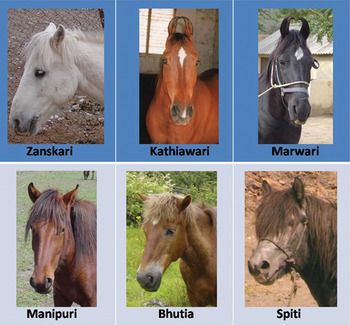
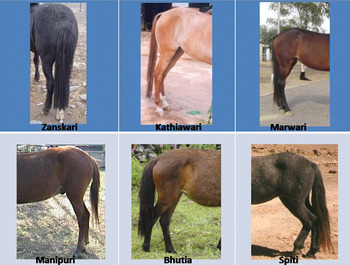
Every breed has its own typical characteristics which are unique to some extent for its identification and differentiation from other similar type of breeding animals. Some characters may be common or near about, indicating similarities among those breeds which can be solved by their evolutionary studies. Figures 3 and 4 present some of the salient characteristics of each breed.
Faces of Indian equine breeds showing typical breed characteristics.

Hind portions of Indian equine breeds showing typical characteristics.

Marwari horse
This breed has its origin in Marwar and Mewar region of Rajasthan. The breeding tract of Marwari breed is Jodhpur, Udaipur, Jalore, Sanchor, Nagore, Pali, Sirohi, Barmer, Jaisalmer and Rajsamand districts of Rajasthan. These horses facially resemble Kathiawari breed probably due to mixing of Arabian blood. Some of the important features of this breed are as follows.
The animals of this breed have a majestic look with fine coat. Their average HW is commonly above 150 cm or 15 hands (range between 14 and 16 hands) with an average weight of healthy adults about 371 kg. Stallions are generally heavier than mares. These horses have proportional structure, well-developed neck and head, long back and body, low set tail and sickle-shaped hocks. Head is generally long with a medium muzzle. Face and neck of Marwari horses are longer than Kathiawari horses. Head joins the neck at an angle of about 45°. Forehead is flat and broad between eyes, and has a flat and long nasal bone. Eyes are large, round and widely apart. The ears are soft, about 10–15 cm long, curved, located at 90° axis and can rotate at 180° angle. Tips of ears are pointed and curved inward like a sickle. The tips of the ears meet or overlap each other when the animal rotates its ears. The ears are slightly larger among the mares compared with stallions. Mane is not very long. Chest is generally deep and medium. Wither is well defined. Shoulders are muscular and long. Canon bones are long and appear broad from side. Hock is broad, while fetlock is round and strong with short pastern. Hooves appear a little different, front ones oblong but hind ones round. The common colours of Marwari breed are bay, kumet (chestnut), surang (liver chestnut), bhanwar (black or dark brown), dane, skewbald, piebald and grey.
It takes much shorter time to train a Marwari horse than many other breeds. In long distance races, its endurance is amazing. Like Arab, it has surefooted and sound legs. It has an easy pace with a beautiful gait.
Kathiawari horse
The breeding tract of Kathiawari horses is Rajkot, Bhavnagar, Surendranagar, Junagadh and Amreli districts of Gujarat. This breed is also found in parts of Rajasthan adjoining Gujarat. This breed is believed to have evolved from the wild horses of Kathiawar of Gujarat state and Arabian horses which happened to land on sea shore after the crash of a ship in Arabian Sea (Kaura, Reference Kaura and Kaura1961). Some of the salient characteristic features of this breed are as given below.
The Kathiawari horses are good looking, well built, intelligent and hardy animals. These animals measure about 13.5–14.5 hands in HW and weigh about 380 kg. Some selected animals also have HW more than 15 hands. Kathiawari horses have developed structure, well-developed neck and head, curved and short back and body but long mane. They also have prominent orbital fossa, concave back and nasal bone with broad face. Muzzle is small with big nostrils. Eyes are large (toad-like) and well set on sides of the forehead. Ears are small (10.0–13.5 cm), narrow, fine, located at 90° axis and can rotate at 180° angle. Tips of ears are pointed and curved inward like a sickle, and can meet or overlap each other when an animal rotates its ears. These animals have well-muscled thighs and shoulders. Neck is crested and stout with slopping shoulder and prominent wither. The main characteristic features are that these horses have sickle hocks. Quarters is strong and almost squash with long forearms. Hooves are generally round. Tail is set high and long. These animals are well known for pace and speed and can withstand both extreme cold and hot climates. The prevalent colours of this breed are mainly chestnut, bay, brown, piebald, skewbald and grey of all types. Some of these similar types of characteristics have also been reported by Ghanshyamji (Reference Ghanshyamji2010) and Singh, Pal and Gupta (Reference Singh, Pal and Gupta2010).
Bhutia pony
Bhutia ponies have their origin in India and their home tract includes Darjeeling, Arunachal Pradesh, Sikkim and Bhutan. They are popular in hilly regions for riding as well as pack purposes. They are similar to Spiti pony and Tibetan pony, as these breeds have been interbred for years.
The HW of Bhutia ponies is 13.0 to 13.2 hands and they weigh about 270 kg. They have a large head with a pronounced jaw and a straight profile. These ponies have a short neck, low withers, a straight back, sloping quarters and deep chest. Their shoulders are straight with long mane and a well-set tail. Their feet are fairly open at hoofs. These ponies can survive on much smaller and poor quality food rations than other ponies of its size. The prevailing colours are usually grey and iron grey, occasionally chestnut and roan.
They are well known especially due to the terrifying habit while moving they always keep to the extreme edge of a mountain path and generally one leg dangles over several hundred feet of nothingness. The reason for this is that the animals are used to carrying luggage on either side of their body, so they keep to the outside of a track to avoid bumping against the cliff wall on the inner side.
Spiti pony
The breeding tract of Spiti horses is Kaza subdivision of the Lahaul and Spiti district and the Yanthang area of the Kinnaur district of Himachal Pradesh in India. They are reared as pack animals at high altitudes in the Himalayan range.
Spiti ponies are smaller in HW at 129 cm, 100 cm BL, 148 cm HG and they weigh about 320 kg. Mane is long and has hairs of 25–40 cm in length. The body is solid, displaying an alert attitude. Face is convex, ears are erect and eyes are black. The tail is medium in length and straight. The common coat colours are grey, brown, black and piebald. These ponies are capable of tolerating extreme cold conditions very easily as their bodies are covered with thick, coarse and long hairs. The ponies are docile in temperament. Pundir (Reference Pundir2004) has also reported similar ranges for height, BL and coat colours.
Generally, these ponies are hardy, surefooted animals, and used mainly for riding and as pack animals in cold hilly regions. Presently population of true to breed Spiti animal is less than 1000 (http://www.hplahaulspiti.nic.in/history.htm), which is much less than the European standards for declaring it as an endangered breed.
Manipuri pony
These animals are bred and found in the state of Manipur. Manipuri is considered to be a descendant of both the Mongolian wild horse and the Arab horse. Some of the common characteristics of this breed are as follows:
These ponies are well known for elegance, endurance and speed. The HW of Manipuri ponies is about 11–13 hands and body weight about 300 kg. These ponies have small-sized body with a fairly long face. Head is proportional and attractive with a straight profile. Ears are alert, small, pointed, pricked and slightly slant like an almond. The muzzle is broad with dilated nostrils. The body is compact with a broad chest but wither is not very prominent. The neck is muscular with coarse mane and slopping shoulders for better movement. The legs are proportionate to the body with strong knees and hocks. Pasterns possess a gradual and proportionate slope. Hooves are in proportion to the body and round, not too boxy while tail is highly set. In Manipuri pony, the predominant body colours are bay, chestnut, grey, skewbald type and brown but black and roan are extremely rare.
These ponies are extremely tough, sure-footed, placid capable of extreme endurance and mainly used for polo, ceremonial activities and routine pack animal. Presently, population of Manipuri pony is 1218 (http://www.e-pao.net/GP.asp?src=13..220411.apr11) and as such there is an urgent need to conserve this breed.
Zanskari pony
Zanskari ponies have their origin in the Great Himalayan range (India), namely in the high altitude Zanskar area of Ladakh region of Jammu and Kashmir state of India. These animals are bred in cold desert at high altitudes where temperature ranges from 20 to −40 °C. At present, only a few hundred ponies exist in the Zanskar and other valleys of Ladakh region. These ponies are known for their hardiness and ability to work at high altitudes.
The Zanskari pony is considered the hardiest among all the pony breeds and can work in the extremes of altitude and temperature. Physique of this pony seems to be very similar to the Spiti pony but it is more adaptable to higher altitude where they are used as work animals. Body hairs are fine, glossy and long. The HW of the animal is between 13.2 and 14.7 hands. Hair coat of Zanskari ponies is thick, rough and quite similar to that of Spiti ponies. Their body is compact and head is broad. The neck is well built and placed middle. The ratio of the HW to BL is 1:1. The animals have well built conformation. The face is long with length and width ratio of about 3:1. The nasal bone is flat or convex. The ocular fossa and pole are deep. The ears are larger in length than width. The eyes are bulging out, muzzle is strong and compact. The tail and mane are long. Tail commonly touches the ground. The common body colour is grey followed by bay and black (Gupta, Pal and Tandon, Reference Gupta, Pal and Tandon2010).
Special mention is made of equines of this region for their exceptional ability to survive and perform under very harsh and unfavourable climatic conditions of their high altitude habitat (between 3000 and 5000 m above sea level). Since this is a breed of hilly region, they have very good stamina as pack animals. They are sure-footed animals when used in difficult terrains. Very seldom they fall sick. These ponies are known for their ability to work tirelessly and carry loads in high altitude regions. These animals are also used for riding and polo and for logistic support by Indian army in Ladakh region.
Indigenous Horse Society of India (http://www.horseindian.com) has defined some of the breed characteristics of five breeds but these are not fully defined and partial information has been provided for some of the breeds. The information presented in this article provides salient breed characteristics of all the six registered Indian horse and pony breeds along with their biometric indices which are quite useful for the selection of purebred animals.
Conclusions
In view of all biometric indices and breed characteristics, it is clear that Marwari and Kathiawari breeds can be differentiated on the basis of their FL, FWs, EL, EWs, HG, HoL, HoW and pole. Single biometric index is not sufficient to differentiate these breeds. More precisely, the face of Kathiawari is much wider than that of Marwari horse; nasal bone of Kathiawari was concave, while in the case of Marwari it was flat or convex. Some of the similarities include that horses of both Marwari and Kathiawari breeds can rotate their ear tips by 180°, leading the tips meet together at the open end. This breed characteristic is not available in any Indian pony breed.
Among pony breeds, Spiti ponies can be differentiated from other breeds on the basis of their HW, BL, EL, EW as well as FL, while pole, FL and muzzle of Manipuri pony can be used to differentiate this breed from other pony breeds. Manipuri breed is considered to be the original polo breed of the world. Although significant differences were observed in most of the biometric indices in all the pony breeds yet Spiti pony is quite similar to Zanskari pony in physical appearance, while Manipuri and Bhutia ponies appear very similar to each other. In general, it is not easy to differentiate these breeds from each other on the basis of a single biometric index as wide or overlapping ranges have been observed for most of the characteristics, but a set of indices can pin point such differences. Further, this study has generated baseline data on different measureable phenotypic traits and other qualitative traits to help in fixing breed standards of Indian horses and ponies and for adopting strategies for planned breeding and conservation of true to breed animals of each breed as populations of all the horse and pony breeds are less than the standard figures.
Acknowledgments
We acknowledge the grant given by ICAR to carry out this work. We thank different state government agencies and local equine breeders for their support and help in sample and data collection and for sharing their views with us.