The recent occurrence of natural and man-made disasters has demonstrated the need for expanded disaster preparedness among all sectors of the population. Recent disasters in the United States, including Hurricane Sandy and the Boston Marathon bombings, have highlighted the extensive gaps that currently exist in the disaster preparedness activities and resources for the pediatric population.
Pediatric disaster preparedness is a relatively new field of study that states that children require special care and considerations in a variety of settings due to unique physical, developmental, and psychological characteristics.Reference Gausche-Hill 1 In a disaster, children can suffer significant physical injury and trauma in nearly every system of the body due to their smaller body size and lack of protective tissues and fluids (ie, thinner skin, less body fat, and smaller blood volume).Reference Gausche-Hill 1 , Reference Allen, Parrillo, Will and Mohr 2
Such physical differences in children make them more susceptible to physical injury and trauma during a disaster. In addition, communication is a key developmental factor. Infants and toddlers may be pre-verbal, and some children are non-communicative so they cannot provide information about themselves or their caregivers.Reference Ginter, Wingate and Rucks 3 A psychological difference for children is their lack of self-preservation skills; in other words, they do not know when or how to flee danger before, during, or after a disaster.Reference Ginter, Wingate and Rucks 3 Each of these developmental and psychological differences make children uniquely susceptible to complications during and after a disaster.
Current pediatric disaster preparedness resources primarily target hospitals (general and pediatric) and health care professionals. Many available resources, especially those targeting hospitals and schools, are more focused on disaster response and recovery efforts versus disaster preparedness efforts. Until recently, children were not seen as a distinct group requiring special provisions for disaster preparedness so the current pediatric-specific resources are more limited in number and scope than that of basic disaster preparedness resources for adults and other groups. Pediatric disaster preparedness is an emerging area of study with an emphasis on reducing the vulnerability of pediatric patients before, during, and after a disaster. Pediatric patients must be treated differently than adults during a disaster, so disaster preparedness must be specialized for pediatric patients as well.
Due to these unique physical, developmental, and psychological characteristics, children require special preparations and treatment before, during, and after a disaster. Based on this need, the purpose of this research project is 3-fold: (1) to identify and evaluate pediatric disaster preparedness resources currently available, (2) perform a gap analysis of available resources, and (3) identify and suggest areas in need of improvement or further development.
METHODS
To identify current pediatric disaster preparedness resources, the primary search engines used were PubMed and Google Scholar. In addition, a medical librarian completed searches using PubMed, Scopus, and CINAHL (Cumulative Index to Nursing and Allied Health Literature). All searches were completed over the course of 2 months in 2015. On PubMed, multiple literature searches were performed using the primary terms “children in disasters,” “pediatric disaster preparedness,” and “pediatric disaster preparedness resources.” In total, 150 initial abstracts were reviewed in PubMed and the articles used in this research were narrowed down and selected based on relevance. Using Google Scholar, multiple basic searches were conducted using the terms “children and disasters,” “children in disasters,” “pediatric disaster preparedness,” and “pediatric disaster preparedness resources.” Thousands of results appeared during these searches; a brief initial review helped determine which websites were most relevant to the goals of this research and were marked for more in-depth review. In-depth gray literature reviews were completed for 100 websites and the 50 most relevant websites for this research were reviewed, summarized, and evaluated for inclusion into the results of this research. Fifty relevant websites were chosen for review and summary to provide a thorough snapshot of the field while also remaining manageable enough for analysis within one manuscript. All initial searches completed were narrowed down based on relevance of the material; the resources chosen for this research were specific to pediatric patients only and had broad appeal for the United States, meaning they were not specific to one region or one type of disaster. Resources were also chosen based on their specificity to pediatric disaster preparedness (vs pediatric disaster response) and their relevance to 3 target areas: hospital preparedness, school preparedness, and education/training preparedness.
Each identified resource was given an A, B, or C rating based on content, format, quality, and thoroughness. A resource with an A rating is a thorough, well-developed resource with pertinent information presented in a clear format. A resource with a B rating contains a good amount of information and is somewhat developed, but could use additional information and/or development. A resource with a C rating contains only brief information and could use improvements in quality, content, and format. These ratings were developed in collaboration and with initial consensus among the 3 primary authors (T.J.K., N.E.D., and R.V.B.) and were based on the in-depth research and evaluation of more than 150 relevant resources. Ratings were reviewed and revised multiple times by the 3 primary authors before further review. Three secondary authors (J.R., A.S., R.S.), who are experts in the field of pediatric disaster preparedness and members of the Los Angeles Children in Disasters Working Group, additionally reviewed the resources and agreed upon the ratings. While ratings were subjective in nature, all ratings were reviewed individually and independently by each of the 6 authors.
RESULTS
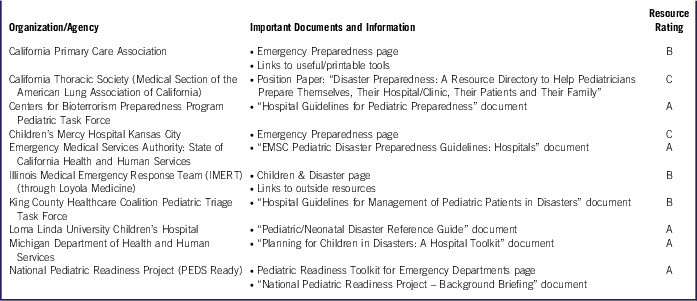
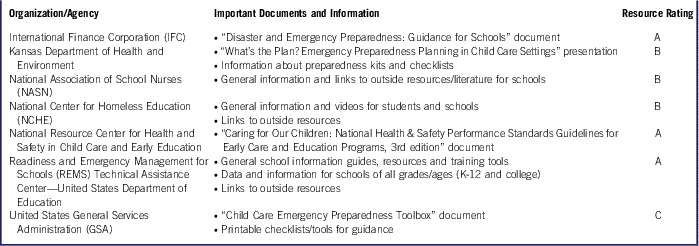
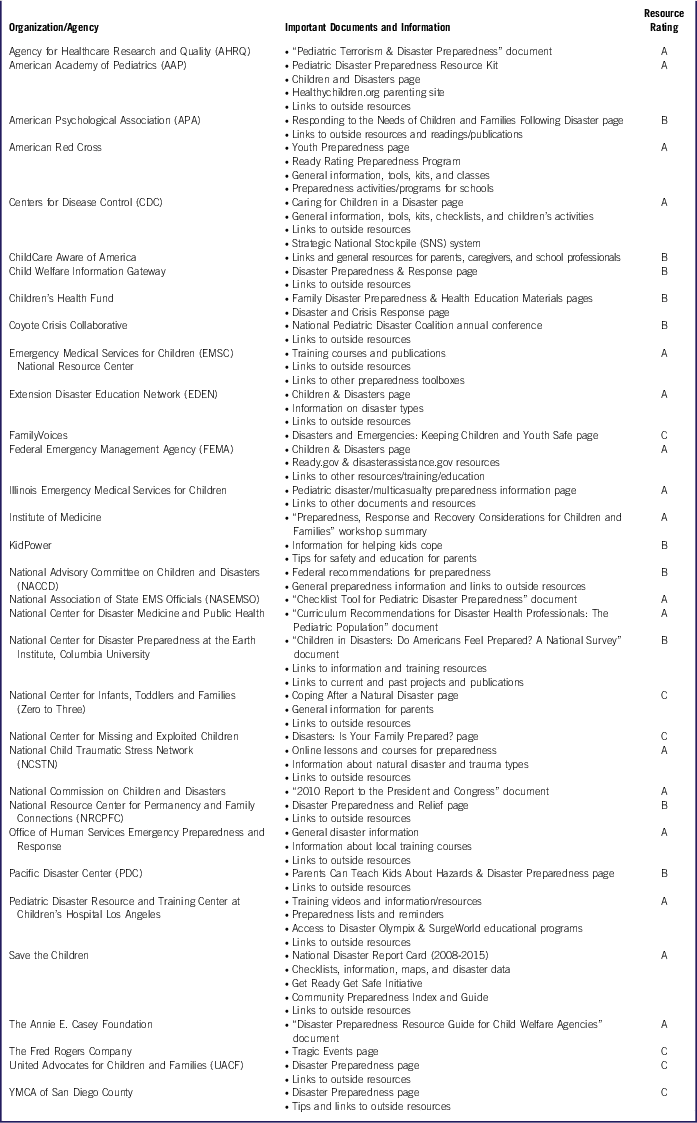
Once the 50 most relevant resources were identified, summarized, and evaluated they were divided into 3 distinct categories: (1) Hospital Resources, (2) School Resources, and (3) Training and Education Resources. Table 1 discusses resources specifically designed for use by hospitals. Of the 10 hospital resources identified, 5 (50%) were given a rating of A, 4 - 8 3 (30%) were given a rating of B, 9 - 11 and 2 (20%) were given a rating of C. 12 , 13 Table 2 discusses resources specifically designed for use in schools and child care facilities. Of the 7 school resources identified, 3 (43%) were given a rating of A, 14 - 16 3 (43%) were given a rating of B, 17 - 19 and 1 (14%) was given a rating of C. 20 Table 3 discusses resources specifically designed for training and/or education efforts. Of the 33 training and/or education resources identified, 17 (52%) were given a rating of A, 21 - Reference Berne 37 10 (30%) were given a rating of B, 38 - 47 and 6 (18%) were given a rating of C. 48 - 53
Hospital Pediatric Disaster Preparedness Resources

A: thorough, well-developed resource with pertinent information presented in a clear format.
B: a resource with a good amount of information and is somewhat developed, but could use additional information and/or development.
C: a resource containing only brief information and could use improvements in quality, content, and format.
School Pediatric Disaster Preparedness Resources

A: thorough, well-developed resource with pertinent information presented in a clear format.
B: a resource with a good amount of information and is somewhat developed, but could use additional information and/or development.
C: a resource containing only brief information and could use improvements in quality, content, and format.
Training/Education Pediatric Disaster Preparedness Resources

A: thorough, well-developed resource with pertinent information presented in a clear format.
B: a resource with a good amount of information and is somewhat developed, but could use additional information and/or development.
C: a resource containing only brief information and could use improvements in quality, content, and format.
Of the 50 resources evaluated, 25 (50%) were given a rating of A, 4 - 8 , 14 - 16 , 21 - Reference Berne 37 16 (32%) were given a rating of B, 9 - 11 , 17 - 19 , 38 - 47 and 9 (18%) were given a rating of C. 12 , 13 , 20 , 48 - 53 The 9 resources that were given a C rating contained accurate information but the depth and breadth of original, organized information was lacking when compared with other notable and trusted primary resources, such as those provided by the American Academy of Pediatrics, the Federal Emergency Management Association, and the Centers for Disease Control. 22 , 24 , 27
GAPS IDENTIFIED
Among the 50 primary resources evaluated, 10 (20%) were more than 50 pages in length, 4 , 6 , 7 , 14 , 15 , 21 , 29 , 33 , 36 , Reference Berne 37 indicating difficulties in summarizing the materials succinctly and limiting the possibility of immediate and widespread paper distribution. Only 19 (38%) of the resources evaluated provided culturally relevant materials or provided resources in languages other than English and Spanish, such as French and Vietnamese. 6 , 7 , 15 , 21 - 28 , Reference Johnson, Ling and Gulley 31 , 33 , 35 - 39 , 41 In addition, only 18 of 50 (36%) resources provided specific or detailed information regarding resources and preparations for children with disabilities and special health care needs. 5 - 8 , 12 , 14 , 15 , 21 , 22 , 24 - 27 , 29 , 30 , 33 , 36 , Reference Berne 37 , 41 Only 20 (40%) of the evaluated resources mentioned specific policies or laws that are relevant to pediatric disaster preparedness in the United States. 4 , 6 - 8 , 11 , 12 , 15 , 16 , 21 - 24 , 27 , 28 , 33 , 35 - Reference Berne 37 , 44 , 45 While 20 (40%) of the primary resources mentioned general hospital and school preparedness, 4 - 22 , 36 emphasis on specific types of hospitals (ie, children’s or trauma hospitals) or specific schools (ie, elementary, middle, or high schools) was limited. The evaluated resources provided general training and education information as well, but only 18 (36%) of the primary resources were designed for training and education of individuals in specific occupations such as nurses, doctors, teachers, and principals. 4 - 7 , 9 , 11 , 12 , 14 - 17 , 20 - 22 , Reference Johnson, Ling and Gulley 31 , 33 , 36 , Reference Berne 37 Resources specific to certain occupations, like nurses, doctors, and teachers, are essential since disaster preparedness material that is applicable in a hospital setting may not be applicable in a school setting.
When evaluating the 50 resources, the date of publication or most recent update was noted to examine patterns in the number of resources produced yearly. Of the 50 resources evaluated, 22 (44%) did not provide their initial publication date but only indicated that they had been updated sometime in 2017. 9 , 10 , 13 , 16 , 18 , 19 , 22 - 25 , 27 , 32 , 35 , 38 - 41 , 44 , 45 , 50 , 51 , 53 The resource with the earliest publication date was 2006; it was the only resource published within that year. 21 Between 2007 and 2017, 3 other years only had 1 resource each published (2007, 2008, and 2011); 4 , 12 , 20 2 years (2009 and 2012) each had 2 resources published while 2 years (2013 and 2016) each had 3 resources published. 6 , 26 , Reference Johnson, Ling and Gulley 31 , 34 , Reference Berne 37 , Reference Van der Zande 43 , 46 , 48 , 49 , 52 Aside from the publications that were updated in 2017, 2014 and 2015 had the greatest number of publications, with 5 each. 7 , 8 , 15 , 17 , 28 - 30 , 36 , 42 , 47 Following close behind, 2010 had 4 publications. 5 , 11 , 14 , 33 The large number of resources that have been updated in 2017 indicate an importance on maintaining accurate and up-to-date information regarding pediatric disaster preparedness.
DISCUSSION
Based on the gaps in cultural relevance, preparations for children with disabilities and the limited number of hospital- and school-specific resources, several recommendations are suggested. First, and perhaps most importantly, the availability of multi-cultural and multi-lingual resources must increase. Following Hurricane Katrina, Dolan and KrugReference Dolan and Krug 54 noted that there was insufficient interpretation and translation support for non-English speaking children and culturally appropriate means for children to express themselves were limited. As the population of the United States continues to become more diverse, particularly in urban areas with large and variable pediatric populations, these type of resources are crucial for preparedness. Officials and governments in urban areas can develop relevant pediatric preparedness resources based on census data; culturally and linguistically appropriate resources can be created and disseminated based on the presence of specific ethnic and racial groups. Ginter et alReference Ginter, Wingate and Rucks 3 also noted a lack of culturally/linguistically diverse resources as a current, major issue in the field of pediatric disaster preparedness. The identification of gaps among existing culturally relevant resources across multiple studies indicates that this area of pediatric disaster preparedness needs considerable attention and development. Cultural relevancy can perhaps be developed using one or more advisory groups comprised of a variety of community professionals and organizations, targeting specific cultural groups.
Considerable gaps also existed in the availability of information and resources for children with disabilities and children with special health care needs. Following Hurricane Katrina, Dolan and KrugReference Dolan and Krug 54 noted that children with disabilities suffered increased morbidity and mortality due to a lack of general preparedness and community coordination with emergency medical services and hospitals.Reference Dolan and Krug 54 A small portion of the reviewed resources mentioned such children, but preparedness provisions lacked important details, such as necessary equipment, staffing and instructions for community coordination, that could provide guidance on current implementation and/or on the development of future resources.
Resources specific to certain locations, namely schools and hospitals, need to be developed in coordination with local, state, and federal officials. Current resources targeting hospitals and schools in general are available but are limited in scope. Resources targeting specific types of hospitals (ie, children’s hospitals or trauma hospitals) and targeting specific types of schools (ie, preschools or high schools) have limited availability. Preparedness exercises, activities, and resources sufficient for a large, urban trauma hospital may prove insufficient or inappropriate for a small, rural hospital, or a children’s hospital. As Ginter et alReference Ginter, Wingate and Rucks 3 noted there are 250-275 children’s hospitals in the United States, representing only about 5% of the total number of hospitals nationwide. Such a limited number of children’s hospitals indicates a clear lack of currently available, relevant resources. Similarly, preparedness provisions for a high school will likely be inadequate for a preschool or elementary school. While current general hospital and school resources provide a basic framework for resource development, further expansion for specific locations is needed. Input from key stakeholders, to include nurses, doctors, emergency medical technicians, principals, teachers, parents, students, community organizations, and emergency organizations, would be crucial in the development and dissemination of specific, relevant resources. Burke et al concluded in a 2010 study that partnerships, regional, and state collaborations and key stakeholder involvement are crucial for disaster preparedness among the pediatric population.Reference Burke, Iverson, Goodhue, Neches and Upperman 55 Additionally, the study advised that pediatric preparedness education and training is needed at all hospitals for all personnel.Reference Burke, Iverson, Goodhue, Neches and Upperman 55 Our results continue to support these recommendations and to further improve preparedness for our children.
LIMITATIONS
Perhaps the most notable limitation of this study is the absence of the use of the newly produced TRACIE (Technical Resources, Assistance Center and Information Exchange) information gateway. This resource became available for use around the time that research for this manuscript was ending so it was not used to complete this research. As such, it is likely that some of the resources analyzed in this research will become rapidly outdated and/or will be missing new and crucial information. The TRACIE gateway streamlines the resource search process and provides a more clear and complete picture of relevant literature and resources for pediatric disaster preparedness. Future use of the TRACIE gateway will be essential in gathering and synthesizing new information to advance the field of pediatric disaster preparedness.
CONCLUSION
A gap analysis of current pediatric disaster preparedness literature and resources has demonstrated the need for further development in this field. An emphasis must be placed on the development of culturally relevant preparedness materials that are widely available in languages other than English so preparedness information can reach all children and families. Additionally, further development and implementation of pediatric-specific preparedness training and resources in all types of hospitals and schools is crucial to the protection of children throughout the United States.
Funding
The authors report no external funding source for this study.
Conflicts of Interest
The authors declare that there are no conflicts of interest to disclose.