Sudden unexpected death in a young person is always tragic and is frequently highly publicised, especially when it occurs in a young athlete. The most recently reported incidences of these events ranged from 1:12,778 young minority athletes to 1:787,392 female athletes;Reference Maron, Haas, Ahluwalia, Murphy and Garberich 1 however, because these events may represent the first manifestation of disease, some sudden deaths are not preventable based on the current level of screening. This article addresses those patients known to have cardiac disease, and how knowledge of their condition informs implantable cardioverter-defibrillator use.
Research to date has elucidated a variety of aetiologies that may predispose to sudden cardiac death in the young. These aetiologies may be broadly categorised as inherited arrhythmia syndromes, inherited cardiomyopathies, and postoperative CHD. Irrespective of the cause, in patients thought to be at particularly high risk, implantable cardioverter-defibrillator therapy has been shown to reduce mortality with progressive reduction in shock-free survival.Reference Olde Nordkamp, Wilde, Tijssen, Knops, van Dessel and de Groot 2 – Reference Silka, Kron, Dunnigan and Dick 5 Implantable cardioverter-defibrillator therapy has been shown to be superior even to amiodarone in adults having ischaemic and non-ischaemic cardiomyopathy.Reference Bardy, Lee and Mark 6 Implantable cardioverter-defibrillators are implanted for either primary or secondary prevention of sudden cardiac death. For purposes of this discussion, primary prevention is defined as implantable cardioverter-defibrillator therapy based on risk factors for sudden death without a previous cardiac arrest or sustained ventricular tachycardia.Reference Schwartz, Spazzolini and Priori 3 Secondary prevention is defined as implantable cardioverter-defibrillator therapy following resuscitated cardiac arrest or sustained ventricular tachycardia.Reference Maron, Spirito and Ackerman 4
Primary versus secondary prevention trends
Between 1980 and1991, the most commonly (76%) reported indication for implantable cardioverter-defibrillator implantation was for secondary prevention;Reference Silka, Kron, Dunnigan and Dick 5 however, over the past two decades, there has been a shift towards primary prevention.Reference Olde Nordkamp, Postema and Knops 7 Recent studies have demonstrated a greater percentage of implantable cardioverter-defibrillators being implanted for primary prevention of sudden cardiac death.Reference Bergen Von, Atkins and Dick 8 The percentage of ICDs implanted for primary prevention roughly doubled over the 10 years between 1996 and 2006.Reference Bergen Von, Atkins and Dick 8 As reported by Burns et al,Reference Burns, Evans and Kaltman 9 this has resulted in a three-fold increase in implantable cardioverter-defibrillator use in patients younger than 18 years of age from 1997 to 2006, as well as a decrease in the average age of implantation from 13.6 to 12.2 years (p=0.01). In a multicentre international registry of implantable cardioverter-defibrillators implanted between 1987 and 2011 in 224 unrelated children and adolescents with hypertrophic cardiomyopathy judged to be at high risk of sudden death, 84% of these patients received an implantable cardioverter-defibrillator for primary (n=188) and only 16% for secondary (n=36) prevention.Reference Maron, Spirito and Ackerman 4 A variety of reasons have been attributed to this trend, including improvements in technology, with smaller devices, earlier diagnosis of channelopathies, increasing numbers of children with CHD surviving into adulthood, and refinement in risk stratification for certain conditions;Reference Olde Nordkamp, Wilde, Tijssen, Knops, van Dessel and de Groot 2 , Reference Priori, Wilde and Horie 10 however, with respect to the latter point, prospective paediatric population-based data on primary prevention are largely lacking, thus limiting the provider’s and family’s ability to make an informed decision regarding risks and benefits.Reference Olde Nordkamp, Postema and Knops 7 Many of these children will have an implantable cardioverter-defibrillator for decades, resulting in cumulative risks over time.Reference Sherrid and Daubert 11 As will be discussed, such cumulative risks may outweigh the benefits, particularly in some patients with devices placed for primary prevention.
Current indications for implantable cardioverter-defibrillators
As mentioned above, indications for implantable cardioverter-defibrillator placement vary according to the specific condition, although secondary prevention is a class I indication in virtually all instances. It is certainly a class I indication after ventricular fibrillation and when an associated condition cannot be diagnosed, when reversible causes such as intoxication, electrolyte disturbance, and other metabolic perturbations do not exist, and when the condition cannot be cured, such as Woff–Parkinson–White syndrome.
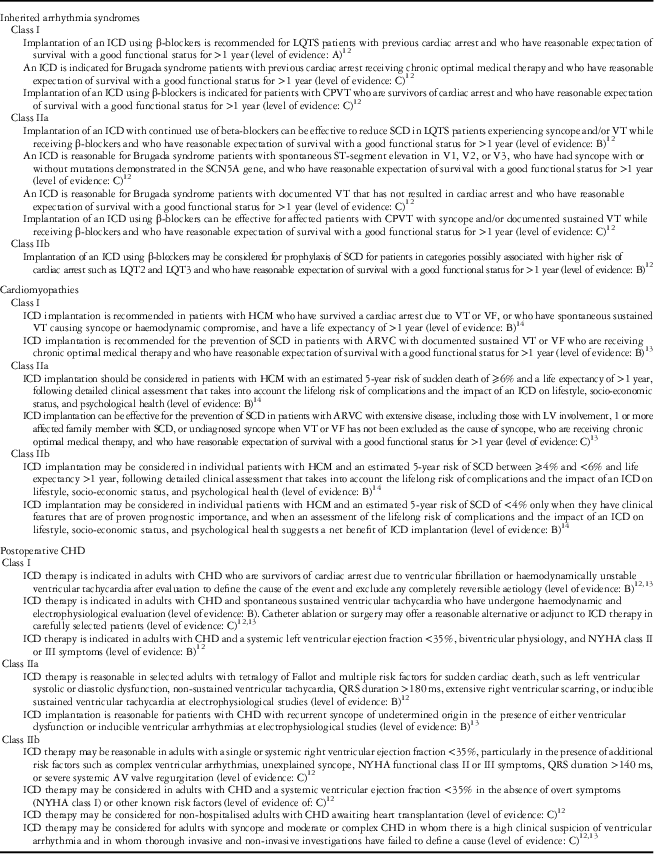
The inherited arrhythmia syndromes include long QT syndrome, short QT syndrome, catecholaminergic polymorphic ventricular tachycardia, Brugada syndrome, idiopathic ventricular fibrillation, and early re-polarisation syndrome. The cardiomyopathies of primary interest in young patients include hypertrophic cardiomyopathy and arrhythmogenic right ventricular cardiomyopathy. Class I, IIa, and IIb indications for implantation, according to disease entity, are shown in Table 1.Reference Khairy, Van Hair and Balaji 12 – Reference Elliott, Anastasakis and Borger 14 Class I indications mostly refer to secondary prevention, and class II indications are variably based on some combination of risk factors that guide primary prevention. Owing to important observations since these guidelines were published, additional comments are in order for two of these conditions.
Indications for implantable cardioverter-defibrillator implantation according to the underlying condition.

AV=atrioventricular; ARVC=arrhythmogenic right ventricular cardiomyopathy; CPVT=catecholaminergic polymorphic ventricular tachycardia; HCM=hypertrophic cardiomyopahy; ICD=implantable cardioverter-defibrillator; LQTS=long QT syndrome; SCD=sudden cardiac death; VT=ventricular tachycardia; VF=ventricular fibrillation
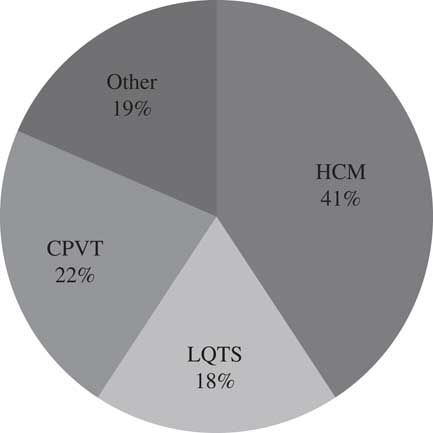
Catecholaminergic polymorphic ventricular tachycardia is a highly lethal, heritable disorder of intracellular calcium trafficking. Especially under adrenergic influence, a triggered form of ventricular tachycardia occurs and can degenerate into ventricular fibrillation. Although defibrillation can be successful in such instances, the initiating ventricular tachycardia cannot be electrically converted; in fact, defibrillatory energy results in additional endogenous catecholamine release, which can re-initiate ventricular tachycardia. This has resulted in fatal ventricular fibrillation “storms”. Nevertheless, at the Children’s Hospital of Orange County, ~22% of secondary prevention implantable cardioverter-defibrillators between 2008 and 2015 were placed in children diagnosed with catecholaminergic polymorphic ventricular tachycardia (Figure 1) – which is disproportionately high relative to the disease prevalence. Nordkamp et alReference Olde Nordkamp, Wilde, Tijssen, Knops, van Dessel and de Groot 2 showed that 75% of implantable cardioverter-defibrillators placed in patients with catecholaminergic polymorphic ventricular tachycardia were for secondary prevention. It is likely that implantable cardioverter-defibrillator use in this condition will diminish in the future, because the disease is now being diagnosed more frequently before near-fatal events occur and because better antiarrhythmic drug options are being discovered.
The distribution of implantable cardioverter-defibrillators implanted for secondary prevention indications at Children’s Hospital of Orange County according to the arrhythmogenic condition. These results encompass 25 patients over 7 years between 2008 and 2015. CPVT=catecholaminergic polymorphic ventricular tachycardia; HCM=hypertrophic cardiomyopahy; LQTS=long QT syndrome.

The most common heritable cardiomyopathy for which guidelines for implantable cardioverter-defibrillator implantation have been established is hypertrophic cardiomyopathy. Class IIa and IIb indications for implantable cardioverter-defibrillator implantation are largely based on a combination of risk factors,Reference Zipes, Camm and Borggrefe 15 which traditionally have included a family history of premature hypertrophic cardiomyopathy-related sudden death, extreme left ventricular hypertrophy (wall thickness >30 mm in teenagers or adults), unexplained syncope inconsistent with neurocardiogenic origin, non-sustained ventricular tachycardia on 24-hour ambulatory (Holter) electrocardiogram (⩾3 beats at a rate ⩾120/minutes), and hypotensive blood pressure in response to exercise.Reference Maron, Spirito and Ackerman 4 , Reference Zipes, Camm and Borggrefe 15 Maron et alReference Maron, Spirito and Ackerman 4 demonstrated that the most common risk factor that led to implantable cardioverter-defibrillator placement was extreme left ventricular hypertrophy. They also showed that the relative frequency of shocks terminating ventricular tachycardia or ventricular fibrillation was the same in patients who had 1, 2, or >3 risk factors, indicating the relative importance of these risk factors to support implantable cardioverter-defibrillator placement. More recently, it has been suggested that these risk factors should probably not be equally weighted, and issues such as left ventricular fibrosis burden, apical aneurysm, complex heterozygosity, and left ventricular outflow tract gradient are likely to have an impact. Indeed, a risk calculator has recently been designed to help clinicians assess five-year risk. It includes the “traditional” risk factors – minus blood pressure response to exercise – plus left atrial area and left ventricular outflow tract gradient.Reference Elliott, Anastasakis and Borger 14
The decision to place an implantable cardioverter-defibrillator in a child is further complicated by the physical and psychological burden of the technology because of inappropriate shocks. A shock is a painful, memorable event often described as being hit/kicked in the chest.Reference DeWitt, Triedman and Cecchin 16 , Reference Vollmann, Lüthje and Unterberg 17 Studies have shown higher rates of reported psychosocial stress and decreased quality of life in children with implantable cardioverter-defibrillators compared with their peers with chronic illnesses.Reference DeWitt, Triedman and Cecchin 16 These patients often avoid activities because of fear of being shocked.Reference DeWitt, Triedman and Cecchin 16 Taking this into consideration, multiple studies have evaluated the effectiveness of implantable cardioverter-defibrillators based on the rate of life-saving, appropriate, and inappropriate discharges to better assist physicians in weighing the decision to place an implantable cardioverter-defibrillator on a case-by-case basis.
Appropriate discharges
Implantable cardioverter-defibrillators detect ventricular tachycardia or fibrillation on the basis of programmable parameters that include ventricular rate cut-off, electrogram morphology, and other features that are designed to discriminate ventricular from supraventricular tachyarrhthmias and vary according to the device manufacturer. Therapies are delivered after a programmable detection time. Bergen et alReference Bergen Von, Atkins and Dick 8 showed that the rate of appropriate discharges was considerably higher following implantation for secondary prevention (52%) versus primary prevention (14%, p<0.001). Patients with an implantable cardioverter-defibrillator implanted for primary prevention were less likely to have an implantable cardioverter-defibrillator discharge for a life-threatening event, even if considered appropriate, than those with an implantable cardioverter-defibrillator implanted for secondary prevention (p=0.04).Reference Bergen Von, Atkins and Dick 8 Maron et alReference Maron, Spirito and Ackerman 4 also showed a higher rate of appropriate discharges in the secondary prevention group (47%) versus the primary prevention group (14%) with a hazard ratio of 4.1 (p<0.001).
As noted above, in patients having catecholaminergic polymorphic ventricular tachycardia, an appropriate discharge is not necessarily clinically appropriate. Conditions associated with non-sustained ventricular tachycardia, although rapid, often benefit from longer detection times. This is especially true in some patients with long QT syndrome. On the other hand, patients having certain cardiomyopathies are less tolerant of even short periods of a non-perfusing rhythm, in which case shorter detection times are recommended.
Inappropriate discharges
Inappropriate charges are shocks that occur in the absence of life-threatening arrhythmias. There are multiple aetiologies for inappropriate shocks, including supraventricular tachycardia, including sinus tachycardia, T wave over-sensing, lead fracture, electrical shorting between conductors due to growth-related changes in anatomy, environmental stray currents, and rarely device malfunction.Reference DeWitt, Triedman and Cecchin 16 Younger patients are at higher risk of receiving inappropriate shocks given their smaller somatic size and increased rates of growth following treatment.Reference DeWitt, Triedman and Cecchin 16 , Reference Link, Hill and Cliff 18 Studies have shown similar rates (25%) of inappropriate discharges between primary and secondary prevention groups within 5 years of implant, suggesting that this problem is independent of device indication.Reference Bergen Von, Atkins and Dick 8 Patients with CHD, however, are most disproportionately affected by inappropriate discharges, likely attributed to anatomical features.Reference Burns, Evans and Kaltman 9 Nordkamp et alReference Olde Nordkamp, Postema and Knops 7 noted a 20% risk of inappropriate shocks within 51 months of implantation with a pooled annual risk of 4.7% per year (p<0.001). Most of these shocks were from supraventricular tachycardia (13%) caused by atrial arrhythmias (7.4%) or sinus tachycardia (7.1%). Patients with short QT syndrome, catecholaminergic polymorphic ventricular tachycardia, and hypertrophic cardiomyopathy were found to have higher rates of inappropriate shocks compared with the other categorical groups.Reference Olde Nordkamp, Postema and Knops 7
Attempts at reducing the rate of inappropriate shocks by improving detection criteria with dual-chamber devices have been met with mixed results. In an adult series in which dual-chamber devices were associated with less inappropriate shocks, there was a higher rate of implantable cardioverter-defibrillator-related complications.Reference Friedman, McClelland and Bamlet 19 , Reference Theuns, Klootwijk, Goedhart and Jordaens 20
Other complications
Similar to complications associated with implantation of any cardiac implantable electronic device, infection (3, 0.53% per year), pericardial effusion (1.1%), haematoma (1.3%), thrombotic events (1.2%), and pneumothorax (0.7%) may occur.Reference Uslan 21 In one series, the overall implantable cardioverter-defibrillator complication rate was 22 or 4.4% per year (p<0.001).Reference Olde Nordkamp, Postema and Knops 7 Approximately 10% of patients experienced a lead malfunction within 53 months of follow-up, but only one-third resulted in inappropriate shocks.Reference Kleemann, Becker and Doenges 22 There are higher rates of psychosocial stress and decreased quality of life among children with implantable cardioverter-defibrillators compared with peers with chronic illnesses.Reference DeWitt, Triedman and Cecchin 16 There is a particular psychological burden related to inappropriate shocks in an awake youngster, especially when multiple.Reference DeWitt, Triedman and Cecchin 16 , Reference Vollmann, Lüthje and Unterberg 17 These patients may avoid previously pleasurable activities because of fear of being shocked.Reference DeWitt, Triedman and Cecchin 16 Taken together, appreciation of these potential complications helps the provider minimise unnecessary interventions while also protecting patients truly at risk. These goals may be best achieved by combining individualised medicine with evidence-based guidelines, as provided in this article.
Future considerations
Most of the changes to reduce the rate of inappropriate shocks have been based on implantable cardioverter-defibrillator programming. By increasing the detection interval and raising the cut-off rate for therapy, there has been a significant reduction in the amount of inappropriate shocks.Reference Moss, Schuger and Beck 23 In adults, NordkampReference Olde Nordkamp, Postema and Knops 7 showed a reduction in the percentage of inappropriate shocks before 2008 (6.1%) compared with after 2008 (4.1%) when a major algorithm was altered (p=0.002); however, as discussed above, greater reductions need to be accomplished for the paediatric population who face the potential for decades of therapy.
There has been some discussion in the paediatric cardiology community to reduce the lifetime preventive treatment to a medium-term preventive measure intended to protect the patient when at highest risk. DeWitt et alReference DeWitt, Triedman and Cecchin 16 showed that if a patient did not experience appropriate therapy within the 1st year after implantable cardioverter-defibrillator placement, the probability of subsequent appropriate therapy decreased in the following years to ~8% 3 years after implantation. They also demonstrated a higher incidence of adverse events relative to appropriate shocks for the same population of paediatric patients.Reference DeWitt, Triedman and Cecchin 16 After approximately 5 years of follow-up, the cumulative incidence of appropriate discharges plateaus to roughly 15%, but the cumulative incidence of adverse events continues to rise.Reference DeWitt, Triedman and Cecchin 16 These observations further emphasise the importance of improved risk analysis, better device technologies, and perhaps greater consideration of the new subcutaneous implantable cardioverter-defibrillator technology.
Conclusion
This review has demonstrated that there has been a substantial change in the use of implantable cardioverter-defibrillators over the past 40 years from secondary prevention to primary prevention approaches. As clinicians learn more about the arrhythmogenic syndromes and diagnose them earlier, there is often a strong indication to consider implantable cardioverter-defibrillator placement before developing a life-threatening arrhythmia; however, these life-saving devices come at a high cost. Children frequently experience inappropriate shocks and have reported lower quality of life compared with children with matched chronic illnesses. These children frequently report a fear of being shocked and avoid activities that may induce normal sinus tachycardia. There is also a relative certainty that the device will malfunction. As a result, each physician must weigh the life-saving benefit of an implantable cardioverter-defibrillator with the likely malfunction and psychological consequences.
Acknowledgements
None.
Financial Support
This research or review received no specific grant from any funding agency or from commercial or not-for-profit sectors.
Conflicts of Interest
None.
Ethical Standards
The authors assert that all referenced work contributing to this review complies with the ethical standards of biomedical or medicolegal investigation.