Introduction
Bulk metallic glasses (BMGs) are metal alloys that exhibit high glass-forming ability (GFA) during casting. Such materials usually also exhibit a suite of desirable mechanical properties such as ultra-high specific strength, high hardness, high elastic limit, low frictional coefficient, and wear resistance[Reference Trexler and Thadhani1–Reference Greer5] that make them potential structural materials for various construction, aeronautical, and aerospace applications. Furthermore, their amorphous structure offers highly isotropic mechanical properties throughout the material, which may be advantageous in many situations. The attraction is further enhanced when BMGs demonstrate other useful properties such as excellent corrosion resistance, biocompatibility, and soft magnetism.[Reference Inoue and Takeuchi2, Reference Greer5] As such, the market for BMGs is slowly being realized, expanding itself from niche-market applications such as cell phone casings and high-efficiency transformer cores[Reference Inoue and Takeuchi2] into much broader applications in structural, electronic, sporting, medical, and military technologies.[Reference Inoue and Takeuchi2]
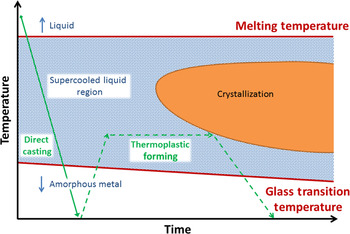
In addition to their desirable material properties, BMGs also show high dimensional tolerance on casting allowing intricate and complex shapes to be produced. The lack of crystallization results in little volumetric shrinkage and the fabricated dimensions of the BMG product will not change upon cooling. BMGs are also amenable to thermoplastic forming (TPF),[Reference Schroers6] whereby the as-cast BMG can be reheated into the supercooled liquid region (SCLR) where viscosity is sufficiently decreased to permit net-shape forming. Worked as supercooled liquids for time periods not exceeding crystal nucleation (Fig. 1), BMGs can be fabricated into complex-shaped components in a manner similar to TPF of thermoplastic polymers.
Schematic time-temperature-transformation (TTT) diagram showing direct casting to generate a metallic glass and the TPF route, whereby the metallic glass is reheated into the SCLR, thermoplastically formed and cooled before the onset of crystallization.

Despite the various attractive properties of metallic glasses, there are two primary limitations that have restricted their more widespread applications[Reference Trexler and Thadhani1–Reference Greer5]: (i) rapid cooling rates from the melt are often required for generating an amorphous alloy (typically 100–106 K/s), and (ii) the as-cast alloys usually exhibit low ductility at temperatures below their glass transition temperature, T g.[Reference Trexler and Thadhani1] The development of multicomponent alloy compositions with high GFA has resulted in realistic critical cooling rates as low as 1 K/s.[Reference Inoue and Takeuchi2] Hence, the primary shortfall of most BMGs is the lack of any appreciable plastic deformation prior to failure that currently restricts these materials from being used extensively as structural (load-bearing) materials for obvious safety reasons.
To overcome the ductility problem of BMGs, research has focused on the development of new classes of BMGs[Reference Lewandowski, Wang and Greer7–Reference Demetriou, Launey, Garrett, Schramm, Hofmann, Johnson and Ritchie9] and BMG composites (BMGCs) (see e.g.,[Reference Bian, Kato, Qin, Zhang and Inoue10–Reference Inoue23]). As an example of the former, BMGs with high Poisson ratios have shown great promise, although such alloys are expensive as they generally contain large amounts of precious metal elements. The aim of BMGCs is to improve fracture toughness and ductility by introducing ductile, homogeneously distributed secondary phases into the amorphous matrix. The logic behind this is straightforward with regard to the mechanism by which BMGs fracture, i.e., formation of localized shear bands occurs under applied shear stress, followed by shear band propagation under loading until the dominant shear band ruptures resulting in catastrophic failure.[Reference Trexler and Thadhani1] In understanding this mechanism, second phases may be introduced within the amorphous matrix to hinder the propagation of the shear bands and dissipate fracture energy. Potentially, these obstructions may even promote initiation of multiple shear bands that further disperse the fracture energy.[Reference Trexler and Thadhani1] A variety of processing methods have been developed for producing both ex situ and in situ BMGCs with the aim of improving ductility. This review will outline the limitations in key mechanical properties of BMGs through to a discussion on possible fabrication methods for producing BMGCs and how a second phase influences their mechanical behavior.
Mechanical aspects of BMGs
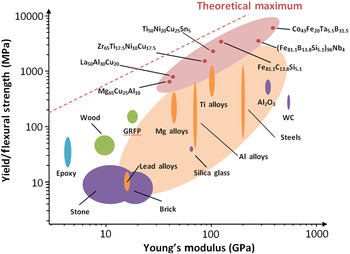
The main advantage in mechanical properties of BMGs over traditional crystalline and composite materials is their significantly higher strength. Due to the absence of the classic dislocation mechanisms that are operative in crystalline materials, BMGs exhibit yield strengths approaching the theoretical limit of E/20 (where E is Young's modulus).[Reference Inoue and Takeuchi2] Uniaxial tensile strengths are typically in the region of 2 GPa, although remarkable values of up to 5 GPa have been reported.[Reference Inoue, Shen, Koshiba, Kato and Yavari24] These values are significantly higher than for most crystalline materials, including high-strength crystalline alloys and fiber-reinforced composites (Fig. 2).
Schematic representation of room-temperature yield (metals, composites, and polymers) or flexural strength (ceramics) as a function of Young's modulus. Note the increased strength of amorphous alloys (light red) over conventional crystalline alloys (light orange). Adapted from Ashby and Greer.[Reference Trexler and Thadhani4]

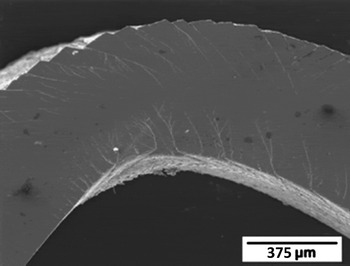
Unfortunately, most BMGs lack any appreciable ductility due to deformation being localized into several thin shear bands during straining below T g (Fig. 3). Extensive dilation occurs along these bands, resulting in a local increase in free volume and hence decrease in viscosity.[Reference Dai and Bai26] This viscosity change allows for small clusters of atoms to spontaneously rearrange themselves under an applied shear stress, creating a shear transformation zone.[Reference Trexler and Thadhani1] As this localized distortion in the amorphous structure progresses, larger distortions form along single planes to become longer shear bands. The generation of shear bands during straining essentially results in “strain softening.” Here, shear band growth and sliding occur along the dominant shear band plane until catastrophic failure results.[Reference Inoue and Takeuchi2] The intention of most BMGCs is to increase the shear-band density such that fracture energy is distributed over a larger volume of the sample.
Scanning electron microscopy (SEM) micrograph of a plastically bent Zr-based metallic glass sample showing localized shear bands.[Reference Trexler and Thadhani25] Reproduced with permission from Conner et al.[Reference Trexler and Thadhani25] (© 2003, AIP).

Development of BMGCs
The major driving force behind the development of BMGCs is the need to overcome the inherent ductility limitations of monolithic BMGs while at the same time maintaining other useful properties such as high strength and large elastic strain limit. The success of composite materials in general is the ability to generate enhanced mechanical properties based on the combined properties of the matrix and reinforcement phases. In terms of the ductility of BMGCs, this property can be improved over their monolithic counterparts by modifying shear banding in the glassy matrix via incorporating a second phase of a certain shape, size and volume fraction into the metallic glass matrix. For example, Hays et al.[Reference Hays, Kim and Johnson27] have shown that the addition of a second phase in BMGs: (i) restricts shear band propagation; (ii) generates multiple shear bands; and (iii) creates additional fracture surface area.
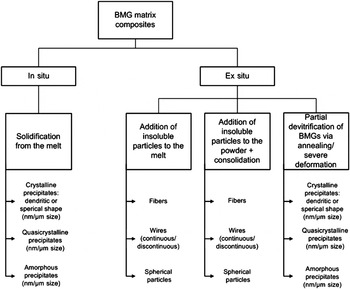
BMGCs may be produced by either ex situ or in situ processing routes.[Reference Eckert, Das, Pauly and Duhamel28]Figure 4 shows a useful BMGC classification scheme devised by Eckert et al.[Reference Eckert, Das, Pauly and Duhamel28]:
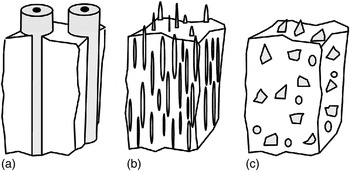
(i) Ex situ BMGCs are produced by a two-step process by adding a foreign phase (fibers, wires, whiskers, spheres, particulates, etc., Fig. 5) to the BMG during a certain stage of processing (i.e., casting, power metallurgy, co-processing of BMG and reinforcement in the SCLR) or by partial devitrification of the final BMG by thermal or mechanical processing. It is pertinent to note that the latter could also be described as an in situ process.
(ii) In situ BMGCs are produced by a single production step, i.e., directly from the melt by chemical separation of a liquid into two distinct phases (i.e., a glassy matrix and crystalline particles or dendrites, etc.).
Possible classification scheme for BMG matrix composites. Reproduced with permission from Eckert et al.[Reference Trexler and Thadhani28] (© 2007, Wiley-VCH Verlag GmbH & Co.).

Schematic of: (a) fiber; (b) whisker, and (c) particulate reinforced ex situ composites. Reproduced with permission from Clyne and Withers[Reference Trexler and Thadhani29] (© 1995, Cambridge University Press).

In general, the advantages of in situ BMGCs are the simpler and more economical fabrication routes, although there is greater opportunity to tailor the microstructure and mechanical properties of ex situ BMGCs via adjustments in the type, shape, size, and volume fraction of the reinforcement phase.
Apart from the selection of matrix composition and reinforcement material, an important factor to consider during the processing of any type of BMGC is the characteristic of the interface between the reinforcement and glassy matrix. In composite materials, load is typically transferred from the matrix to the reinforcing material through shear at the matrix/reinforcement interface.[Reference Clyne and Withers29] With poor interfacial strength, shear stress transfer is far less efficient, regardless of the properties of either phase. This may lead to an ineffective composite. This consideration applies more to ex situ composites than in situ composites. Overall, good wettability of the reinforcement phase within the matrix, similar thermal-expansion coefficients, and Poisson ratios are important factors to address.[Reference Choi-Yim, Conner and Johnson30]
Ex situ BMGCs
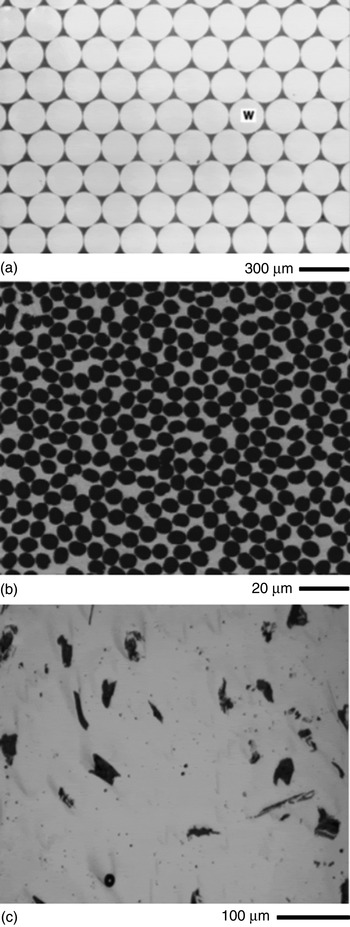
The production of ex situ BMGCs in both the liquid and solid states has been investigated by several researchers (see e.g.,[Reference Conner, Dandliker and Johnson18–Reference Szuecs, Kim and Johnson20, Reference Choi-Yim, Conner and Johnson30–Reference Choi-Yim, Busch, Köster and Johnson39]). The most common matrix BMG compositions are based on Zr due to their high GFA and ease of processing.[Reference Choi-Yim, Conner, Szuecs and Johnson14] Various experiments have been conducted with reinforcing the BMG matrices with wires, fibers, or particles using materials such as graphite, Kevlar, WC, SiC, TiB2, W, Ta, Nb, Mo, and steel to varying levels of success.[Reference Choi-Yim, Conner and Johnson30–Reference Choi-Yim, Busch, Köster and Johnson39]Figure 6 shows selected examples of ex situ BMGCs containing various types of reinforcement. Given that fabrication via melt infiltration or liquid pressing[Reference Choi-Yim, Busch, Köster and Johnson39] of ex situ BMGCs often takes place above the liquidus temperature of the metallic glass, the choice of second phase is limited as it must be able to withstand high temperatures and not react with the molten alloy; this may generate undesirable crystalline phases as a by-product which can degrade the interfacial bond between the matrix and reinforcement.
Representative micrographs of ex situ BMGCs produced by various routes: (a) tungsten wire reinforced composite[Reference Trexler and Thadhani36]; (b) carbon fiber reinforced composite[Reference Trexler and Thadhani37]; (c) graphite particle reinforced composite.[Reference Trexler and Thadhani38] Adapted from Dandliker et al.,[Reference Trexler and Thadhani36] Kim et al.,[Reference Trexler and Thadhani37] and Siegrist and Löffler.[Reference Trexler and Thadhani38]

A relatively new method of fabricating ex situ BMGCs has been through thermoplastic infiltration in the SCLR where the BMG can undergo TPF into the second phase (Fig. 7). This method can also be used for embedding second phases into a “softened BMG surface.” With this processing route, the low processing temperature means that no undesirable interface products are formed that permits the use of a larger variety of second-phase materials. The key limitation of this method is the infiltration depth of secondary phases into the BMG which is limited principally by its viscosity of which can lead to poor volume fraction into the matrix.
Schematic illustration of the TPF BMGC synthesis method: (a) homogeneous bulk composites and (b) surface composites can be synthesized by this method. Reproduced with permission from Schroers et al.[Reference Trexler and Thadhani40] (© 2007, Elsevier).

In situ BMGCs
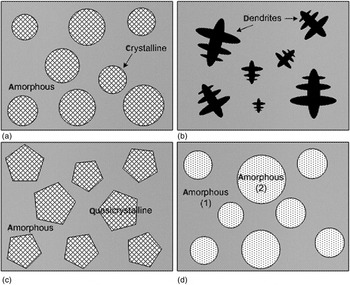
In situ BMGCs are produced by chemical separation or precipitation during solidification to generate a distribution of second phase/s in a glassy matrix (Fig. 4). Such phases are often discrete crystalline dendrites or globules of micro- or nanoscale size, distributed throughout the glassy matrix (Fig. 8). Tailoring the secondary phase is typically performed through altering melt chemistry and solidification conditions, including semisolid processing.[Reference Trexler and Thadhani1] A major advantage of in situ BMGCs is that they potentially produce better interfacial bonding of the particle and matrix leading to superior mechanical properties.[Reference Trexler and Thadhani1]
Schematic diagrams of the in situ formation of second phases in a glassy matrix: (a) spherical crystalline particles, (b) dendrites, (c) quasicrystalline phase, and (d) second amorphous phase. Reproduced with permission from Eckert et al.[Reference Trexler and Thadhani28](© 2007, Wiley-VCH Verlag GmbH & Co.).

There are at least three primary methods for producing in situ BMGCs (see e.g.,[Reference Hofmann, Wiest, Duan, Lind, Demetriou and Johnson13–Reference Hays, Kim and Johnson17, Reference Hays, Kim and Johnson27–Reference Eckert, Das, Pauly and Duhamel28, Reference Fan, Zhang, Mao, Shen and Inoue41–Reference Doglione, Spriano and Battezzati50]):
• precipitation of crystalline or amorphous phases during direct casting or by semi-solid processing;
• precipitation of crystalline phases by inoculation of the melt; and
• thermally or stress-induced crystallization (i.e., devitrification) during postprocessing of as-cast BMGs (again, this may also be classed as an ex situ process[Reference Eckert, Das, Pauly and Duhamel28]).
Direct casting is the most common in situ route, primarily due to the simplicity and economy of the process. Here, nucleation of reinforcement particles is promoted either by partial crystallization of the BMG matrix or precipitation of an altogether foreign composition. The crystalline phases precipitated during casting are typically similar in composition to the amorphous matrix, as illustrated by Fan et al.[Reference Fan, Zhang, Mao, Shen and Inoue41] and Hays et al.,[Reference Hays, Kim and Johnson17] although there are exceptions.[Reference Das, Loser, Kuhn, Eckert, Roy and Schultz42] This method of creating in situ BMGCs has been very successful for Zr-based systems due to their superior GFA and significantly lower critical cooling rates.[Reference Das, Loser, Kuhn, Eckert, Roy and Schultz42]
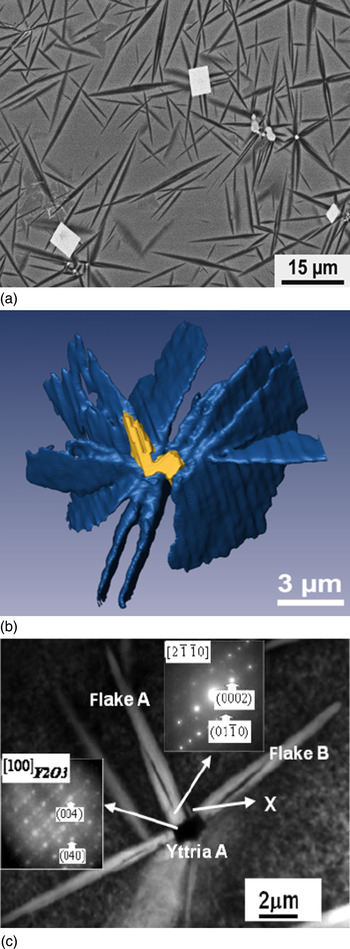
Related to the foregoing processing method, in situ BMGCs can also be produced by inoculation of the melt with micron-sized insoluble oxide particles, etc. Such particles need to share crystallographic similarities with the solid nucleating phases of the BMG to generate very low interfacial mismatch, hence, interfacial energy. This results in a high probability of heterogeneous nucleation from the surface of the particles. An example of inoculation was demonstrated by Xu et al.[Reference Xu, Zheng, Laws, Ringer and Ferry44] in a Mg-based BMG. By inoculating the melt with yttria particles, it was found that certain planar symmetries between yttria and the crystalline α-Mg phase led to nucleation and subsequent growth of the flakes in distinct orientations (Fig. 9). When viewed in 3D,[Reference Robin, Laws, Xu, Kurniawan, Privat and Ferry45] this generated a multivariant, interwoven crystalline structure throughout the glassy matrix.
(a) SEM micrograph showing the uniform dispersion of crystalline Mg flakes within a glassy matrix in a Mg-base in situ BMGC. (b) 3D focused ion beam (FIB) micrograph showing groups of Mg flakes nucleating and growing normal to the surface of a yttria particle. (c) Bright field TEM micrograph showing the orientation of flakes radiating from a rectangular-shaped yttria particle, labeled A. Adapted from Xu et al.[Reference Trexler and Thadhani44]

In situ BMGCs may also be produced by partial devitrification of the as-cast BMG by thermally or stress-induced nucleation of crystalline phases by annealing or hot working above T g.[Reference Leonhar, Xing, Heilmaier, Gebert, Eckert and Schultz49] This method is a more laborious and costly process compared with casting due to the additional processing steps. Nevertheless, induced devitrification ultimately achieves the same goal as casting, whereby nano- or microcrystalline phases are precipitated from the glassy matrix. Annealing is argued to be inferior to quenching from the melt, as it may deteriorate the intrinsic ductility of the glassy matrix through structural relaxation or more explicitly the annihilation of structural free volume.[Reference Doglione, Spriano and Battezzati50, Reference Gilbert, Ritchie and Johnson51] However, annealing generally allows better control of partial crystallization and generates a homogeneous dispersion of secondary phases throughout the glassy matrix.
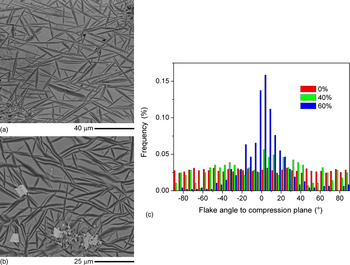
The orientation and distribution of a second phase within the glassy matrix of a BMGC may also be tailored by TPF since the amorphous matrix is amenable to superplastic forming. By deforming the BMGC shown in Fig. 9 in the SCLR, the crystalline flakes both rotate and deform plastically to realign normal to the direction of principal strain[Reference Xu, Robin, Zheng, Laws and Ferry52] (Fig. 10). The degree of alignment of a crystalline phase is affected by its shape, distribution, and volume fraction, and also the strain rate and processing temperature. This method is particularly useful for tailoring composite properties, as the alignment of secondary phases may significantly improve ductility and fracture toughness in certain directions of the formed component.
The Mg-base BMGC shown in Fig. 10a after: (a) 40% and (b) 60% uniaxial compression (vertical direction) in the SCLR showing flake bending and alignment parallel to the compression plane. (c) Frequency distribution of the flake angle to the compression plane showing the substantial alignment of this phase during TPF in the SCLR. Adapted from Xu et al.[Reference Trexler and Thadhani52]

Mechanical performance of BMGCs
Significance of the rule of mixtures
Composites usually derive their properties from a volumetric weighted ratio of the same properties from their constituent phases. This classic relationship is termed the Rule of Mixtures,[Reference Clyne and Withers29] and has been shown to hold for metallic glass containing materials. For example, Strife and Prewo[Reference Strife and Prewo53] achieved close conformity to the Rule of Mixtures for Young's modulus with a Fe40Ni38Mo4B18 fiber-reinforced epoxy-resin matrix. Axial tensile strength, however, was not as conforming, exhibiting values consistently higher than those predicted by the Rule of Mixtures. Similar results were observed by Conner et al.[Reference Conner, Dandliker and Johnson18] on metal fiber-reinforced BMGCs. The limitation of this relationship is that it applies to fiber-reinforced composites such as ex situ BMGCs.
More relevant to in situ BMGCs are property relationships for particle or dendrite-reinforced structures. Unlike ex situ BMGCs, the properties of these composites are less predictable. Here, the effect of reinforcement particles is not necessarily to carry loads directly, but to introduce residual stresses at the matrix/phase interface. The creation of residual stresses around the reinforcement particles has several effects. The first is that it encourages initiation of multiple shear bands at the stressed sites. By increasing the number of shear bands present, the stress is more homogeneously dissipated throughout the amorphous matrix, thereby delaying the onset of catastrophic failure.[Reference Trexler and Thadhani1] Furthermore, the presence of crystalline particles has been observed to have significant influence on the pattern of shear band propagation through the microstructure. This was noted by Hays et al.[Reference Hays, Kim and Johnson17] as “cooperative interplay” between the microstructure and deformation mechanisms. In their observations, dendrite phases appeared to cause controlled initiation of shear bands, and also served to contain the shear bands in organized patterns. Shear band spacing was observed to correlate to dendrite arm spacing and many shear bands were shown to propagate preferentially through the dendrite arms. Occasionally, shear bands would also experience arrest and termination within dendrites. These observations suggest that mechanical deformation behavior could be tailored according to the composite microstructure.
Selected mechanical properties of ex situ BMGCs
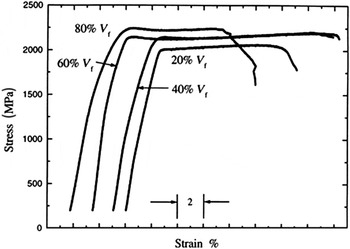
Choi-Yim et al.[Reference Choi-Yim, Conner, Szuecs and Johnson14] showed that the addition of ductile metal phases within a BMG matrix experiences different needs according to the nature of loading. As noted, particle/matrix interface is less important in improving material properties in situations of compressive loading compared with tensile loading. The explanation for this is that interfacial bonding is important to stress distribution when loads are compressive, whereas strong bonding is critical for better dispersion of forces when the composite is stressed in tension. The volume fraction of reinforcement particles is also important for mechanical performance of ex situ composites. As noted by Choi-Yim et al.,[Reference Choi-Yim, Conner, Szuecs and Johnson14] large amounts of ex situ reinforcement particles have a significant effect on enhancing BMG plasticity. Some ex situ BMGCs have generated promising results, with Conner et al.[Reference Conner, Dandliker and Johnson18] recording plastic strains of up to 16% in compression for a tungsten wire-reinforced Zr-based composite (Fig. 11), compared with <0.5% for the monolithic glass.
Room temperature stress–strain curves for uniaxially compressed tungsten-reinforced Zr41.25Ti13.75Cu12.5Ni10Be22.5 BMGCs containing varying fiber volume fractions (V f). Reproduced with permission from Conner et al.[Reference Trexler and Thadhani18] (© 1998, Elsevier).

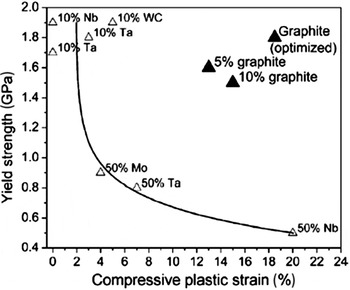
There is a possible limitation of using particulates as a reinforcement in amorphous alloys, whereby the plastic strain is increased but the yield strength is reduced[Reference Choi-Yim, Conner and Johnson30] (Fig. 12). An exception was shown for graphite particle reinforced BMGs, where the best combination of strength and ductility properties was obtained for 3–10 vol.% (44–75 µm sized) graphite.[Reference Siegrist and Löffler38] A compressive plastic strain of 18.5% was achieved without sacrificing the high 1.85 GPa yield strength of the matrix material.
Room temperature yield strength and compressive plastic strain of 5 vol%, 10 vol% and optimised graphite-reinforced BMGCs showing the high strength/ductility combination in comparison with those of other melt-processed Zr-based foreign-particle-reinforced BMGCs. The optimized specimen has a graphite volume fraction of 3 vol% with sizes of 44–75 µm, whereas in other cases 25–44 µm were used. Reproduced with permission from Siegrist and Löffler[Reference Trexler and Thadhani38] (© 2007, Elsevier).

Selected mechanical properties of in situ BMGCs
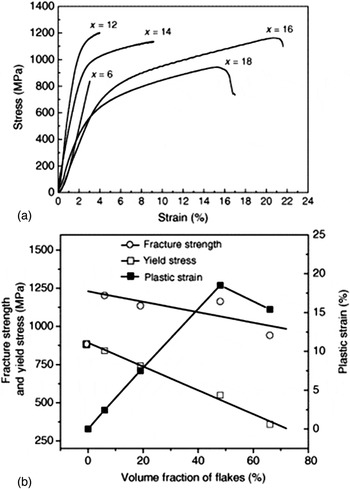
In terms of mechanical performance, in situ BMGCs have experienced a broad range of success. For example, early work by Inoue and co-workers[Reference Fan, Li, Inoue and Haas54] obtained nanocomposites by annealing a glassy precursor and improved the plasticity by up to 2.5% in compression. Subsequently, work done by in situ precipitating out ductile dendritic crystalline phases during solidification from the melt also produced BMGCs exhibiting significant ductility.[Reference Szuecs, Kim and Johnson20] Similarly, Lee et al.[Reference Lee, Li and Schuh11] reported a 6% tensile ductility in a La-base BMGC where they identified two common features for increasing ductility[Reference Fu, Li and Schuh55]: (i) a high volume fraction of the second phase above a certain value needs to be present in the amorphous matrix, and (ii) the second phases must be inherently ductile crystalline phases such as pure La in their La-base BMGCs. Hui and co-workers[Reference Hui, Dong, Chen and Yao47, Reference Li, Hui, Zhang and Chen56] recently developed a light-weight Mg-based in situ BMGC similar to that shown in Fig. 10 that sustains up to 18.5% compressive strain at a fracture strength of 1.1 GPa (Fig. 13).
(a) Room-temperature compressive stress–strain curves for Mg65+x(Cu0.667Y0.333)30−xZn5 (x = 6, 12, 14, 16, and 18) in situ BMGCs containing similar two-phase structures to that shown in Fig. 10a. (b) The compressive yield stress, fracture strength, and plastic strain of the composites as a function of volume fraction of Mg flakes. Reproduced with permission from Hui et al.[Reference Trexler and Thadhani47] (© 2007, Elsevier).

A range of studies on Zr-based BMGC systems have also yielded very promising results. Hays et al.[Reference Hays, Kim and Johnson17] generated β-phase Ti–Zr–Nb dendrites within a Zr–Ti–Nb–Cu–Ni–Be matrix and obtained an elastic modulus of E = 110 GPa, σ UTS = 1.7 GPa and a total strain to failure of over 8%. This compares significantly to the monolithic Zr41.2Ti13.8Cu12.5Ni10Be22.5 (Vitreloy 1) precursor, which exhibits a 1.9 GPa tensile strength but only 2% strain to failure. A small sacrifice in total strength seems well compensated by the considerable gain in tensile ductility. Charpy impact toughness was also observed to be higher in the Zr-based BMGC, recording values at 200 kJ/m2 compared with 80 kJ/m2 for the monolithic BMG.[Reference Hays, Kim and Johnson27]
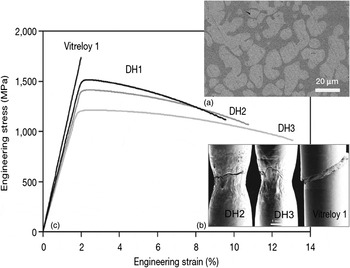
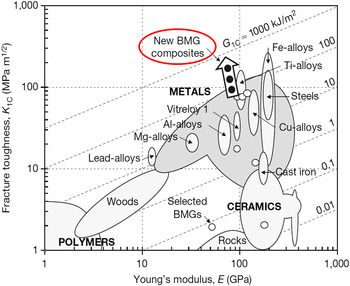
Hofmann et al.[Reference Hofmann, Wiest, Duan, Lind, Demetriou and Johnson13] recently reported a dramatic improvement in the combination of strength, ductility, and toughness of Ti–Zr-based BMG compositions by heating their alloys into the semi-solid region and holding isothermally for several minutes followed by rapid quenching; a two-phase microstructure containing a uniform distribution of dendrites in a glassy matrix was generated [Fig. 14(a)]. During tensile testing, these BMGCs exhibited necking behavior rather than shearing [Fig. 14(b)] and a ductility in excess of 10% and yield strengths of 1.2–1.5 GPa [Fig. 14(c)]. Moreover, K 1C-values up to ~170 MPa m1/2 and fracture energies for crack propagation as high as G 1C ≈ 340 kJ m−2 were reported, thereby equaling or exceeding those achievable in the toughest titanium or iron alloys. Figure 15 illustrates how these new BMGCs are ideally placed in an unfilled region of key property space. The enhanced plasticity in these BMGCs was argued to be due to any shear bands initiated in plastically soft regions (with lower yield stress or lower shear modulus) being arrested in surrounding regions of higher yield stress or stiffness. This enhancement of ductility and toughness is analogous to the toughening of plastic by inclusion of rubber particles.[Reference Liang and Li57]
(a) SEM micrograph of a typical in situ Zr–Ti-based BMGC (DH3) containing a dendritic network (light phase) dispersed throughout the glassy matrix. (b) SEM micrographs of tensile-strained Zr–Ti-based BMGCs (DH2 and DH3) and the monolithic BMG (Vitreloy 1) showing substantial necking in the former and classic brittle fracture in the latter. (c) Engineering stress–strain curves for Vitreloy 1 and Zr–Ti-based BMGCs. The BMGC compositions are variations of Vitreloy 1 (Zr41.2Ti13.8Cu12.58Ni10Be22.5): Zr36.6Ti31.4Nb7Cu5.9Be19.1 (DH1), Zr38.3Ti32.9Nb7.3Cu6.2Be15.3 (DH2) and Zr39.6Ti33.9Nb7.6Cu6.4Be12.5 (DH3) contain 42%, 51%, and 67% dendritic phase in a glassy matrix, respectively. Adapted from Hofmann et al.[Reference Trexler and Thadhani13]

Ashby plot of fracture toughness and Young's modulus for a range of engineering materials showing the occupation of a new region of property space for the in situ BMGCs shown in Fig. 15. Reproduced with permission from Hofmann et al.[Reference Trexler and Thadhani13] (© 2008, Nature).

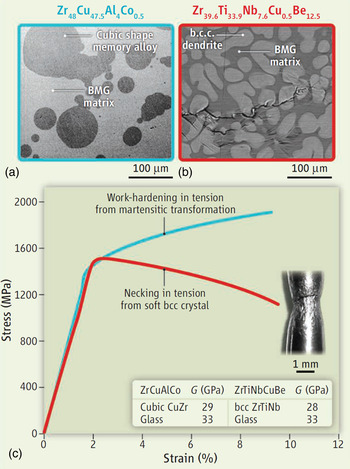
A new and innovative method for improving the ductility of BMGs utilizes the shape memory effect (martensitic transformation) whereby a shape memory crystalline phase is dispersed throughout an amorphous matrix.[Reference Hofmann58–Reference Gargarella, Pauly, Song, Hu, Barekar, Samadi Khoshkhoo, Teresiak, Wendrock, Kühn, Ruffing, Kerscher and Eckert61] These composites exhibit large ductility and high strength combined with a strong work-hardening behavior. Such materials were originally demonstrated for a two-phase shape memory/metallic glass composite in Cu47.5Zr47.5Al5 by annealing at high temperatures to partially crystallize the matrix into the cubic phase.[Reference Pauly, Gorantla, Wang, Kühn and Eckert59, Reference Pauly, Liu, Wang, Das, Kim, Kühn and Eckert60] The partial crystallization of the BMG into a composite containing the shape-memory phase resulted in extensive work hardening and enhanced tensile ductility (Fig. 16). Most recently, Ti–Cu–Ni shape memory alloy (SMA) reinforced BMGCs were obtained by carefully controlling the cooling rate upon quenching. This generated a metastable microstructure consisting mainly of ductile, spherical martensitic Ti(Ni,Cu) precipitates embedded in an amorphous matrix, as well as a small volume fraction of TiCu and Ti2Cu precipitates. The behavior was explained by the shear bands that form above the yield stress in the glassy matrix are arrested by the soft cubic phase, which then undergoes a martensitic transformation into the harder monoclinic phase. This causes a cascade of shear bands to form. Overall, the blocking effect of the precipitates and the work-hardening effect of the martensitic phase are responsible for the enhanced mechanical properties of these alloys. The discovery of SMA-reinforced BMGCs greatly enhance the potential structural applications for amorphous alloys.[Reference Hofmann58]
Tensile ductility of a new class of shape memory alloy (SMA) reinforced BMGCs. (a) SEM micrograph of a CuZrAlCo composite showing the isolated SMA phase embedded in a glassy matrix. (b) SEM micrograph of a ZrTiNbCuBe composite showing isolated body-centerd cubic dendrites embedded in a glassy matrix (also showing a crack arrested by the microstructure). (c) Tensile tests representative of the work-hardening behavior observed in SMA-reinforced composites and the necking behavior observed in b.c.c-dendrite-reinforced composites. Inset: the shear modulus of the crystal and glass matrix of both composites show that the inclusion is a soft phase, a criterion that is expected to produce substantial tensile ductility. Reproduced with permission from Hofmann[Reference Trexler and Thadhani58] (© 2010, Science).

Concluding summary
BMGs possess some very desirable mechanical and chemical properties that may find great use in a variety of structural applications. With yield strengths of nearly three times the crystalline alloy of equivalent composition, excellent specific properties, and high elastic strains, BMGs are competitive against the most advanced nanostructure and composite structural materials. However, the primary limitation of most BMGs in load-bearing roles is their lack of macroscopic plasticity caused by uncontrolled shear band propagation, whereby stress concentration in narrow shear bands accentuates localized stress such that band propagation occurs quickly and dramatically resulting in catastrophic failure. Based upon this knowledge, considerable research has focused on developing BMG microstructures that effectively control shear band behavior for generating more ductile materials. BMGCs have been investigated for this purpose, with various ex situ and in situ types under development. Ex situ BMGCs are produced by adding a foreign phase such as fibers, wires, whiskers, or particulates to the alloy during either casting or by co-processing the BMG (powder, sheets, etc.) and second phase in the SCLR. In contrast, in situ BMGCs are produced directly from the melt by chemical separation of a liquid into two distinct phases (i.e., a glassy matrix and crystalline particles or dendrites, etc.) or by partial crystallization of the as-cast BMG on either reheating or during mechanical processing above the glass transition temperature.
As noted, the main purpose of the second phase in BMGCs is to improve ductility by altering or impeding the dynamic path of propagating shear bands and absorbing shear strain or energy through the nucleation and redirection of multiple shear bands in the glassy matrix. With ex situ processing methods, homogenous second phase distribution is possible using a large variety of second phases. However, it has been found that an increase in plastic strain is usually accompanied by a decrease in the yield strength compared with the monolithic BMG. In addition, since most ex situ BMGCs are melt processed, unwanted interfacial reactions often occur that may lead to weakening of the composite. In situ BMGCs usually contain ductile crystalline particles or dendrites that are reasonably homogeneously distributed throughout the glassy matrix. These phases typically act as initiation sites for shear bands, resulting in multiple banding; this enables in situ BMGCs to exhibit significantly improved plasticity (albeit at a small cost of strength) due to better control of shear band propagation through the glassy matrix. Nevertheless, some fundamental challenges of in situ BMGCs include the difficulty in reproducing the desired microstructures during casting and the likelihood that only a restricted number of glass-forming compositions develop ductile phases for reinforcing the BMG matrix.
Acknowledgments
The authors gratefully acknowledge the continuing support of the Australian Research Council Centre of Excellence for Design in Light Metals (Grant No. CEO561574) for partly funding our research on bulk metallic glasses and their composites.