Introduction
Disordered eating (DE) refers to sub-threshold variants of threshold eating disorders (TED: e.g., anorexia nervosa, bulimia nervosa and binge eating disorder) and include behaviours such as fasting, binge eating, vomiting, laxative use, or maintaining body mass index (BMI) < 18.5, in addition to substantial concerns about food, body weight and shape. The pursuit of efficacious DE risk reduction is of critical importance for many reasons (Wilksch, Reference Wilksch2014; Austin, Reference Austin2016). First, DE can be a risk factor for the development of TED (Patton et al. Reference Patton, Selzer, Coffey, Carlin and Wolfe1999; Wertheim et al. Reference Wertheim, Koerner and Paxton2001; Stice et al. Reference Stice, Davis, Miller and Marti2008a). Second, the prevalent nature of DE, as highlighted by an Australian cohort study (N = 9688) where DE was observed in 23% of young-adult women (Wade et al. Reference Wade, Wilksch and Lee2012). Third, evidence suggests those with DE experience similar impairment in functioning and quality of life as those with TED (Fairburn & Cooper, Reference Fairburn and Cooper2011; Fairweather-Schmidt & Wade, Reference Fairweather-Schmidt and Wade2014). Fourth, DE has been prospectively linked to symptoms of depression, anxiety, and suicidality (Braun et al. Reference Braun, Sunday and Halmi1994; Franko & Keel, Reference Franko and Keel2006). Fifth, DE in mid-adolescence is prospectively associated with the development of overweight and obesity at 6-year follow-up, independent of baseline or parental BMI (Herpertz-Dahlmann et al. Reference Herpertz-Dahlmann, Dempfle, Konrad, Klasen and Ravens-Sieberer2015). Sixth, DE can persist or increase from adolescence into adulthood (Kotler et al. Reference Kotler, Cohen, Davies, Pine and Walsh2001; Neumark-Sztainer et al. Reference Neumark-Sztainer, Wall, Larson, Eisenberg and Loth2011). A recent survey of 50 000 Australian females and males aged 11–24 years (Mission Australia, 2010) found that body image ranked as the highest personal concern by 28.1% of 11–14 year-olds, 33.3% of 15–19 year-olds, and 40.3% of 20–24 year-olds. These studies suggest that body image and eating pathology are not limited to adolescence; rather, they increase during early adulthood. Clearly, the burden and consequences of DE are immense and require efficacious risk reduction programs that can be easily disseminated at-scale.
Prevention programs for DE usually occur across the spectrum of universal (e.g. large groups of participants regardless of baseline level of DE risk), selective [e.g. participants selected based on a prospectively identified risk factor (e.g. females)], and indicated (i.e. participant selection based on exhibiting clear precursors to an ED such as elevated weight concerns). Three indicated risk reduction programs have had favourable outcomes across multiple randomized controlled trials (RCTs): The Body Project (Stice et al. Reference Stice, Mazotti, Weibel and Agras2000); Healthy Weight (Stice et al. Reference Stice, Chase, Stormer and Appel2001); and, Student Bodies (SB: Winzelberg et al. Reference Winzelberg, Eppstein, Eldredge, Wilfley, Dasmahapatra and Dev2000). The first two are delivered face-to-face, while SB is delivered online with therapist moderation. For the current study where the goal was to evaluate programs in a ‘real-world’ context, it was thought that online programs would be more scalable at lower cost, thus SB was included. Since the commencement of this research, an online version of The Body Project has been investigated (Stice et al. Reference Stice, Rohde, Durant and Shaw2012).
Online risk reduction programs are becoming more common across the DE prevention spectrum (e.g. see Melioli et al. Reference Melioli, Bauer, Franko, Moessner, Ozer and Chabrol2016). Online delivery holds the appeal of sidestepping two important gaps in reducing the burden of mental illness (Patel et al. Reference Patel, Chowdhary, Rahman and Verdeli2011; Kazdin et al. Reference Kazdin, Fitzsimmons-Craft and Wilfley2017): the research-practice gap (efficacious delivery of evidence-based programs in the real world); and, the treatment gap (discrepancy between those who could benefit from services and those who receive such services). Specifically, ‘pure self-help’ online interventions (i.e. no personalized online therapist moderator) do not require training of health providers to deliver – the intervention is designed by the specialist, made available online and then accessed directly by individuals at scale. As such, online interventions have no limitation to the number of participants who can participate, unlike face-to-face services that are bound by the availability of service providers, training of these providers, and, assumptions intervention fidelity is maintained.
SB has been evaluated in 11 RCTs, seven in the USA (Winzelberg et al. Reference Winzelberg, Taylor, Sharpe, Eldredge, Dev and Constantinou1998; Celio et al. Reference Celio, Winzelberg, Wilfley, Eppstein-Herald, Springer and Dev2000; Winzelberg et al. Reference Winzelberg, Eppstein, Eldredge, Wilfley, Dasmahapatra and Dev2000; Bruning Brown et al. Reference Bruning Brown, Winzelberg, Abascal and Taylor2004; Low et al. Reference Low, Charanasomboon, Lesser, Reinhalter, Martin and Jones2006; Taylor et al. Reference Taylor, Bryson, Luce, Cunning, Doyle and Abascal2006; Kass et al. Reference Kass, Trockel, Safer, Sinton, Cunning and Rizk2014; Taylor et al. Reference Taylor, Kass, Trockel, Cunning, Weisman and Bailey2016) and four in Germany (Jacobi et al. Reference Jacobi, Morris, Beckers, Bronisch-Holtze, Winter and Winzelberg2005, Reference Jacobi, Morris, Beckers, Bronisch-Holtze, Winter and Winzelberg2007; Jacobi et al. Reference Jacobi, Völker, Trockel and Taylor2012). These samples have included young-adult or late adolescent females from college and high-school settings. The most methodologically rigorous trial was with college-aged women with elevated weight concerns (M age = 20.8 years: Taylor et al. Reference Taylor, Bryson, Luce, Cunning, Doyle and Abascal2006), showing significant differences of moderate effect size (ES) at 1-year follow-up favouring the SB for weight and shape concern, global measures of disordered eating, and ED risk factors. Although no main effects were shown for prevention of ED onset, prevention effects were found for two subsets of users at 2-year follow-up: those who were overweight at baseline (i.e. SB = 0% v. controls = 10.8%); and, at one site, amongst those engaging in compensatory behaviours at baseline (i.e. SB = 14.4% v. controls = 30%). A comparison of guided v. self-help versions of SB (conducted concurrently to the current trial) found the guided group had significantly lower weight concerns and lower odds of remaining at high risk of an ED than the non-guided group at post-intervention (M age = 20.1 years: Kass et al. Reference Kass, Trockel, Safer, Sinton, Cunning and Rizk2014). While a recent RCT for those at ‘very high risk’ of an eating disorder (Taylor et al. Reference Taylor, Kass, Trockel, Cunning, Weisman and Bailey2016) found amongst participants with high shape and weight concerns, ED onset was significantly lower in the SB group compared with controls (SB = 20% v. controls = 42%).
To date SB has not been compared with another intervention. In the current study we compared it with Media Smart-Targeted (MS-T), an adapted online version of an 8-lesson school-based program (MS) that has been found to reduce ED risk factors relative to controls and active interventions in young-adolescent (Grades 7 and 8) girls and boys (Wilksch & Wade, Reference Wilksch and Wade2009; Wilksch et al. Reference Wilksch, Paxton, Byrne, Austin, McLean and Thompson2015). MS is one of the most robust universal ED risk reduction programs (Levine & Smolak, Reference Levine and Smolak2016; Piran, Reference Piran2015) and has been found to significantly lower shape and weight concerns in girls over a 2.5-year follow-up (Wilksch & Wade, Reference Wilksch and Wade2009) and halve the risk of onset of clinical concerns about shape and weight at 12-month follow-up (Wilksch et al. Reference Wilksch, Paxton, Byrne, Austin, McLean and Thompson2015). The current study was the first evaluation of MS-T.
The World Health Organization estimates 22 as the peak age in the relative value of healthy lived years (Murray & Lopez, Reference Murray and Lopez1996) and thus DE risk reduction in young-adults is important to ensure this peak productivity is not compromised and to prevent impairment over future years (Wade et al. Reference Wade, Wilksch and Lee2012). Thus the primary aim of this research was to evaluate the ‘real world’ effectiveness of an established online ED prevention program (SB) relative to a new online program (MS-T) and a control condition with young-adult women. Related to this, we sought to maximize the external validity of this research by: using a general community population as opposed to university and school-based settings typically investigated; and, allowing participants with higher baseline levels of eating pathology than in previous trials.
Methods
Participants
Participants were women aged 18–25 years from Australia and New Zealand who wished to improve their body image. Participants self-referred through advertisements posted around university campuses, social media online, and, health clinic waiting rooms. Exclusion criteria were minimal: suicide risk [e.g. have a suicide plan (Lecrubier et al. Reference Lecrubier, Sheehan, Weiller, Amorim, Bonora and Harnett Sheehan1997)]; alcohol or substance abuse [e.g. the presence of withdrawal effects when reducing use (Lecrubier et al. Reference Lecrubier, Sheehan, Weiller, Amorim, Bonora and Harnett Sheehan1997)]; or, self-reported BMI < 15.0. Women with premorbid DE were included in the study, to reflect the real-world likelihood of such women accessing online resources.
Conditions
SB has been described in detail (Winzelberg et al. Reference Winzelberg, Eppstein, Eldredge, Wilfley, Dasmahapatra and Dev2000), as has MS (Wilksch & Wade, Reference Wilksch and Wade2009). SB and MS-T are 9-module programs that follow the principles of effective prevention, such as interactive content and targeting prospectively identified ED risk factors (Stice et al. Reference Stice, Shaw and Marti2007). Consistent with previous SB trials (Taylor et al. Reference Taylor, Kass, Trockel, Cunning, Weisman and Bailey2016), both programs released modules weekly via a password-protected mobile internet-platform and both programs were a pure self-help format (no online therapist moderator). The SB program was delivered in its usual form on a mobile platform but without moderation. Participants were encouraged to view content (e.g. written, video), respond to questions, and complete accompanying assignments. Supplementary Table 1 provides a description of the programs. Both target weight concerns, a robust and proximal ED risk factor (Jacobi et al. in press), but do this in differing ways. SB focused on behavioural targets (e.g. eating, exercise) that are proximal to DE in risk factor models while MS-T focused more on cognitive components (e.g. media internalization, ineffectiveness) that are more distal in such models (Stice, Reference Stice2001; Fairburn et al. Reference Fairburn, Cooper and Shafran2003).
The translation of MS to MS-T was guided by three rationale. First, the theoretical targets of MS (media internalization) are informed by the dual-pathway model, developed from risk factor research with young-adult women and thus relevant to this population (Stice, Reference Stice2001). Second, The Body Project also targets this variable and has been found to be effective with this population (Stice et al. Reference Stice, Rohde, Gau and Shaw2009). Third, given that results for universal samples are usually of a smaller effect than for university-aged, high-risk samples (Stice et al. Reference Stice, Shaw and Marti2007), it was expected that MS-T could produce at least comparable outcomes to MS.
MS-T was developed over an 18-month process of: writing and adapting each module to include age-appropriate content; pilot testing; ensuring accurate data collection; and, further revisions. For example where module 3 in MS provided a clip on standing up to peer pressure on teen drinking, in MS-T this was replaced by a post titled ‘You look so different on Facebook’ and then examining strategies to reduce pressures felt from social media usage. The new content included a focus on: emotion regulation, goal setting, and ‘healthy eating’, which included four tips informed by risk factor research: eat breakfast; eat regularly; drink water; and, dieting as unhelpful. MS-T modules were designed to be of comparable length and aesthetics to SB, to reduce confounds. There was one difference of note: MS-T participants received an automated weekly email to advise their module was available, whereas SB participants did not. The control condition involved one email containing 10 tips for improving body image as used in other targeted trials (e.g. Stice et al. Reference Stice, Rohde, Shaw and Gau2011).
Procedure
Approval for this research was received from the Flinders University Social and Behavioural Research Ethics Committee. Potential participants were directed to the study website where they were provided with information, consent procedures, and baseline questionnaires. Upon completion and meeting inclusion criteria, participants were automatically randomized to one of the three groups. Randomization was stratified by age (18–21 years; 21.01 years- 25 years) and baseline scores on the Weight Concerns Scale (<47; >47: WCS: Killen et al. Reference Killen, Taylor, Hayward, Wilson, Haydel and Hammer1994). A WCS score of 47 or higher has been found to have a sensitivity of 79%, specificity of 67%, and positive predictive value of 13% for identifying adolescents who developed partial- or full-syndrome EDs (Jacobi et al. Reference Jacobi, Abascal and Taylor2004).
Age was included as a proxy for duration of body image concerns (Rohde et al. in press). Whilst participants were accepted across the WCS score spectrum in line with the pragmatic RCT, we expected the majority of participants to score ⩾47. Participants allocated to an intervention were able to access their respective website immediately. All participants received an email reminder to complete post-program measures 10-weeks after baseline. This process was repeated at 6- and 12-month follow-up. If a participant did not commence the measures at any time point they received two further email reminders at weekly intervals. Participants who completed a minimum of three assessment points received a $50 gift voucher as reimbursement for their time. Intervention participation was not a requirement for this reimbursement.
Measures
Primary outcome
The Eating Disorder Examination Questionnaire (EDE-Q) Global was used to provide a continuous measure of eating pathology. The use of the EDE-Q was consistent with the pragmatic, ‘pure self-help’ nature of this trial where phone interview (i.e. EDE) could deter participation and would be unlikely in real-world implementation. The EDE-Q has only moderate diagnostic concordance against the EDE (Berg et al. Reference Berg, Stiles-Shields, Swanson, Peterson, Lebow and Le Grange2012) and therefore diagnostic categories were not utilized.
Secondary outcomes
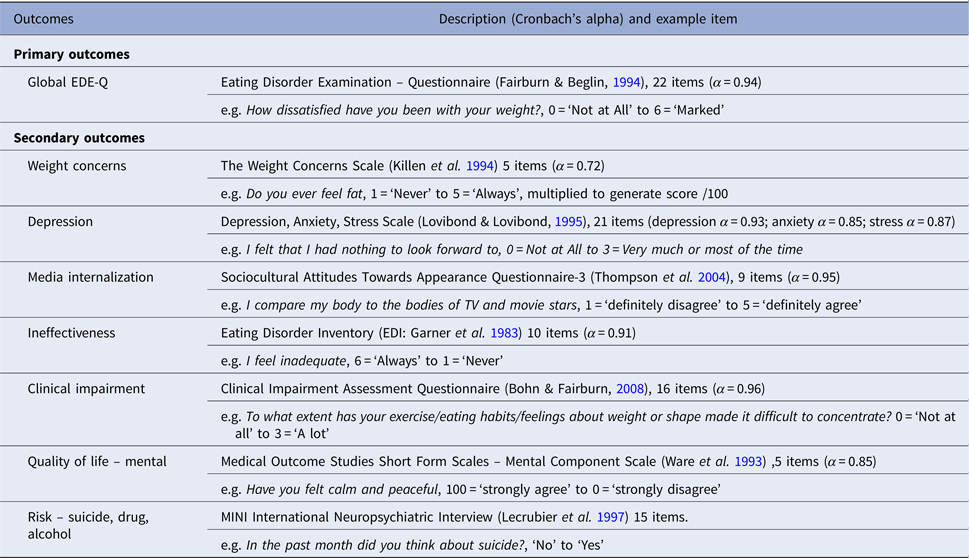
A range of risk factor and impairment measures in addition the EDE-Q were selected based upon the evidence supporting their construct validity (Sheehan et al. Reference Sheehan, Lecrubier, Harnett Sheehan, Janavs, Weiller and Keskiner1997; Espelage et al. Reference Espelage, Mazzeo, Aggen, Quittner, Sherman and Thompson2003; Jacobi et al. Reference Jacobi, Abascal and Taylor2004; Thompson et al. Reference Thompson, van den Berg, Roehrig, Guarda and Heinberg2004; Henry & Crawford, Reference Henry and Crawford2005; Berg et al. Reference Berg, Peterson, Frazier and Crow2011; Vannucci et al. Reference Vannucci, Kass, Sinton, Aspen, Weisman and Bailey2012) and their frequent use in other prevention trials (e.g. Taylor et al. Reference Taylor, Bryson, Luce, Cunning, Doyle and Abascal2006; Wilksch & Wade, Reference Wilksch and Wade2009). Higher scores indicated higher levels of risk for all but the quality of life mental scale, where a lower score indicated a poorer outcome (see Table 1).
Summary and description of primary and secondary outcome self-report measures

Tertiary outcomes
Consistent with previous investigations (Bardone-Cone et al. Reference Bardone-Cone, Harney, Maldonado, Lawson, Robinson and Smith2010), DE was defined as having a global EDE-Q score ⩾1 SD of the community mean (i.e. 2.46: Mond et al. Reference Mond, Hay, Rodgers, Owen and Beumont2004), and the presence of one or more of the following in the previous 4-week period: objective bulimic episode; fasting; vomiting or laxatives to control weight; or BMI < 18.5. Thus DE was a dichotomous outcome and allowed exploration of both prevention (DE status at follow-up for those who did not have DE at baseline) and treatment effects (DE status at follow-up for those who had DE at baseline).
Statistical analyses
Participant flow, variables impacting intervention access and baseline differences
Demographic details were investigated (e.g. age, living location) using analysis of variance (ANOVA) and χ2 analyses. Potential variables impacting on intervention access were examined univariately and then multivariately using linear regressions.
As data were only analyzed for those participants who accessed their intervention, consistent with previous investigations (e.g. Taylor et al. Reference Taylor, Bryson, Luce, Cunning, Doyle and Abascal2006), logistic regressions investigated baseline differences between participants who accessed their allocated intervention, v. those who did not. They were also used to compare rates of module completion across interventions. Baseline differences across the three groups were analyzed using ANOVAs for continuous measures and χ2 for dichotomous outcomes, with an alpha level of 0.05.
Missing data and intervention completion rates
To determine whether data were missing at random, logistic regressions were used to assess whether ‘measure completers’ (those who completed baseline measures and at least one other assessment point, the minimum necessary given baseline was a covariate in analyses) differed from those who only completed baseline measures in the intervention conditions. Logistic regressions were also used to compare rates of module access and completion between MS-T and SB.
Due to an error in the US web company hosting SB, program usage data for n = 50 consecutive new SB participants over a 2.5-month period was not available. Thus there were no means for identifying if these users accessed SB. Logistic regression analyses found no significant baseline differences between these n = 50 cases v. the other n = 140 SB participants for any outcome variable [e.g. EDE-Q Global: OR = 1.14, 95% CI (0.90–1.46)]. These participants were omitted from all further analyses.
Primary and secondary outcomes
Linear mixed model (LMM) analyses, with baseline observations used as a covariate to ensure that any observed effects for that variable were due to changes at post-program and follow-up, were used to compare the impact of the conditions. A 3 (group: MS-T, SB, Control) × 3 (time: post-program, 6-month follow-up; 12-month follow-up) design was used, allowing for direct comparisons between the groups at post-program and follow-up using Bonferroni-adjusted post-hoc analyses. Cohen's d between group ES with 95% confidence intervals (CI) were calculated using means and standard errors from the LMM. Analyses were run in two ways. First, intent-to-treat (ITT) analyses included all participants who accessed their intervention at least once (MS-T = 122; SB = 98) and all controls (n = 194; Total N = 414), regardless of if the participant completed any further measures after baseline. These ITT analyses were conducted using multiple imputation (MI) in SPSS to estimate missing values using Bayesian analysis (Enders, Reference Enders2010). The imputation step of the procedure used all the outcome variables at each assessment and the number of modules completed (the control group was scored as having completed no modules). MI incorporates post-randomization variables that are not part of the analysis model (intervention models completed) in the imputation step and so enable an analysis that is valid under a more realistic missing at random assumption (Sterne et al. Reference Sterne, White, Carlin, Spratt, Royston and Kenward2009). Five data sets were imputed. Second, using all available data for measure completers (MS-T = 82; SB = 70; controls n = 169; N = 321).
Tertiary outcomes
Both prevention (DE status for those who did not have DE at baseline, N = 92) and treatment effects (DE status for those who had DE at baseline, N = 169) were investigated for measure completers at 12-month follow-up. Odds ratios (OR) and 95% CI from logistic regressions were used to compare DE status at 12-month follow-up in the intervention groups relative to the control group. These analyses were also run adjusting for receiving any external professional treatment (e.g. psychologist, psychiatrist) at any of the four assessment points.
Results
Participant flow
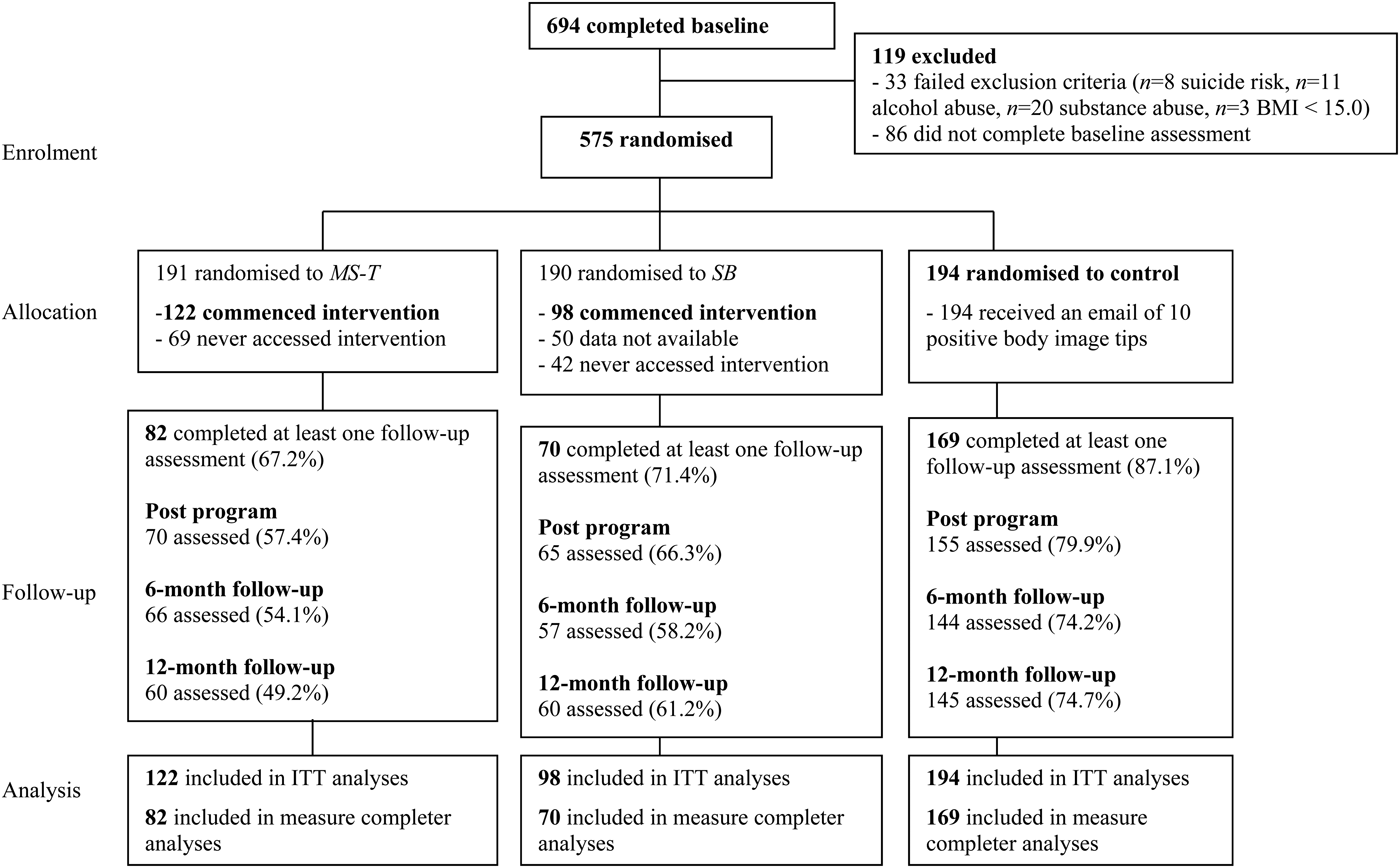
Participant flow can be seen in Fig. 1. Recruitment occurred over a 12-month period between 3 November 2014 and 1 November 2015, with the final 12-month follow-up assessment completed on 29 December 2016. N = 608 women (M age = 20.71 years, SD = 2.26, range 18–25 years) completed baseline measures, with 33 participants excluded due to one or more of the following: suicide risk (n = 8); alcohol abuse (n = 11); substance abuse (n = 20); and, BMI < 15.0 (n = 3). Thus N = 575 were randomized to MS-T, SB or control.
Participant flow chart.

The most common sources of recruitment were: flyers at universities and colleges (n = 179; 29.7%); social media (n = 164; 27.2%); and, media reports (n = 114; 18.9%). Participants lived in each state and territory of Australia (n = 460) and NZ (n = 144). Capital cities (n = 362; 59.7%) were the most common location followed by regional towns (n = 207; 34.2%). Current undergraduate was the most common education level (n = 229; 37.9%), followed by completion of year 12 (n = 169; 27.9%) and completion of the undergraduate degree (n = 169; 18.8%). Ethnicity included: Caucasian – Australian (n = 367; 60.4%), followed by Caucasian – NZ (n = 131; 21.7%), and Asian (n = 53; 8.8%).
Variables impacting on intervention access
Five variables were significantly associated with likelihood of accessing an intervention: age [OR = 1.14, 95% CI (1.02–1.27)]; attitude towards program participation [OR = 0.53, 95% CI (0.35–0.82)]; EDE-Q – Global [OR = 1.21, 95% CI (1.02–1.44)]; clinical impairment [OR = 1.03, 95% CI (1.01–1.05)]; and quality of life – mental [OR = 0.99, 95% CI (0.98–1.00)]. Attitude towards program participation was the only predictor to remain significant [OR = 0.56, 95% CI (0.37–0.86)] in a simultaneous multiple regression, where participants were significantly more likely to access the intervention if they identified themselves as ‘committed to trying the program’.
Baseline measures
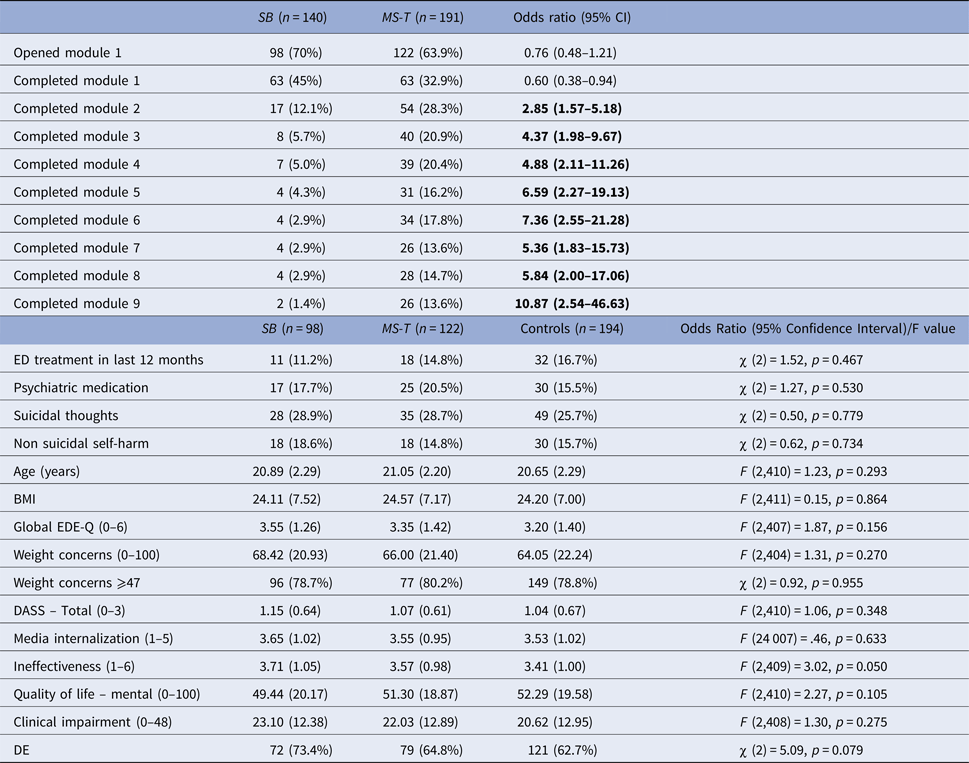
Table 2 presents baseline scores by group for those who accessed their intervention (MS-T = 122; SB = 98) and controls (n = 194). No significant differences were found.
Rates of access and completion of Student Bodies and Media Smart-Targeted and baseline scores across conditions

Note: ED, eating disorder; BMI, body mass index; EDE-Q, eating disorder examination – questionnaire; DASS, depression, anxiety, stress scale; DE, disordered eating case. Bonferroni-adjusted p value for multiple testing in rates of module completion (0.05/9) to p = 0.06. Frequencies (and percentages) are reported for dichotomous variables while means (and standard deviations) are provided for continuous measures. Bolded values indicate significant odds ratios (p < 0.05)
Missing data
No significant differences were found between intervention participants who completed more than one assessment point (n = 150: MS-T = 82; SB = 68) and those who completed baseline only (n = 70: MS-T = 40; SB = 30). EDE-Q Global [OR = 1.05, 95% CI (0.85–1.29)], risk factors [e.g. internalization: OR = .87, 95% CI (0.64–1.17)], BMI [OR = 1.25, 95% CI (0.78–1.99)], and, DE [OR = .81, 95% CI (0.50–1.33)], were all non-significant. There was no significant difference in rates of post-program and follow-up measure completion between MS-T and SB [OR = .90, 95% CI (0.51–1.60)]. Module completion was significantly positively associated with assessment completion at post-program and follow-up [OR = 2.02, 95% CI (1.44–2.84)], indicating the inclusion of module completion as a variable in the determination of MI.
Intervention completion
Table 2 presents completion rates of each module for SB (n = 140) and MS-T (n = 191). A total of n = 111 (33.5%: SB = 42 + MS-T = 69 = 111/331) of participants did not open their allocated intervention. There were no significant differences in rates of first accessing the interventions or completion of module 1. From module 2 through 9, a significantly higher proportion of participants completed MS-T than SB. Of the participants who completed module 1 of their programs (SB = 63; MS-T = 63), n = 2 (3.2%) and n = 26 (41.2%) completed the full SB and MS-T programs, respectively.
Primary outcome
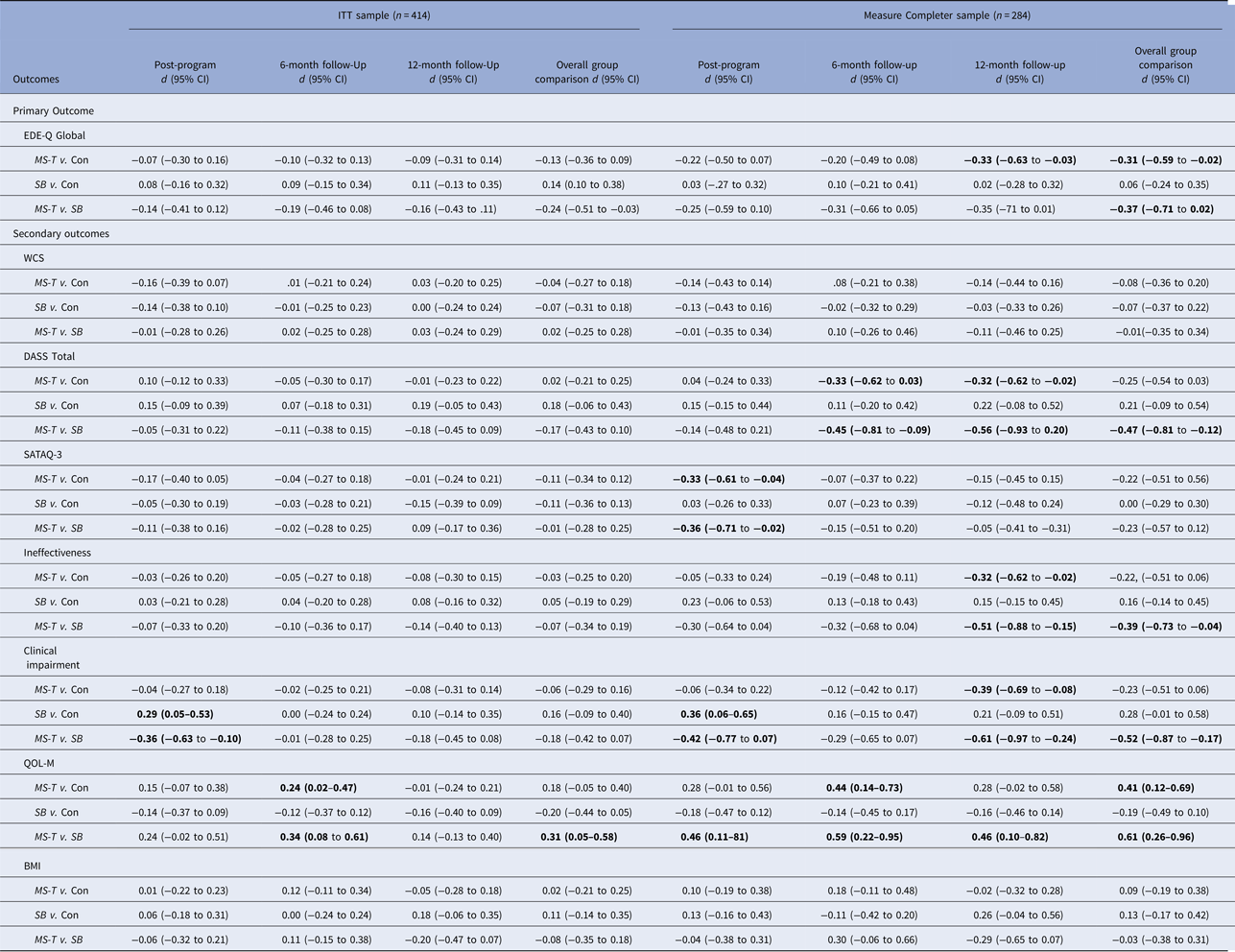
ITT analyses found no significant differences in EDE-Q Global outcomes across the three groups (see Table 3). Measure completer analyses found MS-T participants had significantly lower EDE-Q Global scores than controls at 12-month follow-up. Main effects for group favouring MS-T were found for comparisons with both the control and SB groups. ES were small.
Effect sizes (Cohen's d) for between-groups pairwise comparisons for primary and secondary outcomes

Note: MS, Media Smart; SB, Student Bodies; Con=, control; CI=, confidence intervals; EDE-Q, eating disorder examination- questionnaire; WCS, weight concerns scale; DASS, depression, anxiety, stress scales; SATAQ-3, sociocultural attitudes towards appearance questionnaire-3; QOL-M, quality of life – mental; BMI, body mass index; ITT, intent-to-treat sample using multiple imputation for missing data; Measure completer sample, participants who completed baseline and at least one other assessment point. For continuous outcomes, a negative d indicates group 1 scoring at lower risk than group 2 for all measures apart from QOL-M, where a positive d indicates group 1 had a higher QOL-M. Between-group comparisons that are significantly different are bolded (p < 0.05). *12-month follow-up frequencies for new disordered cases at 12-month follow-up that did not meet diagnosis at baseline. ^12-month follow-up frequencies for cases who did meet disordered eating diagnosis at baseline but who did not meet diagnosis at 12-month follow-up. Between-group comparisons that are significantly different are bolded (p < 0.05)
Secondary outcomes
ITT analyses revealed significant effects of small ES for two variables. Specifically, SB participants had significantly higher levels of clinical impairment at post-program than both MS-T and controls. MS-T participants had significantly higher quality of life- mental at 6-month follow-up than both controls and SB (see Table 3). Amongst measure completers, MS-T participants reported significantly lower scores than both controls and SB on 5 variables with ES ranging from small to medium in magnitude: depression (6- and 12-month follow-up); internalization (post-program); ineffectiveness (12-month follow-up); clinical impairment (12-month follow-up); and quality of life mental (6-month follow-up). MS-T participants also scored significantly higher than SB at each assessment point for the quality of life – mental.
Tertiary outcomes
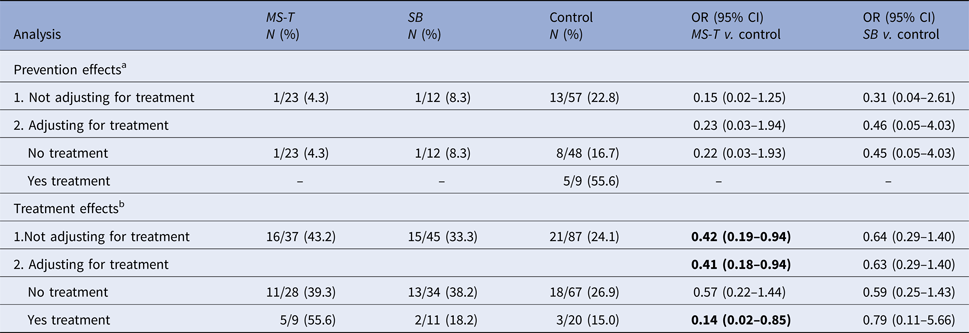
Prevention effects
Of measure completer participants with 12-month follow-up data, a total of n = 15 met DE criteria who did not meet DE at baseline (n = 92). Table 4 provides the frequency and percentage of participants from each group that developed DE at 12-month follow-up. It shows MS-T and SB participants had an 85% and 69% lower likelihood than controls of becoming a new DE case at 12-month follow-up respectively. Amongst those who did not seek external treatment at any point in the study, MS-T and SB participants were 78% and 55% less likely than controls respectively to become a new DE case at 12-month follow-up. No results relating to prevention effects were significant.
Tertiary outcomes, presence of disordered eating at 12-month follow-up (significant results are bolded)

Note: aProportion per condition of new cases of disordered eating at 12-month follow-up: only participants who did not have DE at baseline.
b Proportion per condition of no longer being a disordered eating case: only participants who did have DE at baseline. Bolded values indicate significant odds ratios (p < 0.05)
Treatment effects
Of measure completer participants with 12-month follow-up data, a total of n = 52 no longer met DE criteria who did meet DE at baseline (n = 169). Table 4 shows MS-T participants who met criteria for eating pathology at baseline had a significantly lower likelihood than controls of still meeting criteria at 12-month follow-up, including when adjusting for accessing ED treatment. Amongst those who did access external ED treatment, MS-T participants were seven times less likely than controls to meet DE criteria at 12-month follow-up. The comparison between SB and controls was not significant. Supplementary Table 2 provides breakdowns of specific DE behaviours.
Discussion
The aim of this pragmatic RCT was to assess the real-world effectiveness of two online DE prevention programs. This study differed to earlier trials in that: participants were sought from the broader community; programs were pure ‘self-help’ rather than moderated by a personalized online therapist; and, less exclusion criteria for eating pathology were used.
What type of participants enrolled and accessed their allocated intervention?
Participants were experiencing higher levels of baseline eating pathology than any previous SB trial (EDE-Q Global M = 3.37), including those ‘at very high risk’ of an eating disorder (M = 2.31: Taylor et al. Reference Taylor, Kass, Trockel, Cunning, Weisman and Bailey2016), and clinical impairment scores (M = 21.61: Bohn & Fairburn, Reference Bohn, Fairburn and Fairburn2008) were in the clinical range (⩾16). This mimics how these interventions might be used in community settings, where website access would not be limited and where those with greater pathology might be more likely to access interventions.
While higher pathology and clinical impairment were associated with greater likelihood of accessing the intervention, the only unique predictor was identification as being ‘committed to trying the program’. One-third of participants allocated to SB (30.0%) or MS-T (36.1%) never opened the website, consistent with the median engagement level of 38% found in a review of online engagement (Waller & Gilbody, Reference Waller and Gilbody2009). There could be value in providing brief motivation enhancement strategies at the completion of baseline measures to increase the likelihood of accessing a program. Alternatively, motivation could be an inclusion criterion, recommending guided or face-to-face options to those who are less motivated.
Rates of intervention completion were low. Of those who opened their allocated intervention, 51.6% (63/122) and 64.3% (63/98) completed module 1 of MS-T and SB, respectively, with attrition for SB significantly greater than for MS-T and the full MS-T program completed at a 10-fold higher rate than SB. Modules were released weekly, in line with earlier SB trials, as it was hoped that this would give participants time to complete homework and consolidate learning. However, this might have been a deterrent to some and future trials could investigate whether allowing open access to the full intervention is associated with greater completion. Also, MS-T participants received an automated weekly email alert that their next module was available, whereas SB participants did not, suggesting that reminders result in higher completion rates. The early and high drop-off rates for SB were inconsistent with previous SB trials. In the most comparable study, Kass et al. (Reference Kass, Trockel, Safer, Sinton, Cunning and Rizk2014) reported that approximately half the participants in an unmoderated group completed at least half the SB program, much higher usage than observed in the current trial. The Kass et al. trial included journal log prompts and guided discussions, both of which may reinforce participation.
MS-T was designed to be aesthetically similar to SB with comparable module length and learning activities, thus it is unlikely that the differing completion rates were due to program appearance factors. One explanation relates to the difference in the way weight concerns were targeted: SB initially focuses on a variety of cognitive issues related to body image with a focus on self-directed behavioural change in later modules; while MS –T focuses on critiquing media messages and developing strategies to resist these and related pressures. Whilst completion rates were low making it difficult to draw conclusions about the program targets, it could be that MS-T participants found their content of personal relevance, which might explain higher completion rates.
What were the outcomes for those who accessed their allocated intervention?
ITT analyses revealed minimal differences in outcomes across the groups and no differences at 12-month follow-up. No significant effect was found for the primary outcome (EDE-Q Global) and only two effects for secondary outcome variables with low ES - MS-T participants reported higher quality of life–mental relative to both controls and SB (6-month follow-up), and MS-T and controls had lower clinical impairment relative to SB (post-program). These minimal differences are likely explained by low rates of intervention completion.
SB did not perform as well as previous findings (e.g. Jacobi et al. Reference Jacobi, Völker, Trockel and Taylor2012; Taylor et al. Reference Taylor, Kass, Trockel, Cunning, Weisman and Bailey2016), though findings are difficult to interpret given very low completion rates. The most likely reason for this was the absence of a personalized online moderator, which has previously been recommended as an important for internet interventions to work (Andersson et al. Reference Andersson, Carlbring, Berger, Almlöv and Cuijpers2009). This is consistent with the recent comparison of guided v. self-help versions of SB where the guided group had superior outcomes (Kass et al. Reference Kass, Trockel, Safer, Sinton, Cunning and Rizk2014). Second, SB was implemented and hosted by a different web team in the USA than earlier trials and did not support some basic features of the program, such as notifications and interactivity or feedback. At the time of this trial, the team was working on a number of larger SB trials where it is possible that program delivery in the current trial was sub-optimal.
Of those who did access their intervention, MS-T achieved some promising results. For the measure completer sample, MS-T participants reported significant benefits relative to both controls and SB at varying time points for EDE-Q Global, depression, ineffectiveness, clinical impairment, media internalization, and quality of life – mental. Amongst measure completers at 12-month follow-up, MS-T participants reported significantly lower Global EDE-Q scores than controls and lower levels than both controls and SB for depression (also at 6-month follow-up); ineffectiveness; and, clinical impairment. Given measure completion was twice as likely by those who completed more modules than those who did not, these findings suggest participants needed to participate in MS-T to experience benefit.
Whilst not significant, MS-T participants who did not meet DE criteria at baseline were 85% less likely than controls to meet criteria at 12-month follow-up. The rates of reduction in onset of eating pathology were comparable with that found for face-to-face delivery of The Body Project (60%) and Healthy Weight (61%) and in earlier trials of SB (88% for those with elevated BMI at baseline: Taylor et al. Reference Taylor, Bryson, Luce, Cunning, Doyle and Abascal2006), though these respective findings were over a 2–3 year follow-up (Stice et al. Reference Stice, Marti, Spoor, Presnell and Shaw2008b) using diagnostic criteria. Of those who met DE criteria at baseline, those in the MS-T group were significantly less likely (59%) than controls to still meet diagnosis at 12-month follow-up, including controlling for accessing external ED treatment. To the best of our knowledge, this was the first time a program has achieved a treatment effect of this type. Most previous studies have excluded participants with elevated levels of baseline eating pathology. MS-T is well-suited to a clinical population given that the program is not face-to-face and it does not include open discussion groups where other participants could be exposed to the unhelpful content. It was of interest that amongst those who did access external ED treatment, MS-T participants were 85% less likely than controls to have DE at 12-month follow-up. This suggests that MS-T might augment treatment response and warrants further investigation.
Limitations and strengths
Four limitations were present in this study, the first two related to the pragmatic RCT approach. First, measure completion was self-report rather than an interview which has been used in other prevention trials (e.g. Taylor et al. Reference Taylor, Bryson, Luce, Cunning, Doyle and Abascal2006). Second, rates of measure completion were lower than in other targeted prevention trials where this was likely exacerbated by online self-report assessment and findings for the ITT analyses should be interpreted cautiously. Third, the lost program usage data for n = 50 new SB participants was beyond our control and this was managed in a conservative fashion (i.e. confirming no differences between these and the remaining SB participants and omitting from analyses). Finally, the follow-up period was shorter than some previous prevention trials (Wilksch & Wade, Reference Wilksch and Wade2009)
There were also strengths, including the: evaluation of multiple programs by two research groups; a large, community-based sample recruited in just 12-months; minimal exclusion criteria allowing for investigation of outcomes by those with pre-existing eating pathology; and, the inclusion of indicators of clinical impairment. Whilst the fully automated online screening and program allocation procedures allowing for real-world application with minimal cost were also a strength, strategies for increasing user engagement and reducing dropout need to be explored. Of the two programs, SB is a far more established program that has shown consistent benefit in previous trials and is likely better suited to guided delivery using a personalized online therapist. The results indicate that MS-T shows promise as a ‘pure self-help’ program where further investigations are indicated.
Supplementary material
The supplementary material for this article can be found at https://doi.org/10.1017/S0033291717003567
Acknowledgements
Grant 1047192 from the National Health and Medical Research Council (NHMRC) supported this work. The development of the online version of Media Smart (MS-T) was supported through a South Australian Government Youth Connect grant. The authors thank the participants for their involvement in this research. Professor C.B. Taylor and Professor D. Wilfley were supported by a HBI grant, NIH R01 MH100455.
Declaration of Interest
Dr Wilksch and Professor Wade are authors of Media Smart-Targeted and Media Smart, where sales of Media Smart fund further ED prevention research.