I. INTRODUCTION
Nickel (Ni), cobalt (Co), and iron (Fe)-based superalloys have increased the efficiency of gas turbines due to their property of retaining the strength, even at elevated temperatures.Reference Goyal, Singh and Prakash1 However, these materials show accelerated deposition of oxide layers when used in air/fuel environment contaminated with molten salts at elevated temperatures (generally between 700 and 925 °C). This form of attack is generally termed as ‘hot corrosion’Reference Goward2–Reference Yoshiba, Abe, Aranami and Harada8 to differentiate it from the traditional low-temperature corrosion. The temperature range, in which hot corrosion takes place, depends on a number of factors such as salt chemistry, gas constituents and their velocity, alloy composition and its fabrication condition, and thermal cycles as well as on the erosion of the alloy during corrosion attack. Hot corrosion has been observed in various marine and industrial applications such as coal gasifiers, internal combustion engines, exhaust systems, petrochemical equipment, boilers and gas turbine engines, etc.Reference Eliaz, Shemesh and Latanision9,Reference Bose10 This form of attack, unlike oxidation, consumes the material at a very fast rate, which decreases their load-bearing capability and ultimately results in the failure of the components.
Ni, Co, and Fe-based superalloys were developed for use in the high temperature applications with emphasis to retain the mechanical properties up to a great extent of their melting temperature. However, their hot corrosion resistance property was not given much attention. Consequently, their mechanical strength is severely affected during service in an aggressive environment (due to hot corrosion attack) and the component fails before the stipulated lifetime. Hence, for the effective and long-term working of these components during their service applications, it is highly desirable to develop these alloys with both the kinds of properties viz. high temperature mechanical strength and good hot corrosion resistance. It is found in the literature that both kinds of properties are generally not fulfilled simultaneously by alloy development.Reference Sidhu, Prakash and Agrawal11 Some elements improve the high temperature strength but delimit the hot corrosion resistance and vice-versa. For example, elements such as molybdenum, vanadium, and tungsten improve the high temperature mechanical properties but their presence in the composition makes the alloy highly susceptible toward hot corrosion. Sidhu et al.Reference Sidhu, Prakash and Agrawal6 reported that superalloys exhibit good strength at high temperature but shows a poor resistance to hot corrosion. Jegadeeswaran et al.Reference Jegadeeswaran, Udaya Bhat and Ramesh12 showed that bare Superco-605 corrodes drastically in Na2SO4 + 50% V2O5 salt at elevated temperatures. In these cases, protective coatings prove quite beneficial in improving the hot corrosion resistance of these alloys.Reference Sidhu, Prakash and Agrawal11,Reference Sidhu, Prakash and Agrawal13,Reference Lee, Tsai and Lee14 Nanostructured coating develops a protective oxide layer on the substrate at high temperature, which minimizes the diffusion of gaseous and liquid species toward the substrateReference Gao and Li15 and the substrate material provides the specified mechanical properties.Reference Sidhu, Prakash and Agrawal13
CrN coatings are generally used to protect metal machining tools from corrosion and oxidation.Reference Vincenzini16 However, the hardness and abrasive wear resistance of CrN coating are found to be much low in comparison to that of other transition metal nitrides. Hence, this coating is not found suitable for turbine blade components. The mechanical properties of CrN coating can be improved by adding Al, thus making a ternary system.Reference Knotek, Atzor, Barimani and Jungblut17 Al can be added up to 60–70 at.% to form a metastable cubic (c)-AlCrN.Reference Hasegawa and Suzuki18,Reference Reiter, Derflinger, Hanselmann, Bachmann and Sartory19 If the amount of Al exceeds further, then it starts forming hexagonal (h)-AlN which again has a low hardness.Reference Reiter, Derflinger, Hanselmann, Bachmann and Sartory19 Also, the (h)-AlN phase is relatively more stable than (c)-AlCrN. So, during the high temperature service applications, there will always be a driving force for transformation of cubic (c)-AlCrN phase into hexagonal (h)-AlN phase and consequently, the mechanical properties will rapidly deteriorate. On the other hand, TiAlN coatings are found to have superior mechanical properties at higher temperature and are commonly used for coating on various machining tools and gas turbine components.Reference Jindal, Santhanam, Schleinkofer and Shuster20 However, their high temperature oxidation resistance has been found to be very low in comparison to that of AlCrN coatings.Reference Kawate, Kimura Hashimoto and Suzuki21 Hence, there is a need for investigation of hot corrosion resistance of these two kinds of coatings at elevated temperatures.
Superco-605 is a face centered cubic cobalt-based superalloy, developed by Mishra Dhatu Nigam Limited, Hyderabad, India, for use in various gas turbine applications (such as rings, blades, and combustion chamber parts), to combat high temperature oxidation, corrosion, and wear. Hot corrosion is one of the major limitations in selecting the materials for service in corrosive and high temperature applications (such as gas turbines, boilers, and refinery furnaces) where residual fuel oil are regularly used in various operations. Residual fuel contains sodium (Na), sulfur (S), and vanadium (V) impurities, which react in the combustion system and form various compounds such as sodium sulfate (Na2SO4), vanadium pentoxide (V2O5), and complex vanadates.Reference Deb, Iyer and Radhakrishnan22,Reference Rocca, Steinmetz and Moliere23 Corrosion resistance ability in the engineering alloys generally depends on their tendency to form external protective oxide scales such as Al2O3, Cr2O3, or sometimes SiO2, which develops at a low rate and has a damage tolerance.Reference Strauss and Putatunda24 Aggressive compounds, Na2SO4 and V2O5, and complex vanadates get deposited on the surface of the material and cause spallation of protective oxide scales during thermal cycles, leading to crack initiation and growth at the grain boundaries.Reference Stringer25,Reference Wright and Gibbons26 Also, during service, the superalloys have to bear many other types of degradations such as erosion, impact, etc.Reference Stein, Schorr and Marder27,Reference Higuera Hidalgo, Belzunce Varela, Carriles Menéndez and Poveda Martı́nez28 Hence, it becomes essential to investigate the hot corrosion behavior of the protective coating on the candidate alloy. Prakash et al.Reference Prakash, Puri and Singh29 reported the severe hot corrosion attack on Ni-based superalloy at 900 °C in the salt, Na2SO4–60% V2O5. TiwariReference Tewari30 studied the hot corrosion behavior of Fe-based superalloy, Superfer 800H at 700, 800, and 900 °C. Several researchers studied Co-, Ni-, and Fe-based superalloys and coatings under Na2SO4–60% V2O5 environment in the temperature range 500–1000 °C.Reference Rocca, Steinmetz and Moliere23,Reference Gitanjaly, Prakash and Singh31–Reference Chim, Ding, Zeng and Zhang35 They concluded that Na2SO4–60% V2O5 salt considerably accelerates the hot corrosion rate of superalloys and the oxide scale over the substrate becomes quite porous.
In the present work, hot corrosion behavior of nanostructured AlCrN and TiAlN coatings over the Superco-605 alloy has been studied in the presence of molten salt, Na2SO4–60% V2O5 at 700 °C up to 80 cycles. Samples after hot corrosion test were characterized using field emission scanning electron microscopy (FESEM) equipped with energy dispersive spectroscopy (EDS), X-ray diffraction (XRD), and thermogravimetric analysis to analyze corrosion surface morphology and distribution of elements after hot corrosion test, to identify corrosion products, to understand the structural changes due to hot corrosion, and to calculate the corrosion kinetics. The comparative study of the two coatings was performed to find out the sustainability of these two kinds of coatings under simulated environment present in power generation units such as gas turbines, boilers, and incinerators.Reference Rocca, Steinmetz and Moliere23,Reference Prakash, Puri and Singh29,Reference Sidhu, Prakash and Agrawal32–Reference Kamal, Jayaganthan, Prakash and Kumar34,Reference Chawla, Chawla, Mehta, Puri, Prakash and Sidhu36–Reference Mudgal, Ahuja, Singh and Prakash38 The cyclic test was chosen to create an aggressive environment (in comparison to an isothermal environment) by the application of thermal shocks. It is well known that during heating, the alloy undergoes thermal expansion, while during cooling, it undergoes thermal contraction which leads to thermal fatigue. Mismatch of the thermal expansions between the alloy and the oxide causes the spallation of the oxide, thus making the substrate bare for any corrosion/degradation phenomenon. Thus, the current study also examines the effect of thermal shocks on the corrosion resistance of the Superco-605 alloy, unlike most of the other studies where isothermal conditions were used for the investigation of hot corrosion behavior.Reference Hurdus, Tomlinson and Titchmarsh39–Reference Klein, Bauer, Neumeier, Göken and Virtanen43
II. EXPERIMENTAL PROCEDURE
A. Substrate material
Starting bare material used for coating in the present study was Superco-605 alloy which was obtained from Mishra Dhatu Nigam Ltd., Hyderabad, India. The equivalent ASTM standard of Superco-605 is ASTM F90-09. This material is considered as a candidate material for use in power generation turbines and high temperature furnaces. The chemical composition (wt%) of the alloy was 14.5 W, 10.1 Ni, 20.2 Cr, 2.9 Fe, 1.2 Mn, 0.3 Si, 0.08 C, 0.03 P, 0.002 S, and balance Co which was confirmed by EDS.
B. Development of coatings
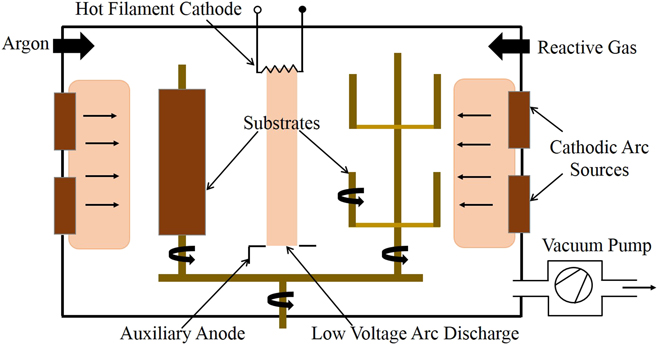
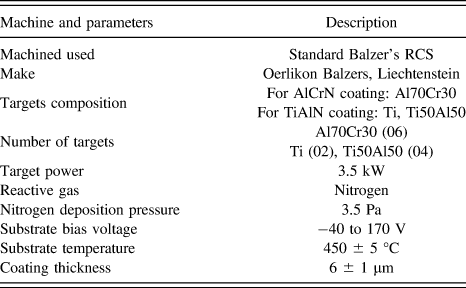
The initial dimension of the bare Superco-605 alloy was taken as 20 × 15 × 5 mm3 for nanostructured coating of AlCrN and TiAlN using the physical vapor deposition (PVD) technique. Before coating, the bare Superco-605 alloy was mechanically polished sequentially using 220 to 2000 grit size emery papers followed by cloth polishing using 1-µm alumina powder suspension. The samples were washed and cleaned with acetone to remove the dust and moisture on the samples’ surface and dried in the presence of hot air. Nanostructured AlCrN and TiAlN were deposited on the polished Superco-605 alloy by the plasma-assisted PVD technique using a Balzer’s rapid coating system (RCS) machine (Oerlikon Balzers, Balzers, Liechtenstein), and the schematic of which is shown in Fig. 1. The machine was equipped with 6 cathodic arc sources. Two of the six arc sources were used to deposit a thin film of 0.3 μm thickness CrN sub-layer to improve adhesion of coating. The remaining four sources were engaged to deposit the main coating layer. Coating deposition was performed in the presence of argon (Ar) and nitrogen (N2) atmosphere with deposition pressure 3.5 Pa and substrate temperature 450 ± 5 °C in the voltage range −40 to 170 V. Details of the coating deposition parameters are presented in Table I. Coating surface morphology and composition were examined using an FESEM (Quanta 200 F, FEI, Eindhoven, the Netherlands) attached with EDS.
Schematic illustration of the coating device used for film deposition.

Details of coating deposition parameters.

C. Molten salt corrosion tests
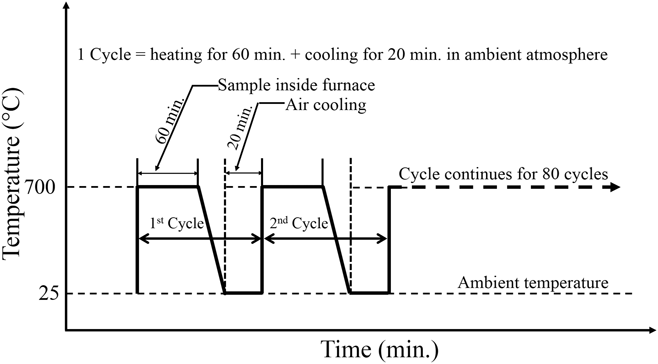
AlCrN- and TiAlN-coated samples were thoroughly washed with acetone and dried in hot air to remove any moisture on the samples’ surface. These samples were preheated in the oven up to 250 °C, to make the samples’ surface adherent to the corrosive salt. Then, uniform multilayers of corrosive salt, Na2SO4–60% V2O5 was deposited on preheated coated samples using a camel hair brush. Na2SO4–60% V2O5 salt was chosen as it is a eutectic composition, having melting point ∼550 °C, which would ensure that the salt melts and forms an aggressive corrosion environment for reaction with the base metal. These samples were dried in an oven at 110 °C for 2 h and weighed. The samples were then placed in an alumina boat and transferred to the central heating zone of a silicon carbide (SiC) horizontal tubular furnace having accuracy within ±1 °C. The hot corrosion test was performed at 700 °C for 80 cycles. Each cycle consisted of 1 h heating at 700 °C followed by 20 min cooling at ambient temperature. A schematic of hot corrosion cycle is shown in detail in Fig. 2. Weight measurements were done before and after every cycle using an electronic weighing balance, model CB-120 (Contech, Kolkata, India), having a least count of 10−3 g.
Schematic of the hot corrosion cycle in Na2SO4–60% V2O5 salt at 700 °C.

III. RESULTS AND DISCUSSION
A. Microstructural characterization of coatings
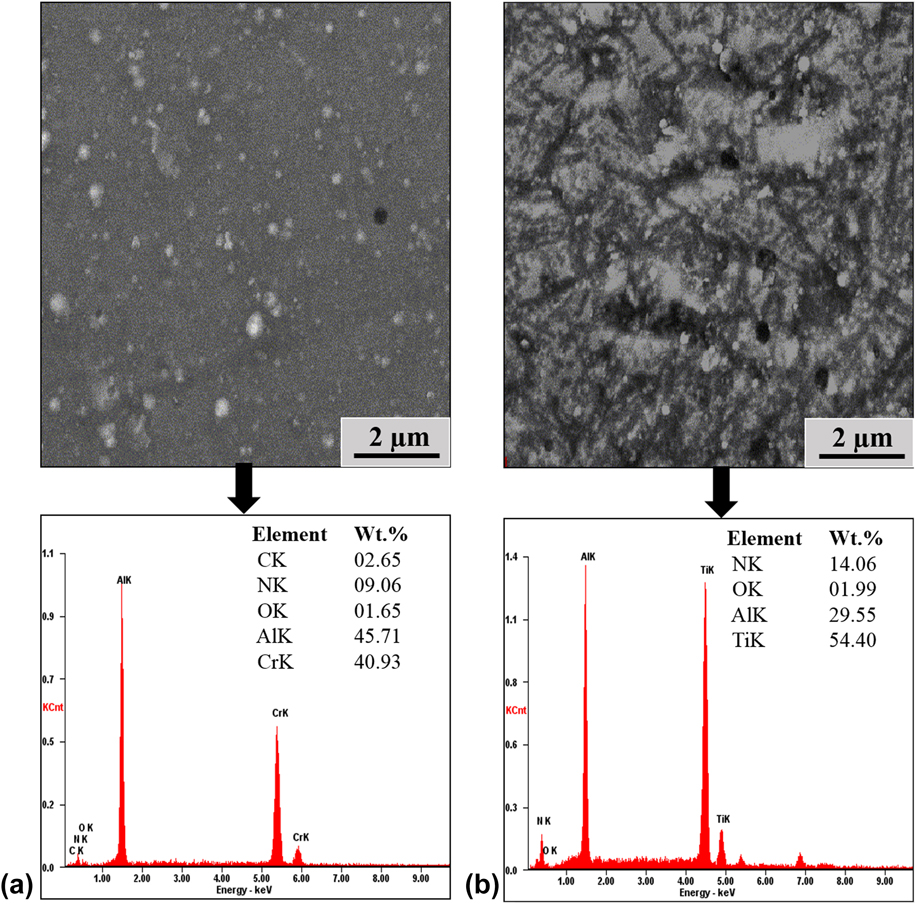
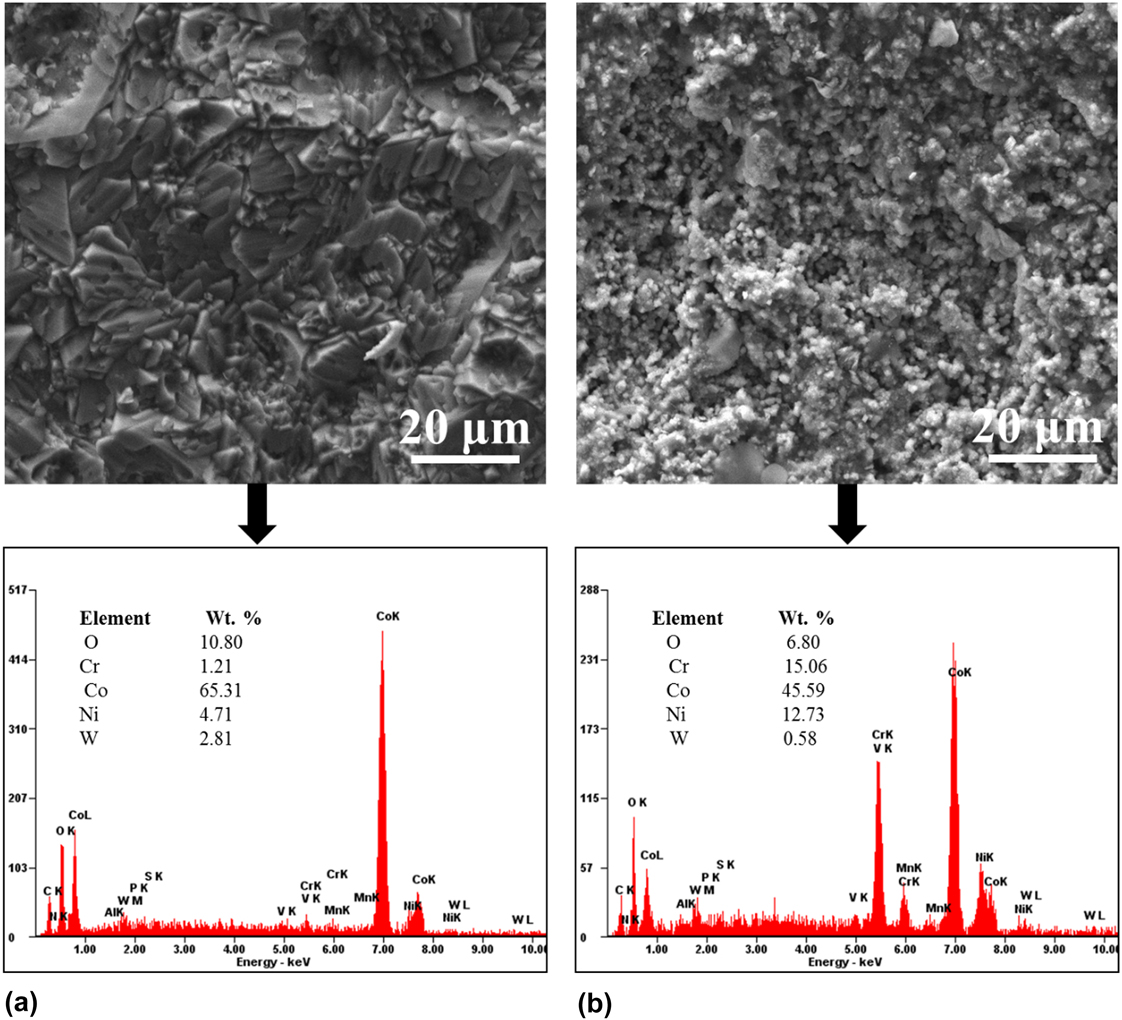
Surface morphology and composition of coatings are shown in Figs. 3(a) and 3(b). We observe that AlCrN coating has almost uniform coating layer with few number of voids while TiAlN coating exhibited nonuniformity in layers along with comparatively higher fraction of voids. This nonuniformity in the coating layer, as well as the presence of voids, leads to an increase in the corrosion rate of TiAlN coating which we will discuss later. EDS analysis confirms the composition of the two coatings, as shown in Fig. 3.
SEM morphology and EDS analysis of (a) AlCrN and (b) TiAlN coating on the bare Superco-605 substrate.

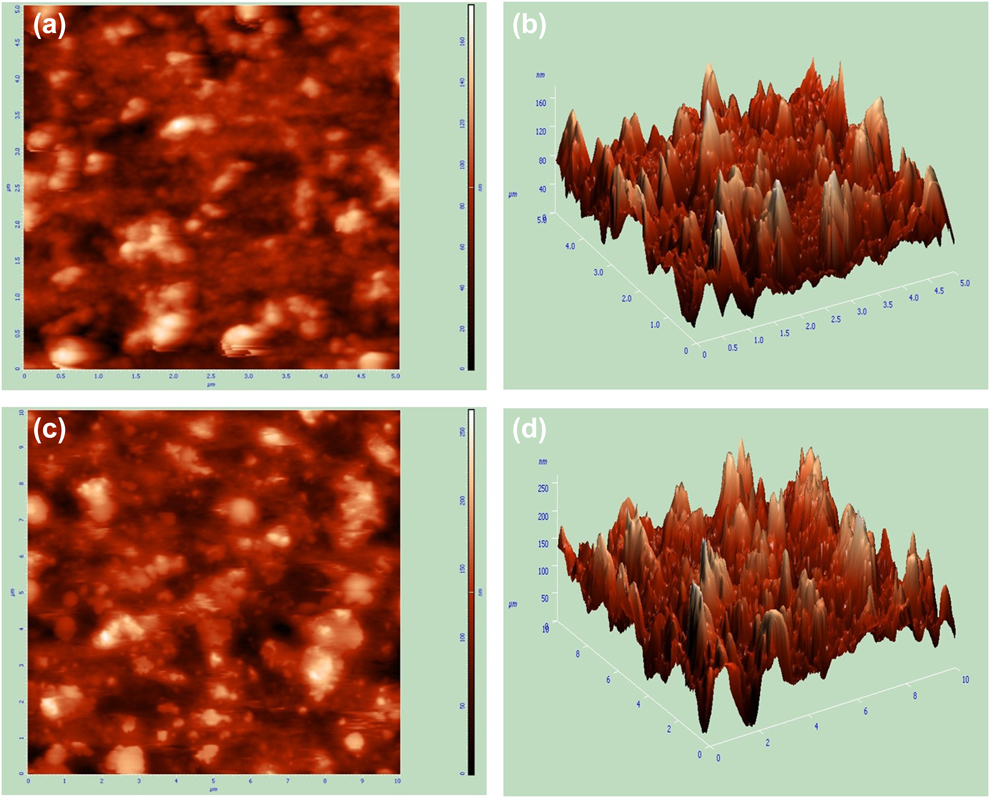
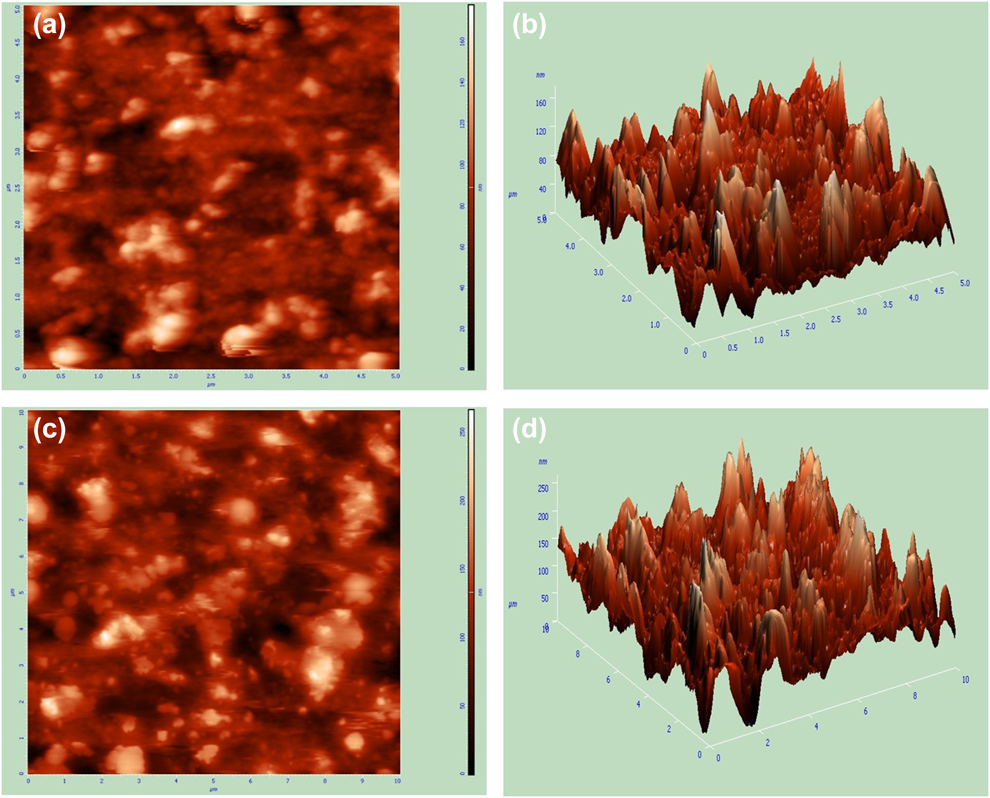
Apart from the nature of coating in terms of surface morphology, roughness was also examined to find out consequences of roughness on the corrosion behavior of coated materials. Average roughness of AlCrN and TiAlN coating was examined using atomic force microscopy (AFM) which is shown in Figs. 4(a) and 4(b), respectively. The AFM surface morphology (2D and 3D) of coated samples indicates the peaks on samples’ surface which is a direct measure of roughness value. Larger the height of the peak, larger will be the roughness and more will be the corrosion of coated materials. A noticeable difference in the surface morphology was observed from the 2D AFM image but clarity in surface roughness was identified from the 3D AFM image. Average roughness was found to be ∼23.63 nm for TiAlN while ∼10.65 nm for AlCrN coating.
2D and 3D AFM surface morphology of the as-coated Superco-605 substrate. (a) and (b) AlCrN coating and (c) and (d) TiAlN coating.
B. Microstructural characterization of hot corroded samples
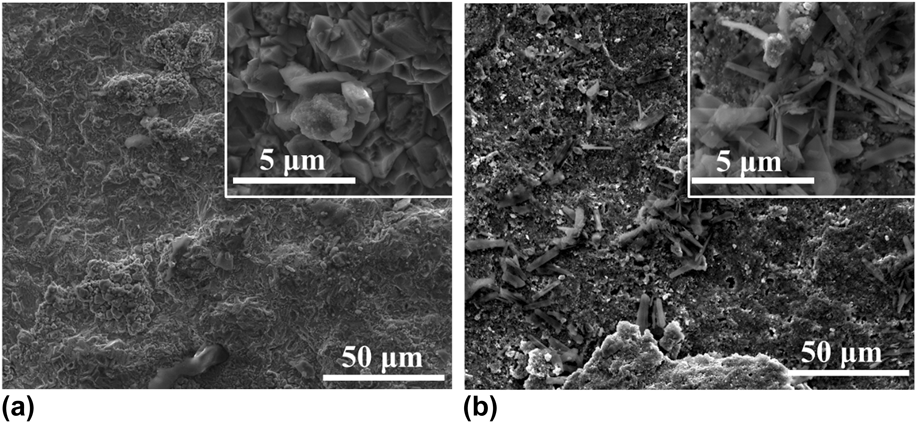
To investigate the hot corrosion behavior of nanostructured AlCrN- and TiAlN-coated samples, the surface morphology of the hot corroded samples were acquired using FESEM. The corroded surface morphology of AlCrN- and TiAlN-coated samples are shown in Figs. 5(a) and 5(b), respectively. The SEM morphology of corroded AlCrN coating reveals rounded and elongated shape particles, which are mostly accumulated along grain boundaries. There is an absence of voids but cracking/spallation can be seen over the surface, which is a direct indication of severe corrosion. In contrast to this, the SEM morphology of corroded TiAlN-coated sample shows needle shaped particles which are distributed nonuniformly over the samples’ surface. Also, the corroded surface of TiAlN coating reveals the presence of larger fraction of voids as well as microcracks. These voids and cracks are responsible for severe corrosion behavior of TiAlN coating in hot corrosive atmosphere. To analyze whether the protective oxide layer is formed or not during hot corrosion, EDS analysis was performed over the corroded and corrosion protected surface of the AlCrN coated sample which is shown in Figs. 6(a) and 6(b), respectively. The corroded region of nanostructured AlCrN coating shows the presence of very low amount of Cr content during initial cycle but after few cycles, the protective layer of Cr2O3 and CoCo2O4 formed which retarded any further corrosion (which was observed from the EDS analysis of the corrosion protected area).
Surface morphology of (a) AlCrN and (b) TiAlN coating after the cyclic hot corrosion test in molten salt (Na2SO4–60% V2O5) at 700 °C for 80 cycles.

EDS analysis of (a) corroded area and (b) corrosion protected area of the AlCrN coating surface in the molten salt mixture (Na2SO4–60% V2O5) at 700 °C after 80 cycles.

C. Thermogravimetric analysis
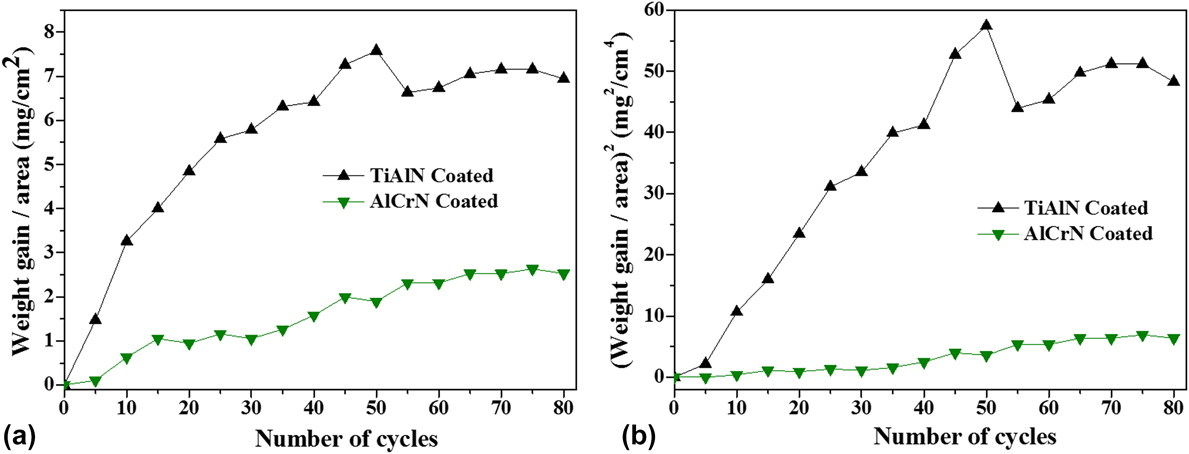
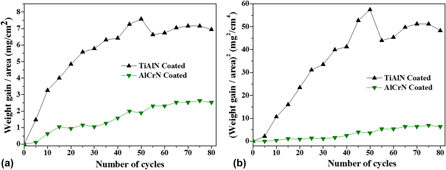
During oxidation, an increase in sample weight corresponds to the weight of oxygen, which reacts with metal and forms metal oxides. For the detailed analysis of the hot corroded sample, variation of weight gain per unit area (mg/cm2) of AlCrN- and TiAlN-coated samples was calculated for 80 cycles and plotted against the number of cycles which is shown in Fig. 7(a). The plot comes parabolic in nature. It was noticed that for the initial 50 cycles, the weight gain per unit area increases rapidly for both AlCrN- and TiAlN-coated samples, but the rate of increment in weight gain per unit area for TiAlN coating is significantly larger than that of AlCrN coating. After 50 cycles, the rate of weight gain slowed down followed by steady state for both AlCrN and TiAlN coatings. It can be said that the rate of corrosion of the AlCrN coated sample is much lower than that of the TiAlN-coated sample. Corrosion kinetic can be characterized by parabolic rate constant (K p) governed by following equationReference Hebsur and Miner44:
 $${\left( {{{\Delta M} \over A}} \right)^2} = {K_{\rm{p}}}t\quad ,$$
where K p is the parabolic rate constant (mg2/cm4/s),  ${{\Delta M} \over A}$ is the weight gain per unit area (mg/cm2), and t is the time (s).
Variation of (a) weight gain/area and (b) (Weight gain/area)2 versus the number of cycles for AlCrN- and TiAlN-coated Superco-605 substrate subjected to cyclic hot corrosion test in molten salt (Na2SO4–60% V2O5) at 700 °C for 80 cycles.

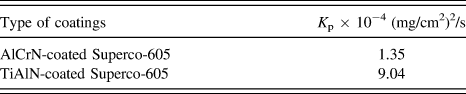
For calculating the parabolic rate constant, the square of the variation of weight gain per unit area (mg2/cm4) of AlCrN- and TiAlN-coated samples was calculated and plotted against the number of cycles as shown in Fig. 7(b). Then, K p was calculated from the slope of the linear regression fitted line, utilizing Eq. (1). Calculated values of K p for the two samples are shown in Table II.
Parabolic rate constant (K p) for AlCrN and TiAlN coatings.

A smaller value of K p represents a low rate of corrosion and thus, surface coating can be regarded as protective in behavior, whereas a higher value of K p would represent a higher rate of corrosion and nonprotective behavior of the coating material. We observed a very low value of K p for AlCrN coating (1.35 × 10⁻⁴ mg2/cm4/s) in comparison to that of TiAlN coating (9.04 × 10⁻⁴ mg2/cm4/s). Thus, AlCrN can be considered to have a better corrosion resistance than that of TiAlN. This improvement in corrosion resistance is primarily due to the improvement in scale adhesion and reduction in the rate of scale growth in the case of AlCrN.
Weight gain with time shows parabolic nature for both nanostructured AlCrN and TiAlN coatings because of the diffusion-controlled mechanism.Reference Mahesh, Jayaganthan and Prakash45 A drastic increase in weight gain during the initial period of time was also reported by Sidhu et al.,Reference Sidhu, Prakash and Agrawal6 Harpreet et al.,Reference Singh, Puri and Prakash46 and Tiwari et al.Reference Tiwari and Prakash47 in hot corrosion atmosphere. When coated samples were exposed to molten salt (Na2SO4–60% V2O5) at 700 °C, the following reaction occurred:
 $${\rm{N}}{{\rm{a}}_2}{\rm{S}}{{\rm{O}}_4} + {{\rm{V}}_2}{{\rm{O}}_5} = 2{\rm{NaV}}{{\rm{O}}_3} + {\rm{S}}{{\rm{O}}_2} + {1 \over 2}{{\rm{O}}_2}\quad .$$
NaVO3 (melting point ∼610 °C) reacts with the protective oxide layer, Cr2O3 which leads to dissolution of the protective layer, and Na2CrO4 gas gets evaporatedReference Fryburg, Kohl, Stearns and Fielder48,Reference Seiersten and Kofstad49 as per the following reaction:
 $${\rm{C}}{{\rm{r}}_2}{{\rm{O}}_3} + 4{\rm{NaV}}{{\rm{O}}_3} + {3 \over 2}{{\rm{O}}_2} = 2{\rm{N}}{{\rm{a}}_2}{\rm{Cr}}{{\rm{O}}_4} + 2{{\rm{V}}_2}{{\rm{O}}_5}\quad .$$
During the reaction, the stresses develop at the coating–base metal interface due to difference in specific volume of the two phases.Reference Kamal, Jayaganthan and Prakash50 This leads to generation of cracks.Reference Heath, Heimgartner, Irons, Miller and Gustafsson51 When these cracks propagate perpendicular to the protective oxide scale, molten salt penetrates through the top oxide scale.Reference Singh, Puri and Prakash52 Some elements on the coating surface diffuse outwards to form oxides or splines. Nickel and chromium contents in the corrosion protected region are much greater than those in the corroded region due to the formation of the Cr2O3 and NiCrO4 oxide layer over the surface of the corroded material which reduces further corrosion. A lower hot corrosion resistance of TiAlN coating compared to AlCrN was also observed by Ding et al.Reference Ding, Tan, Zeng, Wang, Yue and Sun53 They found limited corrosion resistance of titanium-based coatings, TiAlN in corrosive environment due to the formation of the porous nonprotective oxide layer. Hot corrosion severely affects the electric power generation industry especially in steam generating equipment, i.e., boilers operating at elevated temperatures (600–1000 °C). Thin films of molten salts may get deposited on metallic surface of boilers, causing a high rate of corrosion.Reference Almeraya-Calderon, Martinez-Villafañe and Gonzalez-Rodriguez54–Reference Cho, Hur, Seo, Yoon and Park56 Kolta et al.Reference Kolta, Hewaidy and Felix57 and Otero et al.Reference Otero, Merino, Pardo, Biezma and Buitrago58 reported that the formation of NaVO3 creates an oxidizing environment which serves as an oxygen carrier to the metal during hot corrosion. They suggested that molten salt, Na2SO4–60% V2O5 leads to the spallation of the protective oxide scales formed on the surface of the superalloy due to which the alloy’s surface comes into direct contact with the aggressive environment. Also, the molten salt provides path for the rapid diffusion of reactant species.
D. XRD analysis
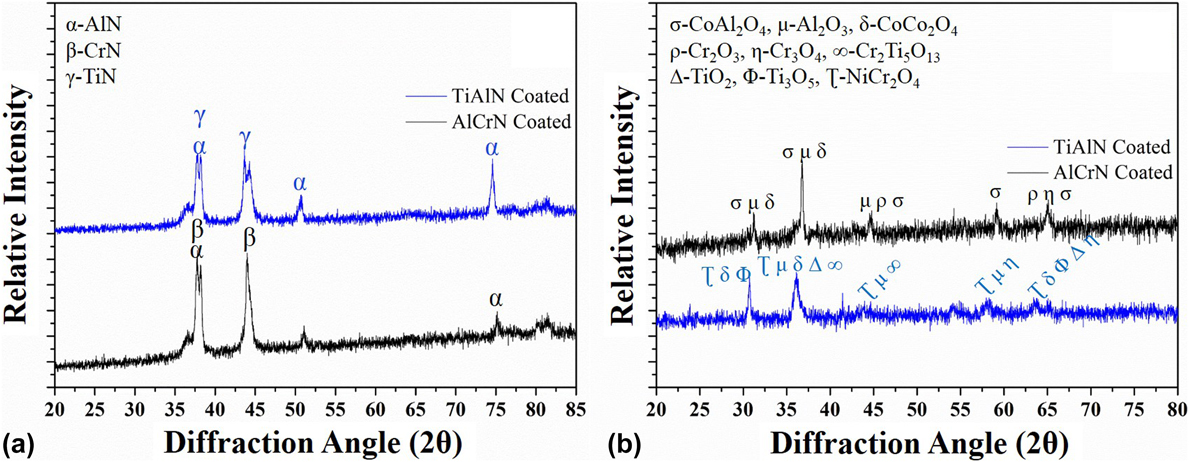
XRD analysis of as-coated and hot corroded samples was performed to identify the phases present in the materials before and after hot corrosion and it is shown in Fig. 8. It is clear from the figure that the as-coated sample detects the presence of only AlCrN and TiAlN, without any extra phase. Jegadeeswaran et al.Reference Jegadeeswaran, Udaya Bhat and Ramesh12 showed that bare Superco-605 corrodes very fast in the hot corrosion environment. Therefore, we performed the XRD of hot corroded samples to examine the formation of any new phase, responsible for retarding the corrosion rate as compared to that of bare Superco-605. XRD of nanostructured AlCrN coating confirms the presence of Al2O3, Cr2O3, CoCo2O4, and CoAl2O4 which acts as the protective oxide layer at elevated temperature. XRD of nanostructured TiAlN coating also shows the presence of Al2O3, NiCrO4, Cr2O3, and CoCo2O4 as by-product which acts as the protective oxide layer. Since we have already seen that AlCrN coating is more corrosion resistant than TiAlN, the reason behind this may be formation of globular shape corrosion particles (Cr2O3 and CoCo2O4) [Fig. 5(a)] which accumulate along grain boundary and retard the motion of cation and anion through grain boundaries.
XRD pattern of (a) AlCrN- and TiAlN-coated samples and (b) AlCrN- and TiAlN-coated Superco-605 alloy subjected to cyclic hot corrosion in molten salt (Na2SO4–60% V2O5) at 700 °C for 80 cycles.

IV. CONCLUSIONS
In this study, cyclic hot corrosion behavior of AlCrN- and TiAlN-coated Co-based superalloy, Superco-605, was investigated in an aggressive environment of vanadate-induced molten salt, Na2SO4–60% V2O5 at 700 °C for 80 cycles. The following pertinent conclusions can be withdrawn:
(1) Parabolic rate constant for AlCrN nanostructured coating after hot corrosion was found to be 1.35 × 10⁻⁴ mg2/cm4/s, which is much lower than 9.04 × 10⁻⁴ mg2/cm4/s for TiAlN-coated sample.
(2) Thermogravimetric analysis showed a continuous weight gain with the successive hot corrosion cycles which indicates that the newly formed oxide scale is intact.
(3) Marginal variation of weight gain for longer span of time was observed for AlCrN nanostructured coating while drastic change in weight gain was noticed for TiAlN nanostructured coating.
(4) The post corroded surface of the TiAlN-coated sample showed larger fraction of voids as well as microcracks while AlCrN-coated samples’ surface showed adherent scale without much voids or cracks.
(5) Oxides present in the scale of the Superco-605 alloy play a major role in the oxidation of the alloy during hot corrosion.
Based on the above-mentioned outcomes, we conclude that AlCrN coating leads to significant improvement in the hot corrosion resistance of Superco-605 in comparison to that of TiAlN coating.