Introduction
Older persons with mental health conditions may experience deprivation of their liberty due to multiple intersecting vulnerabilities, often enduring lack of autonomy, independence, and free decision-making (WPA Position Statement on Prison Public Health, 2017). Hence, liberty and dignity-based mental healthcare and policies are crucial as part of an ethical framework to better support older people against stigma and discrimination, and protect them from neglect, elder abuse, and violence (Banerjee et al., Reference Banerjee, Rabheru, de Mendonca Lima and Ivbijaro2021). At this article liberty of a person concerns freedom from the person’s confinement, while security of a person concerns freedom from any kind of injury (United Nations, 1976). This Position Statement outlines the views of two global organizations on the deprivation of liberty of older adults with mental health conditions: the International Psychogeriatric Association (IPA) and the World Psychiatric Association Section of Old Age Psychiatry (WPA-SOAP). Three contexts of deprivation of liberty are considered, namely deprivation of liberty of decision-making, deprivation of liberty within care settings and deprivation of liberty within detention facilities.
Deprivation of liberty of decision-making because of age and mental health condition
About 20% of older persons experience some kind of mental health condition (WHO, 2017). However, neither old age nor a diagnosis of a mental condition is sufficient in itself to determine the lack of capacity to make meaningful decisions (Katona et al., Reference Katona2009). Every older adult has the right to make their own decisions and must be presumed to have capacity unless it can be proven otherwise. Capacity is a threshold requirement for persons to retain the power to make decisions for themselves (Appelbaum and Gutheil, Reference Appelbaum and Gutheil1991). Key components of capacity include understanding, appreciation, reasoning, retention, and the ability to express preference with consistency (Katona et al., Reference Katona2009).
The impairment of decision-making capacity due to mental health condition leaves older persons vulnerable to loss of liberty and exploitation. They are less likely to be able to advocate for themselves and protect their own interests (WPA Position Statement on the Rights of Persons with Disabilities, 2017). Most states have established mechanisms for the determination of capacity and for decisions to be made on behalf of persons found to lack capacity. Those decisions may cover areas such as finances, living situations, medical treatment, hospitalization, and institutionalization in long-term facilities. These decisions are vital to protect and to preserve the person’s integrity and dignity and are based on promoting wellbeing, autonomy, independence, safety, privacy, respect, and access to all forms of healthcare (Katona et al., Reference Katona2009).
A substitute decision maker (SDM) may be appointed, or lawful advance directives put in place, in order to protect the personal health and other interests of older persons who experiences impaired decision-making capacity (Katona et al., Reference Katona2009). People with limited capacity should be allowed to make those decisions, which they remain capable of making for themselves. A SDM must only be invoked as a last resort and be limited to areas over which an individual is proven to lack capacity (Katona et al., Reference Katona2009). Appropriate measures should be taken to ensure and maintain discretion, respect, privacy, and protect the older person’s dignity (Katona et al., Reference Katona2009). A SDM must be considered as a complementary alternative to optimize the person’s liberty of decision-making, and not as a simple substitute for it.
Deprivation of liberty in care settings
Recognizing that some older persons with severe mental health conditions may pose a substantial risk for the general security, legal mechanisms must be followed to permit coercion to care to ensure their safety and wellbeing (Katona et al., Reference Katona2009; WPA Position Statement on the Rights of Persons with Disabilities, 2017). The most common situations that can contribute for such decision are a danger to self (danger to own life, danger to own health, self-neglect, decrease in social status) or a danger to others (danger to other’s safety, danger to other’s life) (Wasserman et al., Reference Wasserman2020). Different forms of coercion to care include: formal detention, compulsory treatments, seclusion, physical, and chemical restraint.
The laws that permit non-consensual hospitalization must be strictly abided by permitting time-limited periods of hospitalization followed by mandatory re-evaluation and reassessment for the need of continued hospitalization.
Non-consensual hospitalization, compulsory out-patient treatment, and the use of SDMs, have an appropriate role in protecting the interests of persons with severe mental conditions. All efforts should be made to assist persons with decisional impairment, to recover capacity and to ensure that their desires, wishes, and decisions are respected (Katona et al., Reference Katona2009).
Non-consensual institutionalization may be required in a long-term care facility, when an older adult is not any more able to live independently at home and the person presents a sufficient loss of capacity to take decisions to assure his/her own security and wellbeing. Mechanisms are needed to ensure appropriate clinical and legal indications and regular review processes are in place, as well as mechanisms to assure the presence of impaired capacity (Katona et al., Reference Katona2009; WPA Position Statement on the Rights of Persons with Disabilities, 2017).
Individuals with dementia living in long-term care facilities need higher levels of specialized care. Placement in such institutions should be made according to medical objectives. Individuals living in these long-term care facilities may face a threat to their liberty. There is a risk that long-term care facilities become segregated institutions, where staff exercise control over the person’s daily life and make decisions about the person’s care, including their placement in segregated locked wards and the use of different forms of restrains (chemical or physical) (Steele et al., Reference Steele, Carr, Swaffer, Phillipson and Fleming2020).
They are often a consequence of limited available resources and staff to provide care as well as limited training in working with older people with substantial mental health conditions. Moreover, older adults’ abuse and neglect is a common occurrence especially in the case of older people with mental health conditions: monitoring and guidance are essential to ensure the safety and wellbeing of those who require long-term care. Quality of life, dignity, safety, and comfort are of critical importance to the treatment and delivery of care to persons with dementia. Meaningful attention should be paid to the activities of daily living, the choice of treatments offered and the involvement and engagement of the individual and their family to enhance and maintain the individual’s liberty (Steele et al., Reference Steele, Carr, Swaffer, Phillipson and Fleming2020).
Residents of long-term facilities, independently if they were involuntarily admitted or not, should enjoy the right to appeal against to this decision and should have free access to justice procedures and to be heard by a judge. Complaints procedures and regular inspection procedures are basic safeguards against any unappropriated treatment of residents (Steele et al., Reference Steele, Carr, Swaffer, Phillipson and Fleming2020).
Deprivation of liberty in detention facilities
The number of older persons in detention facilities is increasing worldwide, in different speeds according to local characteristics as consequence of a hardening of sentencing practices, increased use of imprisonment and life imprisonment, reduced mechanisms for early release; and isolation, poverty, and lack of family support (Penal Reform International, 2022).
Age or health problems are not necessarily a bar to imposing a prison sentence, but both factors should be taken into account either when a sentence is passed or while the sentence is being served (11). All governments should be clear about the purpose of their prisons to ensure that all imprisonment is human, decent, reasonable, and proportionate (WPA Position Statement on Prison Public Health, 2017). The mental and physical health conditions of older persons should not deteriorate or be exacerbated just because of the custodial environment (WPA Position Statement on Prison Public Health, 2017).
Human rights of older persons in detention facilities may be violated at all stages of imprisonment: at the admission, during the classification to accommodation, the provision of adequate healthcare, rehabilitation, and reintegration upon release. Very often, the prison staff is not trained to interact with older persons on age-related health needs, increasing the risk of discrimination, of physical, psychological, or sexual abuse and the risk of harsher treatment and penalties because of poor behavior or difficulty cooperating caused, for example, by sensory or cognitive impairment (Prais and Lawrence, n.d.).
Older persons in prison have the same rights to access appropriate health care as those in the community. States are responsible for ensuring that older prisoners receive appropriate clinical care and that general prison conditions promote their wellbeing, and the welfare of staff (WPA Position Statement on Prison Public Health, 2017). Given the high risk of mortality and morbidity levels and abuse in prisons, health screening should be universally provided, and effective mental health assessment and treatment should readily be available (WPA Position Statement on the Rights of Persons with Disabilities, 2017).
The following principles should guide the mental health care of older adults in prisons (WPA Position Statement on Prison Public Health, 2017):
-
timely medical interventions should be provided when older persons in prisons are in need of clinical attention;
-
multidisciplinary systems and procedures should be in place for the early identification and management of vulnerability to self-harm or suicide. Any death by suicide should be investigated;
-
all clinical interventions should respect the intimacy, be delivered after an informed consent is given;
-
prisoners with decision-making capacity have the right to refuse treatment without any consequence for their security or punishment;
-
the relationship between clinician and patient should be governed by the same ethical and professional standards as in the community, especially regarding the confidentiality of medical information, unless disclosure is justified in the public interest. However, some information sharing between practitioners and prison staff may be essential to safeguard and promote the welfare of people in prison;
-
healthcare professionals are prohibited to engage in acts that may constitute torture or other cruel, inhuman, or degrading treatment or punishment. This includes the administration of lethal injections as part of a death sentence;
-
healthcare professionals who become aware of any signs of torture or other cruel, abuse, inhuman, or degrading treatment or punishment should document and report such cases;
-
healthcare personnel do not have any role in imposing disciplinary sanctions. They must visit older prisoners daily when they are held in seclusion to effectively monitor mental and physical health needs, to provide prompt medical assistance, and treatment. Any adverse physical or mental effects arising from disciplinary sanctions should be reported, with advice provided regarding necessary termination or alteration of conditions of detention as required;
-
solitary confinement of older adults can have severe and sustained adverse health effects. Particular attention should be paid to any pre-existing vulnerabilities, such as acute mental or physical illness, physical disability, intellectual disabilities, neurodegenerative disorders, or the ongoing management of drug or alcohol disorders, and to any exacerbation or deterioration in mental or physical health;
-
effective rehabilitation is necessary: the containment of older persons who are socially, physically, intellectually, and mentally disadvantaged can be damaging;
-
untreated significant mental illness can lead to repeat criminality and additionally may place the individual or the public at risk. Improving social skills should be part of any general rehabilitation program, alongside educational opportunities. Minimum standards for meaningful daytime activity should be developed that include the amount and range of these activities.
Conclusion
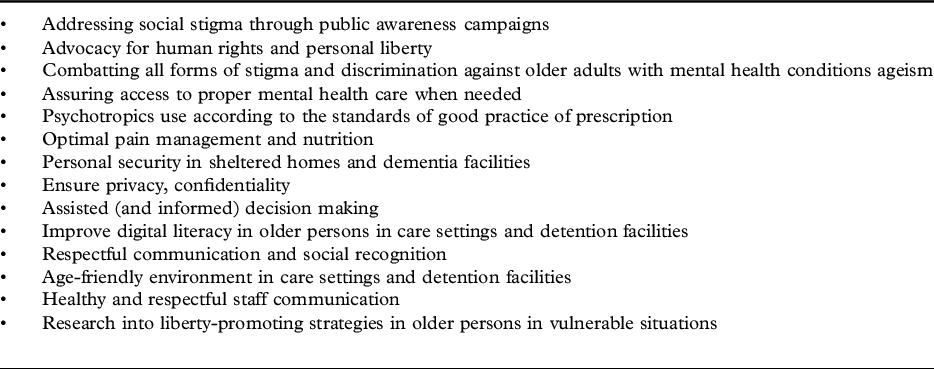
The main goal of this position statement is to optimize the integration of individuals’ capacity, autonomy, respect, Human Rights, and dignity in all healthcare plans which apply to older persons with mental health conditions. The most relevant, actionable areas presented in this document had been summarized in Table 1. IPA and WPA-SOAP strongly recommend the implementation of all the listed to ensure liberty for older persons with mental health conditions and to enhance their quality of life, dignity, safety, and comfort.
Table 1.
Actionable areas to ensure liberty for older persons with mental health conditions and to enhance their quality of life, dignity, safety, and comfort





 You have
Access
Introduction
Older persons with mental health conditions may experience deprivation of their liberty due to multiple intersecting vulnerabilities, often enduring lack of autonomy, independence, and free decision-making (WPA Position Statement on Prison Public Health, 2017). Hence, liberty and dignity-based mental healthcare and policies are crucial as part of an ethical framework to better support older people against stigma and discrimination, and protect them from neglect, elder abuse, and violence (Banerjee et al., Reference Banerjee, Rabheru, de Mendonca Lima and Ivbijaro2021). At this article liberty of a person concerns freedom from the person’s confinement, while security of a person concerns freedom from any kind of injury (United Nations, 1976). This Position Statement outlines the views of two global organizations on the deprivation of liberty of older adults with mental health conditions: the International Psychogeriatric Association (IPA) and the World Psychiatric Association Section of Old Age Psychiatry (WPA-SOAP). Three contexts of deprivation of liberty are considered, namely deprivation of liberty of decision-making, deprivation of liberty within care settings and deprivation of liberty within detention facilities.
Deprivation of liberty of decision-making because of age and mental health condition
About 20% of older persons experience some kind of mental health condition (WHO, 2017). However, neither old age nor a diagnosis of a mental condition is sufficient in itself to determine the lack of capacity to make meaningful decisions (Katona et al., Reference Katona2009). Every older adult has the right to make their own decisions and must be presumed to have capacity unless it can be proven otherwise. Capacity is a threshold requirement for persons to retain the power to make decisions for themselves (Appelbaum and Gutheil, Reference Appelbaum and Gutheil1991). Key components of capacity include understanding, appreciation, reasoning, retention, and the ability to express preference with consistency (Katona et al., Reference Katona2009).
The impairment of decision-making capacity due to mental health condition leaves older persons vulnerable to loss of liberty and exploitation. They are less likely to be able to advocate for themselves and protect their own interests (WPA Position Statement on the Rights of Persons with Disabilities, 2017). Most states have established mechanisms for the determination of capacity and for decisions to be made on behalf of persons found to lack capacity. Those decisions may cover areas such as finances, living situations, medical treatment, hospitalization, and institutionalization in long-term facilities. These decisions are vital to protect and to preserve the person’s integrity and dignity and are based on promoting wellbeing, autonomy, independence, safety, privacy, respect, and access to all forms of healthcare (Katona et al., Reference Katona2009).
A substitute decision maker (SDM) may be appointed, or lawful advance directives put in place, in order to protect the personal health and other interests of older persons who experiences impaired decision-making capacity (Katona et al., Reference Katona2009). People with limited capacity should be allowed to make those decisions, which they remain capable of making for themselves. A SDM must only be invoked as a last resort and be limited to areas over which an individual is proven to lack capacity (Katona et al., Reference Katona2009). Appropriate measures should be taken to ensure and maintain discretion, respect, privacy, and protect the older person’s dignity (Katona et al., Reference Katona2009). A SDM must be considered as a complementary alternative to optimize the person’s liberty of decision-making, and not as a simple substitute for it.
Deprivation of liberty in care settings
Recognizing that some older persons with severe mental health conditions may pose a substantial risk for the general security, legal mechanisms must be followed to permit coercion to care to ensure their safety and wellbeing (Katona et al., Reference Katona2009; WPA Position Statement on the Rights of Persons with Disabilities, 2017). The most common situations that can contribute for such decision are a danger to self (danger to own life, danger to own health, self-neglect, decrease in social status) or a danger to others (danger to other’s safety, danger to other’s life) (Wasserman et al., Reference Wasserman2020). Different forms of coercion to care include: formal detention, compulsory treatments, seclusion, physical, and chemical restraint.
The laws that permit non-consensual hospitalization must be strictly abided by permitting time-limited periods of hospitalization followed by mandatory re-evaluation and reassessment for the need of continued hospitalization.
Non-consensual hospitalization, compulsory out-patient treatment, and the use of SDMs, have an appropriate role in protecting the interests of persons with severe mental conditions. All efforts should be made to assist persons with decisional impairment, to recover capacity and to ensure that their desires, wishes, and decisions are respected (Katona et al., Reference Katona2009).
Non-consensual institutionalization may be required in a long-term care facility, when an older adult is not any more able to live independently at home and the person presents a sufficient loss of capacity to take decisions to assure his/her own security and wellbeing. Mechanisms are needed to ensure appropriate clinical and legal indications and regular review processes are in place, as well as mechanisms to assure the presence of impaired capacity (Katona et al., Reference Katona2009; WPA Position Statement on the Rights of Persons with Disabilities, 2017).
Individuals with dementia living in long-term care facilities need higher levels of specialized care. Placement in such institutions should be made according to medical objectives. Individuals living in these long-term care facilities may face a threat to their liberty. There is a risk that long-term care facilities become segregated institutions, where staff exercise control over the person’s daily life and make decisions about the person’s care, including their placement in segregated locked wards and the use of different forms of restrains (chemical or physical) (Steele et al., Reference Steele, Carr, Swaffer, Phillipson and Fleming2020).
They are often a consequence of limited available resources and staff to provide care as well as limited training in working with older people with substantial mental health conditions. Moreover, older adults’ abuse and neglect is a common occurrence especially in the case of older people with mental health conditions: monitoring and guidance are essential to ensure the safety and wellbeing of those who require long-term care. Quality of life, dignity, safety, and comfort are of critical importance to the treatment and delivery of care to persons with dementia. Meaningful attention should be paid to the activities of daily living, the choice of treatments offered and the involvement and engagement of the individual and their family to enhance and maintain the individual’s liberty (Steele et al., Reference Steele, Carr, Swaffer, Phillipson and Fleming2020).
Residents of long-term facilities, independently if they were involuntarily admitted or not, should enjoy the right to appeal against to this decision and should have free access to justice procedures and to be heard by a judge. Complaints procedures and regular inspection procedures are basic safeguards against any unappropriated treatment of residents (Steele et al., Reference Steele, Carr, Swaffer, Phillipson and Fleming2020).
Deprivation of liberty in detention facilities
The number of older persons in detention facilities is increasing worldwide, in different speeds according to local characteristics as consequence of a hardening of sentencing practices, increased use of imprisonment and life imprisonment, reduced mechanisms for early release; and isolation, poverty, and lack of family support (Penal Reform International, 2022).
Age or health problems are not necessarily a bar to imposing a prison sentence, but both factors should be taken into account either when a sentence is passed or while the sentence is being served (11). All governments should be clear about the purpose of their prisons to ensure that all imprisonment is human, decent, reasonable, and proportionate (WPA Position Statement on Prison Public Health, 2017). The mental and physical health conditions of older persons should not deteriorate or be exacerbated just because of the custodial environment (WPA Position Statement on Prison Public Health, 2017).
Human rights of older persons in detention facilities may be violated at all stages of imprisonment: at the admission, during the classification to accommodation, the provision of adequate healthcare, rehabilitation, and reintegration upon release. Very often, the prison staff is not trained to interact with older persons on age-related health needs, increasing the risk of discrimination, of physical, psychological, or sexual abuse and the risk of harsher treatment and penalties because of poor behavior or difficulty cooperating caused, for example, by sensory or cognitive impairment (Prais and Lawrence, n.d.).
Older persons in prison have the same rights to access appropriate health care as those in the community. States are responsible for ensuring that older prisoners receive appropriate clinical care and that general prison conditions promote their wellbeing, and the welfare of staff (WPA Position Statement on Prison Public Health, 2017). Given the high risk of mortality and morbidity levels and abuse in prisons, health screening should be universally provided, and effective mental health assessment and treatment should readily be available (WPA Position Statement on the Rights of Persons with Disabilities, 2017).
The following principles should guide the mental health care of older adults in prisons (WPA Position Statement on Prison Public Health, 2017):
timely medical interventions should be provided when older persons in prisons are in need of clinical attention;
multidisciplinary systems and procedures should be in place for the early identification and management of vulnerability to self-harm or suicide. Any death by suicide should be investigated;
all clinical interventions should respect the intimacy, be delivered after an informed consent is given;
prisoners with decision-making capacity have the right to refuse treatment without any consequence for their security or punishment;
the relationship between clinician and patient should be governed by the same ethical and professional standards as in the community, especially regarding the confidentiality of medical information, unless disclosure is justified in the public interest. However, some information sharing between practitioners and prison staff may be essential to safeguard and promote the welfare of people in prison;
healthcare professionals are prohibited to engage in acts that may constitute torture or other cruel, inhuman, or degrading treatment or punishment. This includes the administration of lethal injections as part of a death sentence;
healthcare professionals who become aware of any signs of torture or other cruel, abuse, inhuman, or degrading treatment or punishment should document and report such cases;
healthcare personnel do not have any role in imposing disciplinary sanctions. They must visit older prisoners daily when they are held in seclusion to effectively monitor mental and physical health needs, to provide prompt medical assistance, and treatment. Any adverse physical or mental effects arising from disciplinary sanctions should be reported, with advice provided regarding necessary termination or alteration of conditions of detention as required;
solitary confinement of older adults can have severe and sustained adverse health effects. Particular attention should be paid to any pre-existing vulnerabilities, such as acute mental or physical illness, physical disability, intellectual disabilities, neurodegenerative disorders, or the ongoing management of drug or alcohol disorders, and to any exacerbation or deterioration in mental or physical health;
effective rehabilitation is necessary: the containment of older persons who are socially, physically, intellectually, and mentally disadvantaged can be damaging;
untreated significant mental illness can lead to repeat criminality and additionally may place the individual or the public at risk. Improving social skills should be part of any general rehabilitation program, alongside educational opportunities. Minimum standards for meaningful daytime activity should be developed that include the amount and range of these activities.
Conclusion
The main goal of this position statement is to optimize the integration of individuals’ capacity, autonomy, respect, Human Rights, and dignity in all healthcare plans which apply to older persons with mental health conditions. The most relevant, actionable areas presented in this document had been summarized in Table 1. IPA and WPA-SOAP strongly recommend the implementation of all the listed to ensure liberty for older persons with mental health conditions and to enhance their quality of life, dignity, safety, and comfort.
Actionable areas to ensure liberty for older persons with mental health conditions and to enhance their quality of life, dignity, safety, and comfort
Conflict of interest
None.
Description of authors’ roles
All authors contributed to the conceptualization and writing of the manuscript, on behalf of their respective organization (IPA or WPA-SOAP).