INTRODUCTION
Sustaining meaningful occupations is critical to maximizing quality-of-life and ameliorating suffering in the presence of a life-threatening illness (Hack et al., Reference Hack, Chochinov, Hassard, Kristjanson, McClement and Harlos2004; Lyons et al., Reference Lyons, Orozovic, Davis and Newman2002; World Health Organization, 2002). Yet living with a life-threatening illness profoundly compromises an individual's ability to participate in occupations, due to the unpredictable physical, psychological, and emotional symptoms experienced (Gruenewald & White, Reference Gruenewald and White2006). When people with a life-threatening illness lose their ability to participate in everyday occupations, they experience feelings of helplessness, loss of dignity, and psychological pain (Gruenewald & White, Reference Gruenewald and White2006; Hack et al., Reference Hack, Chochinov, Hassard, Kristjanson, McClement and Harlos2004; Lyons et al., Reference Lyons, Orozovic, Davis and Newman2002). These psychological, emotional, and physical issues affect an individual's ability to make the most of life before death (McKechni et al., Reference McKechnie, MacLeod and Keeling2007) and have a significant impact on their sense of control and health, as well as their quality-of-life (Hasselkus, Reference Hasselkus2002; La Cour et al., Reference La Cour, Johannessen and Josephsson2009).
Occupational therapists aim to “promote health and well-being through occupation” with the primary goal being to improve quality-of-life (World Federation of Occupational Therapy, 2011, 1). The profession's focus on holistic, client-centered practice and physical and psychological well-being through occupation makes occupational therapy a natural fit with the philosophy and approach of palliative care (Pearson et al., Reference Pearson, Todd and Futcher2007). A number of scholars within palliative care have proposed that occupational therapists assist people with a life-threatening illness to find reprieve from pain and suffering and improve the quality of their end-of-life experiences (American Occupational Therapy Association, 2011; Egan, Reference Egan2003). In theory, this is achieved through supporting individuals to participate in occupations that they find meaningful and purposeful. However, there is some evidence in recent literature that suggests occupations are not always at the forefront of occupational therapy practice in palliative care (Keesing & Rosenwax, Reference Keesing and Rosenwax2011; Park Lala & Kinsella, Reference Park Lala and Kinsella2011).
While there is a shortage of research on the explicit impact of occupational therapy in palliative care, a number of studies have indicated that specific interventions commonly used by occupational therapists in palliative care are beneficial. Examples include: rehabilitation programs that are individualized and include interventions such as activities of daily living training, positioning and therapeutic exercise (Scialla et al., Reference Scialla, Cole, Scialla, Bednarz and Scheerer2000; Yoshioka, Reference Yoshioka1994); creative activities (La Cour et al., Reference La Cour, Josephsson and Luborsky2005; Reference La Cour, Josephsson, Tishelman and Nygard2007); and fatigue management programs (Saarik & Hartley, Reference Saarik and Hartley2010). These interventions have been found to be effective as they improve factors related to quality-of-life, namely the ability to participate in activities of daily living, physical symptoms, and perceived ability to cope with their illness. Further, patients’ interviewed for a service evaluation of occupational therapy in a palliative care setting indicated that they were generally satisfied with the service provided (Kealey & McIntyre, Reference Kealey and McIntyre2005). For all studies reviewed however, the researchers, rather than the palliative care patients, defined the outcomes of interest. Currently, there have been no studies that examine the patient's perspective of the impact of occupational therapy interventions on their self-defined quality-of-life. This knowledge is critical for occupational therapists to develop effective interventions based on the patients’ perspective of what is needed, thus facilitating client-centered practice.
The purpose of this study was to investigate the lived experience of occupational therapy in palliative care from the perspective of patients.
METHODS
A qualitative approach was adopted for this study, specifically hermeneutic interpretive phenomenology. This approach is appropriate as it allows an understanding of an individual's subjective experience of a phenomenon (Creswell, Reference Creswell2007). Hermeneutic interpretive phenomenology acknowledges that people experience health in the context of their family, community and the wider sociocultural environment (Clarke, Reference Clarke2009). In addition, it acknowledges that the findings generated are a product of both the individuals’ experiences and the researcher's interpretation (Wojnar & Swanson, Reference Wojnar and Swanson2007).
Participants
Following approval from The University of Sydney Human Research Ethics Committee (2013/1073) and the sampling site, participants were recruited through a hospital on the Lower North Shore of Sydney, Australia, which specializes in palliative care. Four occupational therapists work in both inpatient and community teams in this service.
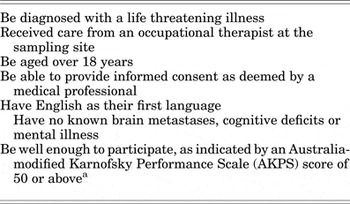
A Clinical Nurse Consultant (CNC) at the sampling site used the eligibility criteria to screen all patients in community and inpatient palliative care (see Table 1). The CNC provided eligible patients with a Participant Information Statement and explained the study verbally, indicating that it was voluntary and participation would not alter the care received. The first author followed up participants who expressed interest in the study by phone or at the hospital, and an interview was organized when informed and written consent was gained. Three participants declined as they were either no longer interested or could not remember receiving occupational therapy.
Eligibility criteria

Note: aThe AKPS (Appendix E) is a measure of functional performance routinely used at the sampling site. A score of 50 or above indicates the participant is able to complete some activities independently. (Abernethy, Shelby-James, Fazekas, Woods, & Currow, Reference Abernethy, Shelby-James, Fazekas, Woods and Currow2005)
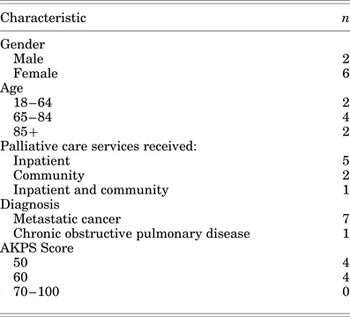
Eight participants were recruited to the study (see Table 2). Between 6 and 12 participants are generally recommended for phenomenological studies, as a small sample size allows for in-depth information to be gained from individuals who have experienced the phenomenon (Smith & Osborn, Reference Smith and Osborn2008).
Participant Demographics

Data Collection
In keeping with hermeneutic phenomenology, data collection included semi-structured interviews, field notes and a reflexive journal (Colaizzi, Reference Colaizzi, Valle and King1978), to provide a platform from which to understand the individual's experience (Clarke, Reference Clarke2009). Field notes were used to capture emotions, body language and the impact of the environment on the participants, aiding in interpretation of the data. A reflexive journal was used to track the researcher's theoretical perspectives and thoughts regarding the data, to determine how these may affect the interpretation of the data (Finlay, Reference Finlay2011).
Each participant engaged in one interview that lasted on average 35 minutes. An interview guide was used to elicit opinions and feelings relating to the experience of receiving occupational therapy in palliative care. Participants were asked about the overall experience of occupational therapy, choice and control in the occupational therapy process and changes in day-to-day life since receiving occupational therapy. The interview guide was designed to allow flexibility so that the interviewer could encourage participants to expand on and discuss the issues that were important to them. The interviews were held either in the palliative care ward at the hospital or in the participant's home. The interviews were audio-recorded and transcribed verbatim by the first author.
Data Analysis
Data analysis involved hermeneutic interpretation and thematic analysis, guided by Colaizzi's (Reference Colaizzi, Valle and King1978) seven-step methodology. The approach chosen was inductive in nature, to allow ideas and themes to emerge from the participants’ experience, rather than imposing a predetermined theory (Patton, Reference Patton2002). The analysis process involved: (1) repeated readings of transcripts to gain a sense of the participant's experience as a whole; (2) extracting significant statements from the transcripts; (3) examining the significant statements for unspoken meanings and formulating meanings that relate directly to the participant's dialogue; (4) combining significant statements and formulated meanings into clusters of themes and subthemes; (5) writing exhaustive descriptions of themes by synthesizing the theme clusters and the associated statements and meanings; and finally (6) refining the exhaustive descriptions to provide an overview of the experience of occupational therapy in palliative care. To establish interpretive rigor, the second author critically reviewed the transcripts and analysis to ensure the themes were representative of the participants’ experience.
FINDINGS
Analysis of the participants’ responses revealed two main themes related to the lived experience of occupational therapy in palliative care. Participants described occupational therapy as providing comfort and safety, and reported trusting the occupational therapist to know what is needed.
Theme 1: Occupational Therapy Provides Comfort and Safety
All participants appeared to be satisfied with the care the occupational therapists had provided them. Participants believed occupational therapy enhanced their quality-of-life through interventions that increased comfort and assisted them to feel safe. While participants described receiving a number of interventions that offered emotional and physical support, the most common interventions discussed by participants were equipment prescription, discharge planning, education and hand therapy.
For most participants, a major contribution to their comfort was being able to live at home. Participants appreciated tangible supports such as education and equipment prescription, which assisted them to live at home comfortably and safely. Most participants recognized that this aim was not achievable without input from the occupational therapist: “if I wasn't able to move [my hand] the way I'm doing, I couldn't go home” (Michelle). Participants who received equipment found that the occupational therapist was able to provide specialist advice on choosing equipment suited to the participant's individual needs: “she suggested some devices and things to make me more comfortable…that has been a help” (Victoria). Many participants appreciated the detailed education provided by the occupational therapist as it made them feel safer at home: “all she has helped me with, well not all but her input into what I need to consider at home… has helped” (Rose). Participants were able to envisage a future in their own home, as most participants perceived that it was now possible for them to live at home comfortably and safely.
“She certainly has made my stay here like hazard-free or worries free. I don't have to think about what I need to… settle back into…home” (Oliver).
All participants described the occupational therapists’ use of self as improving their experience of occupational therapy as a whole, and ultimately improving their comfort. A strong, trusting relationship was developed between most of the participants and their occupational therapist. In part, this was as a result of the occupational therapists’ personal qualities, with all participants describing their occupational therapist as patient, friendly, and caring: “Just being who she is. It's just her. Just her personality and just who she is, is what makes you feel comfortable” (Beatrix).
The occupational therapists’ use of self-enabled participants to feel more comfortable, both physically and emotionally. The relationship between the therapist and the participant assisted participants to come to terms with their loss of function and most felt as though they were able to rely on the occupational therapist to provide the support they required: “she tried to understand my condition first… she put herself in my shoes” (Oliver). In particular, Michelle reported the collaborative relationship with her occupational therapist provided her with motivation to persist with hand therapy: “she helped me with anything, whether I could do it, we tried together to help me.” Participants also reported that the occupational therapist helped them to realize and accept the support they would require on returning home.
“She just puts you at ease and she just makes you realize what you actually do need to have when you get home. You think you'd just go back [home] and everything's going to be normal but it's not, and she makes you feel comfortable about realizing that it's not. And that it's okay to have aids to help you.” (Beatrix)
Surprisingly none of the participants discussed their therapy as being related to occupations they wanted to engage in. Although they did not see occupation as the focus of the therapy provided, most did discuss how the comfort and safety facilitated by the occupational therapist had an impact on their activities. Five out of eight participants reported that through tangible supports provided by the occupational therapist, they were able to spend more quality time socializing with their family and friends. These supports also enabled some participants to engage in other activities that were too difficult before receiving occupational therapy. For example, Victoria, who was previously confined to her bed as it was the only place she found comfortable, was able to sit comfortably in her living room following provision of a pressure cushion by the occupational therapist. This enabled Victoria to watch television: “my eyesight is going and I therefore can't read anymore which was my greatest love and so, it's been a great help being able to sit in front of the TV comfortably.” Michelle also benefited functionally from the therapy she received, and thus her ability to perform meaningful occupations improved: “when I first came here I thought I'm never going to be able to use the needle again [for dressmaking]… now I can!” Michelle's quality-of-life has improved significantly through occupational therapy: “I didn't want to live, but now I can see things can come back to normal.” Oliver, who was paraplegic due to spinal cord compression, also relished his ability to leave his hospital bed. This was facilitated by the occupational therapist, who provided a suitable chair and education on transfer techniques: “it's good to be out of the room…[it's] too small [and] most of my friends and family will be here… so it's good to be out in the open.”
Theme 2: Trusting the Occupational Therapist to Know What is Needed
Participants followed the occupational therapists’ lead throughout the occupational therapy process, which may have limited the client-centeredness of interventions. Although participants felt as though they had some control over the direction of therapy, they did not participate in goal setting.
Participants often reported that, as a patient, they expected to be told what to do by health professionals; hence they went along with what was asked of them.
“Being in control is not something I can answer being a patient in a hospital… what they tell me is good for me, I guess that's the normal attitude of a person who has been sick” (Rose).
This was not necessarily seen in a negative way: “I've sort of basically gone along with what she thinks and says cause I feel like I can, I've got trust in her and… I respect her opinions” (Beatrix).
Participants appreciated the occupational therapist making decisions for them regarding their therapy, as well as having some control over the process. When participants discussed therapy options with the occupational therapist, they appreciated the detailed information provided on the benefits and risks of interventions. This enabled them to make an informed choice.
“Oh my goodness, [occupational therapist] said ‘you can't have this rug here because it might slip,’ ‘you have to have this rail to get up from the toilet.’ She's tough. But they didn't tell me what I have to do… the only thing she can say is not to be stupid, not to… go against her prescription” (Charlie).
It gave participants great comfort knowing that they had control over saying no to therapy, if the therapy or equipment the occupational therapist had chosen for them was not suitable: “yes I felt comfortable saying it ‘cause I had given it a good try” (Victoria).
Surprisingly, seven of the eight participants reported that they did not discuss goals with their occupational therapist during their care, thus their therapy was not client-centered. Interestingly, this did not seem to upset the participants. Participants discussed their goals during the interview and most had a goal of being comfortable until death, going home or participating in a particular occupation. Often, participants did not know how to achieve their goal: “I want to know what's happening with that [lymphedema massage] you know… [but] I don't like to, I don't like sort of asking for things much” (Madelyn). Madelyn suffered from debilitating fatigue and requested assistance to continue interacting with her friends, as without them she had no will to live. However, she was not enabled to participate in her chosen meaningful occupation as the occupational therapist dismissed her concern, contradicting client-centered care: “It's very hard. They also say there is nothing wrong with just falling asleep but you know [that's not what I want].”
DISCUSSION
The findings of this study begin to provide an understanding of the intricate lived experience of occupational therapy in palliative care. The findings indicate aspects of the lived experience of occupational therapy in palliative care that are both similar to and different from the experience of occupational therapy in other settings. Critical similarities include the value of equipment provision and timely individual support (Boutin-Lester & Gibson, Reference Boutin-Lester and Gibson2002; Lattanzi et al., Reference Lattanzi, Giuliano, Meehan, Sander, Wootten and Zimmerman2010; Orpen & Harris, Reference Orpen and Harris2010) and the importance of the occupational therapist-client relationship and the therapeutic use of self.
As in the current study, Palmadottir (Reference Palmadottir2006) found the therapist-patient relationship was a major determinant of the success or failure of the occupational therapy encounter. This relationship can provide emotional support and increase patient confidence, by allaying anxieties and helping patients to cope better with their illness (Lattanzi et al., Reference Lattanzi, Giuliano, Meehan, Sander, Wootten and Zimmerman2010; Orpen & Harris, Reference Orpen and Harris2010). Participants in the current study also perceived that the success of occupational therapy relied on the occupational therapist's qualities, a finding that is in agreement with a number of studies (Boutin-Lester & Gibson, Reference Boutin-Lester and Gibson2002; Cole & McLean, Reference Cole and McLean2003; Lattanzi et al., Reference Lattanzi, Giuliano, Meehan, Sander, Wootten and Zimmerman2010; Orpen & Harris, Reference Orpen and Harris2010). The term therapeutic use of self has been employed to describe the application of the occupational therapist's personal qualities to improving the therapy interaction (Punwar & Peloquin, Reference Punwar and Peloquin2000; Taylor, Reference Taylor2008). Personal qualities of the therapist that can contribute to a successful therapeutic relationship include skills in collaboration, use of empathy, and effective verbal and non-verbal communication (Taylor, Reference Taylor2008). Therapeutic use of self in occupational therapy practice creates a collaborative relationship, which can empower people with a life-threatening illness and lead to improved therapy outcomes (Townsend, Reference Townsend2003).
In some ways, the lived experience of occupational therapy in palliative care is different to the lived experience of occupational therapy in other settings. The findings of this study suggest that occupational therapy in palliative care has diverged from its beginnings as an occupation-focused profession. This confirms recent research in palliative care that suggests occupational therapists are not using occupation as a tool to relieve pain and suffering (Keesing & Rosenwax, Reference Keesing and Rosenwax2011; Park Lala & Kinsella, Reference Park Lala and Kinsella2011).
It is evident from the findings that most participants received therapy that lacked client-centered goal setting. Studies that investigated the lived experience of home health and pre-operative occupational therapy note the importance of setting and achieving goals (Boutin-Lester & Gibson, Reference Boutin-Lester and Gibson2002; Orpen & Harris, Reference Orpen and Harris2010). Participants in this study, who conformed to the expectations of the medical model by placing themselves in a passive role in their therapy, did not promote their desire to engage in meaningful occupations. The overwhelming attitude of the participants in this study was that, as patients, they were expected to follow the health professional's lead. People with a life-threatening illness seek control through different strategies. Carter et al. (Reference Carter, MacLeod, Brander and McPherson2004) have suggested that to facilitate people with a life-threatening illness to take charge of their healthcare, health professionals must recognize that patients may choose to delegate control over decisions that need to be made, rather than assuming total responsibility for the choices themselves. As such, occupational therapists in palliative care need to ensure they facilitate decision-making based on a thorough understanding of the patient's goals. This can be achieved through discussing collaboratively with their patient as to how much involvement they want in the decision-making process, and support them to make choices instead of expecting patients to make decisions for themselves.
Not only did participants in this study perceive occupational therapy as being therapist-directed, they also saw it as primarily focused on and influencing comfort and safety. The impact on occupations appeared secondary and sometimes even incidental. There is an abundance of literature that outlines the benefits of participating in occupation, specifically that participating in meaningful activities at end-of-life provides a sense of control over a deteriorating body, as well as a sense of wellness (Hasselkus, Reference Hasselkus2002; La Cour et al., Reference La Cour, Johannessen and Josephsson2009; Vrkljan & Miller-Polgar, Reference Vrkljan and Miller-Polgar2001). However, Park Lala and Kinesella (Reference Park Lala and Kinsella2011) suggest that occupational therapists may not be adequately prepared to offer care that attends to the intricacies of occupation at end-of-life. Thus, occupation is often ignored in palliative care. In addition, the environment of palliative care is not conducive to traditional occupational therapy as a result of time and resource constraints. This prevents important occupational issues such as productivity and leisure from being addressed during therapy (Davis et al., Reference Davis, Asuncion, Rabello, Silangcruz and van Dyk2013; Keesing & Rosenwax, Reference Keesing and Rosenwax2011), with the focus being, as suggested by the current study, on living at home comfortably and safely. For occupational therapists to provide care that attends to the quality-of-life of people receiving palliative care, they need to better understand and prioritize the occupational dimensions of an individual's end-of-life. For this to occur, everyday occupations that are meaningful to patients but may have been disregarded need to be acknowledged. Through this knowledge, occupational therapists may identify ways to improve the quality of end-of-life experiences of their patients. It is imperative for occupational therapists in palliative care to note that patients receiving occupational therapy do not always understand the benefits of occupation and choice. Therefore, occupational therapists need to take it upon themselves to promote an understanding of the importance and benefits of occupation and choice to their patients.
This study investigated the experience of occupational therapy in palliative care for eight people with a life-threatening illness at one hospital. The majority of participants had a diagnosis of metastatic cancer, which is representative of the majority of people that receive palliative care (Palliative Care Australia, 2003). However, people with other life-threatening illnesses and in other palliative care settings may have a different experience. Due to the phenomenological nature of this study, it does not claim or seek to be generalizable to other settings. Instead the rigor of phenomenological research is measured by the degree to which the findings reveal the lived experience of a phenomenon (van Manen, Reference van Manen1997). Readers are able to assess the applicability of the findings to their own situations by referring to the background information provided.
CONCLUSION
This study responded to a gap in knowledge about the perspectives of palliative care patients on receiving occupational therapy. While participants reported benefiting from the services provided, they saw occupational therapy as providing specific services related to comfort and safety, rather than as helping them to participate in occupations that were meaningful to them. This may suggest that, in palliative care, occupational therapy has lost the focus on goal and occupation orientated interventions. Future research should explore how occupational therapists can deliver occupation-focused care that is more attentive to the lived experience at end-of-life. Occupational therapists in palliative care need to maximize their patient's ability to participate, in order for people with a life-threatening illness to make the most of the remainder of their life.
ACKNOWLEDGEMENTS
Heartfelt appreciation is extended to the participants for sharing their experiences and allowing this study to be possible. We would also like to acknowledge the efforts of the sampling site's staff for recruiting participants and welcoming the first author to the team. The first author wishes to thank Professor Rod MacLeod and Dr. Anne Honey, for their invaluable support and guidance throughout this project, which was undertaken in partial satisfaction of the Bachelor of Applied Science (Occupational Therapy) Honors at The University of Sydney.