Emerald ash borer, Agrilus planipennis Fairmaire (Coleoptera: Buprestidae), is an important invasive pest of ash, Fraxinus Linnaeus (Oleaceae) species, in North America (Herms and McCullough Reference Herms and McCullough2014). This insect has successfully established and spread in many regions of North America subjected to frequent sub-freezing winter temperatures. To avoid freezing, overwintering larvae depress temperatures at which ice nucleates in their tissues through accumulation of cryoprotectants, the so called “supercooling point” (Crosthwaite et al. Reference Crosthwaite, Sobek, Lyons, Bernards and Sinclair2011). The mean supercooling temperature for winter acclimated A. planipennis larvae collected from St. Paul, Minnesota, United States of America was −25 °C (Venette and Abrahamson Reference Venette and Abrahamson2010), whereas Crosthwaite et al. (Reference Crosthwaite, Sobek, Lyons, Bernards and Sinclair2011) quantified a supercooling point of −27.8 °C for ~200 prepupae collected in London, Ontario, Canada.
We documented significant overwintering A. planipennis mortality following a cold front that moved across New York from 13 to 15 February 2016 with minimum temperatures ranging from −40 °C to −9 °C (Northeast Regional Climate Centers 2016a). Mortality likely occurred when minimum temperatures in some regions of the state where A. planipennis is established dropped below the supercooling point of overwintering larvae. In addition, above average winter temperatures and warm spells before the cold front (Northeast Regional Climate Centers 2016b) may have made larvae less cold tolerant and more susceptible to freezing, as predicted by Sobek-Swant et al. (Reference Sobek-Swant, Crosthwaite, Lyons and Sinclair2012).
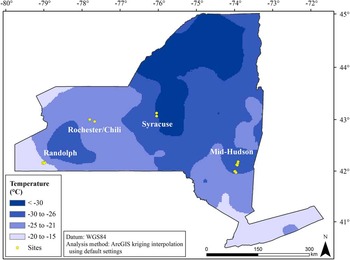
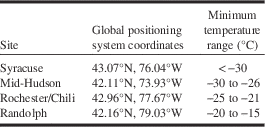
To determine the extent of overwintering mortality across New York, we reviewed temperature data for 13, 14, and 15 February 2016 from 160 weather stations and identified 14 February as the coldest day (mean temperature −20 °C), with temperatures ranging from −40 °C to −3 °C, depending on geographical location (Regional Climate Centers Applied Climate Information Systems 2016). Temperature data from 14 February were mapped using kriging interpolation (ArcGIS 10.1, Environmental Systems Research Institute, Redlands, California, United States of America) to create a visual reference of minimum temperatures (Fig. 1). Trees were selected for sampling from four areas of the map based on the presence of documented A. planipennis infestations and a range of thermal gradients (Table 1). Several trees (n=5–10) from multiple forest stands in each area were felled and bark was peeled to ⩽5 cm diameter or a sub-sample of 1-m bolts were peeled to collect larvae. Larvae that appeared healthy were stored at room temperature (~25 °C) for 24 hours and observed for signs of movement.
Minimum temperatures across New York on 14 February 2016. Temperatures in many regions exceeded the supercooling point of cold acclimated overwintering Agrilus planipennis larvae and resulted in high mortality.

Minimum temperature ranges for 14 February 2016 at four New York sites selected for sampling overwintering Agrilus planipennis mortality.

Trees were sampled for overwintering mortality at sites where we were concurrently collecting data for other A. planipennis research. Because of this, we were not able to record fine-scale, tree-level mortality data for all sites and mortality values were pooled from observations of larvae collected from multiple trees in each area.
High overwintering A. planipennis mortality was initially detected in Syracuse, New York, when >90% of larvae excised from a F. pennsylvanica Marshall felled and peeled on 11 March 2016 were dead. A second F. pennsylvanica was felled and peeled at the same site on 29 March and again, >90% of larvae were dead. By comparison, <1% of larvae we collected from two F. pennsylvanica at the same site on 31 January and 8 February were dead.
Subsequent sampling at four sites across New York revealed variable larval mortality of ⩽5% to 93%, which increased as the minimum temperature decreased (Table 2). In both Syracuse and Mid-Hudson Valley where temperatures were coldest, dead overwintering larvae were detected in prepupal cells located in the xylem (sapwood) and periderm (outer bark), and in larval galleries in the phloem (inner bark). Observations made while collecting larvae from these two areas indicated mortality was consistent throughout the trees regardless of diameter at breast height or bark thickness, which was ⩽12 mm thick for sampled trees. In Rochester/Chili where minimum temperatures were not as cold, bark thickness appeared to make a difference. Larval mortality was 30–40% when larvae were collected from beneath bark that was >10 mm thick, but was closer to 60% when bark was <10 mm thick. In Rochester/Chili and Randolph, most dead larvae were excised from prepupal cells. The majority of smaller larvae (first to third instars) in the phloem undergoing a two-year life cycle (Cappaert et al. Reference Cappaert, McCullough, Poland and Siegert2005) were still alive.
Data collected at each New York site sampled for overwintering Agrilus planipennis mortality following a freeze event in mid-February 2016.

* Mortality values were pooled from observations of larvae collected from multiple trees. When tree level data were collected, mean (±standard error) is provided.
† Mortality in Rochester/Chili was higher when larvae were excised from beneath bark <10 mm thick and decreased when bark was >10 mm thick.
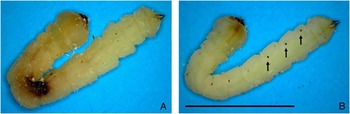
At all sites, dead larvae had two general appearances: discoloured with spots of brown tissue or a “healthy” buff colour with necrotic black tissue in the spiracles (Fig. 2). Larvae with black tissue in the spiracles were determined to be dead when no movement was detected after the 24-hour observation period. Brown tissue was most often detected at the fold of prepupal larvae (J-larvae), but was also found in the spiracles and foregut of fourth instars that were overwintering in galleries or were in the process of excavating a prepupal cell.
Darkened necrotic tissue of overwintering Agrilus planipennis larvae killed by cold temperatures from 13 to 15 February 2016 often appeared (A), at the fold of prepupal larvae (J-larvae) or (B), in tissue around the spiracles (arrows). Scale bar=1 cm.

Overwintering A. planipennis mortality observed in this study was slightly higher than Venette and Abrahamson (Reference Venette and Abrahamson2010) predicted would occur in a more northerly part of the invaded range of A. planipennis (Minnesota). For example, we observed up to 60% mortality in Rochester/Chili where minimum temperatures ranged from −25 °C to −21 °C, while they predicted ~34% mortality would occur at −23 °C. This could be due to populations from more northerly invaded regions having lower supercooling points than populations in New York. However, the mean supercooling point (−27.8 °C) documented by Crosthwaite et al. (Reference Crosthwaite, Sobek, Lyons, Bernards and Sinclair2011) in London, Ontario, Canada was lower than what we observed in Rochester/Chili, even though the two study areas were at similar latitudes (~43°N).
A more likely contributing factor to the higher mortality we observed was the above average winter temperatures and multiple warm spells (10–20 °C above mean) experienced by larvae and pre-pupae in January and early February (Northeast Regional Climate Centers 2016b). Sobek-Swant et al. (Reference Sobek-Swant, Crosthwaite, Lyons and Sinclair2012) determined periods of mid-winter warm spells could deacclimate larvae by initiating breakdown of cryoprotectants, making them more susceptible to future freeze events. The presence of necrotic tissue in the spiracles and foregut suggested larvae may have broken dormancy or became less cold tolerant before the cold front and were indeed more susceptible to freezing. Further monitoring of A. planipennis in Syracuse yielded only three living pupae detected in the 19 trees sampled in spring and early summer, suggesting that the mortality observed was widespread and consistent within the region bounded by the coldest temperatures.
For the first time in North America, we detected and recorded extensive overwintering A. planipennis mortality following a cold front that dropped temperatures below the supercooling point of many overwintering larvae. Mortality may have also increased as mid-winter warm spells could have deacclimated larvae, making them more susceptible to freeze. The mortality we observed highlight a vulnerability to climatic fluctuations that likely will influence A. planipennis as its range continues to expand.
Acknowledgements
The authors are grateful to undergraduate technicians Ian Newcomb, Ben Kosalek, and research technician Trupti Indurkar for their assistance in data collection, as well as our collaborators from New York State Department of Environmental Conservation, United States Department of Agriculture-Agricultural Research Service, and United States Department of Agriculture, Animal and Plant Health Inspection Service. The New York State Department of Environmental Conservation was especially helpful in providing transportation and permission to access study sites. The New York State Department of Agriculture and Markets was helpful in obtaining access to study sites in the Mid-Hudson Valley and Randolph. The authors would also like to thank Dylan Parry (State University of New York, College of Environmental Science and Forestry) and two anonymous reviewers for their invaluable edits and comments on the manuscript. This project was funded by the United States Department of Agriculture, Animal and Plant Health Inspection Service.