Introduction
There is no clear consensus on the findings or clinical manifestations of laryngopharyngeal reflux (LPR) disease.Reference Koufman1 Furthermore, there are no ideal diagnostic procedures for evaluating LPR disease, and diagnostic outcome criteria are ambiguous.Reference Koufman1 Double-probe, 24-hour pH monitoring remains the ‘gold standard’ for the diagnosis of LPR disease.Reference Koufman1–Reference Postma3 However, there is no consensus on how many pH sensors to use, their precise location or how to interpret the data collected.Reference Postma3, Reference Postma, Belafsky, Aviv and Koufman4
In this paper, tetra-probe, 24-hour pH monitoring was performed to investigate the pattern of LPR and gastroesophageal reflux and the validity of using a pH level of 5.0 to indicate LPR.
Materials and methods
Tetra-probe, 24-hour pH monitoring was performed in 56 patients with suspected LPR. Seven out of 56 patients had organic lesions and the remainder had non-organic lesions. Four cases had laryngeal granuloma, one had epithelial hyperplasia and one had Reinke's oedema.
Tetra-probe, 24-hour pH monitoring
Twenty-four hour pH monitoring was performed with a tetra-probe, antimony pH catheter (Zinetics 24 ME Multi-use pH catheter, Medtronic Functional Diagnostics, Skovlunde, Denmark). The four pH probes of the catheter were located every 10 cm. The proximal probe sensor (channel one) was placed in the hypopharynx (just above the upper oesophageal sphincter), the second probe (channel two) in the middle oesophagus, the third probe (channel three) above the lower oesophageal sphincter and the distal probe (channel four) in the stomach.
The proximal probe of the catheter was placed under direct vision, using transnasal videolaryngoscopy. A videofluorogram was thereafter performed to ensure accurate placement of the proximal probe (just above the upper oesophageal sphincter) and of the other three probes (positioned in the middle oesophagus, a few centimetres above the lower oesophageal sphincter, and in the fundus of the stomach).
The pH probes were simultaneously calibrated in buffer solutions at pH 7 and pH 1 before initiation of the study. The pH values were recorded second by second on a pH monitor (Digitrapper pH, Medtronic Functional Diagnostics).
Data analysis
Data were analysed using the Polygram Net TM software program (Medtronic, Skovlunde, Denmark). We took a pH level of <4.0 or <5.0 to indicate a significant reflux event at channel one, and a pH level of <4.0 to indicate a significant reflux event at the other channels. The pH values recorded at all four channels were calculated second by second. Recordings were made while subjects were upright and supine, and during preprandial, mealtime and postprandial periods. We evaluated the number of reflux episodes, number of long reflux episodes (>5 minutes), duration of the longest reflux episode, time spent with pH < 4.0 or <5.0 (in minutes), percentage of time with pH < 4.0 or <5.0, minimum pH, maximum pH, mean pH and median pH.
Results
Reflux at each site
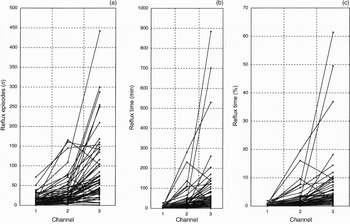
Figure 1 shows reflux data for monitoring sites one, two and three, using a cut-off of pH < 4.0. The number of reflux episodes and the total time and percentage time of reflux correlated with the distance of the probe from the lower oesophageal sphincter.
Results for (a) total number of reflux events, (b) total reflux time and (c) percentage reflux time, for monitoring channels one, two and three, using a cut-off of pH < 4.

The number of gastroesophageal reflux episodes was greater than that of LPR episodes. However, the total time and percentage time for gastroesophageal reflux were less than those for LPR. These results indicated that gastroesophageal reflux occurred with greater frequency (i.e. a greater number of reflux acid exposure events) but lesser duration (i.e. smaller total and percentage time durations of reflux acid exposure events), compared with LPR.
Gastroesophageal reflux
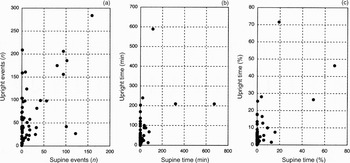
The number, total time and percentage time of gastroesophageal reflux episodes (i.e. pH < 4.0, measured at channel three) were assessed both while patients were supine (i.e. while sleeping) and upright (i.e. during the daytime) (Figure 2). The number, total time and percentage time of gastroesophageal reflux events were greater when patients were upright compared with supine.
Comparison of upright and supine results for gastroesophageal reflux (measured at channel 3), assessed at pH < 4: (a) total number of reflux events; (b) total reflux time; and (c) percentage reflux time.

Laryngopharyngeal reflux
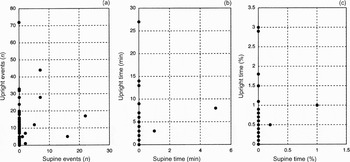
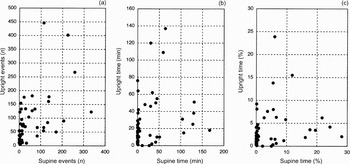
Results for LPR episodes (i.e. the number, total time and percentage time of reflux events, measured just above the upper oesophageal sphincter (channel one)) were compared during supine and upright periods, for pH < 4.0 (Figure 3) and pH < 5.0 (Figure 4). The number, total time and percentage time of LPR were greater when patient were upright compared with supine. However, when a pH level of <5.0 was used, the number, total time and percentage time of LPR became greater during the supine period in a quarter of patients (27 per cent).
Comparison of upright and supine results for laryngopharyngeal reflux (measured at channel one), assessed at pH < 4: (a) total number of reflux events; (b) total reflux time; and (c) percentage reflux time.

Comparison of upright and supine results for laryngopharyngeal reflux (measured at channel one), assessed at pH < 5: (a) total number of reflux events; (b) total reflux time; and (c) percentage reflux time.

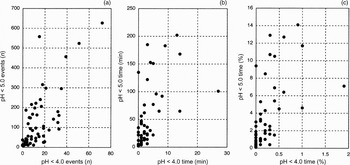
Figure 5 shows the relationship between LPR results (at channel one) for pH levels of <4.0 and <5.0. When a pH level of <4.0 was used to indicate a significant reflux event, three out of 56 patients were assessed as having no episodes of reflux into the pharynx. However, when a pH level of <5.0 was used to indicate a significant reflux event, all three of these patients were assessed as having significant reflux events. While there were few LPR events at a pH level of <4.0, there were a significant number at a pH level of <5.0, a level capable of causing LPR disease.
Comparison of laryngopharyngeal reflux results (measured at channel one) assessed at pH < 4.0 and at pH < 5.0: (a) total number of reflux events; (b) total reflux time; and (c) percentage reflux time.

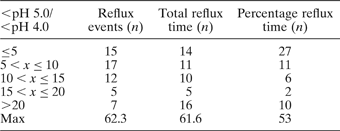
Table I shows how many times the events increase when a pH level of <5.0 was used, when compared with a pH level of <4.0 was used as a significant reflux event. When a pH level of <5.0 was used as a significant reflux event, 43% (24/56) of the cases had more than ten times as many events as the total number of reflux events, 55% (31/56) of the cases had more than ten times as many events as the total reflux time, and 32% (18/56) of the cases had more than ten times as many events as the percentage reflux time, when compred with a pH level of <4.0 was used as a significant reflux event. Each of the maximum times was 62.3 times the events in the total number of reflux events, 61.6 times the events in the total reflux time, and 53 times the events in the percentage reflux time.
Results for pH levels of <4.0 and <5.0 at channel One
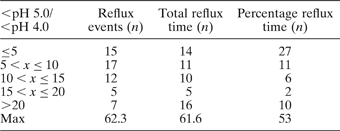
Data represent number of patients. Max = maximum
From these results, it was considered valid to use a pH level of not only <4.0 but also <5.0 as indicative of LPR in the hypopharynx.
Discussion
The diagnosis and treatment of LPR disease are still controversial. Ambulatory, double-probe, 24-hour (simultaneous oesophageal and hypopharyngeal) pH monitoring is currently considered the gold standard for LPR disease diagnosis.Reference Koufman1–Reference Postma3 However, this technique is still somewhat controversial, especially regarding interpretation of results.
The advantage of tetra-probe, 24-hour pH monitoring is that the pH can be monitored simultaneously at four sites, enabling gastric acid levels and gastroesophageal and laryngopharyngeal reflux to be thoroughly assessed.Reference Sato5 This tool reveals gastric acid levels and reflux patterns, and enables the relationship between the four probe locations to be well documented.Reference Sato5 However, even with such extra precision, data interpretation has still been ambiguous.
It has been stated that patients with LPR appear to have a different pathophysiological mechanism and pattern of reflux, compared with patients with gastroesophageal reflux disease. The relationship between LPR disease and gastroesophaeal reflux disease is also controversial.
In this study, patterns of LPR and gastroesophageal reflux were investigated using tetra-probe, 24-hour pH monitoring. The study also investigated the interpretation of pH within LPR, especially the validity of using a pH level of <5.0 as indicative of LPR. Finally, the relationship between LPR disease and gastroesophaeal reflux disease was considered.
Interpretation of laryngopharyngeal reflux pH
The interpretation of pH monitoring for gastroesophageal reflux disease has been studied (for oesophageal acid levels 5 cm above the lower oesophageal sphincter) and normal pH values are well established, as is the percentage time duration for pH < 4.0.Reference Feussner, Petri, Walker, Bollschweiner and Siewert6 In contrast, there are no ideal diagnostic procedures for evaluation of LPR, and diagnostic outcome criteria are ambiguous.Reference Koufman1, Reference Koufman, Aviv, Casiano and Shaw2 The use of pH monitoring is considered the gold standard for LPR disease; however, there is no consensus on how many pH sensors to use, where to locate them or how best to interpret the results.
Smit et al. Reference Smit, Tan, Devriese, Mathus-Vliegen, Brandsen and Schouwenburg7 assessed the percentage of time during which a pH of <4.0 was detected in cases of LPR. They suggested that the proportion of time required to indicate pathological reflux was more than 0.1 per cent for total recording, 0.2 per cent for upright recordings and 0 per cent for supine recordings. In addition, they considered more than four reflux episodes to be pathological.Reference Smit, Tan, Devriese, Mathus-Vliegen, Brandsen and Schouwenburg7 On the other hand, there is an opinion that a single episode of reflux into the pharynx indicates LPR.Reference Postma, Belafsky, Aviv and Koufman4, Reference Koufman8 Postma et al. Reference Postma, Belafsky, Aviv and Koufman4 have established four criteria that must be met in order for an event to be defined as pharyngeal reflux: (1) a decrease in pH to <4.0 (or <5.0); (2) a decrease in pharyngeal pH level immediately following distal oesophageal acid exposure; (3) no decrease in pH level during eating or swallowing; and (4) a rapid and sharp decrease in pH level at the proximal sensor, rather than a gradual decrease.
The mucosal linings of the oesophagus, pharynx and larynx differ in their susceptibility to peptic acid injury. Laryngeal epithelium can sustain peptic acid injury at a pH level of 5.0 or more,Reference Axford, Sharp, Ross, Pearson, Dettmar and Panetti9 and is far more sensitive to reflux-related injury than oesophageal epithelium. Other authors have suggested that the use of a pH level of 5.0 may be valid in indicating LPR,Reference Postma, Belafsky, Aviv and Koufman4 because proximal acid exposure times are short and the dilutional and neutralisation factors present in saliva are greater at this level.Reference Dobhan and Castell10
In the current study, a pH level of <4.0 or <5.0 was calculated at the proximal probe (channel one, just above the upper oesophageal sphincter). Three out of 56 cases had no single reflux event into the pharynx when a pH level of <4.0 was assessed as a significant reflux event. However, these cases all had significant reflux events when a pH level of <5.0 was assessed as a significant reflux event. When a pH level of <5.0 was assessed as a significant reflux event, many cases had a greatly increased number of reflux events, compared with assessment using a pH level of <4.0. Thus, while there were few LPR events with a pH level of <4.0, there were a significant number of such events at a pH level of <5.0, a level capable of causing laryngeal lesions.
These results suggest that it is appropriate to use pH levels of not only <4.0 but also <5.0 as indicators of significant LPR events. Thus, we would consider it valid to use a pH level of <5.0 as indicative of LPR in the hypopharynx.
Relationship between laryngopharyngeal and gastroesophaeal reflux
The relationship between laryngopharyngeal and gastroesophaeal reflux disease is also controversial. Patients with LPR appear to have different pathophysiological mechanisms and patterns of reflux, as well as different symptoms, signs and responses to treatment, compared with patients with gastroesophaeal reflux disease.Reference Koufman, Aviv, Casiano and Shaw2 The majority of patients with LPR do not have oesophagitis or its primary symptom, heartburn.Reference Koufman, Aviv, Casiano and Shaw2 Patients with LPR suffer predominantly upright (daytime) reflux events, whereas patients with gastroesophaeal reflux disease suffer predominantly supine (nocturnal) reflux events.Reference Koufman, Aviv, Casiano and Shaw2 Patients with gastroesophageal reflux disease suffer prolonged periods of acid exposure, while those with LPR do not.Reference Koufman, Aviv, Casiano and Shaw2 Patients with gastroesophaeal reflux disease have dysmotility and prolonged oesophageal clearance, whereas those with LPR do not.Reference Koufman, Aviv, Casiano and Shaw2 The primary defect in gastroesophaeal reflux disease is lower oesophageal dysfunction, whereas the primary defect in LPR is upper oesophageal sphincter dysfunction.Reference Koufman, Aviv, Casiano and Shaw2
It is obvious that LPR occurs subsequent to gastroesophageal reflux when the upper oesophageal sphincter is dysfunctional. The laryngeal epithelium is far more sensitive to reflux-related injury than the oesophageal epithelium. In the present study, tetra-probe, 24-hour pH monitoring was performed to investigate patterns of laryngopharyngeal and gastroesophageal reflux. Laryngopharyngeal reflux occurred subsequent to gastroesophageal reflux, and the recorded reflux events correlated with the distance of the monitoring probe from the lower oesophageal sphincter. When a pH level of <5.0 was assessed as a significant reflux event, many patients had many times more reflux events registered, compared with the number registered when a reflux event was defined as pH < 4.0.
It has been postulated that the pH level indicative of LPR, and the differences in susceptibility to peptic acid injury between oesophageal, laryngeal and pharyngeal mucosa, indicate that patients with LPR have a different pathophysiological mechanism and pattern of reflux, compared with patients with gastroesophaeal reflux disease.
Conclusion
There are currently no ideal diagnostic procedures for evaluating LPR disease, and diagnostic outcome criteria are ambiguous. Double-probe, 24-hour pH monitoring remains the gold standard for the diagnosis of LPR disease; however there is no consensus on how best to interpret the data collected.
In the present study, there were few LPR events with a pH level of <4.0, but a significant number of LPR events at a pH level of <5.0, a level capable of causing LPR disease. We therefore consider it appropriate and valid to use a pH level of not only <4.0 but also <5.0 as indicative of a significant LPR event.