Introduction
Intercropping of crops on the same piece of land (Ofori and Stern, Reference Ofori and Stern1987) enhances ecosystem productivity (Willey, Reference Willey1979) through environment-friendly management of nutrients (Houggaard-Nielsen et al., Reference Houggaard-Nielsen, Ambus and Jensen2001), weeds (Midmore, Reference Midmore1993) and pests (Mitchell et al., Reference Mitchell, Tilman and Groth2002) and results in better quality of produce (Anil et al., Reference Anil, Park and Miller1998). Gill et al. (Reference Gill, Abid and Azam2009) reported improved soil fertility and higher grain yield of the cereal with green manuring or intercropping of a legume. The population of developing countries like India is increasing day by day, but the food grain production remains stagnant due to low or plateaued crop productivity and limited resources. So, it necessitates increasing production of food grains per unit of the resource availability. Having large number of small and marginal farmers, intercropping is one of the possible ways to increase the productivity on small farms in India as it provides security against potential losses of monoculture. Intercropping increases diversity in the cropping system and results in higher yield on a certain piece of land by making more effective usage of the existing growth resources, such as light, heat and water, with a combination of crops of diverse rooting ability, canopy arrangement, height and nutrient requirements based on the corresponding exploitation of growth resources by the component sole crops (Eskandari, Reference Eskandari2011). So, in modern agriculture, intercropping can help increase crop productivity particularly at small farms as it satisfies the diversified demands of the farm people (Imran et al., Reference Imran, Ali, Waseem, Tahir, Mohsin, Shehzad, Ghaffari and Rehman2011).
Wheat (Triticum aestivum L.), the world's most important crop and a staple food of about one-third of the world's population (Hussain et al., Reference Hussain, Shah, Hussain and Iqbal2002), and chickpea (Cicer arietinum L.), the third most important pulse crop, play a vital role in global agricultural economy (FAO, 2012). Wheat in Northwest India is generally grown as an irrigated crop, but still considerable wheat area is rainfed, where use of agrochemicals is very less and these areas are nearly organic. These rainfed areas are the potential areas to meet the market demand for organic wheat. However, the crop productivity is low due to limited moisture and nutrition. Nitrogenous compounds released mainly from the legume roots or on decomposition of the dead roots and nodule tissues could increase nitrogen (N) supply to the associated cereals (Gill et al., Reference Gill, Abid and Azam2006). The positive effects of pulses in cropping systems are the symbiotic N fixation ability, supplying N to crops, recycling of N-rich crop residues and the break-crop effect in cereal-rich rotations (Jensen, Reference Jensen1996). Soil N availability is known to be heterogeneously distributed in time and space (Stevenson and Kessel, Reference Stevenson and Kessel1997). When growing an intercrop consisting of a grain legume and a cereal at variable soil N levels, the grain legume has a higher interspecific competitive ability in areas with lower soil N levels and vice-versa for the cereal component. Such self-regulation results in an overall better use of N resources, water, light and other nutrients. Legumes in intercrop are also potential sources of N nutrient as a complement/supplement to inorganic fertilizers (Banik, Reference Banik1996).
Organic growers often broadcast chickpea or legume mixtures in wheat for better wheat nutrition rather than legume harvests. Thus, wheat + chickpea intercropping offers a viable option under organic and limited moisture conditions as the chickpea contribute to wheat nutrition through atmospheric N fixation and reduces the moisture stress on wheat due to exploitation of deeper soil layers for moisture. Moreover, both wheat and chickpea are in demand as organic products in India. This study was aimed at to compare the productivity of organically manured wheat and chickpea intercropping system with that of component sole crops under limited moisture conditions and to find out the suitable intercropping planting ratio to get higher system productivity. However, the primary objective of the study was to get better wheat yields through chickpea intercropping as wheat is assured crop of this region. The intercropping system was evaluated under limited moisture conditions, as under irrigated system because of higher irrigation requirement of wheat, the chickpea crop often fails to give satisfactory seed yield.
Materials and Methods
The field experiment was carried out during winter season of 2013–2014 and 2014–2015 at Ludhiana in Northwest India, which is situated at 30°54′N latitude and 75°48′E longitude at a height of 247 m above the mean sea level. The site is characterized by subtropical and semi-arid type of climate with annual rainfall of 500–750 mm. Soil texture of the experimental site, determined by International Pipette Method (Piper, Reference Piper1966), was loamy sand (sand 77.5%, silt 9.2% and clay 13.1%). Soil pH, determined by Beckman's Glass Electrode pH Meter (Jackson, Reference Jackson1967), was 7.8; soil organic carbon, determined by Walkley and Black's Rapid Titration Method (Jackson, Reference Jackson1967), was 0.36%; available N, determined by Alkaline Potassium Permanganate Method (Subbiah and Asija, Reference Subbiah and Asija1956), was 0.13 Mg ha−1; available phosphorus, determined by 0.5 N Sodium Bicarbonate Extractable Method (Olsen et al., Reference Olsen, Cole, Watanabe and Dean1954), was 0.05 Mg ha−1 and available potassium, determined by 1N Ammonium Acetate Extractable Method (Jackson, Reference Jackson1967), was 0.15 Mg ha−1. Water use was determined as described by Singh et al. (Reference Singh, Gandhi and Raheja1960). The cropping system followed was green gram (Vigna radiata L.)–wheat + chickpea as green gram being a pulse crop contributes to soil health and has a niche in organic market in this region.
The intercropping treatments consisted of sole wheat, sole chickpea and nine wheat + chickpea intercropping systems at row ratios of 1:1, 1:2, 1:3, 2:1, 2:2, 2:3, 3:1, 3:2 and 3:3 in a randomized complete block design with four replications. The gross plot size was of 5.5 m × 5.4 m (29.7 m2) and net plot size was of 4.0 m × 3.6 m (14.4 m2). The crops were sown simultaneously by applying one pre-sowing irrigation, and only one post-sowing irrigation was given at the time of ear initiation in wheat. The total rainfall received during the crop season was 192.0 and 249.3 mm during 2013–2014 and 2014–2015, respectively. Farmyard manure (1.2% N, 0.63% P and 0.82% K) at 6.70 Mg ha−1 was mixed thoroughly in the soil before sowing to supply 0.08 Mg N ha−1 to wheat. Wheat variety PBW 644 and chickpea variety GPF 2 were sown at 8 and 12 cm depth, respectively, with a seed drill at row spacings of 30 cm on 25 and 29 October during 2013 and 2014, respectively. Seed rates of 0.10 and 0.045 Mg ha−1 for wheat and chickpea, respectively, were used in sole cropping, and in intercropping systems, the seed rates were adjusted as per the row ratios. Seeds of chickpea were inoculated with Rhizobium culture before sowing. Weeds were managed with two hand hoeing at 30 and 70 days after sowing. The harvesting of wheat was done manually on 18 and 25 April during 2014 and 2015, respectively, and that of chickpea on 6 and 10 May during 2014 and 2015, respectively.
Evaluation of intercropping system
The intercropping systems were evaluated in terms of wheat equivalent yield (WEY) (Anjaneyulu et al., Reference Anjaneyulu, Singh and Pal1982), land equivalent ratio (LER) (Willey and Osiru, Reference Willey and Osiru1972), competitive ratio (CR) (Willey and Rao, Reference Willey and Rao1980) and water-use efficiency (WUE) (Reddy and Reddi, Reference Reddy and Reddi2008) by using the following formulae:
WEY
In multiple or intercropping systems, it is difficult to compare the economic produce of different component crops, and thus comparisons are made by converting the yields of different component crops, based on the price of the respective produce, into equivalent yield of any one crop such as WEY in this study. The grain yields of wheat and chickpea in intercropping system were converted into WEY by using the formula:
 $$\eqalign{& {\rm WEY} = \; \hbox{Grain yield of wheat}\; + \cr & \quad \displaystyle{{\hbox{Seed yield of chickpea} \times \hbox{Price of chickpea}} \over {\hbox{Price of wheat}}}.} $$
LER
LER denotes the relative land area under sole crop that would be required to produce the equivalent yield under a mixed or an intercropping system at the same level of management. It compares the yields of two or more crops grown together with yields from the same crops in monocultures or pure stands and measures the effect of both beneficial and negative interactions between the crops. LER of more than 1 indicates yield advantage; equal to 1 indicates no gain or loss and <1 indicates yield loss. It gives an accurate assessment of the biological efficiency of intercropping.
 $${\rm LER} = {\rm LER}_a + {\rm LER}_b$$
 $$\hskip -3.5pc{\rm LER}_a = \displaystyle{{Y_{ab}} \over {Y_{aa}}}$$
 $$\hskip -3.1pc{\rm LER}_b = \displaystyle{{Y_{ba}} \over {Y_{bb}}},$$
where LERa and LERb are the partial LER of wheat and chickpea, respectively. Y ab is the yield of wheat in intercropping and Y ba is the yield of chickpea in intercropping. Y aa and Y bb are the yields of sole wheat and sole chickpea, respectively.
CR
CR indicates the ability of competition of one component crop over the other under intercropped conditions. Its value over unity indicates the component as a good competitor, while less than unity as a poor competitor when grown in association (Jedel et al., Reference Jedel, Helm and Burnett1998).
 $${\rm C}{\rm R}_a = \displaystyle{{{\rm LER}_a} \over {{\rm LER}_b}} \times \displaystyle{{Z_{ba}} \over {Z_{ab}}}$$
 $${\rm C}{\rm R}_b = \displaystyle{{{\rm LER}_b} \over {{\rm LER}_a}} \times \displaystyle{{Z_{ab}} \over {Z_{ba}}},$$
where CRa = CR for the wheat and CRb = CR for the chickpea. LERa = LER of wheat LERb = LER of chickpea. Z ab and Z ba are the sown proportions of wheat and chickpea, respectively, in the intercropping system.
WUE
 $$\eqalign{& {\rm WUE} \,({\rm Mg}\,{\rm h}{\rm a}^{ - {\rm 1}}\,{\rm c}{\rm m}^{ - {\rm 1}}) = \cr & \quad \displaystyle{{\hbox{Wheat equivalent yield} \,({\rm Mg}\,{\rm ha}^{ - {\rm 1}})} \over {\hbox{Water used} \,({\rm cm})\, \hbox{by the wheat crop}}}.} $$
The data were analyzed with mean separation generated with Least Significant Difference by using the STAR 2.0.1 developed by Biometrics and Breeding Informatics-IRRI (International Rice Research Institute).
Results and Discussion
Meteorological conditions
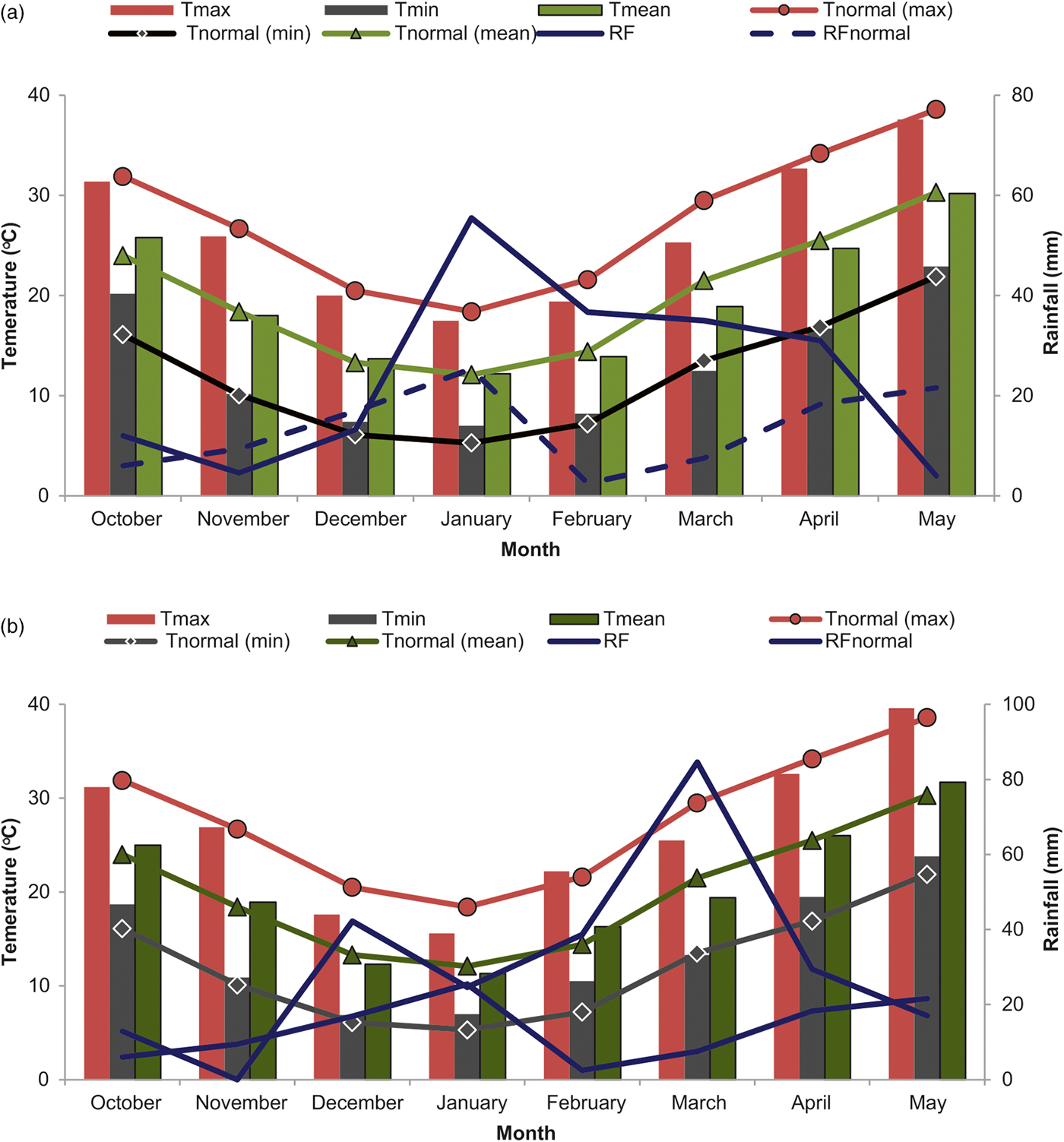
The meteorological data showed marked variation in weather conditions during both the crop seasons (Fig. 1a and 1b). During 2013–2014, there was 192.0 mm rainfall in 18 rainy days with the highest (55.5 mm) occurring in January, and during 2014–2015, 249.3 mm rainfall was received in just 9 rainy days with the highest (84.6 mm) occurring in March. Precipitation received during the crop season 2014–2015 was 30% higher than that during 2013–2014. Heavy rainfall in March during 2014–2015 resulted in lodging of crops and wilting of chickpea crop. The average temperature during February to April, coinciding with the reproductive and maturity stages of the wheat and chickpea, remained milder during the first than the second year of study.
Weather parameter during the crop growth period. T min, minimum Temperature; T max, maximum temperature; T mean, mean temperature; RF, rainfall; normal means: 30 yr average.

Yield attributes of wheat
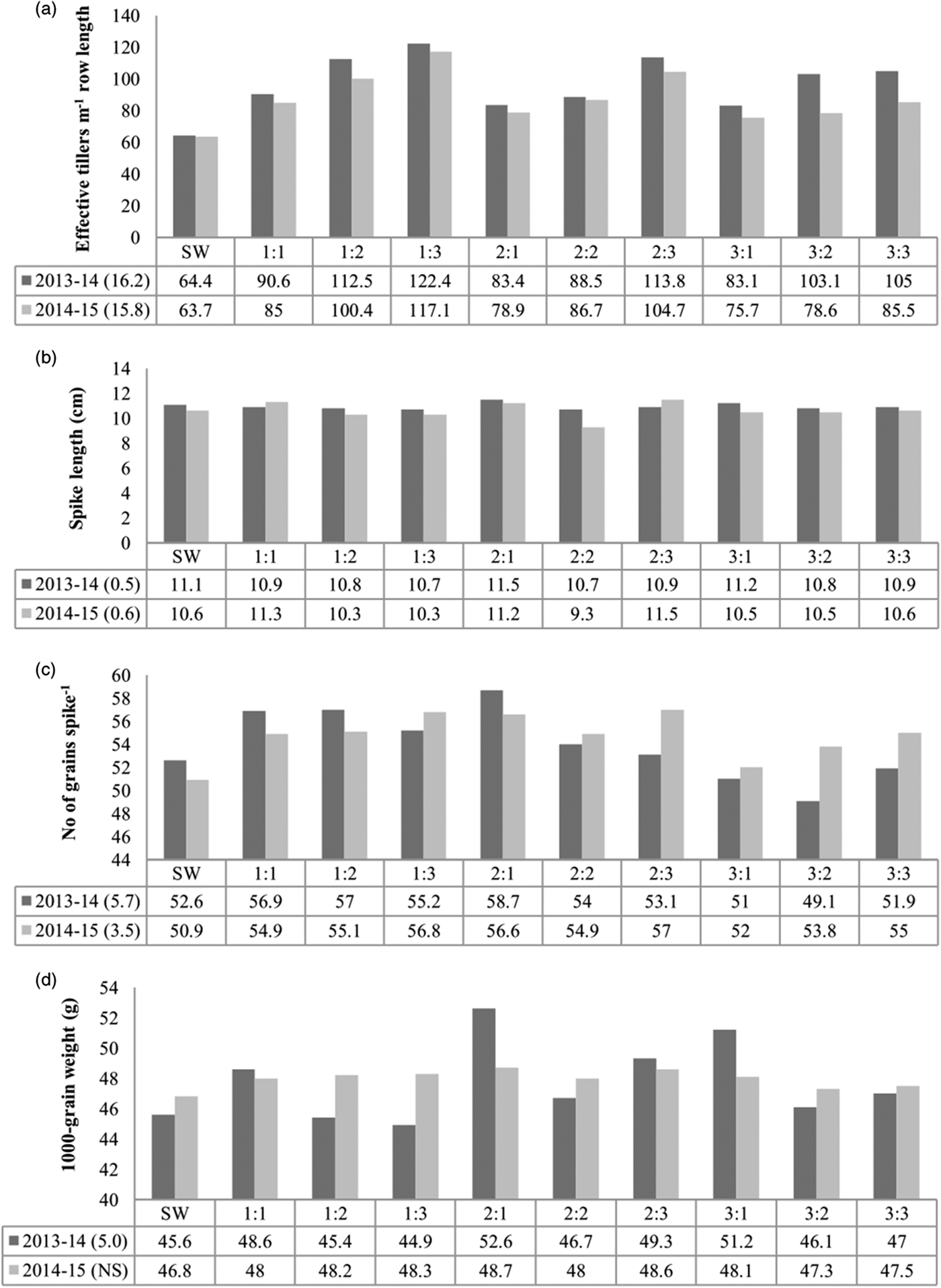
In general, the number of effective tillers per meter row length was more during the first year than the second year of study, and that might be due to well-distributed rainfall (Fig. 1a and 1b) and better growth of intercropped chickpea during the first year. The effect of intercropping systems on number of effective tillers was significant during both the years (Fig. 2a). During the first year, the highest number of effective tillers (122.4 m−1 row length) was in wheat + chickpea (1:3) and it was significantly better than sole wheat and all the other wheat + chickpea intercropping systems, except wheat + chickpea (1:2) and wheat + chickpea (2:3) row ratios, which were statistically at par. During the second year also, the highest number of effective tillers (117.1 m−1 row length) was in wheat + chickpea (1:3), and it was significantly better than sole wheat and all the other wheat + chickpea intercropping systems except wheat + chickpea (2:3), which was statistically at par. Sole wheat had the lowest number of effective tillers (64.4 and 63.7 during 2013–2014 and 2014–2015, respectively). The more number of mean effective tillers in 1:3, 2:3 and 1:2 row ratios might be due to less competition among the wheat plants for nutrients, space and light. Moreover, the chickpea might have contributed N supply to wheat plants. The spike lengths of wheat in all the wheat + chickpea intercropping systems were statistically at par with that of sole wheat (Fig. 2b) during the first year. However, among the wheat + chickpea intercropping systems, the longest spike length (11.5 cm) in wheat + chickpea (2:1) was statistically at par with wheat + chickpea (3:1), but significantly more than other wheat + chickpea row ratios. During the second year, the highest spike length (11.5 cm) was recorded in wheat + chickpea (2:3) intercropping system, which was significantly more than sole wheat and all the wheat + chickpea intercropping systems, except wheat + chickpea row ratios of 1:1 and 2:1, which were statistically at par. Wheat + chickpea row ratios of 2:2 and 1:3 gave the lowest spike length (10.7 cm, each) during 2013–2014 and wheat + chickpea (2:2) gave the lowest spike length (9.3 cm) during 2014–2015. The maximum number of grains spike−1 (58.7) was recorded in wheat + chickpea (2:1), which was statistically at par with wheat + chickpea row ratios of 1:1, 1:2, 1:3, 2:2 and 2:3 during 2013–2014 (Fig. 2c). During 2014–2015, the maximum number of grains spike−1 (57.0) was recorded in wheat + chickpea (2:3), which was statistically at par with wheat + chickpea row ratios of 1:1, 1:2, 1:3, 2:1, 2:2, 3:2 and 3:3. The lowest number of grains spike−1 was recorded in wheat + chickpea (3:2) row ratio and sole wheat (49.1 and 50.9 during 2013–2014 and 2014–2015, respectively). The highest 1000-grain weight (52.6 g) during the first year was observed in wheat + chickpea (2:1), and it was statistically at par with wheat + chickpea row ratios of 1:1, 2:3 and 3:1 but significantly higher than sole wheat and other wheat + chickpea row ratios. The 1000-grain weights of sole wheat and wheat + chickpea row ratios of 1:1, 1:2, 1:3, 2:2, 2:3, 3:2 and 3:3 were statistically at par among each other (Fig. 2d). During the second year, the 1000-grain weight did not vary significantly with different treatments, but its highest value (48.7 g) was observed in wheat + chickpea (2:1) row ratio. The lowest 1000-grain weight was observed in wheat + chickpea (1:3) row ratio and sole wheat (44.9 and 46.8 g during 2013–2014 and 2014–2015, respectively). The limited competition for nutrients and moisture in intercropping systems than the sole wheat might have contributed to more transfer of photosynthesis to the grains leading to development of bold grains.
Effect of intercropping system on yield attributes of wheat. SW, sole wheat; the ratios are wheat:chickpea; NS, non-significant at P = 0.05; the parentheses denotes L.S.D. at P = 0.05. (a) Effective tillers per meter row length. (b) Spike length (cm). (c) Number of grains spike−1. (d) 1000-grain weight (g).

Grain yield of wheat
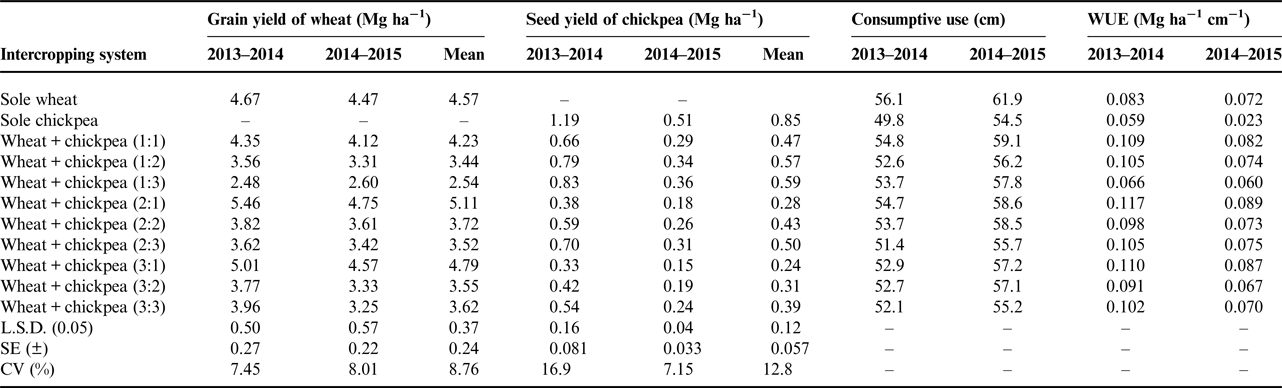
The highest grain yield of wheat was obtained in wheat + chickpea (2:1) row ratio during both the years of study (5.46 and 4.75 Mg ha−1 during the first and second years, respectively), and it was statistically at par with wheat + chickpea (3:1) during both the years of study and with sole wheat (4.47 Mg ha−1) during the second year of study and significantly higher than other wheat + chickpea row ratios. The statistically at par yields of sole wheat and wheat + chickpea row ratio of 2:1 and 3:1 during the second year might be due to less moisture stress to wheat plants because of more rainfall (Fig. 1b) and consequently poor crop of chickpea, which might have contributed relatively less toward wheat nutrition. The grain yields of wheat + chickpea row ratios of 1:2, 2:2, 2:3, 3:2 and 3:3 were statistically at par among each other, during the first year. The lowest grain yield was recorded in wheat + chickpea (1:3) row ratio during both the years of study (2.48 and 2.60 Mg ha−1 during the first and second years, respectively) (Table 1). The higher grain yield in wheat + chickpea row ratios of 2:1 and 3:1 might be due to relatively higher wheat population and better yield-attributing characters (effective tillers and 1000-grain weight) as compared with other row ratios. The higher wheat grain yield under row ratios of 2:1 and 3:1 than the sole wheat, though statistically at par during the second year, might be due to improvement in yield-attributing characters, which might have resulted due to the higher chlorophyll index, contribution of N by chickpea and higher availability of soil moisture, especially under limited nutrition and moisture conditions. The contribution of N to wheat plants by intercropped chickpea has been reported by Willey and Osiru (Reference Willey and Osiru1972). Singh (Reference Singh1982) reported higher grain yield of wheat with wheat + chickpea (2:1) and wheat + chickpea (3:1) row ratios than sole wheat. Singh and Sarawgi (Reference Singh and Sarawgi1995) and Dhakad et al. (Reference Dhakad, Rajput, Mishra and Sarawgi2005) also reported significantly higher grain yield of wheat in wheat + chickpea (2:1) row ratio than other wheat + chickpea row ratios. However, Khan et al. (Reference Khan, Khan, Wahab and Rashid2005) reported the highest wheat grain yield with wheat + chickpea (1:1) row ratio, which was statistically at par with wheat + chickpea (2:1) row ratio. In a cereal–legume intercropping system, Andrews (Reference Andrews1979) reported improved grain yield of cereal with legume intercropping; whereas, Houggaard-Nielsen and Jensen (Reference Houggaard-Nielsen and Jensen2001) observed increased yield of cereal and decreased yield of legume in a cereal–legume intercropping.
Effect of intercropping system on grain yield of wheat, seed yield of chickpea, consumptive use and water-use-efficiency (WUE).

Yield attributes of chickpea
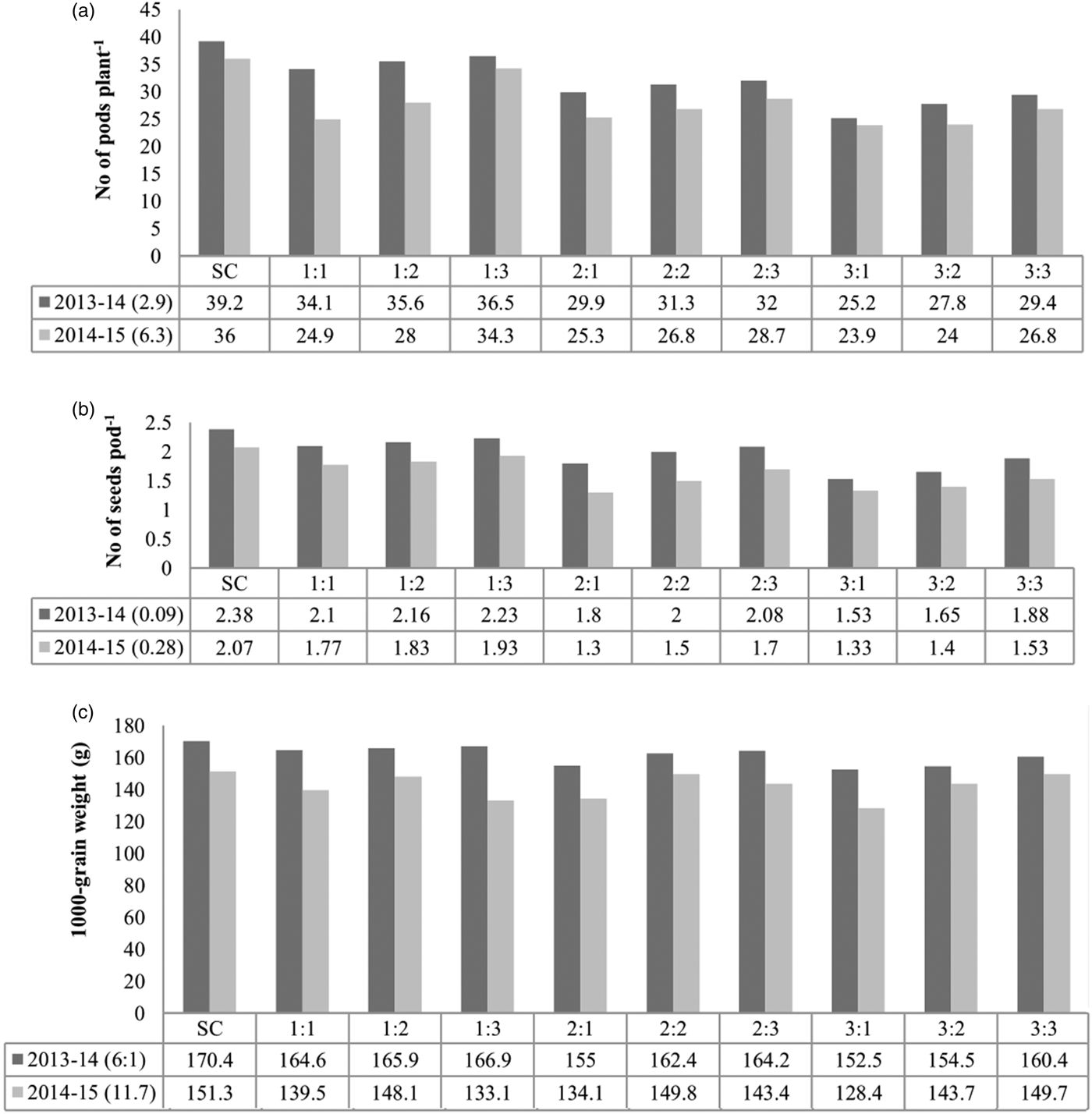
The maximum number of pods plant−1 (39.2 and 36.0 during 2013–2014 and 2014–2015, respectively) was recorded in sole chickpea, and it was statistically at par with wheat + chickpea (1:3) row ratio but was significantly higher than all the other wheat + chickpea row ratios during both the years of study (Fig. 3a). The lowest number of pods plant−1 was recorded in wheat + chickpea (3:1) during both the years of study (25.2 and 23.9 during the first and second years, respectively). The maximum number of seeds pod−1 (2.38 and 2.07 during the first and second years, respectively) was recorded in sole chickpea, which was significantly higher than all the wheat + chickpea intercropping systems during the first year, but during the second year, it was statistically at par with wheat + chickpea row ratios of 1:2 and 1:3 (Fig. 3b). The 1000-grain weight was the highest in sole chickpea during both the years of study, and it was statistically at par with wheat + chickpea row ratios of 1:1, 1:2 and 1:3 during 2013–2014 and with wheat + chickpea row ratios of 1:2, 2:2, 2:3, 3:2 and 3:3 during 2014–2015, but was significantly higher than other wheat + chickpea row ratios (Fig. 3c). The lower yield attributes of chickpea in intercropping systems might be due to suppression of chickpea by wheat due to competition for nutrients and light.
Effect of intercropping system on yield attributes of chickpea. SC, sole chickpea; the ratios are wheat:chickpea; the parentheses denotes L.S.D. at P = 0.05. (a) Number of pods plant−1. (b) Number of seeds pod−1. (c) Number of 1000-grain weight (g).

Seed yield of chickpea
Sole chickpea gave significantly higher seed yield (1.19 and 0.51 Mg ha−1 during 2013–2014 and 2014–2015, respectively) than all the wheat + chickpea row ratios (Table 1). Among the wheat + chickpea row ratios, wheat + chickpea (1:3) gave significantly higher seed yield than all the other wheat + chickpea row ratios except wheat + chickpea (1:2) during both the years of study and wheat + chickpea (2:3) during 2013–2014, where it was statistically at par. The significantly lowest seed yield (0.33 and 0.15 Mg ha−1 during 2013–2014 and 2014–2015, respectively) was obtained in wheat + chickpea (3:1) except 2:1 and 3:2 row ratios during 2013–2014 and 2:1 row ratio during 2014–2015, which were statistically at par. Heavy rainfall (84.6 mm) during March 2014–2015 (Fig. 1b) resulted in lodging of the wheat and chickpea crops due to which there was poor seed yield of chickpea during the second year. The highest seed yield in sole chickpea during the both years of study might be due to least competition to the chickpea plants by wheat and also due to proportionally higher area under chickpea. The higher chickpea seed yields in sole cropping compared with the intercropped yield have also been reported by Das et al. (Reference Das, Khaliq and Haider2012); Singh and Yadav (Reference Singh and Yadav1992); Singh and Sarawgi (Reference Singh and Sarawgi1995) and Munir et al. (Reference Munir, Saeed and Imran2004). The lowest seed yield in wheat + chickpea (3:1) might be due to proportionally less area under chickpea in this row ratio. Islam (Reference Islam1996) also observed the highest seed yield (1.66 Mg ha−1) in sole chickpea and the lowest seed yield (0.31 Mg ha−1) in chickpea 20% + wheat 80% seed ratio.
Effect on consumptive use and WUE
Water is a major constraint for higher productivity of crops under rainfed or limited moisture conditions. Sole wheat resulted in more consumptive use of water than sole chickpea and all the other wheat + chickpea row ratios, whereas sole chickpea recorded the lowest consumptive use (Table 1). This might be due to more water requirement of wheat and loss of water from bare soil surface in case of sole wheat, which lead to higher evaporation losses from the surface than the chickpea that covered the soil surface resulting in less evaporation. There was a marked increase in WUE in wheat + chickpea intercropping systems except in wheat + chickpea (1:3) during the first year and wheat + chickpea row ratios of 1:3, 3:2 and 3:3 during the second year, where WUE was less than sole wheat. Wheat + chickpea (2:1) recorded the highest WUE as compared with sole wheat, sole chickpea and all the other wheat + chickpea row ratios due to higher WEY under this row ratio. Mallick et al. (Reference Mallick, Verma, Thakur and Srivastava1993) also reported higher WUE with wheat and chickpea intercropping under limited moisture conditions. Jahansooz et al. (Reference Jahansooz, Yunusa and Coventry2004) also reported higher WUE in wheat + chickpea mixed cropping than sole wheat. Increased WUE with intercropping of legumes with wheat has been reported by Mengping and Zhangjinsong (Reference Mengping and Zhangjinsong2004).
Effect on WEY
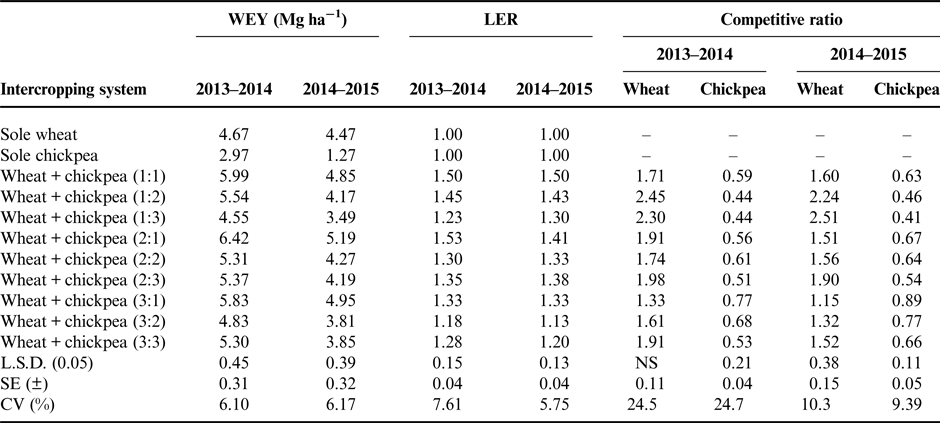
The maximum WEY (6.42 and 5.19 Mg ha−1 during 2013–2014 and 2014–2015, respectively) was recorded in wheat + chickpea (2:1) row ratio, which was statistically at par with wheat + chickpea row ratio of 1:1 during the first year of study and row ratios of 1:1 and 3:1 during the second year of study but were significantly higher than sole wheat and all other wheat + chickpea intercropping systems (Table 2). Singh and Yadav (Reference Singh and Yadav1990) and Singh et al. (Reference Singh, Gangasaran and Bandyopadhyay1996) also reported significantly higher WEY in wheat + chickpea intercropping than sole cropping.
Effect of intercropping system on wheat equivalent yield (WEY), land equivalent ratio (LER) and competitive ratio (CR).

Effect of intercropping system on LER
All the intercropping systems resulted in significantly higher LER than the sole cropping indicating the yield advantage in intercropping during both the years of study (Table 2). Wheat + chickpea (2:1) row ratio recorded the maximum LER value (1.53), which was statistically at par with wheat + chickpea row ratios of 1:1 and 1:2 and was significantly higher than all the other wheat + chickpea intercropping systems during 2013–2014; but during 2014–2015, wheat + chickpea (1:1) row ratio recorded the maximum LER value (1.50), which was statistically at par with wheat + chickpea row ratios 2:1, 2:3 and 1:2 but significantly higher than all the other row ratios. The lowest LER value was recorded in wheat + chickpea (3:2) intercropping system during both the years of study. Singh and Yadav (Reference Singh and Yadav1990) and Das et al. (Reference Das, Khaliq and Haider2012) also reported higher LER with wheat + chickpea intercropping system.
Effect on CR
The higher CR values for wheat than those for chickpea during both the years of study indicated competitiveness of wheat vis-à-vis chickpea when grown in association with each other (Table 2). The highest CR value (2.45) of wheat was observed in wheat + chickpea (1:2) row ratio during 2013–2014, but during 2014–2015, the highest CR value (2.51) of wheat was recorded in wheat + chickpea (1:3). Wheat in wheat + chickpea (3:1) row ratio showed the lowest CR value (1.33 and 1.15 during 2013–2014 and 2014–2015, respectively). More than unity CR value of wheat in all the wheat + chickpea intercropping systems indicated its superiority of competition to chickpea. The lowest differences between CR values of wheat and chickpea were recorded in wheat + chickpea (3:1) row ratio reflecting the comparatively similar competitive ability for resources. However, Das et al. (Reference Das, Khaliq and Haider2012) reported the highest CR value in wheat + chickpea (1:1) intercropping system.
It is concluded from the study that wheat + chickpea (2:1) intercropping system resulted in higher wheat grain yield, WUE, WEY and LER than sole wheat and the other intercropping systems under organic management and limited moisture conditions.
Acknowledgements
The authors are thankful to Punjab Agricultural University, Ludhiana for providing necessary facilities for the conduct of the studies.