Introduction
The incidence of eating disorders within the general population is unknown, particularly as some conditions (e.g. anorexia nervosa) are egosyntonic and patients do not voluntarily report themselves for treatment (Strober, Reference Strober2004). The majority of eating disorder patients are treated on an outpatient basis (Wilson et al. Reference Wilson, Grilo and Vikousek2007) with hospitalization only being considered if there is substantial medical or suicidal risk, or after failure to improve despite an adequate course of psychotherapy (National Institute for Clinical Excellence, 2004). Many such patients are treated in specialist eating disorder units with structured regimens focused on re-feeding and weight gain in combination with broader interventions (Long et al. Reference Long, Fitzgerald and Hollin2012). Women admitted involuntarily to secure psychiatric services have complex needs, a forensic history of co-morbid psychopathology and a history of challenging behaviour particularly self harm (Long et al. Reference Long, Fulton and Hollin2008). Such services have relational security and risk management as their priority. Little is known of the extent of eating disorders within secure psychiatric services for women; many form part of a broader picture of challenging behaviour and psychological distress and may not be the focus of intervention/assessment because of a (necessary) focus on outward directed aggression and dramatic self harming that pose an immediate threat. They may also be overlooked because of conflicting views among health professionals that range from the perception of eating disorders as trivial to the view that all eating disorders are so serious and complex that they must be treated by a specialist service (Robinson, Reference Robinson2009). Perhaps for these reasons, manifestation of eating disorders in secure samples may go unrecognised or unaddressed.
There are, however, two compelling reasons to support the view that eating disorders are a significant issue in secure psychiatric settings for women: the first concerns the nature of the patient population admitted to such settings (Coid et al. Reference Coid, Kahtan, Gault and Jarman2000) and the second relates to the iatrogenic effects of hospitalization.
A significant proportion of women in secure settings (Coid et al. Reference Coid, Kahtan, Gault and Jarman2000) have a primary diagnosis of borderline personality disorder (BPD) which is frequently associated with eating disorders and substance abuse among other problem behaviours/symptomatology (Robinson, Reference Robinson2009). The concept of a constellation of symptoms such that criteria for both eating disorders and borderline personality disorder are fulfilled has been previously noted (Lacey & Evans, Reference Lacey and Evans1986). The term ‘multi impulsive bulimia’ was used to describe such presentations and inpatient care was developed that appeared to be effective in motivated patients (Lacey & Read, Reference Lacey and Read1993). Self injurious behaviours, which are common in BPD patients, have a significant association with eating disorders (Favano et al. Reference Favano, Ferrara and Santonastaso2007). Indeed recent literature found an occurrence of eating disorders in self harming patients that ranges between 54% and 61% (Svirko & Hawton, Reference Svirko and Hawton2007). The incidence of eating disorders in non BPD psychiatric inpatient samples however is also likely to be high. Eating disorders are associated with high rates of co-morbidity including mood, anxiety, substance use and personality disorders (Wonderlich & Mitchell Reference Wonderlich and Mitchell1997; Peterson Reference Peterson2005) and with high rates of depression and suicidal ideation (Laessle et al. Reference Laessle, Kith, Fitxher, Wittchen and Pirke1987; Viesselman & Roig, Reference Viesselman and Roig1985).
A second reason for assuming a relationship between inpatient care and eating disorders is the potential for secure psychiatric settings to promote over eating and under exercising (Long et al. Reference Long, Brillon, Schell and Webster2009). Obesity, which is present in many such patients, is exacerbated by medications with the side effect of weight gain (Cormac et al. Reference Cormac, Martin and Ferriter2004).
Despite these considerations there are few assessments of the incidence and nature of the eating disorders within secure psychiatric settings for women, or the treatment implications for conditions that may warrant liaison between medical, psychiatric and specialist eating disorder unit facilities (Royal College of Psychiatrists and Royal College of Physicians, 2010).
In view of these considerations, a survey of the nature and incidence of eating disorders within a secure service for women was undertaken. In addition to gathering information about the extent of the problem, the study aimed to assess how such conditions were being managed with a view to making recommendations for service development and improvement.
Setting and participants
Participants were women and girls being treated in a secure psychiatric care pathway of an independent charitable trust (St Andrews Healthcare) in Northampton and Basildon, Essex, UK.
Those surveyed include three medium secure adolescent wards (a total of 29 beds), two medium secure women's wards (total 28 beds), four low secure wards (total 52 beds); one low secure ward for borderline personality disorder patients (23 patients); one locked rehabilitation unit (16 beds) and one open unit (9 beds).
Design and procedure
A survey design was used to assess the point in time incidence of eating disorders in women and girls in secure services. Staff interviews and case note or care plan review was used to identify current and past ‘cases’ of eating disorder. Patients thus identified were subsequently interviewed and completed self report psychometric measures of eating disorders and other symptomatology. Patients with an eating disorder were compared on a variety of measures with non-eating disorder secure patients. Data was collected over a 12 week period.
Case note/care plan review
Information was gathered regarding previous treatment (inpatient; day patient; outpatient; individual; out-patient group; medication; self help) medical history; family history; obesity; diabetes; eating disorders; mood disorders; anxiety disorders; substance abuse/dependence; antisocial behaviours; psychiatric hospitalizations; social and developmental history; psychiatric diagnosis; co-morbid psychopathological symptoms (depression; dysthymia; mania and hypomania; substance abuse and dependence; Axis II personality disorder diagnoses; anti-social behaviours; psychotic symptoms; impulse control problems (e.g. gambling, shoplifting) trauma history, post traumatic stress disorder (PTSD); self-injurious behaviours, OCD; panic attacks, agoraphobia and phobias (including social anxiety).
Semi-structured staff interview
Ward managers and/or responsible clinicians responded to an ad-hoc semi-structured questionnaire. Questions covered:
• Identification of patients with eating disorders on the ward including those with a past history of an eating disorders and those with disordered eating that was seen to pose a problem (i.e. a risk to psychological or physical health)
• Whether eating disorders were viewed as a risk or a problem on the ward; staff experience of training in working with eating disorder patients; and whether there was a need for training
• Whether there was a ward protocol/guidelines for eating problems that applied to all
• Whether eating specific care plans existed for eating disorder patients.
Measures
Interview for Diagnosis of Eating Disorders – IV (IDED-IV)
The fourth version of the IDED (Williamson Reference Williamson1990; Kutlesic et al. Reference Kutlesic, Williamson, Gleaves, Barbin and Murphy-Ebernenz1998) is a semi-structured interview designed for the purpose of differential diagnosis of DSM IV (American Psychiatric Association, 1994) eating disorders. In contrast to the Eating Disorder Examination (Fairburn & Cooper, Reference Fairburn and Cooper1993), the IDED is focused on establishing a differential diagnosis and does not therefore focus on frequency and severity data. IDED ratings do, however, allow for sophisticated analyses of psychopathology (Williamson, Reference Williamson1990) in addition to diagnoses. Kutlesic et al. (Reference Kutlesic, Williamson, Gleaves, Barbin and Murphy-Ebernenz1998) described four studies that reveal good internal consistency for symptom data specific to diagnoses, evidence for content validity, evidence for concurrent and discriminate validity and excellent inter-rater reliability for differential diagnosis of specific eating disorder categories. Interview data was used to arrive at the following DSM IV classifications:
• Anorexia nervosa (AN; restricting or binge-purge sub types)
• Bulimia nervosa (BN)
• Binge eating disorder (BED)
• Eating disorders not otherwise classified (EDNOS); including sub-threshold or atypical AN or BN; night eating syndrome (NES) or childhood eating disorders.
Scores above 3 on a 1–5 rating denotes the definite presence of a symptom/behaviour that would contribute to an eating disorder diagnosis.
Eating Disorder Inventory – 3 (EDI-3)
In the EDI-3 (Garner, Reference Garner2004), 91 items cover three eating disorder subscales (drive for thinness; bulimia; body dissatisfaction) and nine other subscales (low self esteem; personal alienation; interpersonal insecurity; interpersonal alienation; interoceptive deficits; emotional dysregulation; perfectionism; asceticism and maturity fears). Scoring results in six composite scores: (i) Eating disorder risk; (ii) ineffectiveness; (iii) interpersonal problems; (iv) affective problems; (v) over control and (vi) general psychological maladjustment, as well as infrequency and negative impression scores. Internal reliability and validity data are strong (Garner, Reference Garner2004).
Patients were also administered the Eating disorder referral form (EDI-3RF) that assesses binge eating, vomiting, use of laxatives and exercise for weight control and weight loss of more than 20 pounds in the previous three months.
St Andrew's Nutritional Screening Tool
This is an ad hoc staff-rated measure that includes information on BMI, weight change (past three months), eating behaviour and evidence of disordered eating to assess level of nutritional risk (Rowell et al. Reference Rowell, Long, Chance and Dolley2012; National Institute for Clinical Excellence, 2006).
Ethical approval
This project was viewed as routine service evaluation. However, Hospital Director permission was sought for the survey and RMO permission sought to approach individual patients. Patients were assured that data collected will be reported on a group and not an individual basis and that refusal to participate would not affect their treatment in any way.
Results
Participants
Patients were on average 28.3 years old (range 14–82 years) and were mostly of Caucasian origin (88%), and single (89%) with a diagnosis of either personality disorder, emotionally unstable type (55%) or schizophrenia/schizoaffective personality disorder (27%) and with index offences of major (23%) or minor (43%) violence or arson (15%). The mean body mass index (BMI) of the groups was 27.3 (SD = 5.7; range 16–50).
Incidence of eating disorders
The case notes of 131 patients were reviewed. Case note review and staff interview resulted in a total of 33 patients (25%) with a recognized eating disorder or a problem of abnormal eating. Of these seven had a pattern of intermittent disordered eating that was psychotically driven and were excluded from further analysis; five other patients had a past history of an eating disorder that was now resolved. This resulted in a group of 21 participants (16%) who were further assessed to determine the nature of their eating disorder.
IDED-IV
Patients interviewed using the IDED-IV (N = 21) were classified as: eating disorders not otherwise specified (EDNOS: n = 9; 42.9%); binge eating disorder (BED: n = 6; 28.6%); anorexia nervosa (AN; n = 5; 23.8%); and bulimia nervosa (BN; n = 1, 4.8%). Most (n = 5) EDNOS patients were type 2 (i.e. meeting criteria for anorexia nervosa but with normal weight); two EDNOS patient were type 3 (i.e. meeting criteria for bulimia nervosa but fewer that 2 binges per week) and two were type 4 (inappropriate amounts of compensatory behaviour following eating small amounts of food). Patients with anorexia nervosa were categorised as restricting subtype (n = 1) purging subtype (n = 3) and atypical subtype (n = 1). For purposes of statistical comparison the latter two groups were combined to form an anorexia/bulimia group (n = 6; 28.6%).
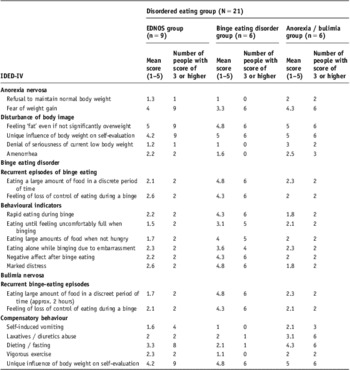
Table 1 provides mean scores (1–5) and details of those scoring 3 or higher (i.e. a significant score) on IDED-IV for each subgroup.
IDED-IV: disordered eating group

This shows that all groups have a fear of weight gain (mean score = 3.8); and describe a disturbed body image (‘feeling fat’ mean = 4.9); and the unique influence of body weight on self evaluation (mean = 4.7). Binge eating was a significant issue for BED groups (mean = 4.8) along with a feeling of a loss of control (mean score = 4.3) rapid eating (mean = 4.8), eating alone (mean = 3.6), negative affect (mean = 4.3) and marked distress after binge eating (mean = 4.7). Patients with BN were also more likely to eat large amounts of food in a discrete time frame (mean = 4.8) and to experience binge-related loss of control (mean = 4.3).
EDI-3
EDI-3RF scores (N = 21) showed that eating binges in the previous three months were frequent for the BED group (2–6 more times per week) as was vomiting to control weight (once a week) and use of laxatives (2–6 times per week).
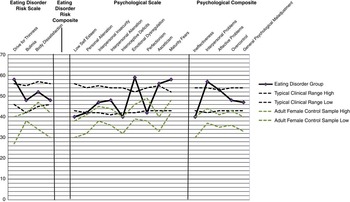
On the EDI-3, all groups scored within the clinical range on the eating disorder risk scales and on the psychological composite scales of affective problems, over control, general psychological maladjustment and interpersonal problems. The sample scored particularly highly on the subscales labelled drive for thinness (T = 59); emotional dysregulation (T = 59); asceticism (T = 56) and maturity fears (T = 58) (see Fig. 1).
(Colour online) EDI scores for eating disorders group (N = 21)

A one way analysis of variance (ANOVA) revealed that the three groups differed significantly on five of the eighteen EDI-3 scales: drive for thinness [f (2, 18) = 6.23, p < 0.01]; bulimia [f (2, 18) = 9.97, p < 0.01]; affective problems composite [f (2, 18) = 5.12, p < 0.01]; body dissatisfaction [f (2, 18) = 6.23, p < 0.01] and maturity fears [f (2, 18) = 5.34, p < 0.01]. Post-hoc comparisons used the Scheffé test to indicate which pairs of groups’ means differed. Only findings of significance at p < 0.01 are reported.
Drive for thinness: The EDNOS (mean = 6.13, SD = 6.7) group had significantly higher scores on the drive for thinness scale than both the BED group [mean = 42.2, SD = 8.01, p = 0.004] and the anorexia/bulimia group [mean = 49.3, SD = 5.4, p = 0.005].
Bulimia: The BED group (mean = 53.5, SD = 8.5) scored more highly on the bulimia scale than the EDNOS group [mean = 41.3, SD = 9.3, p = 0.004].
Affective problems composite: The EDNOS group (mean = 70.3, SD = 3.2) scored higher on the affective problems composite than both the BED group [mean = 38.5, SD = 6.2, df (2.18), p = 0.005] and the anorexia/bulimia group [mean = 49.4, SD = 4.8, p < 0.004].
Body dissatisfaction: The anorexia /bulimia group scored more highly on the body dissatisfaction scale (mean = 60.4, SD = 8.3) than the EDNOS group [mean = 49.7, SD = 7.1, p = 0.001].
Maturity fears: The anorexia/bulimia group scored higher on the maturity fears scale (mean = 71.6, SD = 5.5) than both the EDNOS group [mean = 57, SD = 4.5, p = 0.005] and the BED group [mean = 44.4, SD = 6.1, df (2,18), p = 0.005].
Eating disorder vs comparison group differences
Eating disorder group patients differed from comparison group patient in having more members with a diagnosis of emotionally unstable personality disorder [n = 18, 85% vs n = 47, 43%; χ2(1) = 15.43, p < 0.01]; fewer with a criminal history [n = 10, 48% vs n = 10, 9%; χ2(1) = 18.2, p < 0.01]; more with an A level/degree education [n = 14, 67% vs n = 42, 38%; χ2(1) = 12.59, p < 0.01]; and in having a lower BMI [mean = 23.7, SD 3.1 vs mean = 31, SD 6.81; t (df 29) = 3.46, p < 0.05]. The BMI of the BED group however did not differ from the comparison sample.
Staff views on eating disorders
18 members of staff were interviewed [10 ward managers, 5 nurses and 3 responsible clinicians (RCs)]. All ward managers except one identified that some sort of training in eating disorders for staff was desirable or required. It was suggested that a workshop (2–3 hours in duration) on the subject of eating disorders or a day long training session would be of benefit.
Out of 11 wards only three staff had received specialist eating disorders training. Four staff had previous experience of working in an eating disorders unit.
Eating disorder interventions were care planned in 9 out of 11 wards. All wards had an individual care plan for patients who were identified as having a diagnosis of eating disorder, abnormal eating pattern or other elements of an eating disorder that was not diagnosed but which was viewed as problematic.
Only at two out of 11 units had a ward protocol or guidelines for eating problems that applied to all, for example an expectation to attend meal times.
Discussion
Findings from this survey of women and girls in secure care show a prevalence of eating disorders of 16%. In all cases this diagnosis was co-morbid with a primary diagnosis of emotionally unstable personality disorder with, as expected, the largest group consisting of EDNOS followed by BED. All subgroups scored within the clinical range on EDI-3 scales of general psychological maladjustment and interpersonal problems. These findings are consistent with studies showing an association between eating disorders, personality disorders, psychopathology and self harm and substance use (Svirko & Hawton, Reference Svirko and Hawton2007; Peterson, Reference Peterson2005; Laessle et al. Reference Laessle, Kith, Fitxher, Wittchen and Pirke1987). A BMI within the obese range of non-eating disorder and BED patients is also reflective of the physical health challenge for long stay psychiatric inpatients and their carers (Cormac et al. Reference Cormac, Martin and Ferriter2004) that has become a key element of the Mental Health Strategy for England (H. Griffiths, The New Mental Health Strategy, unpub. report to the 5th National Healthcare Events Conference: Measuring, Monitoring and Improving Outcomes in Mental Health, January 2011).
In the current study, the BED groups accounted for over a quarter of identified eating disorder patients. This group described a significant pattern of binge eating (up to six times a week) in the three months before the survey. Such patients report greater energy intake than obese controls, not only on a day when they report binge eating, but also on days during which they feel that their eating is under control (Yanovski & Sebring, Reference Yanovski and Sebring1994). Binge eating disorder has a different course compared to other eating disorders (Fairburn, Reference Fairburn2008) and the tendency for weight gain means that patients pose a considerable clinical challenge, particularly since many treatments are effective for binge eating but treatments for weight loss are less so (de Zwann, Reference de Zwann2005).
Patients falling into the largest of the eating disorder subgroups (EDNOS) were characterized with anorexia nervosa symptomatology but normal weight. They exhibited a higher incidence of psychological maladjustment, particularly affective disorders, than other groups. These patients, together with those diagnosed with anorexia nervosa, were seen to present the greatest challenge to staff.
Whilst treatment guidelines were evident, detailed treatment plans were not and staff did not feel skilled or equipped to treat these patients. This would seem to relate to a variety of factors within the secure services under review:
• A lack of specific training and experience in coping with the complexities of eating disorders with an associated lack of preparedness when such psychopathology was exhibited (the illusion of therapeutic alliance and contract; Strober, Reference Strober2004).
• Concern that tackling eating disorder specific problems would stir up a ‘hornets’ nest’ of issues that would make management more difficult and which would ‘contaminate’ other patients leading to imitative or competitive behaviours.
• The focus in the secure environment on safety dictating a primary focus on dealing with self harm and aggressive behaviours and teaching coping skills to deal with these (e.g. Linehan, Reference Linehan1993) in all cases except those involving rapid weight loss or very low BMI. Eating disorder issues are therefore likely to take a lower priority in treatment sequencing.
• A tendency for clinicians to view eating disorders in terms of personality based clusters (high functioning/perfectionist; constricted/over controlled; and dysregulated/under controlled) that do not map onto existing diagnoses or treatment programmes (Westen & Harnden-Fischer, Reference Westen and Harnden-Fischer2001).
• Environmental constraints which mitigate the effective management of low weight eating disorder patients e.g. staff ratios and ward layout which do not easily allow for the close observation needed for effective re-feeding, bed rest and management of naso-gastric feeding (Royal College of Psychiatrists and the Royal College of Physicians, 2010).
Whilst specialist care may not be available in secure inpatient services for women, issues common to all eating disorder subgroups were a fear of integration and a distorted body image. The latter finding reinforces the importance of the development of specific experience for the management of body image and self care issues within secure settings (Long & Ritchie, Reference Long and Ritchie2007) and for work on issues of self esteem (de Zwann, Reference de Zwann2005).
Providing gender sensitive, safe and effective care for women in secure settings provides a significant challenge (Long et al. Reference Long, Fulton and Hollin2008). It is only complicated by eating disorders that can be both severe and enduring (Robinson, Reference Robinson2009). Whilst it is arguable that treatment for the latter under specified conditions needs specialist inpatient care involving close collaboration between medical and psychiatric personnel (Royal College of Psychiatrists and the Royal College of Physicians, 2010), the behavioural problems such patients present often make it difficult for them to be managed in conventional inpatient eating disorder units or in general hospital wards. One potential solution is the development of secure physical healthcare units as a part of existing services where re-feeding and nutritional rehabilitation for forensic anorexia patients could occur along with other general medical care.
A further issue is whether to actively treat (as opposed to manage) the eating disorder psychopathology displayed by secure inpatients. Issues of the sequencing and timing of any such treatment is paramount and in a majority of cases it could be argued that such conditions are best dealt with on an open unit or outpatient bases when risk issues have been addressed. However, the current survey indicates the presence of significant problems that staff feel the need to address but are not confident to deal with. It is also possible that surveys of this sort undertaken here provide a snapshot of a developmental process that reflect different stages of the eating disorder process rather than diagnostic diversity (Bauer et al. Reference Bauer, Richard and Kordy2005). This accords with the view that eating disorder classifications are developing entities, that patients may move between eating disorders diagnoses during their clinical career, and that they share a clinical psychopathology i.e. the transdiagnostic view (Fairburn, Reference Fairburn2008). There are two implications of this view. The first is the need to train more secure unit staff in the nature and general management of eating disorders in inpatient settings. The second is to train selected staff in transdiagnostic treatment of eating disorders where the psychopathological features present and the apparent maintaining processes dictate the content of therapy as in the enhanced cognitive behaviour therapy for eating disorders (CBT-E) approach (Fairburn et al. Reference Fairburn, Cooper and Waller2008).