Introduction
Many novel sulfate mineral species have been described from volcanic fumaroles and scoria cones of the Great Tolbachik fissure eruption of 1975–1976 and the Tolbachik fissure eruption of 2012–2013 (Pekov et al., Reference Pekov, Agakhanov, Zubkova, Koshlyakova, Shchipalkina, Sandalov, Yapaskurt, Turchkova and Sidorov2020), including ivsite, Na3H(SO4)2 (Filatov et al., Reference Filatov, Karpov, Shablinskii, Krivovichev, Vergasova and Antonov2013), cryptochalcite, K2Cu5O(SO4)5, cesiodymite, CsKCu5O(SO4)5 (Pekov et al., Reference Pekov, Zubkova, Agakhanov, Pushcharovsky, Yapaskurt, Belakovskiy, Vigasina, Sidorov and Britvin2018), wulffite, K3NaCu4O2(SO4)4 and parawulffite, K5Na3Cu8O4(SO4)8 (Pekov et al., Reference Pekov, Zubkova, Yapaskurt, Belakovskiy, Chukanov, Lykova, Savelyev, Sidorov and Pushcharovsky2014), belomarinaite, KNaSO4 (Filatov et al., Reference Filatov, Shablinskii, Vergasova, Saprikina, Bubnova, Moskaleva and Belousov2019), metathénardite, Na2SO4 (Pekov et al., Reference Pekov, Shchipalkina, Zubkova, Gurzhiy, Agakhanov, Belakovskiy Chukanov, Lykova, Vigasina, Koshlyakova, Sidorov and Giester2019), koryakite, NaKMg2Al2(SO4)6 (Siidra et al., Reference Siidra, Nazarchuk, Zaitsev and Vlasenko2020), natroapthitalite, Na3K(SO4)2 (Shchipalkina et al., Reference Shchipalkina, Pekov, Chukanov, Zubkova, Belakovskiy, Koshlyakova, Britvin, Sidorov and Vozchikova2020) and petrovite, Na10CaCu2(SO4)8 (Filatov et al., Reference Filatov, Shablinskii, Krivovichev, Vergasova and Moskaleva2020). Vergasova and Filatov (Reference Vergasova and Filatov2012, Reference Vergasova and Filatov2016) and Pekov et al. (Reference Pekov, Agakhanov, Zubkova, Koshlyakova, Shchipalkina, Sandalov, Yapaskurt, Turchkova and Sidorov2020) reviewed the mineralisation and fumarolic activity of the scoria cones of Tolbachik eruptions.
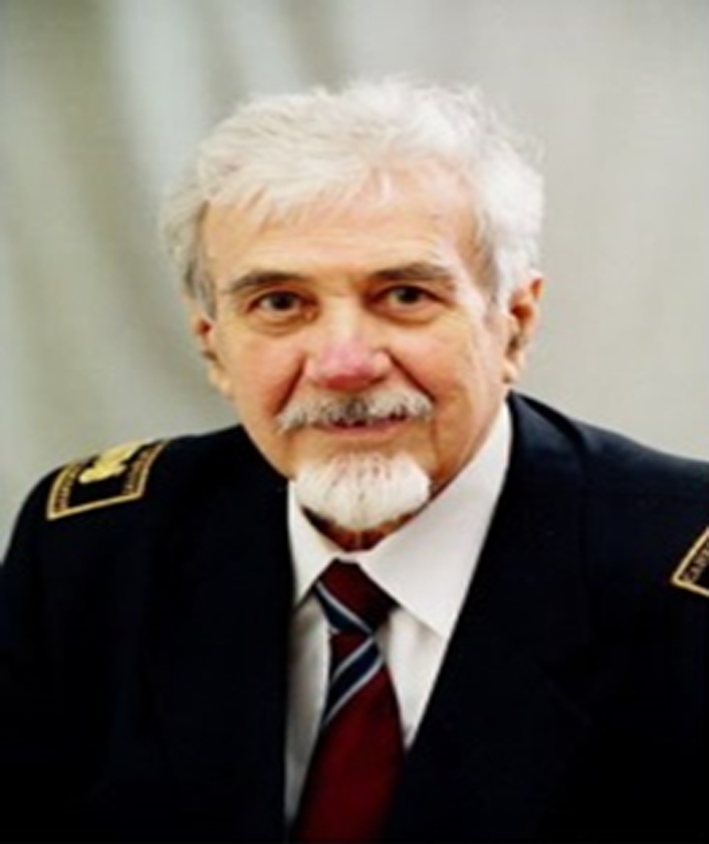
Herein we describe dobrovolskyite (Russian Cyrillic: добровольскийит), a new mineral, ideally Na4Ca(SO4)3, found in 2000 in fumaroles of the Second scoria cone of the Great Tolbachik fissure eruption, Kamchatka peninsula, Russia. The mineral has been approved by the Commission on New Minerals, Nomenclature and Classification of the International Mineralogical Association (IMA2019-106; Shablinskii et al., Reference Shablinskii, Filatov, Vergasova, Moskaleva, Avdontseva and Bubnova2020). The mineral is named in honour of Prof. Dr. Vladimir Vitalievich Dolivo-Dobrovolsky (1927–2009) (Fig. 1), who was an Honorary Member of the Russian Mineralogical Society and Professor of St. Petersburg Mining Institute. Prof. V.V. Dolivo-Dobrovolsky was one of the leading Russian scientists in the field of petrology, crystal optics and crystal chemistry. The main results of his mineralogical and petrological studies were published in more than 100 articles, including his fundamental paper “The crystallography of the various Earth's spheres”, where he gave a numerical characterisation of the symmetry of various Earth spheres (Dolivo-Dobrovolsky, Reference Dolivo-Dobrovolsky1984). The type material for dobrovolskyite is stored in the Saint-Petersburg State University Mineralogical Museum, University Emb. 7/9, St. Petersburg 199034, Russia, under catalogue number 1/19829.
Vladimir Vitalievich Dolivo-Dobrovolsky.

Occurrence and association
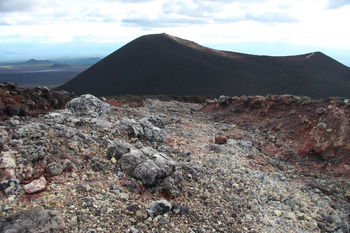
The holotype material was collected in 2000 from the fumarole located on the west side of a micrograben of the Second scoria cone of the Northern Breakthrough of the Great Tolbachik fissure eruption that occurred in 1975–1976 on Tolbachik volcano, Kamchatka, Far-Eastern Region, Russia (55°41′N 160°14′E, 1200 m asl) (Fig. 2). Dobrovolskyite is a product of exhalative fumarolic activity. The mineral crystallised from gases in the cone onto substrate. The temperature of the surface of the fumarole was ~200°C. The temperature was measured with a mercury thermometer at a depth of 20 cm. The sample was placed into a glass tube that was then closed and waxed to avoid moisture contamination. The sample was kept in the glass tube under ambient conditions until analysis, no visual changes were noted during this time.
A view of fissure of micrograben on the west side of the Second Cinder cone of Great Tolbachik fissure eruption. Photo by A.V. Sokorenko, 2010.

The new mineral forms small thin (no more than 1 cm) cryptocrystalline crusts with abundant gas inclusions and was found in close association with petrovite, Na10CaCu2(SO4)8 (Filatov et al., Reference Filatov, Shablinskii, Krivovichev, Vergasova and Moskaleva2020). Single grains of euchlorine, NaKCu3O(SO4)3, tenorite, CuO, anhydrite, CaSO4 and anglesite, PbSO4, were established by electron microscopy analysis in pyroclastic material of the magnesian basalt scoria.
General appearance and physical properties
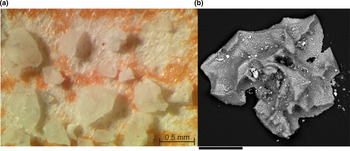
The mineral occurs as aggregates of tabular crystals up to 1–2 mm in maximum dimension (Fig. 3). The streak is white and the lustre is vitreous. Fracture is conchoidal. No parting was observed. The Mohs’ hardness is 3.5.
(a) Photo of the dobrovolskyite Na4Ca(SO4)3, (b) SEM image of individual grain of dobrovolskyite Na4Ca(SO4)3 (scale bar = 100 μm) .

The mineral is uniaxial (+), with ω = 1.489(2) and ɛ = 1.491(2) (λ = 589 nm). No dispersion or pleochroism was observed. The calculated density based on the empirical formula and single-crystal unit-cell parameters is 2.68 g/cm3. The Gladstone–Dale compatibility index (Mandarino, Reference Mandarino1981) based on the empirical formula and unit-cell parameters from the powder X-ray diffraction data is calculated as (1 – K P/K C) = 0.0014 (superior).
Chemical composition
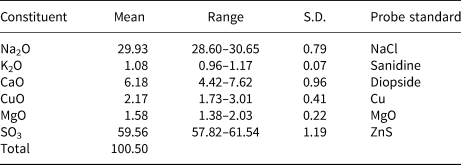
The chemical composition of dobrovolskyite (10 analyses) was studied using a TESCAN “Vega3” electron microprobe equipped with an Oxford Instruments X-max 50 silicon drift energy-dispersive spectroscopy system, operated at 20 kV and 700 pA, with a beam size of 220 nm. Analytical results are given in Table 1. The data processing was done with Oxford Instruments AZtec software and an X-MAX-80 mm2 detector (Institute of Volcanology and Seismology, Petropavlovsk-Kamchatsky, Russia). The empirical formula calculated on the basis of 12 O apfu is(Na3.90K0.10)Σ4(Ca0.45Mg0.16Cu0.12Na0.10)Σ0.83S3.08O12. The simplified formula is (Na,K)Σ4(Ca,Mg,Cu)Σ1(SO4)3. The idealised formula is Na4Ca(SO4)3, which requires Na2O 29.50, CaO 13.34, SO3 57.16, total 100 wt.%.
Chemical data of dobrovolskyite (wt.%).

S.D. – standard deviation
Powder X-ray diffraction
The powder X-ray diffraction data were collected using a Rigaku R-AXIS RAPID II diffractometer (Gandolfi mode, CoKα) and handled using the domestic software (Britvin et al., Reference Britvin, Dolivo-Dobrovolsky and Krzhizhanovskaya2017). Dobrovolskyite is trigonal, R3, a = 15.7223(2), c = 22.0160(5) Å, V = 4713.1(2) Å3 and Z = 18. The measured and calculated powder-diffraction data are given in Table 2. The seven strongest lines of the powder X-ray diffraction pattern [d, Å (I, %) (hkl)] are: 11.58(40)(101); 5.79(22)(202); 4.54(18)(030); 3.86(88)(033); 3.67(32)(006); 2.855(50)(306); and 2.682(100)(330).
Powder X-ray diffraction data (d in Å) for dobrovolskyite.*

The seven strongest lines are shown in bold; For the calculated pattern, only reflections with intensities ≥1 are given.
* The values of d calc are calculated on the basis of unit cell parameters refined by powder XRD data
Single-crystal X-ray diffraction
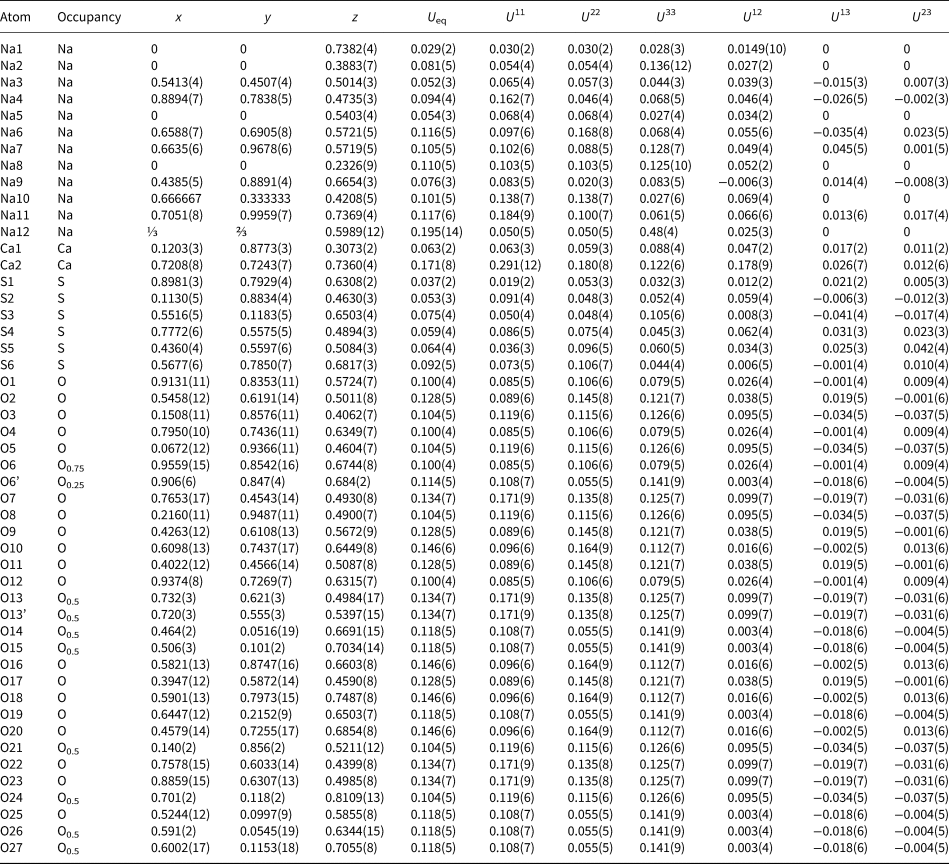
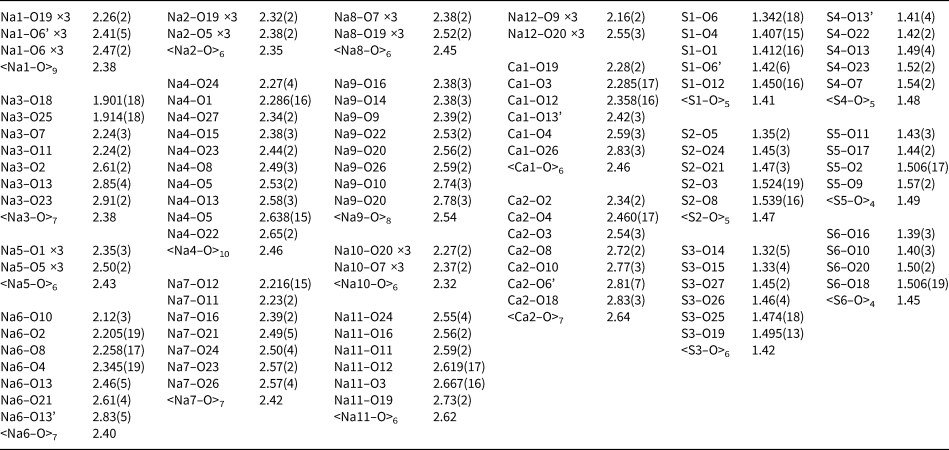
The single-crystal X-ray diffraction data were collected using a Bruker Smart APEX II diffractometer with MoKα radiation. The unit-cell parameters were refined by least squares method. The intensity data were integrated and corrected for Lorentz, polarisation, and background effects by APEX Bruker software. An absorption correction was performed with the Bruker SADABS program. The structure was solved by charge flipping and refined on the basis of 2492 independent observed reflections using the Jana 2006 program suite (Petříček et al., Reference Petříček, Dusek and Palatinus2006). During the refinement, it was observed that O atoms at several sites are statistically disordered, similar to the situation observed in metathénardite, α-Na2SO4 (Pekov et al., Reference Pekov, Shchipalkina, Zubkova, Gurzhiy, Agakhanov, Belakovskiy Chukanov, Lykova, Vigasina, Koshlyakova, Sidorov and Giester2019). Short distances between alternative sites are as following: O6–O6’ (0.76 Å), O13–O13’ (1.32 Å), O14–O15 (1.05 Å), O21–O24 (1.80 Å) and O26–O27 (1.75 Å). Crystallographic data and refinement parameters, atomic coordinates and equivalent displacement parameters, atomic anisotropic displacement parameters and selected bond lengths are summarised in Tables 3–5. The crystallographic information file has been deposited with the Principal Editor of Mineralogical Magazine and is available as Supplementary material (see below).
Crystallographic data and refinement parameters.

Atomic coordinates and displacement parameters (Å2).

Selected bond lengths (Å).

Crystal structure
Cation coordination
The crystal structure of dobrovolskyite contains two symmetrically independent Ca, six S and twelve Na sites. The Ca1 and Ca2 sites are surrounded by six O atoms each. The Na1, Na2, Na5, Na8, Na10, Na11 and Na12 sites are octahedrally coordinated with the average <Na–O> bond lengths equal to 2.38, 2.35, 2.43, 2.45, 2.32, 2.62 and 2.35 Å, respectively. The Na3, Na6 and Na7 sites are surrounded by seven O atoms with the Na–O bond lengths in the ranges of 1.90–2.91, 2.12–2.83 and 2.22–2.57 Å, respectively. The coordination number of the Na9 site is eight, and the Na–O bond lengths vary from 2.38 to 2.78 Å. The Na12 site has a tenfold coordination with the Na–O bond lengths in the range 2.16–2.55 Å. Regardless of the observed disorder of O atoms, the SO4 tetrahedra have rather usual geometrical parameters with the average S–O distances in the range 1.41–1.49 Å (Hawthorne et al., Reference Hawthorne, Krivovichev and Burns2000) (Table 5). The short S–O bonds in several tetrahedra can be explained by libration effects (see e.g. Cruickshank, Reference Cruickshank1956; Reference Cruickshank1961), typical for the crystal structures with statistical or dynamical disorder.
Structure description in terms of cation-centred polyhedra
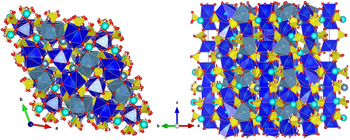
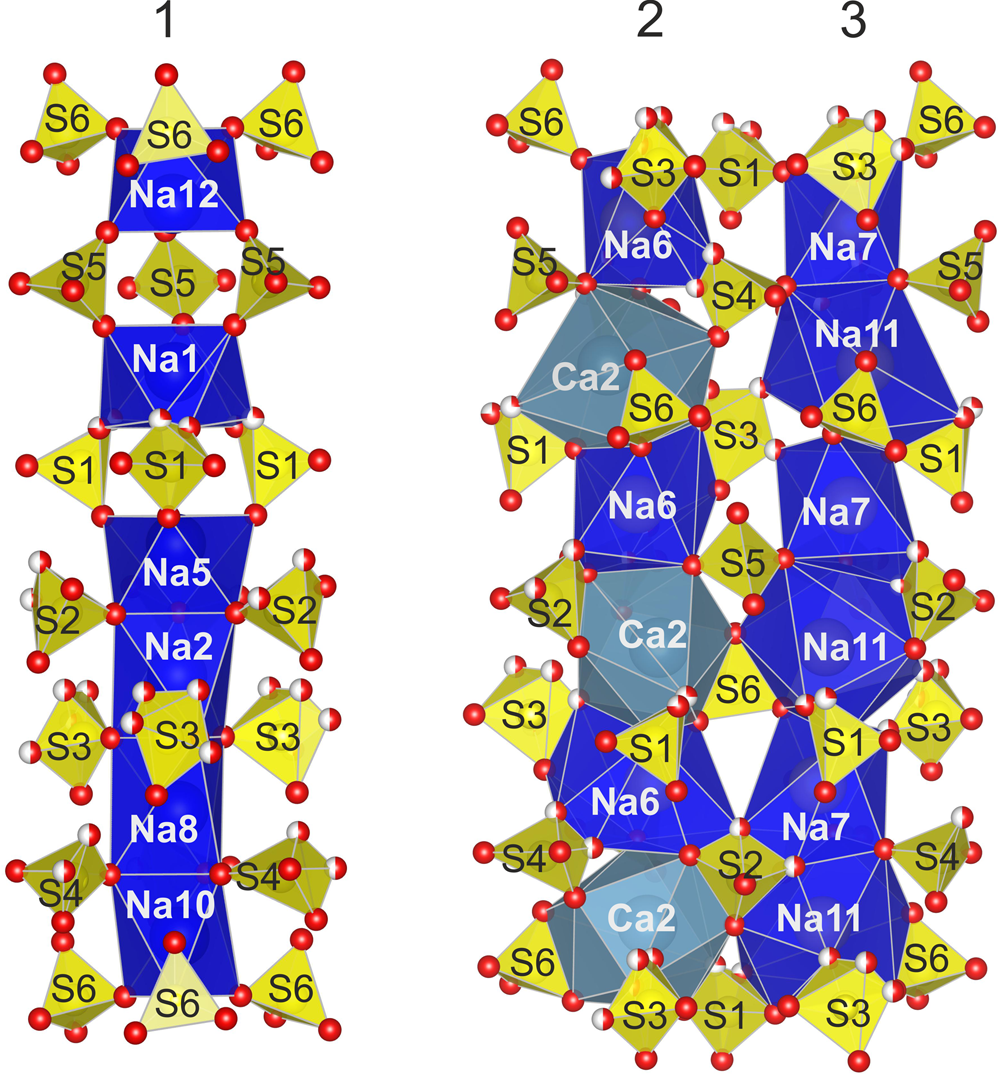
The crystal structure of dobrovolskyite can be described as a three-dimensional framework consisting of Na and Ca polyhedra and SO4 tetrahedra (Fig. 4). The framework can be split into three symmetrically independent rods along the c axis and composed from octahedral–tetrahedral clusters formed by one central NaO6 or CaO6 octahedron sharing six corners with six adjacent SO4 tetrahedra (Fig. 5).
Three dimensional framework in the crystal structure of dobrovolskyite. Na and Ca atoms are shown as dark- blue and grey, respectively; sulfate tetrahedra are highlighted in yellow.

Three types of rods in the crystal structure of dobrovolskyite.

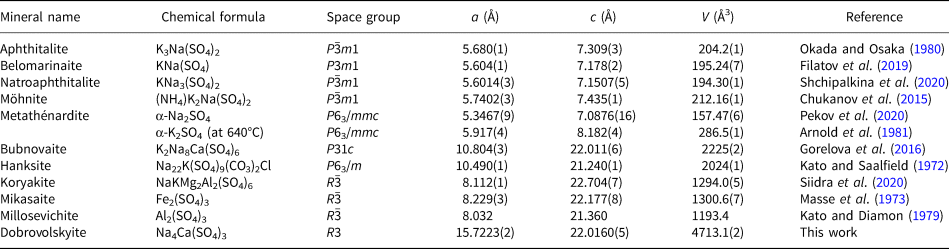
The crystal structure of dobrovolskyite is related to the crystal structures of aphthitalite- and NASICON-related compounds. The unit-cell parameters of dobrovolskyite (dob) and aphthitalite (apth) are related by the ratios: a dob ≈ 3a apth, c dob ≈ 3c apth, whereas the unit-cell parameters of dobrovolskyite and NASICON-like (nas) phases are related by the ratios: a dob ≈ 2a nas, c dob ≈ 3c nas. The relationships between the unit-cell parameters and the crystal structures of aphthitalite and NASICON-like compounds were discussed by Vlasse et al. (Reference Vlasse, Parent, Salmon, Le Flem and Hagenmuller1980), who concluded that both families contain similar fundamental building blocks. Kostov-Kytin et al. (Reference Kostov-Kytin, Nikolova, Kerestedjian and Bezdicka2013) investigated phase transformations of the aphthitalite-like zirconosilicate Na3HZrSi2O8⋅0.4H2O and reported the existence of a structural phase transition from the aphthitalite to the NASICON structure types at 700°C. The crystallographic data on aphthitalite and NASICON-related minerals and compounds are given in Table 6. As mentioned above, the disorder of sulfate tetrahedra was observed previously for metathénardite, α-Na2SO4, a quenched high-temperature modification of sodium sulfate chemically stabilised by admixtures (Pekov et al., Reference Pekov, Shchipalkina, Zubkova, Gurzhiy, Agakhanov, Belakovskiy Chukanov, Lykova, Vigasina, Koshlyakova, Sidorov and Giester2019).
Crystallographic data for dobrovolskyite and related minerals.

Structure description in terms of cation arrays
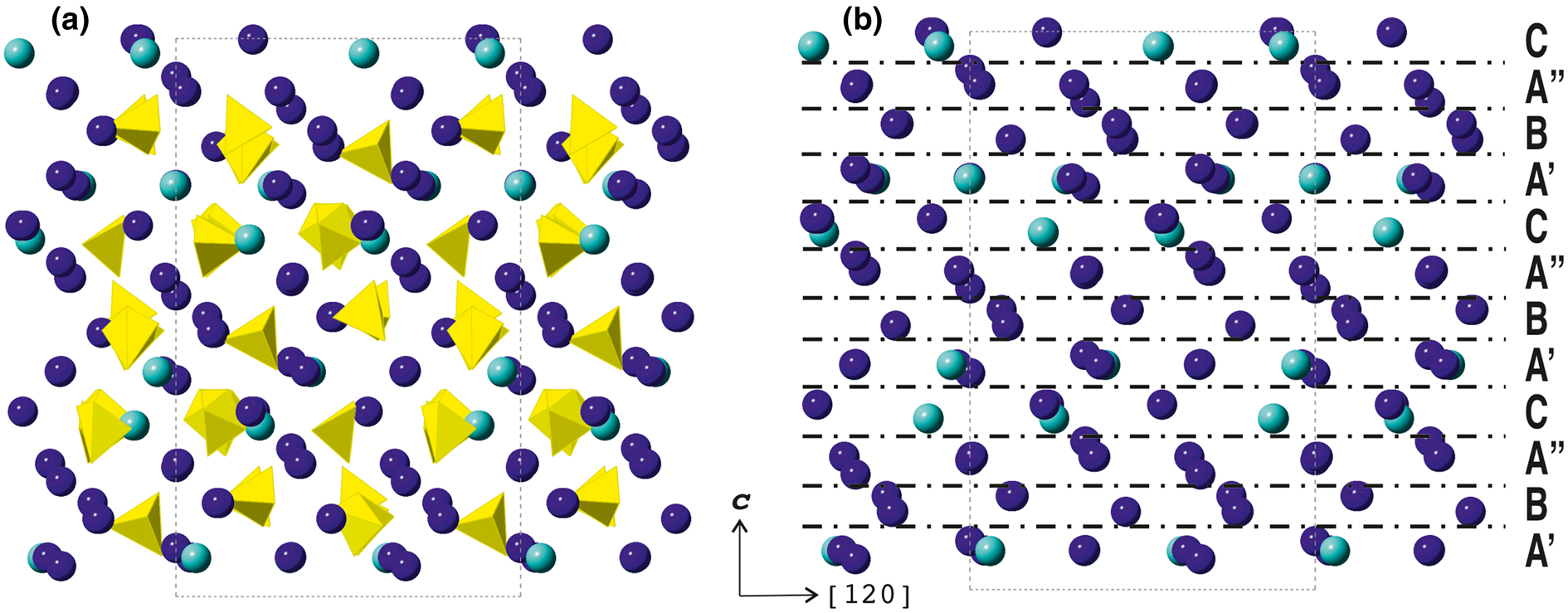
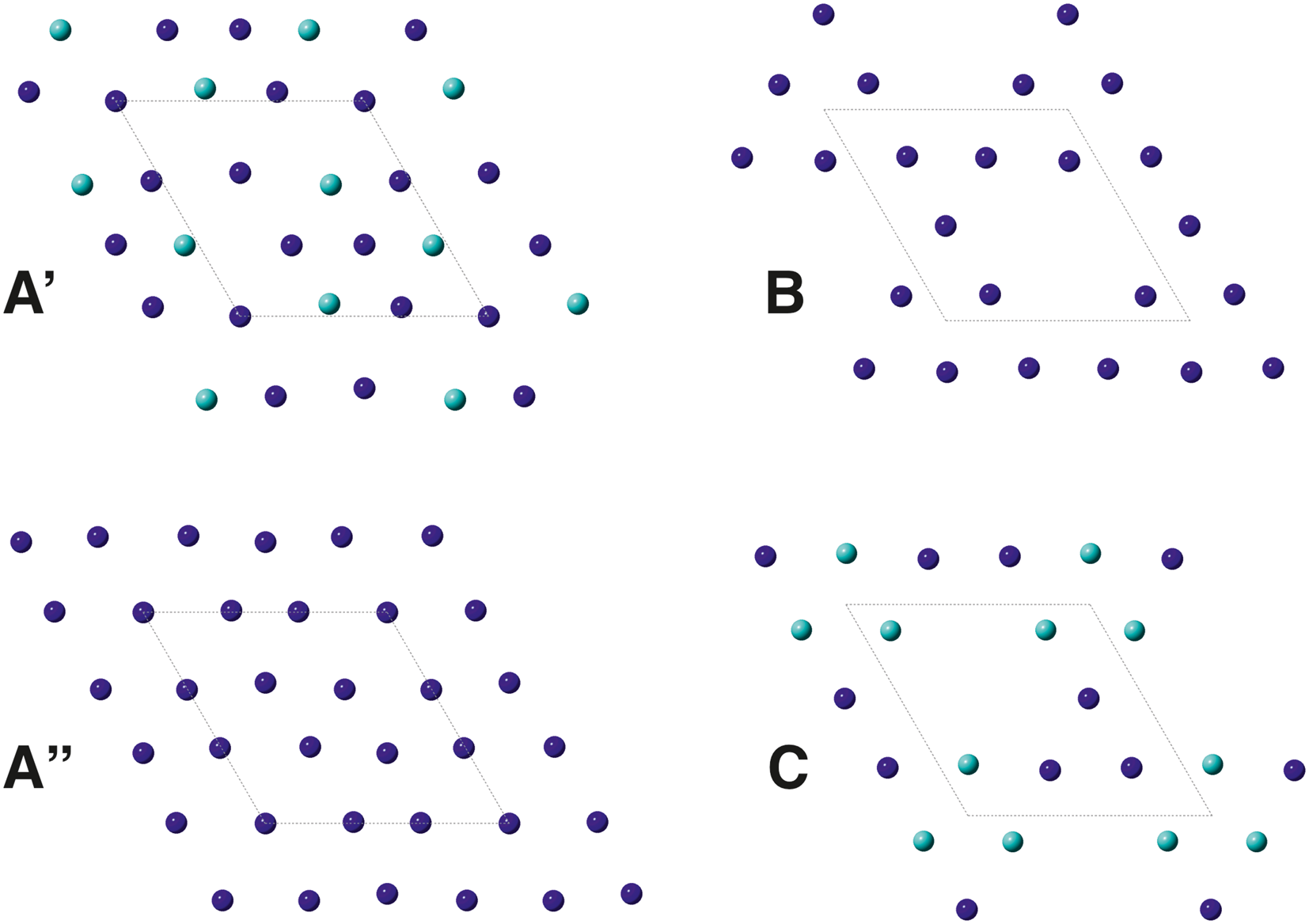
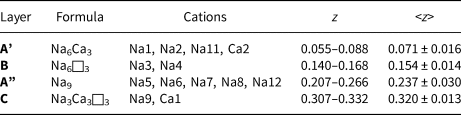
An alternative description of the crystal structure of dobrovolskyite can be presented as cation arrays or cation packings (O'Keeffe and Hyde, Reference O'Keeffe and Hyde1985; Krivovichev and Filatov, Reference Krivovichev and Filatov1999; Vegas, Reference Vegas2000; Krivovichev, Reference Krivovichev2017), adopted to trigonal and hexagonal alkali metal sulfates by Gorelova et al. (Reference Gorelova, Vergasova, Krivovichev, Avdontseva, Moskaleva, Karpov and Filatov2016). Using this approach, the crystal structure is considered as a three-dimensional eutactic (pseudo-close-packed) array with hexagonal layers of cations parallel to (001). The SO4 tetrahedra occupy cavities of this array and can be completely disordered (e.g. metathénardite), partly disordered (e.g. bubnovaite and dobrovolskyite) or fully ordered (e.g. belomarinaite, aphthitalite and natroaphthitalite). The crystal structure of dobrovolskyite as a eutectic array of cations with SO4 tetrahedra in the interstices is shown in Fig 6a, and the splitting the array into layers with hexagonal packing of Ca and Na cations is demonstrated in Fig. 6b. The layers projected onto the (001) plane are shown in Fig. 7. Within each layer, cations are arranged in hexagonal fashion typical for close packings of spheres in two dimensions. Following standard crystal chemical notations for close-packings, we distinguished three possible positions of the close-packed layers denoted as A, B and C. In dobrovolskyite, there are two symmetrically independent A layers, A’ and A”, that are different in cation composition. The B and C layers contain vacancies (□). Table 7 lists four layers, each characterised by a formula (or ideal formula), atoms involved, the range and an average value of z coordinate.
(a) The crystal structure of dobrovolskyite shown as a cation-vacancy array filled with (SO4) tetrahedra and (b) the view of the cation–vacancy array. Ca and Na atoms are shown as light- and dark-blue, respectively; sulfate tetrahedra in (a) are highlighted in yellow.

The projections of the cation layers in the crystal structure of dobrovolskyite along the c axis. Legend as in Fig. 6.

Parameters of the Na4Ca cation–vacancy eutactic array in the crystal structure of dobrovolskyite.

There are twelve cation layers within the unit cell of dobrovolskyite that are stacked along the c axis in the sequence A'BA”CA'BA”CA'BA”C, with the subsequence A'BA”C as its repeat unit. The first and second A’ and A’ layers in the subsequence A'BA”C are related by the (⅓ ⅔ ⅓) R-translation of the rhombohedral lattice.
Discussion
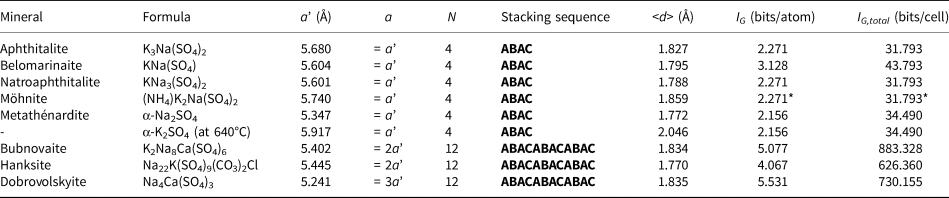
The geometrical parameters of eutactic cation arrays in trigonal and hexagonal alkali metal sulfates known so far are summarised in Table 8. All known variations of the cation arrays can be represented as superstructures of the parent structure with the space group P63/mmc observed in metathénardite. The stacking of cation layers is of the ABAC type in all the observed structures with either N = 4 or 12 layers per unit cell. The a unit-cell parameter can be either doubled (in bubnovaite and hanksite) or tripled (in dobrovolskyite) relative to the parent structure of metathénardite. In terms of the unit-cell parameters, there are 1 × 1 × 1 (metathénardite, aphthitalite, natroaphthitalite, möhnite and belomarinaite), 2 × 2 × 3 (bubnovaite and hanksite) and 3 × 3 × 3 (dobrovolskyite) superstructures relative to the parent structure type. The space-group variations within each superstructure type depend upon the cation ordering and local structure deviations. The parameters of the subcell can be defined as a’ and <d>, where the latter is the average distance between the adjacent cation layers defined as c/N (N is the number of layers per unit cell). It can be seen clearly that both a’ and <d> parameters correlate with the ionic radii of cations that define the particular structure type with the maximum values observed for the largest cation, K+, and the minimum values specific for the smallest cations, Na+ and Ca2+. It is clear that other chemical and structural variations can occur in aphthitalite-related structures, and the discovery of dobrovolskyite is further proof of the efficiency of the cation-array description adopted for these kinds of structures by Gorelova et al. (Reference Gorelova, Vergasova, Krivovichev, Avdontseva, Moskaleva, Karpov and Filatov2016).
Geometrical parameters and structural complexity measures for aphthitalite-related alkali metal sulfates based upon eutactic cation (–vacancy) arrays.

* H atoms are not taken into account.
Notes: N is the number of layers per unit cell; <d> is the average distance between the adjacent cation layers defined as c/N; IG is the structure information content; I G,total is total structural information content.
In the family of minerals and inorganic compounds with aphthitalite- (or metathénardite-) related structures, dobrovolskyite is unique: (1) it is the only known mineral with a 3 × 3 × 3 superstructure and (2) it contains completely ordered vacant sites in the cation array (sites with partial cation occupancy were reported for bubnovaite).
The information-based structural complexity parameters (Krivovichev, Reference Krivovichev2012, Reference Krivovichev2013) for the aphthitalite-related structures are listed in Table 8. It can be seen that, despite the fact that dobrovolskyite has the largest superstructure dimensions known so far, the most complex mineral in this family is bubnovaite, K2Na8Ca(SO4)6, which is based upon the 2 × 2 × 3 superstructure and has the highest Shannon information amount per unit cell. The observed difference is a consequence of the higher chemical complexity of bubnovaite compared to dobrovolskyite, which results in the absence in the former and the presence in the latter of the R-translation reducing the real unit-cell volume by the factor of three.
The observed structural similarities (identical overall architecture and disorder in the arrangements of sulfate groups) and structure–superstructure relations allows us to suggest that dobrovolskyite formed as a result of cooling of a high-temperature phase structurally similar to α–Na2SO4, but with essential content of Ca that led to the Na–Ca ordering and formation of a superstructure with unique chemical composition and structure type. Verifying this hypothesis might be performed by crystallisation experiments in the system Na2SO4–CaSO4, with different ratios of initial components. It cannot be excluded that dobrovolskyite is in fact a metastable quenched compound, by analogy with metathénardite. The formation of such unusual crystalline solids is typical for the crystallisation from fumarolic gases with high kinetic regimes of cooling under atmospheric conditions.
Supplementary material
To view supplementary material for this article, please visit https://doi.org/10.1180/mgm.2021.9
Acknowledgements
This work was supported by the Ministry of Science and Higher Education of the Russian Federation within the scientific tasks of the Institute of Silicate Chemistry (Russian Academy of Sciences) [project number 0097-2019-0013], the Russian Foundation for Basic Research, grant no. 18-29-12106, the President of the Russian Federation Grant for Leading Scientific Schools in Russia (2526.2020.5) and The Russian Academic Excellence Project of Lobachevsky University (5-100) Н-435-99_2020-2021. Technical support by the SPbSU X-ray Diffraction Centre is gratefully acknowledged.